


Wood Chipper Machines Market Size and Growth Forecast 2026-2030
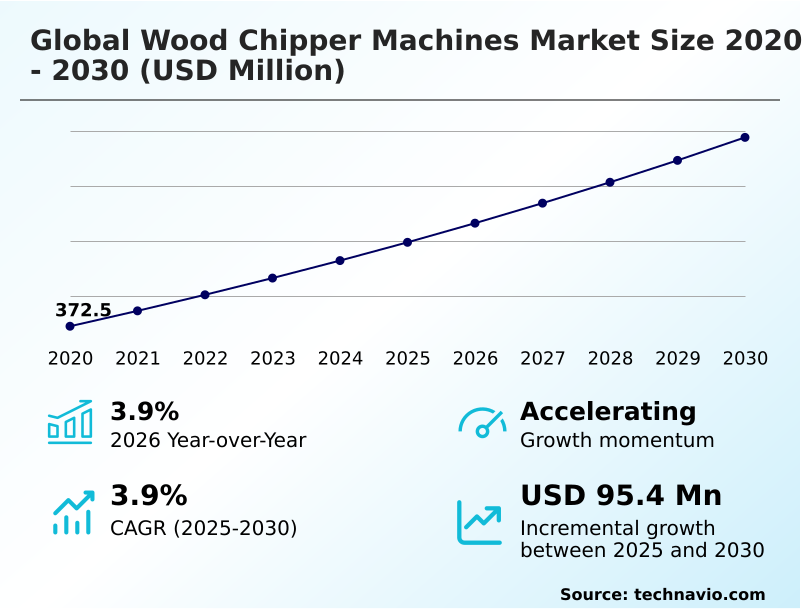
The Wood Chipper Machines Market size was valued at USD 448.8 million in 2025 growing at a CAGR of 3.9% during the forecast period 2026-2030.
North America accounts for 38.9% of incremental growth during the forecast period. The Drum chippers segment by Type was valued at USD 184.8 million in 2024, while the Low capacity segment holds the largest revenue share by Capacity.
The market is projected to grow by USD 171.7 million from 2020 to 2030, with USD 95.4 million of the growth expected during the forecast period of 2025 to 2030.
Get Key Insights on Market Forecast (PDF) Request Free Sample
Wood Chipper Machines Market Overview
The wood chipper machines market is advancing beyond simple waste reduction, becoming integral to sustainable forest management and bioenergy feedstock production. Demand is shaped by the need to comply with stringent emission regulations, such as EPA Tier 4 Final, which mandates sophisticated after-treatment systems. North America is set to contribute nearly 39% of market growth, driven by extensive forestry and urban maintenance needs. In a typical scenario, a commercial forestry operation deploys a whole-tree chipper to process harvested timber into uniform biomass feedstock for a regional power plant. The focus is on achieving specific chip size uniformity and moisture content to meet contractual obligations for bioenergy feedstock production, directly linking machine performance to revenue generation. This operational reality underscores the importance of equipment that balances high throughput with adherence to operator safety standards, making technology integration a key factor for procurement decision-makers. The transition toward intelligent machinery ensures compliance and enhances productivity in a resource-driven economy.
Drivers, Trends, and Challenges in the Wood Chipper Machines Market
Procurement decisions are increasingly complex, balancing upfront capital expenditure against long-term operational viability and regulatory compliance. For instance, a contractor specializing in large-scale infrastructure projects may select a high-capacity chipper for land clearing, prioritizing throughput and power.
However, for operations within city limits, an electric wood chipper for urban use becomes a more viable choice due to noise and emission constraints under directives like the EU's Clean Air Strategy. The decision matrix for a small agricultural enterprise is different still, where a PTO-driven chipper for small farm use offers a cost-effective solution by leveraging existing tractor assets.
Across all segments, wood chipper maintenance and repair costs are a primary concern, influencing the total cost of ownership.
For example, a diesel-powered unit compliant with EPA Tier 4 standards may have a lower initial purchase price than a comparable hybrid model, but the lifetime cost, factoring in diesel exhaust fluid and particulate filter maintenance, can be up to 15% higher.
This complex interplay between application, regulation, and lifecycle cost is shaping purchasing patterns, pushing manufacturers to offer a diversified portfolio that addresses specific end-user needs, from large-scale wood chipper for biomass power generation to compact residential units.
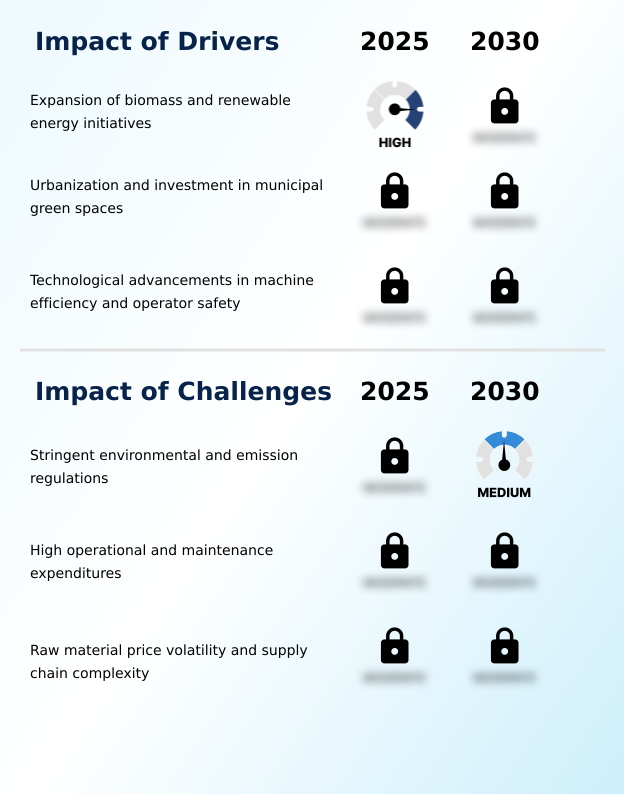
Primary Growth Driver: The expansion of biomass utilization and renewable energy initiatives serves as a primary driver for the wood chipper machines market.
Demand is fundamentally propelled by the global shift towards renewable energy and sustainable land use.
The expansion of bioenergy feedstock production for power plants and industrial heating serves as a primary commercial driver, creating a consistent need for high-output chipping machinery. This is complemented by public sector demand linked to environmental management.
Municipalities are increasingly investing in equipment for urban green infrastructure maintenance and disaster recovery debris clearance.
Furthermore, a heightened focus on wildfire prevention is driving significant investment in hazardous fuel reduction programs, particularly in North America, which accounts for over 38% of the market's growth potential.
These initiatives, rooted in sustainable forest management principles, transform wood waste from a liability into a valuable commodity, underpinning the market's stable growth.
Emerging Market Trend: A key market trend is the proliferation of electric and hybrid power systems. This shift is driven by stricter emission regulations and noise ordinances in urban areas.
The market is undergoing a significant technological evolution, driven by the convergence of electrification and automation. The proliferation of the electric wood chipper and hybrid power system models is a direct response to tightening noise and emission regulations in urban centers. This allows for compliance with ordinances while reducing operational fuel costs.
Concurrently, the integration of autonomous feed control systems, guided by advanced sensors, is enhancing productivity and reinforcing operator safety standards. These intelligent systems optimize engine load and prevent material jams, which is critical for maintaining high throughput.
This technological shift also aligns with broader circular economy initiatives, as more efficient and cleaner processing of wood waste into usable mulch or biomass feedstock becomes more economically viable and environmentally sound.
Key Industry Challenge: The implementation of stringent environmental and emission regulations presents a significant challenge, impacting equipment design and manufacturing costs in the industry.
Navigating stringent regulatory frameworks and managing high operational expenditures remain primary market constraints. Compliance with emission regulations, such as EPA Tier 4 Final and EU Stage V, necessitates the integration of costly after-treatment systems like diesel particulate filters and selective catalytic reduction, significantly increasing the initial purchase price of new equipment.
This, combined with volatile fuel prices and the need for frequent blade maintenance, contributes to a high total cost of ownership. Furthermore, the industry is grappling with a skilled labor shortage, which impacts both the operation and servicing of increasingly sophisticated machinery.
This labor-related issue puts upward pressure on wages and can lead to extended equipment downtime, directly affecting the profitability of forestry and landscaping contractors.
Explore Full Market Dynamics Analysis Request Free Sample
Wood Chipper Machines Market Segmentation
The wood chipper machines industry research report provides comprehensive data including region-wise segment analysis, with forecasts and analysis for the period 2026-2030, as well as historical data from 2020-2024 for the following segments.
Type Segment Analysis
The drum chippers segment is estimated to witness significant growth during the forecast period.
The drum chipper segment represents a critical component of the wood chipper machines market, specifically tailored for high-volume processing and the management of large-diameter timber.
These machines, which account for a substantial portion of the market's value, utilize a heavy, rotating steel cutting drum assembly to process heterogeneous materials, such as brush and logs, making them a preferred choice for large-scale forestry operations.
The integration of advanced hydraulic feed systems allows operators to manage material flow with precision, ensuring the engine operates within its optimal power band.
In practice, a whole-tree chipper of this design is indispensable for converting timber into biomass feedstock, meeting the specifications required for bioenergy applications. The mechanism’s robust cutting force minimizes jamming, making it effective for producing significant chip volumes.
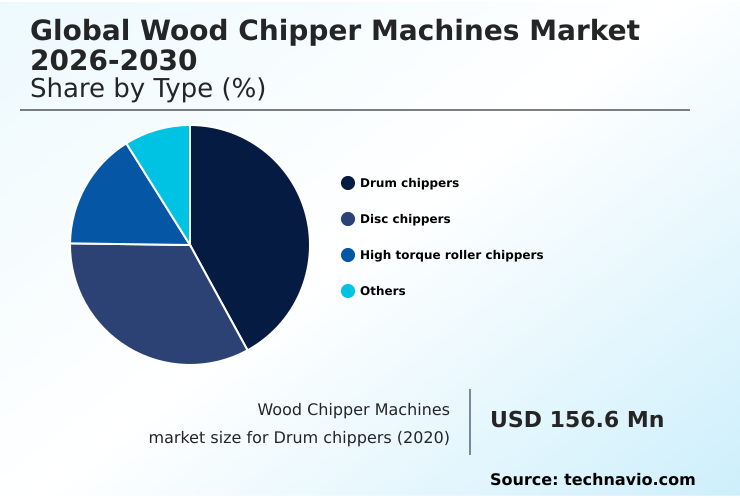
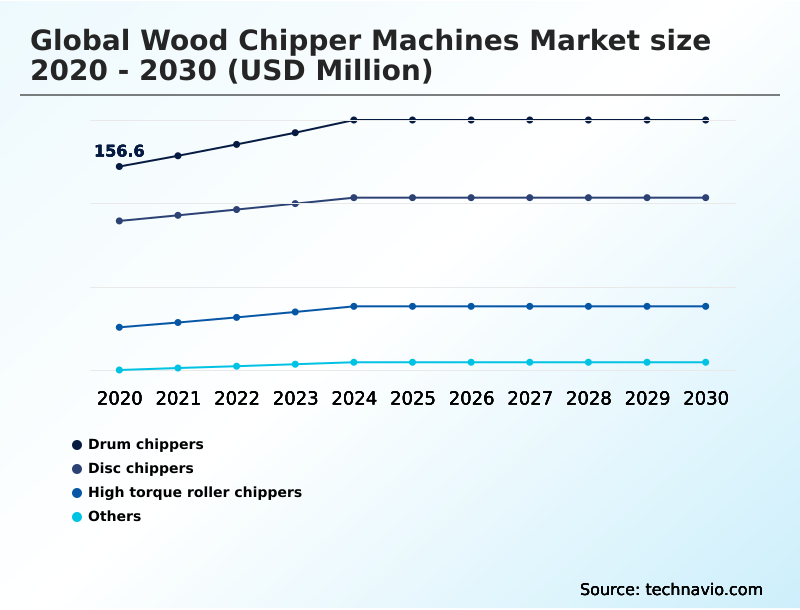
The Drum chippers segment was valued at USD 184.8 million in 2024 and showed a gradual increase during the forecast period.
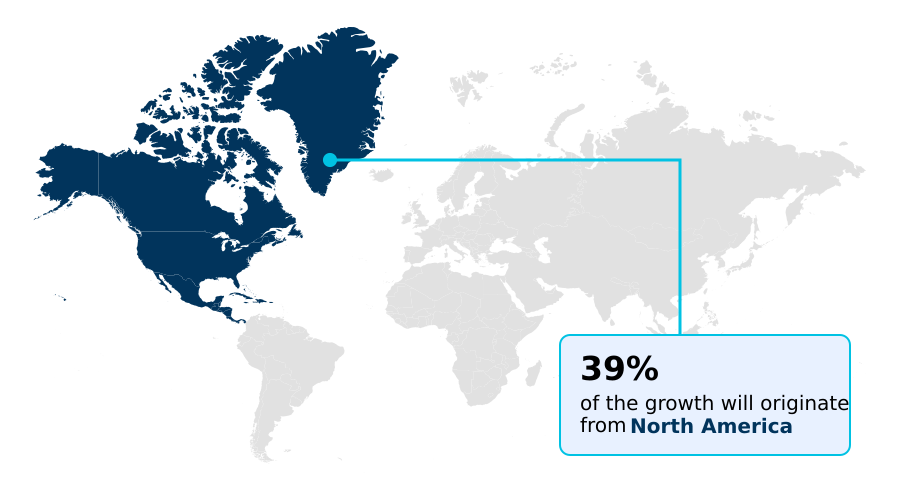
Wood Chipper Machines Market by Region: North America Leads with 38.9% Growth Share
North America is estimated to contribute 38.9% to the growth of the global market during the forecast period.
The geographic landscape of the market is characterized by distinct regional drivers and regulatory pressures.
North America, contributing approximately 39% of the incremental growth, is a mature market where stringent EPA emission standards and a focus on sustainable forest management dictate equipment specifications.
In contrast, the APAC region, accounting for over 28% of growth, is driven by rapid urbanization and infrastructure projects, particularly in China.
European markets are heavily influenced by circular economy principles and a strong push for bioenergy feedstock production, leading to high adoption rates of advanced chipping technologies compliant with EU Stage V regulations.
Across these regions, the deployment of arboriculture equipment is becoming standard for the maintenance of urban green infrastructure, reflecting a global convergence on professionalized land management and biomass utilization.
Customer Landscape Analysis for the Wood Chipper Machines Market
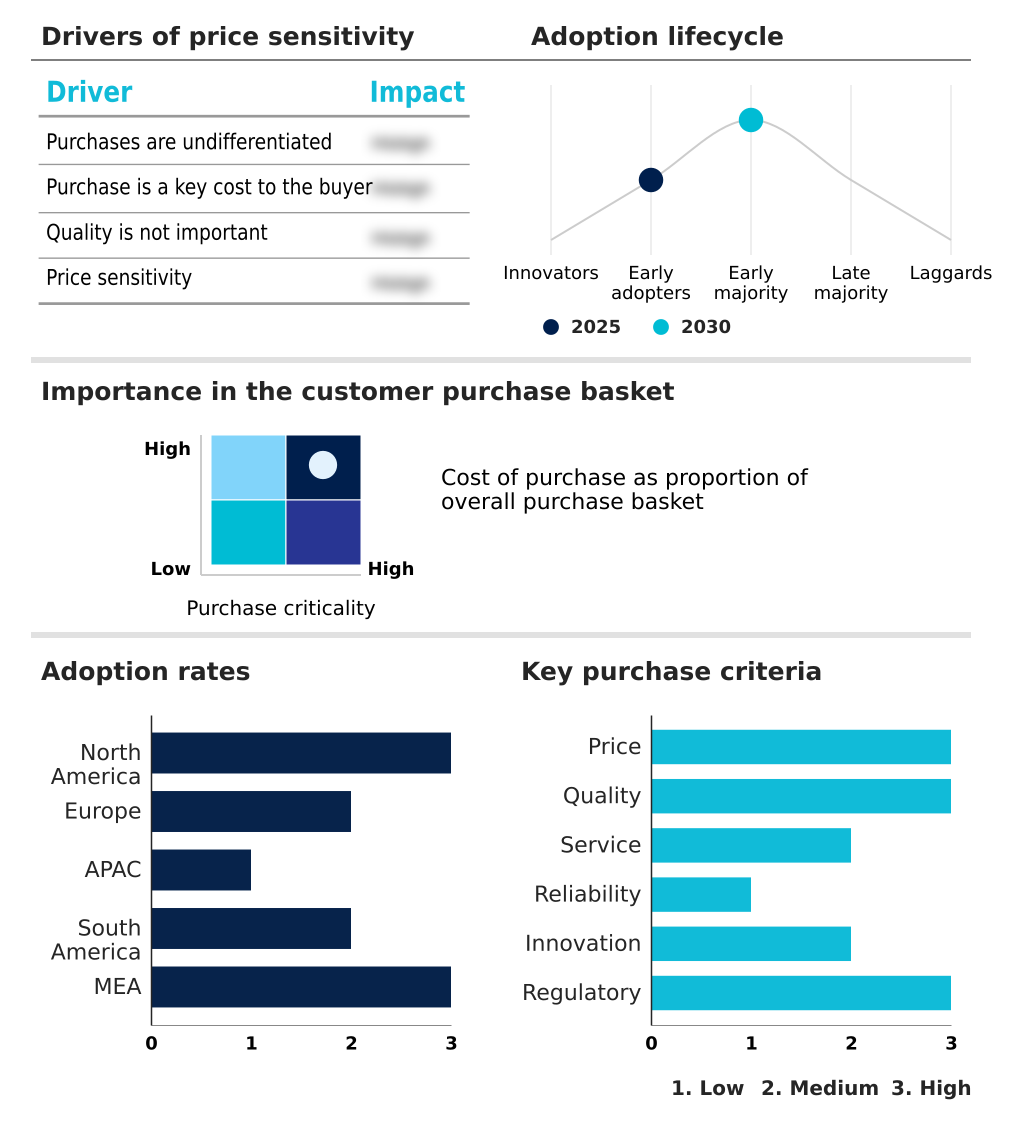
The wood chipper machines market forecasting report includes the adoption lifecycle of the market, covering from the innovator’s stage to the laggard’s stage. It focuses on adoption rates in different regions based on penetration. Furthermore, the wood chipper machines market report also includes key purchase criteria and drivers of price sensitivity to help companies evaluate and develop their market growth analysis strategies.
Competitive Landscape of the Wood Chipper Machines Market
Companies are implementing various strategies, such as strategic alliances, partnerships, mergers and acquisitions, geographical expansion, and product/service launches, to enhance their presence in the wood chipper machines market industry.
ALBACH Maschinenbau AG - Delivers industrial-grade disc and drum chippers, engineered for high-volume biomass processing and fuel chip production.
The industry research and growth report includes detailed analyses of the competitive landscape of the market and information about key companies, including:
- ALBACH Maschinenbau AG
- Astec Industries Inc.
- Avant Tecno Oy
- Bandit Industries Inc.
- Bruks Siwertell Group
- Crary Industries Inc.
- J.P. Carlton Co.
- Morbark LLC.
- MTD Products Inc.
- Salsco LLC
- Schliesing Machinery GmbH
- Terex Corp.
- Timberwolf Ltd.
- Turcomdecor
- UNTHA shredding technology GmbH
- Vermeer Corp.
- Wallenstein Equipment Inc.
- Zerkleinerungsmaschinenbau GmbH
Qualitative and quantitative analysis of companies has been conducted to help clients understand the wider business environment as well as the strengths and weaknesses of key industry players. Data is qualitatively analyzed to categorize companies as pure play, category-focused, industry-focused, and diversified; it is quantitatively analyzed to categorize companies as dominant, leading, strong, tentative, and weak.
Recent Developments in the Wood Chipper Machines Market
- In March, 2025, the American National Standards Institute released a comprehensive update to the Z133 safety standards, introducing mandatory design guidelines for feed tray extensions on brush chippers to prevent accidental contact with the cutting mechanism.
- In April, 2025, the European Commission adopted the new Clean Air Strategy, which established stricter limits on volatile organic compounds and fine particulate matter for all industrial wood processing equipment, compelling manufacturers to redesign engine configurations.
- In May, 2025, the World Bioenergy Association introduced a global certification framework for wood chip quality and sustainability, setting new benchmarks for moisture content and particle size distribution required for international trade.
- In May, 2025, Bandit Industries introduced a new high-capacity drum assembly that incorporates a reinforced steel alloy, designed to extend the lifespan of the cutting components by twenty percent and reduce maintenance intervals.
Research Analyst Overview: Wood Chipper Machines Market
The market's current trajectory, with a steady year-over-year growth of 3.9%, is less about volume and more about technological bifurcation. The drum chipper segment remains dominant, but the critical advancements are occurring within the control systems and powertrain.
For boardroom consideration, the integration of telematics systems into arboriculture equipment is no longer a value-add but a core component for managing fleet efficiency, ensuring operator safety standards, and providing verifiable data for ESG reporting.
The mandate for EPA Tier 4 Final compliance, necessitating diesel particulate filter and selective catalytic reduction technologies, has permanently altered the cost structure of diesel-powered whole-tree chippers. This has created an opening for electric and hybrid power system alternatives, particularly in non-industrial settings.
The future of competitive differentiation lies not in the raw cutting power of a disc chipper, but in the intelligence of its autonomous feed control and the efficiency of its biomass feedstock conversion, ultimately lowering the total cost of ownership.
Dive into Technavio’s robust research methodology, blending expert interviews, extensive data synthesis, and validated models for unparalleled Wood Chipper Machines Market insights. See full methodology.
| Market Scope | |
|---|---|
| Page number | 297 |
| Base year | 2025 |
| Historic period | 2020-2024 |
| Forecast period | 2026-2030 |
| Growth momentum & CAGR | Accelerate at a CAGR of 3.9% |
| Market growth 2026-2030 | USD 95.4 million |
| Market structure | Fragmented |
| YoY growth 2025-2026(%) | 3.9% |
| Key countries | US, Canada, Mexico, UK, France, Germany, Italy, Spain, The Netherlands, China, India, Japan, Australia, South Korea, Indonesia, Brazil, Argentina, Chile, South Africa, UAE, Saudi Arabia, Nigeria and Turkey |
| Competitive landscape | Leading Companies, Market Positioning of Companies, Competitive Strategies, and Industry Risks |
Wood Chipper Machines Market: Key Questions Answered in This Report
-
What is the expected growth of the Wood Chipper Machines Market between 2026 and 2030?
-
The Wood Chipper Machines Market is expected to grow by USD 95.4 million during 2026-2030, registering a CAGR of 3.9%. Year-over-year growth in 2026 is estimated at 3.9%%. This acceleration is shaped by expansion of biomass and renewable energy initiatives, which is intensifying demand across multiple end-use verticals covered in the report.
-
-
What segmentation does the market report cover?
-
The report is segmented by Type (Drum chippers, Disc chippers, High torque roller chippers, and Others), Capacity (Low capacity, Medium capacity, and High capacity), End-user (Forestry and timber operations, Commercial landscaping, Residential, and Others) and Geography (North America, Europe, APAC, South America, Middle East and Africa). Among these, the Drum chippers segment is estimated to witness significant growth during the forecast period, driven by rising adoption across key application areas. Each segment includes detailed qualitative and quantitative analysis, along with historical data from 2020-2024 and forecasts through 2030 with year-over-year growth rates.
-
-
Which regions are analyzed in the report?
-
The report covers North America, Europe, APAC, South America and Middle East and Africa. North America is estimated to contribute 38.9% to market growth during the forecast period. Country-level analysis includes US, Canada, Mexico, UK, France, Germany, Italy, Spain, The Netherlands, China, India, Japan, Australia, South Korea, Indonesia, Brazil, Argentina, Chile, South Africa, UAE, Saudi Arabia, Nigeria and Turkey, with dedicated market size tables and year-over-year growth for each.
-
-
What are the key growth drivers and market challenges?
-
The primary driver is expansion of biomass and renewable energy initiatives, which is accelerating investment and industry demand. The main challenge is stringent environmental and emission regulations, creating operational barriers for key market participants. The report quantifies the impact of each driver and challenge across 2026 and 2030 with comparative analysis.
-
-
Who are the major players in the Wood Chipper Machines Market?
-
Key vendors include ALBACH Maschinenbau AG, Astec Industries Inc., Avant Tecno Oy, Bandit Industries Inc., Bruks Siwertell Group, Crary Industries Inc., J.P. Carlton Co., Morbark LLC., MTD Products Inc., Salsco LLC, Schliesing Machinery GmbH, Terex Corp., Timberwolf Ltd., Turcomdecor, UNTHA shredding technology GmbH, Vermeer Corp., Wallenstein Equipment Inc. and Zerkleinerungsmaschinenbau GmbH. The report provides qualitative and quantitative analysis categorizing companies as dominant, leading, strong, tentative, and weak based on their market positioning. Company profiles include business segment analysis, SWOT assessment, key offerings, and recent strategic developments.
-
Wood Chipper Machines Market Research Insights
Market dynamics are increasingly shaped by the dual pressures of urban expansion and climate-related risk management, compelling a strategic focus on total cost of ownership. The expansion of urban green infrastructure and the need for municipal green space maintenance drive consistent demand for mobile chipping solutions.
Simultaneously, an intensified focus on wildfire mitigation and disaster recovery debris clearance creates procurement urgency for equipment capable of hazardous fuel reduction, guided by frameworks like the National Fire Protection Association's Firewise USA program. North America's growth contribution, at over 38%, outpaces that of APAC, reflecting the region's mature and regulation-intensive operational environment.
This landscape supports circular economy initiatives by converting urban and forest waste into valuable resources, shifting the equipment value proposition from simple disposal to resource conversion.
We can help! Our analysts can customize this wood chipper machines market research report to meet your requirements.
 RIA -
RIA - 
