AI In Space Exploration Market Size 2025-2029
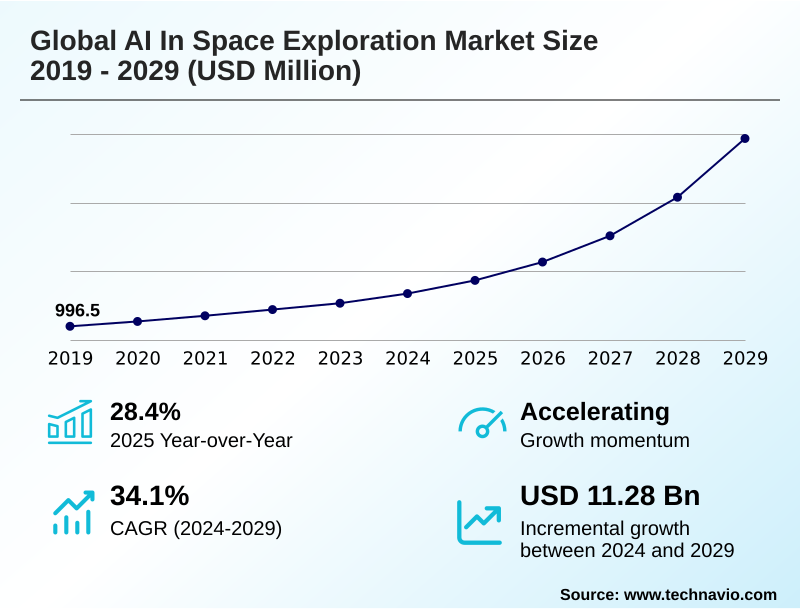
The ai in space exploration market size is forecast to increase by USD 11.3 billion, at a CAGR of 34.1% between 2024 and 2029.
The global AI in space exploration market is shaped by a significant increase in strategic investments from both governmental bodies and private enterprises. This financial commitment supports the development of sophisticated autonomous ai for complex missions. A key advancement is in enhanced autonomous navigation and mission control systems, which reduce reliance on constant human intervention, a critical factor for deep-space endeavors. The integration of predictive ai in robotics is transforming how missions are executed, enabling greater efficiency and adaptability. These developments allow for more ambitious explorations, pushing the boundaries of what is technologically achievable. The ongoing refinement of these systems is central to the industry's forward momentum, promising a future of more independent and scientifically productive space operations.Progress in the market is tempered by the high development and implementation costs associated with creating specialized, radiation-hardened AI solutions. These expenses present a considerable barrier, particularly for emerging players in the aerospace artificial intelligence (AI) field. The need for rigorous testing and custom hardware further inflates expenditures, challenging the scalability of advanced technologies. Despite these financial constraints, the demand for applied ai in autonomous vehicles and spacecraft continues to drive innovation. The industry is navigating this challenge by focusing on developing more efficient algorithms and leveraging modular, reusable systems to mitigate the financial burden, ensuring that the pace of advancement in space exploration continues.
What will be the Size of the AI In Space Exploration Market during the forecast period?
Explore in-depth regional segment analysis with market size data - historical 2019 - 2023 and forecasts 2025-2029 - in the full report.
Request Free Sample
The trajectory of the AI in space exploration market is characterized by a definitive shift toward intelligent automation and deep-space autonomy. The deployment of autonomous navigation and mission-critical systems is becoming standard for overcoming communication latencies and enhancing operational resilience. This evolution supports complex endeavors such as on-orbit servicing and asteroid exploration, driven by advancements in predictive ai in robotics. The market's momentum is sustained by a synergistic relationship between public and private sector initiatives, which collectively advance the capabilities of autonomous ai.Data processing and analysis represent another critical frontier, where AI is indispensable for managing the immense data volumes generated by modern space missions. The use of on-board AI processors for real-time hyperspectral imagery analysis and satellite imagery analysis is transforming Earth observation and scientific discovery. These capabilities, integral to aerospace artificial intelligence (AI), allow for faster insights and reduced data downlink burdens. This trend is democratizing access to advanced analytical tools, enabling a broader range of scientific and commercial applications.
How is this AI In Space Exploration Industry segmented?
The ai in space exploration industry research report provides comprehensive data (region-wise segment analysis), with forecasts and estimates in "USD million" for the period 2025-2029, as well as historical data from 2019 - 2023 for the following segments.
- Type
- Rovers
- Robotic arms
- Space probes
- Others
- Application
- Robotics
- Manned vehicles launch
- Communications
- Remote sensing and monitoring
- Others
- End-user
- Geography
- North America
- APAC
- China
- Japan
- India
- Australia
- South Korea
- Europe
- South America
- Middle East and Africa
- Rest of World (ROW)
By Type Insights
The rovers segment is estimated to witness significant growth during the forecast period.
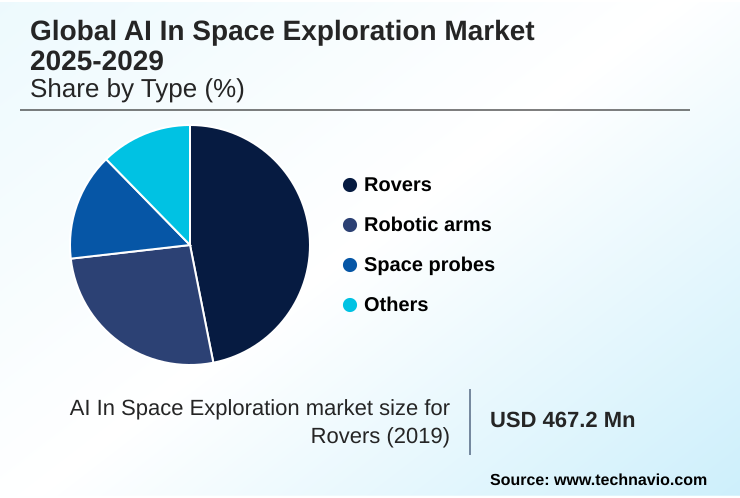
The application of AI in space exploration rovers is enabling greater autonomy, scientific productivity, and operational resilience in planetary surface missions. AI-powered systems allow rovers to perform complex tasks like navigating difficult terrain and identifying scientific targets with minimal human oversight. The rovers segment represented approximately 47% of the market by type in the previous year. This capability is crucial for missions to distant celestial bodies where communication delays make real-time control impractical, thus maximizing scientific returns.
AI algorithms facilitate autonomous decision-making for path planning, hazard avoidance, and sample selection. Machine vision helps rovers discern between different rock types, prioritizing samples that may contain evidence of past life. AI also contributes to instrument operations, assisting with focusing, chemical analysis, and target identification. Ongoing refinements in AI models are focused on enhancing self-correction and anomaly detection, ensuring mission continuity in unpredictable environments and enabling more ambitious and independent exploration capabilities for future missions.

Request Free Sample
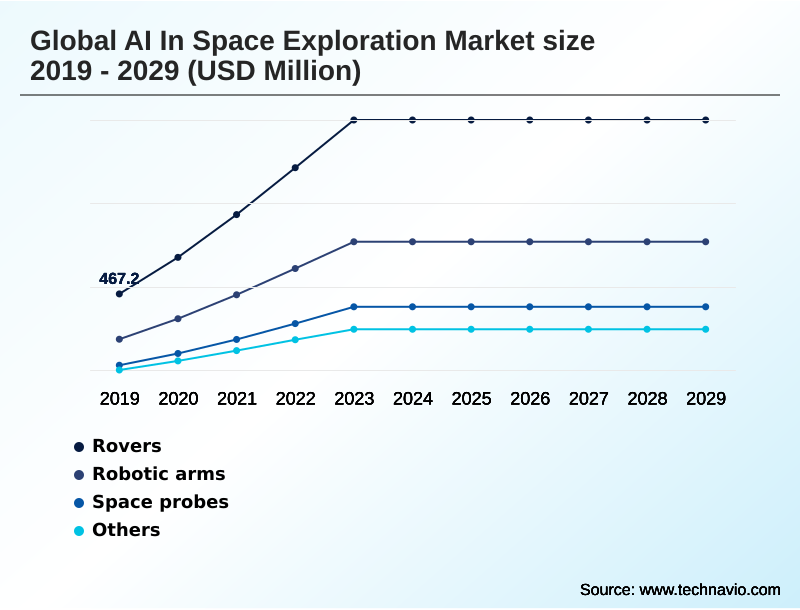
The Rovers segment was valued at USD 467.20 million in 2019 and showed a gradual increase during the forecast period.
Regional Analysis
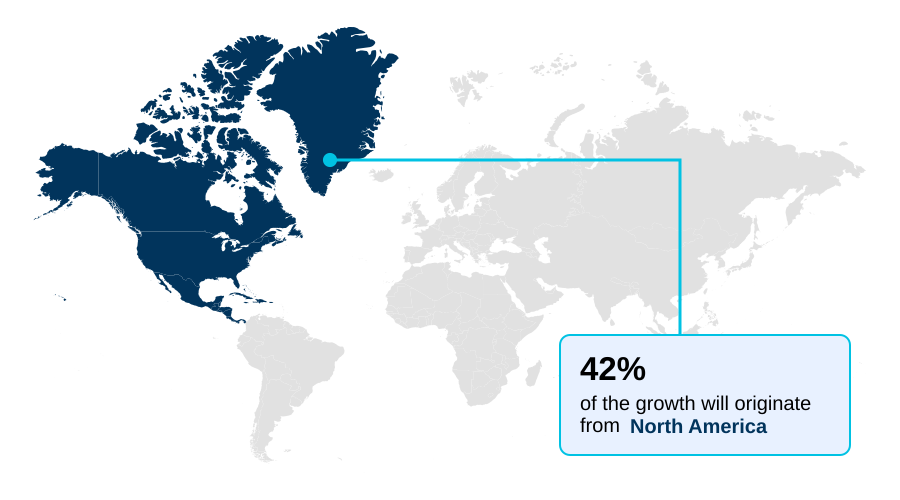
North America is estimated to contribute 41.8% to the growth of the global market during the forecast period.Technavio’s analysts have elaborately explained the regional trends and drivers that shape the market during the forecast period.
Request Free Sample
North America leads the global AI in space exploration market, with the region projected to contribute over 41% of the market's incremental growth. This dominance is driven by substantial investments from government agencies like NASA and a highly innovative private sector. These entities are integrating AI into mission planning, data analysis, and autonomous operations for space robotics and deep-space probes. The United States, in particular, is at the forefront of developing AI for robotic arm movements and sample acquisition for extraterrestrial material analysis.
The region's robust private sector, including companies in both the US and Canada, is a significant contributor, developing AI for satellite constellation management, collision avoidance, and network optimization. Collaborative efforts between academic institutions and industry further bolster North America's leadership position by advancing foundational research in areas like deep space communication. A strong venture capital ecosystem accelerates AI adoption by funding startups that are creating niche solutions for autonomous navigation and AI-driven image analysis, ensuring continued innovation.
Market Dynamics
Our researchers analyzed the data with 2024 as the base year, along with the key drivers, trends, and challenges. A holistic analysis of drivers will help companies refine their marketing strategies to gain a competitive advantage.
The Global AI in Space Exploration Market is witnessing unprecedented growth, driven by the integration of sophisticated artificial intelligence across various mission-critical segments. Innovations in AI for satellite mission planning and operations are optimizing resource allocation, while the development of AI for autonomous space robotics is enabling more complex unmanned missions. Furthermore, advancements in AI for deep space exploration guidance and control are crucial for long-duration voyages. The industry is also focused on building AI for resilient space systems to ensure operational continuity. On the manufacturing front, AI-enhanced manufacturing for rocket components is accelerating production cycles for OEMs, complemented by research into AI for advanced propulsion systems that promises to redefine space travel capabilities and efficiency.The applications of AI extend significantly into data processing and communications, with AI in signal processing for space-based communication and AI for advanced satellite communications being pivotal. In fact, the role of AI in advanced satellite communications cannot be overstated for ensuring reliable data links. For security, AI for threat detection in space and robust AI for space-based surveillance are paramount. This is supported by AI-driven analytics for defense and intelligence and AI-driven sensor fusion for space-based assets. Earth observation benefits immensely from AI-powered image processing for Earth observation and specialized AI for high-resolution SAR image processing. Concurrently, machine learning for object identification and tracking enhances situational awareness, alongside practical applications like AI for global weather forecasting and AI-driven ship and aircraft tracking. The synthesis of data through machine learning for data fusion and obtaining AI for Earth intelligence from radio frequency data is creating comprehensive, actionable insights for a multitude of sectors.

What are the key market drivers leading to the rise in the adoption of AI In Space Exploration Industry?
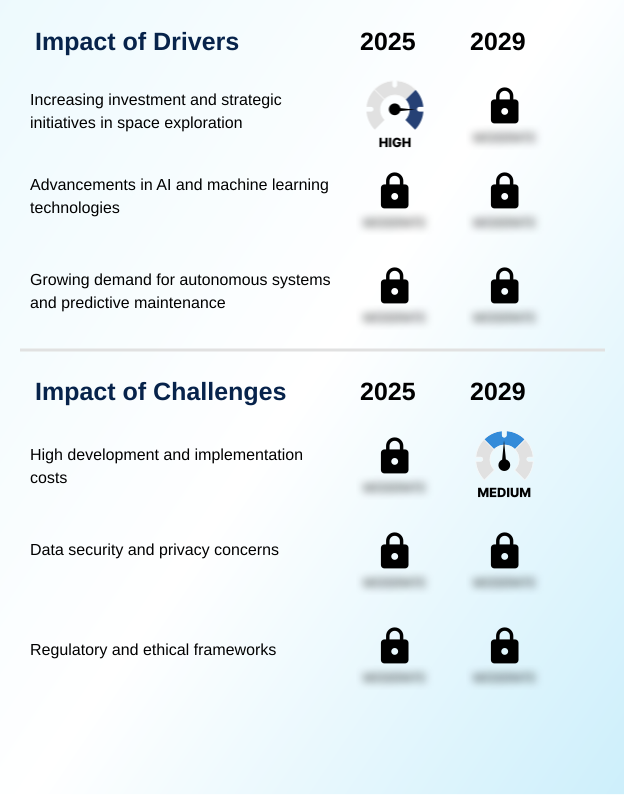
- The market's expansion is primarily driven by increasing investment and strategic initiatives in space exploration from both public and private sectors.
Increasing investment from government and private sectors is a primary factor shaping the AI in space exploration market. This funding directly supports the development of advanced autonomous systems, such as those used for spacecraft navigation, resource utilization, and in-situ manufacturing capabilities. These financial injections create a fertile ground for integrating ai for resilient space systems across various mission phases. With North America projected to contribute over 41% of the market's incremental growth, the region's focus on lunar and martian exploration programs necessitates sophisticated solutions that AI is uniquely positioned to provide. The demand for ai-driven navigation and intelligent data processing is directly fueled by these strategic initiatives, pushing the boundaries of space exploration through intelligent automation and sophisticated data interpretation.Continuous advancements in core AI and machine learning technologies are enabling more complex, autonomous, and efficient space operations. Innovations in deep reinforcement learning are improving path planning algorithms for extraterrestrial rovers, allowing them to adapt to unpredictable terrain. The development of explainable ai (XAI) is also gaining traction for mission-critical systems, enhancing trust in decisions made by autonomous spacecraft. The government end-user segment, which accounted for approximately 62% of the market, heavily relies on these technological leaps for scientific and defense missions. This evolution in underlying AI technologies, including on-board ai processors and radiation-hardened ai chips, acts as a perpetual engine for market expansion, driving innovation in every segment of space exploration.
What are the market trends shaping the AI In Space Exploration Industry?
- A key market trend is the significant advancement in autonomous navigation and mission control systems, enabling more self-directed and efficient space operations.
A dominant trend is the move toward enhanced autonomy in spacecraft navigation and mission control, driven by the need to manage communication latencies in deep-space missions. This involves using artificial intelligence algorithms for processing telemetry data, detecting anomalies in real time, and making automatic adjustments to flight paths. The integration of machine learning for predictive maintenance and fault detection further ensures mission longevity. The APAC region, which represents a geographic opportunity of over 28%, is investing heavily in this area. This trend reflects a paradigm shift from pre-programmed systems to intelligent agents capable of independent decision-making, a key enabler for future autonomous scientific discovery. This shift toward self-sufficient spacecraft underscores the transformative role of autonomous ai.The application of AI for advanced data analysis is another major trend accelerating scientific discovery. With missions generating enormous volumes of data, AI offers powerful tools to identify patterns, classify objects, and extract insights from complex datasets. The rovers segment, which accounted for nearly 47% of the market by type, heavily relies on ai-powered data analysis for sample selection and geological mapping. AI models trained on astronomical catalogs can detect novel celestial objects and analyze spectroscopic data for biosignatures. This automation allows researchers to focus on theoretical work, shifting from purely observational science to a more interpretive and predictive approach facilitated by real-time decision-making ai agents and other adaptive ai systems.
What challenges does the AI In Space Exploration Industry face during its growth?
- The market's growth is significantly constrained by the high development and implementation costs associated with specialized AI solutions for space.
High development and implementation costs represent a significant financial hurdle for market participants. These expenditures are magnified by the need for specialized, radiation-hardened components, extensive testing protocols, and the inherent risks of space missions. The initial investment in developing sophisticated AI algorithms, custom hardware like radiation-hardened ai processors, and ground support infrastructure can be prohibitive, especially for smaller companies. The European market, which is growing at a cagr of 32.1%, feels this pressure as agencies and firms balance budgets against ambitious technological goals. Furthermore, the costs of retrofitting existing space infrastructure with advanced AI capabilities and the ongoing expenses for maintenance and model retraining add to the financial burden, constraining accelerated market expansion.Data security and privacy concerns pose a substantial challenge due to the increasing reliance on AI in space exploration. Missions involve transmitting vast quantities of sensitive data, making these streams vulnerable to cyberattacks and unauthorized access. This risk affects national security, scientific integrity, and mission success. The South American market, expanding at a cagr of 31.7%, is also navigating these complexities as it builds its space capabilities. The global nature of space missions complicates data governance, as establishing unified security standards across different national legal frameworks is a formidable task. Moreover, the potential for AI systems themselves to be compromised necessitates the development of highly resilient and verifiable AI, adding another layer of complexity and cost.
Exclusive Customer Landscape
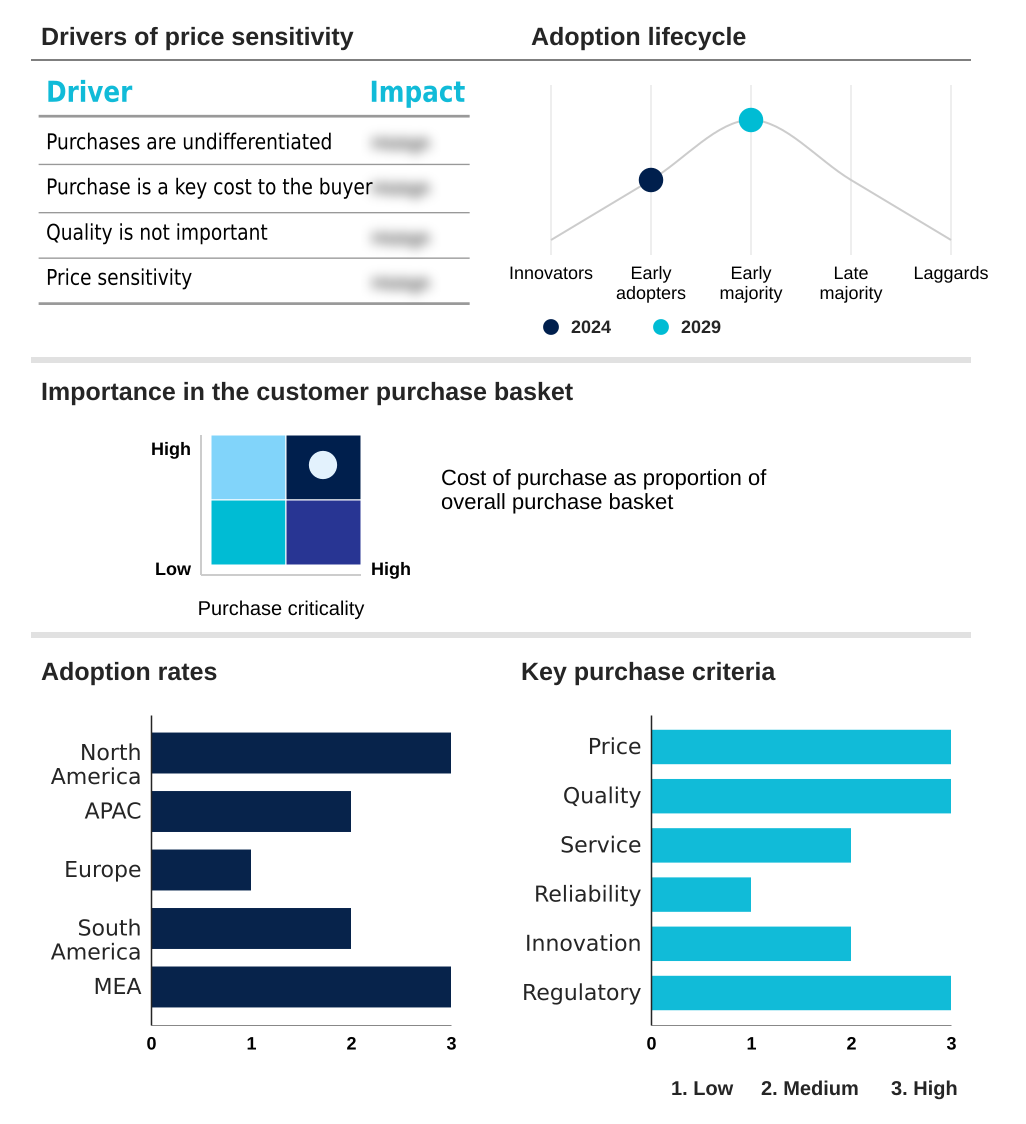
The ai in space exploration market forecasting report includes the adoption lifecycle of the market, covering from the innovator’s stage to the laggard’s stage. It focuses on adoption rates in different regions based on penetration. Furthermore, the ai in space exploration market report also includes key purchase criteria and drivers of price sensitivity to help companies evaluate and develop their market growth analysis strategies.
Customer Landscape
Key Companies & Market Insights
Companies are implementing various strategies, such as strategic alliances, ai in space exploration market forecast, partnerships, mergers and acquisitions, geographical expansion, and product/service launches, to enhance their presence in the industry.
Airbus SE - Key offerings in the market focus on delivering AI-driven solutions to enhance and automate space missions. These include systems for autonomous navigation, guidance, and control for deep space exploration, rovers, and landing systems. Offerings also encompass AI-powered satellite mission planning, operational management, and image processing for Earth observation, providing advanced analytics for defense, intelligence, and environmental monitoring. Vendors provide AI for resilient space systems, including signal processing for communications and threat detection. In addition, solutions cover AI-enhanced manufacturing, on-orbit servicing with robotic arms, and predictive maintenance for space-based assets to ensure mission longevity and efficiency. Cognitive computing and hybrid cloud platforms are offered for scientific data analysis and anomaly detection, accelerating discovery and improving system reliability.
The industry research and growth report includes detailed analyses of the competitive landscape of the market and information about key companies, including:
- Airbus SE
- BAE Systems Plc
- Blue Origin Enterprises LP
- Booz Allen Hamilton Holding Corp.
- Capella Space Corp.
- D-Orbit
- Hewlett Packard Enterprise Co.
- ICEYE Oy
- International Business Machines Corp.
- Lockheed Martin Corp.
- Maxar Technologies Inc.
- Northrop Grumman Corp.
- OHB System AG
- Planet Labs PBC
- Spire Global Inc.
- Thales Group
- The Boeing Co.
Qualitative and quantitative analysis of companies has been conducted to help clients understand the wider business environment as well as the strengths and weaknesses of key industry players. Data is qualitatively analyzed to categorize companies as pure play, category-focused, industry-focused, and diversified; it is quantitatively analyzed to categorize companies as dominant, leading, strong, tentative, and weak.
Recent Development and News in Ai In Space Exploration Market
In April 2024, Lockheed Martin was awarded a contract by the Space Development Agency (SDA) to build 36 Tranche 2 Transport Layer-Alpha satellites, which will incorporate advanced communication and data processing capabilities.In March 2024, Airbus announced that its Pléiades Neo Earth observation satellites are now using an AI-powered mission planning system called "Operator" to automate operations and improve tasking efficiency.In February 2024, Northrop Grumman's Mission Extension Vehicle-2 (MEV-2) successfully completed its service to the Intelsat 10-02 satellite and relocated to a new client's satellite, demonstrating the viability of autonomous in-orbit servicing.In February 2024, IBM, in collaboration with NASA, released the largest geospatial AI foundation model, watsonx.ai, designed to analyze satellite data for climate-related applications such as flood and fire mapping.
Research Analyst Overview
The global AI in space exploration market is defined by the continuous integration of intelligent systems into mission-critical operations. The evolution from ground-based control to on-board autonomy is evident in the deployment of on-board AI processors and specialized radiation-hardened components. These systems enable sophisticated autonomous navigation for space probes and facilitate complex autonomous docking procedures for on-orbit servicing. The application of AI extends to enhancing autonomous space robotics, where robotic arms perform intricate tasks with increasing independence. For deep space missions, deep space exploration guidance and autonomous landing systems, including lunar lander AI, are becoming standard, reducing reliance on real-time human intervention. This shift is also present in processes surrounding manned vehicles launch, where telemetry analysis and sensor data analysis are heavily automated to ensure safety and efficiency.The market's advancement is further reflected in sophisticated data processing capabilities, with an expected increase in AI-driven mission deployments of over 25% in the coming years. Techniques like deep reinforcement learning are applied to satellite imagery analysis and sar image processing for applications ranging from global weather forecasting to change detection. The analysis of scientific data, including hyperspectral imagery analysis of martian surface imagery and identification of fast radio bursts, is accelerated by AI. For long-term presence, concepts like in-situ resource utilization (ISRU) are materializing through autonomous excavation and lunar regolith 3d printing. This improves space situational awareness by enabling better orbital debris tracking and informs future satellite mission planning. The need for transparency in these complex systems is also driving development in explainable AI (XAI), ensuring reliability in autonomous space vehicle navigation and sensor fusion.
Dive into Technavio’s robust research methodology, blending expert interviews, extensive data synthesis, and validated models for unparalleled AI In Space Exploration Market insights. See full methodology.
|
Market Scope
|
|
Report Coverage
|
Details
|
|
Page number
|
282
|
|
Base year
|
2024
|
|
Historic period
|
2019 - 2023 |
|
Forecast period
|
2025-2029
|
|
Growth momentum & CAGR
|
Accelerating at a CAGR of 34.1%
|
|
Market growth 2024-2029
|
USD 11.3 billion
|
|
Market structure
|
Fragmented
|
|
YoY growth 2024-2029(%)
|
28.4%
|
|
Key countries
|
US, Canada, China, Japan, India, Australia, South Korea, Germany, UK, France, Brazil, Argentina, Saudi Arabia, UAE
|
|
Competitive landscape
|
Leading Companies, Market Positioning of Companies, Competitive Strategies, and Industry Risks
|
Request Free Sample
What are the Key Data Covered in this AI In Space Exploration Market Research and Growth Report?
- CAGR of the AI In Space Exploration industry during the forecast period
- Detailed information on factors that will drive the growth and forecasting between 2024 and 2029
- Precise estimation of the size of the market and its contribution of the industry in focus to the parent market
- Accurate predictions about upcoming growth and trends and changes in consumer behaviour
- Growth of the market across North America, APAC, Europe, South America, Middle East and Africa
- Thorough analysis of the market’s competitive landscape and detailed information about companies
- Comprehensive analysis of factors that will challenge the ai in space exploration market growth of industry companies
We can help! Our analysts can customize this ai in space exploration market research report to meet your requirements.
Get in touch
1 Executive Summary
- 1 Executive Summary
- 1.1 Market overview
- Executive Summary - Chart on Market Overview
- Executive Summary - Data Table on Market Overview
- Executive Summary - Chart on Global Market Characteristics
- Executive Summary - Chart on Market by Geography
- Executive Summary - Chart on Market Segmentation by Type
- Executive Summary - Chart on Market Segmentation by Application
- Executive Summary - Chart on Market Segmentation by End-user
- Executive Summary - Chart on Incremental Growth
- Executive Summary - Data Table on Incremental Growth
- Executive Summary - Chart on Company Market Positioning
2 Technavio Analysis
- 2 Technavio Analysis
- 2.1 Analysis of price sensitivity, lifecycle, customer purchase basket, adoption rates, and purchase criteria
- Analysis of price sensitivity, lifecycle, customer purchase basket, adoption rates, and purchase criteria
- 2.2 Criticality of inputs and Factors of differentiation
- Chart on Overview on criticality of inputs and factors of differentiation
- 2.3 Factors of disruption
- Chart on Overview on factors of disruption
- 2.4 Impact of drivers and challenges
- Chart on Impact of drivers and challenges in 2024 and 2029
3 Market Landscape
- 3 Market Landscape
- 3.1 Market ecosystem
- Chart on Parent Market
- Data Table on - Parent Market
- 3.2 Market characteristics
- Chart on Market characteristics analysis
- 3.3 Value chain analysis
- Chart on Value chain analysis
4 Market Sizing
- 4 Market Sizing
- 4.1 Market definition
- Data Table on Offerings of companies included in the market definition
- 4.2 Market segment analysis
- 4.3 Market size 2024
- 4.4 Market outlook: Forecast for 2024-2029
- Chart on Global - Market size and forecast 2024-2029 ($ billion)
- Data Table on Global - Market size and forecast 2024-2029 ($ billion)
- Chart on Global Market: Year-over-year growth 2024-2029 (%)
- Data Table on Global Market: Year-over-year growth 2024-2029 (%)
5 Historic Market Size
- 5 Historic Market Size
- 5.1 Global AI In Space Exploration Market 2019 - 2023
- Historic Market Size - Data Table on Global AI In Space Exploration Market 2019 - 2023 ($ billion)
- 5.2 Type segment analysis 2019 - 2023
- Historic Market Size - Type Segment 2019 - 2023 ($ billion)
- 5.3 Application segment analysis 2019 - 2023
- Historic Market Size - Application Segment 2019 - 2023 ($ billion)
- 5.4 End-user segment analysis 2019 - 2023
- Historic Market Size - End-user Segment 2019 - 2023 ($ billion)
- 5.5 Geography segment analysis 2019 - 2023
- Historic Market Size - Geography Segment 2019 - 2023 ($ billion)
- 5.6 Country segment analysis 2019 - 2023
- Historic Market Size - Country Segment 2019 - 2023 ($ billion)
6 Five Forces Analysis
- 6 Five Forces Analysis
- 6.1 Five forces summary
- Five forces analysis - Comparison between 2024 and 2029
- 6.2 Bargaining power of buyers
- Bargaining power of buyers - Impact of key factors 2024 and 2029
- 6.3 Bargaining power of suppliers
- Bargaining power of suppliers - Impact of key factors in 2024 and 2029
- 6.4 Threat of new entrants
- Threat of new entrants - Impact of key factors in 2024 and 2029
- 6.5 Threat of substitutes
- Threat of substitutes - Impact of key factors in 2024 and 2029
- 6.6 Threat of rivalry
- Threat of rivalry - Impact of key factors in 2024 and 2029
- 6.7 Market condition
- Chart on Market condition - Five forces 2024 and 2029
7 Market Segmentation by Type
- 7 Market Segmentation by Type
- 7.1 Market segments
- Chart on Type - Market share 2024-2029 (%)
- Data Table on Type - Market share 2024-2029 (%)
- 7.2 Comparison by Type
- Chart on Comparison by Type
- Data Table on Comparison by Type
- 7.3 Rovers - Market size and forecast 2024-2029
- Chart on Rovers - Market size and forecast 2024-2029 ($ billion)
- Data Table on Rovers - Market size and forecast 2024-2029 ($ billion)
- Chart on Rovers - Year-over-year growth 2024-2029 (%)
- Data Table on Rovers - Year-over-year growth 2024-2029 (%)
- 7.4 Robotic arms - Market size and forecast 2024-2029
- Chart on Robotic arms - Market size and forecast 2024-2029 ($ billion)
- Data Table on Robotic arms - Market size and forecast 2024-2029 ($ billion)
- Chart on Robotic arms - Year-over-year growth 2024-2029 (%)
- Data Table on Robotic arms - Year-over-year growth 2024-2029 (%)
- 7.5 Space probes - Market size and forecast 2024-2029
- Chart on Space probes - Market size and forecast 2024-2029 ($ billion)
- Data Table on Space probes - Market size and forecast 2024-2029 ($ billion)
- Chart on Space probes - Year-over-year growth 2024-2029 (%)
- Data Table on Space probes - Year-over-year growth 2024-2029 (%)
- 7.6 Others - Market size and forecast 2024-2029
- Chart on Others - Market size and forecast 2024-2029 ($ billion)
- Data Table on Others - Market size and forecast 2024-2029 ($ billion)
- Chart on Others - Year-over-year growth 2024-2029 (%)
- Data Table on Others - Year-over-year growth 2024-2029 (%)
- 7.7 Market opportunity by Type
- Market opportunity by Type ($ billion)
- Data Table on Market opportunity by Type ($ billion)
8 Market Segmentation by Application
- 8 Market Segmentation by Application
- 8.1 Market segments
- Chart on Application - Market share 2024-2029 (%)
- Data Table on Application - Market share 2024-2029 (%)
- 8.2 Comparison by Application
- Chart on Comparison by Application
- Data Table on Comparison by Application
- 8.3 Robotics - Market size and forecast 2024-2029
- Chart on Robotics - Market size and forecast 2024-2029 ($ billion)
- Data Table on Robotics - Market size and forecast 2024-2029 ($ billion)
- Chart on Robotics - Year-over-year growth 2024-2029 (%)
- Data Table on Robotics - Year-over-year growth 2024-2029 (%)
- 8.4 Manned vehicles launch - Market size and forecast 2024-2029
- Chart on Manned vehicles launch - Market size and forecast 2024-2029 ($ billion)
- Data Table on Manned vehicles launch - Market size and forecast 2024-2029 ($ billion)
- Chart on Manned vehicles launch - Year-over-year growth 2024-2029 (%)
- Data Table on Manned vehicles launch - Year-over-year growth 2024-2029 (%)
- 8.5 Communications - Market size and forecast 2024-2029
- Chart on Communications - Market size and forecast 2024-2029 ($ billion)
- Data Table on Communications - Market size and forecast 2024-2029 ($ billion)
- Chart on Communications - Year-over-year growth 2024-2029 (%)
- Data Table on Communications - Year-over-year growth 2024-2029 (%)
- 8.6 Remote sensing and monitoring - Market size and forecast 2024-2029
- Chart on Remote sensing and monitoring - Market size and forecast 2024-2029 ($ billion)
- Data Table on Remote sensing and monitoring - Market size and forecast 2024-2029 ($ billion)
- Chart on Remote sensing and monitoring - Year-over-year growth 2024-2029 (%)
- Data Table on Remote sensing and monitoring - Year-over-year growth 2024-2029 (%)
- 8.7 Others - Market size and forecast 2024-2029
- Chart on Others - Market size and forecast 2024-2029 ($ billion)
- Data Table on Others - Market size and forecast 2024-2029 ($ billion)
- Chart on Others - Year-over-year growth 2024-2029 (%)
- Data Table on Others - Year-over-year growth 2024-2029 (%)
- 8.8 Market opportunity by Application
- Market opportunity by Application ($ billion)
- Data Table on Market opportunity by Application ($ billion)
9 Market Segmentation by End-user
- 9 Market Segmentation by End-user
- 9.1 Market segments
- Chart on End-user - Market share 2024-2029 (%)
- Data Table on End-user - Market share 2024-2029 (%)
- 9.2 Comparison by End-user
- Chart on Comparison by End-user
- Data Table on Comparison by End-user
- 9.3 Government - Market size and forecast 2024-2029
- Chart on Government - Market size and forecast 2024-2029 ($ billion)
- Data Table on Government - Market size and forecast 2024-2029 ($ billion)
- Chart on Government - Year-over-year growth 2024-2029 (%)
- Data Table on Government - Year-over-year growth 2024-2029 (%)
- 9.4 Commercial - Market size and forecast 2024-2029
- Chart on Commercial - Market size and forecast 2024-2029 ($ billion)
- Data Table on Commercial - Market size and forecast 2024-2029 ($ billion)
- Chart on Commercial - Year-over-year growth 2024-2029 (%)
- Data Table on Commercial - Year-over-year growth 2024-2029 (%)
- 9.5 Market opportunity by End-user
- Market opportunity by End-user ($ billion)
- Data Table on Market opportunity by End-user ($ billion)
10 Customer Landscape
- 10 Customer Landscape
- 10.1 Customer landscape overview
- Analysis of price sensitivity, lifecycle, customer purchase basket, adoption rates, and purchase criteria
11 Geographic Landscape
- 11 Geographic Landscape
- 11.1 Geographic segmentation
- Chart on Market share by geography 2024-2029 (%)
- Data Table on Market share by geography 2024-2029 (%)
- 11.2 Geographic comparison
- Chart on Geographic comparison
- Data Table on Geographic comparison
- 11.3 North America - Market size and forecast 2024-2029
- Chart on North America - Market size and forecast 2024-2029 ($ billion)
- Data Table on North America - Market size and forecast 2024-2029 ($ billion)
- Chart on North America - Year-over-year growth 2024-2029 (%)
- Data Table on North America - Year-over-year growth 2024-2029 (%)
- Chart on Regional Comparison - North America
- Data Table on Regional Comparison - North America
- 11.3.1 US - Market size and forecast 2024-2029
- Chart on US - Market size and forecast 2024-2029 ($ billion)
- Data Table on US - Market size and forecast 2024-2029 ($ billion)
- Chart on US - Year-over-year growth 2024-2029 (%)
- Data Table on US - Year-over-year growth 2024-2029 (%)
- 11.3.2 Canada - Market size and forecast 2024-2029
- Chart on Canada - Market size and forecast 2024-2029 ($ billion)
- Data Table on Canada - Market size and forecast 2024-2029 ($ billion)
- Chart on Canada - Year-over-year growth 2024-2029 (%)
- Data Table on Canada - Year-over-year growth 2024-2029 (%)
- 11.4 APAC - Market size and forecast 2024-2029
- Chart on APAC - Market size and forecast 2024-2029 ($ billion)
- Data Table on APAC - Market size and forecast 2024-2029 ($ billion)
- Chart on APAC - Year-over-year growth 2024-2029 (%)
- Data Table on APAC - Year-over-year growth 2024-2029 (%)
- Chart on Regional Comparison - APAC
- Data Table on Regional Comparison - APAC
- 11.4.1 China - Market size and forecast 2024-2029
- Chart on China - Market size and forecast 2024-2029 ($ billion)
- Data Table on China - Market size and forecast 2024-2029 ($ billion)
- Chart on China - Year-over-year growth 2024-2029 (%)
- Data Table on China - Year-over-year growth 2024-2029 (%)
- 11.4.2 Japan - Market size and forecast 2024-2029
- Chart on Japan - Market size and forecast 2024-2029 ($ billion)
- Data Table on Japan - Market size and forecast 2024-2029 ($ billion)
- Chart on Japan - Year-over-year growth 2024-2029 (%)
- Data Table on Japan - Year-over-year growth 2024-2029 (%)
- 11.4.3 India - Market size and forecast 2024-2029
- Chart on India - Market size and forecast 2024-2029 ($ billion)
- Data Table on India - Market size and forecast 2024-2029 ($ billion)
- Chart on India - Year-over-year growth 2024-2029 (%)
- Data Table on India - Year-over-year growth 2024-2029 (%)
- 11.4.4 Australia - Market size and forecast 2024-2029
- Chart on Australia - Market size and forecast 2024-2029 ($ billion)
- Data Table on Australia - Market size and forecast 2024-2029 ($ billion)
- Chart on Australia - Year-over-year growth 2024-2029 (%)
- Data Table on Australia - Year-over-year growth 2024-2029 (%)
- 11.4.5 South Korea - Market size and forecast 2024-2029
- Chart on South Korea - Market size and forecast 2024-2029 ($ billion)
- Data Table on South Korea - Market size and forecast 2024-2029 ($ billion)
- Chart on South Korea - Year-over-year growth 2024-2029 (%)
- Data Table on South Korea - Year-over-year growth 2024-2029 (%)
- 11.5 Europe - Market size and forecast 2024-2029
- Chart on Europe - Market size and forecast 2024-2029 ($ billion)
- Data Table on Europe - Market size and forecast 2024-2029 ($ billion)
- Chart on Europe - Year-over-year growth 2024-2029 (%)
- Data Table on Europe - Year-over-year growth 2024-2029 (%)
- Chart on Regional Comparison - Europe
- Data Table on Regional Comparison - Europe
- 11.5.1 Germany - Market size and forecast 2024-2029
- Chart on Germany - Market size and forecast 2024-2029 ($ billion)
- Data Table on Germany - Market size and forecast 2024-2029 ($ billion)
- Chart on Germany - Year-over-year growth 2024-2029 (%)
- Data Table on Germany - Year-over-year growth 2024-2029 (%)
- 11.5.2 UK - Market size and forecast 2024-2029
- Chart on UK - Market size and forecast 2024-2029 ($ billion)
- Data Table on UK - Market size and forecast 2024-2029 ($ billion)
- Chart on UK - Year-over-year growth 2024-2029 (%)
- Data Table on UK - Year-over-year growth 2024-2029 (%)
- 11.5.3 France - Market size and forecast 2024-2029
- Chart on France - Market size and forecast 2024-2029 ($ billion)
- Data Table on France - Market size and forecast 2024-2029 ($ billion)
- Chart on France - Year-over-year growth 2024-2029 (%)
- Data Table on France - Year-over-year growth 2024-2029 (%)
- 11.6 South America - Market size and forecast 2024-2029
- Chart on South America - Market size and forecast 2024-2029 ($ billion)
- Data Table on South America - Market size and forecast 2024-2029 ($ billion)
- Chart on South America - Year-over-year growth 2024-2029 (%)
- Data Table on South America - Year-over-year growth 2024-2029 (%)
- Chart on Regional Comparison - South America
- Data Table on Regional Comparison - South America
- 11.6.1 Brazil - Market size and forecast 2024-2029
- Chart on Brazil - Market size and forecast 2024-2029 ($ billion)
- Data Table on Brazil - Market size and forecast 2024-2029 ($ billion)
- Chart on Brazil - Year-over-year growth 2024-2029 (%)
- Data Table on Brazil - Year-over-year growth 2024-2029 (%)
- 11.6.2 Argentina - Market size and forecast 2024-2029
- Chart on Argentina - Market size and forecast 2024-2029 ($ billion)
- Data Table on Argentina - Market size and forecast 2024-2029 ($ billion)
- Chart on Argentina - Year-over-year growth 2024-2029 (%)
- Data Table on Argentina - Year-over-year growth 2024-2029 (%)
- 11.7 Middle East and Africa - Market size and forecast 2024-2029
- Chart on Middle East and Africa - Market size and forecast 2024-2029 ($ billion)
- Data Table on Middle East and Africa - Market size and forecast 2024-2029 ($ billion)
- Chart on Middle East and Africa - Year-over-year growth 2024-2029 (%)
- Data Table on Middle East and Africa - Year-over-year growth 2024-2029 (%)
- Chart on Regional Comparison - Middle East and Africa
- Data Table on Regional Comparison - Middle East and Africa
- 11.7.1 Saudi Arabia - Market size and forecast 2024-2029
- Chart on Saudi Arabia - Market size and forecast 2024-2029 ($ billion)
- Data Table on Saudi Arabia - Market size and forecast 2024-2029 ($ billion)
- Chart on Saudi Arabia - Year-over-year growth 2024-2029 (%)
- Data Table on Saudi Arabia - Year-over-year growth 2024-2029 (%)
- 11.7.2 UAE - Market size and forecast 2024-2029
- Chart on UAE - Market size and forecast 2024-2029 ($ billion)
- Data Table on UAE - Market size and forecast 2024-2029 ($ billion)
- Chart on UAE - Year-over-year growth 2024-2029 (%)
- Data Table on UAE - Year-over-year growth 2024-2029 (%)
- 11.8 Market opportunity by geography
- Market opportunity by geography ($ billion)
- Data Tables on Market opportunity by geography ($ billion)
12 Drivers, Challenges, and Opportunity
- 12 Drivers, Challenges, and Opportunity
- 12.1 Market drivers
- Increasing investment and strategic initiatives in space exploration
- Advancements in AI and machine learning technologies
- Growing demand for autonomous systems and predictive maintenance
- 12.2 Market challenges
- High development and implementation costs
- Data security and privacy concerns
- Regulatory and ethical frameworks
- 12.3 Impact of drivers and challenges
- Impact of drivers and challenges in 2024 and 2029
- 12.4 Market opportunities
- Advancements in autonomous navigation and mission control
- AI-powered data analysis and scientific discovery
- AI for in-situ resource utilization and space manufacturing
13 Competitive Landscape
- 13 Competitive Landscape
- 13.1 Overview
- 13.2 Competitive Landscape
- Overview on criticality of inputs and factors of differentiation
- 13.3 Landscape disruption
- Overview on factors of disruption
- 13.4 Industry risks
- Impact of key risks on business
14 Competitive Analysis
- 14 Competitive Analysis
- 14.1 Companies profiled
- 14.2 Company ranking index
- 14.3 Market positioning of companies
- Matrix on companies position and classification
- 14.4 Airbus SE
- Airbus SE - Overview
- Airbus SE - Business segments
- Airbus SE - Key news
- Airbus SE - Key offerings
- Airbus SE - Segment focus
- SWOT
- 14.5 BAE Systems Plc
- BAE Systems Plc - Overview
- BAE Systems Plc - Business segments
- BAE Systems Plc - Key news
- BAE Systems Plc - Key offerings
- BAE Systems Plc - Segment focus
- SWOT
- 14.6 Blue Origin Enterprises LP
- Blue Origin Enterprises LP - Overview
- Blue Origin Enterprises LP - Product / Service
- Blue Origin Enterprises LP - Key offerings
- SWOT
- 14.7 Capella Space Corp.
- Capella Space Corp. - Overview
- Capella Space Corp. - Product / Service
- Capella Space Corp. - Key offerings
- SWOT
- 14.8 Hewlett Packard Enterprise Co.
- Hewlett Packard Enterprise Co. - Overview
- Hewlett Packard Enterprise Co. - Business segments
- Hewlett Packard Enterprise Co. - Key news
- Hewlett Packard Enterprise Co. - Key offerings
- Hewlett Packard Enterprise Co. - Segment focus
- SWOT
- 14.9 ICEYE Oy
- ICEYE Oy - Overview
- ICEYE Oy - Product / Service
- ICEYE Oy - Key offerings
- SWOT
- 14.10 International Business Machines Corp.
- International Business Machines Corp. - Overview
- International Business Machines Corp. - Business segments
- International Business Machines Corp. - Key news
- International Business Machines Corp. - Key offerings
- International Business Machines Corp. - Segment focus
- SWOT
- 14.11 Lockheed Martin Corp.
- Lockheed Martin Corp. - Overview
- Lockheed Martin Corp. - Business segments
- Lockheed Martin Corp. - Key news
- Lockheed Martin Corp. - Key offerings
- Lockheed Martin Corp. - Segment focus
- SWOT
- 14.12 Maxar Technologies Inc.
- Maxar Technologies Inc. - Overview
- Maxar Technologies Inc. - Product / Service
- Maxar Technologies Inc. - Key news
- Maxar Technologies Inc. - Key offerings
- SWOT
- 14.13 Northrop Grumman Corp.
- Northrop Grumman Corp. - Overview
- Northrop Grumman Corp. - Business segments
- Northrop Grumman Corp. - Key news
- Northrop Grumman Corp. - Key offerings
- Northrop Grumman Corp. - Segment focus
- SWOT
- 14.14 OHB System AG
- OHB System AG - Overview
- OHB System AG - Product / Service
- OHB System AG - Key offerings
- SWOT
- 14.15 Planet Labs PBC
- Planet Labs PBC - Overview
- Planet Labs PBC - Product / Service
- Planet Labs PBC - Key offerings
- SWOT
- 14.16 Spire Global Inc.
- Spire Global Inc. - Overview
- Spire Global Inc. - Product / Service
- Spire Global Inc. - Key offerings
- SWOT
- 14.17 Thales Group
- Thales Group - Overview
- Thales Group - Business segments
- Thales Group - Key news
- Thales Group - Key offerings
- Thales Group - Segment focus
- SWOT
- 14.18 The Boeing Co.
- The Boeing Co. - Overview
- The Boeing Co. - Business segments
- The Boeing Co. - Key news
- The Boeing Co. - Key offerings
- The Boeing Co. - Segment focus
- SWOT
15 Appendix
- 15 Appendix
- 15.1 Scope of the report
- Market definition
- Objectives
- Notes and caveats
- 15.2 Inclusions and exclusions checklist
- Inclusions checklist
- Exclusions checklist
- 15.3 Currency conversion rates for US$
- Currency conversion rates for US$
- 15.4 Research methodology
- 15.5 Data procurement
- 15.6 Data validation
- 15.7 Validation techniques employed for market sizing
- Validation techniques employed for market sizing
- 15.8 Data synthesis
- 15.9 360 degree market analysis
- 360 degree market analysis
- 15.10 List of abbreviations