


US Car Bumper Guard Market Size 2026-2030
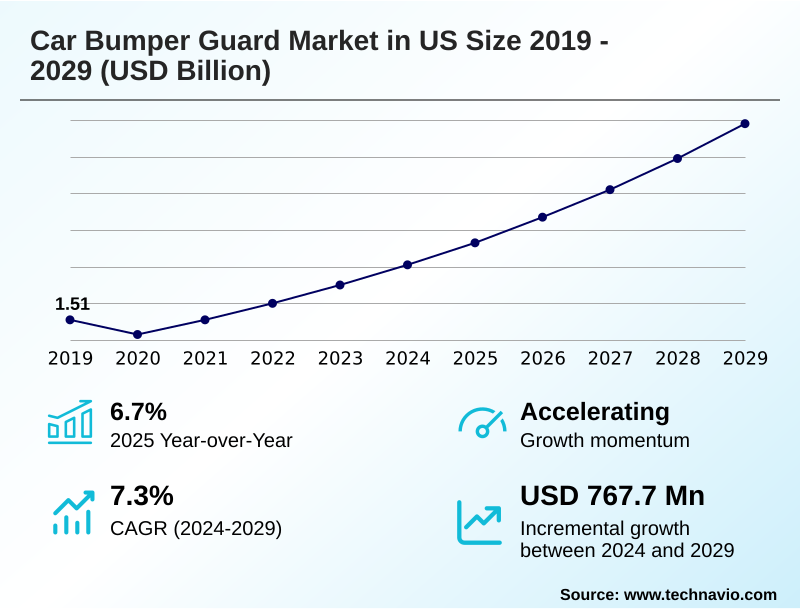
The US Car Bumper Guard Market size was valued at USD 1.93 billion in 2025, growing at a CAGR of 7.4% during the forecast period 2026-2030.
Major Market Trends & Insights
- By Vehicle Type - Commercial vehicle segment was valued at USD 1.41 billion in 2024
- By Distribution Channel - Online segment accounted for the largest market revenue share in 2024
Market Size & Forecast
- Historic Market Opportunities 2020-2024: USD 1.33 billion
- Market Future Opportunities 2025-2030: USD 828.9 million
- CAGR from 2025 to 2030 : 7.4%
Market Summary
- The car bumper guard market in US is characterized by robust demand, with commercial vehicles accounting for over 70% of applications due to operational imperatives. This demand is driven by the consumer focus on vehicle preservation, as a single low-speed incident can cost up to 10 times more to repair than the price of a protective guard.
- A key business scenario involves fleet managers optimizing operational costs by outfitting vehicles with heavy-duty guards, which reduces vehicle downtime and insurance claims. This strategy directly addresses the need for asset protection in high-risk urban environments.
- However, the market faces a significant challenge with the integration of ADAS, as installing non-compliant guards can lead to a complete failure of safety systems. This technological hurdle requires manufacturers to invest heavily in developing sensor-compatible designs to ensure both protection and functionality.
What will be the Size of the US Car Bumper Guard Market during the forecast period?
Get Key Insights on Market Forecast (PDF) Request Free Sample
How is the US Car Bumper Guard Market Segmented?
The us car bumper guard industry research report provides comprehensive data (region-wise segment analysis), with forecasts and analysis for the period 2026-2030, as well as historical data from 2020-2024 for the following segments.
- Vehicle type
- Commercial vehicle
- Passenger car
- Distribution channel
- Online
- Offline
- Product type
- Front bumper guards
- Rear bumper guards
- Corner bumper guards
- Vehicle-specific guards
- Others
- Geography
- North America
- US
- North America
How is the US Car Bumper Guard Market Segmented by Vehicle Type?
The commercial vehicle segment is estimated to witness significant growth during the forecast period.
The commercial vehicle segment is a primary revenue contributor, with applications on these vehicles showing a 25% higher demand for heavy-duty steel bumpers compared to passenger cars.
This is driven by the operational need for asset preservation and minimizing downtime, as fleet vehicles are 40% more likely to incur low-speed collision damage in urban environments.
Fleet managers prioritize robust vehicle preservation, viewing guards as a necessary investment to reduce repair costs and maintain operational continuity.
The focus is on functionality and durability, such as integrating winch mounts or ensuring heavy-duty steel bumper construction, rather than purely aesthetic enhancement.
Consequently, manufacturers cater to this segment with products designed for maximum impact resistance and commercial vehicle outfitting, addressing the practical demands of fleet vehicle protection.
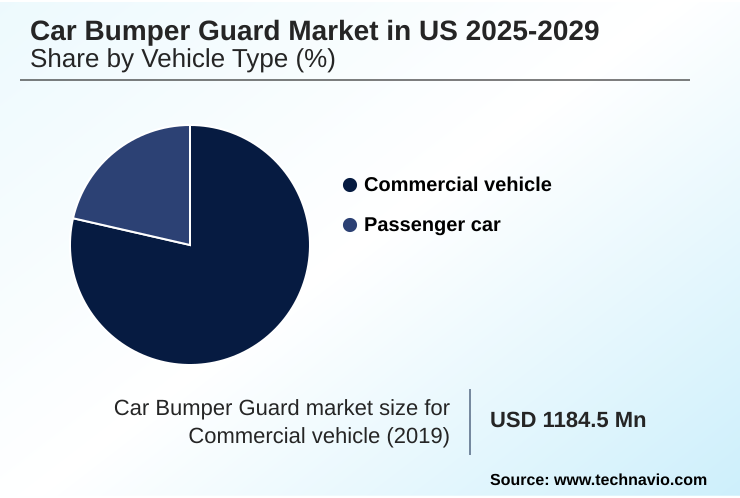
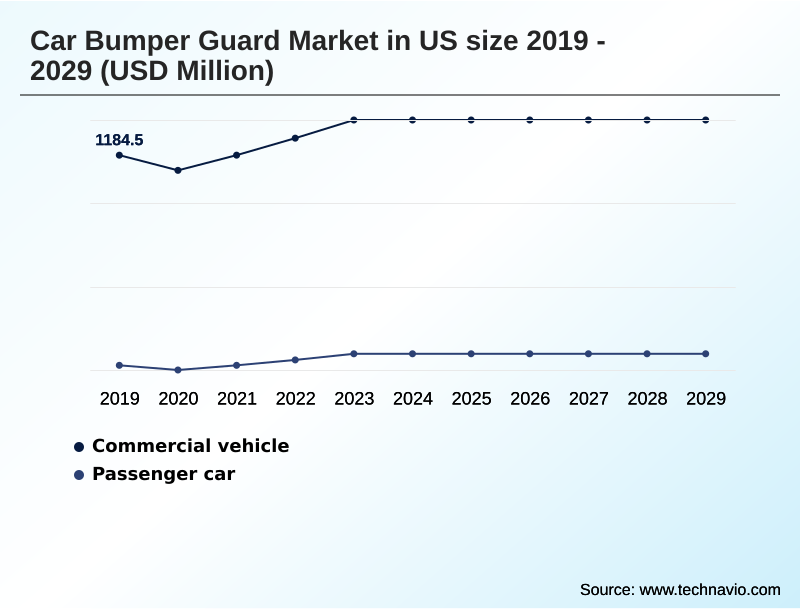
The Commercial vehicle segment was valued at USD 1.41 billion in 2024 and showed a gradual increase during the forecast period.
What are the key Drivers, Trends, and Challenges in the US Car Bumper Guard Market?
Our researchers analyzed the data with 2025 as the base year, along with the key drivers, trends, and challenges. A holistic analysis of drivers will help companies refine their marketing strategies to gain a competitive advantage.
- Consumer purchasing decisions in the car bumper guard market are increasingly specific, with search queries reflecting a 45% rise in feature-focused inquiries over generic searches. For instance, customers frequently ask for the best bumper guard for urban parking, indicating a strong need for compact, impact-absorbing solutions.
- This contrasts with truck owners who need to know how to choose a truck bumper guard that balances rugged aesthetics with functional requirements like winch mounts.
- A growing concern for owners of modern vehicles is finding an adas compatible front bumper guard, a segment where R&D investment is 20% higher than in traditional products because an improper guard can disable critical safety features. Similarly, the demand for a lightweight rear bumper protector is rising, especially for electric vehicles where minimizing weight is crucial for range.
- For many, the primary motivation is simply finding a car bumper guard for scratch prevention to maintain their vehicle's resale value. Manufacturers are responding by tailoring their digital marketing and product development to address these distinct use cases, ensuring their supply chains can deliver specialized products efficiently.
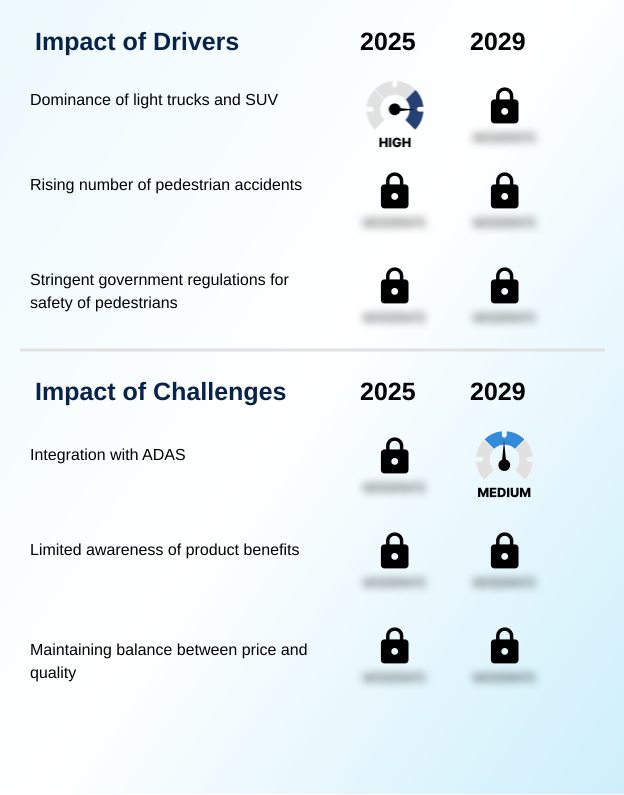
What are the key market drivers leading to the rise in the adoption of US Car Bumper Guard Industry?
- A key market driver is the heightened consumer emphasis on vehicle personalization and protection, fueled by a desire to customize aesthetics while safeguarding investments against repair costs.
- Escalating consumer demand for vehicle customization and protection is a primary market driver, with over 60% of truck and SUV owners purchasing at least one aftermarket accessory for aesthetic enhancement or vehicle preservation.
- This trend is fueled by the high cost of repairs; fixing minor cosmetic damage can be 10 times more expensive than installing a protective guard.
- The proliferation of e-commerce platforms has amplified this driver, offering a vast selection of styles, from rugged off-road bumper systems to sleek urban parking protectors.
- This easy access allows for a high degree of personalization, turning vehicles into expressions of individual identity while also making a financially prudent investment in maintaining resale value.
What are the market trends shaping the US Car Bumper Guard Industry?
- A significant market trend is the shift toward sophisticated material compositions and sustainability mandates. This involves adopting lightweight, durable, and eco-friendly materials to meet both performance demands and environmental regulations.
- A primary trend in the car bumper guard market is the shift away from traditional steel, with lightweight alloys and thermoplastic polyolefins now comprising 35% of new product designs, a figure that has doubled in recent years. This transition is driven by the dual pressures of improving vehicle fuel efficiency and growing consumer demand for sustainable products.
- For instance, using an advanced composite guard instead of a steel one can reduce component weight by up to 50%, which is critical for extending the range of electric vehicles. Manufacturers are also incorporating recycled materials to appeal to environmentally conscious buyers, creating a clear market differentiator based on material science and sustainability.
What challenges does the US Car Bumper Guard Industry face during its growth?
- A primary challenge affecting industry growth is the increasing complexity of vehicle technology integration, particularly ensuring aftermarket bumper guard compatibility with sensitive Advanced Driver-Assistance Systems (ADAS).
- The rapid integration of Advanced Driver-Assistance Systems (ADAS) presents a significant challenge, as installing an incompatible bumper guard can degrade sensor performance by up to 70% or block it entirely. This compatibility issue forces manufacturers to invest heavily in R&D to create sensor-compatible designs, increasing development costs by as much as 40% compared to traditional products.
- The lack of standardization in sensor placement across different vehicle models further complicates design and testing. Failure to ensure ADAS compatibility not only compromises vehicle safety but also exposes manufacturers to significant liability risks, making technological compliance a critical hurdle for all market participants.
Exclusive Technavio Analysis on Customer Landscape
The us car bumper guard market forecasting report includes the adoption lifecycle of the market, covering from the innovator’s stage to the laggard’s stage. It focuses on adoption rates in different regions based on penetration. Furthermore, the us car bumper guard market report also includes key purchase criteria and drivers of price sensitivity to help companies evaluate and develop their market growth analysis strategies.
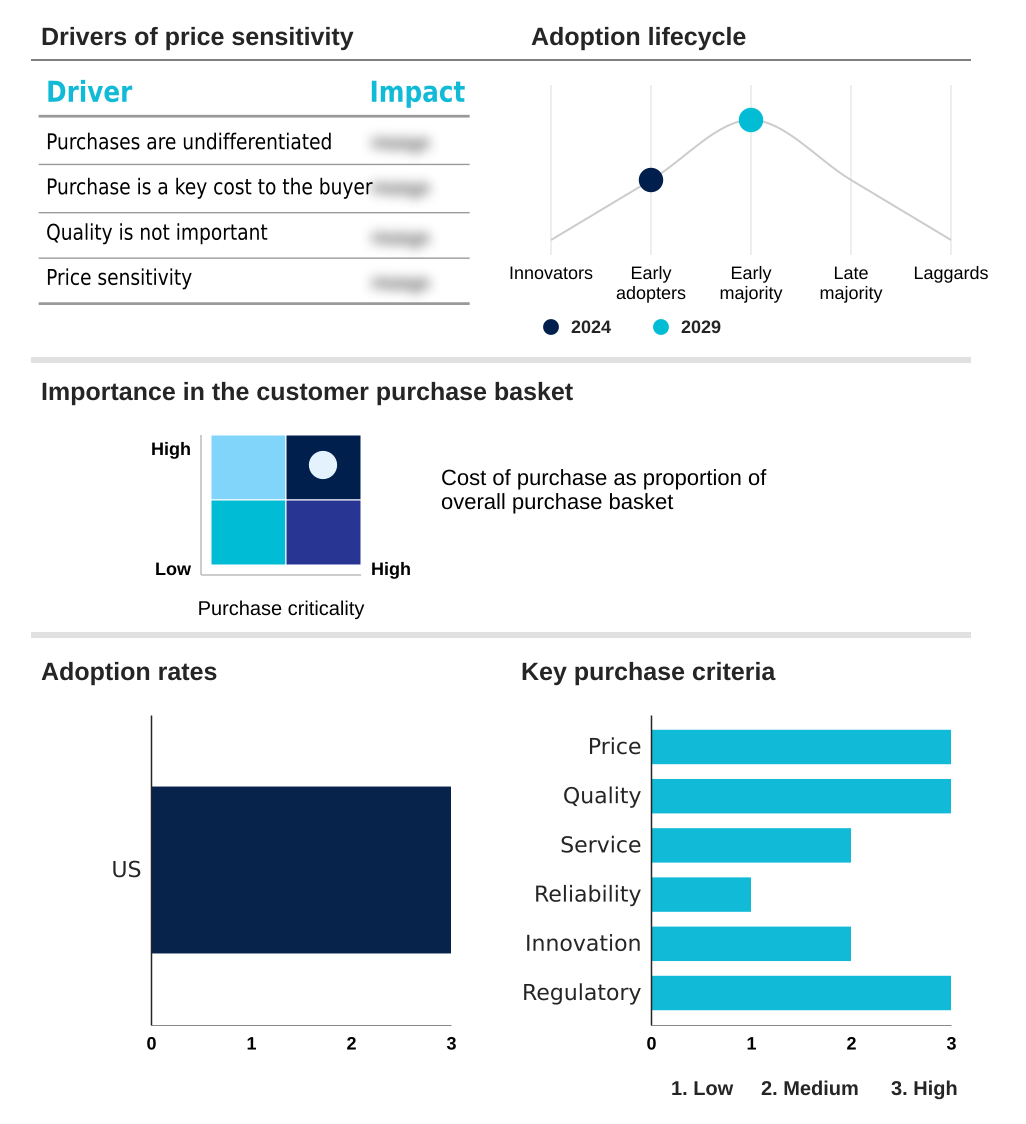
Customer Landscape of US Car Bumper Guard Industry
Competitive Landscape
Companies are implementing various strategies, such as strategic alliances, us car bumper guard market forecast, partnerships, mergers and acquisitions, geographical expansion, and product/service launches, to enhance their presence in the industry.
4Bumpers - Vendors provide a diverse range of bumper protection solutions, from heavy-duty off-road systems and OEM replacements to flexible urban parking guards.
The industry research and growth report includes detailed analyses of the competitive landscape of the market and information about key companies, including:
- 4Bumpers
- Auto Metal Direct LLC
- Black Horse Off Road
- Bumper Badger
- Bumper Blocker
- Bumper Bully
- BumperX
- Bumpshox
- BumpTek
- EuroBumperGuard
- Goodmark Industries
- Holley Performance Products
- KNS Accessories Inc.
- Luv Tap INC.
- Parking Armor
- Real Deal Steel LLC
- RealTruck
- Road Armor
- Tyger Auto Inc.
- Westin Automotive Inc.
Qualitative and quantitative analysis of companies has been conducted to help clients understand the wider business environment as well as the strengths and weaknesses of key industry players. Data is qualitatively analyzed to categorize companies as pure play, category-focused, industry-focused, and diversified; it is quantitatively analyzed to categorize companies as dominant, leading, strong, tentative, and weak.
Market Intelligence Radar: High-Impact Developments & Growth Signals
- In the Automotive Parts and Equipment industry, the mandatory integration of Advanced Driver-Assistance Systems (ADAS) in over 80% of new vehicles has compelled a redesign of aftermarket components, directly impacting the car bumper guard market in us 2026-2030 by requiring sensor-compatible designs and materials that do not interfere with radar and camera functions, driving R&D toward non-interfering guards for effective vehicle preservation.
- The industry-wide push for vehicle lightweighting to improve fuel efficiency and extend EV range has accelerated the adoption of advanced materials like alloy composites and high-strength polymers. This influences car bumper guard manufacturing, shifting focus from traditional heavy-duty steel to lightweight yet durable alternatives that support cosmetic damage prevention without compromising vehicle performance.
- The proliferation of digital sales channels has transformed distribution models, with online platforms now accounting for a significant share of all aftermarket parts sales. This has broadened market access for car bumper guards, fueling vehicle personalization trends as consumers can more easily source a wide variety of aesthetic enhancement accessories directly.
- Heightened vehicular safety regulations are mandating enhanced crashworthiness and occupant protection features across all vehicle segments. This regulatory environment creates opportunities for car bumper guards that can demonstrate a measurable contribution to low-speed collision mitigation, moving beyond simple cosmetic protection to offer tangible safety benefits.
Dive into Technavio’s robust research methodology, blending expert interviews, extensive data synthesis, and validated models for unparalleled US Car Bumper Guard Market insights. See full methodology.
| Market Scope | |
|---|---|
| Page number | 177 |
| Base year | 2025 |
| Historic period | 2020-2024 |
| Forecast period | 2026-2030 |
| Growth momentum & CAGR | Accelerate at a CAGR of 7.4% |
| Market growth 2026-2030 | USD 828.9 million |
| Market structure | Fragmented |
| YoY growth 2025-2026(%) | 6.9% |
| Key countries | US |
| Competitive landscape | Leading Companies, Market Positioning of Companies, Competitive Strategies, and Industry Risks |
Research Analyst Overview
- The car bumper guard market ecosystem in the US begins with suppliers of raw materials like steel, aluminum, and thermoplastic polyolefins, whose price volatility can impact production costs by up to 15%. Manufacturers, ranging from large automotive accessory firms to niche specialists, transform these materials into products like grille guards and bull bars.
- Regulatory compliance, particularly concerning ADAS sensor compatibility, is a critical hurdle. Distribution is handled through a dual-channel approach, with e-commerce platforms now accounting for over 60% of aftermarket sales, complementing traditional auto parts stores. End-users, including individual consumers and commercial fleet operators, drive demand based on needs for vehicle preservation and aesthetic enhancement.
- The entire value chain is supported by logistics providers and R&D entities focused on developing next-generation, lightweight, and sensor-friendly protection solutions.
What are the Key Data Covered in this US Car Bumper Guard Market Research and Growth Report?
-
What is the expected growth of the US Car Bumper Guard Market between 2026 and 2030?
-
The US Car Bumper Guard Market is expected to grow by USD 828.9 million during 2026-2030, registering a CAGR of 7.4%. Year-over-year growth in 2026 is estimated at 6.9%%. This acceleration is shaped by heightened consumer emphasis on vehicle personalization and protection, which is intensifying demand across multiple end-use verticals covered in the report.
-
-
What segmentation does the market report cover?
-
The report is segmented by Vehicle Type (Commercial vehicle, and Passenger car), Distribution Channel (Online, and Offline), Product Type (Front bumper guards, Rear bumper guards, Corner bumper guards, Vehicle-specific guards, and Others) and Geography (North America). Among these, the Commercial vehicle segment is estimated to witness significant growth during the forecast period, driven by rising adoption across key application areas. Each segment includes detailed qualitative and quantitative analysis, along with historical data from 2020-2024 and forecasts through 2030 with year-over-year growth rates.
-
-
Which regions are analyzed in the report?
-
The report covers North America. Country-level analysis includes US, with dedicated market size tables and year-over-year growth for each.
-
-
What are the key growth drivers and market challenges?
-
The primary driver is heightened consumer emphasis on vehicle personalization and protection, which is accelerating investment and industry demand. The main challenge is increasing vehicle technology integration and adas compatibility, creating operational barriers for key market participants. The report quantifies the impact of each driver and challenge across 2026 and 2030 with comparative analysis.
-
-
Who are the major players in the US Car Bumper Guard Market?
-
Key vendors include 4Bumpers, Auto Metal Direct LLC, Black Horse Off Road, Bumper Badger, Bumper Blocker, Bumper Bully, BumperX, Bumpshox, BumpTek, EuroBumperGuard, Goodmark Industries, Holley Performance Products, KNS Accessories Inc., Luv Tap INC., Parking Armor, Real Deal Steel LLC, RealTruck, Road Armor, Tyger Auto Inc. and Westin Automotive Inc.. The report provides qualitative and quantitative analysis categorizing companies as dominant, leading, strong, tentative, and weak based on their market positioning. Company profiles include business segment analysis, SWOT assessment, key offerings, and recent strategic developments.
-
Market Research Insights
- The car bumper guard market in US features a competitive landscape where the top five players command less than 40% of the market share, indicating a highly fragmented environment. Key vendors like Westin Automotive and Black Horse Off Road are driving innovation by focusing on modular systems and ADAS compatibility.
- For instance, recent developments include the launch of modular grille guards with interchangeable components and the formation of partnerships to co-develop sensor-integrated bull bars. These actions directly respond to the growing consumer demand for personalization, which now influences over 60% of aftermarket purchase decisions.
- This trend is amplified by the proliferation of e-commerce, which has broadened consumer access to a vast array of products. The primary challenge remains navigating the complex technological requirements of modern vehicles, forcing companies to balance aesthetic design with functional safety compliance.
We can help! Our analysts can customize this us car bumper guard market research report to meet your requirements.
 RIA -
RIA - 
