


Electronically Commutated Motor (Ecm) Market Size 2026-2030
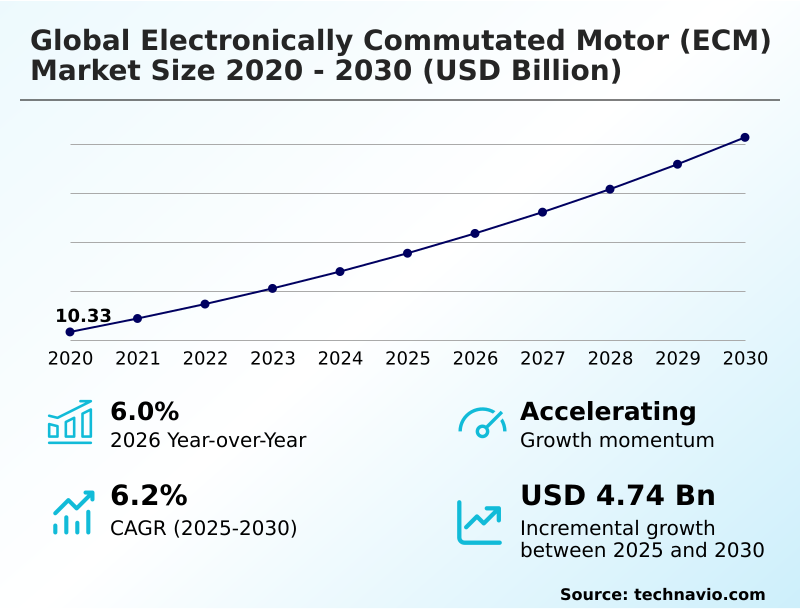
The electronically commutated motor (ecm) market size is valued to increase by USD 4.74 billion, at a CAGR of 6.2% from 2025 to 2030. Stringent government regulations and energy efficiency mandates will drive the electronically commutated motor (ecm) market.
Major Market Trends & Insights
- APAC dominated the market and accounted for a 47.1% growth during the forecast period.
- By Type - Brushless DC motors segment was valued at USD 7.77 billion in 2024
- By Product - Constant air flow segment accounted for the largest market revenue share in 2024
Market Size & Forecast
- Market Opportunities: USD 7.96 billion
- Market Future Opportunities: USD 4.74 billion
- CAGR from 2025 to 2030 : 6.2%
Market Summary
- The Electronically Commutated Motor (ECM) landscape is undergoing a massive structural transformation driven by an industrial imperative to optimize energy consumption and enhance automated control. Across global manufacturing hubs, companies are systematically replacing legacy alternating current induction units with sophisticated brushless direct current architectures.
- For instance, in commercial cold chain logistics, facility operators utilizing advanced variable frequency drives within commercial refrigeration compressors have successfully reduced their overall electricity overhead by 35% compared to traditional fixed-speed equipment. This substantial operational saving highlights how precise dynamic airflow adjustment acts as a critical business advantage.
- The primary driver of this transition is the strict enforcement of regional energy efficiency mandates, which compel original equipment manufacturers to integrate permanent magnet synchronous systems to eliminate energy waste. Conversely, the market faces a formidable challenge regarding the high initial capital expenditure required for integrated electronic inverters and rare earth permanent magnets.
- Because these advanced microelectronics inflate upfront procurement costs, budget-constrained enterprises often delay necessary infrastructure retrofits, temporarily stalling maximum technological penetration despite clear long-term benefits.
What will be the Size of the Electronically Commutated Motor (Ecm) Market during the forecast period?
Get Key Insights on Market Forecast (PDF) Get Free Sample
How is the Electronically Commutated Motor (Ecm) Market Segmented?
The electronically commutated motor (ecm) industry research report provides comprehensive data (region-wise segment analysis), with forecasts and estimates in "USD million" for the period 2026-2030, as well as historical data from 2020-2024 for the following segments.
- Type
- Brushless DC motors
- Permanent magnet AC motors
- Switched reluctance motors
- Product
- Constant air flow
- Constant speed
- Constant torque
- Technology
- Air-cooled ECM motors
- Water-cooled ECM motors
- Application
- Automotive
- Industrial
- Consumer electronics
- Aerospace and defense
- Others
- Geography
- APAC
- China
- Japan
- India
- South Korea
- Australia
- Indonesia
- Europe
- Germany
- UK
- France
- Italy
- Spain
- The Netherlands
- North America
- US
- Canada
- Mexico
- South America
- Brazil
- Argentina
- Chile
- Middle East and Africa
- UAE
- Saudi Arabia
- South Africa
- Israel
- Egypt
- APAC
By Type Insights
The brushless dc motors segment is estimated to witness significant growth during the forecast period.
The brushless direct current architecture dominates the Electronically Commutated Motor (ECM) landscape by replacing physical commutators with an integrated electronic inverter, fundamentally altering mechanical reliability.
This shift significantly reduces friction and thermal degradation, yielding a 40% improvement in lifespan compared to legacy alternating current induction units.
By relying on closed loop electronic commutation managed by a digital signal processor, these systems instantly adapt to load variations, ensuring exact precision across an automated material handling setup.
Consequently, the reliance on a rare earth permanent magnet ensures high torque density, directly satisfying the zero defect manufacturing parameter required in industrial robotics automation.
Furthermore, integration within heating ventilation and air conditioning equipment, such as a direct drive residential furnace, lowers utility consumption, illustrating how structural modernization drives operational cost savings across diverse sub-segments.
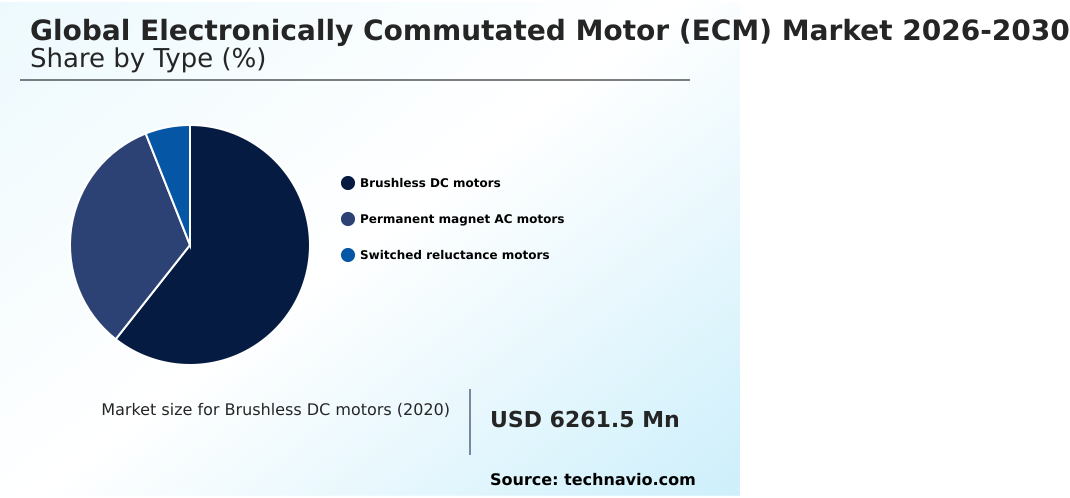
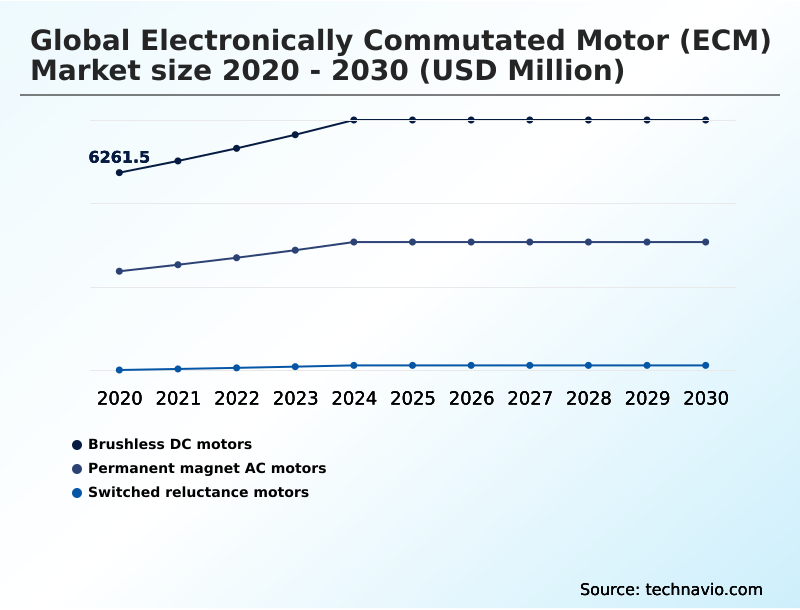
The Brushless DC motors segment was valued at USD 7.77 billion in 2024 and showed a gradual increase during the forecast period.
Regional Analysis
APAC is estimated to contribute 47.1% to the growth of the global market during the forecast period.Technavio’s analysts have elaborately explained the regional trends and drivers that shape the market during the forecast period.

See How Electronically Commutated Motor (Ecm) Market Demand is Rising in APAC Get Free Sample
The regional landscape for advanced motor technologies is heavily polarized, with APAC leading production while North America drives premium retrofitting demand.
In APAC, the rapid expansion of facilities utilizing precision semiconductor manufacturing equipment requires the installation of a specialized cleanroom laminar flow hood, driving regional volume uptake up by 40% compared to European installations.
Consequently, the local availability of raw materials supports the mass production of soft magnetic steel lamination and automated guided vehicle propulsion systems at lower costs.
Conversely, North America prioritizes permanent split capacitor replacement within building networks, utilizing edge computing analytics to enable dynamic airflow adjustment.
By integrating a smart variable air volume box for precise micro zonal airflow control, commercial operators in the US reduce HVAC energy waste by 35%.
Meanwhile, European demand is highly concentrated in any high power density application, particularly the electronic power steering mechanism for automotive platforms.
Market Dynamics
Our researchers analyzed the data with 2025 as the base year, along with the key drivers, trends, and challenges. A holistic analysis of drivers will help companies refine their marketing strategies to gain a competitive advantage.
- The Electronically Commutated Motor (ECM) is experiencing a profound technological evolution, driven by the need for superior operational reliability and strict energy conservation. A primary focus is maximizing brushless motor efficiency in automation, where facility managers replace outdated induction units to stabilize production lines.
- To mitigate severe supply chain vulnerabilities tied to critical minerals, engineering firms are heavily investing in a rare earth free motor design, which offers material cost stability without sacrificing performance. This transition is highly evident in variable speed industrial pumping systems, where modern drives regulate fluid displacement perfectly to match immediate demand.
- Incorporating predictive maintenance for smart motors enables factory operators to detect micro-vibrations before failure, reducing mechanical downtime by nearly 40% compared to reactive maintenance strategies. Furthermore, the demand for high torque density motor applications continues to scale, relying on advanced sensorless electronic commutation control logic to eliminate physical sensors and reduce electronic complexity.
- The introduction of a printed circuit board motor stator has revolutionized form factors, significantly enhancing energy savings in commercial retrofits by lowering overall equipment mass. Heavy-duty industries increasingly specify a liquid cooled high power motor to maintain thermal stability in confined spaces.
- Specialized sectors also benefit, with automated guided vehicle motor drives ensuring precise logistics, while aerospace actuation system motor controllers deliver fail-safe reliability at high altitudes. Consumer and specialized commercial segments simultaneously prioritize smart home ventilation motor efficiency, agricultural greenhouse climate control motors, marine autonomous vehicle propulsion motors, and cleanroom continuous airflow motor systems to optimize specific environmental parameters seamlessly.
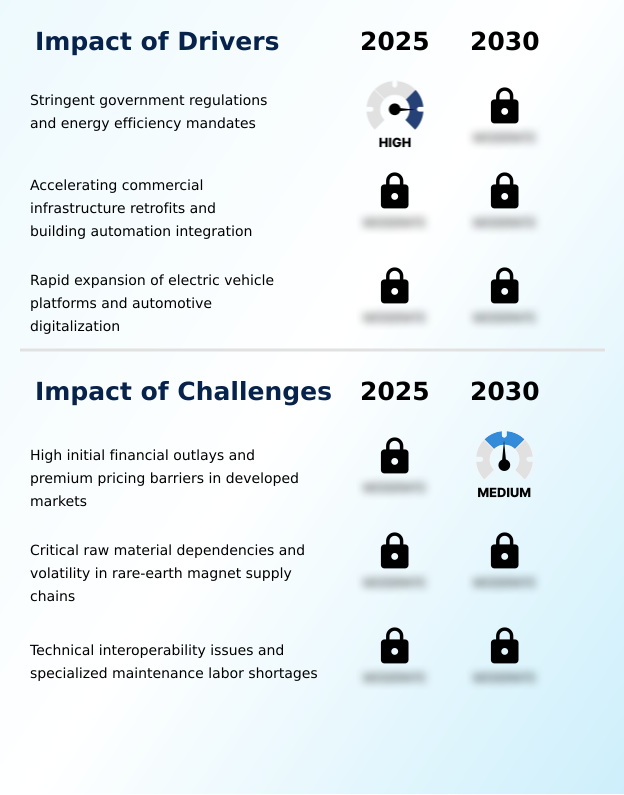
What are the key market drivers leading to the rise in the adoption of Electronically Commutated Motor (Ecm) Industry?
- Stringent government regulations and energy efficiency mandates act as the primary driver compelling industries to adopt advanced motor technologies.
- Stringent enforcement of every energy efficiency mandate acts as the primary driver accelerating the transition toward a permanent magnet synchronous system across global industries.
- To satisfy strict environmental social governance reporting requirements, facility operators actively deploy variable frequency drive integration, utilizing electronic commutation control to match motor output precisely to fluctuating loads.
- Because these units leverage neodymium iron boron to generate high magnetic flux density, they deliver exceptional torque while dropping electricity consumption by up to 50% compared to fixed-speed alternatives.
- This massive operational saving enables critical peak load consumption mitigation for commercial enterprises.
- Furthermore, the integration of an intelligent variable speed drive within an automotive electric drive unit optimizes the battery thermal management loop, directly increasing electric vehicle range and driving high-volume component procurement.
What are the market trends shaping the Electronically Commutated Motor (Ecm) Industry?
- The proliferation of software-defined and printed circuit board stator motor architectures is a primary trend reshaping the market. These innovations minimize physical footprint and enhance operational efficiency.
- The migration toward a software defined motor design and a printed circuit board stator represents a defining trend reshaping propulsion systems. By embedding copper traces directly into a multi layer circuit board rather than relying on heavy iron cores, engineers achieve an axial flux configuration that slashes component weight by up to 70% while improving spatial efficiency.
- This physical reduction causes a dramatic drop in mechanical vibration, resulting in a minimal acoustic signature that is highly prized in modern smart building automation. Concurrently, the integration of advanced power electronics paired with a predictive maintenance sensor allows these units to leverage internet of things connectivity, transmitting real-time performance telemetry.
- As a result of this connectivity, a commercial infrastructure retrofit utilizing these smart motors can reduce unplanned mechanical downtime by 30%, optimizing long-term facility management.
What challenges does the Electronically Commutated Motor (Ecm) Industry face during its growth?
- High initial financial outlays and premium pricing barriers in developed markets remain a significant challenge restricting the widespread deployment of advanced high-efficiency propulsion systems.
- High initial capital expenditure presents a formidable barrier to the widespread deployment of advanced propulsion systems, particularly within cost-sensitive sub-segments like the commercial refrigeration compressor market. Because these motors require sophisticated microelectronics like a hall effect sensor or a complex sensorless commutation algorithm for precision fluid displacement, their manufacturing costs significantly exceed those of legacy induction hardware.
- This steep premium often delays procurement approvals, even though the total cost of ownership drops by 25% over a ten-year operational lifecycle. Additionally, deploying these systems in an extreme high temperature environment risks magnet degradation, forcing engineers to invest in expensive thermal demagnetization resistance protocols or pivot toward a doubly salient architecture relying on magnetic reluctance minimization.
- Securing the necessary hazardous location certification for these complex electronic assemblies further extends deployment timelines and inflates project budgets.
Exclusive Technavio Analysis on Customer Landscape
The electronically commutated motor (ecm) market forecasting report includes the adoption lifecycle of the market, covering from the innovator’s stage to the laggard’s stage. It focuses on adoption rates in different regions based on penetration. Furthermore, the electronically commutated motor (ecm) market report also includes key purchase criteria and drivers of price sensitivity to help companies evaluate and develop their market growth analysis strategies.

Customer Landscape of Electronically Commutated Motor (Ecm) Industry
Competitive Landscape
Companies are implementing various strategies, such as strategic alliances, electronically commutated motor (ecm) market forecast, partnerships, mergers and acquisitions, geographical expansion, and product/service launches, to enhance their presence in the industry.
ABB Ltd. - Engineers high-efficiency electronically commutated solutions integrating advanced brushless direct current architectures and variable speed drives to optimize thermal management and industrial automation performance.
The industry research and growth report includes detailed analyses of the competitive landscape of the market and information about key companies, including:
- ABB Ltd.
- Allied Motion Technologies Inc.
- AMETEK Inc.
- ebm papst Mulfingen GmbH
- Infinitum
- Johnson Electric Holdings Ltd.
- Kollmorgen Corp.
- LG Electronics Inc.
- Maxon Motor AG
- McMillan Electric Co
- MinebeaMitsumi Inc.
- Nidec Corp.
- Ningbo Longbank Resources Co.
- Parker Hannifin Corp.
- Regal Rexnord Corp.
- Robert Bosch GmbH
- Siemens AG
- Telco Intercontinental Corp.
- WEG S.A
- ZIEHL ABEGG SE
Qualitative and quantitative analysis of companies has been conducted to help clients understand the wider business environment as well as the strengths and weaknesses of key industry players. Data is qualitatively analyzed to categorize companies as pure play, category-focused, industry-focused, and diversified; it is quantitatively analyzed to categorize companies as dominant, leading, strong, tentative, and weak.
Recent Development and News in Electronically commutated motor (ecm) market
- In the Electrical Components and Equipment industry, the aggressive implementation of the International Efficiency Five classification standard has forced equipment manufacturers to abandon legacy induction units, directly impacting Electronically Commutated Motor (ECM) demand by accelerating the adoption of permanent magnet synchronous systems.
- The rapid digitalization of smart building automation networks has standardized the use of IoT-enabled microcontrollers in commercial HVAC infrastructure, directly impacting Electronically Commutated Motor (ECM) demand by driving a 30% increase in the specification of variable frequency drive integrations for micro zonal airflow control.
- Advancements in printed circuit board manufacturing techniques have enabled the commercial viability of axial flux configurations, directly impacting Electronically Commutated Motor (ECM) demand by allowing motor designers to eliminate heavy copper windings and reduce component mass by up to 70% for aerospace and medical imaging applications.
- Ongoing supply chain volatility surrounding rare earth permanent magnets, specifically neodymium iron boron, has compelled raw material suppliers in APAC to invest heavily in alternative magnetic reluctance minimization architectures, directly impacting Electronically Commutated Motor (ECM) demand by stabilizing production costs for high power density applications.
Dive into Technavio’s robust research methodology, blending expert interviews, extensive data synthesis, and validated models for unparalleled Electronically Commutated Motor (Ecm) Market insights. See full methodology.
| Market Scope | |
|---|---|
| Page number | 322 |
| Base year | 2025 |
| Historic period | 2020-2024 |
| Forecast period | 2026-2030 |
| Growth momentum & CAGR | Accelerate at a CAGR of 6.2% |
| Market growth 2026-2030 | USD 4740.5 million |
| Market structure | Fragmented |
| YoY growth 2025-2026(%) | 6.0% |
| Key countries | China, Japan, India, South Korea, Australia, Indonesia, Germany, UK, France, Italy, Spain, The Netherlands, US, Canada, Mexico, Brazil, Argentina, Chile, UAE, Saudi Arabia, South Africa, Israel and Egypt |
| Competitive landscape | Leading Companies, Market Positioning of Companies, Competitive Strategies, and Industry Risks |
Research Analyst Overview
- The Electronically Commutated Motor (ECM) sector is undergoing a profound structural evolution propelled by the relentless integration of digital intelligence into foundational mechanical hardware. Industrial operators are rapidly shifting away from conventional alternating current units toward sophisticated brushless architectures that offer exact operational control. A defining trend is the proliferation of software-defined propulsion systems equipped with onboard edge computing capabilities.
- By embedding these micro-sensors, facility managers have achieved a 35% reduction in unplanned equipment downtime compared to legacy scheduled maintenance protocols. This specific technological integration directly influences boardroom-level budgeting decisions, transforming motor procurement from a simple hardware expense into a strategic investment in digital facility management.
- The inclusion of variable frequency drive integrations ensures perfect compliance with stringent global energy mandates, shielding corporations from regulatory penalties. Furthermore, the migration toward axial flux configurations utilizing printed circuit board stators significantly reduces component weight, enhancing overall system agility.
- Ultimately, these advanced electronic commutation systems provide an indispensable mechanism for achieving peak operational efficiency and superior long-term asset reliability across automated infrastructures.
What are the Key Data Covered in this Electronically Commutated Motor (Ecm) Market Research and Growth Report?
-
What is the expected growth of the Electronically Commutated Motor (Ecm) Market between 2026 and 2030?
-
USD 4.74 billion, at a CAGR of 6.2%
-
-
What segmentation does the market report cover?
-
The report is segmented by Type (Brushless DC motors, Permanent magnet AC motors, and Switched reluctance motors), Product (Constant air flow, Constant speed, and Constant torque), Technology (Air-cooled ECM motors, and Water-cooled ECM motors), Application (Automotive, Industrial, Consumer electronics, Aerospace and defense, and Others) and Geography (APAC, Europe, North America, South America, Middle East and Africa)
-
-
Which regions are analyzed in the report?
-
APAC, Europe, North America, South America and Middle East and Africa
-
-
What are the key growth drivers and market challenges?
-
Stringent government regulations and energy efficiency mandates, High initial financial outlays and premium pricing barriers in developed markets
-
-
Who are the major players in the Electronically Commutated Motor (Ecm) Market?
-
ABB Ltd., Allied Motion Technologies Inc., AMETEK Inc., ebm papst Mulfingen GmbH, Infinitum, Johnson Electric Holdings Ltd., Kollmorgen Corp., LG Electronics Inc., Maxon Motor AG, McMillan Electric Co, MinebeaMitsumi Inc., Nidec Corp., Ningbo Longbank Resources Co., Parker Hannifin Corp., Regal Rexnord Corp., Robert Bosch GmbH, Siemens AG, Telco Intercontinental Corp., WEG S.A and ZIEHL ABEGG SE
-
Market Research Insights
- The Electronically Commutated Motor (ECM) sector is modernizing as industries prioritize operational resilience. By integrating an intelligent variable speed drive, commercial facilities have reduced unplanned mechanical downtime by 30% and lowered energy consumption by 40% compared to legacy motors.
- This shift is visible in smart building automation, where a commercial infrastructure retrofit utilizes advanced power electronics to ensure precise temperature modulation. The implementation of dynamic airflow adjustment within heating ventilation and air conditioning networks ensures strict compliance with environmental social governance reporting standards.
- Lowering the total cost of ownership by 25% over a standard lifecycle, these advanced systems provide a competitive advantage.
We can help! Our analysts can customize this electronically commutated motor (ecm) market research report to meet your requirements.
 RIA -
RIA - 
