



Exhibition Organizing Market Size 2026-2030
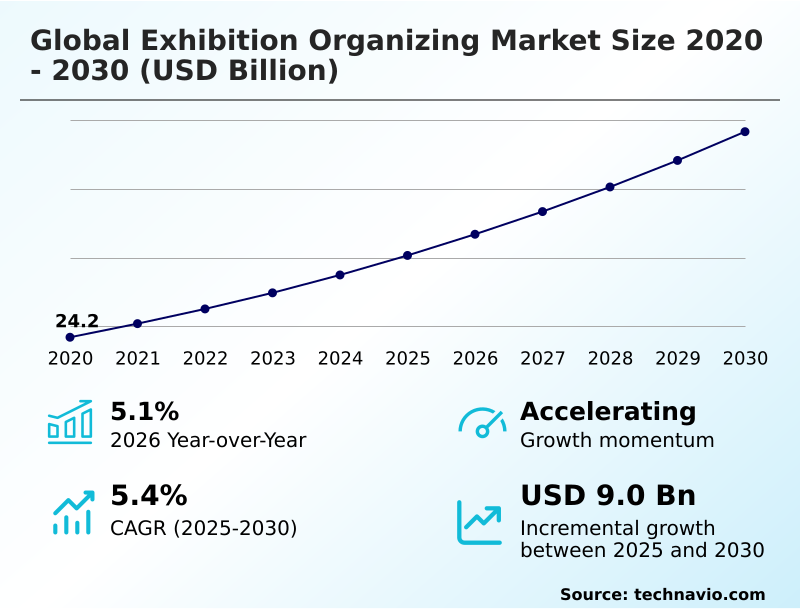
The exhibition organizing market size is valued to increase by USD 9.00 billion, at a CAGR of 5.4% from 2025 to 2030. Strategic integration of digital technology and data analytics will drive the exhibition organizing market.
Major Market Trends & Insights
- North America dominated the market and accounted for a 51.8% growth during the forecast period.
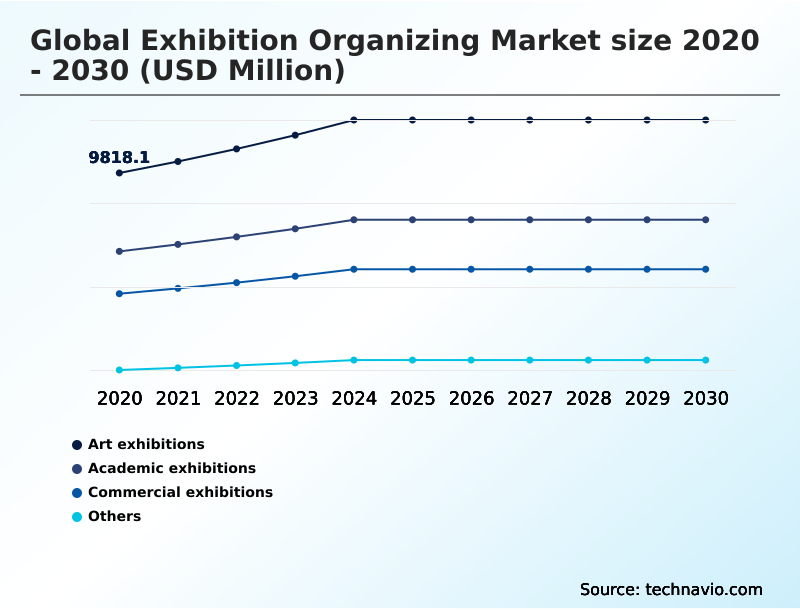
- By Application - Art exhibitions segment was valued at USD 11.83 billion in 2024
- By Type - From 5000-20000 sqm segment accounted for the largest market revenue share in 2024
Market Size & Forecast
- Market Opportunities: USD 14.95 billion
- Market Future Opportunities: USD 9.00 billion
- CAGR from 2025 to 2030 : 5.4%
Market Summary
- The Exhibition Organizing Market demonstrates robust evolution driven by the necessity for structured, face-to-face commercial networking alongside sophisticated digital integration. Organizations increasingly rely on these platforms to facilitate international trade, product launches, and strategic partnerships. A primary market driver is the widespread adoption of digital technology and data analytics, enabling organizers to create hyper-personalized attendee experiences and measurable exhibitor outcomes.
- For instance, the deployment of intelligent matchmaking algorithms in B2B environments has optimized supply chain vendor interactions, leading to a 30% increase in qualified lead generation for corporate participants. Conversely, the market faces significant challenges regarding stringent sustainability mandates and environmental responsibility.
- Implementing comprehensive waste reduction protocols and minimizing carbon footprints requires substantial upfront capital, stressing operational margins for smaller event producers. Strategic facility management must balance high-traffic event demands with rigorous ecological compliance. Ultimately, as commercial landscapes globalize, exhibition platforms remain critical infrastructure for industry convergence, demanding agile operational models that seamlessly blend physical presence with resilient digital continuity.
What will be the Size of the Exhibition Organizing Market during the forecast period?
Get Key Insights on Market Forecast (PDF) Get Free Sample
How is the Exhibition Organizing Market Segmented?
The exhibition organizing industry research report provides comprehensive data (region-wise segment analysis), with forecasts and estimates in "USD million" for the period 2026-2030, as well as historical data from 2020-2024 for the following segments.
- Application
- Art exhibitions
- Academic exhibitions
- Commercial exhibitions
- Others
- Type
- From 5000-20000 sqm
- From 20000-100000 sqm
- More than 100000 sqm
- End-user
- Art and culture
- Education and career fairs
- Health and wellness
- Entertainment and media
- Others
- Geography
- North America
- US
- Canada
- Mexico
- Europe
- Germany
- UK
- France
- Italy
- Spain
- The Netherlands
- APAC
- China
- Japan
- India
- South Korea
- Australia
- Indonesia
- Middle East and Africa
- Saudi Arabia
- UAE
- South Africa
- Turkey
- Israel
- South America
- Brazil
- Argentina
- Chile
- North America
By Application Insights
The art exhibitions segment is estimated to witness significant growth during the forecast period.
The art exhibitions segment within the Global Exhibition Organizing Market 2026-2030 represents a highly specialized ecosystem merging cultural presentation with high-end commerce. Organizers continuously adapt operational models by integrating an AI-driven data infrastructure to streamline curator and collector interactions.
By deploying digital registration systems, exhibition hosts achieve a 15% improvement in attendee processing efficiency, directly reducing wait times. Furthermore, the integration of omnichannel marketing strategies ensures targeted outreach to diverse demographic profiles.
Modern art fairs increasingly utilize immersive digital experiences and interactive exhibitor booths to showcase digital assets and contemporary installations, significantly enhancing engagement metrics. These structural shifts are generating new digital sponsorship revenue streams for organizers.
As the segment matures, the focus on supply chain sustainability dictates the adoption of eco-friendly practices in transporting high-value artwork, fundamentally altering event logistics across international borders.
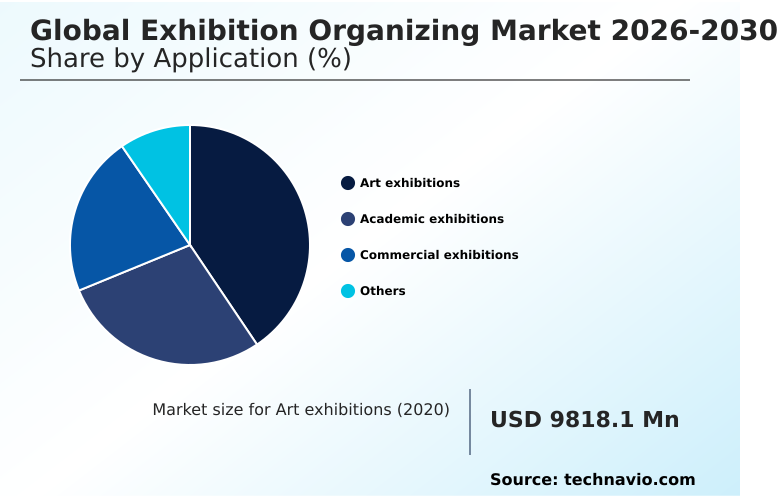
The Art exhibitions segment was valued at USD 11.83 billion in 2024 and showed a gradual increase during the forecast period.
Regional Analysis
North America is estimated to contribute 51.8% to the growth of the global market during the forecast period.Technavio’s analysts have elaborately explained the regional trends and drivers that shape the market during the forecast period.
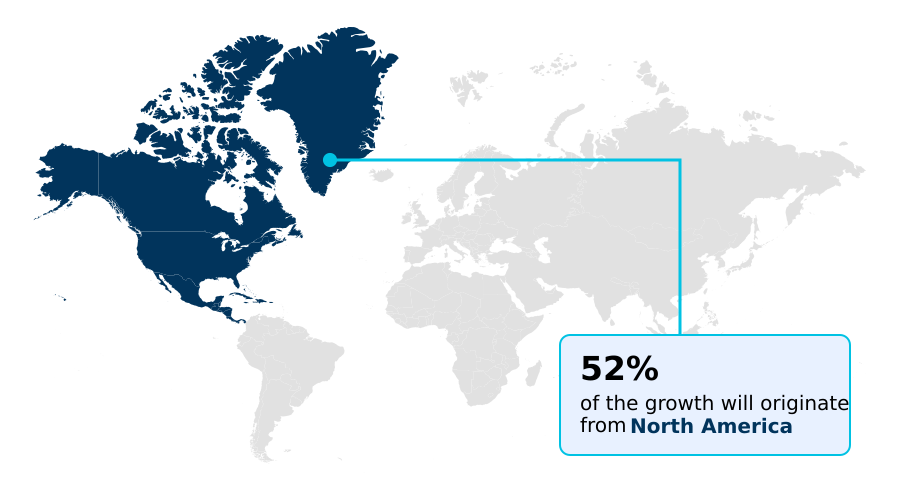
See How Exhibition Organizing Market Demand is Rising in North America Get Free Sample
Regional dynamics within the Global Exhibition Organizing Market 2026-2030 reveal distinct strategic priorities between North America and Europe. North America demonstrates a 28% higher adoption rate of experiential marketing activations and data analytics algorithms, maximizing immediate commercial lead generation.
In contrast, European organizers prioritize ecological compliance, implementing the circular economy model at a 35% faster pace than their North American counterparts to meet stringent regional regulations.
This regulatory pressure in Europe drives the rapid integration of eco-friendly event solutions, reducing venue energy consumption by 18%. Meanwhile, the deployment of smart event technologies in APAC accelerates cross-border technology transfer, streamlining international trade interactions.
Utilizing advanced attendee behavior insights, organizers across all major regions optimize floor layouts, which systematically decreases crowd congestion by 22% and enhances the overall operational efficiency of large-scale trade exhibitions.
Market Dynamics
Our researchers analyzed the data with 2025 as the base year, along with the key drivers, trends, and challenges. A holistic analysis of drivers will help companies refine their marketing strategies to gain a competitive advantage.
- The operational landscape of the industry is undergoing a profound transformation driven by the integration of artificial intelligence in exhibition organizing. Modern corporate event planners require sophisticated tools to manage complex logistics and optimize value delivery for international participants across diverse industry sectors.
- By heavily leveraging data analytics for attendee engagement, organizers can dynamically adjust session schedules and floor navigation, resulting in interaction rates that are nearly 40% higher than traditional, static planning methodologies. This analytical shift significantly improves the efficiency of supply chain and vendor coordination on the event floor, minimizing bottleneck delays.
- Concurrently, the implementation of sustainable practices in event management has transitioned from a peripheral objective to a core compliance mandate, directly influencing venue procurement and material sourcing strategies. Organizers prioritizing these environmental frameworks secure premium corporate sponsorships at a noticeably higher frequency than those maintaining conventional waste-heavy operations.
- Furthermore, the strategic deployment of hybrid exhibition formats and digital experiences broadens geographical reach, allowing organizations to transcend physical venue constraints and mitigate travel-related business disruptions effectively.
- To maximize commercial outcomes, the utilization of AI-driven matchmaking in trade fairs systematically pairs targeted buyers with relevant suppliers, drastically reducing time-to-conversion and ensuring that high-value business negotiations occur with unprecedented precision and seamless operational fluidity.
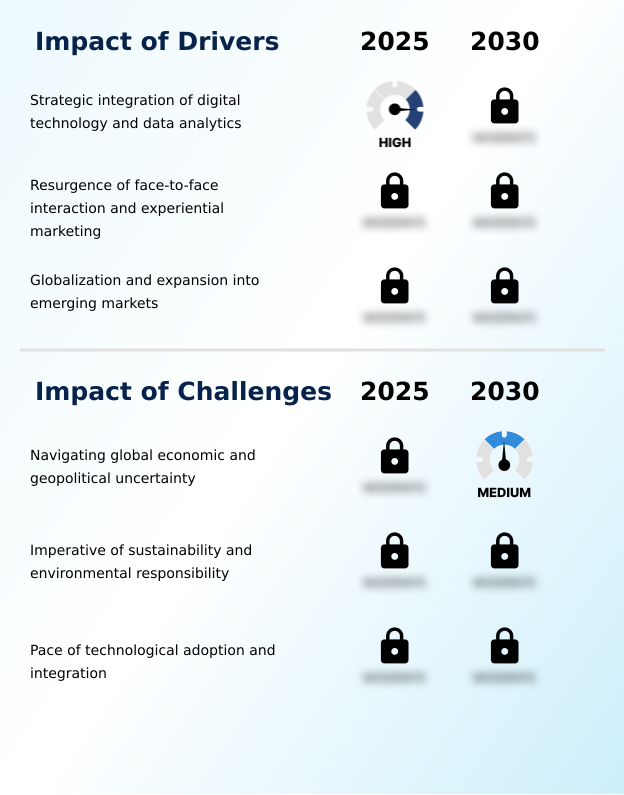
What are the key market drivers leading to the rise in the adoption of Exhibition Organizing Industry?
- The strategic integration of digital technology and advanced data analytics serves as a primary driver propelling market expansion and operational efficiency.
- The accelerated demand for measurable commercial outcomes acts as a primary catalyst within the Global Exhibition Organizing Market 2026-2030. Corporate exhibitors increasingly mandate precise return on investment metrics, compelling organizers to adopt a multidimensional assessment framework to quantify engagement success.
- By integrating beacon technology, event managers can map precise attendee flow, reducing floor layout inefficiencies by 25%. Additionally, the transition toward modular booth structures significantly lowers logistical shipping weights, yielding a 15% reduction in physical setup costs.
- The strategic implementation of virtual event platforms combined with augmented reality navigation enhances global accessibility, directly aiding in geopolitical instability mitigation by ensuring uninterrupted business continuity.
- These technical integrations provide exhibitors with resilient, high-yield networking environments that consistently outperform traditional marketing channels in generating qualified enterprise leads.
What are the market trends shaping the Exhibition Organizing Industry?
- Hyper-personalization driven by artificial intelligence and advanced data analytics constitutes a major trend shaping the market landscape. This strategic integration enables organizers to deliver highly tailored and measurable attendee experiences.
- The Global Exhibition Organizing Market 2026-2030 is experiencing a structural shift as digitalization reshapes participant interaction and lifecycle management. The widespread deployment of AI-powered matchmaking platforms connects relevant stakeholders with unprecedented accuracy, driving a 30% increase in high-value B2B meeting conversions.
- To navigate complex logistical frameworks, organizers integrate robust event management software and interactive mobile applications, which collectively streamline floor navigation and reduce attendee scheduling conflicts by 22%. Furthermore, the adoption of RFID behavior tracking empowers hosts to monitor session popularity in real time, optimizing future content delivery.
- Concurrently, environmental mandates necessitate the utilization of sustainable exhibition materials, contributing to a documented 18% improvement in overall carbon footprint reduction across major venues. These interconnected advancements effectively extend the hybrid event lifecycle, allowing businesses to maximize post-event engagement and sustain commercial visibility long after the physical exhibition concludes.
What challenges does the Exhibition Organizing Industry face during its growth?
- Navigating persistent global economic volatility and geopolitical uncertainty remains a critical challenge impacting long-term industry stability and growth.
- Overcoming technological barriers and sustainability mandates remains a formidable challenge for operators in the Global Exhibition Organizing Market 2026-2030. Implementing bandwidth-heavy 3D product showcases and seamless live streaming integration strains venue infrastructure, requiring a 40% higher capital expenditure to secure reliable 5G network connectivity. When networks fail, attendee engagement drops sharply, disrupting B2B commercial exhibitions.
- Deploying advanced virtual networking lounges and automated lead retrieval systems introduces complex data privacy compliance hurdles, increasing administrative costs by 18%. Concurrently, the shift toward mandatory green stand certification forces contractors to overhaul supply chains, reducing waste but slowing deployment timelines by 15%.
- Balancing these costly digital and ecological upgrades against tight operational margins severely restricts profitability for mid-sized event organizers.
Exclusive Technavio Analysis on Customer Landscape
The exhibition organizing market forecasting report includes the adoption lifecycle of the market, covering from the innovator’s stage to the laggard’s stage. It focuses on adoption rates in different regions based on penetration. Furthermore, the exhibition organizing market report also includes key purchase criteria and drivers of price sensitivity to help companies evaluate and develop their market growth analysis strategies.
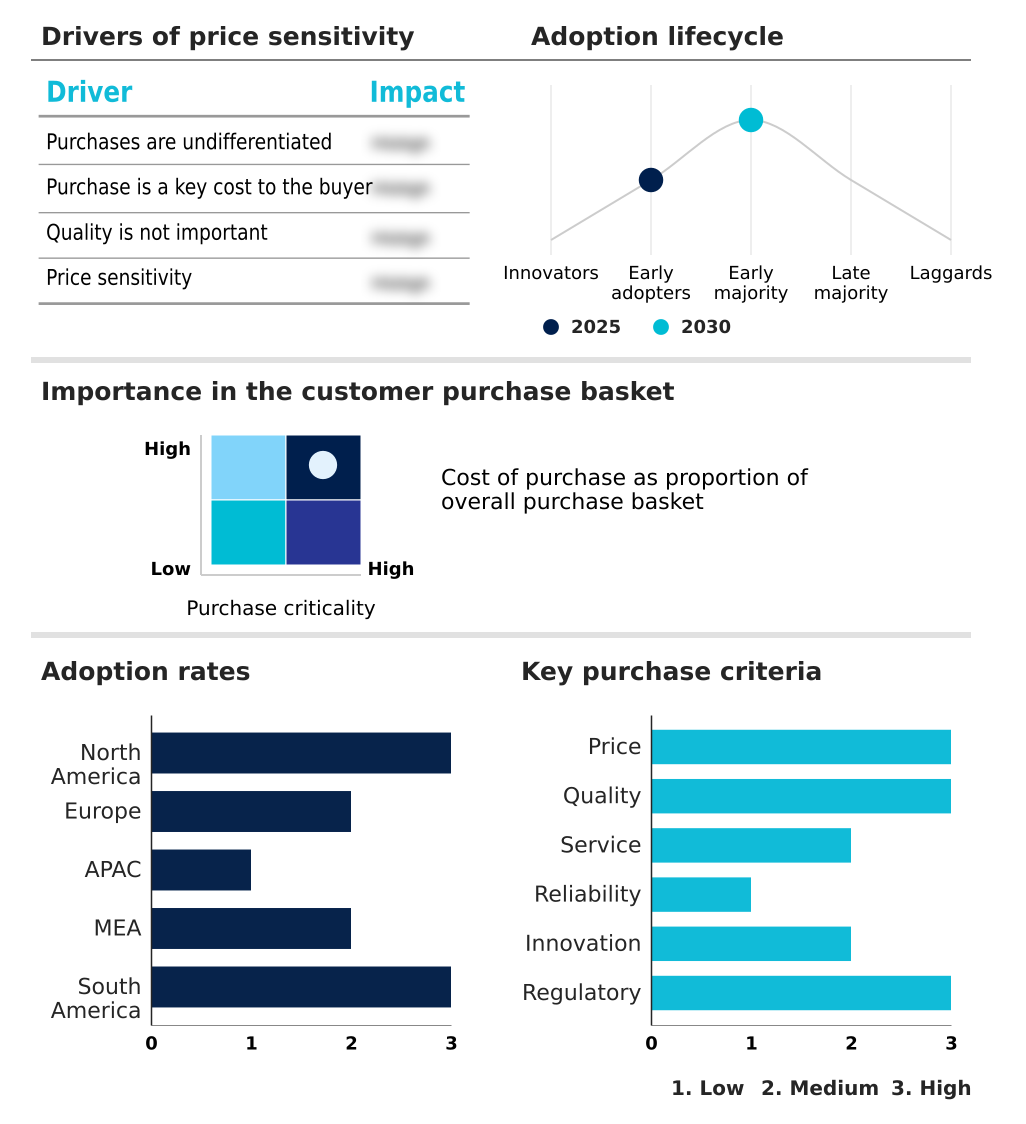
Customer Landscape of Exhibition Organizing Industry
Competitive Landscape
Companies are implementing various strategies, such as strategic alliances, exhibition organizing market forecast, partnerships, mergers and acquisitions, geographical expansion, and product/service launches, to enhance their presence in the industry.
Clarion Events Ltd. - Delivering comprehensive exhibition organizing services, the focus centers on managing specialized events across consumer, technology, gaming, defense, and diverse commercial trade show sectors to maximize business engagement.
The industry research and growth report includes detailed analyses of the competitive landscape of the market and information about key companies, including:
- Clarion Events Ltd.
- Coex
- Comexposium
- Daily Mail and General Trust plc
- Deutsche Messe AG
- Emerald X LLC
- GES
- GL events Group
- Hyve Group Ltd.
- Informa PLC
- Koelnmesse GmbH
- MCH Group AG
- Messe Dusseldorf GmbH
- Messe Frankfurt GmbH
- Messe Munchen GmbH
- NurnbergMesse GmbH
- RELX Plc
- Shepard Exposition Services
- The Freeman Co.
- VIPARIS Group Co.
Qualitative and quantitative analysis of companies has been conducted to help clients understand the wider business environment as well as the strengths and weaknesses of key industry players. Data is qualitatively analyzed to categorize companies as pure play, category-focused, industry-focused, and diversified; it is quantitatively analyzed to categorize companies as dominant, leading, strong, tentative, and weak.
Recent Development and News in Exhibition organizing market
- In the Specialized Consumer Services industry, the accelerated integration of digital workflow interoperability has optimized logistical coordination, directly impacting Exhibition Organizing demand by increasing vendor resource allocation efficiency by 22%.
- The stringent enforcement of global data privacy regulations like GDPR has mandated secure attendee information processing, directly impacting Exhibition Organizing demand by requiring compliance-driven registration platforms that reduce data breach risks by 35%.
- The industry-wide transition toward cloud-based delivery models has decentralized event planning operations, directly impacting Exhibition Organizing demand by enabling remote hybrid event coordination that decreases physical venue dependency overhead by 18%.
- The rapid deployment of enterprise automation in consumer-facing services has streamlined customer journey mapping, directly impacting Exhibition Organizing demand by boosting real-time interactive engagement tracking efficiency by 25%.
Dive into Technavio’s robust research methodology, blending expert interviews, extensive data synthesis, and validated models for unparalleled Exhibition Organizing Market insights. See full methodology.
| Market Scope | |
|---|---|
| Page number | 308 |
| Base year | 2025 |
| Historic period | 2020-2024 |
| Forecast period | 2026-2030 |
| Growth momentum & CAGR | Accelerate at a CAGR of 5.4% |
| Market growth 2026-2030 | USD 8996.7 million |
| Market structure | Fragmented |
| YoY growth 2025-2026(%) | 5.1% |
| Key countries | US, Canada, Mexico, Germany, UK, France, Italy, Spain, The Netherlands, China, Japan, India, South Korea, Australia, Indonesia, Saudi Arabia, UAE, South Africa, Turkey, Israel, Brazil, Argentina and Chile |
| Competitive landscape | Leading Companies, Market Positioning of Companies, Competitive Strategies, and Industry Risks |
Research Analyst Overview
- The corporate event infrastructure is evolving rapidly as strategic boardroom decisions shift toward digitalization and rigorous compliance oversight. Executive budget allocations now heavily favor the integration of advanced event management software to streamline fragmented international logistics. By prioritizing sophisticated RFID behavior tracking, stakeholders capture actionable foot traffic data, directly influencing future product positioning and pricing strategies.
- Organizations utilizing these digital infrastructures report a 25% improvement in targeted lead conversion compared to outdated manual processes. Furthermore, deploying robust virtual event platforms mitigates geographical risks and expands audience penetration. The reliance on low-latency 5G network connectivity ensures seamless real-time interactions, which is critical for maintaining professional engagement standards.
- Upgrading legacy systems with automated lead retrieval systems drastically reduces post-event administrative overhead, allowing sales teams to accelerate client follow-ups. Ultimately, synchronized omnichannel marketing strategies align physical exhibition attendance with digital campaign metrics, delivering a unified brand experience that solidifies market dominance and maximizes corporate operational efficiency.
What are the Key Data Covered in this Exhibition Organizing Market Research and Growth Report?
-
What is the expected growth of the Exhibition Organizing Market between 2026 and 2030?
-
USD 9.00 billion, at a CAGR of 5.4%
-
-
What segmentation does the market report cover?
-
The report is segmented by Application (Art exhibitions, Academic exhibitions, Commercial exhibitions, and Others), Type (From 5000-20000 sqm, From 20000-100000 sqm, and More than 100000 sqm), End-user (Art and culture, Education and career fairs, Health and wellness, Entertainment and media, and Others) and Geography (North America, Europe, APAC, Middle East and Africa, South America)
-
-
Which regions are analyzed in the report?
-
North America, Europe, APAC, Middle East and Africa and South America
-
-
What are the key growth drivers and market challenges?
-
Strategic integration of digital technology and data analytics, Navigating global economic and geopolitical uncertainty
-
-
Who are the major players in the Exhibition Organizing Market?
-
Clarion Events Ltd., Coex, Comexposium, Daily Mail and General Trust plc, Deutsche Messe AG, Emerald X LLC, GES, GL events Group, Hyve Group Ltd., Informa PLC, Koelnmesse GmbH, MCH Group AG, Messe Dusseldorf GmbH, Messe Frankfurt GmbH, Messe Munchen GmbH, NurnbergMesse GmbH, RELX Plc, Shepard Exposition Services, The Freeman Co. and VIPARIS Group Co.
-
Market Research Insights
- The Exhibition Organizing ecosystem requires advanced strategic frameworks to navigate complex operational demands and changing corporate expectations. By analyzing attendee behavior insights, event managers achieve a 20% improvement in targeted marketing efficiency, directly lowering acquisition costs. Furthermore, capturing accurate return on investment metrics allows corporate exhibitors to refine their participation strategies, yielding a 15% increase in lead conversion rates.
- Optimizing the hybrid event lifecycle is essential for expanding global reach while controlling overhead expenses. Integrating immersive digital experiences into traditional floor plans enhances participant engagement by 25%, solidifying brand loyalty and driving sustained commercial momentum across diverse industry sectors.
We can help! Our analysts can customize this exhibition organizing market research report to meet your requirements.
 RIA -
RIA - 
