


Food Intolerance Products Market Analysis North America, Europe, APAC, South America, Middle East and Africa - US, China, Germany, Italy, Spain - Size and Forecast 2024-2028

Food Intolerance Products Market Analysis North America, Europe, APAC, South America, Middle East and Africa - US, China, Germany, Italy, Spain - Size and Forecast 2024-2028

Published: Dec 2023 182 Pages SKU: IRTNTR77138

Market Overview at a Glance

$7.07 B
Market Opportunity
5.52%
CAGR
5.34
YoY growth 2023-2024(%)

Food Intolerance Products Market Size 2024-2028 

The food intolerance products market size is forecast to increase by USD 7.07 billion at a CAGR of 5.52% between 2023 and 2028. The market is witnessing significant growth due to the rising prevalence of chronic conditions such as migraines, sore throats, and irritable bowel syndrome. The increasing urbanization and changing consumer lifestyles are contributing to the market's expansion. Food manufacturers are responding to this trend by introducing new product offerings and promotional activities. Technological advancements in food processing are enabling the production of high-quality food intolerance products, despite their higher price points. The geriatric population's growing numbers, with their increased susceptibility to food intolerances, further fuel market growth. Effective packaging solutions are also crucial in ensuring the longevity and safety of these sensitive products.
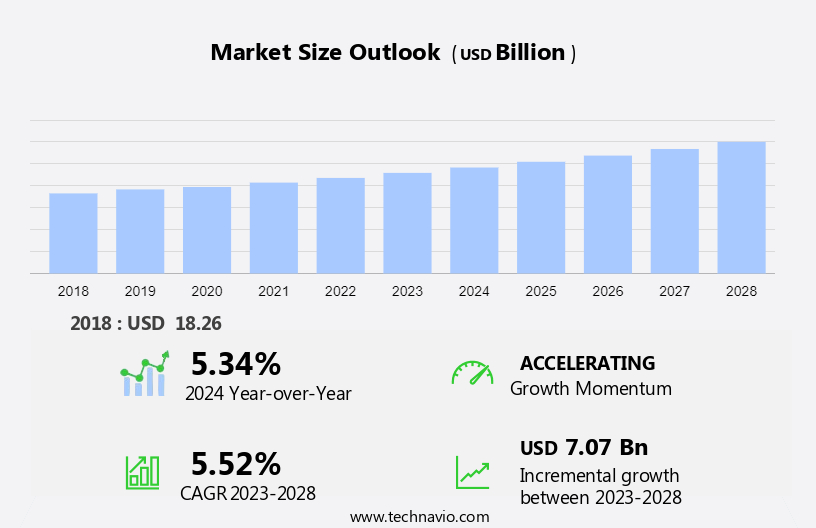
Food Intolerance Products Market Size

 Request Free Sample

The food intolerance products market is expanding rapidly, driven by the growing gluten-free product trend and increasing prevalence of celiac disease diagnoses. As awareness of food allergies in adults rises, consumers are actively seeking gluten-free (GF) foods that cater to their dietary needs. This demand has led to the development of a variety of gluten-free products, prominently featured on food labels to ensure transparency. Color additives are also being scrutinized, as consumers prioritize natural ingredients. According to German Trade & Invest, the market is responding to these shifts by offering innovative food and beverage products that accommodate individuals with conditions like Crohn's disease and indigestion. With a focus on health and wellness, the gluten-free diet is becoming a mainstream choice for many.

Market Segmentation

The market research report provides comprehensive data (region-wise segment analysis), with forecasts and estimates in "USD billion" for the period 2024-2028, as well as historical data from 2018-2022 for the following segments.

  • Distribution Channel
    • Hypermarkets and supermarkets
    • Convenience stores
    • Online channels
  • Product
    • Lactose-free food
    • Gluten-free food
    • Diabetic food
    • Others
  • Geography
    • North America
      • US
    • Europe
      • Germany
      • Italy
      • Spain
    • APAC
      • China
    • South America
    • Middle East and Africa

By Distribution Channel Insights

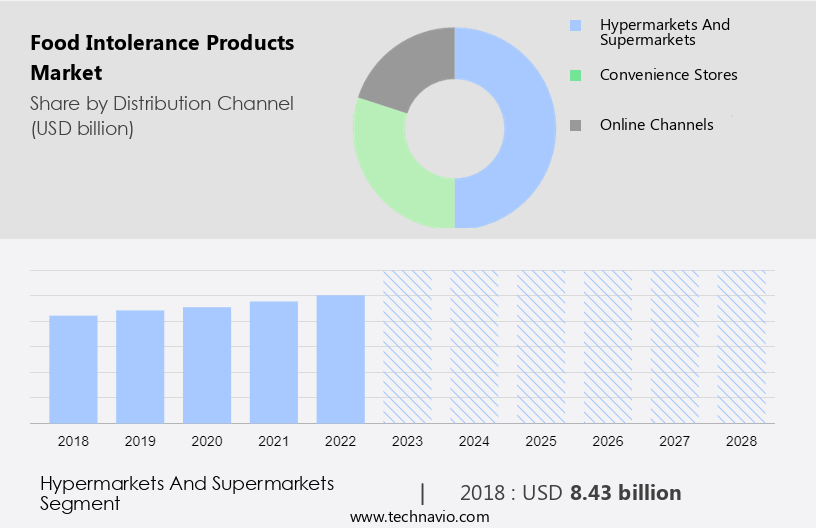
The hypermarkets and supermarkets segment is estimated to witness significant growth during the forecast period. The market caters to various dietary requirements, such as lactose intolerance, celiac disease, and gluten allergies, among others. Supermarkets and hypermarkets hold a substantial position in this market, providing an extensive array of options for consumers. These retailers are dedicated to meeting the increasing demand for vegan diet and allergen-free products, including gluten-free and dairy-free alternatives. By stocking a diverse selection of food intolerance products, supermarkets and hypermarkets ensure their accessibility and affordability to consumers. For instance, prominent retailers like Walmart and Kroger have designated sections for these specialized items, making it convenient for shoppers to locate suitable options. This strategic approach not only simplifies the shopping experience but also fosters the normalization of food intolerant products within mainstream retail spaces.
Food Intolerance Products Market Size

Get a glance at the market share of various segments Request Free Sample

The hypermarkets and supermarkets segment accounted for USD 8.43 billion in 2018 and showed a gradual increase during the forecast period.

Regional Insights

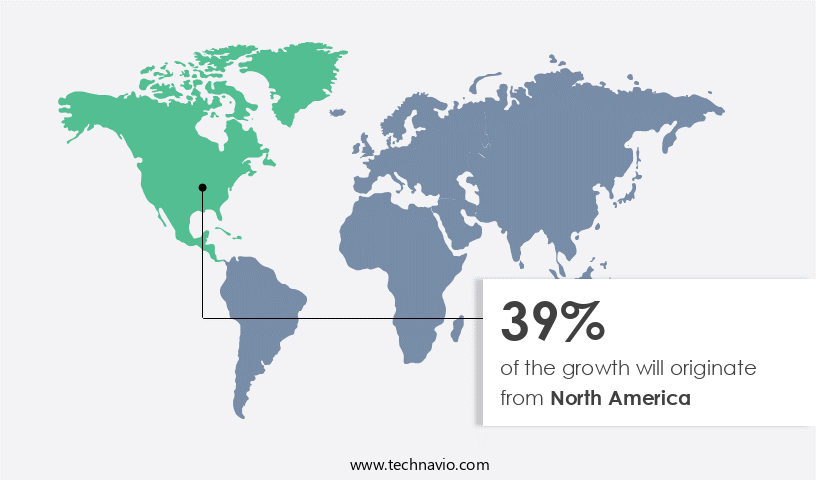
North America is estimated to contribute 39% to the growth of the global market during the forecast period. Technavio's analysts have elaborately explained the regional trends and drivers that shape the market during the forecast period.
Food Intolerance Products Market Share by Geography

For more insights on the market share of various regions Request Free Sample

In 2023, North America held the largest share of The market. This region is projected to experience significant growth during the forecast period due to several factors. The increasing prevalence and incidences of celiac disease are among the primary reasons for this growth. The US, Mexico, and Canada are major contributors to this trend within the region. Celiac disease, which can lead to medical issues like diabetes, Down syndrome, and infertility, has prompted various institutions to raise awareness about this condition. The market in North America is segmented into confectionery products, meat and seafood, sauces, condiments, and dressings.

Gluten-free and lactose-free food products dominate the market due to the high prevalence of food intolerances in the region. Labeling type analysis reveals that certified gluten-free and lactose-free labels are preferred by consumers. As a result, food manufacturers are increasingly focusing on producing food intolerance products with these labels to cater to the growing demand. In conclusion, the North American market is experiencing significant growth due to the increasing incidence of celiac disease and the rising demand for certified gluten-free and lactose-free food products. The market is segmented into various categories, with confectionery products, meat and seafood, sauces, condiments, and dressings being the major segments. The availability of these products in restaurants and cafes is also contributing to the market's growth.

Our researchers analyzed the data with 2023 as the base year, along with the key drivers, trends, and challenges. A holistic analysis of drivers will help companies refine their marketing strategies to gain a competitive advantage.

Market Driver

The increasing geriatric population and chronic diseases is the key driver of the market. The prevalence of chronic diseases, including cancer and type 2 diabetes, continues to rise in the US, with unhealthy dietary habits and sedentary lifestyles being significant contributing factors. According to the World Health Organization (WHO), cancer was responsible for nearly 10 million deaths worldwide in 2020, making it a leading cause of death. Chronic diseases are expected to remain a significant health concern, particularly for the geriatric population. Food intolerance products offer a solution for individuals with chronic diseases or inflammatory conditions, such as celiac disease, non-celiac gluten sensitivity, or lactose intolerance. These conditions can exacerbate symptoms, including bloating, abdominal pain, and diarrhea.

Moreover, autoimmune disorders, including inflammatory diseases, are also on the rise, making the demand for food intolerance products increasingly important. Food intolerances can trigger allergic reactions, leading to inflammation and other health issues. By avoiding the offending allergens, individuals can reduce inflammation and improve their overall health and well-being. The market is expected to grow significantly due to the increasing prevalence of chronic diseases and the need for healthy dietary options. The lactose-free food segment is expected to dominate the market due to the high prevalence of lactose intolerance. Overall, food intolerance products offer a valuable solution for individuals seeking to manage their chronic conditions and maintain a healthy lifestyle.

Market Trends

Technological advancements in food processing is the upcoming trend in the market. The market has been significantly influenced by advancements in food processing technology. These innovations have led to the creation of ready meals and other products tailored to individuals with food intolerances, addressing nutritional deficits and aiding in gut recovery. Sales channels for these products have expanded, with online sales channels gaining popularity.

Further, technological advancements, such as the development of novel extraction methods for plant-based ingredients, have allowed manufacturers to efficiently produce alternatives like oat milk, almond flour, and pea protein, catering to the increasing demand for dairy and gluten substitutes. Food trends, particularly those focused on health and wellness, have further fueled market growth. Manufacturers continue to invest in research and development to meet the evolving needs of consumers with food intolerances.

Market Challenge

The high price of gluten-free food products is a key challenge affecting the market growth. The market in the United States is in its growth phase, albeit smaller than the market for food products containing gluten. The production process of gluten-free food items is intricate, leading to higher manufacturing costs. Primary ingredients such as rice and corn, used instead of wheat in gluten-free food, are pricier than wheat. Other expenses incurred during the manufacturing of gluten-free food include certifications, exclusive transportation to prevent cross-contamination, specialized supply chains, and logistics. Consequently, the cost of producing gluten-free food is greater than that of food containing gluten, which is reflected in the higher selling prices. Food manufacturers in the US are increasingly focusing on catering to the growing consumer base with food intolerances, particularly those suffering from conditions like migraines, sore throats, and irritable bowel syndrome. Moreover, urbanization and changing consumer preferences have fueled the demand for food intolerance products.

Exclusive Customer Landscape

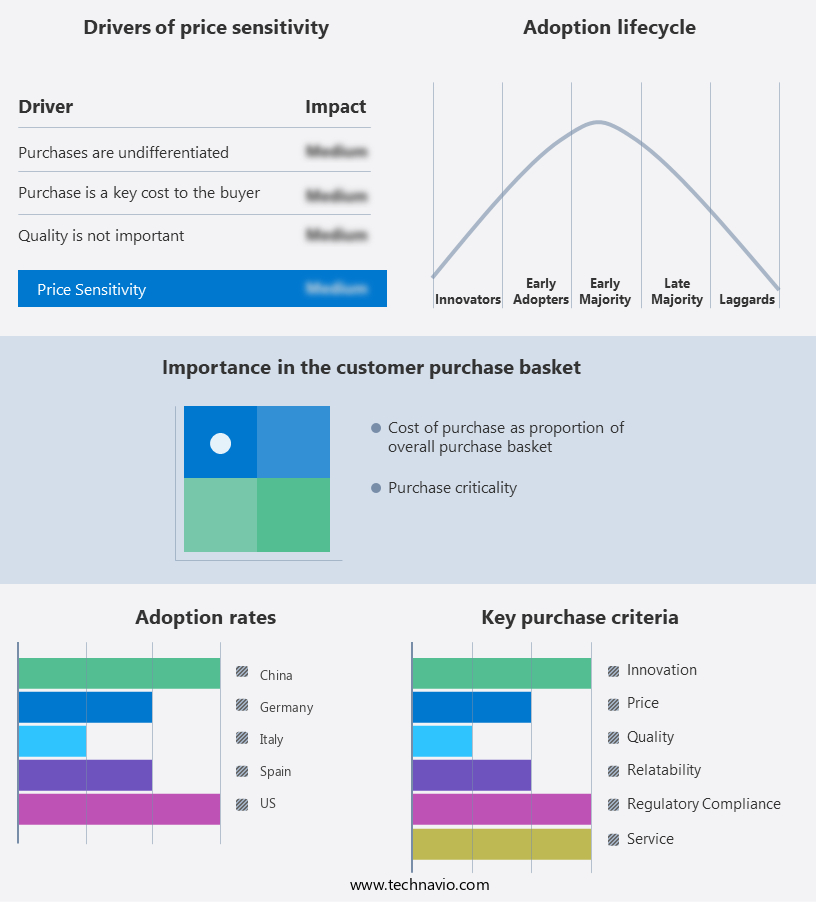
The market forecasting report includes the adoption lifecycle of the market, covering from the innovator's stage to the laggard's stage. It focuses on adoption rates in different regions based on penetration. Furthermore, the report also includes key purchase criteria and drivers of price sensitivity to help companies evaluate and develop their market growth analysis strategies.
Food Intolerance Products Market Share by Geography

 Customer Landscape

Key Companies & Market Insights

Companies are implementing various strategies, such as strategic alliances, partnerships, mergers and acquisitions, geographical expansion, and product/service launches, to enhance their presence in the market.

Campbell Soup Co: The company offers food intolerance products such as Gluten Free Cream of Chicken Soup and Gluten Free Cream of Mushroom Soup.

The market research and growth report includes detailed analyses of the competitive landscape of the market and information about key companies, including:

  • Arla Foods amba
  • Arva Flour Mills
  • Beyond Meat Inc.
  • Bobs Red Mill Natural Foods Inc.
  • Chobani Global Holdings LLC
  • Conagra Brands Inc.
  • Danone SA
  • Dr. Schar AG Spa
  • General Mills Inc.
  • Glanbia plc
  • Gruma SAB de CV
  • Impossible Foods Inc.
  • Kellogg Co.
  • Lantmannen ekonomisk forening
  • McCain Foods Ltd.
  • Mondelez International Inc.
  • Nestle SA
  • Oatside
  • Organic Valley
  • Otsuka Holdings Co. Ltd.
  • Paulig Ltd.
  • Rhythm Superfoods LLC
  • Simple Mills
  • The Kraft Heinz Co.
  • Valio Oy

Qualitative and quantitative analysis of companies has been conducted to help clients understand the wider business environment as well as the strengths and weaknesses of key market players. Data is qualitatively analyzed to categorize companies as pure play, category-focused, industry-focused, and diversified; it is quantitatively analyzed to categorize companies as dominant, leading, strong, tentative, and weak.

Research Analyst Overview

The market is witnessing significant growth due to the rising prevalence of conditions such as lactose intolerance and celiac disease. According to recent studies, an estimated 65% of the global population may have lactose intolerance, while celiac disease affects approximately 1% of the population. Gluten-free (GF) and lactose-free products have gained immense popularity in the clean-label category, with GF foods being the most sought-after. Transparency in labeling is crucial for consumers with food allergies or intolerances. Gluten-free food and lactose-free food segments are witnessing high demand due to the increasing number of diagnoses for celiac disease, gluten intolerance, and non-celiac gluten sensitivity. These conditions can lead to various symptoms such as bloating, migraines, sore throats, and irritable bowel syndrome. Food manufacturers are focusing on producing GF and lactose-free products to cater to this growing demand.

Additionally, the trend towards GF diets is not limited to those with celiac disease but also includes individuals following a vegan diet or those seeking to reduce calorie intake. The market for GF and lactome-free products includes various categories such as confectionery, meat and seafood, sauces, condiments, dressings, and ready meals. Government laws and promotional activities are driving the growth of the market. Packaging solutions and urbanization are also contributing factors. However, cross-contamination and the presence of allergens in these products remain concerns. The market is expected to witness further growth due to the increasing awareness of inflammatory diseases and autoimmune disorders. The market analysis includes a meta-analysis of various studies and sales channels, including online sales channels. Production costs and specialty ingredients are other critical factors influencing the market.

Market Scope

Report Coverage

Details

Page number

182

Base year

2023

Historic period

2018-2022

Forecast period

2024-2028

Growth momentum & CAGR

Accelerate at a CAGR of 5.52%

Market Growth 2024-2028

USD 7.07 billion

Market structure

Fragmented

YoY growth 2023-2024(%)

5.34

Regional analysis

North America, Europe, APAC, South America, and Middle East and Africa

Performing market contribution

North America at 39%

Key countries

US, China, Germany, Italy, and Spain

Competitive landscape

Leading Companies, Market Positioning of Companies, Competitive Strategies, and Industry Risks

Key companies profiled

Arla Foods amba, Arva Flour Mills, Beyond Meat Inc., Bobs Red Mill Natural Foods Inc., Campbell Soup Co., Chobani Global Holdings LLC, Conagra Brands Inc., Danone SA, Dr. Schar AG Spa, General Mills Inc., Glanbia plc, Gruma SAB de CV, Impossible Foods Inc., Kellogg Co., Lantmannen ekonomisk forening, McCain Foods Ltd., Mondelez International Inc., Nestle SA, Oatside, Organic Valley, Otsuka Holdings Co. Ltd., Paulig Ltd., Rhythm Superfoods LLC, Simple Mills, The Kraft Heinz Co., and Valio Oy

Market dynamics

Parent market analysis, market growth inducers and obstacles, market forecast, fast-growing and slow-growing segment analysis, COVID-19 impact and recovery analysis and future consumer dynamics, market condition analysis for the forecast period

Customization purview

If our market report has not included the data that you are looking for, you can reach out to our analysts and get segments customized.

Request Free Sample

What are the Key Data Covered in this Market Research and Growth Report?

  • CAGR of the market during the forecast period
  • Detailed information on factors that will drive the market growth and forecasting between 2024 and 2028
  • Precise estimation of the size of the market  and its contribution of the market in focus to the parent market
  • Accurate predictions about upcoming market growth and trends and changes in consumer behaviour
  • Growth of the market across North America, Europe, APAC, South America, and Middle East and Africa
  • Thorough analysis of the market's competitive landscape and detailed information about companies
  • Comprehensive analysis of factors that will challenge the growth of market companies

We can help! Our analysts can customize this market research report to meet your requirements. Get in touch

1 Executive Summary

  • 1.1 Market overview
    • Exhibit 01: Executive Summary – Chart on Market Overview
    • Exhibit 02: Executive Summary – Data Table on Market Overview
    • Exhibit 03: Executive Summary – Chart on Global Market Characteristics
    • Exhibit 04: Executive Summary – Chart on Market by Geography
    • Exhibit 05: Executive Summary – Chart on Market Segmentation by Distribution Channel
    • Exhibit 06: Executive Summary – Chart on Market Segmentation by Product
    • Exhibit 07: Executive Summary – Chart on Incremental Growth
    • Exhibit 08: Executive Summary – Data Table on Incremental Growth
    • Exhibit 09: Executive Summary – Chart on Vendor Market Positioning

2 Market Landscape

  • 2.1 Market ecosystem
    • Exhibit 10: Parent market
    • Exhibit 11: Market Characteristics

3 Market Sizing

  • 3.1 Market definition
    • Exhibit 12: Offerings of vendors included in the market definition
  • 3.2 Market segment analysis
    • Exhibit 13: Market segments
  • 3.3 Market size 2023
    • 3.4 Market outlook: Forecast for 2023-2028
      • Exhibit 14: Chart on Global - Market size and forecast 2023-2028 ($ billion)
      • Exhibit 15: Data Table on Global - Market size and forecast 2023-2028 ($ billion)
      • Exhibit 16: Chart on Global Market: Year-over-year growth 2023-2028 (%)
      • Exhibit 17: Data Table on Global Market: Year-over-year growth 2023-2028 (%)

    4 Historic Market Size

    • 4.1 Global food intolerance products market 2018 - 2022
      • Exhibit 18: Historic Market Size – Data Table on global food intolerance products market 2018 - 2022 ($ billion)
    • 4.2 Distribution Channel Segment Analysis 2018 - 2022
      • Exhibit 19: Historic Market Size – Distribution Channel Segment 2018 - 2022 ($ billion)
    • 4.3 Product Segment Analysis 2018 - 2022
      • Exhibit 20: Historic Market Size – Product Segment 2018 - 2022 ($ billion)
    • 4.4 Geography Segment Analysis 2018 - 2022
      • Exhibit 21: Historic Market Size – Geography Segment 2018 - 2022 ($ billion)
    • 4.5 Country Segment Analysis 2018 - 2022
      • Exhibit 22: Historic Market Size – Country Segment 2018 - 2022 ($ billion)

    5 Five Forces Analysis

    • 5.1 Five forces summary
      • Exhibit 23: Five forces analysis - Comparison between 2023 and 2028
    • 5.2 Bargaining power of buyers
      • Exhibit 24: Chart on Bargaining power of buyers – Impact of key factors 2023 and 2028
    • 5.3 Bargaining power of suppliers
      • Exhibit 25: Bargaining power of suppliers – Impact of key factors in 2023 and 2028
    • 5.4 Threat of new entrants
      • Exhibit 26: Threat of new entrants – Impact of key factors in 2023 and 2028
    • 5.5 Threat of substitutes
      • Exhibit 27: Threat of substitutes – Impact of key factors in 2023 and 2028
    • 5.6 Threat of rivalry
      • Exhibit 28: Threat of rivalry – Impact of key factors in 2023 and 2028
    • 5.7 Market condition
      • Exhibit 29: Chart on Market condition - Five forces 2023 and 2028

    6 Market Segmentation by Distribution Channel

    • 6.1 Market segments
      • Exhibit 30: Chart on Distribution Channel - Market share 2023-2028 (%)
      • Exhibit 31: Data Table on Distribution Channel - Market share 2023-2028 (%)
    • 6.2 Comparison by Distribution Channel
      • Exhibit 32: Chart on Comparison by Distribution Channel
      • Exhibit 33: Data Table on Comparison by Distribution Channel
    • 6.3 Hypermarkets and supermarkets - Market size and forecast 2023-2028
      • Exhibit 34: Chart on Hypermarkets and supermarkets - Market size and forecast 2023-2028 ($ billion)
      • Exhibit 35: Data Table on Hypermarkets and supermarkets - Market size and forecast 2023-2028 ($ billion)
      • Exhibit 36: Chart on Hypermarkets and supermarkets - Year-over-year growth 2023-2028 (%)
      • Exhibit 37: Data Table on Hypermarkets and supermarkets - Year-over-year growth 2023-2028 (%)
    • 6.4 Convenience stores - Market size and forecast 2023-2028
      • Exhibit 38: Chart on Convenience stores - Market size and forecast 2023-2028 ($ billion)
      • Exhibit 39: Data Table on Convenience stores - Market size and forecast 2023-2028 ($ billion)
      • Exhibit 40: Chart on Convenience stores - Year-over-year growth 2023-2028 (%)
      • Exhibit 41: Data Table on Convenience stores - Year-over-year growth 2023-2028 (%)
    • 6.5 Online channels - Market size and forecast 2023-2028
      • Exhibit 42: Chart on Online channels - Market size and forecast 2023-2028 ($ billion)
      • Exhibit 43: Data Table on Online channels - Market size and forecast 2023-2028 ($ billion)
      • Exhibit 44: Chart on Online channels - Year-over-year growth 2023-2028 (%)
      • Exhibit 45: Data Table on Online channels - Year-over-year growth 2023-2028 (%)
    • 6.6 Market opportunity by Distribution Channel
      • Exhibit 46: Market opportunity by Distribution Channel ($ billion)
      • Exhibit 47: Data Table on Market opportunity by Distribution Channel ($ billion)

    7 Market Segmentation by Product

    • 7.1 Market segments
      • Exhibit 48: Chart on Product - Market share 2023-2028 (%)
      • Exhibit 49: Data Table on Product - Market share 2023-2028 (%)
    • 7.2 Comparison by Product
      • Exhibit 50: Chart on Comparison by Product
      • Exhibit 51: Data Table on Comparison by Product
    • 7.3 Lactose-free food - Market size and forecast 2023-2028
      • Exhibit 52: Chart on Lactose-free food - Market size and forecast 2023-2028 ($ billion)
      • Exhibit 53: Data Table on Lactose-free food - Market size and forecast 2023-2028 ($ billion)
      • Exhibit 54: Chart on Lactose-free food - Year-over-year growth 2023-2028 (%)
      • Exhibit 55: Data Table on Lactose-free food - Year-over-year growth 2023-2028 (%)
    • 7.4 Gluten-free food - Market size and forecast 2023-2028
      • Exhibit 56: Chart on Gluten-free food - Market size and forecast 2023-2028 ($ billion)
      • Exhibit 57: Data Table on Gluten-free food - Market size and forecast 2023-2028 ($ billion)
      • Exhibit 58: Chart on Gluten-free food - Year-over-year growth 2023-2028 (%)
      • Exhibit 59: Data Table on Gluten-free food - Year-over-year growth 2023-2028 (%)
    • 7.5 Diabetic food - Market size and forecast 2023-2028
      • Exhibit 60: Chart on Diabetic food - Market size and forecast 2023-2028 ($ billion)
      • Exhibit 61: Data Table on Diabetic food - Market size and forecast 2023-2028 ($ billion)
      • Exhibit 62: Chart on Diabetic food - Year-over-year growth 2023-2028 (%)
      • Exhibit 63: Data Table on Diabetic food - Year-over-year growth 2023-2028 (%)
    • 7.6 Others - Market size and forecast 2023-2028
      • Exhibit 64: Chart on Others - Market size and forecast 2023-2028 ($ billion)
      • Exhibit 65: Data Table on Others - Market size and forecast 2023-2028 ($ billion)
      • Exhibit 66: Chart on Others - Year-over-year growth 2023-2028 (%)
      • Exhibit 67: Data Table on Others - Year-over-year growth 2023-2028 (%)
    • 7.7 Market opportunity by Product
      • Exhibit 68: Market opportunity by Product ($ billion)
      • Exhibit 69: Data Table on Market opportunity by Product ($ billion)

    8 Customer Landscape

    • 8.1 Customer landscape overview
      • Exhibit 70: Analysis of price sensitivity, lifecycle, customer purchase basket, adoption rates, and purchase criteria

    9 Geographic Landscape

    • 9.1 Geographic segmentation
      • Exhibit 71: Chart on Market share by geography 2023-2028 (%)
      • Exhibit 72: Data Table on Market share by geography 2023-2028 (%)
    • 9.2 Geographic comparison
      • Exhibit 73: Chart on Geographic comparison
      • Exhibit 74: Data Table on Geographic comparison
    • 9.3 North America - Market size and forecast 2023-2028
      • Exhibit 75: Chart on North America - Market size and forecast 2023-2028 ($ billion)
      • Exhibit 76: Data Table on North America - Market size and forecast 2023-2028 ($ billion)
      • Exhibit 77: Chart on North America - Year-over-year growth 2023-2028 (%)
      • Exhibit 78: Data Table on North America - Year-over-year growth 2023-2028 (%)
    • 9.4 Europe - Market size and forecast 2023-2028
      • Exhibit 79: Chart on Europe - Market size and forecast 2023-2028 ($ billion)
      • Exhibit 80: Data Table on Europe - Market size and forecast 2023-2028 ($ billion)
      • Exhibit 81: Chart on Europe - Year-over-year growth 2023-2028 (%)
      • Exhibit 82: Data Table on Europe - Year-over-year growth 2023-2028 (%)
    • 9.5 APAC - Market size and forecast 2023-2028
      • Exhibit 83: Chart on APAC - Market size and forecast 2023-2028 ($ billion)
      • Exhibit 84: Data Table on APAC - Market size and forecast 2023-2028 ($ billion)
      • Exhibit 85: Chart on APAC - Year-over-year growth 2023-2028 (%)
      • Exhibit 86: Data Table on APAC - Year-over-year growth 2023-2028 (%)
    • 9.6 South America - Market size and forecast 2023-2028
      • Exhibit 87: Chart on South America - Market size and forecast 2023-2028 ($ billion)
      • Exhibit 88: Data Table on South America - Market size and forecast 2023-2028 ($ billion)
      • Exhibit 89: Chart on South America - Year-over-year growth 2023-2028 (%)
      • Exhibit 90: Data Table on South America - Year-over-year growth 2023-2028 (%)
    • 9.7 Middle East and Africa - Market size and forecast 2023-2028
      • Exhibit 91: Chart on Middle East and Africa - Market size and forecast 2023-2028 ($ billion)
      • Exhibit 92: Data Table on Middle East and Africa - Market size and forecast 2023-2028 ($ billion)
      • Exhibit 93: Chart on Middle East and Africa - Year-over-year growth 2023-2028 (%)
      • Exhibit 94: Data Table on Middle East and Africa - Year-over-year growth 2023-2028 (%)
    • 9.8 US - Market size and forecast 2023-2028
      • Exhibit 95: Chart on US - Market size and forecast 2023-2028 ($ billion)
      • Exhibit 96: Data Table on US - Market size and forecast 2023-2028 ($ billion)
      • Exhibit 97: Chart on US - Year-over-year growth 2023-2028 (%)
      • Exhibit 98: Data Table on US - Year-over-year growth 2023-2028 (%)
    • 9.9 Germany - Market size and forecast 2023-2028
      • Exhibit 99: Chart on Germany - Market size and forecast 2023-2028 ($ billion)
      • Exhibit 100: Data Table on Germany - Market size and forecast 2023-2028 ($ billion)
      • Exhibit 101: Chart on Germany - Year-over-year growth 2023-2028 (%)
      • Exhibit 102: Data Table on Germany - Year-over-year growth 2023-2028 (%)
    • 9.10 Italy - Market size and forecast 2023-2028
      • Exhibit 103: Chart on Italy - Market size and forecast 2023-2028 ($ billion)
      • Exhibit 104: Data Table on Italy - Market size and forecast 2023-2028 ($ billion)
      • Exhibit 105: Chart on Italy - Year-over-year growth 2023-2028 (%)
      • Exhibit 106: Data Table on Italy - Year-over-year growth 2023-2028 (%)
    • 9.11 China - Market size and forecast 2023-2028
      • Exhibit 107: Chart on China - Market size and forecast 2023-2028 ($ billion)
      • Exhibit 108: Data Table on China - Market size and forecast 2023-2028 ($ billion)
      • Exhibit 109: Chart on China - Year-over-year growth 2023-2028 (%)
      • Exhibit 110: Data Table on China - Year-over-year growth 2023-2028 (%)
    • 9.12 Spain - Market size and forecast 2023-2028
      • Exhibit 111: Chart on Spain - Market size and forecast 2023-2028 ($ billion)
      • Exhibit 112: Data Table on Spain - Market size and forecast 2023-2028 ($ billion)
      • Exhibit 113: Chart on Spain - Year-over-year growth 2023-2028 (%)
      • Exhibit 114: Data Table on Spain - Year-over-year growth 2023-2028 (%)
    • 9.13 Market opportunity by geography
      • Exhibit 115: Market opportunity by geography ($ billion)
      • Exhibit 116: Data Tables on Market opportunity by geography ($ billion)

    10 Drivers, Challenges, and Trends

    • 10.1 Market drivers
      • 10.2 Market challenges
        • 10.3 Impact of drivers and challenges
          • Exhibit 117: Impact of drivers and challenges in 2023 and 2028
        • 10.4 Market trends

          11 Vendor Landscape

          • 11.1 Overview
            • 11.2 Vendor landscape
              • Exhibit 118: Overview on Criticality of inputs and Factors of differentiation
            • 11.3 Landscape disruption
              • Exhibit 119: Overview on factors of disruption
            • 11.4 Industry risks
              • Exhibit 120: Impact of key risks on business

            12 Vendor Analysis

            • 12.1 Vendors covered
              • Exhibit 121: Vendors covered
            • 12.2 Market positioning of vendors
              • Exhibit 122: Matrix on vendor position and classification
            • 12.3 Arla Foods amba
              • Exhibit 123: Arla Foods amba - Overview
              • Exhibit 124: Arla Foods amba - Business segments
              • Exhibit 125: Arla Foods amba - Key offerings
              • Exhibit 126: Arla Foods amba - Segment focus
            • 12.4 Campbell Soup Co.
              • Exhibit 127: Campbell Soup Co. - Overview
              • Exhibit 128: Campbell Soup Co. - Business segments
              • Exhibit 129: Campbell Soup Co. - Key offerings
              • Exhibit 130: Campbell Soup Co. - Segment focus
            • 12.5 Conagra Brands Inc.
              • Exhibit 131: Conagra Brands Inc. - Overview
              • Exhibit 132: Conagra Brands Inc. - Business segments
              • Exhibit 133: Conagra Brands Inc. - Key news
              • Exhibit 134: Conagra Brands Inc. - Key offerings
              • Exhibit 135: Conagra Brands Inc. - Segment focus
            • 12.6 Danone SA
              • Exhibit 136: Danone SA - Overview
              • Exhibit 137: Danone SA - Business segments
              • Exhibit 138: Danone SA - Key news
              • Exhibit 139: Danone SA - Key offerings
              • Exhibit 140: Danone SA - Segment focus
            • 12.7 Dr. Schar AG Spa
              • Exhibit 141: Dr. Schar AG Spa - Overview
              • Exhibit 142: Dr. Schar AG Spa - Product / Service
              • Exhibit 143: Dr. Schar AG Spa - Key news
              • Exhibit 144: Dr. Schar AG Spa - Key offerings
            • 12.8 General Mills Inc.
              • Exhibit 145: General Mills Inc. - Overview
              • Exhibit 146: General Mills Inc. - Business segments
              • Exhibit 147: General Mills Inc. - Key news
              • Exhibit 148: General Mills Inc. - Key offerings
              • Exhibit 149: General Mills Inc. - Segment focus
            • 12.9 Glanbia plc
              • Exhibit 150: Glanbia plc - Overview
              • Exhibit 151: Glanbia plc - Business segments
              • Exhibit 152: Glanbia plc - Key news
              • Exhibit 153: Glanbia plc - Key offerings
              • Exhibit 154: Glanbia plc - Segment focus
            • 12.10 Gruma SAB de CV
              • Exhibit 155: Gruma SAB de CV - Overview
              • Exhibit 156: Gruma SAB de CV - Business segments
              • Exhibit 157: Gruma SAB de CV - Key offerings
              • Exhibit 158: Gruma SAB de CV - Segment focus
            • 12.11 Kellogg Co.
              • Exhibit 159: Kellogg Co. - Overview
              • Exhibit 160: Kellogg Co. - Business segments
              • Exhibit 161: Kellogg Co. - Key offerings
              • Exhibit 162: Kellogg Co. - Segment focus
            • 12.12 Mondelez International Inc.
              • Exhibit 163: Mondelez International Inc. - Overview
              • Exhibit 164: Mondelez International Inc. - Business segments
              • Exhibit 165: Mondelez International Inc. - Key news
              • Exhibit 166: Mondelez International Inc. - Key offerings
              • Exhibit 167: Mondelez International Inc. - Segment focus
            • 12.13 Nestle SA
              • Exhibit 168: Nestle SA - Overview
              • Exhibit 169: Nestle SA - Business segments
              • Exhibit 170: Nestle SA - Key news
              • Exhibit 171: Nestle SA - Key offerings
              • Exhibit 172: Nestle SA - Segment focus
            • 12.14 Otsuka Holdings Co. Ltd.
              • Exhibit 173: Otsuka Holdings Co. Ltd. - Overview
              • Exhibit 174: Otsuka Holdings Co. Ltd. - Business segments
              • Exhibit 175: Otsuka Holdings Co. Ltd. - Key offerings
              • Exhibit 176: Otsuka Holdings Co. Ltd. - Segment focus
            • 12.15 Paulig Ltd.
              • Exhibit 177: Paulig Ltd. - Overview
              • Exhibit 178: Paulig Ltd. - Product / Service
              • Exhibit 179: Paulig Ltd. - Key offerings
            • 12.16 The Kraft Heinz Co.
              • Exhibit 180: The Kraft Heinz Co. - Overview
              • Exhibit 181: The Kraft Heinz Co. - Business segments
              • Exhibit 182: The Kraft Heinz Co. - Key offerings
              • Exhibit 183: The Kraft Heinz Co. - Segment focus
            • 12.17 Valio Oy
              • Exhibit 184: Valio Oy - Overview
              • Exhibit 185: Valio Oy - Product / Service
              • Exhibit 186: Valio Oy - Key offerings

            13 Appendix

            • 13.1 Scope of the report
              • 13.2 Inclusions and exclusions checklist
                • Exhibit 187: Inclusions checklist
                • Exhibit 188: Exclusions checklist
              • 13.3 Currency conversion rates for US$
                • Exhibit 189: Currency conversion rates for US$
              • 13.4 Research methodology
                • Exhibit 190: Research methodology
                • Exhibit 191: Validation techniques employed for market sizing
                • Exhibit 192: Information sources
              • 13.5 List of abbreviations
                • Exhibit 193: List of abbreviations

              Research Methodology

              Technavio presents a detailed picture of the market by way of study, synthesis, and summation of data from multiple sources. The analysts have presented the various facets of the market with a particular focus on identifying the key industry influencers. The data thus presented is comprehensive, reliable, and the result of extensive research, both primary and secondary.

              INFORMATION SOURCES

              Primary sources

              • Manufacturers and suppliers
              • Channel partners
              • Industry experts
              • Strategic decision makers

              Secondary sources

              • Industry journals and periodicals
              • Government data
              • Financial reports of key industry players
              • Historical data
              • Press releases

              DATA ANALYSIS

              Data Synthesis

              • Collation of data
              • Estimation of key figures
              • Analysis of derived insights

              Data Validation

              • Triangulation with data models
              • Reference against proprietary databases
              • Corroboration with industry experts

              REPORT WRITING

              Qualitative

              • Market drivers
              • Market challenges
              • Market trends
              • Five forces analysis

              Quantitative

              • Market size and forecast
              • Market segmentation
              • Geographical insights
              • Competitive landscape

              Interested in this report?

              Get your sample now to see our research methodology and insights!

              Download Now

              Frequently Asked Questions

              Food Intolerance Products market growth will increase by $ 7.07 bn during 2024-2028 .

              The Food Intolerance Products market is expected to grow at a CAGR of 5.52% during 2024-2028 .

              Food Intolerance Products market is segmented by Distribution Channel( Hypermarkets and supermarkets, Convenience stores, Online channels) Product( Lactose-free food, Gluten-free food, Diabetic food, Others)

              Arla Foods amba, Arva Flour Mills, Beyond Meat Inc., Bobs Red Mill Natural Foods Inc., Campbell Soup Co., Chobani Global Holdings LLC, Conagra Brands Inc., Danone SA, Dr. Schar AG Spa, General Mills Inc., Glanbia plc, Gruma SAB de CV, Impossible Foods Inc., Kellogg Co., Lantmannen ekonomisk forening, McCain Foods Ltd., Mondelez International Inc., Nestle SA, Oatside, Organic Valley, Otsuka Holdings Co. Ltd., Paulig Ltd., Rhythm Superfoods LLC, Simple Mills, The Kraft Heinz Co., Valio Oy are a few of the key vendors in the Food Intolerance Products market.

              North America will register the highest growth rate of 39% among the other regions. Therefore, the Food Intolerance Products market in North America is expected to garner significant business opportunities for the vendors during the forecast period.

              US, China, Germany, Italy, Spain

              • Increasing geriatric population and chronic diseasesThe increasing geriatric population and prevalence of infectious and chronic diseases like cancer and diabetes in all cohorts require patients to have healthy diets. According to the World Health Organization (WHO) is the driving factor this market.
              • as of 2020 is the driving factor this market.
              • cancer is a leading cause of death worldwide is the driving factor this market.
              • accounting for nearly 10 million deaths is the driving factor this market.
              • or nearly one in six deaths. The trend of chronic diseases is likely to continue is the driving factor this market.
              • with unhealthy dietary habits is the driving factor this market.
              • a sedentary lifestyle is the driving factor this market.
              • and obesity being some of the prime factors contributing to the prevalence of these diseases. The rising incidence rates of diseases such as diabetes and cancer will create an opportunity for food intolerance products is the driving factor this market.
              • as food intolerance products can be beneficial for the geriatric population and individuals with chronic diseases in several ways: Reducing Symptoms: Certain chronic diseases and conditions is the driving factor this market.
              • such as irritable bowel syndrome (IBS) or inflammatory bowel disease (IBD) is the driving factor this market.
              • can be exacerbated by certain food intolerances. Food intolerance products that eliminate or reduce the problematic ingredients can help alleviate symptoms and improve overall well-being. Nutritional Support: As individuals age or cope with chronic diseases is the driving factor this market.
              • their nutritional needs may change. Some may require more easily digestible or nutrient-dense options. Food intolerance products designed with these needs in mind can offer a convenient way to obtain essential nutrients without the risk of discomfort or adverse reactions. Maintaining Quality of Life: Food intolerance can sometimes lead to social isolation is the driving factor this market.
              • particularly during shared meals or social gatherings. Having access to a variety of food intolerance products can help individuals feel included and enjoy a wider range of dining experiences is the driving factor this market.
              • thus enhancing their quality of life. Preventing Cross-Contamination: For individuals with severe food allergies as well as intolerances is the driving factor this market.
              • dedicated food intolerance products can help prevent cross-contamination and accidental ingestion of problematic substances is the driving factor this market.
              • reducing the risk of adverse reactions. Thus is the driving factor this market.
              • the above-mentioned factors are expected to increase the demand for food intolerance products is the driving factor this market.
              • which will propel the growth of the global food intolerance products market during the forecast period. is the driving factor this market.

              The Food Intolerance Products market vendors should focus on grabbing business opportunities from the Hypermarkets and supermarkets segment as it accounted for the largest market share in the base year.
