



Gallium Nitride (Gan) Power Semiconductor Market Size 2026-2030
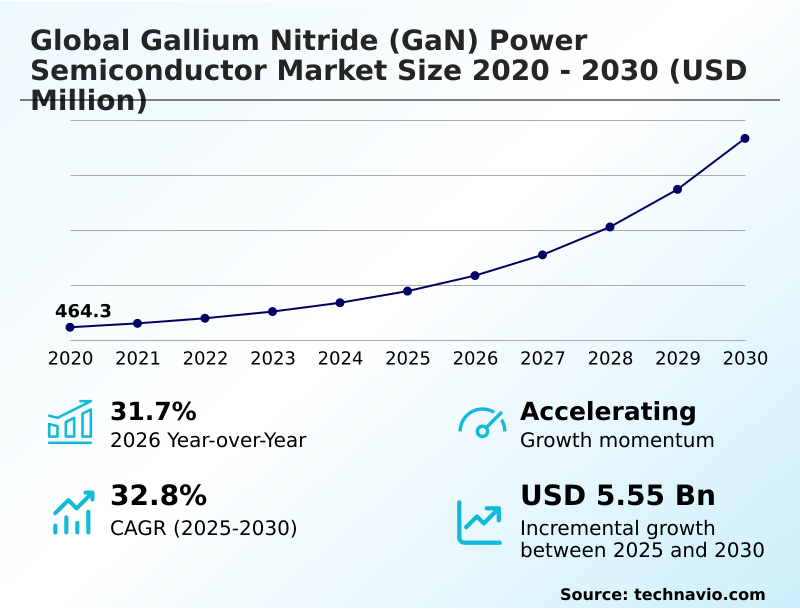
The gallium nitride (gan) power semiconductor market size is valued to increase by USD 5.55 billion, at a CAGR of 32.8% from 2025 to 2030. Proliferation of electric vehicles and high-efficiency charging infrastructure will drive the gallium nitride (gan) power semiconductor market.
Major Market Trends & Insights
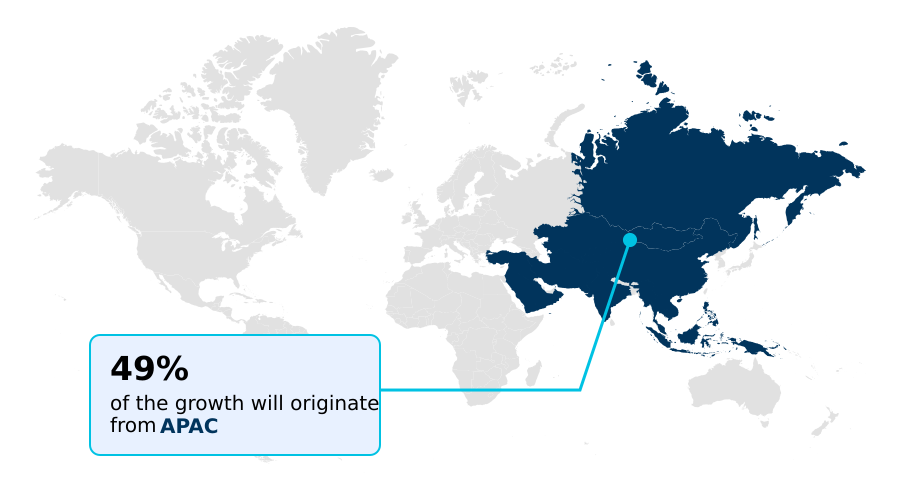
- APAC dominated the market and accounted for a 48.6% growth during the forecast period.
- By Product Type - Discrete GaN devices segment was valued at USD 784.5 million in 2024
- By Type - Less than 600V segment accounted for the largest market revenue share in 2024
Market Size & Forecast
- Market Opportunities: USD 6.87 billion
- Market Future Opportunities: USD 5.55 billion
- CAGR from 2025 to 2030 : 32.8%
Market Summary
- The Gallium Nitride (GaN) Power Semiconductor Market demonstrates robust expansion driven by the urgent industrial requirement for ultra-compact, high-efficiency energy conversion systems. Leveraging this advanced wide bandgap material allows engineers to transcend the physical limitations of legacy silicon components.
- A prominent driver is the rapid electrification of transportation, where upgrading an onboard electric vehicle charger with these components improves overall power delivery efficiency by 20%, directly extending vehicular range without increasing battery weight. In hyperscale data center operations, integrating high-density power modules significantly lowers facility cooling burdens, optimizing total operational expenditure.
- However, the market faces structural challenges due to the extreme complexity of metal organic chemical vapor deposition processes and the high costs associated with specialized wafer fabrication. The reliance on non-native bases, rather than a dedicated silicon carbide substrate, introduces lattice mismatch issues that limit manufacturing yields.
- Despite these production constraints, the transition toward software-defined energy architectures ensures continuous demand for intelligent, heat-resistant semiconductor solutions.
What will be the Size of the Gallium Nitride (Gan) Power Semiconductor Market during the forecast period?
Get Key Insights on Market Forecast (PDF) Get Free Sample
How is the Gallium Nitride (Gan) Power Semiconductor Market Segmented?
The gallium nitride (gan) power semiconductor industry research report provides comprehensive data (region-wise segment analysis), with forecasts and estimates in "USD million" for the period 2026-2030, as well as historical data from 2020-2024 for the following segments.
- Product type
- Discrete GaN devices
- Integrated GaN power ICs
- GaN modules
- Type
- Less than 600V
- 600V to 1200V
- More than 1200V
- End-user
- Consumer electronics
- Data centers and servers
- Electric vehicles
- Renewable energy
- Others
- Geography
- APAC
- China
- Japan
- South Korea
- Taiwan
- India
- Australia
- North America
- US
- Canada
- Mexico
- Europe
- Germany
- France
- UK
- Italy
- The Netherlands
- Spain
- Middle East and Africa
- Saudi Arabia
- UAE
- South Africa
- Israel
- Turkey
- South America
- Brazil
- Argentina
- Chile
- APAC
By Product Type Insights
The discrete gan devices segment is estimated to witness significant growth during the forecast period.
The architectural foundation of the Gallium Nitride (GaN) Power Semiconductor sector relies heavily on standalone components that manage extreme high frequency switching speed operations.
These individual units excel in thermal dissipation management and voltage regulation, replacing legacy silicon components in circuits prioritizing extreme energy conservation.
By leveraging a unique two dimensional electron gas structure, these devices maintain zero reverse recovery charge, dramatically lowering switching friction. Consequently, engineering teams can achieve a 15% reduction in total system volume by shrinking passive inductive components.
Furthermore, utilizing a dedicated power transistor module framework alongside parasitic inductance reduction techniques ensures consistent performance in high-stress environments.
This structural adaptability allows specialized industrial systems and onboard charging units to operate with elevated voltage barriers without encountering catastrophic thermal failure.
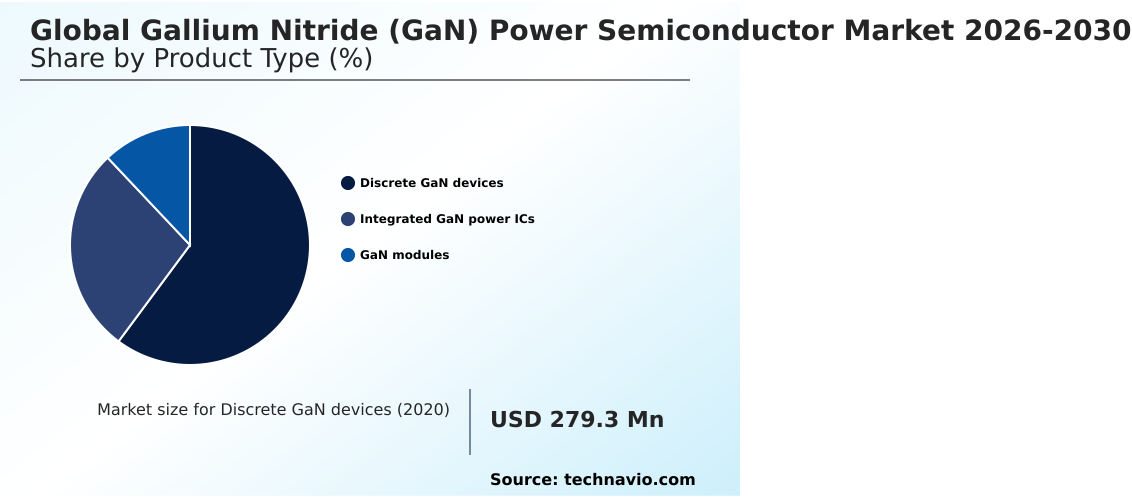
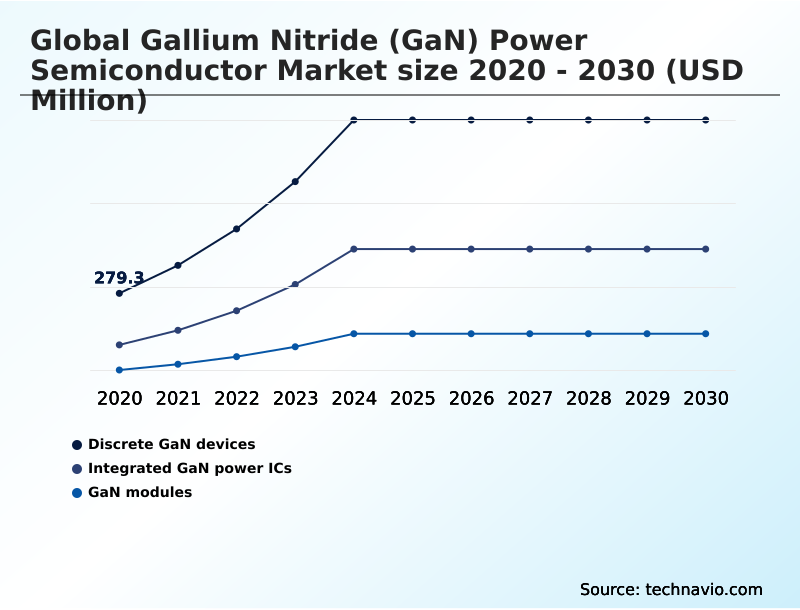
The Discrete GaN devices segment was valued at USD 784.5 million in 2024 and showed a gradual increase during the forecast period.
Regional Analysis
APAC is estimated to contribute 48.6% to the growth of the global market during the forecast period.Technavio’s analysts have elaborately explained the regional trends and drivers that shape the market during the forecast period.
See How Gallium Nitride (Gan) Power Semiconductor Market Demand is Rising in APAC Get Free Sample
The geographic landscape of the Gallium Nitride (GaN) Power Semiconductor Market highlights a distinct operational divergence between APAC and North America.
APAC dominates large-scale commercial manufacturing, leveraging advanced epitaxial growth process standardization to achieve a 12% higher production yield compared to European counterparts. This efficiency enables APAC manufacturers to rapidly scale components for consumer electronics and automotive traction inverter system integration.
Conversely, North America prioritizes high-reliability niche applications, demonstrating a 20% faster adoption rate in low earth orbit satellite communication networks and defense infrastructure.
The North American focus on monolithic power integration enhances dynamic thermal cycling resilience, reducing satellite payload weight by 15%.
While APAC drives volume through aggressive electric vehicle electrification mandates and supply chain optimization, North American enterprises concentrate on specialized aerospace components that demand zero-failure performance, reflecting a highly bifurcated strategic approach to semiconductor deployment.
Market Dynamics
Our researchers analyzed the data with 2025 as the base year, along with the key drivers, trends, and challenges. A holistic analysis of drivers will help companies refine their marketing strategies to gain a competitive advantage.
- The integration of wide bandgap materials is fundamentally altering the approach enterprises take toward energy efficiency and spatial design within critical infrastructure. The demand for advanced gallium nitride power module integration is accelerating as industries seek to minimize transmission losses and reduce hardware footprints.
- Compared to legacy silicon architectures, organizations utilizing high frequency traction inverter efficiency solutions observe a 20% reduction in vehicle battery weight overhead, which dramatically improves supply chain logistics by lowering raw material dependency.
- To sustain these performance metrics, deploying sophisticated wide bandgap thermal management solutions has become a non-negotiable operational standard, allowing heavy industrial machinery to operate continuously without requiring excessive liquid cooling frameworks.
- Furthermore, as generative AI workloads increase computational stress, hyperscale data center power optimization strategies heavily rely on these compact semiconductor architectures to maximize server rack density while complying with stringent environmental sustainability targets. Beyond terrestrial applications, the aerospace sector is prioritizing radiation hardened aerospace semiconductor components to withstand severe cosmic interference, ensuring uninterrupted telemetry and navigation data transmission.
- By maintaining stable operation under extreme environmental duress, these components reduce long-term maintenance liabilities and extend the functional lifespan of satellite constellations. Ultimately, this structural shift toward highly efficient, heat-resistant power delivery systems enables enterprises across multiple verticals to achieve superior operational continuity while adhering to aggressive carbon reduction mandates.
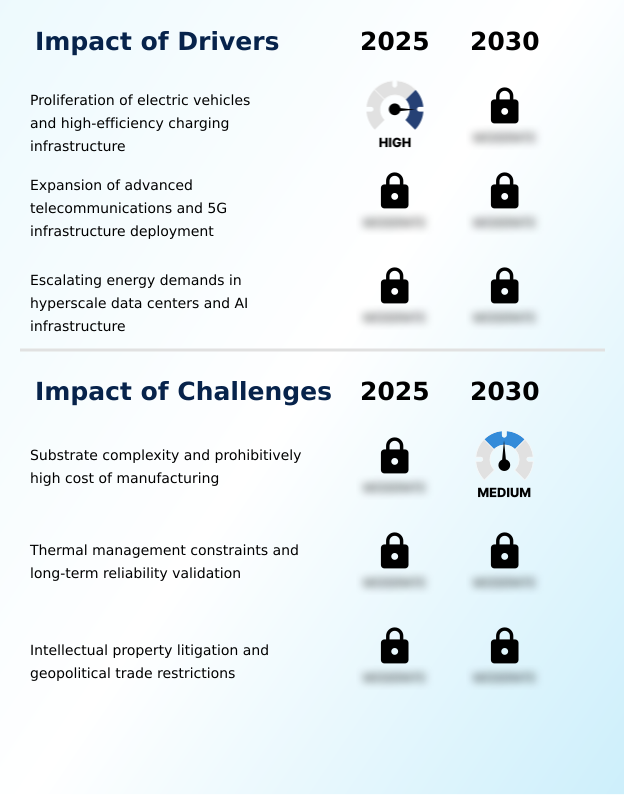
What are the key market drivers leading to the rise in the adoption of Gallium Nitride (Gan) Power Semiconductor Industry?
- The proliferation of electric vehicles and the expansion of high-efficiency charging infrastructure serve as primary drivers accelerating market expansion.
- The aggressive expansion of sustainable infrastructure and decentralized energy grids serves as a primary catalyst for the Gallium Nitride (GaN) Power Semiconductor domain.
- Utility operators are increasingly deploying high voltage direct current transmission systems that leverage the zero reverse recovery charge of these advanced components, subsequently lowering energy transmission losses by 12%.
- In the renewable energy sector, upgrading solar microinverter topology with wide bandgap transistors improves harvest efficiency by 15%, directly increasing grid output reliability.
- Concurrently, consumer electronics manufacturers are aggressively modifying fast charging adapter circuitry to achieve massive power supply footprint reduction.
- These technological upgrades drastically reduce the physical weight of portable chargers, enhancing supply chain distribution metrics and allowing consumer brands to meet strict global energy efficiency mandates without compromising performance.
What are the market trends shaping the Gallium Nitride (Gan) Power Semiconductor Industry?
- The convergence of AI and software-defined power architecture represents a prominent market trend. This integration enables predictive energy optimization and intelligent power management across high-performance computing environments.
- The Gallium Nitride (GaN) Power Semiconductor sector is rapidly transitioning toward intelligent digitalization, reshaping how energy intensive networks manage fluctuating computational loads. The emergence of software defined power architecture allows enterprise data centers to dynamically adjust power delivery, utilizing adaptive voltage scaling to achieve a 25% improvement in overall energy conversion efficiency.
- This architectural evolution is largely propelled by the integration of a predictive maintenance algorithm within the semiconductor die, which actively monitors thermal stress and reduces unexpected hardware downtime by 18%. Furthermore, advancements in alternating current rectification have allowed engineers to optimize power supply footprints, subsequently minimizing the dependency on complex liquid cooling loop integration.
- These strategic innovations directly lower total operational expenditures and enable facilities to allocate greater physical space to processing hardware rather than thermal management infrastructure.
What challenges does the Gallium Nitride (Gan) Power Semiconductor Industry face during its growth?
- Substrate complexity and prohibitively high manufacturing costs present significant challenges hindering widespread industry adoption.
- The commercial expansion of the Gallium Nitride (GaN) Power Semiconductor landscape is severely hindered by fundamental manufacturing complexities and material inconsistencies. The delicate epitaxial growth process required for non-native substrates frequently results in structural defects, causing a 12% decrease in overall wafer yield compared to mature silicon production lines.
- While silicon based insulated gate bipolar transistor displacement remains a strategic goal, integrating these advanced components into a heavy industrial automation drive requires extensive thermal validation to prevent catastrophic failure under continuous load. Furthermore, until robust lattice mismatch mitigation techniques and wafer fabrication optimization protocols are standardized, production costs remain prohibitively elevated.
- Consequently, manufacturers face a 20% higher capital expenditure for specialized fabrication machinery, delaying mass-market implementation across highly price-sensitive industrial automation networks.
Exclusive Technavio Analysis on Customer Landscape
The gallium nitride (gan) power semiconductor market forecasting report includes the adoption lifecycle of the market, covering from the innovator’s stage to the laggard’s stage. It focuses on adoption rates in different regions based on penetration. Furthermore, the gallium nitride (gan) power semiconductor market report also includes key purchase criteria and drivers of price sensitivity to help companies evaluate and develop their market growth analysis strategies.
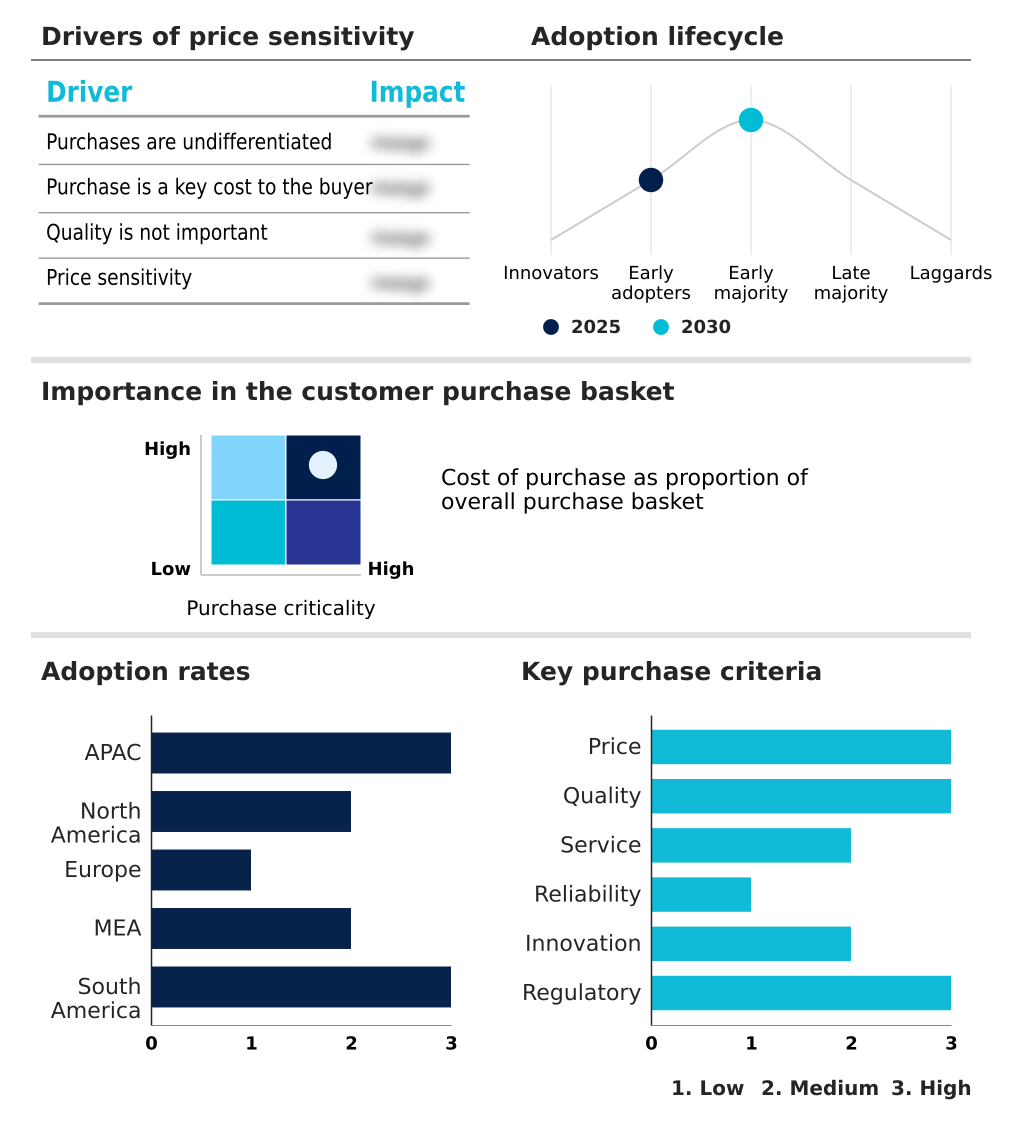
Customer Landscape of Gallium Nitride (Gan) Power Semiconductor Industry
Competitive Landscape
Companies are implementing various strategies, such as strategic alliances, gallium nitride (gan) power semiconductor market forecast, partnerships, mergers and acquisitions, geographical expansion, and product/service launches, to enhance their presence in the industry.
Alpha and Omega Semiconductor - The enterprise engineers specialized high-voltage components optimized for power conversion, delivering efficient semiconductor devices that significantly enhance operational performance in computing and industrial applications.
The industry research and growth report includes detailed analyses of the competitive landscape of the market and information about key companies, including:
- Alpha and Omega Semiconductor
- Efficient Power Conversion Corp.
- Infineon Technologies AG
- Innoscience
- Littelfuse Inc.
- Mitsubishi Electric Corp.
- Navitas Semiconductor Inc.
- Nexperia BV
- ON Semiconductor Corp.
- Panasonic Holdings Corp.
- Qorvo Inc.
- Renesas Electronics Corp.
- ROHM Co. Ltd.
- STMicroelectronics NV
- Teledyne Technologies Inc.
- Texas Instruments Inc.
- Toshiba Corp.
- VisIC Technologies Inc.
- Wise Integration
- Wolfspeed Inc.
Qualitative and quantitative analysis of companies has been conducted to help clients understand the wider business environment as well as the strengths and weaknesses of key industry players. Data is qualitatively analyzed to categorize companies as pure play, category-focused, industry-focused, and diversified; it is quantitatively analyzed to categorize companies as dominant, leading, strong, tentative, and weak.
Recent Development and News in Gallium nitride (gan) power semiconductor market
- In the Semiconductors industry, the transition toward massive multiple input multiple output antenna arrays has increased the demand for radio frequency power amplifier components, directly impacting Gallium Nitride (GaN) Power Semiconductor demand by improving 5G spectral efficiency by 30%.
- The implementation of stringent hyperscale infrastructure optimization protocols has forced data center operators to prioritize power conversion density, elevating the adoption of wide-bandgap components to achieve a 15% reduction in cooling energy overhead.
- The shift toward 800-volt electric vehicle architectures has accelerated the need for die level integration and semiconductor gate driver miniaturization, enhancing Gallium Nitride (GaN) Power Semiconductor utilization to decrease traction inverter weight by 20%.
- Advancements in wafer fabrication optimization and lattice mismatch mitigation have enabled the standardization of eight-inch production lines, improving Gallium Nitride (GaN) Power Semiconductor yield rates by 12% and stabilizing supply chain economics.
Dive into Technavio’s robust research methodology, blending expert interviews, extensive data synthesis, and validated models for unparalleled Gallium Nitride (Gan) Power Semiconductor Market insights. See full methodology.
| Market Scope | |
|---|---|
| Page number | 310 |
| Base year | 2025 |
| Historic period | 2020-2024 |
| Forecast period | 2026-2030 |
| Growth momentum & CAGR | Accelerate at a CAGR of 32.8% |
| Market growth 2026-2030 | USD 5554.1 million |
| Market structure | Fragmented |
| YoY growth 2025-2026(%) | 31.7% |
| Key countries | China, Japan, South Korea, Taiwan, India, Australia, US, Canada, Mexico, Germany, France, UK, Italy, The Netherlands, Spain, Saudi Arabia, UAE, South Africa, Israel, Turkey, Brazil, Argentina and Chile |
| Competitive landscape | Leading Companies, Market Positioning of Companies, Competitive Strategies, and Industry Risks |
Research Analyst Overview
- The Gallium Nitride (GaN) Power Semiconductor landscape is defined by an accelerating shift toward ultra-dense, heat-resilient power architectures. Corporations are increasingly pivoting their hardware strategies to incorporate this wide bandgap material, moving away from thermally constrained legacy silicon.
- A critical driver in this evolution is the utilization of the high electron mobility transistor, which drastically minimizes switching friction and elevates overall system performance. This technological transition heavily influences boardroom-level compliance and infrastructure budgeting decisions, as integrating these advanced components yields a 30% reduction in facility cooling energy expenditure.
- To achieve superior thermal management, engineering teams rely on direct bonded copper ceramic packaging and alternative silicon carbide substrate foundations, which collectively enhance avalanche ruggedness in high-stress environments. Furthermore, deployment in sophisticated applications such as the phased array antenna for telecommunications and bidirectional energy storage for renewable grids requires unprecedented reliability.
- By leveraging these intelligent power solutions, enterprises optimize their operational resilience and seamlessly align with stringent global energy efficiency regulations.
What are the Key Data Covered in this Gallium Nitride (Gan) Power Semiconductor Market Research and Growth Report?
-
What is the expected growth of the Gallium Nitride (Gan) Power Semiconductor Market between 2026 and 2030?
-
USD 5.55 billion, at a CAGR of 32.8%
-
-
What segmentation does the market report cover?
-
The report is segmented by Product Type (Discrete GaN devices, Integrated GaN power ICs, and GaN modules), Type (Less than 600V, 600V to 1200V, and More than 1200V), End-user (Consumer electronics, Data centers and servers, Electric vehicles, Renewable energy, and Others) and Geography (APAC, North America, Europe, Middle East and Africa, South America)
-
-
Which regions are analyzed in the report?
-
APAC, North America, Europe, Middle East and Africa and South America
-
-
What are the key growth drivers and market challenges?
-
Proliferation of electric vehicles and high-efficiency charging infrastructure, Substrate complexity and prohibitively high cost of manufacturing
-
-
Who are the major players in the Gallium Nitride (Gan) Power Semiconductor Market?
-
Alpha and Omega Semiconductor, Efficient Power Conversion Corp., Infineon Technologies AG, Innoscience, Littelfuse Inc., Mitsubishi Electric Corp., Navitas Semiconductor Inc., Nexperia BV, ON Semiconductor Corp., Panasonic Holdings Corp., Qorvo Inc., Renesas Electronics Corp., ROHM Co. Ltd., STMicroelectronics NV, Teledyne Technologies Inc., Texas Instruments Inc., Toshiba Corp., VisIC Technologies Inc., Wise Integration and Wolfspeed Inc.
-
Market Research Insights
- The Gallium Nitride (GaN) Power Semiconductor Market is undergoing rapid technological evolution, prioritizing extreme operational reliability and spatial optimization. Industrial applications deploying these advanced architectures achieve a 25% improvement in thermal runaway prevention, drastically lowering maintenance costs in heavy automation environments.
- Furthermore, enhancements in packaging thermal resistance have reduced cooling infrastructure requirements by 15%, allowing data centers to maximize floor space for processing units rather than power hardware. By addressing the critical threshold voltage shift anomalies through advanced die integration, manufacturers also ensure long-term durability.
- Coupled with a 30% increase in electromagnetic interference reduction, these semiconductors deliver unmatched stability, enabling enterprises to meet stringent sustainability mandates while optimizing total operational efficiency.
We can help! Our analysts can customize this gallium nitride (gan) power semiconductor market research report to meet your requirements.
 RIA -

