


Geothermal Heat Pump Market Size 2026-2030
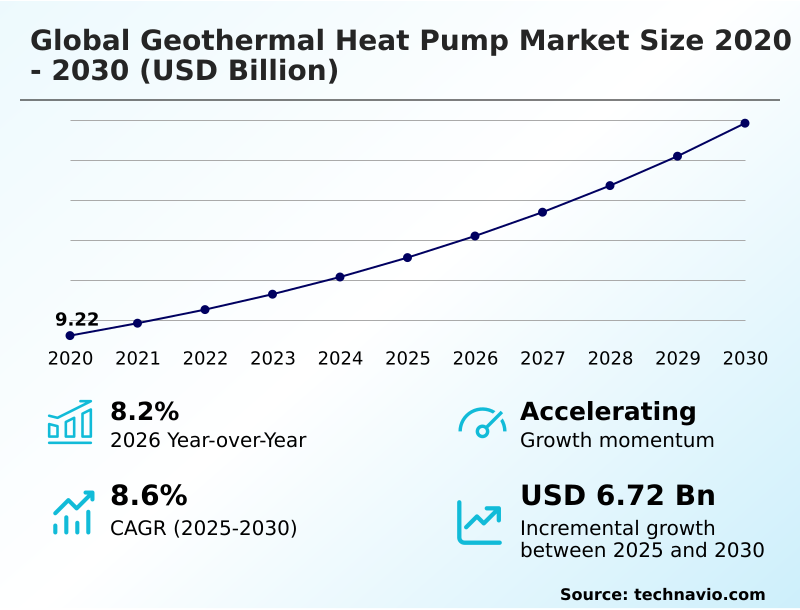
The geothermal heat pump market size is valued to increase by USD 6.72 billion, at a CAGR of 8.6% from 2025 to 2030. National decarbonization mandates and industrialization of low-carbon thermal infrastructure will drive the geothermal heat pump market.
Major Market Trends & Insights
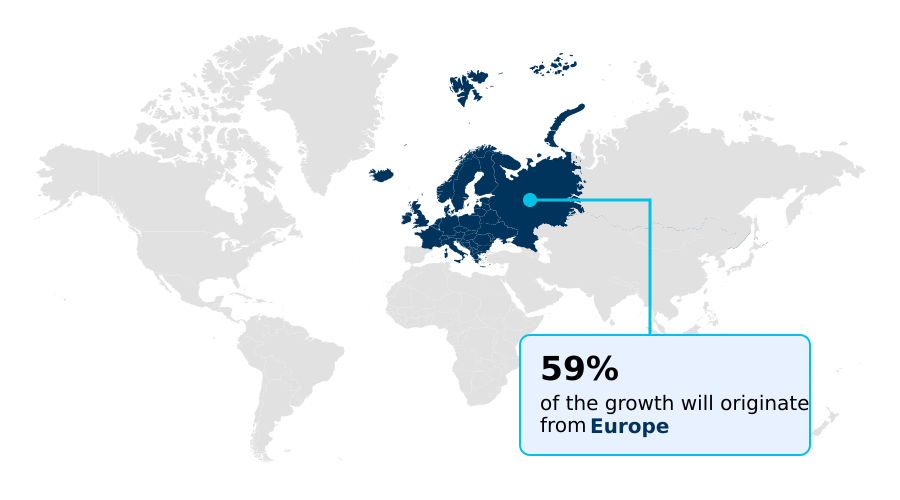
- Europe dominated the market and accounted for a 58.9% growth during the forecast period.
- By End-user - Residential segment was valued at USD 6.57 billion in 2024
- By Type - Closed loop system segment accounted for the largest market revenue share in 2024
Market Size & Forecast
- Market Opportunities: USD 10.62 billion
- Market Future Opportunities: USD 6.72 billion
- CAGR from 2025 to 2030 : 8.6%
Market Summary
- The geothermal heat pump market is undergoing a significant transformation, driven by the global push for decarbonized heating and cooling. This shift is characterized by the adoption of ground-source technology in large-scale commercial, industrial, and residential applications to achieve greater energy efficiency and independence from volatile fossil fuel markets.
- A key trend is the move toward district-scale systems and thermal microgrids, which centralize geothermal resources to serve entire communities.
- For instance, a commercial real estate developer seeking green building certifications for a new urban complex must weigh the high initial capital expenditure of a vertical ground loop configuration against the substantial long-term operational savings and alignment with environmental, social, and governance (ESG) mandates.
- While upfront costs and the need for specialized drilling expertise present challenges, continuous innovation in automated drilling rig platform technology and subsurface heat exchanger innovation are improving economic viability. The convergence of supportive government policies and advanced high-temperature output heat pump systems is expanding applications, ensuring the market's role in the future of sustainable infrastructure.
What will be the Size of the Geothermal Heat Pump Market during the forecast period?
Get Key Insights on Market Forecast (PDF) Get Free Sample
How is the Geothermal Heat Pump Market Segmented?
The geothermal heat pump industry research report provides comprehensive data (region-wise segment analysis), with forecasts and estimates in "USD million" for the period 2026-2030, as well as historical data from 2020-2024 for the following segments.
- End-user
- Residential
- Non-residential
- Type
- Closed loop system
- Open loop system
- Application
- Horizontal loop
- Vertical loop
- Pond loop
- Geography
- Europe
- Germany
- France
- UK
- North America
- US
- Canada
- Mexico
- APAC
- China
- Japan
- South Korea
- South America
- Brazil
- Argentina
- Middle East and Africa
- South Africa
- Saudi Arabia
- UAE
- Rest of World (ROW)
- Europe
By End-user Insights
The residential segment is estimated to witness significant growth during the forecast period.
The residential sector's adoption of ground-source heat pump (GSHP) systems is driven by a focus on long-term cost control and achieving energy sovereignty for homeowners.
Government incentives are pivotal in mitigating the initial ground-loop installation cost, making the technology more accessible.
The integration of a residential ground-source system is increasingly viewed as a premium upgrade that enhances property valuation, with advanced systems reducing space conditioning energy use by up to 60%.
As financing evolves, including subscription-based retrofitting model options, market penetration is broadening beyond new builds into the extensive retrofitting segment.
This shift is supported by hybrid renewable heating solution configurations that combine geothermal with other clean energy sources, optimizing performance and grid-conscious energy consumption for modern sustainable living environments.
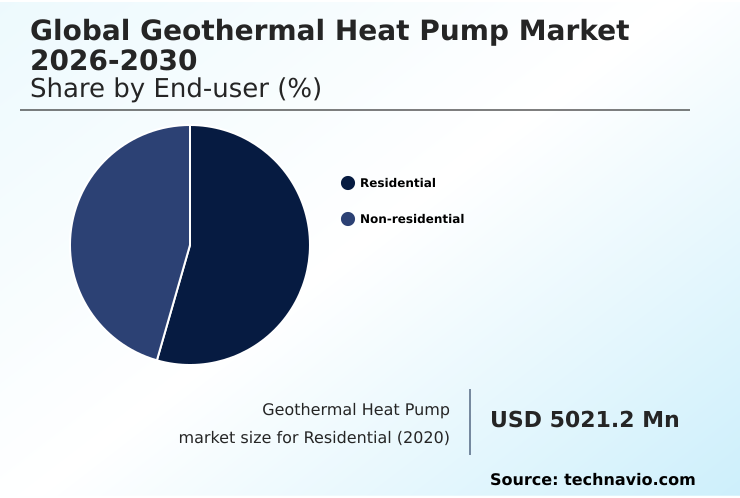
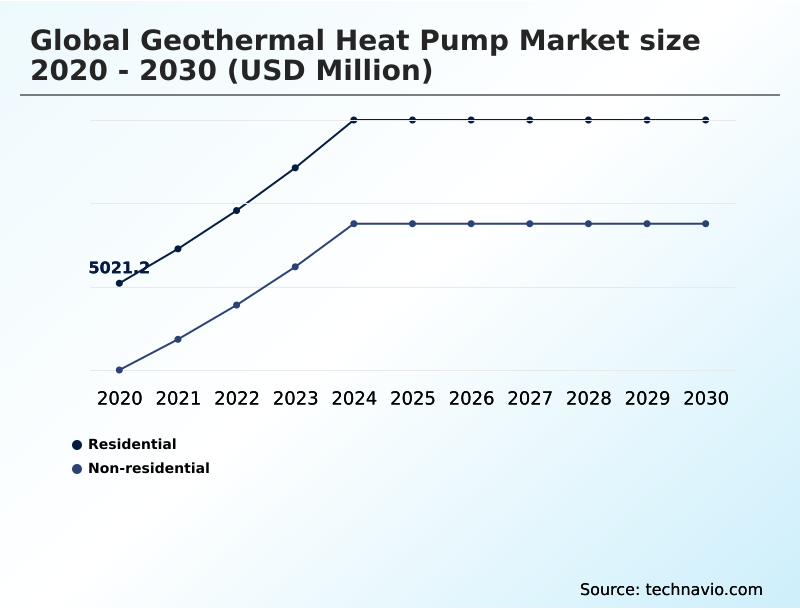
The Residential segment was valued at USD 6.57 billion in 2024 and showed a gradual increase during the forecast period.
Regional Analysis
Europe is estimated to contribute 58.9% to the growth of the global market during the forecast period.Technavio’s analysts have elaborately explained the regional trends and drivers that shape the market during the forecast period.
See How Geothermal Heat Pump Market Demand is Rising in Europe Get Free Sample
The geographic landscape is defined by distinct regional dynamics, with Europe demonstrating mature adoption focused on district heating networks and North America leveraging federal incentives for residential geothermal retrofitting and commercial projects.
In contrast, the APAC region is the fastest-growing market, driven by massive urbanization and government-led green building initiatives. This growth differential is significant, with APAC's expansion rate outpacing North America's by more than two percentage points annually.
Advanced drilling automation is a key enabler globally, with automated rigs reducing operational risks by over 50%. The adoption of smart grid ready systems and demand-response program participation is most advanced in European markets, fostering grid-interactive load management.
This regional diversity underscores the importance of tailored strategies that account for varying regulatory environments, economic conditions, and grid infrastructure maturity, including the development of prefabricated thermal management solutions for large-scale data center environments.
Market Dynamics
Our researchers analyzed the data with 2025 as the base year, along with the key drivers, trends, and challenges. A holistic analysis of drivers will help companies refine their marketing strategies to gain a competitive advantage.
- Strategic decision-making in the geothermal heat pump market increasingly involves complex evaluations, such as assessing the cost of vertical vs horizontal loop installation and navigating financing models for large-scale geothermal projects. For mission-critical facilities, geothermal heat pump for data center cooling is a primary application, optimizing power usage effectiveness with geothermal cooling.
- A key consideration for project viability is understanding open loop system water quality requirements and the complexities of environmental permitting for open-loop geothermal. The challenge of retrofitting historic buildings with geothermal HVAC is being addressed by high-temperature geothermal for industrial steam cycles and other advanced systems.
- In the residential sector, new subscription models for residential geothermal systems are lowering the barrier to entry, reducing upfront capital for geothermal installation and promoting geothermal energy sovereignty for residential use. As the market matures, the focus shifts to technical specifics like using low-GWP refrigerants for geothermal heat pumps and designing geothermal systems for extreme climate zones.
- Integrating geothermal with smart home energy systems further enhances efficiency. However, the skilled labor shortage in geothermal drilling remains a persistent challenge, impacting project timelines and costs across both residential and geothermal applications in commercial office buildings, which have different ROI calculations than industrial settings.
What are the key market drivers leading to the rise in the adoption of Geothermal Heat Pump Industry?
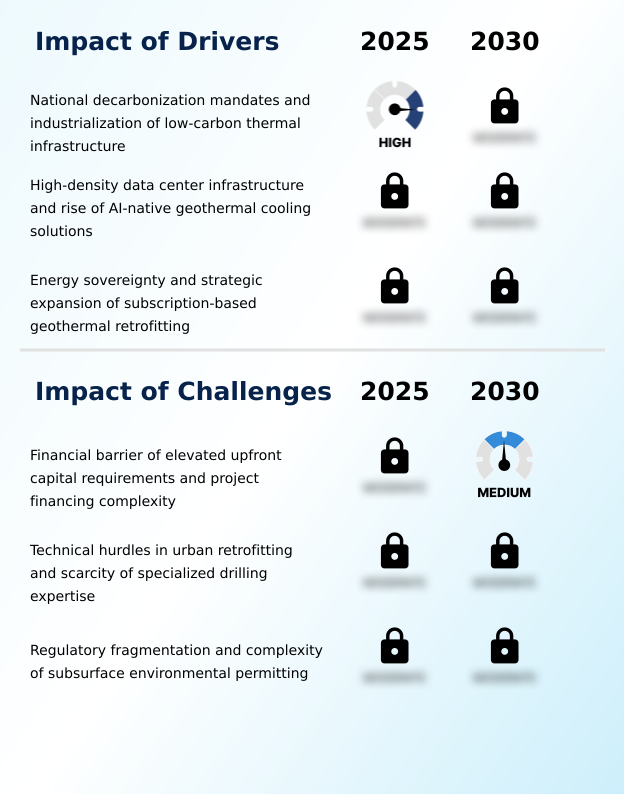
- National decarbonization mandates, along with the industrialization of low-carbon thermal infrastructure, are key drivers propelling market growth.
- Market growth is fundamentally driven by stringent decarbonization mandates and the strategic need for energy sovereignty.
- The high-density data center infrastructure boom, coupled with the rise of AI-native geothermal cooling, has created urgent demand for efficient thermal management, leveraging deep-well heat rejection methods. This is pushing the adoption of high-efficiency HVAC systems and modular HVAC solutions.
- In the residential sector, the pursuit of energy sovereignty for homeowners is fueling the strategic expansion of retrofitting, supported by innovative geothermal-as-a-service (GaaS) model offerings that overcome high upfront ground-loop installation costs.
- These drivers are underpinned by technological advancements in sustainable heating technology and smart connectivity features, making ground-source systems a viable and economically attractive alternative to conventional methods, with some projects achieving a 25% faster ROI.
What are the market trends shaping the Geothermal Heat Pump Industry?
- A key market trend is the institutionalization of net-zero energy buildings. This is developing alongside the expansion of district-scale geothermal pilot programs.
- Key market trends are centered on the institutionalization of high-performance thermal infrastructure. The development of high-temperature output systems, capable of exceeding 80 degrees Celsius, enables direct replacement of fossil-fuel boilers in industrial process heating and commercial ground-source system retrofits. This is driving demand for advanced heat exchanger design and building automation integration.
- Concurrently, the expansion of district-scale geothermal pilots is creating shared thermal grids, a model supported by innovations like ambient temperature loop systems. This approach, which fosters community-scale thermal grid development, relies on robust hydronic distribution products and energy optimization software.
- These trends signify a move toward more integrated, large-scale applications, away from standalone installations, to meet ambitious decarbonization goals and green building certification requirements.
What challenges does the Geothermal Heat Pump Industry face during its growth?
- A key challenge affecting industry growth is the financial barrier created by elevated upfront capital requirements and complex project financing.
- The market faces significant challenges, primarily the high borehole construction capital expenditure and complex subsurface environmental permitting processes, which deter investment. The upfront cost for a closed-loop geothermal system remains two to three times higher than conventional alternatives.
- A chronic scarcity of specialized labor for thermal conductivity testing protocol and automated drilling rig platform operation exacerbates these issues, extending project timelines. This talent gap is critical, with demand for qualified technicians outstripping supply by nearly 40% in some regions. Furthermore, regulatory fragmentation in geothermal resource ownership law and thermal interference regulation creates uncertainty.
- Overcoming these hurdles requires streamlined permitting, innovative financing like the subscription-based retrofitting model, and concerted efforts to expand vocational training to support large-scale deployment and meet net-zero carbon operational pledge targets.
Exclusive Technavio Analysis on Customer Landscape
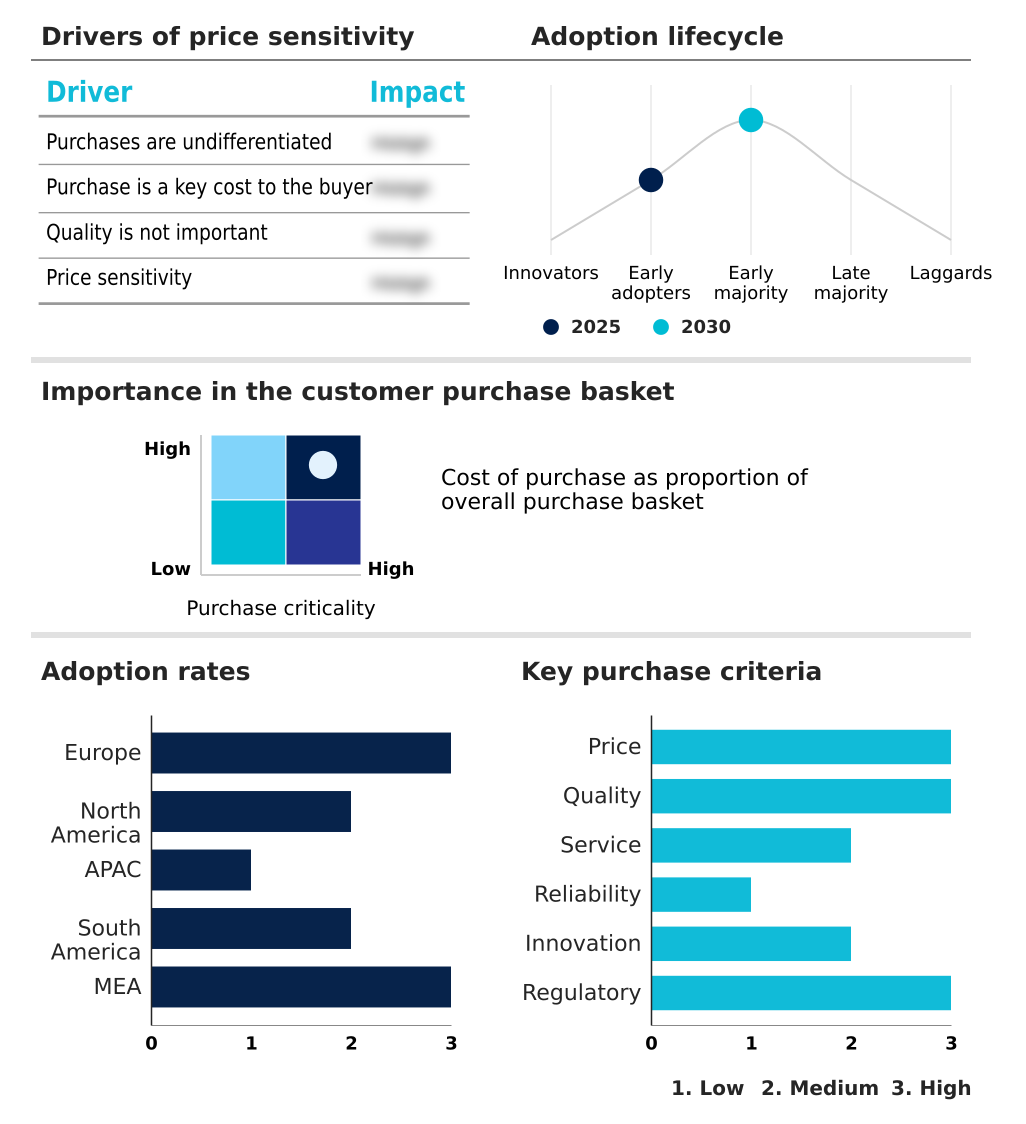
The geothermal heat pump market forecasting report includes the adoption lifecycle of the market, covering from the innovator’s stage to the laggard’s stage. It focuses on adoption rates in different regions based on penetration. Furthermore, the geothermal heat pump market report also includes key purchase criteria and drivers of price sensitivity to help companies evaluate and develop their market growth analysis strategies.
Customer Landscape of Geothermal Heat Pump Industry
Competitive Landscape
Companies are implementing various strategies, such as strategic alliances, geothermal heat pump market forecast, partnerships, mergers and acquisitions, geographical expansion, and product/service launches, to enhance their presence in the industry.
AAON Inc. - Specializing in high-efficiency, modular HVAC systems, the firm provides tailored geothermal heat pump solutions for commercial and industrial infrastructure.
The industry research and growth report includes detailed analyses of the competitive landscape of the market and information about key companies, including:
- AAON Inc.
- Aermec S.p.A.
- Ariston Holding NV
- Bard HVAC
- BDR Thermea Group
- Carrier Global Corp.
- Daikin Industries Ltd.
- GeoSmart Energy
- Glen Dimplex Group.
- Heliotherm Wärmepumpentechnik
- Johnson Controls International
- LG Electronics Inc.
- Maritime Geothermal Ltd.
- MIDEA Group Co. Ltd.
- Mitsubishi Electric Corp.
- NIBE Industrier AB
- OCHSNER Warmepumpen GmbH
- Robert Bosch GmbH
- STIEBEL ELTRON GmbH
- Trane Technologies plc
Qualitative and quantitative analysis of companies has been conducted to help clients understand the wider business environment as well as the strengths and weaknesses of key industry players. Data is qualitatively analyzed to categorize companies as pure play, category-focused, industry-focused, and diversified; it is quantitatively analyzed to categorize companies as dominant, leading, strong, tentative, and weak.
Recent Development and News in Geothermal heat pump market
- In February 2025, Trane Technologies plc completed its acquisition of Stellar Energy, a move designed to integrate modular, prefabricated thermal management solutions into its portfolio to meet rising demand from large-scale data center environments.
- In January 2025, NIBE Industrier AB secured a significant role in the UK's Procure Plus program, a large-scale initiative focused on retrofitting social housing, where the company will supply ground-source heat pumps to improve energy efficiency in the public sector.
- In November 2024, Google LLC announced a long-term agreement with Ormat Technologies Inc. to develop new geothermal projects intended to supply clean, firm power for its data center operations, utilizing a novel clean transition tariff.
- In October 2024, Daikin Industries Ltd.'s European division received the Factory of the Future Award for its commitment to advanced digital manufacturing and scaling sustainable heating solutions, such as its R290-based Altherma series.
Dive into Technavio’s robust research methodology, blending expert interviews, extensive data synthesis, and validated models for unparalleled Geothermal Heat Pump Market insights. See full methodology.
| Market Scope | |
|---|---|
| Page number | 291 |
| Base year | 2025 |
| Historic period | 2020-2024 |
| Forecast period | 2026-2030 |
| Growth momentum & CAGR | Accelerate at a CAGR of 8.6% |
| Market growth 2026-2030 | USD 6716.3 million |
| Market structure | Fragmented |
| YoY growth 2025-2026(%) | 8.2% |
| Key countries | Germany, France, UK, Italy, Spain, Sweden, US, Canada, Mexico, China, Japan, South Korea, Australia, India, Thailand, Brazil, Argentina, Chile, South Africa, Saudi Arabia, UAE, Egypt and Morocco |
| Competitive landscape | Leading Companies, Market Positioning of Companies, Competitive Strategies, and Industry Risks |
Research Analyst Overview
- The geothermal heat pump market is advancing beyond conventional HVAC, establishing itself as a cornerstone of sustainable infrastructure through deep technological integration. The proliferation of the ground-source heat pump (GSHP) is driven by its superior coefficient of performance (COP) rating, with some residential ground-source system installations reducing energy consumption by up to 60%.
- Core innovations focus on system components, including high-density polyethylene piping, advanced heat exchanger design, and thermally enhanced grout materials to maximize thermal transfer. The transition to low global warming potential (GWP) refrigerants and inverter-driven compressor technology within the vapor-compression refrigeration cycle is now standard.
- At a macro level, the market is shaped by the deployment of district-scale geothermal network projects and their integration into net-zero energy building (NZEB) integration designs. These community-scale thermal grid networks, often using a shared ground-loop array, provide a baseload renewable heat source.
- This shift influences everything from subscription-based retrofitting model offerings for homeowners to the design of high-temperature output heat pump systems for industrial process heating application needs and specialized data center geothermal cooling solutions.
What are the Key Data Covered in this Geothermal Heat Pump Market Research and Growth Report?
-
What is the expected growth of the Geothermal Heat Pump Market between 2026 and 2030?
-
USD 6.72 billion, at a CAGR of 8.6%
-
-
What segmentation does the market report cover?
-
The report is segmented by End-user (Residential, and Non-residential), Type (Closed loop system, and Open loop system), Application (Horizontal loop, Vertical loop, and Pond loop) and Geography (Europe, North America, APAC, South America, Middle East and Africa)
-
-
Which regions are analyzed in the report?
-
Europe, North America, APAC, South America and Middle East and Africa
-
-
What are the key growth drivers and market challenges?
-
National decarbonization mandates and industrialization of low-carbon thermal infrastructure, Financial barrier of elevated upfront capital requirements and project financing complexity
-
-
Who are the major players in the Geothermal Heat Pump Market?
-
AAON Inc., Aermec S.p.A., Ariston Holding NV, Bard HVAC, BDR Thermea Group, Carrier Global Corp., Daikin Industries Ltd., GeoSmart Energy, Glen Dimplex Group., Heliotherm Wärmepumpentechnik, Johnson Controls International, LG Electronics Inc., Maritime Geothermal Ltd., MIDEA Group Co. Ltd., Mitsubishi Electric Corp., NIBE Industrier AB, OCHSNER Warmepumpen GmbH, Robert Bosch GmbH, STIEBEL ELTRON GmbH and Trane Technologies plc
-
Market Research Insights
- Market dynamics are shaped by a complex interplay of financial incentives, technological advancements, and workforce availability. While the strategic expansion of retrofitting offers significant growth avenues, adoption is often constrained by high borehole construction capital expenditure.
- Innovative geothermal-as-a-service (GaaS) model structures are emerging to address this, yet industry data shows over 64% of potential commercial clients defer projects due to inflexible financing. Concurrently, technological progress in areas like predictive thermal management AI is enhancing operational efficiency, with automated drilling rigs reducing project risks by over 50% in certain geological settings.
- However, this progress is tempered by a critical labor shortage, as the demand for qualified geothermal engineers outstrips training capacity by nearly 40% in key regions, creating a bottleneck for scaling deployment and meeting net-zero carbon operational pledge targets.
We can help! Our analysts can customize this geothermal heat pump market research report to meet your requirements.
 RIA -
RIA - 
