


Green Hydrogen Market Size 2026-2030
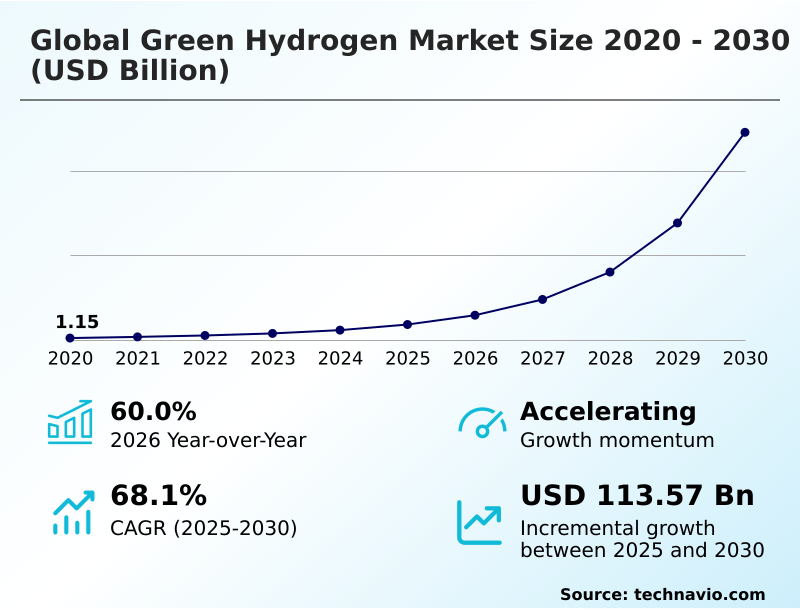
The green hydrogen market size is valued to increase by USD 113.57 billion, at a CAGR of 68.1% from 2025 to 2030. Supportive government policies and climate goals will drive the green hydrogen market.
Major Market Trends & Insights
- APAC dominated the market and accounted for a 57.4% growth during the forecast period.
- By End-user - Chemical segment was valued at USD 2.04 billion in 2024
- By Technology - Alkaline electrolyzer segment accounted for the largest market revenue share in 2024
Market Size & Forecast
- Market Opportunities: USD 121.57 billion
- Market Future Opportunities: USD 113.57 billion
- CAGR from 2025 to 2030 : 68.1%
Market Summary
- The green hydrogen market is advancing as a cornerstone of the global energy transition, driven by the urgent need to decarbonize industrial operations and power systems. Its development is characterized by the scaling of electrolysis technology and the integration of renewable energy sources to produce a carbon-free fuel.
- A key trend is the establishment of comprehensive national strategies and financial incentives, such as the hydrogen production tax credit, which aim to reduce the levelized cost of hydrogen and stimulate investment in the hydrogen value chain. For instance, a heavy industry manufacturer seeking to reduce its carbon footprint might transition to using green hydrogen as a decarbonization feedstock.
- This move involves navigating complex offtake agreements for a stable supply, investing in on-site hydrogen production, or connecting to regional clean hydrogen hubs. Despite the high initial capital outlay for electrolyzers and storage, the long-term benefits include compliance with emissions trading schemes and enhanced brand reputation.
- The market's trajectory is further influenced by the build-out of essential hydrogen infrastructure development, including pipelines and hydrogen refueling stations, to support applications in mobility and power generation.
What will be the Size of the Green Hydrogen Market during the forecast period?
Get Key Insights on Market Forecast (PDF) Get Free Sample
How is the Green Hydrogen Market Segmented?
The green hydrogen industry research report provides comprehensive data (region-wise segment analysis), with forecasts and estimates in "USD million" for the period 2026-2030, as well as historical data from 2020-2024 for the following segments.
- End-user
- Chemical
- Power
- Industrial
- Others
- Technology
- Alkaline electrolyzer
- Polymer electrolyte membrane (PEM) electrolyzer
- Distribution channel
- Pipeline
- Cargo
- Geography
- APAC
- China
- India
- Japan
- Europe
- Germany
- France
- UK
- North America
- US
- Canada
- Mexico
- Middle East and Africa
- Saudi Arabia
- UAE
- South America
- Brazil
- Argentina
- Rest of World (ROW)
- APAC
By End-user Insights
The chemical segment is estimated to witness significant growth during the forecast period.
The chemical segment is a important area for the global green hydrogen market 2026-2030, driven by the adoption of decarbonization feedstock in industrial processes.
Green ammonia production and the synthesis of methanol rely on low-carbon hydrogen to reduce the carbon footprint of fertilizers, polymers, and other essential chemical products.
Utilizing hydrogen in chemical process synthesis is pivotal for hard-to-abate sectors facing stringent carbon pricing impacts. The industry's shift is supported by a growing hydrogen value chain and expanding industrial gas services, which facilitate the transition away from fossil-based feedstocks.
For instance, optimizing production with green hydrogen has demonstrated the potential to lower carbon intensity in ammonia synthesis by more than 90%, showcasing its transformative impact on the sector's sustainability targets and operational efficiency.
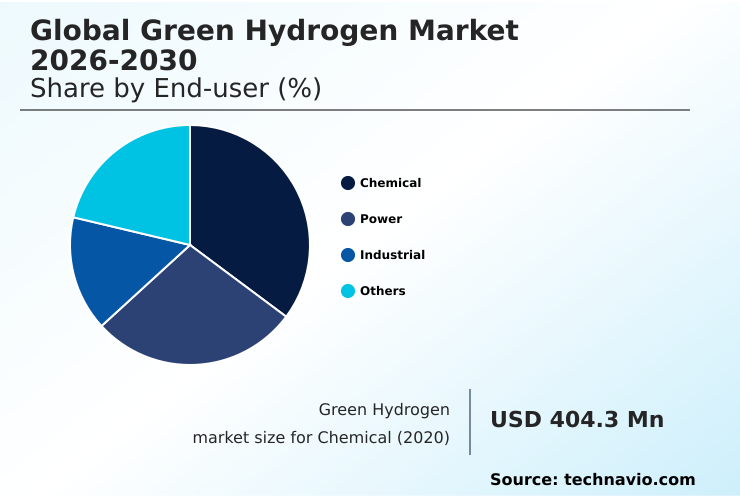
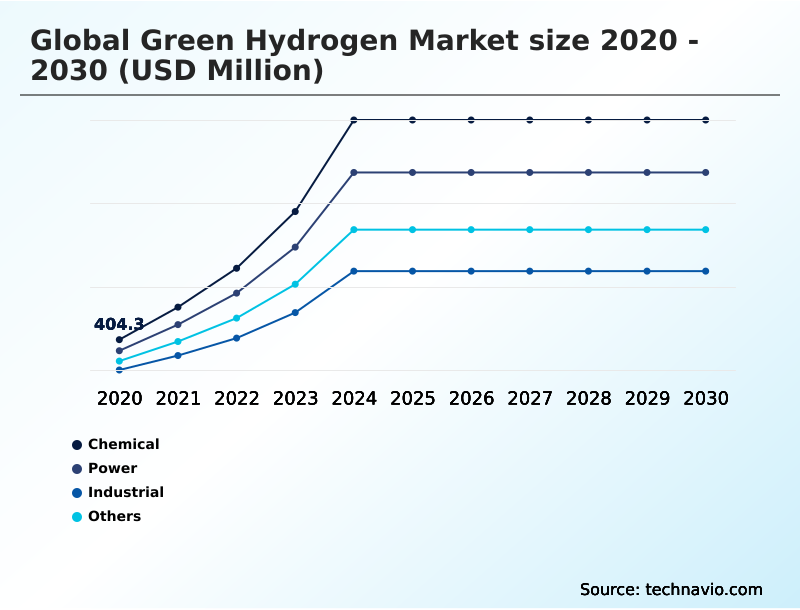
The Chemical segment was valued at USD 2.04 billion in 2024 and showed a gradual increase during the forecast period.
Regional Analysis
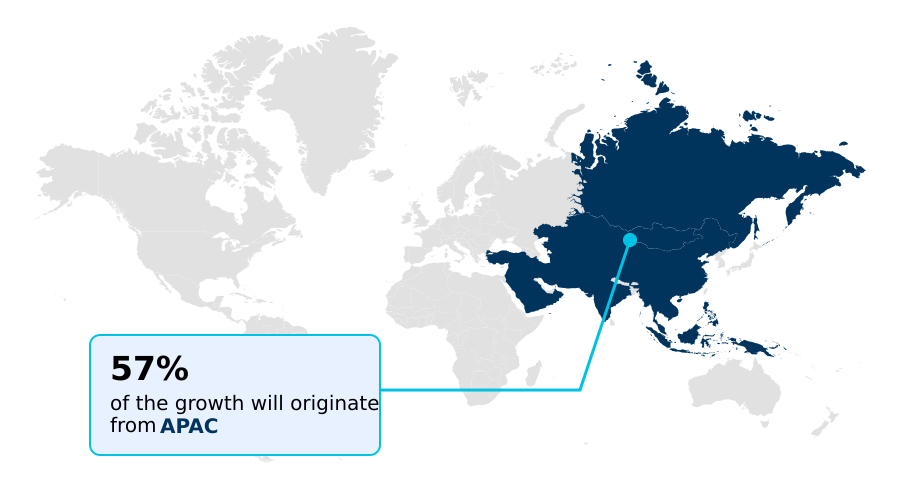
APAC is estimated to contribute 57.4% to the growth of the global market during the forecast period.Technavio’s analysts have elaborately explained the regional trends and drivers that shape the market during the forecast period.
See How Green Hydrogen Market Demand is Rising in APAC Get Free Sample
The geographic landscape of the global green hydrogen market 2026-2030 is increasingly centered on APAC, which accounts for over 57% of the global incremental growth opportunity, significantly outpacing Europe's 21%.
This dominance is fueled by aggressive national policies and massive investments in hydrogen infrastructure development, particularly for clean ammonia production and industrial decarbonization.
Countries are leveraging advanced technologies like solid oxide electrolyzer and fuel cell systems to build out capabilities for both domestic use and export.
Applications are expanding from industrial feedstock to include grid injection and fuel for zero-emission vehicles, supported by advancements in hydrogen combustion engines.
The region's focus on creating a complete ecosystem, including hydrogen blending into existing gas networks, positions it as a critical hub in the evolving water electrolysis technology landscape, driving both supply and demand.
Market Dynamics
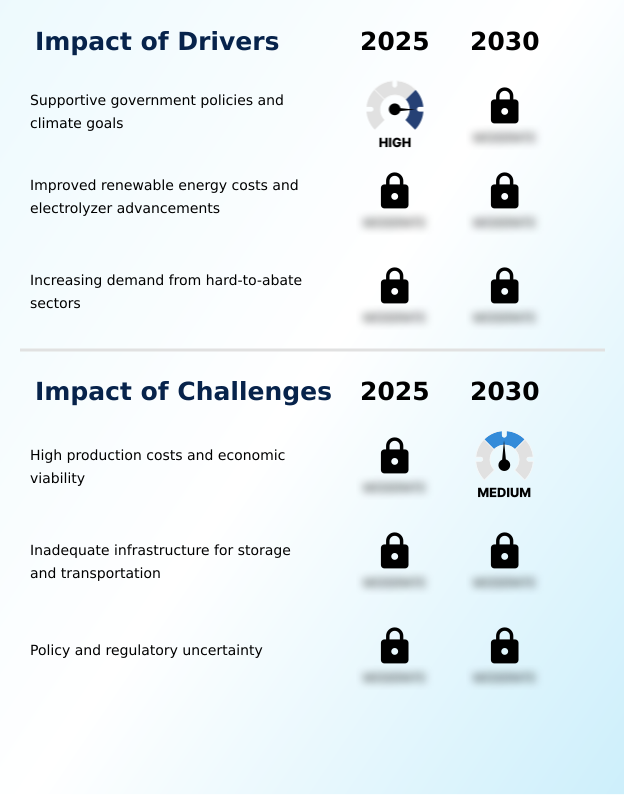
Our researchers analyzed the data with 2025 as the base year, along with the key drivers, trends, and challenges. A holistic analysis of drivers will help companies refine their marketing strategies to gain a competitive advantage.
- Analyzing the future of the global green hydrogen market 2026-2030 requires a deep dive into several interconnected factors. The comparative cost of green hydrogen vs grey hydrogen remains a central challenge, though this gap is narrowing due to technological progress and supportive policies.
- A key consideration is the debate over PEM vs alkaline electrolyzer efficiency, where PEM technology offers faster response times ideal for grid balancing, while alkaline systems currently provide a lower-cost pathway for large-scale, continuous production.
- The role of green hydrogen in steel manufacturing and other heavy industries is a primary demand driver, as it offers one of the few viable routes for deep industrial decarbonization. However, significant hurdles remain, particularly the challenges in hydrogen transportation infrastructure.
- The prospect of converting natural gas pipelines for hydrogen is promising for reducing costs but involves technical and safety evaluations. The impact of government subsidies on LCOH is profound, with incentives capable of reducing project costs by over 40% in some regions, thereby accelerating final investment decisions.
- Furthermore, the application of green hydrogen for heavy-duty transport and the industrial-scale deployment of solid oxide electrolyzer technology are set to unlock new market segments. Its use in chemical process synthesis, replacing fossil-based feedstocks, underscores its versatility and importance in the broader energy transition.
What are the key market drivers leading to the rise in the adoption of Green Hydrogen Industry?
- Supportive government policies and ambitious climate goals are primary drivers stimulating investment and development across the green hydrogen market.
- Supportive government policies are a primary driver for the global green hydrogen market 2026-2030, de-risking investments and accelerating commercialization.
- Financial incentives like the hydrogen production tax credit directly address cost barriers, while the formation of regional clean hydrogen hubs fosters ecosystem development.
- These programs stimulate on-site hydrogen production and large-scale electrolysis projects through mechanisms like renewable power purchase agreement support, which can lower operational expenditures by up to 30%.
- The focus on building domestic electrolyzer manufacturing capabilities strengthens the entire hydrogen value chain.
- Furthermore, government-backed initiatives for creating hydrogen export corridor networks enhance global trade prospects, enabling renewable energy integration on an international scale and boosting project bankability by over 40% in some cases.
What are the market trends shaping the Green Hydrogen Industry?
- The market is shaped by intensifying global decarbonization mandates and supportive government policies. These factors are accelerating the adoption of green hydrogen as a pivotal solution for climate targets.
- Key trends in the global green hydrogen market 2026-2030 are driven by robust policy support and corporate decarbonization goals. Governments are enacting national hydrogen strategy frameworks and establishing emissions trading schemes, creating a favorable investment climate. This has spurred a significant increase in hydrogen production capacity, with projects leveraging both alkaline electrolyzer and polymer electrolyte membrane electrolyzer technologies.
- For instance, some jurisdictions now permit hydrogen blending of up to 20% in natural gas grids, expanding offtake opportunities. Concurrently, corporations are driving demand through fuel cell deployment in logistics and transport, supported by a growing network of hydrogen refueling stations.
- These initiatives have led to an 18% improvement in the cost-efficiency of certain electrolysis projects over the past two years, accelerating market adoption.
What challenges does the Green Hydrogen Industry face during its growth?
- High production costs relative to conventional alternatives and the ongoing challenge of achieving broad economic viability remain significant barriers for the industry.
- High production cost remains a formidable challenge for the global green hydrogen market 2026-2030, directly impacting its competitiveness. The levelized cost of hydrogen is heavily influenced by electrolysis technology efficiency and the price of renewable electricity. Securing long-term offtake agreements is difficult as buyers hesitate due to price volatility, creating a significant hurdle for project financing.
- Regulatory uncertainty, such as the stringent hourly time matching and regional proximity requirement rules for tax credits, can increase compliance costs for some developers by over 15%. These factors complicate the development of critical hydrogen storage solutions and hydrogen delivery systems.
- While innovations in modular alkaline electrolysers and solid oxide fuel cells are improving electrolyzer efficiency, achieving cost parity with conventional hydrogen without substantial, stable subsidies remains a key barrier to widespread market adoption.
Exclusive Technavio Analysis on Customer Landscape
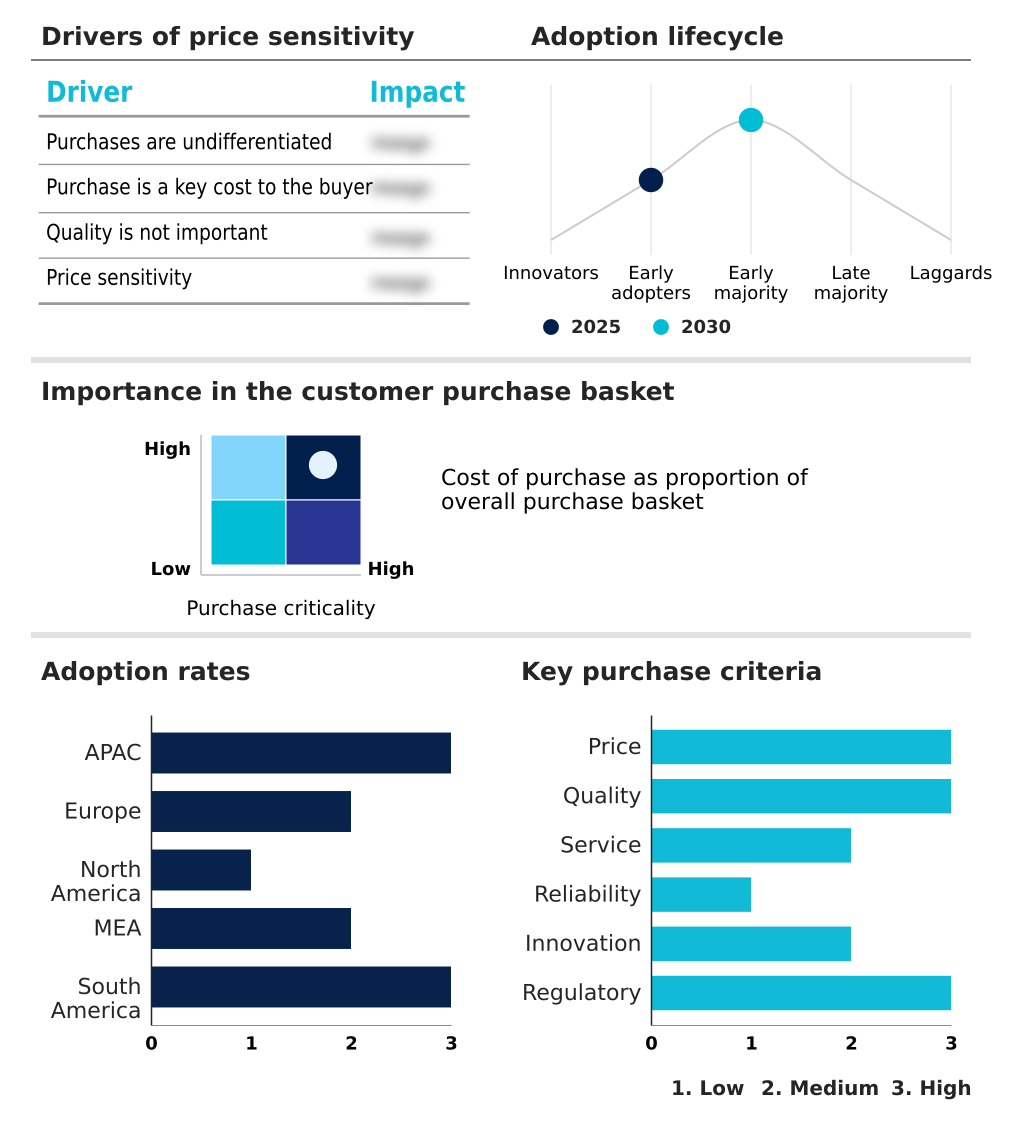
The green hydrogen market forecasting report includes the adoption lifecycle of the market, covering from the innovator’s stage to the laggard’s stage. It focuses on adoption rates in different regions based on penetration. Furthermore, the green hydrogen market report also includes key purchase criteria and drivers of price sensitivity to help companies evaluate and develop their market growth analysis strategies.
Customer Landscape of Green Hydrogen Industry
Competitive Landscape
Companies are implementing various strategies, such as strategic alliances, green hydrogen market forecast, partnerships, mergers and acquisitions, geographical expansion, and product/service launches, to enhance their presence in the industry.
Acwa Power Co. - Develops and operates large-scale, renewable-powered electrolysis projects focused on clean ammonia production for global markets.
The industry research and growth report includes detailed analyses of the competitive landscape of the market and information about key companies, including:
- Acwa Power Co.
- Air Liquide SA
- Air Products and Chemicals Inc
- Ballard Power Systems Inc.
- Bloom Energy Corp.
- Ceres Power Holdings plc
- Cummins Inc.
- Green Hydrogen Systems
- Guangdong Nation Synergy
- Indian Oil Corp. Ltd.
- Jindal Steel and Power Ltd.
- Larsen and Toubro Ltd.
- Linde Plc
- Nel ASA
- Nikola Corp.
- Plug Power Inc.
- Siemens Energy AG
- Teralta Hydrogen Solutions
Qualitative and quantitative analysis of companies has been conducted to help clients understand the wider business environment as well as the strengths and weaknesses of key industry players. Data is qualitatively analyzed to categorize companies as pure play, category-focused, industry-focused, and diversified; it is quantitatively analyzed to categorize companies as dominant, leading, strong, tentative, and weak.
Recent Development and News in Green hydrogen market
- In May 2025, Daye Green Power reportedly commenced production at its facility in Hubei province, marking a significant milestone in China's transition toward hydrogen derived from renewable sources.
- In March 2025, ChinaCoal Linxi Bioenergy Co. Ltd. obtained approval for its integrated wind-solar-to-hydrogen project in Chifeng Linxi County, backed by an initial investment of approximately $232.4 million.
- In February 2025, reports indicated that a prominent green hydrogen export project in Queensland, Australia, was halted after the state government withdrew its financial support, citing escalating infrastructure and development costs.
- In January 2025, the U.S. Treasury Department released its definitive guidance concerning the 45V hydrogen production tax credit, upholding a rigorous framework that includes hourly time-matching requirements for electricity sources.
Dive into Technavio’s robust research methodology, blending expert interviews, extensive data synthesis, and validated models for unparalleled Green Hydrogen Market insights. See full methodology.
| Market Scope | |
|---|---|
| Page number | 289 |
| Base year | 2025 |
| Historic period | 2020-2024 |
| Forecast period | 2026-2030 |
| Growth momentum & CAGR | Accelerate at a CAGR of 68.1% |
| Market growth 2026-2030 | USD 113574.0 million |
| Market structure | Fragmented |
| YoY growth 2025-2026(%) | 60.0% |
| Key countries | China, India, Japan, Australia, South Korea, Indonesia, Germany, France, UK, The Netherlands, Spain, Italy, US, Canada, Mexico, Saudi Arabia, UAE, Egypt, Oman, Qatar, Brazil, Chile and Argentina |
| Competitive landscape | Leading Companies, Market Positioning of Companies, Competitive Strategies, and Industry Risks |
Research Analyst Overview
- The global green hydrogen market 2026-2030 is rapidly advancing, driven by innovations across its value chain. Central to this is the evolution of electrolysis technology, with both alkaline electrolyzer and polymer electrolyte membrane electrolyzer systems scaling up.
- The development of modular alkaline electrolysers is enabling more flexible on-site hydrogen production, while advancements in solid oxide fuel cells and solid oxide electrolyzer technology promise higher efficiency for industrial applications.
- This increasing hydrogen production capacity is critical for supplying a range of end-uses, from fuel for hydrogen combustion engines and fuel cell electric vehicles to feedstock for clean ammonia production. The build-out of infrastructure, including hydrogen refueling stations and regional clean hydrogen hubs, is essential for enabling widespread adoption of zero-emission vehicles.
- Industrial gas services are expanding to include low-carbon hydrogen and comprehensive hydrogen delivery systems, supported by incentives like the hydrogen production tax credit. For projects, securing long-term offtake agreements for large-scale electrolysis projects remains a key milestone, with successful ventures often reducing financial risk by over 30% before construction begins.
What are the Key Data Covered in this Green Hydrogen Market Research and Growth Report?
-
What is the expected growth of the Green Hydrogen Market between 2026 and 2030?
-
USD 113.57 billion, at a CAGR of 68.1%
-
-
What segmentation does the market report cover?
-
The report is segmented by End-user (Chemical, Power, Industrial, and Others), Technology (Alkaline electrolyzer, and Polymer electrolyte membrane (PEM) electrolyzer), Distribution Channel (Pipeline, and Cargo) and Geography (APAC, Europe, North America, Middle East and Africa, South America)
-
-
Which regions are analyzed in the report?
-
APAC, Europe, North America, Middle East and Africa and South America
-
-
What are the key growth drivers and market challenges?
-
Supportive government policies and climate goals, High production costs and economic viability
-
-
Who are the major players in the Green Hydrogen Market?
-
Acwa Power Co., Air Liquide SA, Air Products and Chemicals Inc, Ballard Power Systems Inc., Bloom Energy Corp., Ceres Power Holdings plc, Cummins Inc., Green Hydrogen Systems, Guangdong Nation Synergy, Indian Oil Corp. Ltd., Jindal Steel and Power Ltd., Larsen and Toubro Ltd., Linde Plc, Nel ASA, Nikola Corp., Plug Power Inc., Siemens Energy AG and Teralta Hydrogen Solutions
-
Market Research Insights
- Market dynamics are shaped by a confluence of supportive policies and technological advancements, fostering an environment of rapid expansion. The industry is witnessing accelerated adoption rates approaching 60% annually, driven by national strategies promoting fuel cell deployment and electrolyzer manufacturing.
- This growth is not uniform, as investment returns are closely tied to regional incentives and the maturity of local hydrogen infrastructure development. For instance, projects with secured renewable power purchase agreements demonstrate up to 25% greater financial viability compared to those exposed to volatile spot electricity prices.
- The market expansion reflects a compound growth trajectory exceeding 68%, highlighting the significant momentum behind industrial decarbonization and the increasing competitiveness of water electrolysis technology in hard-to-abate sectors.
We can help! Our analysts can customize this green hydrogen market research report to meet your requirements.
 RIA -
RIA - 
