

Industrial Belt Tensioners Market Analysis, Size, and Forecast 2025-2029: North America (US and Canada), Europe (France, Germany, and UK), APAC (Australia, China, India, Japan, and South Korea), and Rest of World (ROW)

Industrial Belt Tensioners Market Analysis, Size, and Forecast 2025-2029:
North America (US and Canada), Europe (France, Germany, and UK), APAC (Australia, China, India, Japan, and South Korea), and Rest of World (ROW)

Published: May 2025 226 Pages SKU: IRTNTR46667

Market Overview at a Glance

$167.6 Mn
Market Opportunity
3.4%
CAGR
3.2
YoY growth 2024-2025(%)

Industrial Belt Tensioners Market Size 2025-2029

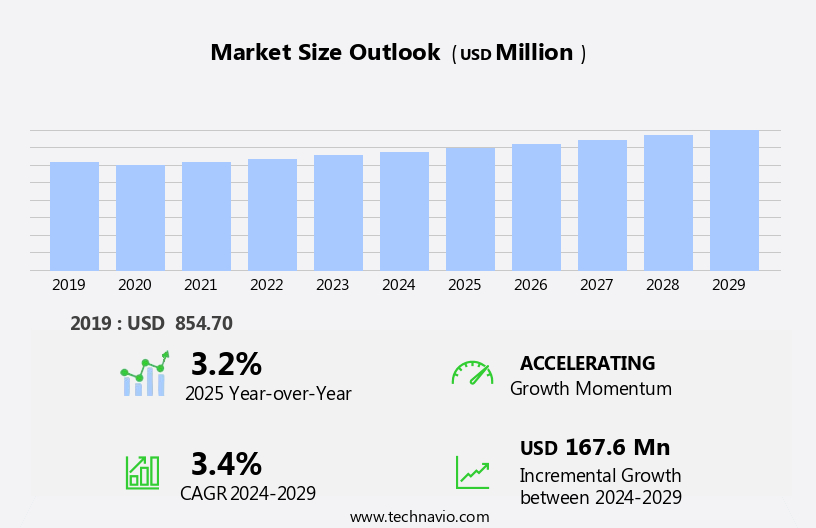
The industrial belt tensioners market size is forecast to increase by USD 167.6 million, at a CAGR of 3.4% between 2024 and 2029.

  • The market is driven by the increasing investments in industrial assets, necessitating the need for efficient and reliable belt tensioning systems. Customization of belt tensioners to cater to specific industrial applications is another key trend, as industries seek to optimize their production processes and minimize downtime. The automotive, mining, and aerospace sectors heavily utilize tensioners in engines, automotive tensioners, and hydraulically operated systems. However, the market faces challenges due to the volatility in prices of raw materials used in manufacturing belt tensioners, such as steel and rubber. This price instability can impact the profitability of belt tensioner manufacturers and may lead to increased costs for end-users.
  • Additionally, the automotive and manufacturing industries, major consumers of belt tensioners, are experiencing significant shifts towards electric vehicles and automation, respectively. Companies in the market must stay abreast of these trends and adapt their product offerings and business strategies accordingly to capitalize on new opportunities and navigate challenges effectively. AI-powered tensioners and finite element analysis are the future, offering advanced capabilities for predictive maintenance and improved operational efficiency.

What will be the Size of the Industrial Belt Tensioners Market during the forecast period?
Industrial Belt Tensioners Market Size

Explore in-depth regional segment analysis with market size data - historical 2019-2023 and forecasts 2025-2029 - in the full report.  
 Request Free Sample

  • The market is witnessing significant advancements, driven by the integration of technology and the pursuit of optimized performance and cost savings. Key trends include the adoption of IoT integration and cloud-based solutions for remote monitoring and virtual commissioning. Environmental impact is a growing concern, leading to the development of smart tensioning systems with noise reduction, dust and debris resistance, and material science advancements for improved wear resistance and temperature resistance. Data analytics and machine learning are revolutionizing belt dynamics analysis, enabling early detection of belt slip and vibration, resulting in extended belt life and reduced downtime.
  • Torque measurement and simulation software are also crucial for ensuring belt performance under various environmental conditions. Abrasion and chemical resistance are essential considerations for belt tensioners in harsh industrial environments. Key industries, including the passenger car, 2-wheeler, and commercial vehicle sectors, rely on belt drives, V-belts, variable belts, synchronous timing belts, and accessory drive belts for power transmission.

How is this Industrial Belt Tensioners Industry segmented?

The industrial belt tensioners industry research report provides comprehensive data (region-wise segment analysis), with forecasts and estimates in "USD million" for the period 2025-2029, as well as historical data from 2019-2023 for the following segments.

  • Application
    • Material handling industry
    • Industrial machinery sector
    • Agriculture industry
    • Mining and mineral industry
  • Type
    • Automatic
    • Non-automatic
  • Material
    • Steel tensioners
    • Aluminum tensioners
    • Plastic tensioners
    • Composite material tensioners
  • Geography
    • North America
      • US
      • Canada
    • Europe
      • France
      • Germany
      • UK
    • APAC
      • Australia
      • China
      • India
      • Japan
      • South Korea
    • Rest of World (ROW)

By Application Insights

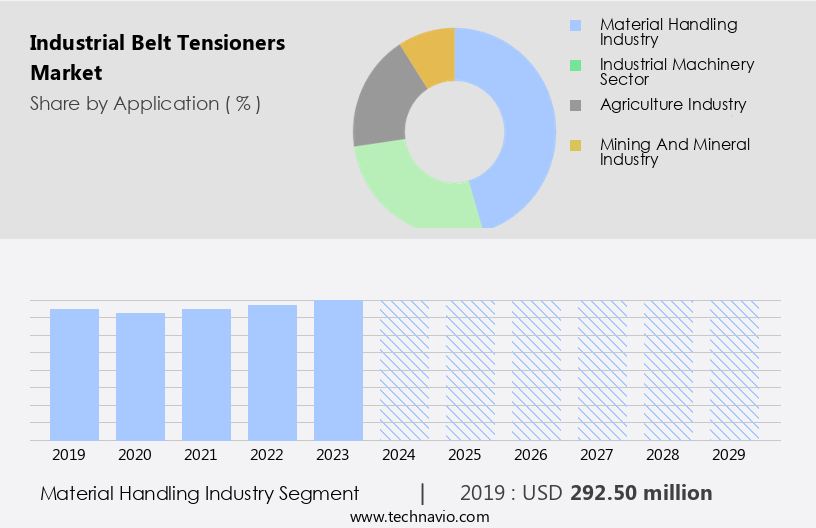
The material handling industry segment is estimated to witness significant growth during the forecast period. In material handling applications, conveyor belts play a crucial role in transporting heavy or bulky items efficiently. Proper belt tension is vital to prevent slippage, minimize wear and tear, and ensure consistent material transport. Belt tensioning devices, including hydraulic, pneumatic, mechanical, and motorized tensioners, help maintain the correct belt tension. Tension sensors and feedback systems enable real-time tension monitoring and optimization. Belt materials, such as rubber, polyurethane, and steel, vary based on application requirements. Belt width, capacity, and speed also influence tension management. Energy efficiency is a significant consideration in material handling, with tension optimization contributing to reduced power consumption and increased productivity.

Belt maintenance, including cleaning, alignment, splicing, and lubrication, is essential to prolong belt life and minimize downtime. Compliance with safety standards and process control requirements is also crucial. Tensioner installation, calibration, and replacement are critical aspects of belt maintenance. Belt tensioners are integral to the efficient operation of conveyor systems in industries like packaging machinery, industrial automation, and heavy-duty applications. Precision tensioning ensures consistent belt performance and reduces the risk of belt-related failures. Tensioner brackets and housings support proper belt alignment and tracking. Belt tension management is a continuous process that involves regular inspection and adjustment.

Automatic tensioners and control systems facilitate this process, ensuring consistent belt tension and reducing the need for manual intervention. Belt thickness and belt wear are essential factors in tension management, as they influence belt performance and lifespan. The market for these tensioners is influenced by the price volatility of raw materials such as metals, plastics, and rubber used in their production.
Industrial Belt Tensioners Market Size

Request Free Sample

The Material handling industry segment was valued at USD 292.50 million in 2019 and showed a gradual increase during the forecast period.

The Industrial Belt Tensioners Market is evolving with advanced vibration analysis techniques, ensuring optimal performance and durability. Improved belt slip detection systems help prevent inefficiencies and downtime in industrial operations. The integration of digital twins enables real-time monitoring and predictive maintenance, enhancing equipment reliability. High abrasion resistance materials in belt tensioners contribute to longer lifespan and reduced maintenance costs. Innovations focused on reduced vibration enhance operational efficiency while minimizing wear and tear on machinery.

Regional Analysis

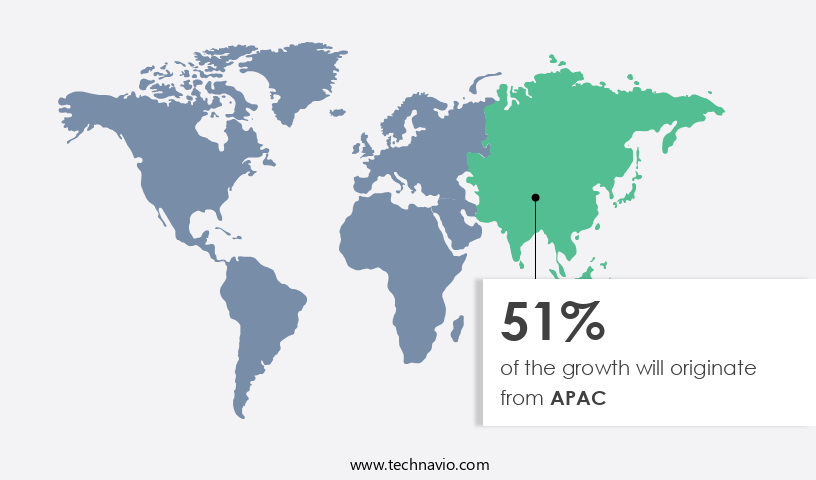
APAC is estimated to contribute 51% to the growth of the global market during the forecast period. Technavio's analysts have elaborately explained the regional trends and drivers that shape the market during the forecast period.
Industrial Belt Tensioners Market Share by Geography

Download Free Sample Report

In APAC, the industrial sector is experiencing significant advancements, with countries like India and China spearheading creative initiatives such as "Make in India" and "Made in China" to bolster their domestic manufacturing industries. China is poised to lead Asian nations in industrial growth, particularly in sectors like industrial machinery, mining, agriculture, and construction. Notably, Australia and China are witnessing a rise in the mining and minerals industry, leading to increased machinery adoption. Consequently, the regional market for industrial belt tensioners is projected to expand at an impressive rate. Material handling applications, which include conveyor systems and packaging machinery, are primary consumers of belt tensioning devices.

Belt tension optimization ensures energy efficiency, reduces downtime, and enhances productivity. Various types of belts, such as flat, round, polyurethane, steel, rubber, and timing belts, necessitate different tensioning methods. Hydraulic, pneumatic, mechanical, and motorized tensioners cater to these requirements. Belt maintenance practices, including belt cleaning, tension measurement, alignment, and lubrication, are crucial for belt longevity and optimal performance. Safety standards and compliance requirements mandate regular belt inspection and tensioner calibration. Precision tensioning and automatic tensioners are increasingly popular for heavy-duty applications. Belt tension management systems employ sensors and control systems to provide real-time feedback, enabling belt wear monitoring and proactive maintenance.

Tensioner installation, replacement, and adjustment are essential for maintaining belt capacity and ensuring process control. Belt splicing and belt joining techniques ensure seamless belt transitions and minimize belt wear. Belt tensioners play a vital role in industrial automation, ensuring efficient and reliable belt operation. High-performance belts, designed for heavy loads and high speeds, necessitate robust tensioning systems. Tensioner bearings and housings facilitate smooth belt movement and protect against wear and tear. The market in APAC is expected to grow at an exponential rate due to the increasing adoption of machinery in the mining and manufacturing sectors.

The market caters to various belt types and applications, employing various tensioning methods and maintenance practices to ensure optimal belt performance and longevity. Precision tensioning, safety standards, and ease of use are key considerations for manufacturers when selecting belt tensioners, making this a dynamic and evolving market. China is projected to lead the region's industrial growth, particularly in sectors like industrial machinery, mining, agriculture, and construction.

Market Dynamics

Our researchers analyzed the data with 2024 as the base year, along with the key drivers, trends, and challenges. A holistic analysis of drivers will help companies refine their marketing strategies to gain a competitive advantage.

What are the Industrial Belt Tensioners market drivers leading to the rise in the adoption of Industry?

  • A significant contributor to market growth is the escalating investment in industrial assets. The market is experiencing significant growth due to the increasing adoption of high performance belts in heavy duty applications. Industrial automation is a key trend in manufacturing, leading companies to invest in advanced machinery to minimize downtime and boost productivity. This growth is particularly noticeable in the Asia Pacific region, where governments are implementing initiatives to strengthen domestic manufacturing sectors. Industrial belt tensioners play a crucial role in maintaining the efficiency and longevity of conveyor systems and packaging machinery. Precision tensioning, belt inspection, and tensioner calibration are essential for ensuring optimal belt performance and minimizing belt wear.
  • Automatic tensioners offer safety standards and ease of use, making them a popular choice for industrial applications. Belt joining and tensioner brackets are essential components of industrial belt drives. The thickness and material of the belts vary depending on the specific application, and tensioners must be able to accommodate these variations. As industrial processes become more complex and demanding, the need for reliable and efficient belt tensioning solutions continues to grow. The market is driven by the increasing demand for productivity and efficiency in manufacturing processes. The adoption of advanced machinery and automation, particularly in the Asia Pacific region, is fueling this growth.

What are the Industrial Belt Tensioners market trends shaping the Industry?

  • Customized belt tensioners are currently gaining popularity in the market for their ability to be tailored to specific industrial applications. The development of these advanced tensioners represents a significant trend in the industry. Industrial belt tensioners play a crucial role in optimizing the performance of flat belts in capital-intensive industries. These tensioners ensure proper belt load and alignment, preventing belt slippage and enhancing energy efficiency. Manufacturers are responding to end-users' demands for advanced belt drive systems by expanding their product portfolios through strategic acquisitions.
  • The focus on material handling applications and conveyor belts highlights the importance of belt tension optimization. Industrial belt tensioners contribute significantly to the modernization of machinery in various industries, making them an indispensable component of contemporary drive systems. By collaborating with end-users, these companies can better understand their requirements and customize belt tensioning devices, including those for polyurethane belts. Belt tension monitoring and measurement are essential for maintaining belt tension and ensuring the drive system's overall efficiency.

How does Industrial Belt Tensioners market face challenges during its growth?

  • The volatility in the prices of raw materials used in manufacturing belt tensioners poses a significant challenge to the industry's growth trajectory. Industrial belt tensioners play a crucial role in maintaining optimal belt speed in manufacturing processes, which directly impacts productivity. Two common types of industrial belts are round belts and steel belts, each requiring specific tensioning methods. Hydraulic tensioners and mechanical tensioners are commonly used for belt tensioning. Belt maintenance is essential to ensure continuous operation and prevent downtime. Proper belt tension management is critical for belt longevity and efficiency. Belt cleaning is another essential aspect of belt maintenance, as debris buildup can negatively affect belt performance. Belt tension feedback systems, such as tensioner sensors, provide real-time data on belt tension levels.
  • This information is vital for preventive maintenance and timely replacement of worn-out belts. Belt material, whether rubber or steel, influences the choice of tensioning method and the required belt width. Raw material price volatility can significantly impact the market. Increases in raw material prices can lead to higher production costs for manufacturers, potentially affecting demand and profit margins. Ensuring a stable supply of raw materials at reasonable prices is essential for maintaining production schedules and delivery times. The market faces challenges due to raw material price volatility. Proper belt tension management, belt maintenance, and the use of advanced technologies like belt cleaning and tension feedback systems are essential for maintaining productivity and efficiency.

Exclusive Customer Landscape

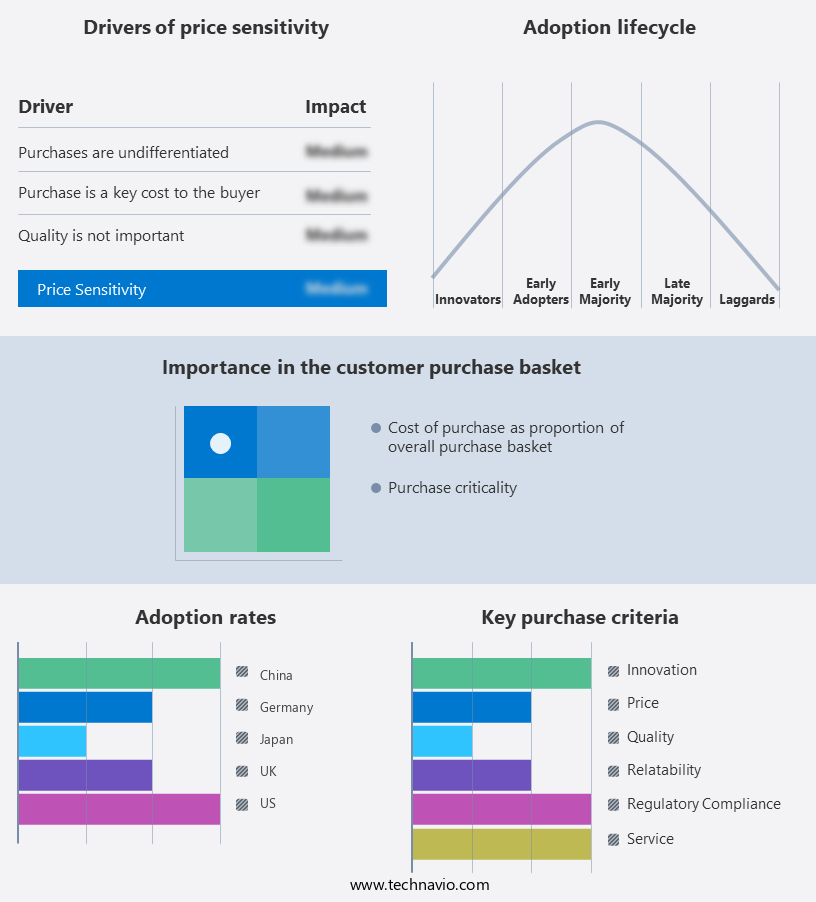
The industrial belt tensioners market forecasting report includes the adoption lifecycle of the market, covering from the innovator's stage to the laggard's stage. It focuses on adoption rates in different regions based on penetration. Furthermore, the industrial belt tensioners market report also includes key purchase criteria and drivers of price sensitivity to help companies evaluate and develop their market growth analysis strategies.
Industrial Belt Tensioners Market Share by Geography

 Customer Landscape

Key Companies & Market Insights

Companies are implementing various strategies, such as strategic alliances, industrial belt tensioners market forecast, partnerships, mergers and acquisitions, geographical expansion, and product/service launches, to enhance their presence in the industry.

AB SKF - The company specializes in providing advanced industrial belt tensioning solutions. Our offerings encompass automatic belt tensioner units and the SKF belt tension system.

The industry research and growth report includes detailed analyses of the competitive landscape of the market and information about key companies, including:

  • AB SKF
  • Applied Industrial Technologies Inc.
  • Bando Chemical Industries Ltd.
  • Brewer Machine and Gear Co.
  • Continental AG
  • Dayco IP Holdings LLC
  • Gates Industrial Corp. Plc
  • Hangzhou Chinabase Machinery Co. Ltd.
  • Hutchinson SA
  • Litens Automotive
  • Michelin Group
  • Murtfeldt Kunststoffe GmbH and Co. KG
  • Regal Rexnord Corp.
  • Schaeffler AG
  • The Timken Co.
  • TotalEnergies SE

Qualitative and quantitative analysis of companies has been conducted to help clients understand the wider business environment as well as the strengths and weaknesses of key industry players. Data is qualitatively analyzed to categorize companies as pure play, category-focused, industry-focused, and diversified; it is quantitatively analyzed to categorize companies as dominant, leading, strong, tentative, and weak.

Recent Development and News in Industrial Belt Tensioners Market

  • In February 2023, Trelleborg AB, a leading industrial solutions provider, announced the launch of its new line of industrial belt tensioners, the T-TEN Series, designed for heavy-duty applications in the mining and quarrying sectors (Trelleborg AB Press Release, 2023). This expansion broadens the company's product portfolio and strengthens its presence in the market.
  • In July 2024, Continental AG and Schaeffler AG, two major automotive and industrial suppliers, entered into a strategic partnership to develop and produce belt drives for electric vehicles (Continental AG Press Release, 2024). This collaboration is expected to result in advanced belt tensioning systems, contributing to the growth of the market in the electric vehicle sector.
  • In November 2024, ContiTech AG, a subsidiary of Continental AG, acquired the industrial belt tensioner business of a leading European competitor, expanding its market share and product offerings in the European market (ContiTech AG Press Release, 2024). This acquisition is expected to generate significant synergies and economies of scale for ContiTech AG.
  • In March 2025, the European Union passed new regulations on emissions standards for industrial processes, which include the use of energy-efficient belt tensioning systems (European Parliament and Council of the European Union, 2025). This regulatory development is expected to drive demand for advanced industrial belt tensioners in Europe, as companies seek to comply with the new regulations and reduce their carbon footprint.

Research Analyst Overview

The market is characterized by its continuous evolution, driven by the dynamic interplay of various factors. Belt load, a significant influencer, is a constant concern for manufacturers seeking to optimize their drive systems and enhance energy efficiency. Belt tensioning devices, including hydraulic, pneumatic, and mechanical varieties, are essential components in this regard, enabling precise belt tensioning and monitoring. Belt slippage, a common issue in material handling applications, is addressed through advanced belt tension optimization techniques. These methods, in turn, contribute to increased productivity and reduced downtime. Polyurethane belts, with their superior strength and durability, are increasingly adopted in heavy-duty applications, necessitating the development of specialized tensioners and installation techniques.

Belt alignment, tension measurement, and belt cleaning are critical aspects of belt maintenance, ensuring the longevity and performance of conveyor belts and other industrial applications. Compliance with safety standards and process control requirements is another driving force, leading to the development of automatic tensioners, tensioner control systems, and belt tension feedback mechanisms. Belt capacity, belt speed, belt width, and belt thickness are essential factors influencing belt selection and tensioning requirements. As industries continue to automate and demand higher performance from their machinery, the market for industrial belt tensioners will remain a vibrant and dynamic arena.

The Industrial Belt Tensioners Market is evolving with advancements in pneumatic tensioners and efficient tensioner adjustment technologies, ensuring smooth operation across industries. Optimized belt tracking enhances the lifespan of rubber belts, reducing wear and tear in conveyor belt systems. Reliable belt lubrication helps maintain performance, while durable tensioner springs and tensioner housings improve stability and longevity. Proper belt tension measurement is critical for preventing failures in high-speed drive system operations. Regular tensioner replacement ensures consistent efficiency, minimizing downtime in industrial processes.

Dive into Technavio's strong research methodology, blending expert interviews, extensive data synthesis, and validated models for unparalleled Industrial Belt Tensioners Market insights. See full methodology.

Market Scope

Report Coverage

Details

Page number

226

Base year

2024

Historic period

2019-2023

Forecast period

2025-2029

Growth momentum & CAGR

Accelerate at a CAGR of 3.4%

Market growth 2025-2029

USD 167.6 million

Market structure

Fragmented

YoY growth 2024-2025(%)

3.2

Key countries

US, China, Japan, India, South Korea, Germany, UK, Australia, Canada, and France

Competitive landscape

Leading Companies, Market Positioning of Companies, Competitive Strategies, and Industry Risks

Request Free Sample

What are the Key Data Covered in this Industrial Belt Tensioners Market Research and Growth Report?

  • CAGR of the Industrial Belt Tensioners industry during the forecast period
  • Detailed information on factors that will drive the growth and forecasting between 2025 and 2029
  • Precise estimation of the size of the market and its contribution of the industry in focus to the parent market
  • Accurate predictions about upcoming growth and trends and changes in consumer behaviour
  • Growth of the market across APAC, Europe, North America, South America, and Middle East and Africa
  • Thorough analysis of the market's competitive landscape and detailed information about companies
  • Comprehensive analysis of factors that will challenge the industrial belt tensioners market growth of industry companies

We can help! Our analysts can customize this industrial belt tensioners market research report to meet your requirements.

Get in touch

1 Executive Summary

  • 1.1 Market overview
    • Executive Summary - Chart on Market Overview
    • Executive Summary - Data Table on Market Overview
    • Executive Summary - Chart on Global Market Characteristics
    • Executive Summary - Chart on Market by Geography
    • Executive Summary - Chart on Market Segmentation by Application
    • Executive Summary - Chart on Market Segmentation by Type
    • Executive Summary - Chart on Market Segmentation by Material
    • Executive Summary - Chart on Incremental Growth
    • Executive Summary - Data Table on Incremental Growth
    • Executive Summary - Chart on Company Market Positioning

2 Technavio Analysis

  • 2.1 Analysis of price sensitivity, lifecycle, customer purchase basket, adoption rates, and purchase criteria
    • Analysis of price sensitivity, lifecycle, customer purchase basket, adoption rates, and purchase criteria
  • 2.2 Criticality of inputs and Factors of differentiation
    • Overview on criticality of inputs and factors of differentiation
  • 2.3 Factors of disruption
    • Overview on factors of disruption
  • 2.4 Impact of drivers and challenges
    • Impact of drivers and challenges in 2024 and 2029

3 Market Landscape

  • 3.1 Market ecosystem
    • Parent Market
    • Data Table on - Parent Market
  • 3.2 Market characteristics
    • Market characteristics analysis
  • 3.3 Value chain analysis
    • Value chain analysis

4 Market Sizing

  • 4.1 Market definition
    • Offerings of companies included in the market definition
  • 4.2 Market segment analysis
    • Market segments
  • 4.3 Market size 2024
    • 4.4 Market outlook: Forecast for 2024-2029
      • Chart on Global - Market size and forecast 2024-2029 ($ million)
      • Data Table on Global - Market size and forecast 2024-2029 ($ million)
      • Chart on Global Market: Year-over-year growth 2024-2029 (%)
      • Data Table on Global Market: Year-over-year growth 2024-2029 (%)

    5 Historic Market Size

    • 5.1 Global Industrial Belt Tensioners Market 2019 - 2023
      • Historic Market Size - Data Table on Global Industrial Belt Tensioners Market 2019 - 2023 ($ million)
    • 5.2 Application segment analysis 2019 - 2023
      • Historic Market Size - Application Segment 2019 - 2023 ($ million)
    • 5.3 Type segment analysis 2019 - 2023
      • Historic Market Size - Type Segment 2019 - 2023 ($ million)
    • 5.4 Material segment analysis 2019 - 2023
      • Historic Market Size - Material Segment 2019 - 2023 ($ million)
    • 5.5 Geography segment analysis 2019 - 2023
      • Historic Market Size - Geography Segment 2019 - 2023 ($ million)
    • 5.6 Country segment analysis 2019 - 2023
      • Historic Market Size - Country Segment 2019 - 2023 ($ million)

    6 Qualitative Analysis

    • 6.1 Impact of AI on global industrial belt tensioners market

      7 Five Forces Analysis

      • 7.1 Five forces summary
        • Five forces analysis - Comparison between 2024 and 2029
      • 7.2 Bargaining power of buyers
        • Bargaining power of buyers - Impact of key factors 2024 and 2029
      • 7.3 Bargaining power of suppliers
        • Bargaining power of suppliers - Impact of key factors in 2024 and 2029
      • 7.4 Threat of new entrants
        • Threat of new entrants - Impact of key factors in 2024 and 2029
      • 7.5 Threat of substitutes
        • Threat of substitutes - Impact of key factors in 2024 and 2029
      • 7.6 Threat of rivalry
        • Threat of rivalry - Impact of key factors in 2024 and 2029
      • 7.7 Market condition
        • Chart on Market condition - Five forces 2024 and 2029

      8 Market Segmentation by Application

      • 8.1 Market segments
        • Chart on Application - Market share 2024-2029 (%)
        • Data Table on Application - Market share 2024-2029 (%)
      • 8.2 Comparison by Application
        • Chart on Comparison by Application
        • Data Table on Comparison by Application
      • 8.3 Material handling industry - Market size and forecast 2024-2029
        • Chart on Material handling industry - Market size and forecast 2024-2029 ($ million)
        • Data Table on Material handling industry - Market size and forecast 2024-2029 ($ million)
        • Chart on Material handling industry - Year-over-year growth 2024-2029 (%)
        • Data Table on Material handling industry - Year-over-year growth 2024-2029 (%)
      • 8.4 Industrial machinery sector - Market size and forecast 2024-2029
        • Chart on Industrial machinery sector - Market size and forecast 2024-2029 ($ million)
        • Data Table on Industrial machinery sector - Market size and forecast 2024-2029 ($ million)
        • Chart on Industrial machinery sector - Year-over-year growth 2024-2029 (%)
        • Data Table on Industrial machinery sector - Year-over-year growth 2024-2029 (%)
      • 8.5 Agriculture industry - Market size and forecast 2024-2029
        • Chart on Agriculture industry - Market size and forecast 2024-2029 ($ million)
        • Data Table on Agriculture industry - Market size and forecast 2024-2029 ($ million)
        • Chart on Agriculture industry - Year-over-year growth 2024-2029 (%)
        • Data Table on Agriculture industry - Year-over-year growth 2024-2029 (%)
      • 8.6 Mining and mineral industry - Market size and forecast 2024-2029
        • Chart on Mining and mineral industry - Market size and forecast 2024-2029 ($ million)
        • Data Table on Mining and mineral industry - Market size and forecast 2024-2029 ($ million)
        • Chart on Mining and mineral industry - Year-over-year growth 2024-2029 (%)
        • Data Table on Mining and mineral industry - Year-over-year growth 2024-2029 (%)
      • 8.7 Market opportunity by Application
        • Market opportunity by Application ($ million)
        • Data Table on Market opportunity by Application ($ million)

      9 Market Segmentation by Type

      • 9.1 Market segments
        • Chart on Type - Market share 2024-2029 (%)
        • Data Table on Type - Market share 2024-2029 (%)
      • 9.2 Comparison by Type
        • Chart on Comparison by Type
        • Data Table on Comparison by Type
      • 9.3 Automatic - Market size and forecast 2024-2029
        • Chart on Automatic - Market size and forecast 2024-2029 ($ million)
        • Data Table on Automatic - Market size and forecast 2024-2029 ($ million)
        • Chart on Automatic - Year-over-year growth 2024-2029 (%)
        • Data Table on Automatic - Year-over-year growth 2024-2029 (%)
      • 9.4 Non-automatic - Market size and forecast 2024-2029
        • Chart on Non-automatic - Market size and forecast 2024-2029 ($ million)
        • Data Table on Non-automatic - Market size and forecast 2024-2029 ($ million)
        • Chart on Non-automatic - Year-over-year growth 2024-2029 (%)
        • Data Table on Non-automatic - Year-over-year growth 2024-2029 (%)
      • 9.5 Market opportunity by Type
        • Market opportunity by Type ($ million)
        • Data Table on Market opportunity by Type ($ million)

      10 Market Segmentation by Material

      • 10.1 Market segments
        • Chart on Material - Market share 2024-2029 (%)
        • Data Table on Material - Market share 2024-2029 (%)
      • 10.2 Comparison by Material
        • Chart on Comparison by Material
        • Data Table on Comparison by Material
      • 10.3 Steel tensioners - Market size and forecast 2024-2029
        • Chart on Steel tensioners - Market size and forecast 2024-2029 ($ million)
        • Data Table on Steel tensioners - Market size and forecast 2024-2029 ($ million)
        • Chart on Steel tensioners - Year-over-year growth 2024-2029 (%)
        • Data Table on Steel tensioners - Year-over-year growth 2024-2029 (%)
      • 10.4 Aluminum tensioners - Market size and forecast 2024-2029
        • Chart on Aluminum tensioners - Market size and forecast 2024-2029 ($ million)
        • Data Table on Aluminum tensioners - Market size and forecast 2024-2029 ($ million)
        • Chart on Aluminum tensioners - Year-over-year growth 2024-2029 (%)
        • Data Table on Aluminum tensioners - Year-over-year growth 2024-2029 (%)
      • 10.5 Plastic tensioners - Market size and forecast 2024-2029
        • Chart on Plastic tensioners - Market size and forecast 2024-2029 ($ million)
        • Data Table on Plastic tensioners - Market size and forecast 2024-2029 ($ million)
        • Chart on Plastic tensioners - Year-over-year growth 2024-2029 (%)
        • Data Table on Plastic tensioners - Year-over-year growth 2024-2029 (%)
      • 10.6 Composite material tensioners - Market size and forecast 2024-2029
        • Chart on Composite material tensioners - Market size and forecast 2024-2029 ($ million)
        • Data Table on Composite material tensioners - Market size and forecast 2024-2029 ($ million)
        • Chart on Composite material tensioners - Year-over-year growth 2024-2029 (%)
        • Data Table on Composite material tensioners - Year-over-year growth 2024-2029 (%)
      • 10.7 Market opportunity by Material
        • Market opportunity by Material ($ million)
        • Data Table on Market opportunity by Material ($ million)

      11 Customer Landscape

      • 11.1 Customer landscape overview
        • Analysis of price sensitivity, lifecycle, customer purchase basket, adoption rates, and purchase criteria

      12 Geographic Landscape

      • 12.1 Geographic segmentation
        • Chart on Market share by geography 2024-2029 (%)
        • Data Table on Market share by geography 2024-2029 (%)
      • 12.2 Geographic comparison
        • Chart on Geographic comparison
        • Data Table on Geographic comparison
      • 12.3 APAC - Market size and forecast 2024-2029
        • Chart on APAC - Market size and forecast 2024-2029 ($ million)
        • Data Table on APAC - Market size and forecast 2024-2029 ($ million)
        • Chart on APAC - Year-over-year growth 2024-2029 (%)
        • Data Table on APAC - Year-over-year growth 2024-2029 (%)
      • 12.4 Europe - Market size and forecast 2024-2029
        • Chart on Europe - Market size and forecast 2024-2029 ($ million)
        • Data Table on Europe - Market size and forecast 2024-2029 ($ million)
        • Chart on Europe - Year-over-year growth 2024-2029 (%)
        • Data Table on Europe - Year-over-year growth 2024-2029 (%)
      • 12.5 North America - Market size and forecast 2024-2029
        • Chart on North America - Market size and forecast 2024-2029 ($ million)
        • Data Table on North America - Market size and forecast 2024-2029 ($ million)
        • Chart on North America - Year-over-year growth 2024-2029 (%)
        • Data Table on North America - Year-over-year growth 2024-2029 (%)
      • 12.6 South America - Market size and forecast 2024-2029
        • Chart on South America - Market size and forecast 2024-2029 ($ million)
        • Data Table on South America - Market size and forecast 2024-2029 ($ million)
        • Chart on South America - Year-over-year growth 2024-2029 (%)
        • Data Table on South America - Year-over-year growth 2024-2029 (%)
      • 12.7 Middle East and Africa - Market size and forecast 2024-2029
        • Chart on Middle East and Africa - Market size and forecast 2024-2029 ($ million)
        • Data Table on Middle East and Africa - Market size and forecast 2024-2029 ($ million)
        • Chart on Middle East and Africa - Year-over-year growth 2024-2029 (%)
        • Data Table on Middle East and Africa - Year-over-year growth 2024-2029 (%)
      • 12.8 US - Market size and forecast 2024-2029
        • Chart on US - Market size and forecast 2024-2029 ($ million)
        • Data Table on US - Market size and forecast 2024-2029 ($ million)
        • Chart on US - Year-over-year growth 2024-2029 (%)
        • Data Table on US - Year-over-year growth 2024-2029 (%)
      • 12.9 China - Market size and forecast 2024-2029
        • Chart on China - Market size and forecast 2024-2029 ($ million)
        • Data Table on China - Market size and forecast 2024-2029 ($ million)
        • Chart on China - Year-over-year growth 2024-2029 (%)
        • Data Table on China - Year-over-year growth 2024-2029 (%)
      • 12.10 Japan - Market size and forecast 2024-2029
        • Chart on Japan - Market size and forecast 2024-2029 ($ million)
        • Data Table on Japan - Market size and forecast 2024-2029 ($ million)
        • Chart on Japan - Year-over-year growth 2024-2029 (%)
        • Data Table on Japan - Year-over-year growth 2024-2029 (%)
      • 12.11 India - Market size and forecast 2024-2029
        • Chart on India - Market size and forecast 2024-2029 ($ million)
        • Data Table on India - Market size and forecast 2024-2029 ($ million)
        • Chart on India - Year-over-year growth 2024-2029 (%)
        • Data Table on India - Year-over-year growth 2024-2029 (%)
      • 12.12 South Korea - Market size and forecast 2024-2029
        • Chart on South Korea - Market size and forecast 2024-2029 ($ million)
        • Data Table on South Korea - Market size and forecast 2024-2029 ($ million)
        • Chart on South Korea - Year-over-year growth 2024-2029 (%)
        • Data Table on South Korea - Year-over-year growth 2024-2029 (%)
      • 12.13 Germany - Market size and forecast 2024-2029
        • Chart on Germany - Market size and forecast 2024-2029 ($ million)
        • Data Table on Germany - Market size and forecast 2024-2029 ($ million)
        • Chart on Germany - Year-over-year growth 2024-2029 (%)
        • Data Table on Germany - Year-over-year growth 2024-2029 (%)
      • 12.14 UK - Market size and forecast 2024-2029
        • Chart on UK - Market size and forecast 2024-2029 ($ million)
        • Data Table on UK - Market size and forecast 2024-2029 ($ million)
        • Chart on UK - Year-over-year growth 2024-2029 (%)
        • Data Table on UK - Year-over-year growth 2024-2029 (%)
      • 12.15 Australia - Market size and forecast 2024-2029
        • Chart on Australia - Market size and forecast 2024-2029 ($ million)
        • Data Table on Australia - Market size and forecast 2024-2029 ($ million)
        • Chart on Australia - Year-over-year growth 2024-2029 (%)
        • Data Table on Australia - Year-over-year growth 2024-2029 (%)
      • 12.16 Canada - Market size and forecast 2024-2029
        • Chart on Canada - Market size and forecast 2024-2029 ($ million)
        • Data Table on Canada - Market size and forecast 2024-2029 ($ million)
        • Chart on Canada - Year-over-year growth 2024-2029 (%)
        • Data Table on Canada - Year-over-year growth 2024-2029 (%)
      • 12.17 France - Market size and forecast 2024-2029
        • Chart on France - Market size and forecast 2024-2029 ($ million)
        • Data Table on France - Market size and forecast 2024-2029 ($ million)
        • Chart on France - Year-over-year growth 2024-2029 (%)
        • Data Table on France - Year-over-year growth 2024-2029 (%)
      • 12.18 Market opportunity by geography
        • Market opportunity by geography ($ million)
        • Data Tables on Market opportunity by geography ($ million)

      13 Drivers, Challenges, and Opportunity/Restraints

      • 13.1 Market drivers
        • 13.2 Market challenges
          • 13.3 Impact of drivers and challenges
            • Impact of drivers and challenges in 2024 and 2029
          • 13.4 Market opportunities/restraints

            14 Competitive Landscape

            • 14.1 Overview
              • 14.2 Competitive Landscape
                • Overview on criticality of inputs and factors of differentiation
              • 14.3 Landscape disruption
                • Overview on factors of disruption
              • 14.4 Industry risks
                • Impact of key risks on business

              15 Competitive Analysis

              • 15.1 Companies profiled
                • Companies covered
              • 15.2 Company ranking index
                • Company ranking index
              • 15.3 Market positioning of companies
                • Matrix on companies position and classification
              • 15.4 AB SKF
                • AB SKF - Overview
                • AB SKF - Business segments
                • AB SKF - Key news
                • AB SKF - Key offerings
                • AB SKF - Segment focus
                • SWOT
              • 15.5 Applied Industrial Technologies Inc.
                • Applied Industrial Technologies Inc. - Overview
                • Applied Industrial Technologies Inc. - Business segments
                • Applied Industrial Technologies Inc. - Key news
                • Applied Industrial Technologies Inc. - Key offerings
                • Applied Industrial Technologies Inc. - Segment focus
                • SWOT
              • 15.6 Bando Chemical Industries Ltd.
                • Bando Chemical Industries Ltd. - Overview
                • Bando Chemical Industries Ltd. - Business segments
                • Bando Chemical Industries Ltd. - Key offerings
                • Bando Chemical Industries Ltd. - Segment focus
                • SWOT
              • 15.7 Brewer Machine and Gear Co.
                • Brewer Machine and Gear Co. - Overview
                • Brewer Machine and Gear Co. - Product / Service
                • Brewer Machine and Gear Co. - Key offerings
                • SWOT
              • 15.8 Continental AG
                • Continental AG - Overview
                • Continental AG - Business segments
                • Continental AG - Key news
                • Continental AG - Key offerings
                • Continental AG - Segment focus
                • SWOT
              • 15.9 Dayco IP Holdings LLC
                • Dayco IP Holdings LLC - Overview
                • Dayco IP Holdings LLC - Product / Service
                • Dayco IP Holdings LLC - Key offerings
                • SWOT
              • 15.10 Gates Industrial Corp. Plc
                • Gates Industrial Corp. Plc - Overview
                • Gates Industrial Corp. Plc - Business segments
                • Gates Industrial Corp. Plc - Key offerings
                • Gates Industrial Corp. Plc - Segment focus
                • SWOT
              • 15.11 Hangzhou Chinabase Machinery Co. Ltd.
                • Hangzhou Chinabase Machinery Co. Ltd. - Overview
                • Hangzhou Chinabase Machinery Co. Ltd. - Product / Service
                • Hangzhou Chinabase Machinery Co. Ltd. - Key offerings
                • SWOT
              • 15.12 Hutchinson SA
                • Hutchinson SA - Overview
                • Hutchinson SA - Product / Service
                • Hutchinson SA - Key offerings
                • SWOT
              • 15.13 Litens Automotive
                • Litens Automotive - Overview
                • Litens Automotive - Product / Service
                • Litens Automotive - Key offerings
                • SWOT
              • 15.14 Michelin Group
                • Michelin Group - Overview
                • Michelin Group - Business segments
                • Michelin Group - Key news
                • Michelin Group - Key offerings
                • Michelin Group - Segment focus
                • SWOT
              • 15.15 Murtfeldt Kunststoffe GmbH and Co. KG
                • Murtfeldt Kunststoffe GmbH and Co. KG - Overview
                • Murtfeldt Kunststoffe GmbH and Co. KG - Product / Service
                • Murtfeldt Kunststoffe GmbH and Co. KG - Key offerings
                • SWOT
              • 15.16 Regal Rexnord Corp.
                • Regal Rexnord Corp. - Overview
                • Regal Rexnord Corp. - Business segments
                • Regal Rexnord Corp. - Key offerings
                • Regal Rexnord Corp. - Segment focus
                • SWOT
              • 15.17 The Timken Co.
                • The Timken Co. - Overview
                • The Timken Co. - Business segments
                • The Timken Co. - Key news
                • The Timken Co. - Key offerings
                • The Timken Co. - Segment focus
                • SWOT
              • 15.18 TotalEnergies SE
                • TotalEnergies SE - Overview
                • TotalEnergies SE - Business segments
                • TotalEnergies SE - Key news
                • TotalEnergies SE - Key offerings
                • TotalEnergies SE - Segment focus
                • SWOT

              16 Appendix

              • 16.1 Scope of the report
                • 16.2 Inclusions and exclusions checklist
                  • Inclusions checklist
                  • Exclusions checklist
                • 16.3 Currency conversion rates for US$
                  • Currency conversion rates for US$
                • 16.4 Research methodology
                  • Research methodology
                • 16.5 Data procurement
                  • Information sources
                • 16.6 Data validation
                  • Data validation
                • 16.7 Validation techniques employed for market sizing
                  • Validation techniques employed for market sizing
                • 16.8 Data synthesis
                  • Data synthesis
                • 16.9 360 degree market analysis
                  • 360 degree market analysis
                • 16.10 List of abbreviations
                  • List of abbreviations

                Research Methodology

                Technavio presents a detailed picture of the market by way of study, synthesis, and summation of data from multiple sources. The analysts have presented the various facets of the market with a particular focus on identifying the key industry influencers. The data thus presented is comprehensive, reliable, and the result of extensive research, both primary and secondary.

                INFORMATION SOURCES

                Primary sources

                • Manufacturers and suppliers
                • Channel partners
                • Industry experts
                • Strategic decision makers

                Secondary sources

                • Industry journals and periodicals
                • Government data
                • Financial reports of key industry players
                • Historical data
                • Press releases

                DATA ANALYSIS

                Data Synthesis

                • Collation of data
                • Estimation of key figures
                • Analysis of derived insights

                Data Validation

                • Triangulation with data models
                • Reference against proprietary databases
                • Corroboration with industry experts

                REPORT WRITING

                Qualitative

                • Market drivers
                • Market challenges
                • Market trends
                • Five forces analysis

                Quantitative

                • Market size and forecast
                • Market segmentation
                • Geographical insights
                • Competitive landscape

                Interested in this report?

                Get your sample now to see our research methodology and insights!

                Download Now

                Frequently Asked Questions

                Industrial Belt Tensioners market growth will increase by $ 167.6 mn during 2025-2029 .

                The Industrial Belt Tensioners market is expected to grow at a CAGR of 3.4% during 2025-2029 .

                Industrial Belt Tensioners market is segmented by Application( Material handling industry, Industrial machinery sector, Agriculture industry, Mining and mineral industry) Type( Automatic, Non-automatic, North America, South America, MEA) Material( Steel tensioners, Aluminum tensioners, Plastic tensioners, Composite material tensioners, Middle East and Africa)

                AB SKF, Applied Industrial Technologies Inc., Bando Chemical Industries Ltd., Brewer Machine and Gear Co., Continental AG, Dayco IP Holdings LLC, Gates Industrial Corp. Plc, Hangzhou Chinabase Machinery Co. Ltd., Hutchinson SA, Litens Automotive, Michelin Group, Murtfeldt Kunststoffe GmbH and Co. KG, Regal Rexnord Corp., Schaeffler AG, The Timken Co., TotalEnergies SE are a few of the key vendors in the Industrial Belt Tensioners market.

                APAC will register the highest growth rate of 51% among the other regions. Therefore, the Industrial Belt Tensioners market in APAC is expected to garner significant business opportunities for the vendors during the forecast period.

                US, China, Japan, India, South Korea, Germany, UK, Australia, Canada, France

                • Increasing investments in industrial assetsThe rising adoption of industrial assets is the driving factor this market.
                • such as advanced machinery is the driving factor this market.
                • with low downtime to improve productivity is the driving factor this market.
                • has prompted companies to increase their investments in machines and equipment. The manufacturing sector in APAC is continually growing is the driving factor this market.
                • and therefore is the driving factor this market.
                • the demand for industrial belt drives is also associated with industrial growth. Countries such as India is the driving factor this market.
                • the UAE is the driving factor this market.
                • Brazil is the driving factor this market.
                • China is the driving factor this market.
                • Thailand is the driving factor this market.
                • and Malaysia are enduring developmental initiatives by governments to bolster the domestic manufacturing sector. Therefore is the driving factor this market.
                • there is a greater need to increase productivity and gain maximum efficiency with the use of industrial belt tensioners.Mechanization is a key aspect of any manufacturing process to ensure that all activities and sub-processes are modernized is the driving factor this market.
                • efficient is the driving factor this market.
                • and quicker. Developing trends in automation are expected to shape the competitive landscape of the global industrial market. Manufacturers are allocating a reasonable share of their annual budget for technologies that can modernize the manufacturing set-up in yielding faster and better returns in the future. During the forecast period is the driving factor this market.
                • it is expected that industrial belt tensioners will form an integral part of belt drives for process automation. This is primarily due to the belt driver wide range of applications in industries is the driving factor this market.
                • ease of use is the driving factor this market.
                • provision of operational cost reduction is the driving factor this market.
                • and energy-efficient properties.The manufacturing expenditure to revolutionize plant facilities has considerably increased over the years. Manufacturers and industrialists are becoming more conscious of the need to integrate their industrial machinery and processes is the driving factor this market.
                • thereby averting downtime is the driving factor this market.
                • increasing efficiency is the driving factor this market.
                • and reducing product lead time. To achieve maximum efficiency is the driving factor this market.
                • a significant investment is being carved out by businesses for renovating manufacturing facilities and assimilating advanced technologies. Thus is the driving factor this market.
                • increasing investments in industrial assets will propel the growth of the global industrial belt tensioners market during the forecast period. is the driving factor this market.

                The Industrial Belt Tensioners market vendors should focus on grabbing business opportunities from the Material handling industry segment as it accounted for the largest market share in the base year.
