



IoT Analytics Market Size 2024-2028
The iot analytics market size is forecast to increase by USD 153.66 billion, at a CAGR of 46.4% between 2023 and 2028.
- The Internet of Things (IoT) analytics market is experiencing significant growth, driven by the increasing need to improve business efficiency and enhance operational productivity. One of the most promising sectors for IoT analytics is healthcare, where real-time data analysis is revolutionizing patient care and diagnosis. However, the market's expansion is not without challenges. The sluggish connectivity for IoT devices poses a significant obstacle, limiting the potential for widespread adoption and integration. To capitalize on the market opportunities and navigate these challenges effectively, companies must focus on developing robust IoT analytics solutions that can seamlessly integrate with various devices and networks.
- By addressing the connectivity issue and delivering actionable insights, organizations can unlock the full potential of IoT analytics and transform their operations.
What will be the Size of the IoT Analytics Market during the forecast period?
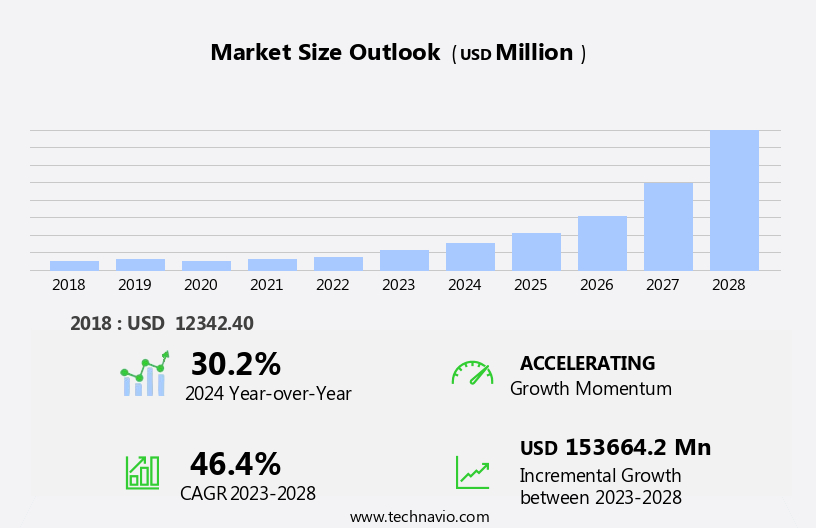
Explore in-depth regional segment analysis with market size data - historical 2018-2022 and forecasts 2024-2028 - in the full report.
Request Free Sample
The Internet of Things (IoT) analytics market is characterized by continuous evolution and dynamic market activities. Deep learning and machine learning algorithms are increasingly being integrated into IoT systems for advanced data analysis, enabling real-time decision making and process automation. Edge computing, with its ability to process data closer to the source, enhances operational efficiency and reduces latency in data transfer. Financial services sector is leveraging IoT analytics for fraud detection, risk management, and customer behavior analysis. Wireless networks and low-power wide-area networks facilitate seamless data acquisition from smart devices, ensuring data privacy and security through robust protocols and encryption techniques.
Cloud integration and API management enable easy access to data and integration with business intelligence tools, enabling data visualization and data governance. Industrial IoT applications span across various sectors, including supply chain management, fleet management, and smart manufacturing, with a focus on cost optimization and energy management. IoT security is a critical concern, with ongoing efforts towards developing advanced security protocols and firmware updates. Precision agriculture, smart homes, retail analytics, and smart cities are among the emerging applications of IoT analytics, offering significant potential for process automation, environmental monitoring, and public safety. The market dynamics of IoT analytics are shaped by ongoing advancements in artificial intelligence, data analytics, and software defined networking.
Integration services and deployment strategies continue to evolve, enabling seamless integration with consumer electronics, healthcare monitoring, and energy management systems. Open standards and real-time monitoring are essential for ensuring interoperability and scalability in IoT ecosystems.
How is this IoT Analytics Industry segmented?
The iot analytics industry research report provides comprehensive data (region-wise segment analysis), with forecasts and estimates in "USD million" for the period 2024-2028, as well as historical data from 2018-2022 for the following segments.
- Component
- Software
- Services
- End-user
- Manufacturing
- Retail
- Healthcare
- Telecommunication and IT
- Others
- Geography
- North America
- US
- Canada
- Europe
- France
- Germany
- Spain
- UK
- APAC
- Australia
- China
- India
- Japan
- Rest of World (ROW)
- North America
By Component Insights
The software segment is estimated to witness significant growth during the forecast period.
In the dynamic landscape of IoT analytics, software solutions have emerged as a dominant force in 2023, accounting for a significant market share. This trend is driven by the expanding global reach of IT and retail companies, necessitating large-scale data management. The surge in SME growth in emerging economies, such as China, India, Brazil, Indonesia, and Mexico, further fuels the demand for data-driven decision-making tools. companies in the market offer software solutions to various industries, enabling real-time data acquisition and analysis for valuable business insights. Edge computing, machine learning, and artificial intelligence technologies are integrated into these solutions to optimize operational efficiency, enhance process automation, and bolster data security.
Furthermore, the integration of wireless networks, cloud services, and APIs facilitates seamless data exchange and analysis. Low-power wide-area networks and sensor networks expand the reach of IoT analytics, enabling precision agriculture, smart homes, and retail analytics, among other applications. The market also prioritizes data privacy, security protocols, and open standards to ensure data governance and consumer trust. IoT platforms, industrial IoT, public safety, energy management, and healthcare monitoring are key areas of focus for companies, as they cater to the evolving needs of diverse industries.
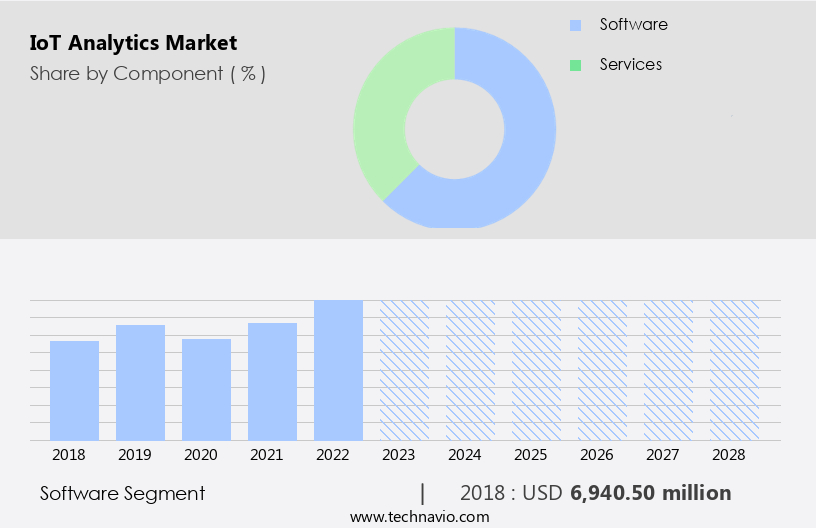
The Software segment was valued at USD 6.94 billion in 2018 and showed a gradual increase during the forecast period.
Regional Analysis
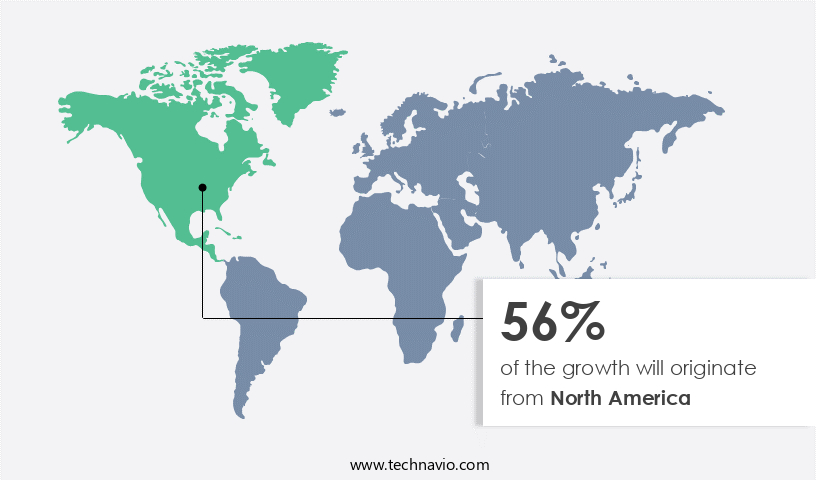
North America is estimated to contribute 56% to the growth of the global market during the forecast period.Technavio’s analysts have elaborately explained the regional trends and drivers that shape the market during the forecast period.
The market is witnessing significant growth, driven by the increasing adoption of deep learning and machine learning technologies for data-driven decision making. Edge computing plays a crucial role in real-time data processing, enabling operational efficiency and reducing latency. Over-the-air updates ensure seamless integration of financial services with IoT devices, while wireless networks and cloud integration facilitate data acquisition and API management. IoT security is a major concern, leading to the development of advanced security protocols and encryption methods. Smart devices, from consumer electronics to industrial IoT, are generating vast amounts of data, necessitating data analytics and data visualization tools.
Low-power wide-area networks and sensor networks enable precision agriculture, energy management, and environmental monitoring, among other applications. Process automation, supply chain management, fleet management, and asset tracking are key areas where IoT analytics is making a significant impact. Smart manufacturing and smart cities are emerging sectors, leveraging artificial intelligence and remote control for improved efficiency and productivity. Energy management, healthcare monitoring, and public safety are other sectors benefiting from real-time monitoring and business intelligence. Cost optimization and deployment strategies are critical factors influencing the market dynamics. Industrial IoT platforms are providing integration services, enabling seamless data flow between various systems and applications.
Geospatial data and network management are essential components of IoT analytics, ensuring data privacy and location tracking. In the US, the market is thriving due to the country's advanced economy and leading industries. The healthcare sector, in particular, is driving growth, with the adoption of IoT technologies for patient monitoring and disease management. The expanding aging population and increasing healthcare spending are further boosting the market. The US is also a hub for technology innovation, making it an attractive region for IoT analytics providers.
Market Dynamics
Our researchers analyzed the data with 2023 as the base year, along with the key drivers, trends, and challenges. A holistic analysis of drivers will help companies refine their marketing strategies to gain a competitive advantage.
What are the key market drivers leading to the rise in the adoption of IoT Analytics Industry?
- To enhance business efficiency is the primary motivator in today's market, with professionals continually seeking ways to optimize operations and increase productivity.
- The Internet of Things (IoT) analytics market is witnessing significant growth due to the increasing adoption of connected devices in various industries. Businesses are recognizing the potential of utilizing the vast data generated by these devices to optimize costs, improve services, and generate new revenue streams. For instance, in the aviation industry, engine manufacturers are offering rental programs that include engine usage data, enabling them to enhance design and reduce manufacturing and maintenance costs, providing a competitive edge. Manufacturing industries are embracing automation and flexible production techniques to boost productivity. Predictive asset maintenance is another area where IoT analytics is making a mark, allowing companies to save on scheduled repairs, reduce maintenance costs, and prevent breakdowns.
- Open standards are essential for IoT platforms to ensure interoperability and seamless data exchange between different devices and systems. Real-time monitoring of environmental conditions, network management, healthcare monitoring, public safety, and geospatial data are some of the key applications of IoT analytics. Cost optimization is a significant driver for businesses adopting IoT analytics, as it enables them to make data-driven decisions and improve operational efficiency. Industrial IoT is expected to dominate the market due to its large-scale implementation in various industries. Business intelligence and consumer electronics are other sectors that are leveraging IoT analytics to gain insights and enhance customer experiences.
- IoT analytics platforms are helping organizations in various industries to make sense of the massive amounts of data generated by connected devices and gain valuable insights for better decision-making.
What are the market trends shaping the IoT Analytics Industry?
- The increasing utilization of Internet of Things (IoT) analytics is a significant market trend in the healthcare sector. This technological advancement enables the collection, processing, and analysis of vast amounts of patient data in real-time, leading to improved healthcare outcomes and operational efficiencies.
- The Internet of Things (IoT) analytics market is experiencing significant growth due to the increasing adoption of deep learning and machine learning technologies in various industries, including financial services. Edge computing enables real-time data processing, allowing for quicker and more effective data-driven decision making. Over-the-air updates ensure that systems remain current and secure, while wireless networks and cloud integration facilitate seamless data acquisition and API management. IoT analytics provides operational efficiency by monitoring and analyzing data in real-time, leading to cost savings and improved productivity. Security is a critical concern, and advanced technologies such as data analytics and machine learning are being used to enhance IoT security.
- Financial services institutions are leveraging IoT analytics to gain insights into customer behavior and market trends, enabling them to offer personalized services and improve overall performance. The integration of IoT with wireless networks and cloud services is facilitating the development of new business models and revenue streams. Deep learning algorithms enable advanced predictive analytics, allowing businesses to anticipate trends and make informed decisions. Machine learning models can be trained on historical data to identify patterns and anomalies, providing valuable insights for decision-making. In conclusion, the market is a dynamic and rapidly evolving field, driven by the adoption of advanced technologies such as deep learning and machine learning.
- The ability to process and analyze data in real-time is leading to operational efficiencies, improved security, and new business opportunities. Financial services institutions are at the forefront of this trend, leveraging IoT analytics to gain insights into customer behavior and market trends.
What challenges does the IoT Analytics Industry face during its growth?
- The slow connectivity of Internet of Things (IoT) devices represents a significant challenge that can hinder industry growth.
- IoT analytics is a crucial component of the Internet of Things (IoT) ecosystem, enabling businesses to derive valuable insights from the vast amounts of data generated by smart devices. IoT analytics solutions facilitate process automation, supply chain management, fleet management, and smart manufacturing by analyzing data from sensors and devices in real-time. However, the increasing number of connected devices places significant demands on Internet networks, particularly in sectors such as transportation and telecommunications. To address the challenge of seamless connectivity, low-power wide-area networks (LPWANs) are gaining popularity due to their ability to support multiple devices with minimal power consumption and reduced bandwidth requirements.
- Furthermore, artificial intelligence (AI) and data visualization tools help businesses make informed decisions by analyzing data from IoT devices and providing actionable insights. Device management and data privacy are other critical aspects of IoT analytics. Effective device management ensures that IoT devices are secure, up-to-date, and functioning optimally. Data privacy is essential to protect sensitive information transmitted between devices and servers. Cellular networks and other connectivity options can be used for remote control and asset tracking, further enhancing the capabilities of IoT analytics solutions. In conclusion, IoT analytics plays a vital role in enabling businesses to gain insights from the data generated by smart devices.
- LPWANs, AI, and data visualization tools help address the challenges of connectivity, while device management and data privacy ensure secure and efficient operations.
Exclusive Customer Landscape
The iot analytics market forecasting report includes the adoption lifecycle of the market, covering from the innovator’s stage to the laggard’s stage. It focuses on adoption rates in different regions based on penetration. Furthermore, the iot analytics market report also includes key purchase criteria and drivers of price sensitivity to help companies evaluate and develop their market growth analysis strategies.
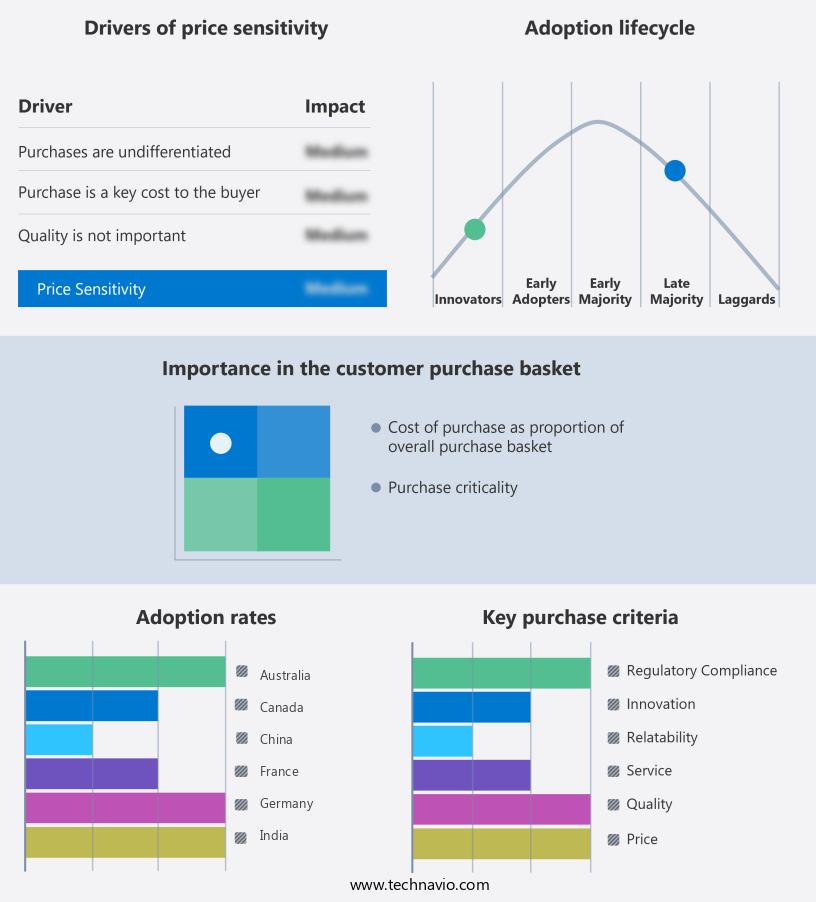
Customer Landscape
Key Companies & Market Insights
Companies are implementing various strategies, such as strategic alliances, iot analytics market forecast, partnerships, mergers and acquisitions, geographical expansion, and product/service launches, to enhance their presence in the industry.
Accenture PLC - The company specializes in IoT analytics solutions, leveraging advanced technologies such as AWS IoT Analytics. By processing and analyzing vast amounts of data generated by Internet of Things devices, we enable businesses to gain valuable insights, optimize operations, and make informed decisions in real-time. Our offerings go beyond basic data collection and storage, providing actionable intelligence that drives business growth and innovation. Our expertise in IoT analytics empowers organizations to unlock the full potential of their connected devices and transform data into meaningful business outcomes.
The industry research and growth report includes detailed analyses of the competitive landscape of the market and information about key companies, including:
- Accenture PLC
- Aeris Communications Inc.
- Amazon.com Inc.
- Cisco Systems Inc.
- Dell Technologies Inc.
- Hewlett Packard Enterprise Co.
- Hitachi Ltd.
- Intel Corp.
- International Business Machines Corp.
- IoT Analytics GmbH
- Microsoft Corp.
- Open Text Corporation
- Oracle Corp.
- PTC Inc.
- Salesforce Inc.
- SAP SE
- SAS Institute Inc.
- Software AG
- Teradata Corp.
Qualitative and quantitative analysis of companies has been conducted to help clients understand the wider business environment as well as the strengths and weaknesses of key industry players. Data is qualitatively analyzed to categorize companies as pure play, category-focused, industry-focused, and diversified; it is quantitatively analyzed to categorize companies as dominant, leading, strong, tentative, and weak.
Recent Development and News in IoT Analytics Market
- In February 2023, IBM announced the launch of its new AI-powered IoT analytics platform, "IBM Watson IoT Platform for Automotive," designed specifically for the automotive industry to analyze real-time vehicle data and improve customer experiences (IBM Press Release).
- In May 2024, Microsoft and Amazon Web Services (AWS) formed a strategic partnership to integrate Microsoft Azure IoT Hub with AWS Greengrass, enabling seamless data transfer and processing between the two platforms (Microsoft News Center).
- In August 2024, Siemens and Google Cloud signed a multi-year agreement to expand their collaboration on IoT analytics, focusing on industrial applications and integrating Siemens' MindSphere IoT operating system with Google Cloud Platform (Siemens Press Release).
- In November 2024, SAS, a leading analytics software company, secured a strategic investment of USD1.3 billion from Blackstone Group to accelerate its growth in the market and expand its offerings (SAS Press Release).
Research Analyst Overview
- In the market, Fog Computing and Edge Computing are gaining traction to address data latency and bandwidth constraints. Data Compliance and Access Control are crucial aspects, with Data Redaction and Data Obfuscation techniques ensuring privacy. Data-driven insights are the heart of IoT analytics, necessitating Data Quality, Data Completeness, and Data Relevance. Data Validation, Data Reporting, and Data Disaster Recovery are essential for maintaining Data Value and Data Integrity. Data Governance Frameworks, Data Encryption, and Data Masking ensure Data Security and Data Consistency. Data Transformation and Data Anonymization techniques protect Data Privacy, while Data Isolation and Data Segmentation offer Data Security and Data Access Control.
- Data Accuracy, Data Disaster Recovery, and Data Logging are vital for Data Availability and Data Reliability. Time Series Analysis and Data Streaming enable Real-time Data Monitoring and Data Aggregation. Data Visualization Tools and Data Retention Policies facilitate Data Storytelling and Data Auditing. Data Tokenization and Cloud Computing offer scalability and flexibility, while Data Cleaning and Data Aggregation ensure Data Consistency and Data Completeness. Network Security and Data Encryption safeguard Data Transmission and Data Access.
Dive into Technavio’s robust research methodology, blending expert interviews, extensive data synthesis, and validated models for unparalleled IoT Analytics Market insights. See full methodology.
|
Market Scope |
|
|
Report Coverage |
Details |
|
Page number |
202 |
|
Base year |
2023 |
|
Historic period |
2018-2022 |
|
Forecast period |
2024-2028 |
|
Growth momentum & CAGR |
Accelerate at a CAGR of 46.4% |
|
Market growth 2024-2028 |
USD 153664.2 million |
|
Market structure |
Fragmented |
|
YoY growth 2023-2024(%) |
30.2 |
|
Key countries |
US, Canada, Germany, UK, China, India, France, Japan, Australia, and Spain |
|
Competitive landscape |
Leading Companies, Market Positioning of Companies, Competitive Strategies, and Industry Risks |
What are the Key Data Covered in this IoT Analytics Market Research and Growth Report?
- CAGR of the IoT Analytics industry during the forecast period
- Detailed information on factors that will drive the growth and forecasting between 2024 and 2028
- Precise estimation of the size of the market and its contribution of the industry in focus to the parent market
- Accurate predictions about upcoming growth and trends and changes in consumer behaviour
- Growth of the market across North America, APAC, Europe, Middle East and Africa, and South America
- Thorough analysis of the market’s competitive landscape and detailed information about companies
- Comprehensive analysis of factors that will challenge the iot analytics market growth of industry companies
We can help! Our analysts can customize this iot analytics market research report to meet your requirements.
 RIA -
RIA - 
