


Luxury Furniture Market Size 2026-2030
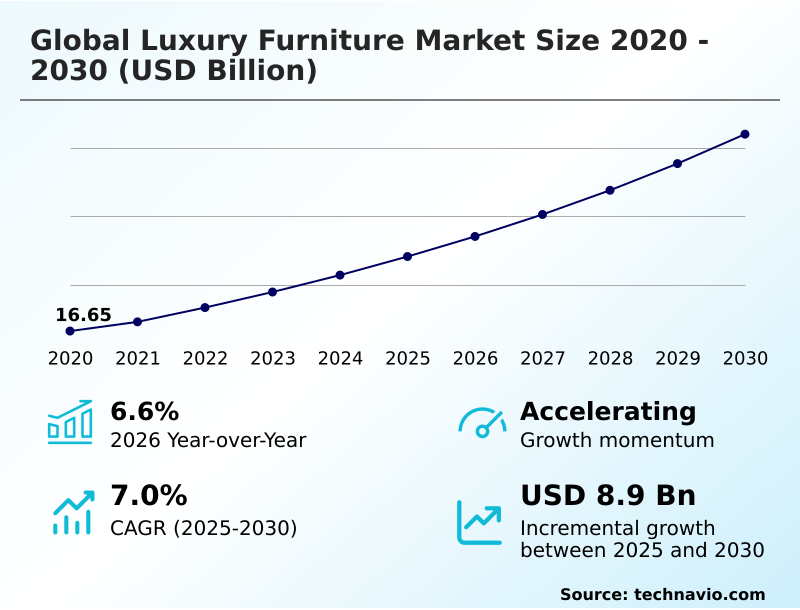
The luxury furniture market size is valued to increase by USD 11.91 billion, at a CAGR of 5.8% from 2025 to 2030. Increasing number of new luxury furniture showroom launches will drive the luxury furniture market.
Major Market Trends & Insights
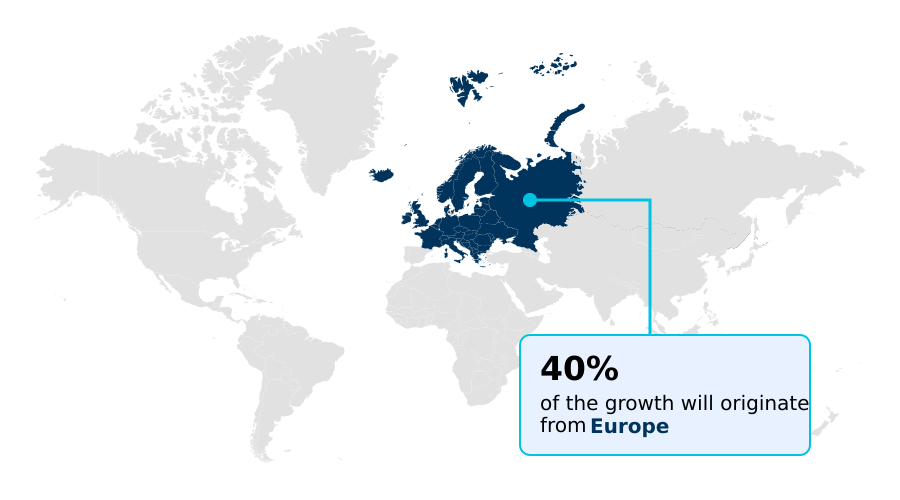
- Europe dominated the market and accounted for a 39.7% growth during the forecast period.
- By Application - Residential segment was valued at USD 26.71 billion in 2024
- By Distribution Channel - Offline segment accounted for the largest market revenue share in 2024
Market Size & Forecast
- Market Opportunities: USD 32.08 billion
- Market Future Opportunities: USD 11.91 billion
- CAGR from 2025 to 2030 : 5.8%
Market Summary
- The luxury furniture market is defined by an emphasis on aesthetic exclusivity and artisanal craftsmanship, catering to a clientele that values heirloom-quality pieces. A significant shift is underway from overt branding to quiet luxury, where the focus is on sustainable materials, premium finishes, and hand-finishing techniques.
- Innovation is a key dynamic, with smart furniture featuring IoT integration becoming more prevalent, and digital tools like augmented reality and virtual showrooms transforming the phygital retail experience.
- For instance, a firm specializing in bespoke customization can leverage 3D printing and CNC machining to create complex, ergonomic designs while using a blockchain-backed system to ensure supply chain transparency for ethically sourced wood, metal, and leather.
- This approach not only enhances the personalized experiences for customers but also streamlines production, meeting demand for both handcrafted furniture and technologically advanced modular sofas. The industry's evolution is shaped by this blend of heritage and forward-thinking technology, from phygital infrastructure in retail to custom ordering platforms that redefine customer engagement.
What will be the Size of the Luxury Furniture Market during the forecast period?
Get Key Insights on Market Forecast (PDF) Get Free Sample
How is the Luxury Furniture Market Segmented?
The luxury furniture industry research report provides comprehensive data (region-wise segment analysis), with forecasts and estimates in "USD million" for the period 2026-2030, as well as historical data from 2020-2024 for the following segments.
- Application
- Residential
- Commercial
- Distribution channel
- Offline
- Online
- Material
- Wood
- Metal
- Leather
- Others
- Geography
- Europe
- Italy
- Germany
- France
- North America
- US
- Canada
- Mexico
- APAC
- China
- Japan
- India
- South America
- Brazil
- Argentina
- Middle East and Africa
- UAE
- Saudi Arabia
- South Africa
- Rest of World (ROW)
- Europe
By Application Insights
The residential segment is estimated to witness significant growth during the forecast period.
The residential segment is the market's primary engine, driven by consumers seeking heirloom-quality pieces and personalized experiences that reflect their values. A clear shift toward quiet luxury is evident, prioritizing handcrafted furniture and aesthetic exclusivity over overt branding.
This is influencing lifestyle branding strategies, compelling manufacturers to focus on circular design and supply chain transparency. The integration of smart furniture is becoming a standard expectation for modern living spaces.
To meet these demands, companies are investing in advanced production, with some achieving a 15% improvement in material efficiency through better design and manufacturing integration, showcasing a commitment to both luxury and responsibility.
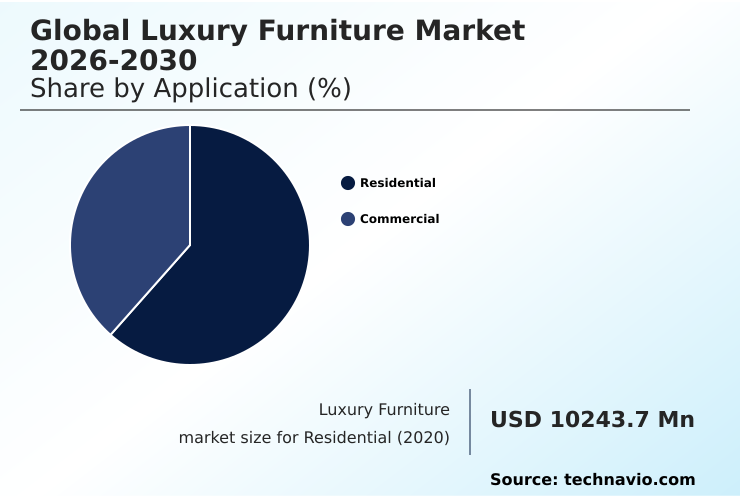
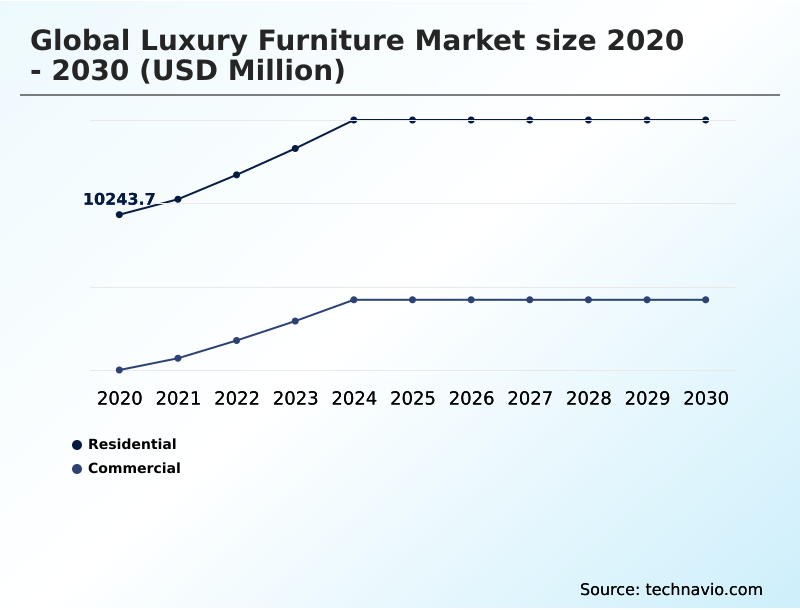
The Residential segment was valued at USD 26.71 billion in 2024 and showed a gradual increase during the forecast period.
Regional Analysis
Europe is estimated to contribute 39.7% to the growth of the global market during the forecast period.Technavio’s analysts have elaborately explained the regional trends and drivers that shape the market during the forecast period.
See How Luxury Furniture Market Demand is Rising in Europe Get Free Sample
The market's geography is defined by Europe's dominance, holding 39.7% of the share, built on a rich design heritage and unparalleled artisanal craftsmanship. European brands lead in sustainable sourcing, with nearly 89% of new collections meeting strict eco-design rules.
North America follows, where a 65% expansion in retail square footage highlights investment in phygital infrastructure and experiential showrooms. In APAC, rapid wealth creation fuels demand for collectible design pieces and custom upholstery.
Across regions, there is a universal demand for sustainable materials and ergonomic designs that merge modern aesthetics with comfort and long-term value, reflecting a globally harmonized view of luxury living.
Market Dynamics
Our researchers analyzed the data with 2025 as the base year, along with the key drivers, trends, and challenges. A holistic analysis of drivers will help companies refine their marketing strategies to gain a competitive advantage.
- The luxury furniture market is navigating a complex landscape of evolving consumer expectations and operational challenges. A critical factor is the impact of raw material volatility on luxury furniture, which pressures manufacturers to innovate supply chains while maintaining quality.
- Simultaneously, the industry is responding to the demand for multifunctional luxury furniture from millennials, who prioritize space optimization and versatility in urban living environments. This demographic's preferences are also accelerating eco-friendly and organic luxury furniture design trends, pushing brands to adopt sustainable materials and transparent production processes.
- To meet these demands, companies are embracing luxury furniture design innovation using smart technology, integrating features like IoT connectivity into their products. The role of augmented reality in online furniture retail has become pivotal, allowing customers to visualize high-value items in their homes before purchasing, thereby reducing returns and increasing conversion rates by over 40% compared to static image listings.
- This digital transformation highlights the importance of omnichannel retailing for luxury brands, as a seamless integration of online platforms and physical showrooms is now essential for delivering the high-touch, personalized experience that luxury consumers expect.
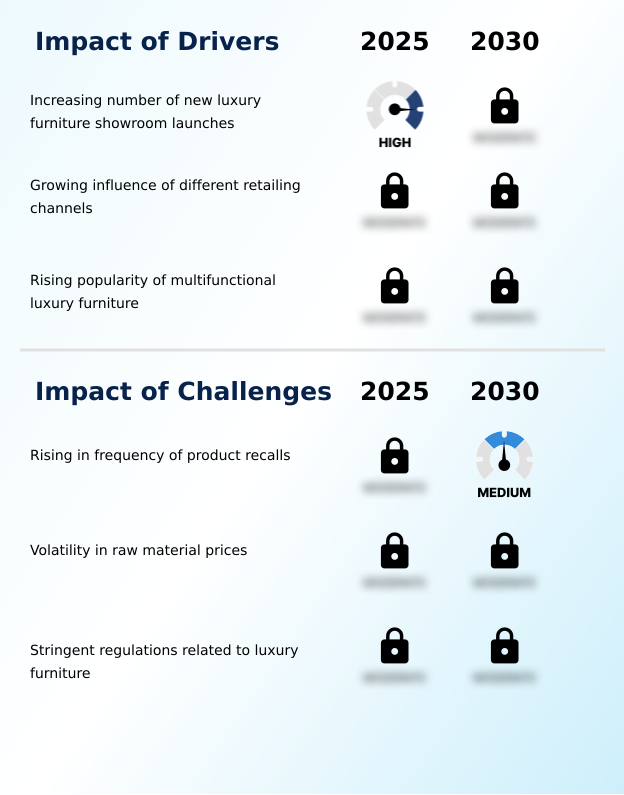
What are the key market drivers leading to the rise in the adoption of Luxury Furniture Industry?
- The increasing number of new luxury furniture showroom launches is a key driver for market growth.
- Market growth is propelled by the demand for adaptability and personalization. The rise of multifunctional luxury furniture and modular sofas directly addresses the need for space optimization in modern living spaces.
- This driver is especially strong in the contract-grade luxury furniture sector, where flexible layouts are key. Bespoke customization remains a primary driver, allowing consumers to tailor premium lifestyle products to their exact specifications, including unique premium finishes.
- A sophisticated omnichannel approach is crucial for facilitating this customization. Moreover, the seamless IoT integration into furniture enhances functionality, with smart features increasing the perceived value of products by over 25% for tech-savvy buyers.
What are the market trends shaping the Luxury Furniture Industry?
- A rapid emergence of eco-friendly and organic products is a key upcoming trend in the luxury furniture market. This shift reflects growing consumer demand for sustainability in high-end design.
- The trend landscape is dominated by sustainability and digitalization. The push for eco-friendly luxury furniture is redefining innovative collections, driving manufacturers to adopt greener processes. Concurrently, the phygital retail experience is being perfected through technology. Augmented reality and virtual showrooms function as powerful digital visualization tools, with some platforms reporting a 40% higher user engagement compared to static galleries.
- These technologies facilitate custom ordering by allowing clients to visualize intricate designs. Behind the scenes, advanced manufacturing using CNC machining and 3D printing enables the production of these complex, personalized pieces at scale, merging high-tech with high-design.
What challenges does the Luxury Furniture Industry face during its growth?
- The rising frequency of product recalls presents a key challenge affecting industry growth.
- Key challenges threaten market stability, primarily from supply chain volatility and the preservation of brand equity. Fluctuating costs for core materials like wood, metal, and leather can impact margins by 10-15% quarterly, complicating financial planning for both experiential retail and luxury e-commerce platforms.
- A significant operational challenge is the scarcity of artisanal skills, which are essential for the hand-finishing techniques that define luxury. Any failure to deliver a flawless product and exceptional white-glove delivery service can immediately erode consumer trust and damage a brand's reputation, making quality control a critical and ongoing battle.
Exclusive Technavio Analysis on Customer Landscape
The luxury furniture market forecasting report includes the adoption lifecycle of the market, covering from the innovator’s stage to the laggard’s stage. It focuses on adoption rates in different regions based on penetration. Furthermore, the luxury furniture market report also includes key purchase criteria and drivers of price sensitivity to help companies evaluate and develop their market growth analysis strategies.
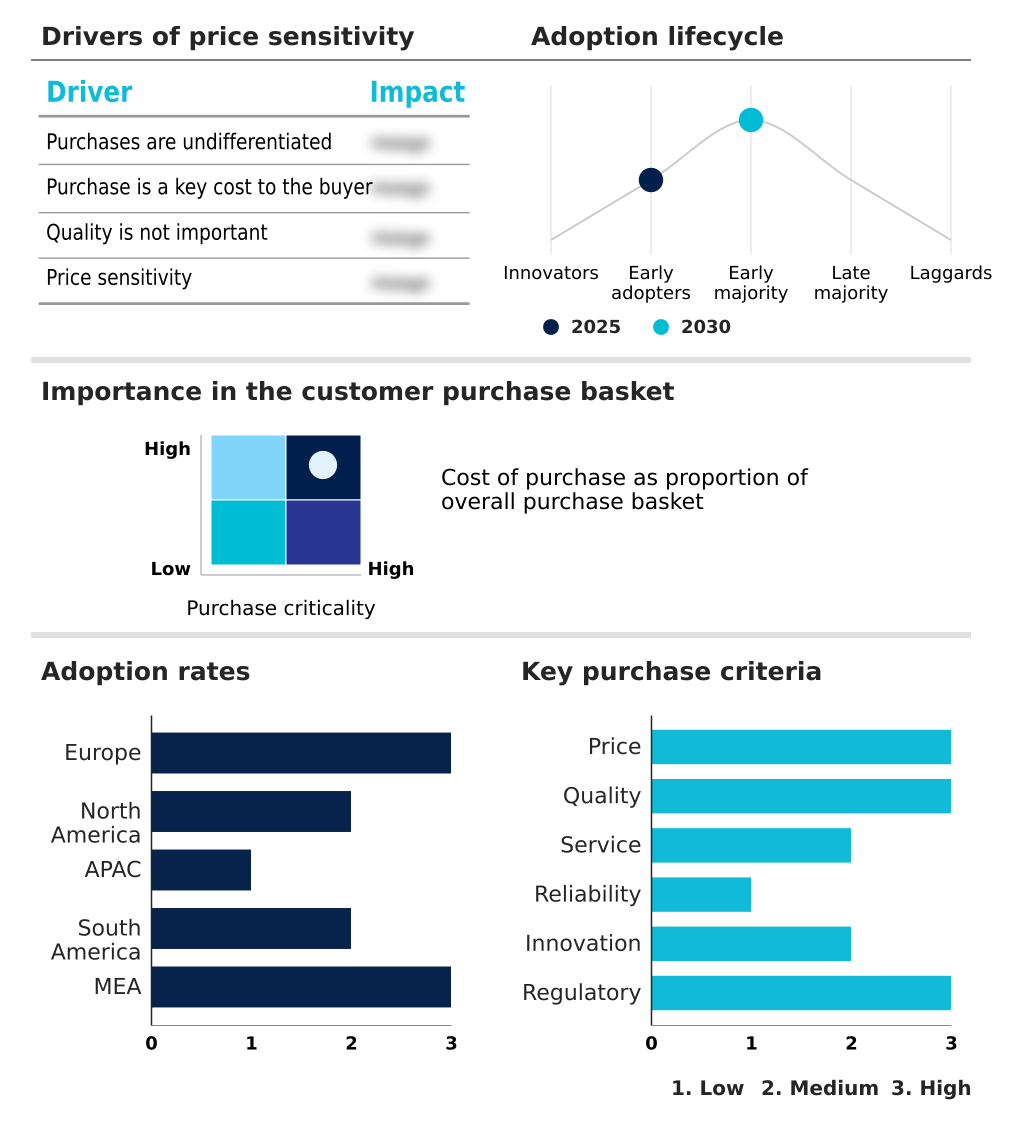
Customer Landscape of Luxury Furniture Industry
Competitive Landscape
Companies are implementing various strategies, such as strategic alliances, luxury furniture market forecast, partnerships, mergers and acquisitions, geographical expansion, and product/service launches, to enhance their presence in the industry.
ANGELO and C. Srl - Provides luxury furniture defined by rigorous shapes and innovative designs, such as sofas with a unique suspension effect achieved through raised metal frames.
The industry research and growth report includes detailed analyses of the competitive landscape of the market and information about key companies, including:
- ANGELO and C. Srl
- Club House Italia SpA
- Eichholtz BV
- Eric Kuster Metropolitan Ltd.
- Giorgio Armani SpA
- Giorgio Collection
- LONGHI Spa
- MillerKnoll Inc.
- Minotti SpA
- MUEBLES PICO SA
- Natuzzi SpA
- Opera Contemporary
- Reflex Spa
- Roche Bobois SA
- Rugiano Srl
- Silik SRL
- Vaughan Bassett
- Williams Sonoma Inc.
Qualitative and quantitative analysis of companies has been conducted to help clients understand the wider business environment as well as the strengths and weaknesses of key industry players. Data is qualitatively analyzed to categorize companies as pure play, category-focused, industry-focused, and diversified; it is quantitatively analyzed to categorize companies as dominant, leading, strong, tentative, and weak.
Recent Development and News in Luxury furniture market
- In August 2025, Maison Sia, celebrated as India's destination for global luxury home decor, launched its luxury furniture line in India.
- In September 2025, Sherrill Furniture Co. is set to debut Aure, a new brand showcasing luxury with a lighter touch, at High Point.
- In March 2025, POS Interiors, a workplace design specialist, introduced its Brands by POS digital platform to streamline high-specification office furniture procurement in the UK.
- In June 2025, UCUORO entered the Indian market through the Salone concept, opening a luxe gallery of curated furniture.
Dive into Technavio’s robust research methodology, blending expert interviews, extensive data synthesis, and validated models for unparalleled Luxury Furniture Market insights. See full methodology.
| Market Scope | |
|---|---|
| Page number | 283 |
| Base year | 2025 |
| Historic period | 2020-2024 |
| Forecast period | 2026-2030 |
| Growth momentum & CAGR | Accelerate at a CAGR of 5.8% |
| Market growth 2026-2030 | USD 11911.6 million |
| Market structure | Fragmented |
| YoY growth 2025-2026(%) | 5.3% |
| Key countries | Italy, Germany, France, UK, Spain, Switzerland, US, Canada, Mexico, China, Japan, India, South Korea, Australia, Indonesia, Brazil, Argentina, Chile, UAE, Saudi Arabia, South Africa, Egypt and Israel |
| Competitive landscape | Leading Companies, Market Positioning of Companies, Competitive Strategies, and Industry Risks |
Research Analyst Overview
- The market is undergoing a significant transformation, balancing artisanal craftsmanship with technological innovation. The core of the industry remains focused on heirloom-quality pieces that offer aesthetic exclusivity through hand-finishing techniques and bespoke customization. However, product strategy at the boardroom level now mandates the integration of smart furniture with IoT integration and the use of sustainable materials.
- This strategic pivot has led to the adoption of advanced manufacturing like CNC machining and 3D printing for creating ergonomic designs and complex modular sofas. For instance, integrating these technologies has enabled some firms to reduce custom order processing time by 30%.
- The consumer experience is enhanced by augmented reality and virtual showrooms, creating a phygital infrastructure that supports the trend toward quiet luxury. This requires a mastery of materials, from traditional wood, metal, and leather with premium finishes to innovative eco-friendly alternatives.
- Success hinges on delivering eco-friendly luxury furniture, including multifunctional luxury furniture and custom upholstery, that resonates with modern consumer values while maintaining the allure of handcrafted furniture.
What are the Key Data Covered in this Luxury Furniture Market Research and Growth Report?
-
What is the expected growth of the Luxury Furniture Market between 2026 and 2030?
-
USD 11.91 billion, at a CAGR of 5.8%
-
-
What segmentation does the market report cover?
-
The report is segmented by Application (Residential, and Commercial), Distribution Channel (Offline, and Online), Material (Wood, Metal, Leather, and Others) and Geography (Europe, North America, APAC, South America, Middle East and Africa)
-
-
Which regions are analyzed in the report?
-
Europe, North America, APAC, South America and Middle East and Africa
-
-
What are the key growth drivers and market challenges?
-
Increasing number of new luxury furniture showroom launches, Rising in frequency of product recalls
-
-
Who are the major players in the Luxury Furniture Market?
-
ANGELO and C. Srl, Club House Italia SpA, Eichholtz BV, Eric Kuster Metropolitan Ltd., Giorgio Armani SpA, Giorgio Collection, LONGHI Spa, MillerKnoll Inc., Minotti SpA, MUEBLES PICO SA, Natuzzi SpA, Opera Contemporary, Reflex Spa, Roche Bobois SA, Rugiano Srl, Silik SRL, Vaughan Bassett and Williams Sonoma Inc.
-
Market Research Insights
- The market's dynamism is driven by a shift toward premium lifestyle products that offer personalized experiences. Brands are curating innovative collections with modern aesthetics to meet evolving tastes. A key dynamic is the omnichannel approach, blending experiential showrooms with luxury e-commerce platforms.
- For example, leading firms have expanded physical retail square footage by 65% while seeing digital visualization tools like AR boost customer engagement fourfold over traditional online catalogs. Furthermore, sustainable sourcing is non-negotiable, with some European brands reporting that 89% of new products comply with updated eco-design regulations.
- This focus on supply chain transparency and design heritage reinforces brand equity in a competitive landscape where a phygital retail experience is paramount for success.
We can help! Our analysts can customize this luxury furniture market research report to meet your requirements.
 RIA -
RIA - 
