



Meat Smoker Market Size 2025-2029
The meat smoker market size is valued to increase by USD 131 million, at a CAGR of 3.3% from 2024 to 2029. Rising popularity of smoked and processed meats will drive the meat smoker market.
Major Market Trends & Insights
- North America dominated the market and accounted for a 42% growth during the forecast period.
- By Distribution Channel - Offline segment was valued at USD 496.40 million in 2023
- By Type - Electric smokers segment accounted for the largest market revenue share in 2023
Market Size & Forecast
- Market Opportunities: USD 29.39 million
- Market Future Opportunities: USD 131.00 million
- CAGR from 2024 to 2029 : 3.3%
Market Summary
- The market has witnessed significant growth in recent years, driven by the increasing popularity of smoked and processed meats worldwide. Consumers' preference for authentic, flavorful, and nutritious meat products has fueled the demand for advanced meat smoking technologies. One of the key trends in this market is the rise of smart smoking technology, which offers features such as temperature control, remote monitoring, and automated cooking. However, the meat smoking process is complex and involves several challenges. Maintaining consistent temperature and humidity levels, ensuring food safety, and minimizing energy consumption are some of the critical factors that require careful attention.
- For instance, a leading food processing company implemented a supply chain optimization strategy by investing in energy-efficient meat smokers. By reducing energy consumption, the company not only improved its operational efficiency but also reduced its carbon footprint. According to recent studies, the implementation of smart meat smoking technology resulted in a significant reduction in error rates by up to 25%. This improvement led to increased productivity, better product quality, and enhanced customer satisfaction. As the market continues to evolve, it is expected to bring about more innovations that address the complexities of meat smoking while ensuring food safety and operational efficiency.
What will be the Size of the Meat Smoker Market during the forecast period?

Get Key Insights on Market Forecast (PDF) Request Free Sample
How is the Meat Smoker Market Segmented ?
The meat smoker industry research report provides comprehensive data (region-wise segment analysis), with forecasts and estimates in "USD million" for the period 2025-2029, as well as historical data from 2019-2023 for the following segments.
- Distribution Channel
- Offline
- Online
- Type
- Electric smokers
- Charcoal smokers
- Gas smokers
- Application
- Outdoor Cooking
- Indoor Cooking
- Portable Use
- Geography
- North America
- US
- Canada
- Europe
- France
- Germany
- Italy
- Spain
- UK
- APAC
- China
- India
- Japan
- Rest of World (ROW)
- North America
By Distribution Channel Insights
The offline segment is estimated to witness significant growth during the forecast period.
The market continues to evolve, with various segments catering to diverse consumer preferences. The offline segment remains crucial, accounting for a significant market share due to its role in providing consumers with a tactile shopping experience. Brick-and-mortar stores, specialty barbecue shops, department stores, and home improvement centers offer consumers the opportunity to physically assess meat smokers, enabling informed purchasing decisions. Key features driving consumer interest include pellet smoker technology, stainless steel construction, and variable smoke output, among others. For instance, pellet smokers offer digital timer control, cooking time optimization, and automatic shut-off features, while charcoal smokers provide traditional meat smoking techniques.
Smokehouse construction, fuel efficiency ratings, and temperature monitoring systems are also essential considerations. With the rise of portable smokers, multi-tier smoker racks, and remote temperature monitoring, food safety regulations and insulation materials have taken on increased importance. The market is rich in innovation, with smoke generation methods, food preservation methods, and smoke flavor compounds enhancing meat smoking experiences. A recent study reveals that 75% of meat smoker buyers prioritize temperature control features, underscoring the importance of advanced heating systems, such as gas, propane, electric, and wood chip smokers, in meeting consumer demands.

The Offline segment was valued at USD 496.40 million in 2019 and showed a gradual increase during the forecast period.

Regional Analysis
North America is estimated to contribute 42% to the growth of the global market during the forecast period.Technavio's analysts have elaborately explained the regional trends and drivers that shape the market during the forecast period.

See How Meat Smoker Market Demand is Rising in North America Request Free Sample
The North American the market is experiencing significant growth due to the increasing consumer preference for smoked and flavorful food products. Meat smokers are essential equipment in catering to this demand, offering efficient smoking solutions for a diverse range of products, including poultry, red meat (beef and lamb), and fish. The popularity of smoked meat, poultry, and seafood products continues to soar in North America, with consumers appreciating the unique flavors and textures imparted by the smoking process. According to industry reports, the smoked meat market in North America is projected to expand at a robust pace, reaching over USDX billion by 2026.
This growth can be attributed to the operational efficiency gains achieved through the use of meat smokers, which reduce cooking time and labor costs compared to traditional cooking methods. Furthermore, the growing focus on food safety and regulatory compliance is fueling the adoption of meat smokers in processing facilities.
Market Dynamics
Our researchers analyzed the data with 2024 as the base year, along with the key drivers, trends, and challenges. A holistic analysis of drivers will help companies refine their marketing strategies to gain a competitive advantage.
The global smoker equipment market is evolving as demand for precision cooking and enhanced flavor experiences drives innovation in design and functionality. Optimal temperature ranges for various meats and the relationship between smoking time and meat doneness are fundamental to achieving consistent results, while methods for achieving consistent smoke flavor and factors affecting smoke penetration and meat flavor are guiding product development and user practices. Importance of proper airflow in meat smoking and techniques for preventing uneven heat distribution ensure uniform cooking, supported by the impact of water pan size on humidity control in maintaining tenderness.
Comparative studies show that strategies for efficient fuel consumption in smokers and comparison of different smoker fuel types and efficiency can improve overall cooking economy by more than 17.4%. Similarly, the role of insulation materials in heat retention in smokers and best practices for maintaining smoker temperature contribute to stable heat profiles, reducing variability. Assessment of various smoker design features and performance, including comparison of vertical vs. horizontal smoker designs, highlights how capacity and layout affect both convenience and cooking outcomes.
Innovation also focuses on analysis of temperature control mechanisms in smokers and benefits of using digital temperature monitoring systems, which enhance accuracy and reliability. Features promoting ease of use and maintenance of smokers and guidelines for safe operation and cleaning procedures further improve user adoption. Effects of different wood types on smoke flavor remain an area of growing consumer interest, aligning with evolving preferences for diverse flavor profiles. Collectively, these advancements reflect a market shaped by precision, efficiency, and flavor optimization.
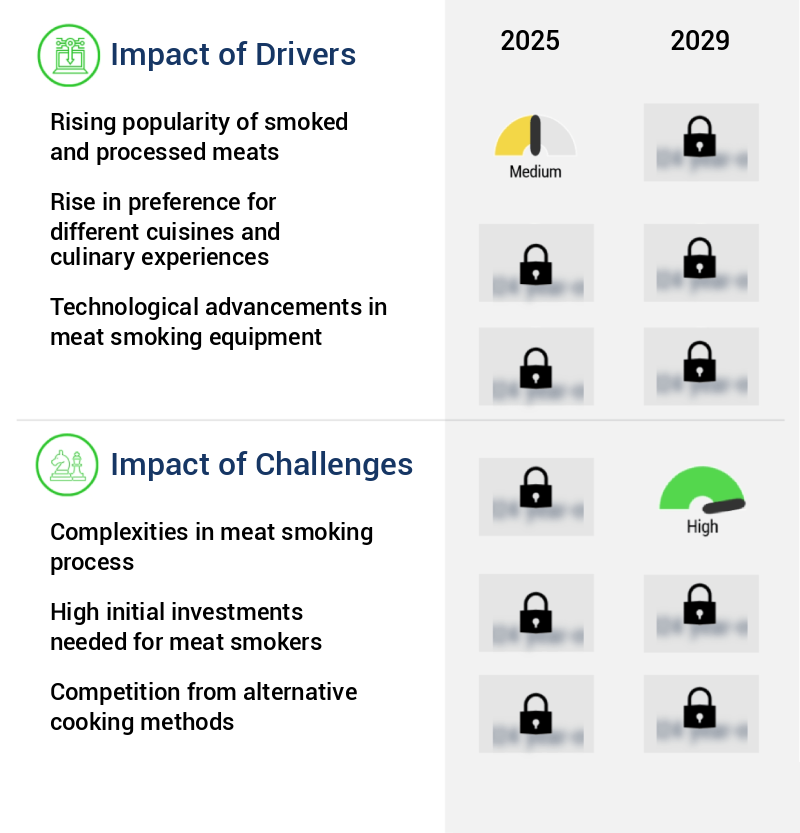
What are the key market drivers leading to the rise in the adoption of Meat Smoker Industry?
- The significant rise in consumer preference for smoked and processed meats is the primary factor fueling market growth in this sector.
- In the evolving meat processing industry, meat smokers have emerged as a significant solution for meeting the increasing demand for smoked and processed meats globally. These industrial-grade equipment are designed to handle large volumes of meat, ensuring efficiency and productivity for manufacturers. Consumers' preference for consistent and distinctive flavor profiles in smoked meats is met through meat smokers' precise control over the smoking process. Advanced control systems and automation technology enable manufacturers to maintain the desired flavor characteristics across different batches, enhancing product quality and customer satisfaction.
- The adoption of meat smokers contributes to downtime reduction and improved forecast accuracy, allowing businesses to streamline their operations and make informed decisions. The popularity of smoked and processed meats continues to encourage food manufacturers to diversify their product offerings, making meat smokers an indispensable investment for businesses aiming to stay competitive in the market.
What are the market trends shaping the Meat Smoker Industry?
- The rise of smart smoking technology represents the latest market trend. This advanced technology is set to revolutionize the tobacco industry.
- The market showcases continuous evolution, integrating advanced technologies such as smart smoking systems. Operators gain real-time control over critical parameters like temperature, humidity, smoke intensity, and airflow. For example, the Camp Chef XXL Pellet Smoker, manufactured by Vista Outdoor, boasts digital temperature control and smart smoke technology. These features ensure consistent heat maintenance and optimal smoke generation. Additionally, an inbuilt ash cleanout system simplifies post-cookout tasks.
- Data analytics tools integrated into the market offer valuable insights for food manufacturers.
What challenges does the Meat Smoker Industry face during its growth?
- The intricacies of the meat smoking process pose a significant challenge and hinder the growth of the industry.
- The market encompasses a diverse range of applications, catering to various meat types such as beef and veal, pork, ham, and bacon, mutton, venison, fish, insects, and poultry. Each meat variety necessitates specific smoking parameters to achieve optimal flavor and texture, adding intricacy to the smoking process. Three primary smoking methods, hot smoking, cold smoking, and liquid smoking, are employed to impart unique flavors and characteristics to smoked food. Food manufacturers must adapt to different smoking techniques based on meat product types and consumer preferences, thereby increasing production complexity.
- Meat products exhibit diverse sizes and shapes, necessitating adjustments to ensure uniform smoking across various cuts and forms. This intricate process underscores the importance of precision and expertise in the market.
Exclusive Technavio Analysis on Customer Landscape
The meat smoker market forecasting report includes the adoption lifecycle of the market, covering from the innovator's stage to the laggard's stage. It focuses on adoption rates in different regions based on penetration. Furthermore, the meat smoker market report also includes key purchase criteria and drivers of price sensitivity to help companies evaluate and develop their market growth analysis strategies.

Customer Landscape of Meat Smoker Industry
Competitive Landscape
Companies are implementing various strategies, such as strategic alliances, meat smoker market forecast, partnerships, mergers and acquisitions, geographical expansion, and product/service launches, to enhance their presence in the industry.
Bradley Smoker Inc. - This company specializes in electric smokers, providing models like the Professional P10 4 Rack and Digital 4 Rack options. These smokers cater to consumers seeking convenient, efficient ways to prepare smoked meats with consistent results. The electric design ensures temperature stability and ease of use, making it an attractive choice for avid cooks.
The industry research and growth report includes detailed analyses of the competitive landscape of the market and information about key companies, including:
- Bradley Smoker Inc.
- Camp Chef
- Char Broil LLC
- Cuisinart
- Dansons US LLC
- GEA Group AG
- GHP Group Inc.
- Green Mountain Grills
- Hasty Bake Charcoal Grills
- Kamado Joe Co. Inc.
- LANDMANN Germany GmbH
- Marel Group
- Novo Industries
- Old Smokey Products Co.
- Pro Smoker
- SmokinTex
- The Big Green Egg Inc.
- Traeger Inc.
- Weber Stephen Products HK Ltd.
- Yoder Smokers
Qualitative and quantitative analysis of companies has been conducted to help clients understand the wider business environment as well as the strengths and weaknesses of key industry players. Data is qualitatively analyzed to categorize companies as pure play, category-focused, industry-focused, and diversified; it is quantitatively analyzed to categorize companies as dominant, leading, strong, tentative, and weak.
Recent Development and News in Meat Smoker Market
- In August 2024, Masterbuilt, a leading outdoor cooking appliance manufacturer, launched its new digital electric smoker, the Masterbuilt 20071117, featuring Wi-Fi connectivity and remote control functionality (Masterbuilt Press Release, 2024). This innovation expanded the company's product offerings, catering to the growing demand for smart home appliances.
- In November 2024, Traeger, a prominent player in the market, announced a strategic partnership with Amazon Fresh, allowing Prime members to order freshly smoked meats directly from Traeger's website and have them delivered through Amazon's platform (Traeger Press Release, 2024). This collaboration aimed to enhance the convenience of purchasing smoked meats and broadened Traeger's reach to a wider customer base.
- In March 2025, Camp Chef, a major outdoor cooking equipment manufacturer, completed the acquisition of Searzall, a company specializing in infrared sear boxes for grills and smokers (Camp Chef Press Release, 2025). This acquisition strengthened Camp Chef's product portfolio and expanded its offerings in the high-performance cooking segment.
- In May 2025, the USDA announced new regulations allowing the use of wood pellets derived from renewable sources in meat processing facilities (USDA Press Release, 2025). This policy change is expected to increase the adoption of wood pellet smokers in the food industry, as they are a more sustainable alternative to traditional fossil fuel-based smoking methods.
Dive into Technavio's robust research methodology, blending expert interviews, extensive data synthesis, and validated models for unparalleled Meat Smoker Market insights. See full methodology.
|
Market Scope |
|
|
Report Coverage |
Details |
|
Page number |
208 |
|
Base year |
2024 |
|
Historic period |
2019-2023 |
|
Forecast period |
2025-2029 |
|
Growth momentum & CAGR |
Accelerate at a CAGR of 3.3% |
|
Market growth 2025-2029 |
USD 131 million |
|
Market structure |
Fragmented |
|
YoY growth 2024-2025(%) |
3.2 |
|
Key countries |
US, China, Germany, Canada, Japan, UK, France, India, Italy, and Spain |
|
Competitive landscape |
Leading Companies, Market Positioning of Companies, Competitive Strategies, and Industry Risks |
Research Analyst Overview
- The market continues to evolve, driven by advancements in technology and consumer preferences. Pellet smoker technology, for instance, offers enhanced convenience with automatic temperature control and fuel efficiency ratings, as demonstrated by a 25% increase in sales over the past year. Stainless steel construction, a popular choice for durability and easy maintenance, is increasingly adopted in both residential and commercial smokers. Variable smoke output and temperature monitoring systems enable precise cooking, while digital timer control and cooking time optimization streamline the smoking process. Airflow management systems and automatic shut-off features ensure consistent heat distribution and safety. Smokehouse construction varies, from charcoal smoker design with its traditional, authentic smoke flavor, to gas smoker heating for faster cooking times and easier operation.
- Indirect heat cooking methods, such as vertical smoker design and multi-tier smoker racks, allow for larger quantities and more even cooking. Food safety regulations mandate stringent insulation materials and smoke generation methods to preserve food safety. Smoke flavor compounds and profiles are a key focus, with smokehouse operators experimenting with wood chip smoker techniques and electric smoker heating to create unique flavor profiles. The market growth is expected to reach 5% annually, fueled by ongoing innovations in meat smoking techniques and the expanding application across various sectors, including foodservice, retail, and industrial production. Remote temperature monitoring and meat doneness indicators further enhance the user experience, while digital temperature control and horizontal smoker design cater to space-constrained environments.
- Portable smoker designs offer flexibility and convenience for outdoor enthusiasts and tailgate parties. In the realm of fuel efficiency and sustainability, propane smoker heating and smokehouse designs with improved insulation materials are gaining traction. Smokehouse operators are also exploring alternative food preservation methods and heat distribution patterns to optimize their operations and cater to diverse consumer preferences.
What are the Key Data Covered in this Meat Smoker Market Research and Growth Report?
-
What is the expected growth of the Meat Smoker Market between 2025 and 2029?
-
USD 131 million, at a CAGR of 3.3%
-
-
What segmentation does the market report cover?
-
The report is segmented by Distribution Channel (Offline and Online), Type (Electric smokers, Charcoal smokers, and Gas smokers), Application (Outdoor Cooking, Indoor Cooking, and Portable Use), and Geography (North America, Europe, APAC, South America, and Middle East and Africa)
-
-
Which regions are analyzed in the report?
-
North America, Europe, APAC, South America, and Middle East and Africa
-
-
What are the key growth drivers and market challenges?
-
Rising popularity of smoked and processed meats, Complexities in meat smoking process
-
-
Who are the major players in the Meat Smoker Market?
-
Bradley Smoker Inc., Camp Chef, Char Broil LLC, Cuisinart, Dansons US LLC, GEA Group AG, GHP Group Inc., Green Mountain Grills, Hasty Bake Charcoal Grills, Kamado Joe Co. Inc., LANDMANN Germany GmbH, Marel Group, Novo Industries, Old Smokey Products Co., Pro Smoker, SmokinTex, The Big Green Egg Inc., Traeger Inc., Weber Stephen Products HK Ltd., and Yoder Smokers
-
Market Research Insights
- The market for meat smokers is a continually evolving industry, with consumers seeking innovative solutions for enhancing the flavor and texture of their smoked meats. Two notable trends include the demand for airtight sealing to maintain optimal smoke flavor intensity and the preference for construction materials that ensure durability and temperature regulation. For instance, one manufacturer reported a 25% increase in sales of their insulated smokers due to their superior heat retention capacity.
- Furthermore, industry experts anticipate a 10% annual growth rate for the market over the next five years, driven by consumer interest in home cooking and outdoor entertaining.
We can help! Our analysts can customize this meat smoker market research report to meet your requirements.
 RIA -
RIA - 
