



Middle Office Outsourcing Market Size 2026-2030
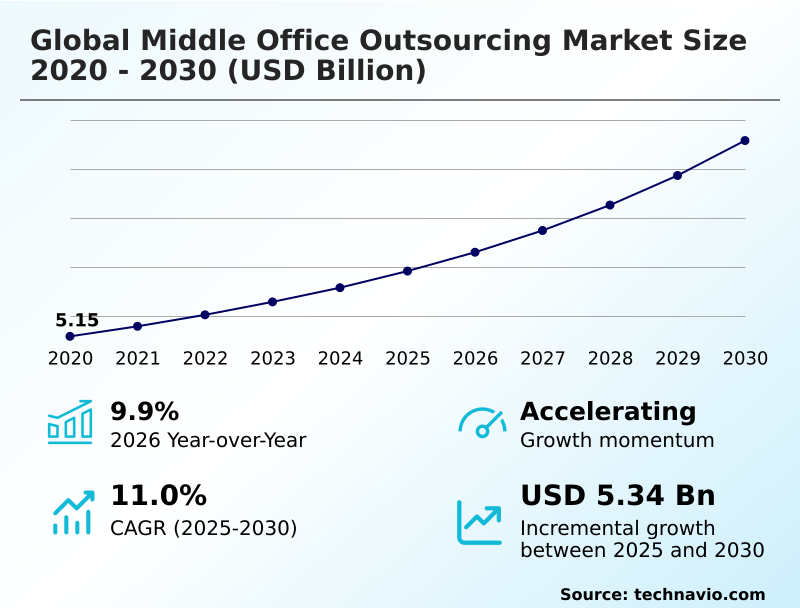
The middle office outsourcing market size is valued to increase by USD 5.34 billion, at a CAGR of 11% from 2025 to 2030. Requirement for new technologies and budget constraints will drive the middle office outsourcing market.
Major Market Trends & Insights
- North America dominated the market and accounted for a 47.8% growth during the forecast period.
- By End-user - Investment banking and management segment was valued at USD 2.51 billion in 2024
- By Deployment - On-premises segment accounted for the largest market revenue share in 2024
Market Size & Forecast
- Market Opportunities: USD 8.02 billion
- Market Future Opportunities: USD 5.34 billion
- CAGR from 2025 to 2030 : 11%
Market Summary
- The Middle Office Outsourcing Market undergoes a profound structural transformation as financial institutions aggressively dismantle rigid legacy post-trade architectures. Confronting compressed settlement windows and complex multi-asset portfolio generation, asset managers are transferring labor-intensive data workflows to specialized external utilities.
- In real-world compliance operations, transitioning intricate otc derivative servicing to third-party providers delivers immediate access to military-grade cybersecurity without heavy capital expenditure. This operational shift yields measurable outcomes, with modernized external networks demonstrating a 40% improvement in collateral reporting efficiency compared to siloed internal configurations.
- The convergence of escalating technological requirements and severe budget constraints acts as a primary driver, forcing firms to convert high fixed IT overheads into predictable variable-expense models. However, unexpected costs and complex implementation delays challenge widespread integration, occasionally disrupting daily operations.
- Ultimately, outsourcing non-client-facing administration enables investment entities to focus exclusively on alpha generation while ensuring flawless regulatory alignment across fragmented international jurisdictions.
What will be the Size of the Middle Office Outsourcing Market during the forecast period?
Get Key Insights on Market Forecast (PDF) Get Free Sample
How is the Middle Office Outsourcing Market Segmented?
The middle office outsourcing industry research report provides comprehensive data (region-wise segment analysis), with forecasts and estimates in "USD million" for the period 2026-2030, as well as historical data from 2020-2024 for the following segments.
- End-user
- Investment banking and management
- Broker-dealers
- Stock exchange
- Others
- Deployment
- On-premises
- Cloud
- Technology
- Cloud-based solutions
- Robotic process automation
- AI and ML
- Blockchain technology
- Internet of things
- Geography
- North America
- US
- Canada
- Mexico
- Europe
- Germany
- UK
- France
- Italy
- Spain
- The Netherlands
- APAC
- China
- Japan
- India
- South Korea
- Australia
- Indonesia
- South America
- Brazil
- Argentina
- Chile
- Middle East and Africa
- Saudi Arabia
- UAE
- South Africa
- Israel
- Turkey
- North America
By End-user Insights
The investment banking and management segment is estimated to witness significant growth during the forecast period.
The investment banking and management segment operates as a highly critical volume sector shaping post-trade data architectures. Financial institutions face an escalating necessity to manage intricate alternative asset classes while achieving flawless straight-through processing rates.
By shifting complex multi-currency cash allocation and corporate action processing to specialized external providers, banking entities seamlessly inherit cloud-native data aggregation capabilities.
This transition systematically eliminates costly operational friction, with institutions commonly reporting that administrative automation improves error detection accuracy by 15%. Integrating advanced exception management workflows allows capital allocators to bypass heavy legacy system maintenance overheads.
Consequently, asset managers achieve superior operational resilience and focus internal resources entirely on core alpha generation strategies within a highly demanding regulatory environment.
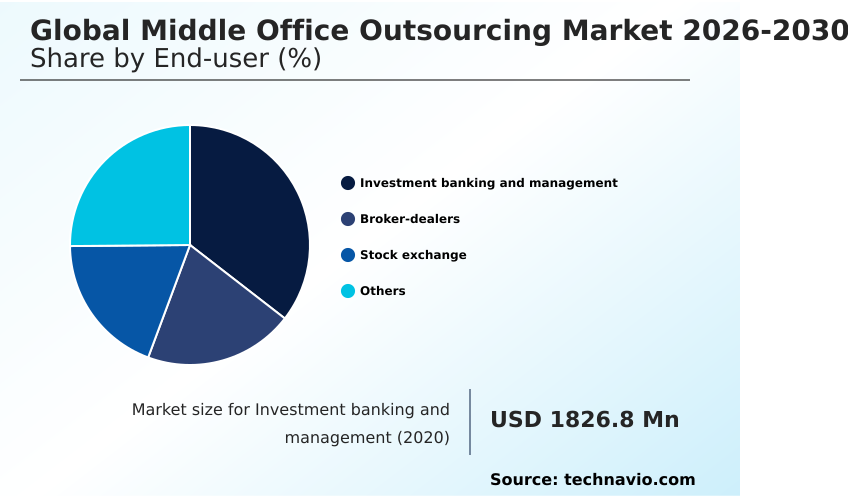
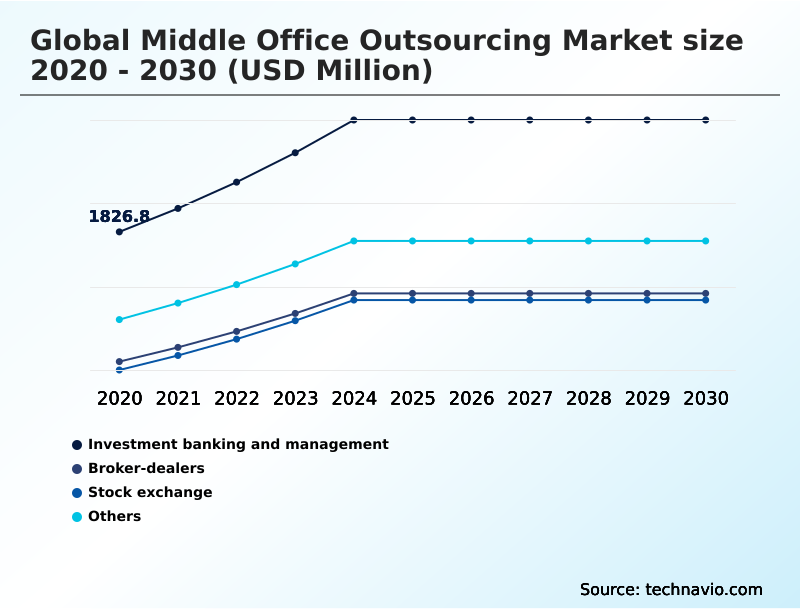
The Investment banking and management segment was valued at USD 2.51 billion in 2024 and showed a gradual increase during the forecast period.
Regional Analysis
North America is estimated to contribute 47.8% to the growth of the global market during the forecast period.Technavio’s analysts have elaborately explained the regional trends and drivers that shape the market during the forecast period.
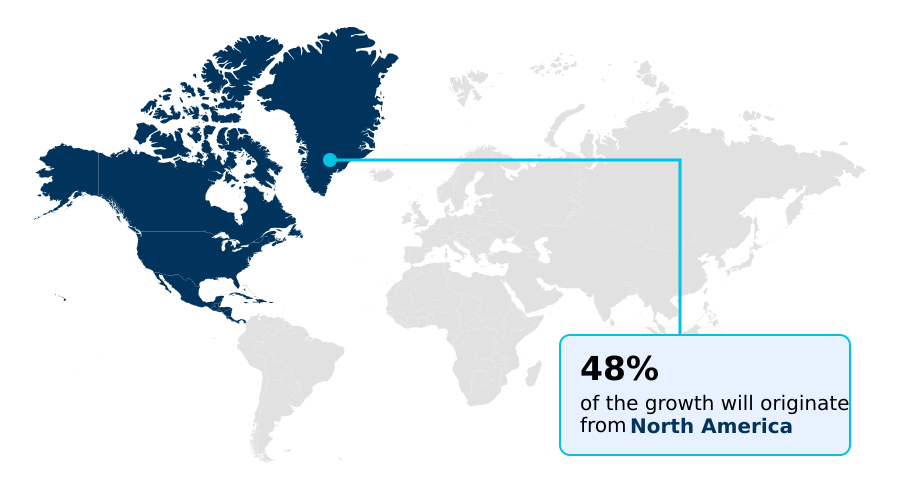
See How Middle Office Outsourcing Market Demand is Rising in North America Get Free Sample
The Middle Office Outsourcing landscape reflects distinct structural variations between North America and APAC.
North America operates as a mature ecosystem where tier-one investment houses aggressively deploy machine learning trade matching to navigate strict accelerated settlement cycles, achieving a 30% reduction in post-trade exception breaks.
In contrast, the APAC region experiences rapid fragmented adoption driven by immense cross-border fund flows and complex localized compliance mandates.
As a result, APAC institutions report a 25% faster integration rate of api data extraction tools to normalize diverse transaction data across varying sovereign laws.
While North American firms prioritize robust infrastructure stability, APAC asset managers heavily leverage bespoke valuation matrices to manage booming alternative asset portfolios.
This geographical divergence highlights how localized regulatory pressure dictates whether firms prioritize rapid cross-border transaction clearing or fortified domestic architecture to optimize operational scale.
Market Dynamics
Our researchers analyzed the data with 2025 as the base year, along with the key drivers, trends, and challenges. A holistic analysis of drivers will help companies refine their marketing strategies to gain a competitive advantage.
- The architectural foundation of modern post-trade administration is shifting rapidly as financial institutions seek absolute operational resilience amid volatile trading environments. Facing compressed fee structures and complex regulatory transparency mandates, asset managers are systematically abandoning rigid localized hardware in favor of highly scalable external infrastructures.
- Central to this transformation is the deployment of cloud-native portfolio accounting systems, which enable investment firms to aggregate disparate data streams effortlessly and maintain a unified source of truth across diverse global portfolios.
- This technological modernization heavily impacts operational planning functions, as relying on external processing pipelines yields a 40% faster transaction clearance speed compared to relying on outdated internal manual reviews. To further eliminate costly downstream settlement failures, institutions are widely adopting automated multi-asset trade reconciliation workflows that seamlessly normalize fragmented transaction data before errors compound.
- When anomalies do occur, deploying machine learning based exception management allows cognitive algorithms to autonomously identify and resolve data mismatches, significantly minimizing human intervention. Furthermore, as fund managers diversify into highly intricate asset classes, utilizing straight-through processing for alternatives ensures that even illiquid investments are handled with extreme precision and speed.
- Concurrently, the integration of real-time collateral valuation engines provides portfolio managers with instantaneous transparency regarding their exact margin requirements and liquidity risk exposure. Ultimately, these advanced technologies empower financial enterprises to optimize their post-trade lifecycles and maintain strict regulatory compliance across fragmented international markets.
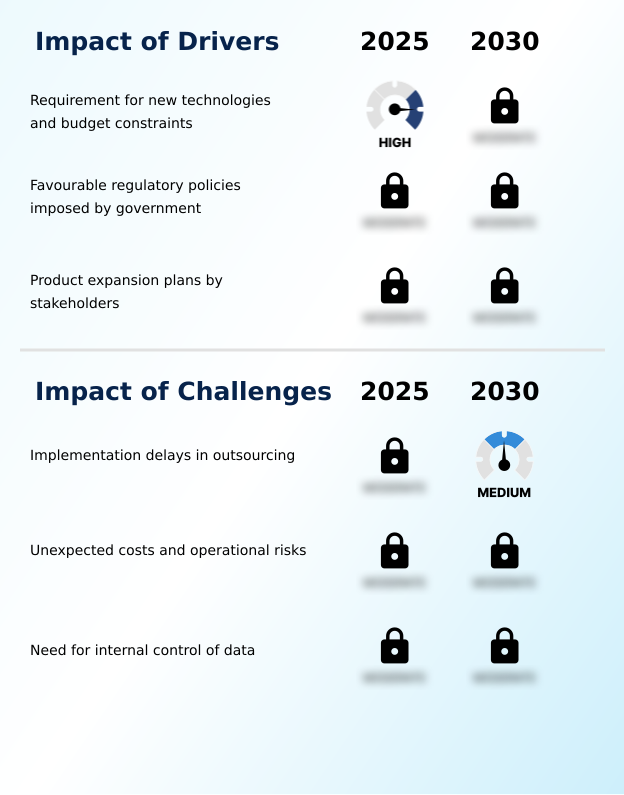
What are the key market drivers leading to the rise in the adoption of Middle Office Outsourcing Industry?
- The convergence of escalating requirements for advanced technologies and intensifying budget constraints acts as a fundamental driver accelerating the adoption of external post-trade infrastructure.
- The convergence of accelerating technological requirements and intensifying budget constraints operates as a powerful structural driver forcing the modernization of post-trade frameworks. Severe capital limitations cause asset managers to realize that continuously upgrading on-premise hardware is financially unviable.
- Consequently, institutions effect a strategic shift toward specialized external providers, accessing sophisticated infrastructure and transferring massive fixed IT costs into variable-expense models. This transition significantly lowers operational maintenance costs by up to 30%.
- Utilizing external collateral optimization algorithms and precise regulatory reporting engines ensures immediate compliance with shifting sovereign laws. Relying on specialized real-time margin calculation and advanced multi-asset reconciliation reduces downstream settlement failures by an estimated 25% compared to localized internal defenses.
- Furthermore, outsourcing platforms maintaining strict iso 27001 certification empower firms to launch complex products safely without draining internal resources.
What are the market trends shaping the Middle Office Outsourcing Industry?
- The acceleration of optimized processing outcomes across specialized operational workflows functions as a primary trend reshaping post-trade frameworks. Financial institutions increasingly prioritize superior processing velocity and exceptional data accuracy over traditional labor arbitrage.
- A dominant trend reshaping post-trade architecture is the deep integration of advanced automation within specialized operational workflows. Escalating demands for flawless processing execution and compressed transaction windows cause investment firms to abandon manual data entry frameworks. As an effect, financial institutions increasingly leverage investment operations outsourcing to bridge disconnected systems seamlessly.
- This rapid technological modernization delivers exceptional business outcomes, with automated exception tracking reducing costly trade mismatches by 45%. Furthermore, embedding real-time performance attribution into execution pipelines improves analytical forecast accuracy by 20% compared to traditional reactive models. By utilizing secure networks, portfolio managers gain unparalleled transparency over their global cash positions.
- Transitioning to specialized sovereign cloud nodes enables asset managers to effortlessly scale transactional volumes during peak volatility without fearing internal system crashes, fundamentally transforming the administrative cost center into an agile high-velocity data management hub.
What challenges does the Middle Office Outsourcing Industry face during its growth?
- Persistent implementation delays and the resulting disruptions to business-as-usual operations present significant structural challenges to the seamless integration of external administrative models.
- Unexpected operational risks and severe implementation delays remain persistent structural challenges hindering the seamless integration of external administrative models. Inaccurate scoping of business requirements and a lack of system consolidation cause massive disruptions to daily activities during the transition phase. As an effect, financial institutions experience extended onboarding timelines, which occasionally degrade overall operational productivity by up to 18%.
- Furthermore, outsourcing critical functions without establishing strict data governance protocols introduces severe vulnerability, as losing direct internal control over private credit administration and complex corporate action processing can attract heavy regulatory penalties. Mismanaged transitions often result in a 15% increase in delayed responses to compliance audits.
- Ensuring robust data oversight across shadow accounting ledgers and maintaining continuous legacy system integration demands rigorous oversight to prevent devastating collateral disputes and downstream operational bottlenecks.
Exclusive Technavio Analysis on Customer Landscape
The middle office outsourcing market forecasting report includes the adoption lifecycle of the market, covering from the innovator’s stage to the laggard’s stage. It focuses on adoption rates in different regions based on penetration. Furthermore, the middle office outsourcing market report also includes key purchase criteria and drivers of price sensitivity to help companies evaluate and develop their market growth analysis strategies.
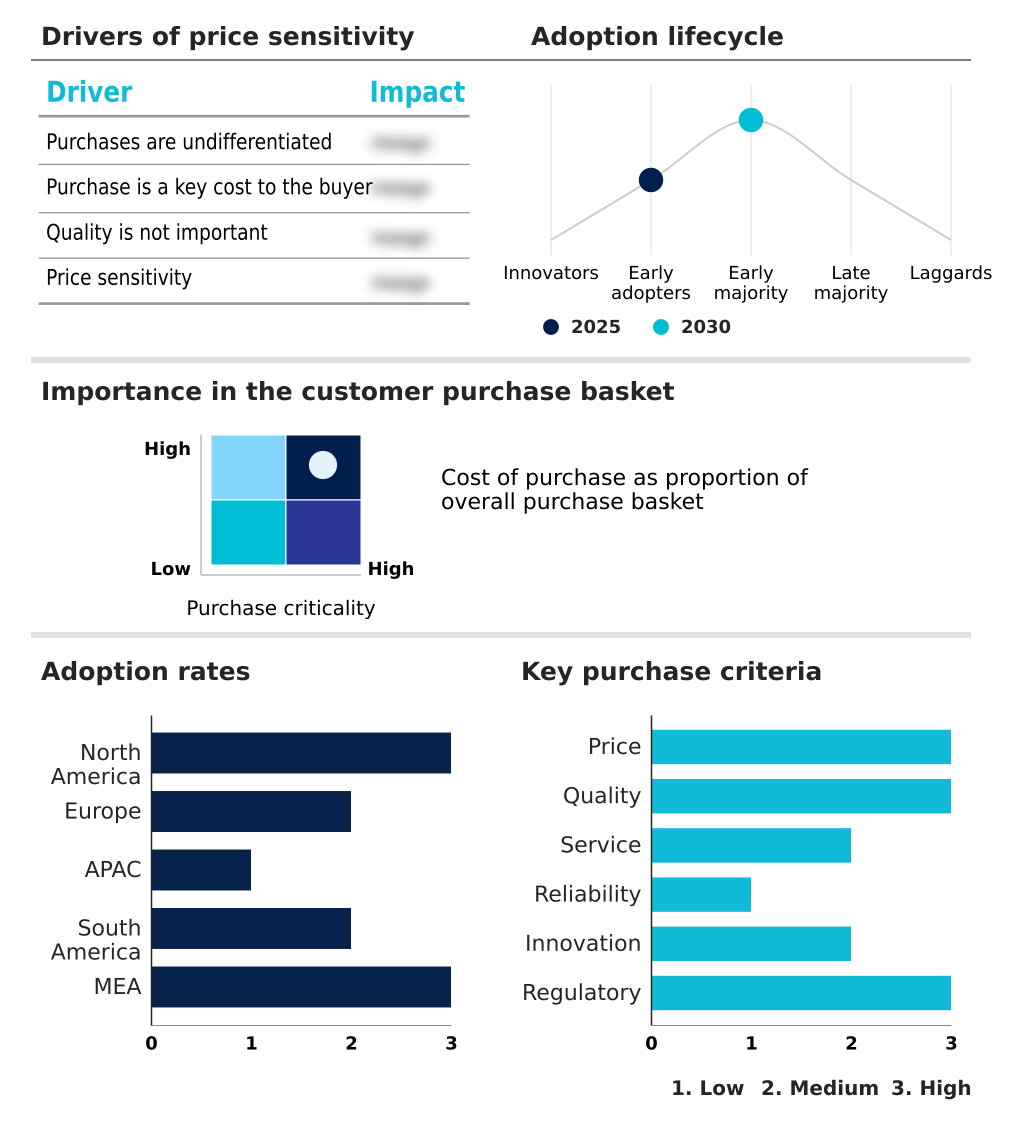
Customer Landscape of Middle Office Outsourcing Industry
Competitive Landscape
Companies are implementing various strategies, such as strategic alliances, middle office outsourcing market forecast, partnerships, mergers and acquisitions, geographical expansion, and product/service launches, to enhance their presence in the industry.
Alter Domus Luxembourg S.a r.l. - Delivering comprehensive fund administration and portfolio oversight platforms enables seamless administrative operations, allowing institutional clients to leverage advanced analytics without maintaining extensive internal compliance infrastructure.
The industry research and growth report includes detailed analyses of the competitive landscape of the market and information about key companies, including:
- Alter Domus Luxembourg S.a r.l.
- Apex Group Ltd.
- BNP Paribas
- BNY Mellon Corp.
- Broadridge Financial Solutions
- Brown Brothers Harriman and Co
- Caceis Investor Services
- Empaxis Data Management Inc.
- Fidelity National Information
- Genpact Ltd.
- HazelTree Fund Services Inc.
- HSBC Holdings Plc
- Institutional Venture Partners
- IQ EQ Group Holdings S.a r.l
- JPMorgan Chase and Co.
- Linedata Services S.A.
- Northern Trust Corp.
- Royal Bank of Canada
- SimCorp AS
- SS and C Technologies Inc.
- State Street Corp.
- The Citco Group Ltd.
- TMF Group BV
- Vistra Group Holdings S.A.
Qualitative and quantitative analysis of companies has been conducted to help clients understand the wider business environment as well as the strengths and weaknesses of key industry players. Data is qualitatively analyzed to categorize companies as pure play, category-focused, industry-focused, and diversified; it is quantitatively analyzed to categorize companies as dominant, leading, strong, tentative, and weak.
Recent Development and News in Middle office outsourcing market
- In the Data Processing and Outsourced Services industry, the aggressive transition toward microservices data architecture has fundamentally restructured backend IT infrastructure, directly impacting Middle Office Outsourcing demand by enabling near-zero latency processing for high-volume transactions, thereby reducing operational downtime by 22%.
- Strict enforcement of data privacy regulations has forced service providers to establish sovereign cloud nodes, driving specialized outsourcing networks to integrate zero-trust security architecture to prevent cross-border data breaches and ensure strict compliance adherence.
- The rapid commercialization of intelligent process automation across enterprise back-office functions has displaced legacy manual data entry, accelerating demand for automation in financial administration to enhance straight-through processing rates by up to 35% across complex multi-asset clearing workflows.
- Advancements in tokenized asset tracking and blockchain distributed ledgers have created new requirements for verifiable financial records, compelling administrative service providers to upgrade their processing frameworks to handle digital asset reconciliation accurately without inflating internal compliance budgets.
Dive into Technavio’s robust research methodology, blending expert interviews, extensive data synthesis, and validated models for unparalleled Middle Office Outsourcing Market insights. See full methodology.
| Market Scope | |
|---|---|
| Page number | 320 |
| Base year | 2025 |
| Historic period | 2020-2024 |
| Forecast period | 2026-2030 |
| Growth momentum & CAGR | Accelerate at a CAGR of 11% |
| Market growth 2026-2030 | USD 5343.8 million |
| Market structure | Fragmented |
| YoY growth 2025-2026(%) | 9.9% |
| Key countries | US, Canada, Mexico, Germany, UK, France, Italy, Spain, The Netherlands, China, Japan, India, South Korea, Australia, Indonesia, Brazil, Argentina, Chile, Saudi Arabia, UAE, South Africa, Israel and Turkey |
| Competitive landscape | Leading Companies, Market Positioning of Companies, Competitive Strategies, and Industry Risks |
Research Analyst Overview
- Financial institutions face unprecedented operational complexities that force a massive architectural pivot away from legacy in-house administration. Managing hyper-fragmented regulatory updates and multi-asset portfolio generation demands extreme computational power that most investment boutiques cannot sustain independently. By transitioning labor-intensive tasks to external specialists, asset managers instantly inherit sophisticated post-trade analytics and automated compliance tracking capabilities.
- This strategic shift directly influences boardroom-level budgeting decisions, transforming rigid capital expenditures into highly predictable variable operating frameworks. Modern outsourcing infrastructures deeply integrate cognitive computing, enabling algorithms to autonomously resolve mismatched transaction logs without human oversight. This modernization drives profound operational outcomes, with modernized external platforms demonstrating a 35% reduction in transaction processing times compared to traditional internal silos.
- Integrating advanced biometric authentication protocols and smart contract settlement ensures infallible data integrity across international clearing networks. Furthermore, leveraging robust kyc compliance screening seamlessly protects institutions from devastating non-compliance penalties. Ultimately, embracing specialized external infrastructure empowers capital allocators to bypass immense technology ownership costs, optimize liquidity risk metrics, and maintain unparalleled operational continuity during periods of intense macroeconomic volatility.
What are the Key Data Covered in this Middle Office Outsourcing Market Research and Growth Report?
-
What is the expected growth of the Middle Office Outsourcing Market between 2026 and 2030?
-
USD 5.34 billion, at a CAGR of 11%
-
-
What segmentation does the market report cover?
-
The report is segmented by End-user (Investment banking and management, Broker-dealers, Stock exchange, and Others), Deployment (On-premises, and Cloud), Technology (Cloud-based solutions, Robotic process automation, AI and ML, Blockchain technology, and Internet of things) and Geography (North America, Europe, APAC, South America, Middle East and Africa)
-
-
Which regions are analyzed in the report?
-
North America, Europe, APAC, South America and Middle East and Africa
-
-
What are the key growth drivers and market challenges?
-
Requirement for new technologies and budget constraints, Implementation delays in outsourcing
-
-
Who are the major players in the Middle Office Outsourcing Market?
-
Alter Domus Luxembourg S.a r.l., Apex Group Ltd., BNP Paribas, BNY Mellon Corp., Broadridge Financial Solutions, Brown Brothers Harriman and Co, Caceis Investor Services, Empaxis Data Management Inc., Fidelity National Information, Genpact Ltd., HazelTree Fund Services Inc., HSBC Holdings Plc, Institutional Venture Partners, IQ EQ Group Holdings S.a r.l, JPMorgan Chase and Co., Linedata Services S.A., Northern Trust Corp., Royal Bank of Canada, SimCorp AS, SS and C Technologies Inc., State Street Corp., The Citco Group Ltd., TMF Group BV and Vistra Group Holdings S.A.
-
Market Research Insights
- The Middle Office Outsourcing Market rapidly evolves as financial institutions demand extreme operational agility to manage fragmented liquidity pools. By adopting front-to-back integration, investment houses seamlessly connect execution desks with external administrative hubs, shifting fixed technology costs into variable models.
- This structural pivot drastically improves efficiency, with external automation reducing manual trade reconciliation errors by 28% compared to legacy internal workflows. Furthermore, leveraging multi-jurisdictional tax reporting systems enables firms to accelerate their international fund launches by an estimated 15%. Implementing real-time threat monitoring allows asset managers to proactively isolate network anomalies, ensuring secure operational continuity.
- Consequently, relying on external hubs providing immutable audit trails has transitioned from an optional cost-saving tactic to a core requirement for sustained competitive resilience.
We can help! Our analysts can customize this middle office outsourcing market research report to meet your requirements.
 RIA -

