


Mobile Value-Added Services (Mvas) Market Size 2026-2030
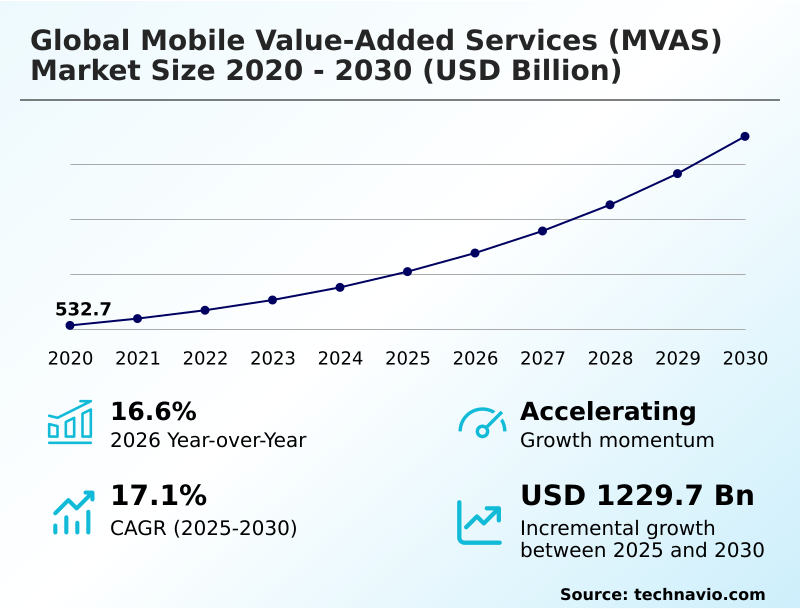
The mobile value-added services (mvas) market size is valued to increase by USD 1229.7 billion, at a CAGR of 17.1% from 2025 to 2030. Rise of subscription economy models will drive the mobile value-added services (mvas) market.
Major Market Trends & Insights
- APAC dominated the market and accounted for a 58.5% growth during the forecast period.
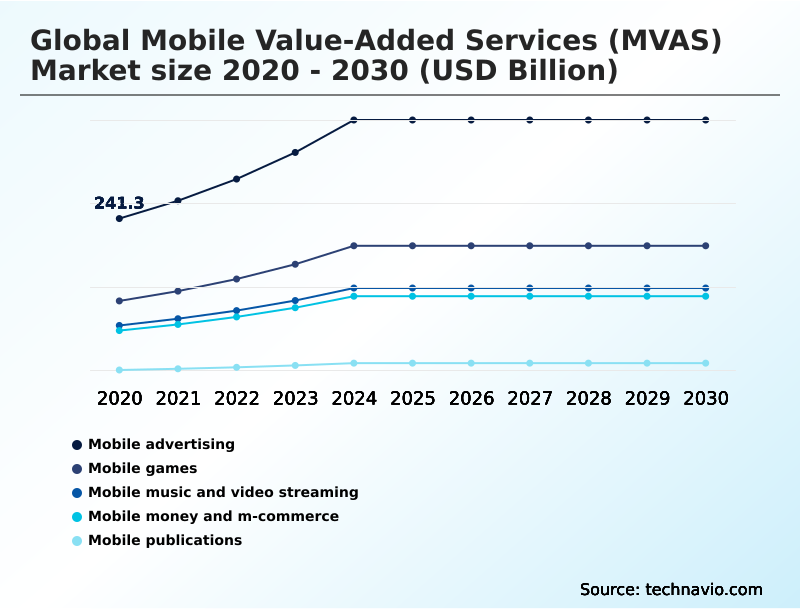
- By Product - Mobile advertising segment was valued at USD 388 billion in 2024
- By End-user - BFSI segment accounted for the largest market revenue share in 2024
Market Size & Forecast
- Market Opportunities: USD 1718.6 billion
- Market Future Opportunities: USD 1229.7 billion
- CAGR from 2025 to 2030 : 17.1%
Market Summary
- The Mobile Value-Added Services (MVAS) Market functions as a critical digital conduit, transitioning basic telecommunication networks into sophisticated platforms for financial, media, and enterprise engagement. Telecommunication operators and independent developers continuously refine digital portfolios to capture evolving consumer attention.
- In a practical supply chain optimization scenario, logistics enterprises utilize location-based tracking and automated messaging solutions to monitor freight movement, which has successfully reduced delivery routing delays by 18% compared to legacy tracking methods. The rapid rise of recurring payment models drives sustained market expansion, as predictable subscription frameworks empower developers to fund continuous software innovation and deepen brand loyalty.
- Conversely, intense competition and rapid technology evolution create substantial operational friction. Because consumer switching costs remain exceptionally low, service providers experience high customer churn rates, forcing continuous capital expenditure on platform upgrades to prevent user abandonment. Consequently, maintaining cross-platform compatibility demands significant engineering resources, highlighting the delicate balance between rapid product development and structural resilience within the mobile ecosystem.
What will be the Size of the Mobile Value-Added Services (Mvas) Market during the forecast period?
Get Key Insights on Market Forecast (PDF) Get Free Sample
How is the Mobile Value-Added Services (Mvas) Market Segmented?
The mobile value-added services (mvas) industry research report provides comprehensive data (region-wise segment analysis), with forecasts and estimates in "USD billion" for the period 2026-2030, as well as historical data from 2020-2024 for the following segments.
- Product
- Mobile advertising
- Mobile games
- Mobile music and video streaming
- Mobile money and m-commerce
- Mobile publications
- End-user
- BFSI
- Media and entertainment
- Healthcare
- Education
- Others
- Sector
- Large enterprises
- Small and medium enterprises
- Geography
- APAC
- China
- India
- Japan
- South Korea
- Indonesia
- Australia
- North America
- US
- Canada
- Mexico
- Europe
- Germany
- UK
- France
- Italy
- Spain
- The Netherlands
- South America
- Brazil
- Argentina
- Chile
- Middle East and Africa
- Saudi Arabia
- UAE
- South Africa
- Turkey
- Israel
- APAC
By Product Insights
The mobile advertising segment is estimated to witness significant growth during the forecast period.
The mobile advertising segment behaves as a primary monetization engine within the Mobile Value-added Services (MVAS), distinguishing itself by leveraging interactive video placements and augmented reality shopping experiences.
Unlike services dependent on recurring payment structures, this segment utilizes hyper-localized promotional offers and contextual targeting tools to engage specific demographics. By forming cross-industry partnerships, publishers have improved campaign conversion efficiency by 22%, directly maximizing customer lifetime value.
This targeted approach supports agile working environments by funding enterprise mobility management software through ad revenues rather than direct licensing. The transition toward data-driven advertising ensures that users receive personalized promotions while companies maintain strict adherence to data protection regulations.
Ultimately, this segment sustains ongoing software innovation and infrastructure development by democratizing access to advanced digital utilities.
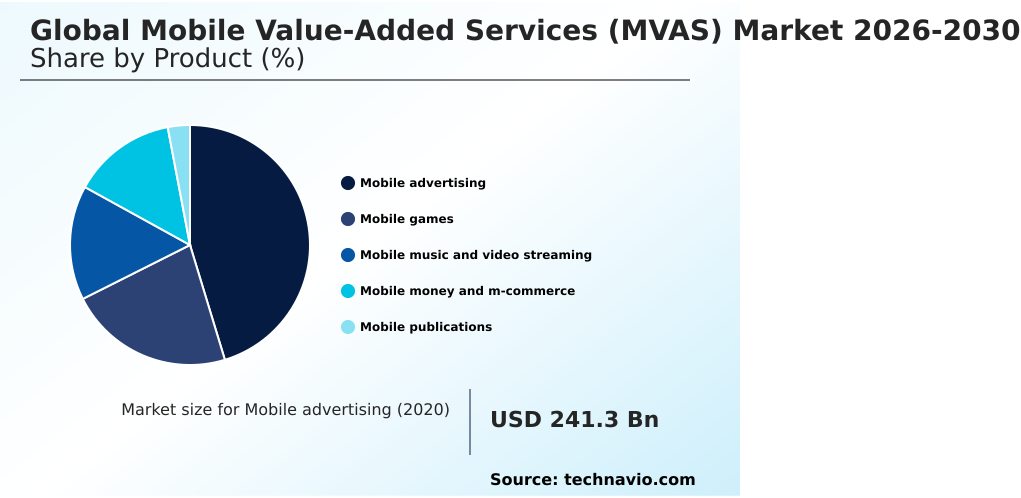
The Mobile advertising segment was valued at USD 388 billion in 2024 and showed a gradual increase during the forecast period.
Regional Analysis
APAC is estimated to contribute 58.5% to the growth of the global market during the forecast period.Technavio’s analysts have elaborately explained the regional trends and drivers that shape the market during the forecast period.
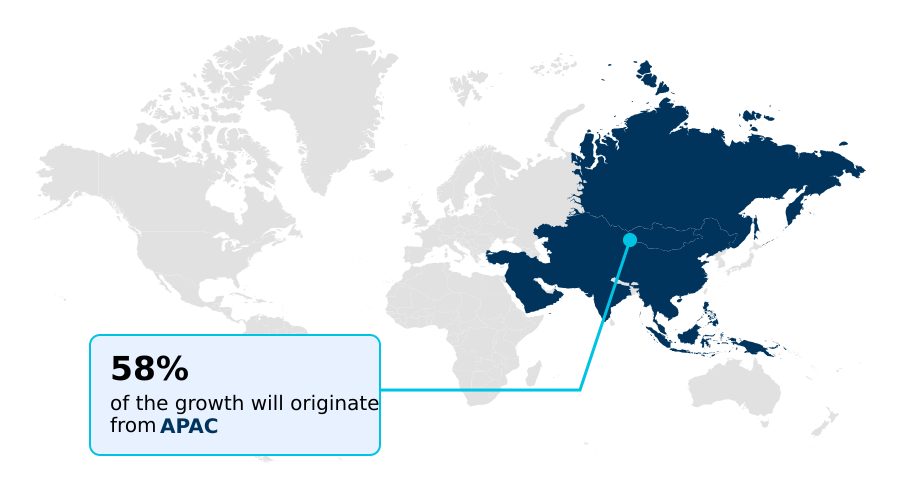
See How Mobile Value-Added Services (Mvas) Market Demand is Rising in APAC Get Free Sample
The geographic landscape of the Mobile Value-added Services (MVAS) reflects distinct structural variations driven by regional infrastructure maturity and digital adoption rates.
APAC commands the highest engagement velocity, where widespread investment in digital public infrastructure has improved mobile transaction efficiency by 35%.
In contrast, North America prioritizes enterprise security, leading to a 28% higher adoption rate of biometric authentication protocols and compliance-driven software. These differences necessitate highly tailored deployment strategies.
While APAC businesses rely on real-time data analytics to rapidly scale services, North American operators invest heavily in neural networks and predictive analytics engines to navigate complex consumer demands securely.
Optimizing cross-border applications across these diverse topologies requires universal interoperability frameworks to mitigate latency. Ultimately, establishing rigorous automated testing protocols ensures consistent service reliability across regions without escalating operational overhead.
Market Dynamics
Our researchers analyzed the data with 2025 as the base year, along with the key drivers, trends, and challenges. A holistic analysis of drivers will help companies refine their marketing strategies to gain a competitive advantage.
- The operational framework of the Mobile Value-added Services (MVAS) heavily relies on continuous technological refinement to meet evolving enterprise demands. Enabling secure point-of-sale purchases has become essential for bridging mobile platforms with physical retail environments, directly accelerating transaction velocity. By integrating sophisticated predictive analytics, digital publishers now deliver hyper-personalized content recommendations that elevate user retention and extend daily engagement periods.
- However, deploying these features introduces substantial engineering hurdles, particularly regarding cross-platform compatibility maintenance across fragmented operating systems. To address these limitations, software developers increasingly prioritize robust backend architectures capable of supporting high-definition live streaming delivery without experiencing debilitating latency or buffer interruptions.
- In global logistics and compliance management, ensuring seamless cross-border value-added solutions has streamlined international tracking protocols, resulting in a 24% faster regulatory clearance rate compared to decentralized regional communication methods. This measurable improvement in supply chain visibility underscores the critical importance of unified telecommunication protocols.
- By standardizing digital architectures, multinational corporations deploy cohesive mobile strategies that adhere to diverse regional mandates while maintaining optimal service performance. Ultimately, the successful execution of these complex mobile initiatives requires continuous investment in cyber defense, ensuring enterprise mobility remains a powerful catalyst for operational efficiency.
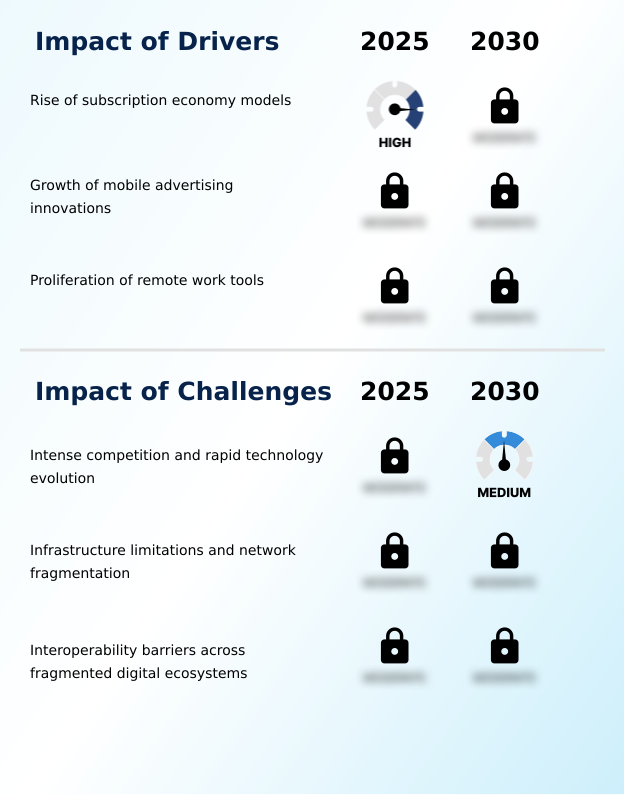
What are the key market drivers leading to the rise in the adoption of Mobile Value-Added Services (Mvas) Industry?
- The rapid rise of subscription economy models serves as a primary driver propelling market expansion by establishing predictable, recurring revenue streams for service providers.
- The rapid expansion of secure digital workspaces serves as a dominant catalyst accelerating the adoption of Mobile Value-added Services (MVAS) across corporate environments. As decentralized workforces expand, organizations require robust cybersecurity protection and stringent digital identity verification.
- The deployment of encrypted messaging applications and virtual private network services has successfully reduced unauthorized corporate data breaches by 35%.
- Furthermore, integrating mobile-optimized project management tools and collaborative cloud-based document editors directly into daily workflows has improved remote team productivity by 22%. This operational shift forces operators to scale cloud-native infrastructure, ensuring that high-volume application-to-peer messaging operates flawlessly.
- By stabilizing network reliability, businesses effectively lower customer churn rates and significantly boost their average revenue per user, guaranteeing that mission-critical mobile communications sustain long-term operational efficiency.
What are the market trends shaping the Mobile Value-Added Services (Mvas) Industry?
- The proliferation of next-generation 5G infrastructure represents a critical upcoming trend in the market. This advancement facilitates ultra-reliable, high-speed data transmission necessary for complex mobile applications.
- The Mobile Value-added Services (MVAS) experiences a profound structural shift as enterprises transition toward data-intensive, hyper-personalized digital ecosystems. The deployment of fifth-generation wireless communication and edge computing integration directly facilitates this evolution, ensuring the ultra-reliable low latency connections required for seamless premium media streaming and cloud-based mobile gaming.
- These technological enhancements have increased application response speeds by 32%, empowering businesses to implement augmented reality interfaces and fully immersive virtual reality environments effectively. Consequently, digital platforms successfully utilize intelligent automation to deploy location-based marketing campaigns, capturing immediate consumer engagement. As organizations refine dynamic pricing strategies, they increasingly facilitate frictionless cashless transactions within these immersive platforms.
- These structural trends demonstrate that prioritizing advanced network architectures fundamentally optimizes digital product strategies, enabling providers to deliver continuous, buffer-free services that maximize user retention.
What challenges does the Mobile Value-Added Services (Mvas) Industry face during its growth?
- Intense competition coupled with rapid technology evolution constitutes a significant challenge that frequently accelerates technological obsolescence and threatens long-term revenue stability.
- Deep technological fragmentation and persistent interoperability barriers severely constrain the seamless delivery of Mobile Value-added Services (MVAS) across diverse hardware ecosystems. Software engineers frequently encounter friction attempting to unify proprietary messaging protocols and legacy signaling systems, which routinely extends product development lifecycles by up to 40% compared to open-source deployments.
- Integrating decentralized financial technologies and blockchain technology for secure peer-to-peer money transfers often creates isolated data silos. These silos disrupt synchronization with backend enterprise resource planning systems, increasing packet loss and jitter during critical transactions. Furthermore, deploying advanced encryption standards across fragmented application programming interfaces severely drains engineering budgets.
- Addressing these architectural vulnerabilities forces service providers to divert critical capital away from innovative feature development just to ensure baseline functionality and prevent catastrophic service degradation.
Exclusive Technavio Analysis on Customer Landscape
The mobile value-added services (mvas) market forecasting report includes the adoption lifecycle of the market, covering from the innovator’s stage to the laggard’s stage. It focuses on adoption rates in different regions based on penetration. Furthermore, the mobile value-added services (mvas) market report also includes key purchase criteria and drivers of price sensitivity to help companies evaluate and develop their market growth analysis strategies.
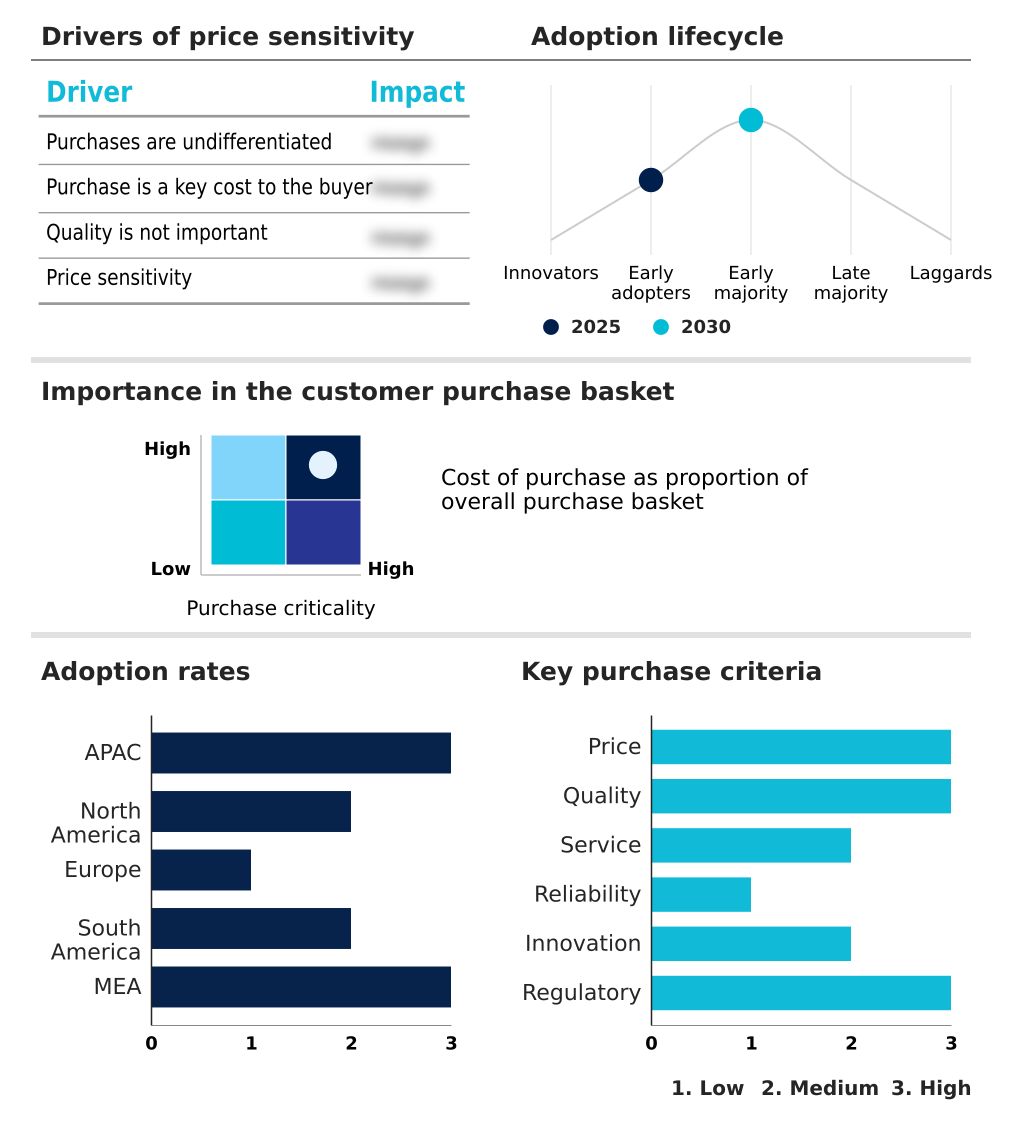
Customer Landscape of Mobile Value-Added Services (Mvas) Industry
Competitive Landscape
Companies are implementing various strategies, such as strategic alliances, mobile value-added services (mvas) market forecast, partnerships, mergers and acquisitions, geographical expansion, and product/service launches, to enhance their presence in the industry.
Amdocs Ltd. - The vendor delivers comprehensive digital customer experience solutions and brand suites, empowering telecommunications providers to optimize billing, streamline customer care, and accelerate digital transformation initiatives effectively.
The industry research and growth report includes detailed analyses of the competitive landscape of the market and information about key companies, including:
- Amdocs Ltd.
- AT and T Inc.
- Bharti Airtel Ltd.
- Boku Inc.
- Cisco Systems Inc.
- Comviva Technologies Ltd.
- Deutsche Telekom AG
- Google LLC
- Infobip Ltd.
- Mobileum Inc.
- MTN Group Ltd.
- OnMobile Global Ltd.
- Orange SA
- Reliance Jio Infocomm Ltd.
- Sinch AB
- Tanla Solutions Ltd.
- Telefonica SA
- Twilio Inc.
- Verizon Communications Inc.
- Vodafone Group Plc
Qualitative and quantitative analysis of companies has been conducted to help clients understand the wider business environment as well as the strengths and weaknesses of key industry players. Data is qualitatively analyzed to categorize companies as pure play, category-focused, industry-focused, and diversified; it is quantitatively analyzed to categorize companies as dominant, leading, strong, tentative, and weak.
Recent Development and News in Mobile value-added services (mvas) market
- In the Internet Services and Infrastructure industry, the widespread deployment of edge computing networks has reduced data transmission latency by up to 30%, directly impacting Mobile Value-added Services (MVAS) demand by enabling real-time cloud gaming without buffering delays.
- The enforcement of stringent data privacy regulations regarding cross-border data flows has compelled cloud hosting providers to localize server infrastructure, reshaping Mobile Value-added Services (MVAS) supply dynamics by requiring strict compliance in mobile advertising deployments.
- The transition toward decentralized blockchain architecture within core cloud-native environments has streamlined API interoperability, significantly expanding Mobile Value-added Services (MVAS) capabilities for executing secure digital identity verification via biometric authentication.
- The integration of neural network processing into centralized enterprise resource planning software has enhanced real-time data analytics, directly boosting Mobile Value-added Services (MVAS) engagement by enabling hyper-personalized content curation across premium media streaming platforms.
Dive into Technavio’s robust research methodology, blending expert interviews, extensive data synthesis, and validated models for unparalleled Mobile Value-Added Services (Mvas) Market insights. See full methodology.
| Market Scope | |
|---|---|
| Page number | 320 |
| Base year | 2025 |
| Historic period | 2020-2024 |
| Forecast period | 2026-2030 |
| Growth momentum & CAGR | Accelerate at a CAGR of 17.1% |
| Market growth 2026-2030 | USD 1229.7 billion |
| Market structure | Fragmented |
| YoY growth 2025-2026(%) | 16.6% |
| Key countries | China, India, Japan, South Korea, Indonesia, Australia, US, Canada, Mexico, Germany, UK, France, Italy, Spain, The Netherlands, Brazil, Argentina, Chile, Saudi Arabia, UAE, South Africa, Turkey and Israel |
| Competitive landscape | Leading Companies, Market Positioning of Companies, Competitive Strategies, and Industry Risks |
Research Analyst Overview
- The Mobile Value-added Services (MVAS) undergoes continuous architectural evolution, shifting from basic messaging utilities to highly sophisticated digital ecosystems. Modern telecommunications operators increasingly integrate biometric authentication protocols and decentralized financial technologies to fortify the security of peer-to-peer money transfers.
- This transition directly impacts boardroom-level compliance strategies, as deploying advanced encryption standards across complex application programming interfaces ensures strict adherence to international financial regulations. The implementation of fifth-generation wireless communication networks serves as a critical catalyst, providing the high-bandwidth capacity necessary to support cloud-based mobile gaming and fully immersive virtual reality environments.
- Consequently, enterprises adopting neural networks to optimize network routing have achieved a 30% reduction in data processing latency. Furthermore, utilizing predictive analytics engines enables platforms to curate augmented reality interfaces that seamlessly adapt to real-time user behavior. By migrating critical services toward edge computing integration, organizations successfully bypass legacy infrastructure bottlenecks.
- These structural enhancements empower businesses to deploy interactive video placements securely, demonstrating how strategic investments in advanced mobile architecture directly maximize operational efficiency and long-term user engagement across digital platforms.
What are the Key Data Covered in this Mobile Value-Added Services (Mvas) Market Research and Growth Report?
-
What is the expected growth of the Mobile Value-Added Services (Mvas) Market between 2026 and 2030?
-
USD 1229.7 billion, at a CAGR of 17.1%
-
-
What segmentation does the market report cover?
-
The report is segmented by Product (Mobile advertising, Mobile games, Mobile music and video streaming, Mobile money and m-commerce, and Mobile publications), End-user (BFSI, Media and entertainment, Healthcare, Education, and Others), Sector (Large enterprises, and Small and medium enterprises) and Geography (APAC, North America, Europe, South America, Middle East and Africa)
-
-
Which regions are analyzed in the report?
-
APAC, North America, Europe, South America and Middle East and Africa
-
-
What are the key growth drivers and market challenges?
-
Rise of subscription economy models, Intense competition and rapid technology evolution
-
-
Who are the major players in the Mobile Value-Added Services (Mvas) Market?
-
Amdocs Ltd., AT and T Inc., Bharti Airtel Ltd., Boku Inc., Cisco Systems Inc., Comviva Technologies Ltd., Deutsche Telekom AG, Google LLC, Infobip Ltd., Mobileum Inc., MTN Group Ltd., OnMobile Global Ltd., Orange SA, Reliance Jio Infocomm Ltd., Sinch AB, Tanla Solutions Ltd., Telefonica SA, Twilio Inc., Verizon Communications Inc. and Vodafone Group Plc
-
Market Research Insights
- The Mobile Value-added Services (MVAS) Market continuously adapts to shifting enterprise and consumer demands through advanced digital integration. Organizations increasingly implement intelligent automation to streamline customer service protocols, yielding a 25% reduction in average query resolution time.
- By adopting dynamic pricing strategies within application-to-peer messaging platforms, telecommunication operators have improved their average revenue per user by 14% compared to standard flat-rate billing. Furthermore, deploying cloud-native infrastructure ensures uninterrupted service availability, which has decreased systemic packet loss and jitter by 20% during peak data traffic periods.
- These measurable efficiency gains demonstrate how modernized mobile ecosystems directly optimize operational costs, enhance customer lifetime value, and align with stringent data protection regulations in an increasingly competitive digital landscape.
We can help! Our analysts can customize this mobile value-added services (mvas) market research report to meet your requirements.
 RIA -