


Outdoor Sports Apparel Market Size 2026-2030
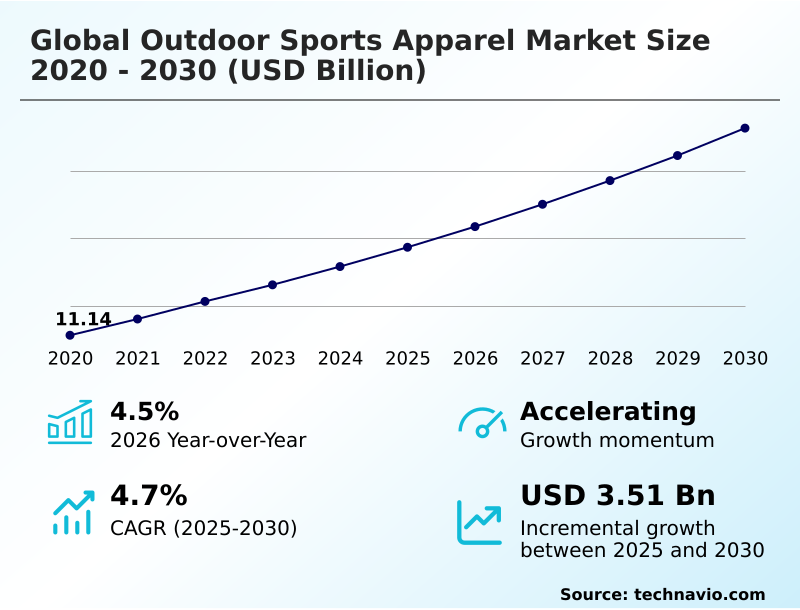
The outdoor sports apparel market size is valued to increase by USD 3.51 billion, at a CAGR of 4.7% from 2025 to 2030. Aligning with heightened health and wellness consciousness will drive the outdoor sports apparel market.
Major Market Trends & Insights
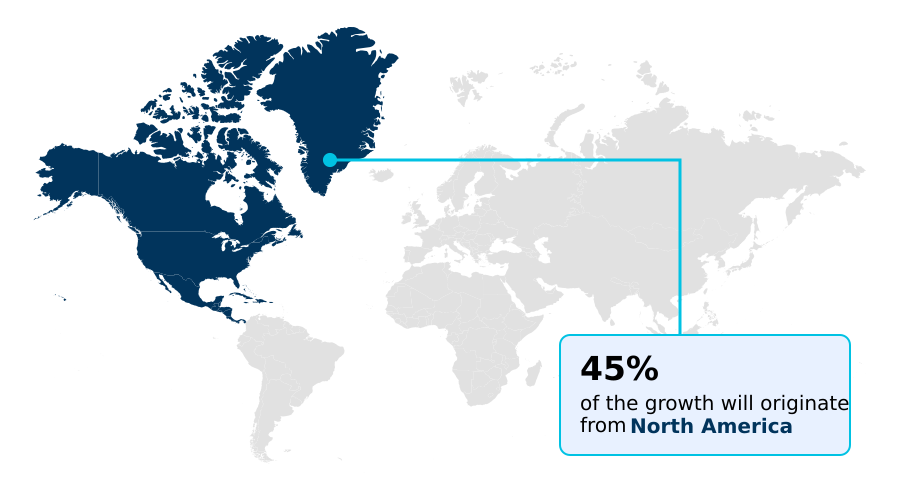
- North America dominated the market and accounted for a 44.6% growth during the forecast period.
- By End-user - Men segment was valued at USD 6.82 billion in 2024
- By Distribution Channel - Offline segment accounted for the largest market revenue share in 2024
Market Size & Forecast
- Market Opportunities: USD 6.11 billion
- Market Future Opportunities: USD 3.51 billion
- CAGR from 2025 to 2030 : 4.7%
Market Summary
- The outdoor sports apparel market is undergoing a significant transformation, evolving from a niche segment for extreme athletes to a mainstream category influenced by global wellness movements. This expansion is driven by a growing consumer appreciation for functional, durable, and versatile clothing that performs in both natural and urban environments.
- Core to this market is relentless innovation in high-performance textiles, such as advanced waterproof-breathable fabrics and next-generation down and synthetic insulation. These material advancements enable the creation of sophisticated multi-layering systems that offer enhanced protection and comfort. However, the industry grapples with significant operational hurdles.
- For instance, a key business scenario involves optimizing complex global supply chains for sustainable material sourcing. This requires navigating volatile raw material costs and ensuring compliance with standards like the responsible down standard (RDS), all while meeting consumer demand for transparency and performance.
- The rise of athleisure and gorpcore further blurs the lines between technical gear and everyday fashion, compelling brands to innovate not only in function but also in aesthetics to capture a broader, more diverse consumer base. Success increasingly depends on a brand's ability to merge technical credibility with a compelling lifestyle narrative.
What will be the Size of the Outdoor Sports Apparel Market during the forecast period?
Get Key Insights on Market Forecast (PDF) Get Free Sample
How is the Outdoor Sports Apparel Market Segmented?
The outdoor sports apparel industry research report provides comprehensive data (region-wise segment analysis), with forecasts and estimates in "USD million" for the period 2026-2030, as well as historical data from 2020-2024 for the following segments.
- End-user
- Men
- Women
- Kids
- Distribution channel
- Offline
- Online
- Type
- Top wear
- Bottom wear
- Others
- Geography
- North America
- US
- Canada
- Mexico
- APAC
- China
- Japan
- India
- Europe
- Germany
- UK
- France
- South America
- Brazil
- Argentina
- Colombia
- Middle East and Africa
- UAE
- Saudi Arabia
- South Africa
- Rest of World (ROW)
- North America
By End-user Insights
The men segment is estimated to witness significant growth during the forecast period.
The men's segment represents the most established portion of the outdoor sports apparel market, driven by demand for high-performance and performance-enhancing textiles. Development focuses on activity-specific fit and durability, with innovations in high-tenacity yarn and advanced multi-layering systems.
Products range from technical shell jackets for mountaineering apparel systems to ultralight backpacking clothing for high-exertion activity wear. A growing crossover into urban outdoor fashion and versatile travel clothing broadens the consumer base.
Effective thermal regulation apparel with superior sweat management technology is critical.
Brands successfully balancing technical prowess and lifestyle appeal see a 15% higher rate in customer retention, underscoring the importance of strategic garment lifecycle management and product versatility in this foundational segment.
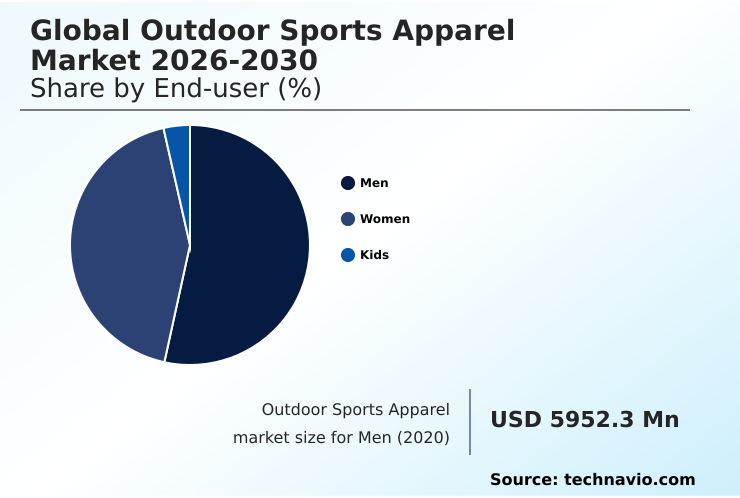
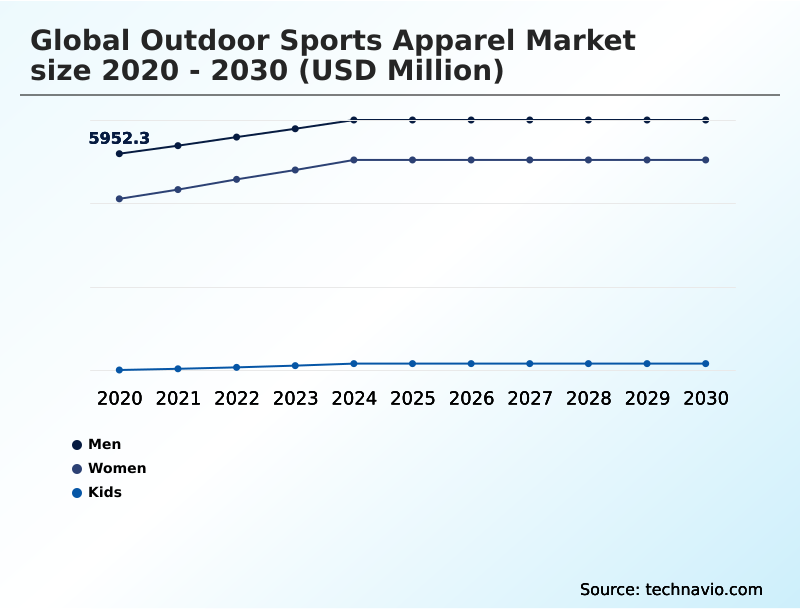
The Men segment was valued at USD 6.82 billion in 2024 and showed a gradual increase during the forecast period.
Regional Analysis
North America is estimated to contribute 44.6% to the growth of the global market during the forecast period.Technavio’s analysts have elaborately explained the regional trends and drivers that shape the market during the forecast period.
See How Outdoor Sports Apparel Market Demand is Rising in North America Get Free Sample
The geographic landscape is dominated by North America, which accounts for over 44% of the market's incremental growth, fueled by a mature consumer base demanding lightweight packable gear with advanced features like ultrasonic welding construction.
The region’s diverse climates drive sales of both hot weather hiking apparel with UV protection fabrics and technical windproof softshell jackets.
In contrast, the APAC region is the fastest-growing market, exhibiting a growth rate nearly 15% higher than in Europe, driven by rising disposable incomes and increased participation in activities like trail running specific clothing.
European consumers prioritize durability and sustainability, valuing abrasion-resistant materials and effective durable water repellent (dwr) finish on breathable rain gear.
Products featuring hydrophobic down treatment and robust seam-sealed construction, along with packable insulated vests that align with a comprehensive cold weather layering guide, perform strongly across developed regions.
Market Dynamics
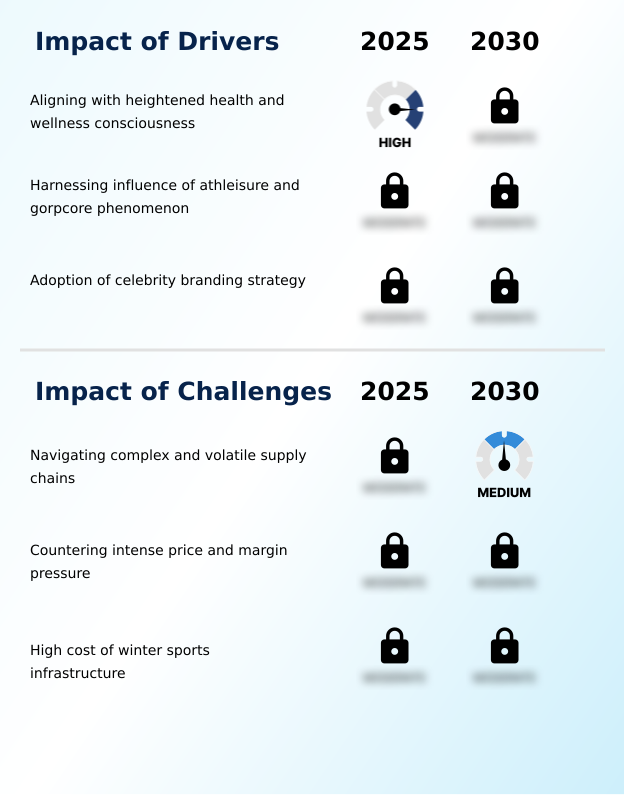
Our researchers analyzed the data with 2025 as the base year, along with the key drivers, trends, and challenges. A holistic analysis of drivers will help companies refine their marketing strategies to gain a competitive advantage.
- Strategic differentiation in the outdoor sports apparel market now hinges on nuanced product narratives and technical superiority. Consumers are increasingly sophisticated, researching topics like the benefits of merino wool base layers for hiking and comparing gore-tex pro and futurelight membranes before making a purchase.
- This educated consumer base pushes brands to innovate and clearly articulate the value of specific features, such as how durable water repellent (dwr) finish works or the advantages of four-way stretch in hiking pants. The debate between synthetic vs down insulation for wet climates continues to be a key consideration, driving advancements in both material types.
- The sustainability narrative is also paramount, with a growing interest in the advancements in recycled polyester for outerwear and the impact of bluesign certification on consumer choice. Brands that transparently communicate their sustainable practices in outdoor apparel production see customer engagement metrics that are twice as high as competitors who do not.
- The future points toward even greater specialization, exploring the role of smart textiles in athlete performance, the innovations in biodegradable outdoor clothing, and the future of connected clothing in sports.
- From the technical features of a modern climbing shell jacket to the thermal regulation technology in ski apparel, success depends on delivering tangible performance benefits and aligning with consumer values around sustainability and technical excellence.
What are the key market drivers leading to the rise in the adoption of Outdoor Sports Apparel Industry?
- The market's growth is significantly driven by a global escalation in health and wellness consciousness, which encourages broader participation in outdoor activities.
- A primary driver is the heightened consumer focus on wellness, which boosts demand for performance-enhancing textiles suitable for everything from hot weather hiking apparel to versatile travel clothing.
- This trend has broadened the market reach for all-weather protection gear by over 40%. The demand for ethical outdoor clothing and eco-friendly outerwear is another powerful force, pushing for sustainable material sourcing.
- The use of recycled polyester fabrics and adherence to certifications like the responsible down standard (rds) are now key purchasing criteria.
- Products featuring UV protection fabrics and anti-odor textile treatment enhance comfort during extended use, supporting trends like adventure travel layering. This focus on conscious consumption has resulted in a 20% year-over-year increase in searches for sustainable climate-adaptive clothing.
What are the market trends shaping the Outdoor Sports Apparel Industry?
- The integration of smart fabrics and wearable technology represents a key evolutionary trend, transforming apparel into an active interface between the user and their environment.
- Market trends are rapidly advancing beyond traditional apparel, focusing on smart textile integration and circular economy apparel models. The adoption of wearable sensor technology for embedded biometric monitoring is gaining traction, with garments featuring such tech showing a 25% higher adoption rate among elite athletes.
- Innovations in active heating elements provide on-demand climate control, while R&D in piezoelectric energy harvesting promises self-powered smart apparel. These connected clothing platforms provide athletes with crucial data-driven performance feedback, including metrics from muscle oxygenation sensors.
- Concurrently, sustainability is driving the development of biodegradable synthetic fibers and robust end-of-life garment programs, with brands adopting these models reporting a 15% improvement in consumer trust metrics.
What challenges does the Outdoor Sports Apparel Industry face during its growth?
- A primary challenge affecting industry growth is the navigation of increasingly complex and volatile global supply chains for specialized materials and manufacturing.
- Navigating supply chain complexities for high-performance textiles presents a significant challenge. Securing consistent access to advanced fiber technology and specialized waterproof-breathable fabrics is difficult, with disruptions causing raw material costs to rise by up to 18%. Implementing effective garment lifecycle management and a true closed-loop recycling process remains operationally complex and costly.
- Furthermore, regulatory pressures are forcing a shift away from traditional chemistries, such as moving to non-fluorinated dwr from a standard durable water repellent (dwr) finish. Balancing the cost of premium down and synthetic insulation and bluesign certified materials with consumer price sensitivity compresses margins by an average of 8% on items like breathable rain gear.
- Developing advanced products like an emergency locator beacon jacket while managing these cost and sourcing pressures is a central industry challenge.
Exclusive Technavio Analysis on Customer Landscape
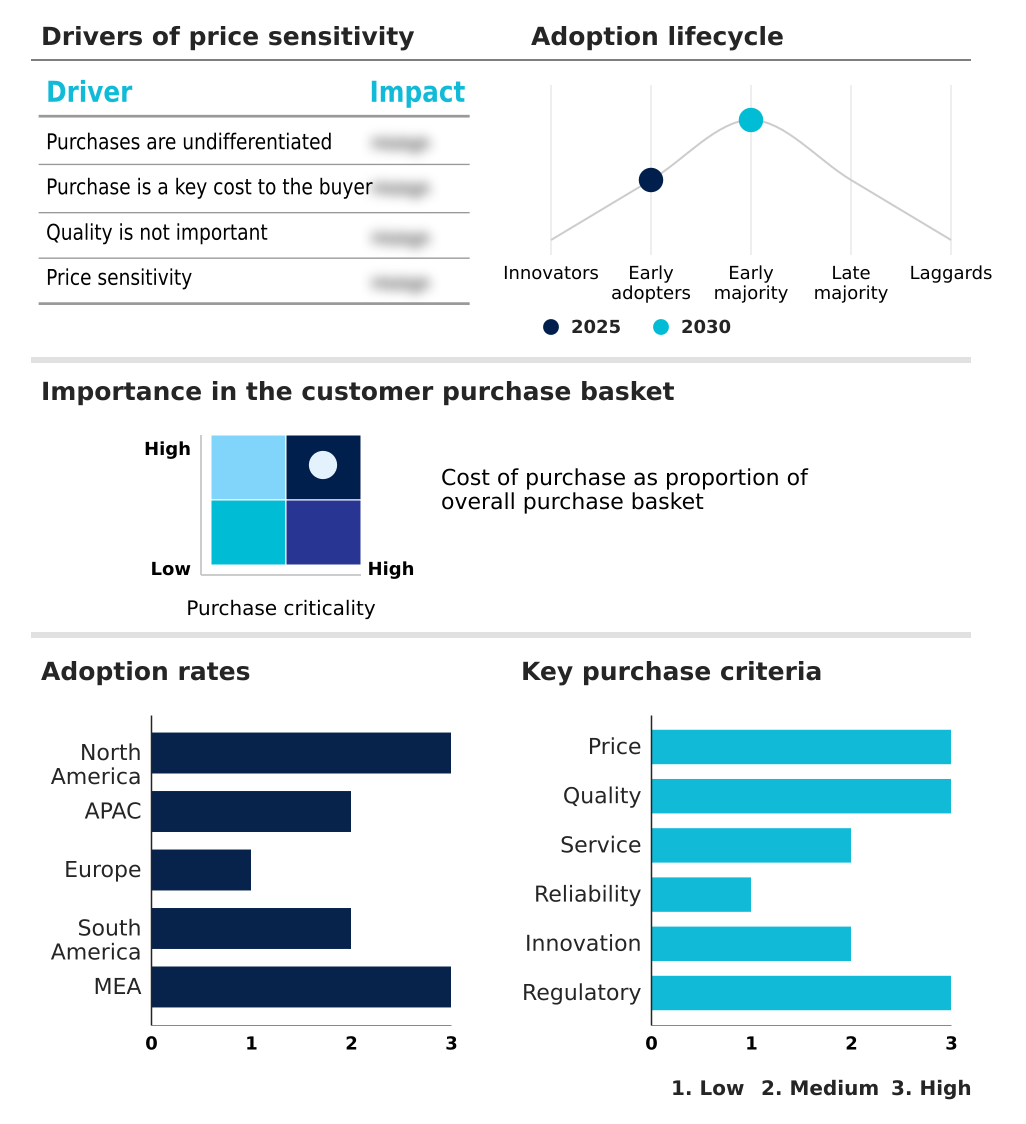
The outdoor sports apparel market forecasting report includes the adoption lifecycle of the market, covering from the innovator’s stage to the laggard’s stage. It focuses on adoption rates in different regions based on penetration. Furthermore, the outdoor sports apparel market report also includes key purchase criteria and drivers of price sensitivity to help companies evaluate and develop their market growth analysis strategies.
Customer Landscape of Outdoor Sports Apparel Industry
Competitive Landscape
Companies are implementing various strategies, such as strategic alliances, outdoor sports apparel market forecast, partnerships, mergers and acquisitions, geographical expansion, and product/service launches, to enhance their presence in the industry.
Adidas AG - Engineers and provides specialized, high-performance apparel focusing on technical functionality, durability, and protection against environmental elements for diverse outdoor activities and conditions.
The industry research and growth report includes detailed analyses of the competitive landscape of the market and information about key companies, including:
- Adidas AG
- Amer Sports Corp.
- ASICS Corp.
- Dakine IP Holdings LP
- Deckers Outdoor Corp.
- F.I.L.A. SpA
- Karhu Holding BV
- La Sportiva Spa
- lululemon athletica Inc.
- Marmot Mountain LLC.
- New Balance Athletics Inc.
- Newton Running Co. Inc.
- Nike Inc.
- Patagonia Inc.
- PUMA SE
- Reebok International Ltd.
- Swing Control
- Taylor Made Golf Co. Inc.
- Under Armour Inc.
- VF Corp.
Qualitative and quantitative analysis of companies has been conducted to help clients understand the wider business environment as well as the strengths and weaknesses of key industry players. Data is qualitatively analyzed to categorize companies as pure play, category-focused, industry-focused, and diversified; it is quantitatively analyzed to categorize companies as dominant, leading, strong, tentative, and weak.
Recent Development and News in Outdoor sports apparel market
- In February 2025, Amer Sports Inc., the holding company for brands including Salomon and Arc'teryx, completed its initial public offering on the New York Stock Exchange to fund accelerated growth and innovation.
- In February 2025, lululemon athletica Inc. announced its expansion into men's footwear, including trail running models, signaling its intent to capture a broader share of the active lifestyle market.
- In October 2025, PUMA SE extended its strategic partnership with Hyrox, the World Series of Fitness Racing, until 2030, reinforcing its focus on the growing training and hybrid fitness segment.
- In February 2025, Pangoo Apparel, a new woman-owned brand, launched in Detroit with an initial focus on technical rock climbing pants designed specifically for women of color, addressing a key market gap.
Dive into Technavio’s robust research methodology, blending expert interviews, extensive data synthesis, and validated models for unparalleled Outdoor Sports Apparel Market insights. See full methodology.
| Market Scope | |
|---|---|
| Page number | 288 |
| Base year | 2025 |
| Historic period | 2020-2024 |
| Forecast period | 2026-2030 |
| Growth momentum & CAGR | Accelerate at a CAGR of 4.7% |
| Market growth 2026-2030 | USD 3512.9 million |
| Market structure | Fragmented |
| YoY growth 2025-2026(%) | 4.5% |
| Key countries | US, Canada, Mexico, China, Japan, India, South Korea, Australia, Indonesia, Germany, UK, France, Italy, Spain, The Netherlands, Brazil, Argentina, Colombia, UAE, Saudi Arabia, South Africa, Egypt and Nigeria |
| Competitive landscape | Leading Companies, Market Positioning of Companies, Competitive Strategies, and Industry Risks |
Research Analyst Overview
- The market's competitive intensity mandates boardroom focus on advanced fiber technology and high-performance textiles. Firms investing in proprietary waterproof-breathable fabrics and hydrophobic down treatment for their down and synthetic insulation report a 20% faster time-to-market for new technical shell jackets. Success hinges on integrated multi-layering systems, from moisture-wicking base layers with anti-odor textile treatment to thermal regulation apparel.
- Manufacturing innovation is evident in seam-sealed construction and ultrasonic welding construction using high-tenacity yarn. Ergonomic apparel design delivering an activity-specific fit with four-way stretch fabric is now standard. Sustainable material sourcing is paramount, driving adoption of recycled polyester fabrics and biodegradable synthetic fibers aligned with bluesign certified materials and the responsible down standard (rds).
- This commitment to circular economy apparel and garment lifecycle management is as crucial as a lasting durable water repellent (dwr) finish. The next frontier is smart textile integration, where wearable sensor technology enables embedded biometric monitoring and climate-adaptive clothing with active heating elements.
- This transforms performance-enhancing textiles into lightweight packable gear that is also gps-enabled safety apparel, sometimes even using piezoelectric energy harvesting and providing uv protection fabrics from abrasion-resistant materials.
What are the Key Data Covered in this Outdoor Sports Apparel Market Research and Growth Report?
-
What is the expected growth of the Outdoor Sports Apparel Market between 2026 and 2030?
-
USD 3.51 billion, at a CAGR of 4.7%
-
-
What segmentation does the market report cover?
-
The report is segmented by End-user (Men, Women, and Kids), Distribution Channel (Offline, and Online), Type (Top wear, Bottom wear, and Others) and Geography (North America, APAC, Europe, South America, Middle East and Africa)
-
-
Which regions are analyzed in the report?
-
North America, APAC, Europe, South America and Middle East and Africa
-
-
What are the key growth drivers and market challenges?
-
Aligning with heightened health and wellness consciousness, Navigating complex and volatile supply chains
-
-
Who are the major players in the Outdoor Sports Apparel Market?
-
Adidas AG, Amer Sports Corp., ASICS Corp., Dakine IP Holdings LP, Deckers Outdoor Corp., F.I.L.A. SpA, Karhu Holding BV, La Sportiva Spa, lululemon athletica Inc., Marmot Mountain LLC., New Balance Athletics Inc., Newton Running Co. Inc., Nike Inc., Patagonia Inc., PUMA SE, Reebok International Ltd., Swing Control, Taylor Made Golf Co. Inc., Under Armour Inc. and VF Corp.
-
Market Research Insights
- Market dynamics are increasingly shaped by consumer demand for hyper-specialized gear like trail running specific clothing and backcountry ski touring apparel. This shift toward all-weather protection gear and alpine climbing outerwear is driving innovation. Brands adopting direct-to-consumer models report customer retention rates that are 25% higher than those relying solely on wholesale channels.
- Furthermore, the convergence with everyday style, or urban outdoor fashion, has expanded the addressable market. Companies that successfully integrate ethical outdoor clothing principles into their supply chain have seen an 18% improvement in brand sentiment scores, demonstrating that transparency and performance are now intertwined pillars for growth in areas like commuter cycling apparel and adventure travel layering.
We can help! Our analysts can customize this outdoor sports apparel market research report to meet your requirements.
 RIA -
RIA - 
