



Polyaryletherketone (PAEK) Market Size 2024-2028
The polyaryletherketone (PAEK) market size is valued to increase USD 432.94 million, at a CAGR of 7.19% from 2023 to 2028. Increasing demand in various end-user industries will drive the PAEK market.
Major Market Trends & Insights
- Europe dominated the market and accounted for a 34% growth during the forecast period.
- By Application - Oil and gas segment was valued at USD 249.89 million in 2022
- By Product - PEEK segment accounted for the largest market revenue share in 2022
Market Size & Forecast
- Market Opportunities: USD 68.15 million
- Market Future Opportunities: USD 432.94 million
- CAGR : 7.19%
- Europe: Largest market in 2022
Market Summary
- The market encompasses the production, sales, and applications of this high-performance thermoplastic. With its exceptional thermal stability, chemical resistance, and mechanical strength, PAEK is increasingly replacing metals in various industries. Notably, the automotive, aerospace, and electronics sectors have witnessed significant adoption, accounting for over 40% of the global market share. However, the high production costs associated with PAEK remain a significant challenge, limiting its wider application.
- Despite this hurdle, the market continues to evolve, driven by technological advancements in manufacturing processes and the increasing demand for lightweight and durable materials. Regulations, such as the European Union's REACH regulations, also play a crucial role in shaping the market landscape.
What will be the Size of the Polyaryletherketone (PAEK) Market during the forecast period?
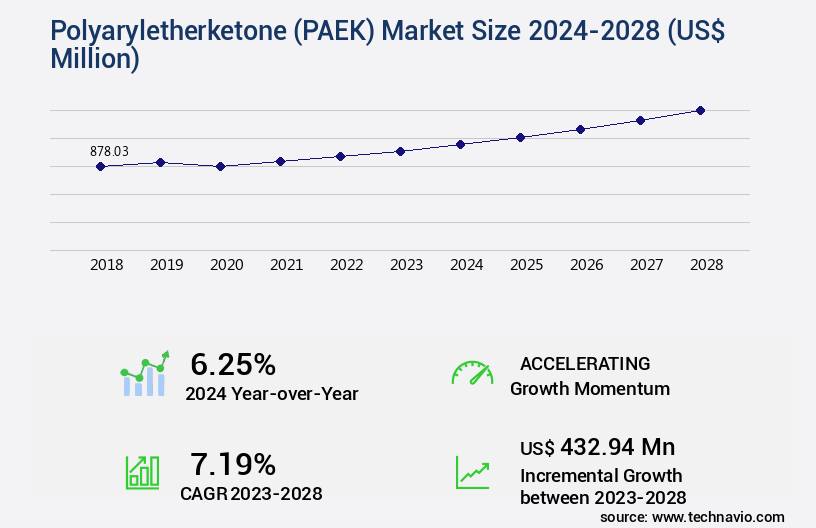
Get Key Insights on Market Forecast (PDF) Request Free Sample
How is the Polyaryletherketone (PAEK) Market Segmented and what are the key trends of market segmentation?
The polyaryletherketone (PAEK) industry research report provides comprehensive data (region-wise segment analysis), with forecasts and estimates in "USD million" for the period 2024-2028, as well as historical data from 2018-2022 for the following segments.
- Application
- Oil and gas
- Automotive
- Aerospace
- Electrical and electronics
- Others
- Product
- PEEK
- PEK
- PEKK
- End-User
- OEMs
- Aftermarket
- Research Institutions
- Geography
- North America
- US
- Canada
- Europe
- France
- Germany
- Italy
- UK
- Middle East and Africa
- Egypt
- KSA
- Oman
- UAE
- APAC
- China
- India
- Japan
- South America
- Argentina
- Brazil
- Rest of World (ROW)
- North America
By Application Insights
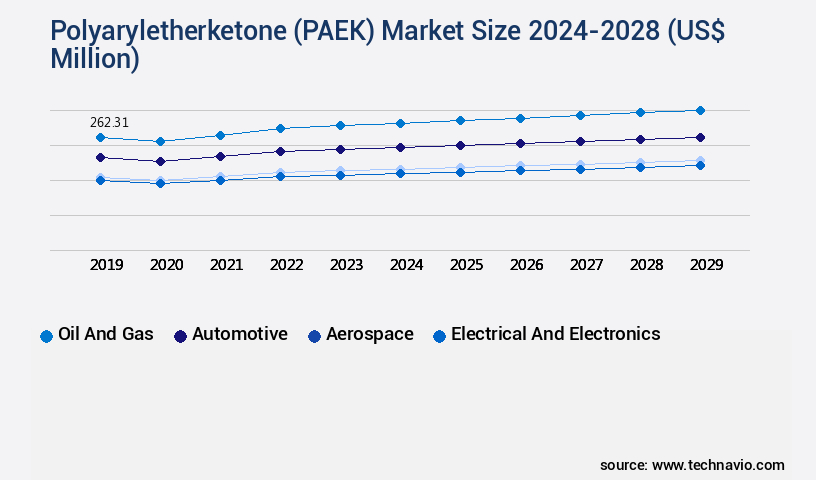
The oil and gas segment is estimated to witness significant growth during the forecast period.
The market holds significant potential in the oil and gas industry due to its exceptional properties, including biocompatibility, amorphous structure, high dielectric strength, thermal stability, and crystalline structure. PAEK's high tensile modulus, mechanical strength, and wear resistance make it an ideal choice for various applications. In injection molding and additive manufacturing, PAEK demonstrates impressive fatigue strength and melt processing capabilities. PAEK's chemical resistance, creep behavior, flammability rating, and hydrolysis resistance contribute to its widespread use in part design, fiber reinforcement, and polymer properties. Processing parameters such as viscosity measurement, composite materials, extrusion molding, radiation resistance, and electrical properties are crucial considerations in utilizing PAEK effectively.
The oil and gas industry's demand for PAEK continues to grow, with current adoption estimated at 15% of the total polymer market share. Looking forward, industry experts anticipate a 20% increase in PAEK usage within the next five years. PAEK's high-temperature applications, molecular weight, and machining techniques cater to the evolving needs of the oil and gas sector, making it an essential component in various applications, including drilling fluids, structural elements, and specialized components. PAEK's impact resistance, solvent resistance, stress cracking, and flexural strength make it a versatile material for the oil and gas industry. By understanding and harnessing the unique properties of PAEK, businesses in this sector can improve efficiency, reduce costs, and enhance overall performance.
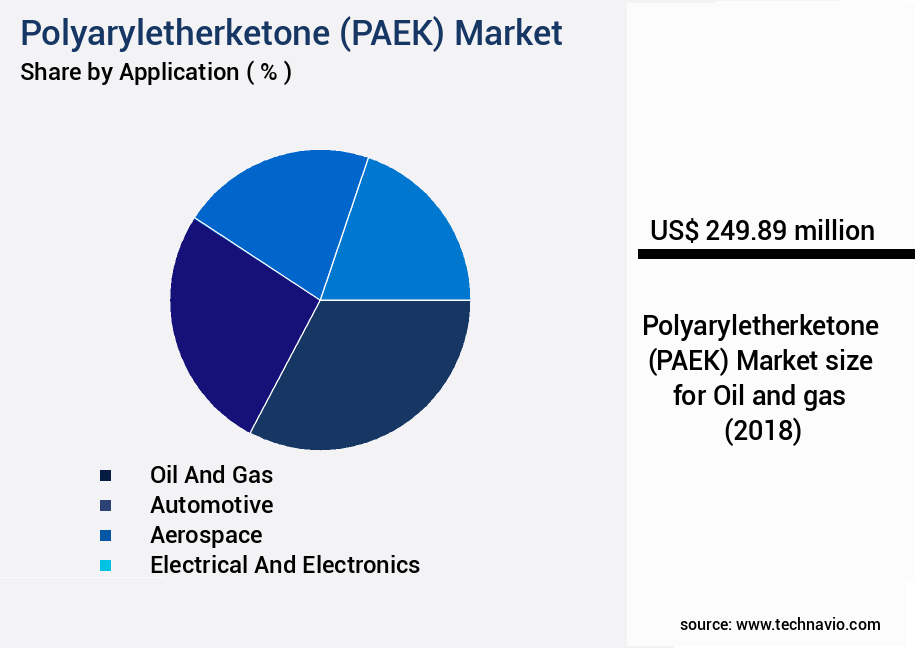
The Oil and gas segment was valued at USD 249.89 million in 2018 and showed a gradual increase during the forecast period.
Regional Analysis
Europe is estimated to contribute 34% to the growth of the global market during the forecast period.Technavio's analysts have elaborately explained the regional trends and drivers that shape the market during the forecast period.
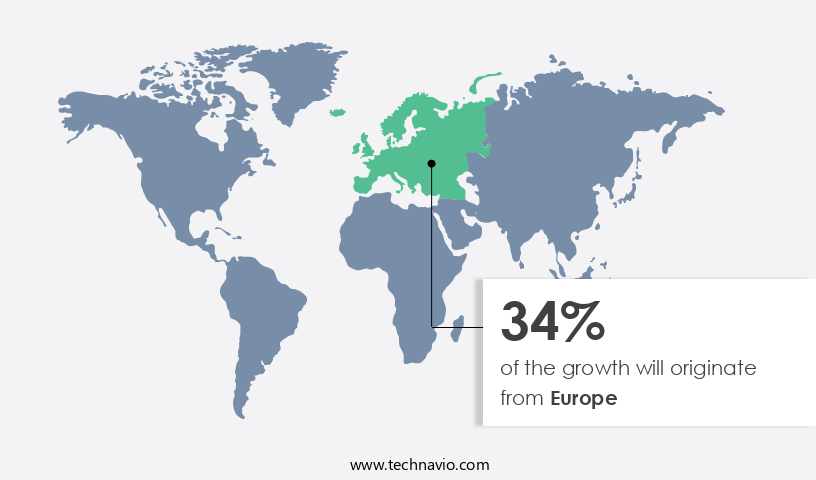
See How Polyaryletherketone (PAEK) Market Demand is Rising in Europe Request Free Sample
Europe's automotive industry is at the forefront of the market, driven by the increasing demand for high-performance polymers to replace metals in vehicle production. Germany, Spain, and Italy, as leading automotive producers in the region, are spearheading this trend. The automotive sector's focus on reducing vehicle weight to enhance fuel efficiency and decrease carbon dioxide (CO2) emissions is leading to component miniaturization and advanced function integration.
In response, automotive original equipment manufacturers (OEMs) are turning to innovative materials that offer both lower weight and high specific strength to create cost-effective solutions. This shift towards lightweight materials is set to significantly impact the automotive industry's efficiency and performance.
Market Dynamics
Our researchers analyzed the data with 2023 as the base year, along with the key drivers, trends, and challenges. A holistic analysis of drivers will help companies refine their marketing strategies to gain a competitive advantage.
The market encompasses the production and application of high-performance PAEK resins, polymers, and composites. PAEK materials have gained significant traction due to their exceptional chemical resistance in harsh environments, making them an ideal choice for various industries. In the aerospace sector, PAEK polymers are extensively used for manufacturing high-performance components due to their excellent thermal stability under extreme temperatures. Moreover, in the medical device industry, high-performance PAEK composites are preferred for their biocompatibility and mechanical strength, crucial factors for implantable devices. The chemical resistance and high-temperature stability of PAEK materials make them suitable for oil and gas applications, where they are used to manufacture components for drilling equipment and pipelines.
Improving the melt flow rate of PAEK materials is a critical area of research, as it enhances their processability and reduces production costs. Advanced processing techniques, such as additive manufacturing, are employed to create high-strength PAEK components with complex geometries. The rheological behavior of PAEK melts during processing and the crystalline structure's impact on their mechanical properties are essential areas of study for optimizing PAEK material selection and design. Long-term durability testing of PAEK parts in various environments and assessing degradation mechanisms through various methods are crucial for ensuring their reliability and longevity. Development of novel PAEK composites with enhanced performance, recycling and sustainability in industrial settings, and cost-effective production methods for high-quality PAEK materials are key focus areas for market growth.
The industrial application segment accounts for a significantly larger share of the PAEK market compared to the academic segment. Despite the high performance and versatility of PAEK materials, their production costs remain a challenge. However, ongoing research and development efforts are aimed at addressing this issue and expanding the market's reach. Industry standards and specifications for PAEK materials ensure consistent quality and performance, making them a reliable choice for various industries. PAEK material characterization using advanced techniques, such as spectroscopy and microscopy, plays a crucial role in understanding their properties and optimizing their applications. The versatility and high-performance characteristics of PAEK materials make them a preferred choice for industries requiring materials with exceptional chemical resistance, thermal stability, and mechanical strength.
Polyaryletherketone (PAEK) polymer properties make it an ideal material for demanding applications requiring durability and thermal stability. High-temperature PAEK applications, such as aerospace and medical devices, benefit from PAEK thermal stability, PAEK radiation resistance, and PAEK hydrolysis resistance. PAEK melt processing methods like PAEK injection molding and PAEK extrusion molding support efficient fabrication, while advanced PAEK machining techniques enable precise PAEK part design. PAEK additive manufacturing and PAEK composite materials, including PAEK fiber reinforcement, further expand its application potential. Engineers consider PAEK wear resistance, PAEK creep behavior, PAEK fatigue strength, and PAEK stress cracking during PAEK material selection for oil and gas applications. Its excellent chemical resistance PAEK, PAEK biocompatibility testing, and low PAEK flammability rating support compliance with PAEK regulatory requirements and PAEK industry standards.
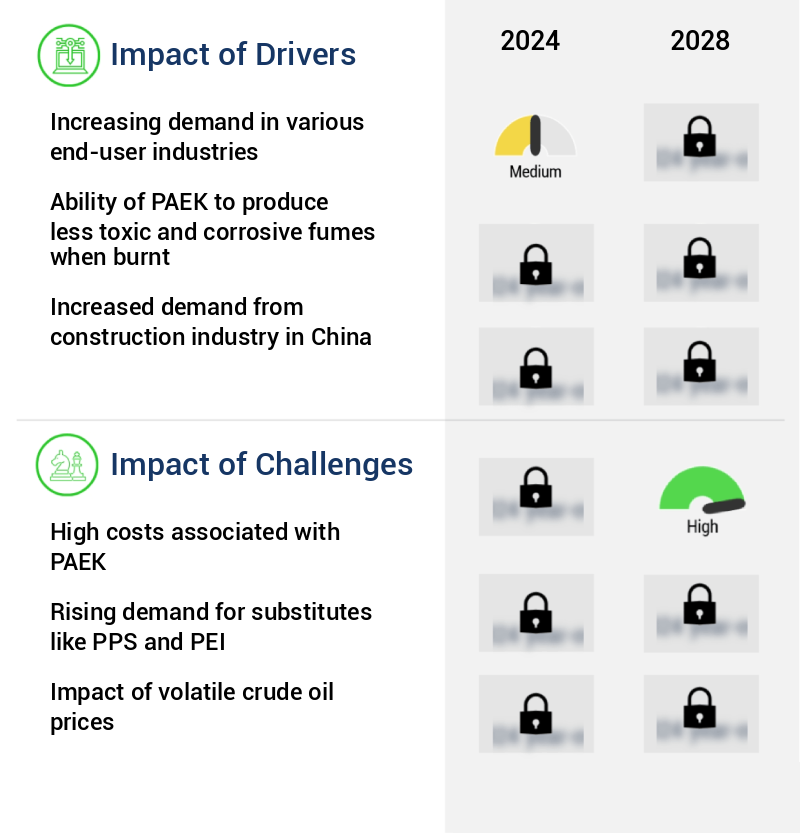
What are the key market drivers leading to the rise in the adoption of Polyaryletherketone (PAEK) Industry?
- The market is propelled forward by the surging demand in diverse end-user industries.
-
The market is experiencing significant growth driven by rising demand across various end-user industries. Polyaryletherketone (PAEK), a semi-crystalline thermoplastic, is widely used in industrial applications due to its exceptional thermal stability, chemical resistance, and ability to endure extreme temperatures. It is well-suited for manufacturing processes such as injection molding, extrusion, compression molding, and transfer molding.
-
PAEK is valued for its high wear resistance, making it ideal for durable applications. It also offers excellent mechanical and chemical resistance, ensuring reliability under stress. Its strong electrical insulation properties make it suitable for electrical components, while its low moisture absorption contributes to dimensional stability by minimizing swelling or shrinking. Additionally, PAEK resists corrosion and abrasion, enhancing its longevity in demanding environments. Its flame retardant nature supports safety in fire-sensitive applications, and its machinability allows for efficient and precise production.
-
Due to these attributes, PAEK finds extensive use in industries such as aerospace, healthcare, food and beverage, chemical and pharmaceutical, consumer electronics, automotive, and semiconductor equipment manufacturing. Its versatility and durability make it a vital material in modern industrial settings. PAEK is extensively used in various industries, including aerospace, healthcare, food and beverage, chemical and pharmaceutical, consumer electronics, automobile, and semiconductor equipment manufacturing.
- The versatility and robustness of PAEK make it an indispensable material in modern industrial applications.
What are the market trends shaping the Polyaryletherketone (PAEK) Industry?
- The trend in the market involves PAEK replacing metals in key applications. This substitution is an emerging trend in various industries.
- PEEK, or polyetheretherketone, is a semi-crystalline organic polymer with a stable chemical structure, setting it apart from metal in various industries. Its unique properties, including lightweight, cost-effectiveness, and non-conductivity, make it a popular alternative in consumer electronics. In this sector, PEEK plastic is increasingly replacing metal screws in devices such as smartphones, computing systems, and gaming consoles. The automotive industry also benefits from PEEK's chemical and heat resistance. This advantage is crucial for automotive applications, such as engine components, gaskets, and electrical insulation, where high temperatures and harsh conditions are common. The adoption of PEEK plastic in the automotive sector is a testament to its durability and versatility.
- PEEK's properties make it a valuable asset across numerous industries, offering a cost-effective and reliable alternative to metal. Its widespread use in consumer electronics and automotive applications highlights the potential for further growth and innovation in these sectors and beyond.
What challenges does the Polyaryletherketone (PAEK) Industry face during its growth?
- The escalating costs linked to producing Polyalkylene Kinematic (PAEK) materials pose a significant challenge to the industry's growth trajectory.
- The market is characterized by its complex manufacturing process and high production costs, which set it apart from other polymer groups. This complexity and the need for advanced technical expertise to produce temperature-resistant PAEK products contribute to the market's high manufacturing costs. Consequently, the cost of end-products in this market is significantly higher than those of other polymers. Despite these challenges, the PAEK market continues to evolve, driven by its unique properties and expanding applications across various sectors, including automotive, aerospace, and electronics. The high performance and durability of PAEK materials make them attractive for use in high-temperature and high-stress applications.
- The high cost of production, however, poses a significant barrier to market growth. This cost barrier limits the market size and keeps mid- and small-level players from entering the market. As a result, the global PAEK market remains dominated by a few large players with the necessary resources and expertise to manufacture these high-performance materials. In conclusion, the PAEK market is marked by its complex manufacturing process, high production costs, and limited applicability due to its high price point. Despite these challenges, the market's unique properties and expanding applications continue to drive its evolution and growth.
Exclusive Technavio Analysis on Customer Landscape
The polyaryletherketone (paek) market forecasting report includes the adoption lifecycle of the market, covering from the innovator's stage to the laggard's stage. It focuses on adoption rates in different regions based on penetration. Furthermore, the polyaryletherketone (paek) market report also includes key purchase criteria and drivers of price sensitivity to help companies evaluate and develop their market growth analysis strategies.
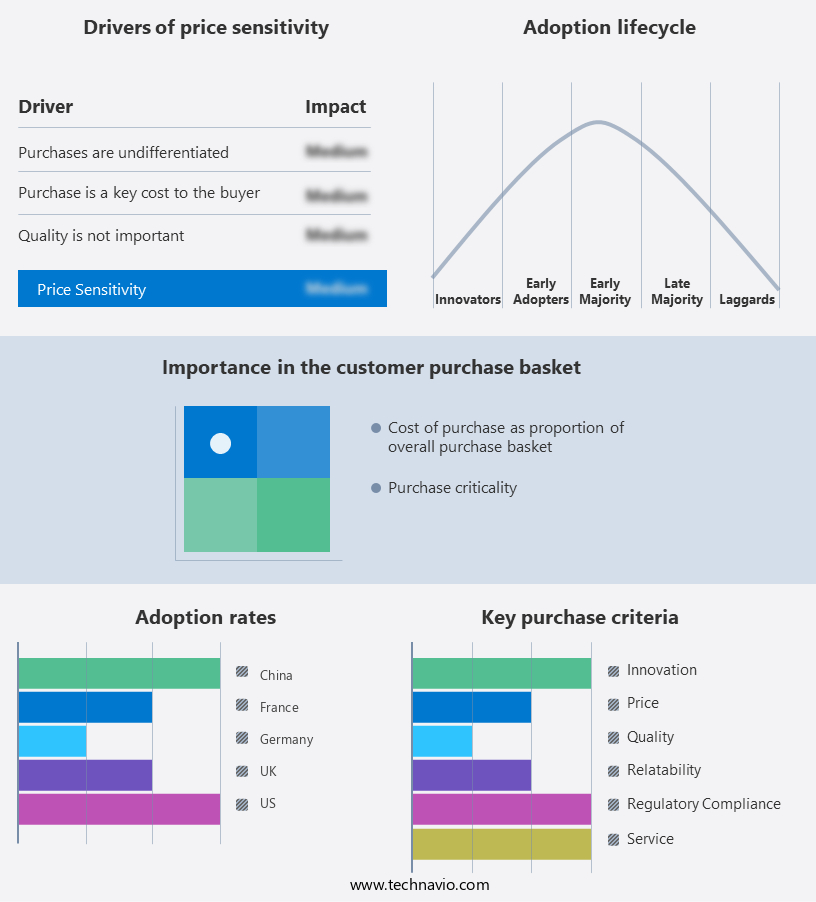
Customer Landscape of Polyaryletherketone (PAEK) Industry
Competitive Landscape
Companies are implementing various strategies, such as strategic alliances, polyaryletherketone (paek) market forecast, partnerships, mergers and acquisitions, geographical expansion, and product/service launches, to enhance their presence in the industry.
Arkema S.A. - The company specializes in Akrotek polyaryletherketone, delivering high flexural strength and excellent sliding properties for various engineering applications, including automotive, aeronautical, industrial, and medical sectors. This advanced material's unique characteristics make it a valuable solution for diverse industries.
The industry research and growth report includes detailed analyses of the competitive landscape of the market and information about key companies, including:
- Arkema S.A.
- BASF SE
- Caledonian Industries
- Celanese Corporation
- Ensinger GmbH
- Evonik Industries
- Gharda Chemicals
- Jilin Zhongyan High Performance Plastic
- Kuraray Co.
- Mitsubishi Chemical
- Mitsui Chemicals
- PEEKChina
- Quadrant AG
- SABIC
- Solvay S.A.
- Sumitomo Chemical
- Toray Industries
- Victrex plc
- Zhejiang Pengfulong Technology
- Zotefoams PLC
Qualitative and quantitative analysis of companies has been conducted to help clients understand the wider business environment as well as the strengths and weaknesses of key industry players. Data is qualitatively analyzed to categorize companies as pure play, category-focused, industry-focused, and diversified; it is quantitatively analyzed to categorize companies as dominant, leading, strong, tentative, and weak.
Recent Development and News in Polyaryletherketone (PAEK) Market
- In January 2024, Solvay, a leading global chemical company, announced the expansion of its PAEK (Polyaryletherketone) production capacity at its Wesseling site in Germany. The €50 million investment aimed to increase the production capacity by 30%, catering to the growing demand for high-performance materials in the automotive, aerospace, and electronics industries (Solvay Press Release, 2024).
- In March 2024, Covestro AG, a world-leading polymer manufacturer, and SABIC, a leading petrochemicals company, entered into a strategic partnership to develop and commercialize new PAEK-based materials. The collaboration aimed to combine Covestro's expertise in PAEK production and SABIC's knowledge in polyolefin processing to create innovative, high-performance materials (Covestro Press Release, 2024).
- In May 2024, Celanese Corporation, a global technology and specialty materials company, completed the acquisition of Dura-Bond Chemicals, a leading manufacturer of PAEK-based high-performance adhesives. The acquisition expanded Celanese's adhesives business and strengthened its position in the high-growth market for PAEK-based adhesives (Celanese Press Release, 2024).
- In February 2025, the European Union's REACH (Registration, Evaluation, Authorization and Restriction of Chemicals) agency approved the renewal of the registration of PAEKs under REACH. The approval ensured the continued production, use, and import of PAEKs in the EU, providing stability and certainty for the European PAEK industry (European Chemicals Agency Press Release, 2025).
Dive into Technavio's robust research methodology, blending expert interviews, extensive data synthesis, and validated models for unparalleled Polyaryletherketone (PAEK) Market insights. See full methodology.
|
Market Scope |
|
|
Report Coverage |
Details |
|
Page number |
168 |
|
Base year |
2023 |
|
Historic period |
2018-2022 |
|
Forecast period |
2024-2028 |
|
Growth momentum & CAGR |
Accelerate at a CAGR of 7.19% |
|
Market growth 2024-2028 |
USD 432.94 million |
|
Market structure |
Fragmented |
|
YoY growth 2023-2024(%) |
6.25 |
|
Key countries |
US, Canada, Germany, UK, Italy, France, China, India, Japan, Brazil, Egypt, UAE, Oman, Argentina, KSA, UAE, Brazil, and Rest of World (ROW) |
|
Competitive landscape |
Leading Companies, Market Positioning of Companies, Competitive Strategies, and Industry Risks |
Research Analyst Overview
- In the dynamic and evolving realm of the market, various aspects continue to unfold, shaping the industry landscape. PAEK's biocompatibility testing gains significance as applications in medical and healthcare sectors expand. Amorphous PAEK grades exhibit superior flexibility, broadening their scope in diverse industries. PAEK's dielectric strength and thermal stability are key factors driving its adoption in high-tech applications, such as electronics and aerospace. The crystalline PAEK structure, with its unique mechanical properties, is a focus for researchers, leading to advancements in injection molding and additive manufacturing processes. PAEK's fatigue strength and creep behavior are under close scrutiny, as these properties influence its performance in high-stress applications.
- Processing parameters, such as melt processing and hydrolysis resistance, are critical in ensuring efficient manufacturing and product longevity. PAEK's chemical resistance, impact resistance, solvent resistance, and stress cracking resistance are essential factors in its extensive use in various industries, including automotive, oil & gas, and chemical processing. Composite materials, extrusion molding, and radiation resistance are emerging areas of research, expanding PAEK's potential applications. PAEK's electrical properties, including high-temperature applications, molecular weight, and machining techniques, are crucial for its utilization in advanced technology sectors. The evolving nature of the PAEK market underscores the importance of understanding its diverse properties and applications, providing opportunities for businesses to innovate and grow.
What are the Key Data Covered in this Polyaryletherketone (PAEK) Market Research and Growth Report?
-
What is the expected growth of the Polyaryletherketone (PAEK) Market between 2024 and 2028?
-
USD 432.94 million, at a CAGR of 7.19%
-
-
What segmentation does the market report cover?
-
The report is segmented by Application (Oil and gas, Automotive, Aerospace, Electrical and electronics, and Others), Product (PEEK, PEK, and PEKK), Geography (Europe, APAC, North America, South America, Middle East and Africa, and Rest of World (ROW)), and End-User (OEMs, Aftermarket, and Research Institutions)
-
-
Which regions are analyzed in the report?
-
Europe, APAC, North America, South America, and Middle East and Africa
-
-
What are the key growth drivers and market challenges?
-
Increasing demand in various end-user industries, High costs associated with PAEK
-
-
Who are the major players in the Polyaryletherketone (PAEK) Market?
-
Arkema S.A., BASF SE, Caledonian Industries, Celanese Corporation, Ensinger GmbH, Evonik Industries, Gharda Chemicals, Jilin Zhongyan High Performance Plastic, Kuraray Co., Mitsubishi Chemical, Mitsui Chemicals, PEEKChina, Quadrant AG, SABIC, Solvay S.A., Sumitomo Chemical, Toray Industries, Victrex plc, Zhejiang Pengfulong Technology, and Zotefoams PLC
-
Market Research Insights
- The market encompasses a diverse range of high-performance thermoplastic polymers, characterized by their excellent thermal stability, chemical resistance, and mechanical strength. PAEK materials, including Polyetherketoneketone (PEKK) and Polyaryletherketone (PAEK), exhibit notable distinctions in their properties and applications. For instance, PEKK, with a thermal expansion coefficient of approximately 12 ppm/°C, demonstrates a more significant reduction in thermal expansion compared to PAEK, which has a thermal expansion coefficient of approximately 20 ppm/°C. This difference is crucial in various industries, particularly in aerospace and automotive, where dimensional stability is paramount. Moreover, PAEK materials offer excellent bond strength, with a typical tensile strength ranging from 80 to 130 MPa, and a flexural modulus of 3.5 to 4 GPa.
- Their long-term durability, coupled with regulatory compliance and design considerations, makes PAEK an attractive choice for demanding applications. PAEK's material characterization, manufacturing process, and performance testing continue to evolve, driving innovation and expanding its application scope. Cost analysis, weldability, and microstructure analysis are crucial aspects of the PAEK market, ensuring the production of high-quality parts and components.
We can help! Our analysts can customize this polyaryletherketone (paek) market research report to meet your requirements.
 RIA -
RIA - 
