


Power Management Integrated Circuit (PMIC) Market Size 2026-2030
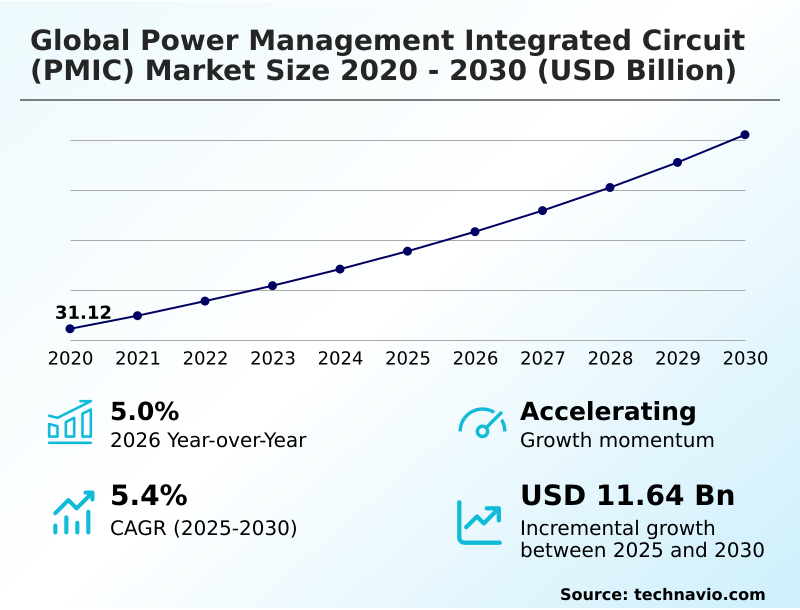
The power management integrated circuit (pmic) market size is valued to increase by USD 11.64 billion, at a CAGR of 5.4% from 2025 to 2030. Inclusion of high-voltage electric vehicle power distribution architectures will drive the power management integrated circuit (pmic) market.
Major Market Trends & Insights
- APAC dominated the market and accounted for a 44.4% growth during the forecast period.
- By Product - Voltage regulators segment was valued at USD 12.26 billion in 2024
- By End-user - Automotive and transportation segment accounted for the largest market revenue share in 2024
Market Size & Forecast
- Market Opportunities: USD 19.41 billion
- Market Future Opportunities: USD 11.64 billion
- CAGR from 2025 to 2030 : 5.4%
Market Summary
- The Power Management Integrated Circuit (PMIC) market is defined by a relentless drive for efficiency and integration, supporting the backbone of modern electronics. Key drivers include the proliferation of high-voltage architectures in electric vehicles and the exponential power demands of hyperscale data centers running AI workloads.
- A significant trend is the shift toward wide-bandgap materials like silicon carbide and gallium nitride, which offer superior thermal performance and lower switching losses. This enables the development of compact, high-density power modules. However, this miniaturization presents thermal dissipation challenges, requiring advanced liquid cooling and packaging innovations.
- For instance, in an industrial automation scenario, deploying PMICs with integrated AI for workload-aware power management can optimize energy use in robotic arms, reducing consumption during idle periods while ensuring peak power for high-precision tasks.
- This convergence of digital logic and analog control is creating cognitive power systems, essential for managing energy in everything from IoT devices with ultra-low quiescent current to complex systems requiring sophisticated battery charging and multi-phase power management. The industry's trajectory is toward creating a more autonomous, energy-aware digital landscape where the PMIC is a critical enabler of performance and sustainability.
What will be the Size of the Power Management Integrated Circuit (PMIC) Market during the forecast period?
Get Key Insights on Market Forecast (PDF) Get Free Sample
How is the Power Management Integrated Circuit (PMIC) Market Segmented?
The power management integrated circuit (pmic) industry research report provides comprehensive data (region-wise segment analysis), with forecasts and estimates in "USD million" for the period 2026-2030, as well as historical data from 2020-2024 for the following segments.
- Product
- Voltage regulators
- Motor control integrated circuit
- Integrated ASSP power management integrated circuit
- Battery management integrated circuit
- Others
- End-user
- Automotive and transportation
- Consumer electronics
- Industrial
- Telecom and networking
- Others
- Usage
- Between 5V to 15V
- Below 5V
- Above 15V
- Geography
- APAC
- China
- Japan
- South Korea
- Europe
- Germany
- UK
- France
- North America
- US
- Canada
- Mexico
- South America
- Brazil
- Argentina
- Middle East and Africa
- Saudi Arabia
- UAE
- South Africa
- Rest of World (ROW)
- APAC
By Product Insights
The voltage regulators segment is estimated to witness significant growth during the forecast period.
The power management integrated circuit (PMIC) market segmentation reflects a dynamic landscape where demand is driven by increasingly sophisticated system requirements. Core segments such as voltage regulators and motor control integrated circuits are evolving to support complex industrial motor drives.
Concurrently, the integrated ASSP and battery management integrated circuit segments are crucial for software-defined vehicles and portable medical diagnostics.
Achieving higher functional density in power modules through advanced mixed-signal design is a key objective, enabling efficient power conversion for applications like remote radio heads and server-side applications.
This focus on integration supports broader green energy workflows, with systems achieving a 15% reduction in board space while enhancing thermal performance, a critical factor for high-performance computing environments.
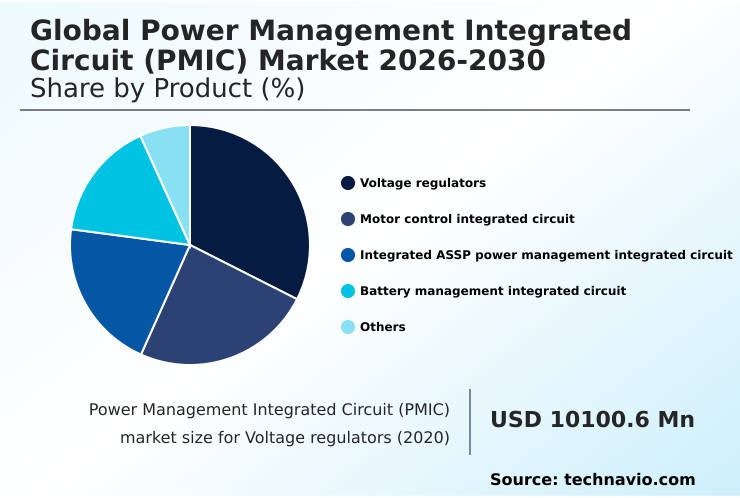
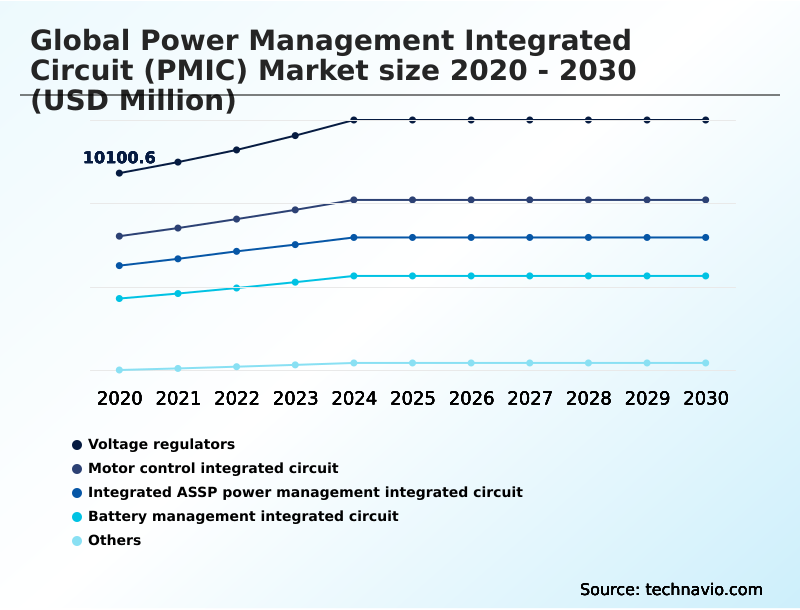
The Voltage regulators segment was valued at USD 12.26 billion in 2024 and showed a gradual increase during the forecast period.
Regional Analysis
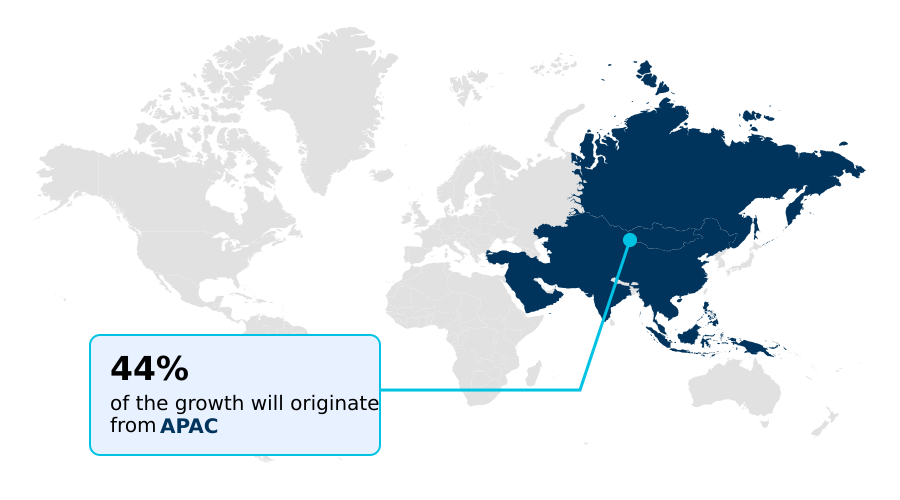
APAC is estimated to contribute 44.4% to the growth of the global market during the forecast period.Technavio’s analysts have elaborately explained the regional trends and drivers that shape the market during the forecast period.
See How Power Management Integrated Circuit (PMIC) Market Demand is Rising in APAC Get Free Sample
The geographic landscape of the Power Management Integrated Circuit (PMIC) market is led by the APAC region, driven by its vast consumer electronics manufacturing base and government initiatives promoting advanced packaging facilities.
In North America, the market is defined by the high-performance computing sector and the rapid expansion of EV infrastructure, requiring advanced voltage scaling and DC-to-DC conversion.
Europe focuses on industrial automation and automotive applications, emphasizing high-efficiency power conversion and digital power controllers. Across all regions, the demand for low quiescent current solutions for battery charging in off-grid solar systems and IoT devices is growing.
For instance, integrating PMICs with smart regulating stage technology in commercial transportation has demonstrated a 12% improvement in fuel efficiency. The development of energy harvesting solutions is a priority in remote applications, further diversifying the market's geographic opportunities.
Market Dynamics
Our researchers analyzed the data with 2025 as the base year, along with the key drivers, trends, and challenges. A holistic analysis of drivers will help companies refine their marketing strategies to gain a competitive advantage.
- The global power management integrated circuit market is navigating complex technological demands, with a strong focus on high-efficiency power conversion for AI accelerators. These applications require precise, high-current, low-voltage supplies, driving innovation in multi-phase architectures. A parallel focus is on multi-channel integrated battery management systems, essential for the safety and longevity of batteries in electric vehicles and portable electronics.
- In data centers, workload-aware power management for data centers is becoming standard, with intelligent power modules for fiber gateways enabling dynamic energy allocation that can reduce consumption by over 15% compared to static systems.
- The adoption of wide-bandgap semiconductor thermal dissipation solutions, using materials like GaN and SiC, addresses a critical bottleneck in high-density power modules for logistics and industrial robotics. However, proprietary power protocol interoperability challenges persist, complicating system integration. Firms are also navigating regulatory compliance for material provenance standards and developing solutions for sub-microampere quiescent current for IoT devices.
- Key development areas include 800-volt electric vehicle powertrain efficiency, integrated biometric sensing power regulation, and bidirectional gallium nitride power switch applications. These advancements in power management for high-performance mobile computing and high-precision voltage scaling for server racks are crucial for next-generation electronics.
What are the key market drivers leading to the rise in the adoption of Power Management Integrated Circuit (PMIC) Industry?
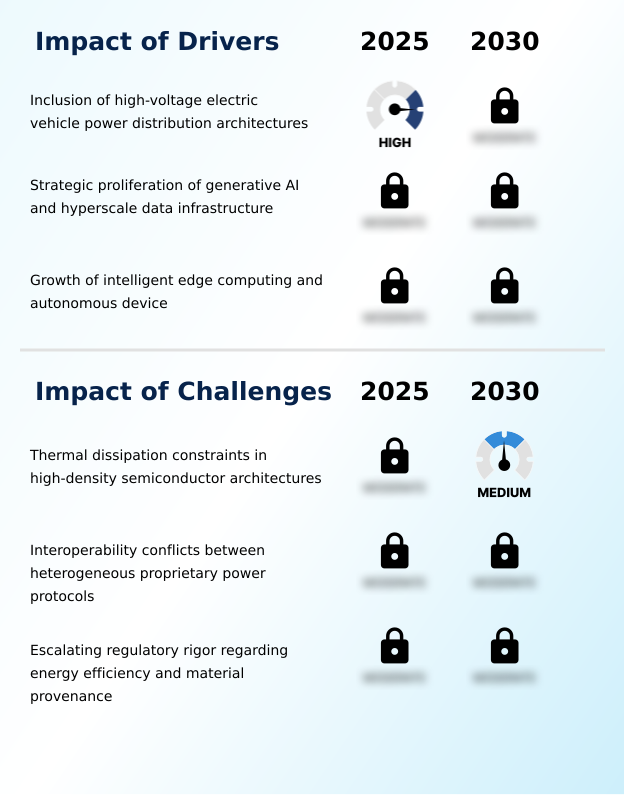
- The rapid institutionalization of high-voltage electrical architectures within the automotive sector, particularly for electric vehicle power distribution, is a primary market driver.
- Market growth is fundamentally driven by the escalating power requirements of high-performance sectors. The proliferation of high-voltage architectures in electric vehicles, which utilize advanced on-board chargers and traction inverters, is a primary catalyst.
- This transition improves energy throughput and enables faster charging. Simultaneously, the expansion of hyperscale data centers for AI workloads necessitates sophisticated multi-phase power management to deliver high-current, low-voltage power with rapid transient response, improving server efficiency by over 15%.
- The growth of the Internet of Things and smart city infrastructure also fuels demand for ultra-low-power ICs. Effective power sequencing in these complex systems, from advanced driver assistance systems to cloud-integrated platforms, is critical for operational reliability.
- This demand ensures that PMICs remain a vital component in the digital economy's backbone.
What are the market trends shaping the Power Management Integrated Circuit (PMIC) Industry?
- A structural market transition is underway, characterized by the expanding adoption of high-voltage silicon carbide and gallium nitride architectures. This shift meets escalating efficiency demands from the ongoing energy transition.
- Key trends in the Power Management Integrated Circuit (PMIC) market are centered on enhancing efficiency and power density to meet the demands of modern electronics. The expansion of wide-bandgap materials, including silicon carbide and gallium nitride, is a structural shift, enabling superior thermal performance and lower switching losses.
- This is critical for electric vehicle platforms and grid-scale energy storage systems, where advanced gate drivers improve power conversion efficiency by up to 25%. In telecommunications infrastructure, GaN-based PMICs allow for smaller, more efficient remote radio heads. Furthermore, the trend toward multi-rail sequencing and dynamic voltage scaling supports the needs of generative AI infrastructure, where precise power delivery is essential.
- This move toward hardware-software integration, supported by advancements in digital product passports, allows for greater system-level optimization and is reshaping the design of next-generation power systems.
What challenges does the Power Management Integrated Circuit (PMIC) Industry face during its growth?
- A key market challenge involves managing thermal dissipation constraints that arise from increasing power densities within high-density semiconductor architectures.
- The primary challenges in the Power Management Integrated Circuit (PMIC) market stem from the physical limitations of high-density designs. As manufacturers integrate more functions, managing thermal throttling becomes a significant barrier, particularly for autonomous device ecosystems and intelligent edge computing. This often requires complex and costly liquid cooling solutions, negating some miniaturization benefits.
- Systems in harsh environmental conditions see reliability drop by 10% without proper thermal management. Another major hurdle is the lack of standardization in communication protocols for fault monitoring and telemetry, which complicates system integration and leads to suboptimal power usage effectiveness.
- Furthermore, escalating regulatory demands for standby power reduction and verifiable material provenance add significant administrative overhead, with compliance costs increasing by over 25% for firms with global supply chains that rely on extensive wafer fabrication networks.
Exclusive Technavio Analysis on Customer Landscape
The power management integrated circuit (pmic) market forecasting report includes the adoption lifecycle of the market, covering from the innovator’s stage to the laggard’s stage. It focuses on adoption rates in different regions based on penetration. Furthermore, the power management integrated circuit (pmic) market report also includes key purchase criteria and drivers of price sensitivity to help companies evaluate and develop their market growth analysis strategies.
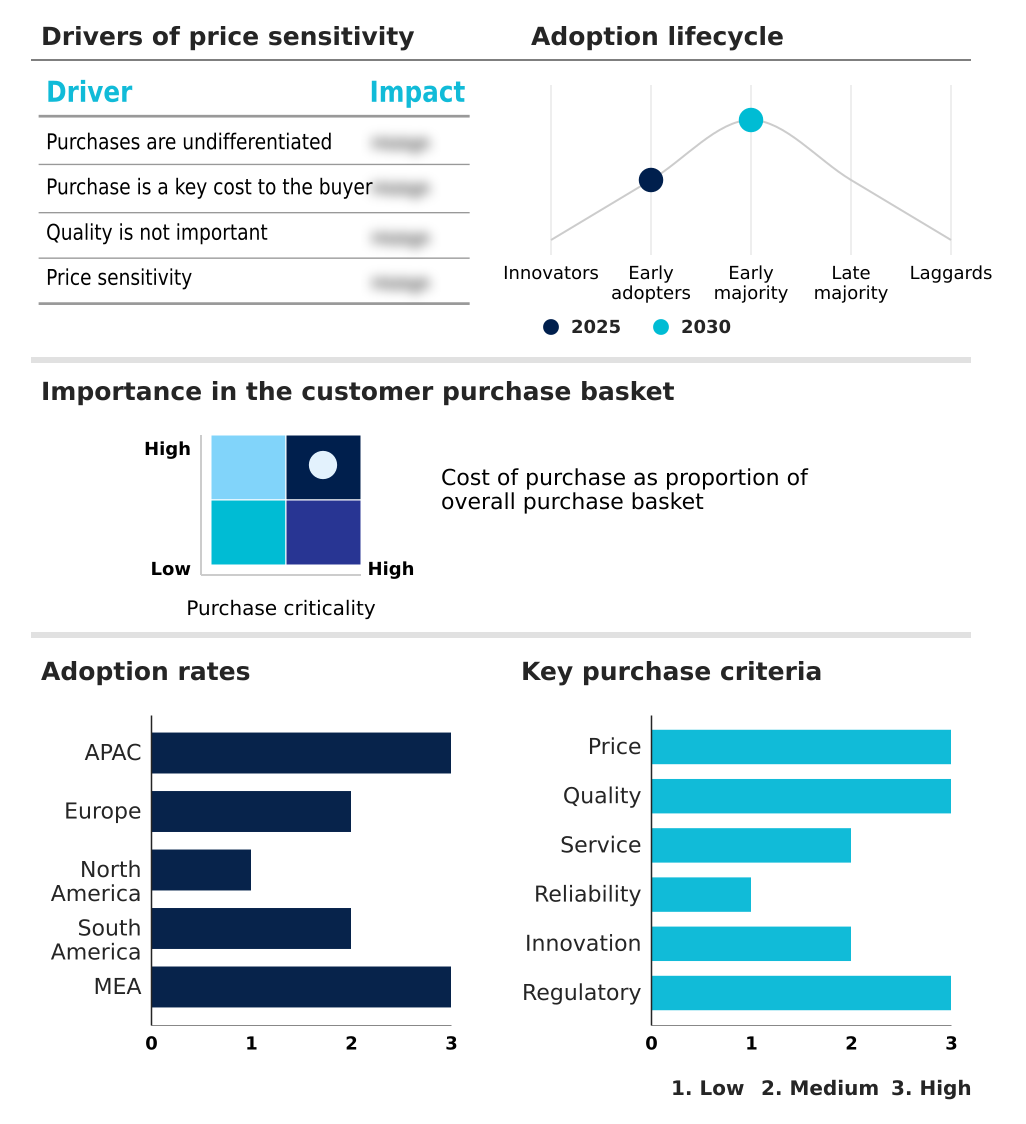
Customer Landscape of Power Management Integrated Circuit (PMIC) Industry
Competitive Landscape
Companies are implementing various strategies, such as strategic alliances, power management integrated circuit (pmic) market forecast, partnerships, mergers and acquisitions, geographical expansion, and product/service launches, to enhance their presence in the industry.
Allegro MicroSystems Inc. - Key offerings include specialized sensors and power management solutions engineered to optimize operational efficiency in advanced mechanical systems for industrial and automotive applications.
The industry research and growth report includes detailed analyses of the competitive landscape of the market and information about key companies, including:
- Allegro MicroSystems Inc.
- Analog Devices Inc.
- Cactus Semiconductor Inc
- Infineon Technologies AG
- JLCPCB
- MagnaChip Semiconductor Corp.
- Microchip Technology Inc.
- MinebeaMitsumi Inc.
- Monolithic Power Systems Inc.
- Nordic Semiconductor ASA
- NXP Semiconductors NV
- ON Semiconductor Corp.
- Qorvo Inc.
- Qualcomm Inc.
- Renesas Electronics Corp.
- ROHM Co. Ltd.
- Semtech Corp.
- STMicroelectronics NV
- Texas Instruments Inc.
- Vishay Intertechnology Inc.
Qualitative and quantitative analysis of companies has been conducted to help clients understand the wider business environment as well as the strengths and weaknesses of key industry players. Data is qualitatively analyzed to categorize companies as pure play, category-focused, industry-focused, and diversified; it is quantitatively analyzed to categorize companies as dominant, leading, strong, tentative, and weak.
Recent Development and News in Power management integrated circuit (pmic) market
- In March, 2025, Renesas Electronics Corp. unveiled its first bidirectional 650-volt gallium nitride power switches, specifically engineered to enhance efficiency in solar inverters and AI data center power supplies.
- In February, 2025, Infineon Technologies AG commenced the commercial ramp-up of its second-generation silicon carbide MOSFET technology, delivering a 30% increase in power density for industrial and automotive power modules.
- In November, 2024, MaxLinear, Inc. introduced a modular intelligent power management solution combining a proprietary controller with smart regulating stage modules, designed to create a thermally optimized architecture for next-generation Wi-Fi 7 and fiber gateways.
- In September, 2024, NVIDIA launched the Nemotron Coalition, a strategic initiative with AI labs to develop open frontier models, driving demand for multi-channel PMICs capable of powering massive GPU arrays with minimal energy loss.
Dive into Technavio’s robust research methodology, blending expert interviews, extensive data synthesis, and validated models for unparalleled Power Management Integrated Circuit (PMIC) Market insights. See full methodology.
| Market Scope | |
|---|---|
| Page number | 321 |
| Base year | 2025 |
| Historic period | 2020-2024 |
| Forecast period | 2026-2030 |
| Growth momentum & CAGR | Accelerate at a CAGR of 5.4% |
| Market growth 2026-2030 | USD 11642.9 million |
| Market structure | Fragmented |
| YoY growth 2025-2026(%) | 5.0% |
| Key countries | China, Japan, South Korea, India, Indonesia, Australia, Germany, UK, France, Italy, The Netherlands, Spain, US, Canada, Mexico, Brazil, Argentina, Chile, Saudi Arabia, UAE, South Africa, Turkey and Israel |
| Competitive landscape | Leading Companies, Market Positioning of Companies, Competitive Strategies, and Industry Risks |
Research Analyst Overview
- The Power Management Integrated Circuit (PMIC) market's trajectory is dictated by the imperative for higher efficiency and functional density across all electronic systems. The transition to high-voltage architectures, particularly in the automotive sector, necessitates advanced power modules and gate drivers capable of managing extreme thermal and electrical stress.
- This shift is mirrored in data centers, where multi-phase power management is critical to support the energy throughput of AI accelerators without thermal throttling. A key boardroom consideration is the adoption of wide-bandgap materials like silicon carbide and gallium nitride, a strategic decision impacting long-term product roadmaps and supply chain resilience.
- For example, firms leveraging these materials have achieved a 30% increase in power density, enabling smaller, more efficient end-products. The market is also defined by the need for sophisticated voltage scaling, battery charging, and DC-to-DC conversion, with advancements in liquid cooling and wafer fabrication being essential enablers.
- The continuous innovation in power conversion and dynamic voltage scaling solidifies the PMIC's role as a foundational technology for next-generation computing and electrification.
What are the Key Data Covered in this Power Management Integrated Circuit (PMIC) Market Research and Growth Report?
-
What is the expected growth of the Power Management Integrated Circuit (PMIC) Market between 2026 and 2030?
-
USD 11.64 billion, at a CAGR of 5.4%
-
-
What segmentation does the market report cover?
-
The report is segmented by Product (Voltage regulators, Motor control integrated circuit, Integrated ASSP power management integrated circuit, Battery management integrated circuit, and Others), End-user (Automotive and transportation, Consumer electronics, Industrial, Telecom and networking, and Others), Usage (Between 5V to 15V, Below 5V, and Above 15V) and Geography (APAC, Europe, North America, South America, Middle East and Africa)
-
-
Which regions are analyzed in the report?
-
APAC, Europe, North America, South America and Middle East and Africa
-
-
What are the key growth drivers and market challenges?
-
Inclusion of high-voltage electric vehicle power distribution architectures, Thermal dissipation constraints in high-density semiconductor architectures
-
-
Who are the major players in the Power Management Integrated Circuit (PMIC) Market?
-
Allegro MicroSystems Inc., Analog Devices Inc., Cactus Semiconductor Inc, Infineon Technologies AG, JLCPCB, MagnaChip Semiconductor Corp., Microchip Technology Inc., MinebeaMitsumi Inc., Monolithic Power Systems Inc., Nordic Semiconductor ASA, NXP Semiconductors NV, ON Semiconductor Corp., Qorvo Inc., Qualcomm Inc., Renesas Electronics Corp., ROHM Co. Ltd., Semtech Corp., STMicroelectronics NV, Texas Instruments Inc. and Vishay Intertechnology Inc.
-
Market Research Insights
- The market dynamics for power management integrated circuits are shaped by the strategic needs of high-growth sectors. The expansion of generative AI infrastructure and intelligent edge computing ecosystems mandates advanced power solutions. In hyperscale data centers, deployments of multi-phase power architectures have improved energy throughput by over 20%, directly lowering operational costs.
- Similarly, the adoption of specialized PMICs in industrial automation sensors has extended device lifespans, reducing maintenance cycles by up to 35% in harsh environmental conditions. This shift is also visible in the automotive sector, where advanced driver assistance systems rely on high-reliability PMICs.
- As industries pursue greater efficiency and autonomy, the focus on sophisticated energy management and embedded wireless connectivity in smart city infrastructure continues to intensify.
We can help! Our analysts can customize this power management integrated circuit (pmic) market research report to meet your requirements.
 RIA -
RIA - 
