



Roll To Roll Flexible Electronics Market Size 2026-2030
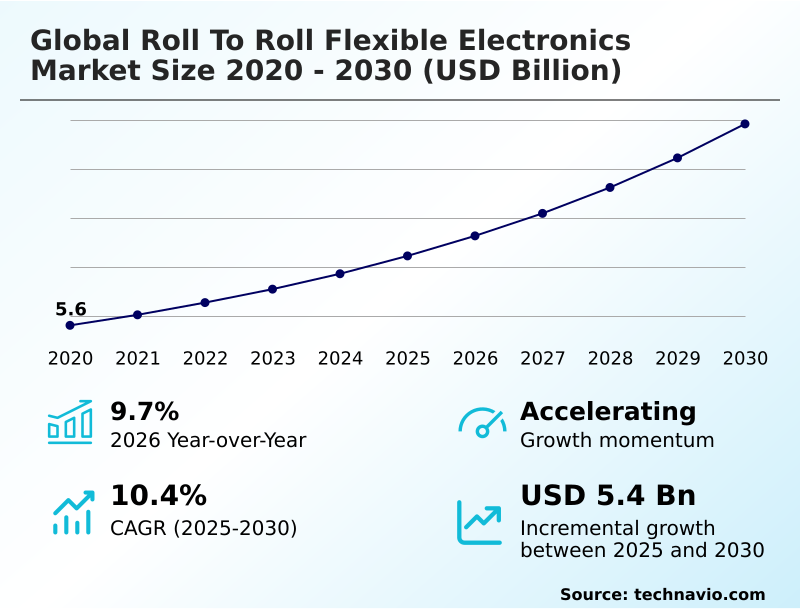
The roll to roll flexible electronics market size is valued to increase by USD 5.40 billion, at a CAGR of 10.4% from 2025 to 2030. Increasing demand for consumer electronics and wearable devices will drive the roll to roll flexible electronics market.
Major Market Trends & Insights
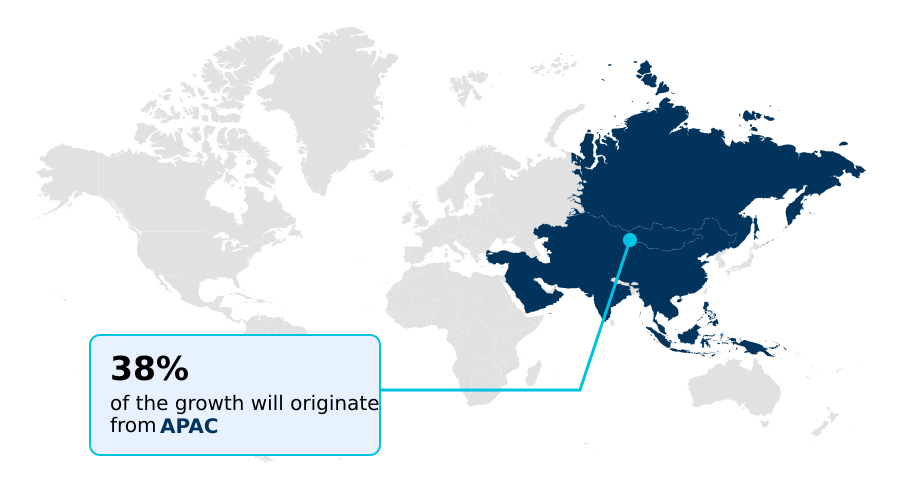
- APAC dominated the market and accounted for a 38.4% growth during the forecast period.
- By End-user - Consumer electronics segment was valued at USD 4.92 billion in 2024
- By Application - Displays segment accounted for the largest market revenue share in 2024
Market Size & Forecast
- Market Opportunities: USD 8.24 billion
- Market Future Opportunities: USD 5.40 billion
- CAGR from 2025 to 2030 : 10.4%
Market Summary
- The roll to roll flexible electronics market is characterized by a move toward scalable manufacturing processes that enable high-volume fabrication of next-generation electronics. This shift is driven by demand for lightweight bendable components across sectors, including consumer devices featuring organic light emitting diode (OLED) screens and advanced automotive display applications.
- At its core, the technology relies on roll based processing of flexible substrates, where functional materials like conductive inks and semiconductor ink formulations are applied using methods such as thin film deposition.
- A key trend is the development of hybrid electronics systems, which merge flexible printed circuits with silicon elements to enhance performance in products requiring both flexibility and computational power.
- For example, a medical device firm can leverage this to produce disposable biosensors for point of care testing at a scale that reduces per-unit costs by 20%, improving accessibility for remote patient monitoring. However, the industry faces challenges related to the high capital investment for advanced manufacturing infrastructure and achieving consistent yield rate improvement.
- Overcoming these hurdles through process optimization strategies and the use of nanoscale coating solutions is essential for unlocking the full potential of large area electronics and smart packaging solutions.
What will be the Size of the Roll To Roll Flexible Electronics Market during the forecast period?
Get Key Insights on Market Forecast (PDF) Get Free Sample
How is the Roll To Roll Flexible Electronics Market Segmented?
The roll to roll flexible electronics industry research report provides comprehensive data (region-wise segment analysis), with forecasts and estimates in "USD million" for the period 2026-2030, as well as historical data from 2020-2024 for the following segments.
- End-user
- Consumer electronics
- Energy
- Healthcare
- Others
- Application
- Displays
- Sensors
- Batteries
- Photovoltaics
- Others
- Material
- Substrates
- Inks
- Others
- Geography
- North America
- US
- Canada
- Mexico
- APAC
- China
- Japan
- India
- Europe
- Germany
- UK
- France
- South America
- Brazil
- Argentina
- Middle East and Africa
- UAE
- Israel
- Saudi Arabia
- Rest of World (ROW)
- North America
By End-user Insights
The consumer electronics segment is estimated to witness significant growth during the forecast period.
The consumer electronics segment is a primary adopter, driven by miniaturization trends and demand for innovative form factors. This sector leverages flexible substrates, including advanced polymer substrates, to create devices that are both durable and lightweight.
Manufacturing processes involving conductive inks and electrophoretic materials are becoming standard for displays and printed sensors. The adoption of flexible hybrid electronics is crucial for integrating complex functionalities, while techniques like atomic layer deposition enhance device longevity.
In a related development, yield rates for disposable biosensors used in point of care testing have improved by over 10%, highlighting the expanding application of these core technologies into adjacent consumer health markets such as remote patient monitoring.
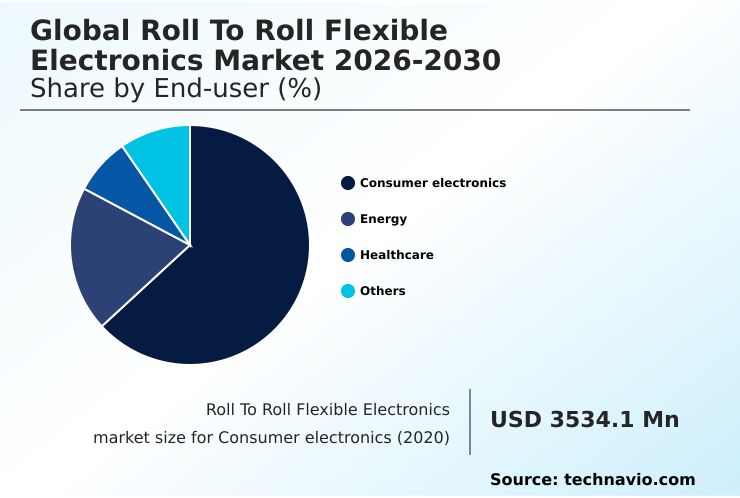
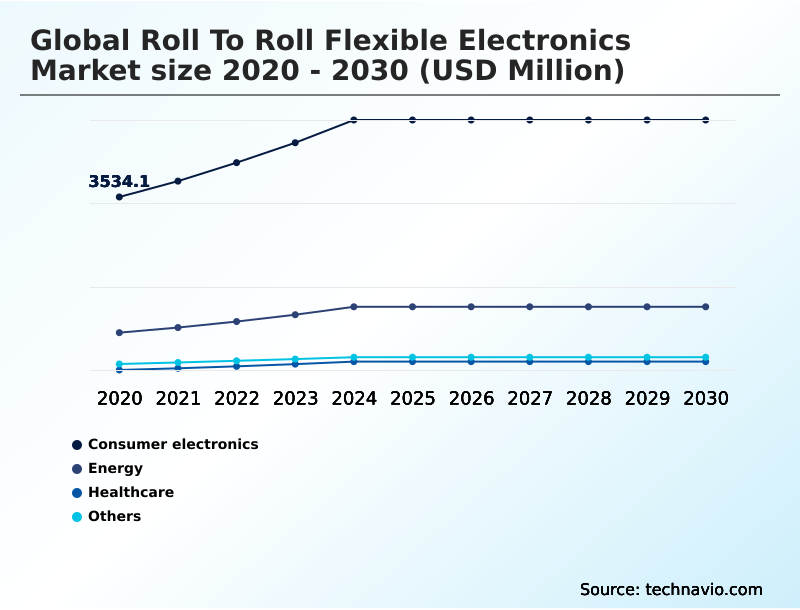
The Consumer electronics segment was valued at USD 4.92 billion in 2024 and showed a gradual increase during the forecast period.
Regional Analysis
APAC is estimated to contribute 38.4% to the growth of the global market during the forecast period.Technavio’s analysts have elaborately explained the regional trends and drivers that shape the market during the forecast period.
See How Roll To Roll Flexible Electronics Market Demand is Rising in APAC Get Free Sample
The geographic landscape is shaped by regional specialization, with APAC leading high volume fabrication at 38.4% of the opportunity share, driven by consumer electronics.
In North America, which accounts for 36.4% of the growth potential, the focus is on advanced applications like medical diagnostics integration and printed organic electronics. Innovations in electrochromic technology are enabling new smart packaging solutions and energy-efficient solutions.
European hubs are advancing large area electronics, particularly in photovoltaic cells fabrication using thin functional films.
The development of functional film layers and reliable flexible interconnects for large area film based devices is critical across all regions, supporting diverse film based electronic components and showing a market-wide year-over-year growth of 9.7%.
Market Dynamics
Our researchers analyzed the data with 2025 as the base year, along with the key drivers, trends, and challenges. A holistic analysis of drivers will help companies refine their marketing strategies to gain a competitive advantage.
- Strategic focus is shifting toward achieving cost-effective flexible display production and enabling high throughput flexible electronics production. Key initiatives include reducing defects in r2r processing and improving yield rates in r2r to make scalable manufacturing viable. In materials science, advancements in polyimide films for flexible circuits and new formulations of conductive inks for printed electronics are critical.
- Similarly, progress in atomic layer deposition on polymers and the development of nanoscale coatings for flexible films are enhancing device durability. Application-specific development is also accelerating. The creation of stretchable electronics for wearable tech and robust flexible pcb for automotive systems highlights this trend.
- Other key areas include flexible electronics for medical diagnostics and the refinement of barrier films for oled displays. Manufacturing methods are also evolving, with a focus on roll based photovoltaic cell manufacturing and improved thin film transistor fabrication methods.
- The development of functional coatings for flexible sensors, coupled with innovations like electrochromic displays via continuous printing and precision patterning for flexible electronics, is crucial. Integrating these complex systems through large area film device integration and addressing material advancements for flexible substrates ensures the market’s forward momentum.
- For instance, firms adopting hybrid systems for iot applications report operational efficiencies nearly double those of traditional batch processing.
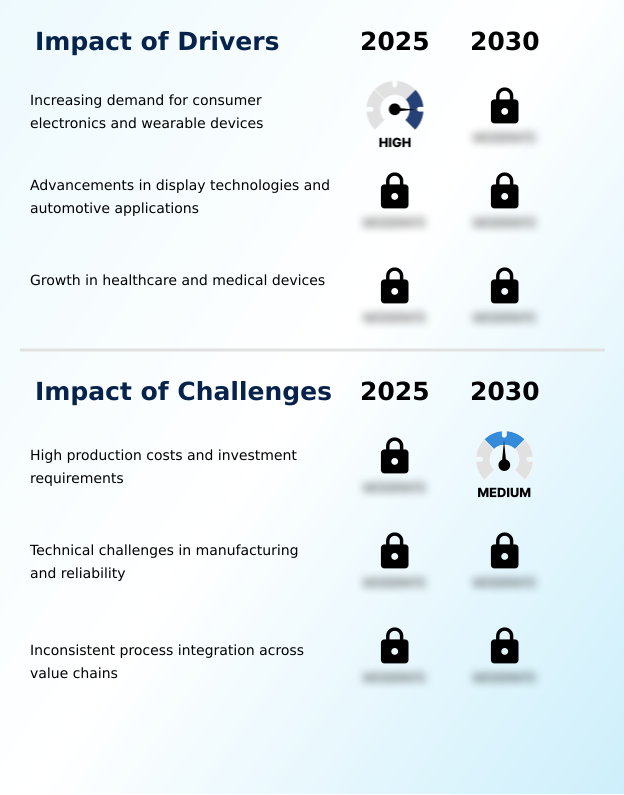
What are the key market drivers leading to the rise in the adoption of Roll To Roll Flexible Electronics Industry?
- The increasing demand for consumer electronics and wearable devices serves as a key driver for market growth.
- Demand for roll to roll flexible electronics is driven by the adoption of lightweight bendable components in consumer devices.
- Scalable manufacturing processes enable the cost-effective production of flexible printed circuits and organic light emitting diode (OLED) screens, with roll based processing increasing throughput by up to 25%.
- Advanced material properties are enhancing the performance of printed electronic components, including flexible antennas for improved connectivity. In automotive display applications, functional coatings are essential for protecting high-resolution screens while maintaining flexibility.
- These innovations contribute to devices with prolonged battery life, showing energy efficiency gains of 12% compared to conventional counterparts.
What are the market trends shaping the Roll To Roll Flexible Electronics Industry?
- The integration of hybrid electronics systems is emerging as a prominent market trend. This approach combines printed flexible components with conventional silicon-based elements to enhance functionality.
- The integration of hybrid electronics systems represents a significant shift, enabling next-generation electronics with advanced capabilities. This approach combines thin film transistors with conformable electronic layers, fostering innovation in stretchable electronics and printed display solutions. Process optimization strategies are critical, improving yield rate improvement by over 15% in some pilot lines.
- Manufacturers are refining precision die cutting techniques for multilayer flexible circuits and developing new functional inks to support complex wearable device integration. These advancements are crucial for the internet of things ecosystems, where performance and form factor are paramount, leading to a 10% reduction in component-level defects.
What challenges does the Roll To Roll Flexible Electronics Industry face during its growth?
- High production costs and significant investment requirements present a key challenge affecting the industry's growth trajectory.
- Achieving cost-effective production in high-throughput manufacturing remains a central challenge, primarily due to the capital-intensive nature of advanced manufacturing infrastructure. The complexity of continuous roll based processing, including thin film deposition and precision patterning techniques, requires significant investment in digital manufacturing systems. While vacuum deposition systems offer high quality, their operational costs can be prohibitive.
- Developing stable semiconductor ink formulations and effective nanoscale coating solutions is crucial for reliable flexible circuit assembly. Adopting sustainable manufacturing processes helps mitigate these costs, with some facilities achieving a 15% reduction in material waste, but integrating these methods without compromising performance remains a key hurdle for the industry.
Exclusive Technavio Analysis on Customer Landscape
The roll to roll flexible electronics market forecasting report includes the adoption lifecycle of the market, covering from the innovator’s stage to the laggard’s stage. It focuses on adoption rates in different regions based on penetration. Furthermore, the roll to roll flexible electronics market report also includes key purchase criteria and drivers of price sensitivity to help companies evaluate and develop their market growth analysis strategies.
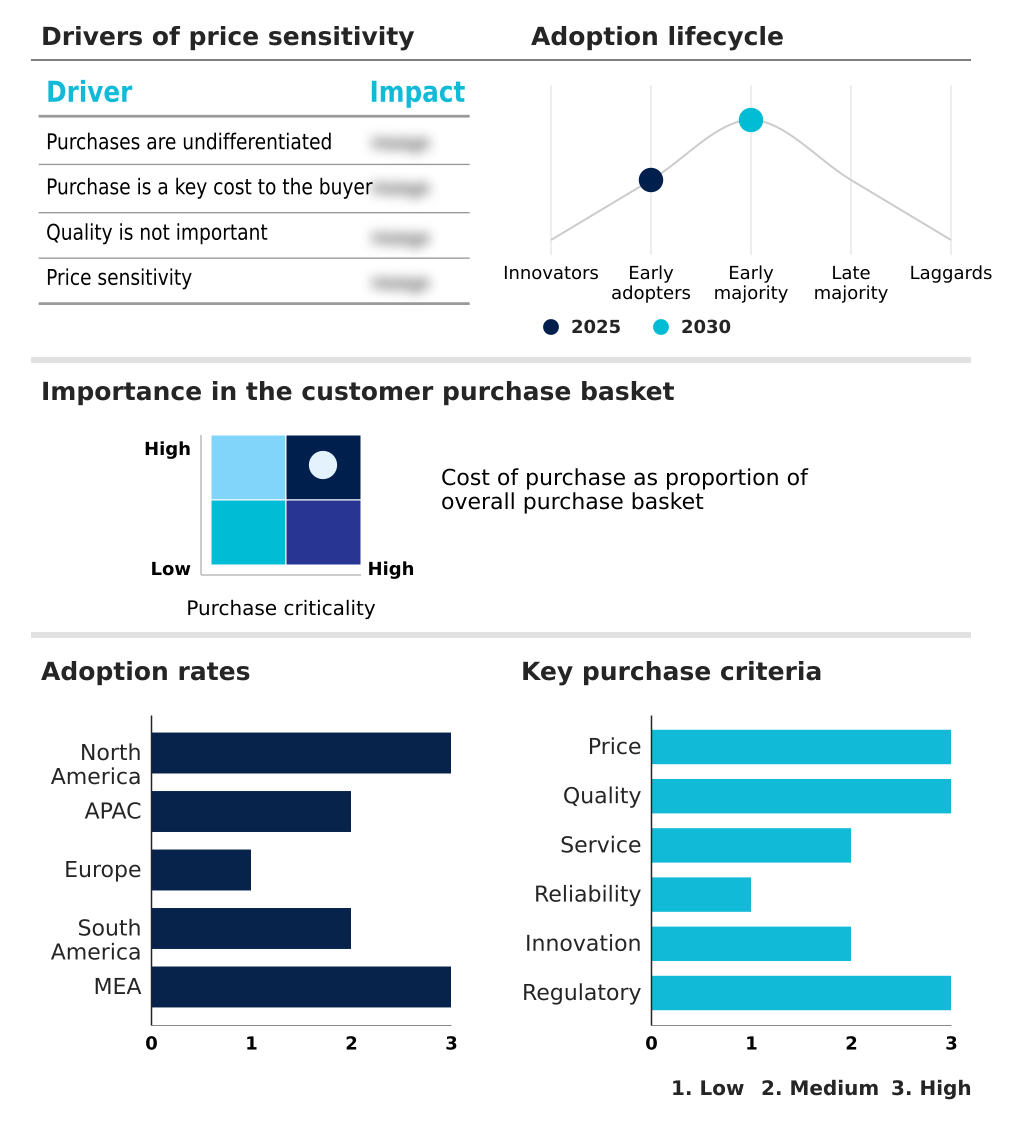
Customer Landscape of Roll To Roll Flexible Electronics Industry
Competitive Landscape
Companies are implementing various strategies, such as strategic alliances, roll to roll flexible electronics market forecast, partnerships, mergers and acquisitions, geographical expansion, and product/service launches, to enhance their presence in the industry.
3M Co. - Provides essential materials and assembly components, including polymer films and adhesives, facilitating scalable manufacturing for flexible circuits, sensors, and printed electronic applications.
The industry research and growth report includes detailed analyses of the competitive landscape of the market and information about key companies, including:
- 3M Co.
- Applied Materials Inc.
- BASF SE
- DuPont de Nemours Inc.
- E Ink Holdings Inc.
- Forge Nano Inc.
- Fujikura Co. Ltd.
- Henkel AG and Co. KGaA
- LG Electronics Inc.
- Marian Inc.
- Molex LLC
- Multek Corp.
- Nissha Co. Ltd.
- Sumitomo Electric Industries
- Ynvisible Interactive Inc
Qualitative and quantitative analysis of companies has been conducted to help clients understand the wider business environment as well as the strengths and weaknesses of key industry players. Data is qualitatively analyzed to categorize companies as pure play, category-focused, industry-focused, and diversified; it is quantitatively analyzed to categorize companies as dominant, leading, strong, tentative, and weak.
Recent Development and News in Roll to roll flexible electronics market
- In February 2025, DuPont announced advancements in high-performance polyimide films designed for flexible electronics manufacturing, emphasizing improved thermal stability and mechanical durability to support continuous roll-based processing.
- In March 2025, Applied Materials expanded its advanced materials engineering operations in the US, focusing on web coating and flexible electronics manufacturing platforms with enhanced process analytics and automation.
- In April 2025, E Ink unveiled its Marquee technology, a four-particle color system that delivers vibrant, energy-efficient displays with extended temperature ranges suitable for outdoor and wearable applications.
- In January 2025, Henkel expanded its manufacturing facility in South Dakota, targeting electric vehicle and electronics innovations with advanced adhesives for flexible components.
Dive into Technavio’s robust research methodology, blending expert interviews, extensive data synthesis, and validated models for unparalleled Roll To Roll Flexible Electronics Market insights. See full methodology.
| Market Scope | |
|---|---|
| Page number | 299 |
| Base year | 2025 |
| Historic period | 2020-2024 |
| Forecast period | 2026-2030 |
| Growth momentum & CAGR | Accelerate at a CAGR of 10.4% |
| Market growth 2026-2030 | USD 5402.6 million |
| Market structure | Fragmented |
| YoY growth 2025-2026(%) | 9.7% |
| Key countries | US, Canada, Mexico, China, Japan, India, South Korea, Indonesia, Australia, Germany, UK, France, Italy, Spain, The Netherlands, Brazil, Argentina, Chile, UAE, Israel, Saudi Arabia, South Africa and Turkey |
| Competitive landscape | Leading Companies, Market Positioning of Companies, Competitive Strategies, and Industry Risks |
Research Analyst Overview
- The roll to roll flexible electronics market is defined by rapid material and process innovation. Core technologies include roll based processing and continuous roll based processing for fabricating components like flexible printed circuits, flexible hybrid electronics, and printed electronic components on flexible substrates, often polymer substrates.
- Key materials such as conductive inks, functional inks, electrophoretic materials, and semiconductor ink formulations are applied through thin film deposition and atomic layer deposition. Systems use vacuum deposition systems and precision patterning techniques for creating thin film transistors and functional film layers.
- Products range from printed display solutions, including organic light emitting diode (OLED) and those using electrochromic technology, to printed sensors, flexible antennas, and stretchable electronics. Assembly relies on flexible interconnects, precision die cutting, and advanced flexible circuit assembly. Innovations in high performance polyimide films, nanoscale coating solutions, and functional coatings enhance durability.
- This technological convergence enables large area film based devices, film based electronic components, and multilayer flexible circuits, impacting boardroom decisions on product roadmaps, where a shift to flexible formats can reduce component weight by 40%.
What are the Key Data Covered in this Roll To Roll Flexible Electronics Market Research and Growth Report?
-
What is the expected growth of the Roll To Roll Flexible Electronics Market between 2026 and 2030?
-
USD 5.40 billion, at a CAGR of 10.4%
-
-
What segmentation does the market report cover?
-
The report is segmented by End-user (Consumer electronics, Energy, Healthcare, and Others), Application (Displays, Sensors, Batteries, Photovoltaics, and Others), Material (Substrates, Inks, and Others) and Geography (North America, APAC, Europe, South America, Middle East and Africa)
-
-
Which regions are analyzed in the report?
-
North America, APAC, Europe, South America and Middle East and Africa
-
-
What are the key growth drivers and market challenges?
-
Increasing demand for consumer electronics and wearable devices, High production costs and investment requirements
-
-
Who are the major players in the Roll To Roll Flexible Electronics Market?
-
3M Co., Applied Materials Inc., BASF SE, DuPont de Nemours Inc., E Ink Holdings Inc., Forge Nano Inc., Fujikura Co. Ltd., Henkel AG and Co. KGaA, LG Electronics Inc., Marian Inc., Molex LLC, Multek Corp., Nissha Co. Ltd., Sumitomo Electric Industries and Ynvisible Interactive Inc
-
Market Research Insights
- Market dynamics are shaped by the convergence of high-throughput manufacturing and demand for lightweight bendable components. The integration into automotive display applications and smart packaging solutions is accelerating, with adoption rates in these sectors increasing by over 15% annually. Scalable manufacturing processes are crucial, enabling cost-effective production and a notable 10% reduction in material waste.
- Advanced material properties are central to creating energy-efficient solutions with prolonged battery life, supporting the expansion of internet of things ecosystems. Innovations in flexible display technologies are meeting demand for high-resolution screens. This evolution, supported by a robust advanced manufacturing infrastructure and digital manufacturing systems, is driving miniaturization trends across all end-user segments, from medical diagnostics integration to next-generation electronics.
We can help! Our analysts can customize this roll to roll flexible electronics market research report to meet your requirements.
 RIA -
RIA - 
