


Roofing Chemicals Market Analysis APAC, North America, Europe, South America, Middle East and Africa - China, US, India, Germany, Canada - Size and Forecast 2024-2028

Roofing Chemicals Market Analysis APAC, North America, Europe, South America, Middle East and Africa - China, US, India, Germany, Canada - Size and Forecast 2024-2028

Published: Jun 2024 155 Pages SKU: IRTNTR73177

Market Overview at a Glance

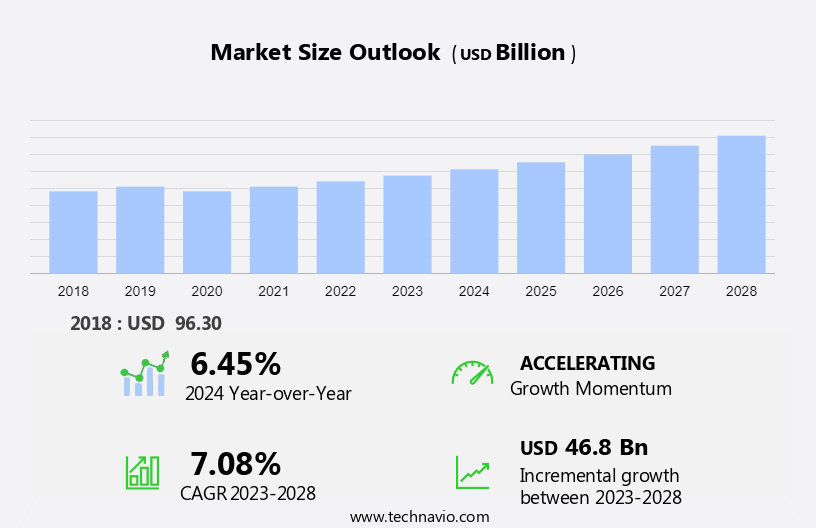
$46.8 B
Market Opportunity
7.08%
CAGR
6.45
YoY growth 2023-2024(%)

Roofing Chemicals Market Size 2024-2028 

The roofing chemicals market size is forecast to increase by USD 46.8 billion at a CAGR of 7.08% between 2023 and 2028. The market is experiencing significant growth due to the increasing demand for durable roofs with superior properties. Roofing chemical formulations, including polymer based roofing chemicals, are gaining popularity for their ability to enhance the performance and longevity of various roofing systems. The trend towards green building practices is driving the development of eco-friendly waterproofing compounds and sealants, which offer excellent adhesion and resistance to water ingress.

Roofing membranes and coatings are essential in preventing water damage, and advances in technology have led to the creation of reflective coatings that reduce heat absorption and minimize the impact of sunlight. Flat roofs, particularly those prone to pooling water and joints with seams, benefit greatly from these advancements. However, challenges such as moisture management and the need for cost-effective solutions continue to pose obstacles in the market. Overall, the market is poised for growth, driven by the need for energy efficiency, sustainability, and effective waterproofing solutions.
Roofing Chemicals Market Size

 Request Free Sample

The market encompasses a wide range of products used in the production of roof coatings and coverings for various types of roofing systems. These include asphalt and bituminous roofing, metal roofing, elastomeric roofing, membrane roofing, and  PVC roofing. Roofing chemical formulations are essential in enhancing the superior properties of these roofing systems, such as adhesion, waterproofing, and resistance to extreme temperatures. Low-temperature roofing chemicals, including acrylic resins and elastomers, are increasingly popular due to their ability to perform effectively in cold climates. Environmental concerns have also driven the demand for sustainable roofing solutions, leading to the adoption of green building practices and the use of eco-friendly roofing chemicals.

Furthermore, waterproofing compounds, sealants, and membranes are crucial components of roofing systems, preventing water ingress and water damage. Roofing chemicals such as epoxy resins, styrene, and polymer-based formulations offer excellent resistance to UV radiation, wind, and other environmental factors. Aesthetics also play a role in the market, with a growing focus on sustainable living standards and the desire for visually appealing roofing solutions.

Market Segmentation

The market research report provides comprehensive data (region-wise segment analysis), with forecasts and estimates in "USD Billion" for the period 2024-2028, as well as historical data from 2018-2022 for the following segments.

  • Product
    • Asphalt
    • Acrylic resin
    • Epoxy resin
    • Elastomer
    • Others
  • Geography
    • APAC
      • China
      • India
    • North America
      • Canada
      • US
    • Europe
      • Germany
    • South America
    • Middle East and Africa

By Product Insights

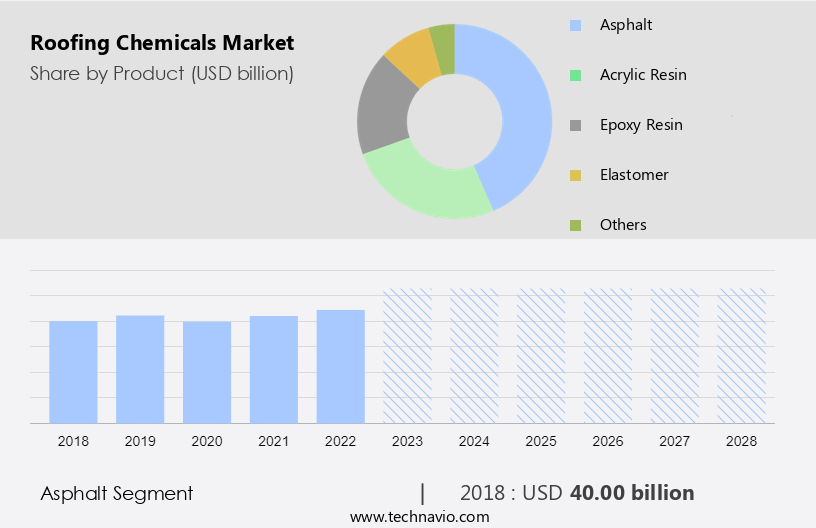
The asphalt segment is estimated to witness significant growth during the forecast period.The asphalt/bituminous segment holds a significant share in The market due to its extensive usage in various construction activities. Bituminous materials, including asphalt and bituminous shingles, are popular choices for roofing applications due to their energy-conserving properties, high tensile strength, and improved surface texture. Bituminous roofing, such as membrane roofing and elastomeric roofing, offers long-lasting solutions for flat roofs. These roofing options are known for their flexibility, waterproofing capabilities, and ease of repair and maintenance. Modified bitumen, a type of asphalt product, can be applied in both hot and cold liquid forms, making it a versatile option for roofing applications.

Furthermore, with a lifespan of up to 20 to 50 years, modified bitumen roofing is an energy-efficient and cost-effective solution for factory sheds and commercial buildings. Bituminous roofing chemicals, including acrylic resins, epoxy resins, elastomers, and styrene, play a crucial role in enhancing the performance and durability of these roofing systems.
Roofing Chemicals Market Size

Get a glance at the market share of various segments Request Free Sample

The asphalt segment was valued at USD 40.00 billion in 2018 and showed a gradual increase during the forecast period.

Regional Insights

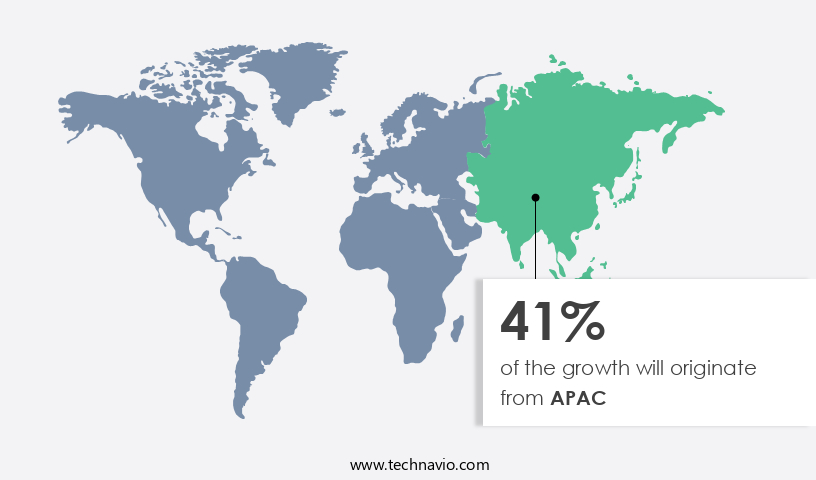
APAC is estimated to contribute 41% to the growth of the global market during the forecast period. Technavio's analysts have elaborately explained the regional trends and drivers that shape the market during the forecast period.
Roofing Chemicals Market Share by Geography

For more insights on the market share of various regions Request Free Sample

The market in the Asia Pacific (APAC) region is experiencing significant growth due to the expanding construction sector, urbanization, and population increase. China, India, South Korea, Japan, and Indonesia are the leading consumers of roofing chemicals in APAC, driven by the increasing construction spending in these countries. The demand for roofing chemicals is further driven by government initiatives encouraging the use of durable and energy-efficient roofing solutions, such as asphalt, bituminous, acrylic resins, epoxy resins, elastomers, styrene, metal roofing, elastomeric roofing, membrane roofing, and plastic roofing. These materials offer high tensile strength, improved surface texture, and energy conservation properties, making them ideal for factory sheds, bituminous shingles, and various roofing applications. The construction industry's rapid growth and the increasing need for energy-efficient solutions in residential and commercial buildings are expected to drive the market in APAC through 2023.

Our researchers analyzed the data with 2023 as the base year, along with the key drivers, trends, and challenges. A holistic analysis of drivers will help companies refine their marketing strategies to gain a competitive advantage.

Market Driver

The growing need for thermal management in buildings is the key driver of the market. The demand for roofing chemicals is on the rise due to the increasing focus on sustainable living standards and energy efficiency in buildings. Roofing chemicals, including roof coatings and coverings, play a crucial role in maintaining the thermal management of structures, particularly in low-temperature environments. These products offer reflective properties, which help in reducing the absorption of solar radiation and subsequently lowering the interior temperature of buildings. Moreover, the implementation of roofing chemicals is not only beneficial for energy savings but also addresses environmental concerns. By reducing the energy consumption of cooling systems, these chemicals contribute to a decrease in carbon emissions.

Furthermore, in industrial structures such as warehouses and factories, the use of roofing chemicals offers additional advantages like fire protection, wind protection, and hail protection. The growing trend of cold roofs, which aims to maintain a low temperature inside the roofing system, further boosts the demand for roofing chemicals. As buildings become more energy-efficient and eco-friendly, the use of sustainable roofing solutions is becoming increasingly popular. Bituminous roofing, a common type of roofing system, benefits significantly from the application of roofing chemicals for enhanced durability and resistance to weather conditions. In summary, the market is witnessing significant growth due to the increasing need for energy-efficient and sustainable roofing solutions. These products offer numerous advantages, including improved thermal management, reduced energy consumption, and enhanced protection against environmental elements. As the construction industry continues to evolve, the demand for roofing chemicals is expected to remain strong.

Market Trends

The rising development of bio-based roofing chemicals is the upcoming trend in the market. The market is witnessing significant growth due to the increasing demand for eco-friendly, sustainable roofing solutions. Consumers are increasingly seeking alternatives to petrochemical-based roof coatings and coverings, with a focus on low-temperature applications for interiors, as well as for cold roofs. Environmental concerns are driving the adoption of bio-based roofing systems that offer improved aesthetics, durability, and energy efficiency. These roofing solutions help reduce the emission of volatile organic compounds (VOCs) and hazardous air pollutants (HAP), making them an attractive choice for buildings that adhere to sustainable living standards. Roofing systems that provide fire, wind, and hail protection are also gaining popularity.

Furthermore, bituminous roofing, a traditional choice, is being replaced with more sustainable options. Icopal, a leading manufacturer, has introduced a 100% bio-based roofing solution under the project DISCOVER. This development underscores the industry's commitment to innovation and the use of renewable resources such as vegetable oils, plants, and starch to create sustainable roofing chemicals. The trend towards bio-based roofing chemicals is expected to continue, as the construction industry shifts towards energy-efficient and environmentally responsible practices.

Market Challenge

The fluctuations in crude oil prices are a key challenge affecting market growth. The market is experiencing significant growth due to its application in the construction industry for energy-efficient roofing solutions, thermal management, and weather protection. Roof coatings, coverings, and bituminous roofing systems are increasingly being used to enhance the durability and sustainability of buildings, aligning with the growing trend toward sustainable living standards.

However, the market growth is challenged by the volatility in raw material prices, particularly those derived from petrochemicals such as asphalt/bitumen, epoxy resins, and acrylic resins. The fluctuations in crude oil prices directly impact the availability and cost of these raw materials, leading to a supply-demand imbalance. The overproduction of oil by certain Organization of Petroleum Exporting Countries (OPEC) members has exacerbated this issue, causing instability in the global oil market and ultimately affecting the roofing chemicals industry. Despite these challenges, the market continues to grow due to the increasing demand for roofing solutions that offer fire protection, wind protection, hail protection, and aesthetics for various buildings, including warehouses and factories.

Exclusive Customer Landscape

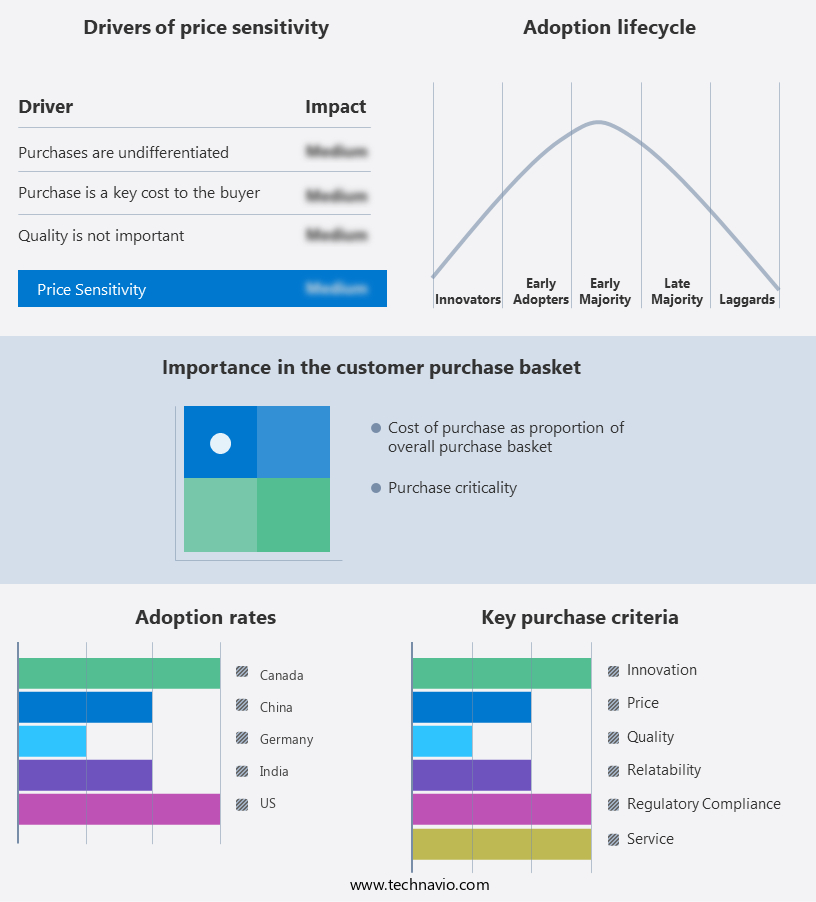
The market forecasting report includes the adoption lifecycle of the market, covering from the innovator's stage to the laggard's stage. It focuses on adoption rates in different regions based on penetration. Furthermore, the report also includes key purchase criteria and drivers of price sensitivity to help companies evaluate and develop their market growth analysis strategies.
Roofing Chemicals Market Share by Geography

 Customer Landscape

Key Companies & Market Insights

Companies are implementing various strategies, such as strategic alliances, partnerships, mergers and acquisitions, geographical expansion, and product/service launches, to enhance their presence in the market.

3M Co:  The company offers roofing chemicals products such as 3M Dyneon and 3M Dynamar.

The market research and growth report includes detailed analyses of the competitive landscape of the market and information about key companies, including:

  • 3M Co.
  • Akzo Nobel NV
  • Atlas Roofing Corp.
  • BASF SE
  • Berkshire Hathaway Inc.
  • CICO Group
  • Compagnie de Saint Gobain
  • Dow Chemical Co.
  • DuPont de Nemours Inc.
  • Eastman Chemical Co.
  • GAF Materials LLC
  • Henry Co.
  • Industrial Foams Pvt. Ltd.
  • Holcim Ltd.
  • National Coatings Corp.
  • NovaTuff Coatings
  • Owens Corning
  • PPG Industries Inc.
  • Sika AG
  • SOPREMA SAS

Qualitative and quantitative analysis of companies has been conducted to help clients understand the wider business environment as well as the strengths and weaknesses of key market players. Data is qualitatively analyzed to categorize companies as pure play, category-focused, industry-focused, and diversified; it is quantitatively analyzed to categorize companies as dominant, leading, strong, tentative, and weak.

Research Analyst Overview

The market is witnessing significant growth due to the increasing demand for energy-efficient solutions in the construction sector. Roof coatings and coverings are gaining popularity as they offer excellent thermal insulation, reflective properties, and UV protection. Low-temperature roofing solutions are particularly in demand in regions with extreme weather conditions. Environmental concerns are driving the market for sustainable living standards, leading to the adoption of eco-friendly roofing systems. Cold roofs, which help prevent overheating, are becoming increasingly popular. Roofing systems are not just about durability and protection against wind, hail, and fire; they also need to meet aesthetic requirements.

Furthermore, roofing chemicals such as acrylic resins, epoxy resins, elastomers, styrene, and polymer-based formulations are used in various roofing applications. Bituminous roofing, including bituminous shingles, asphalt, and membranes, continues to dominate the market due to their high tensile strength and durability. Roofing chemicals are used in various types of roofing systems, including metal, elastomeric, membrane, plastic (PVC) roofing, and bituminous roofing. Advanced polymers and eco-friendly roofing materials, such as cool-roof coatings with infrared reflective pigments, are gaining traction due to their energy conservation properties. Waterproofing compounds, sealants, membranes, and coatings are essential components of roofing systems, preventing water ingress and damage.

Market Scope

Report Coverage

Details

Page number

155

Base year

2023

Historic period

2018-2022

Forecast period

2024-2028

Growth momentum & CAGR

Accelerate at a CAGR of 7.08%

Market growth 2024-2028

USD 46.8 billion

Market structure

Fragmented

YoY growth 2023-2024(%)

6.45

Regional analysis

APAC, North America, Europe, South America, and Middle East and Africa

Performing market contribution

APAC at 41%

Key countries

China, US, India, Germany, and Canada

Competitive landscape

Leading Companies, Market Positioning of Companies, Competitive Strategies, and Industry Risks

Key companies profiled

3M Co., Akzo Nobel NV, Atlas Roofing Corp., BASF SE, Berkshire Hathaway Inc., CICO Group, Compagnie de Saint Gobain, Dow Chemical Co., DuPont de Nemours Inc., Eastman Chemical Co., GAF Materials LLC, Henry Co., Industrial Foams Pvt. Ltd., Holcim Ltd., National Coatings Corp., NovaTuff Coatings, Owens Corning, PPG Industries Inc., Sika AG, and SOPREMA SAS

Market dynamics

Parent market analysis, market growth inducers and obstacles, market forecast, fast-growing and slow-growing segment analysis, COVID-19 impact and recovery analysis and future consumer dynamics, market condition analysis for the forecast period

Customization purview

If our market report has not included the data that you are looking for, you can reach out to our analysts and get segments customized.

Request Free Sample

What are the Key Data Covered in this Market Research and Growth Report?

  • CAGR of the market during the forecast period
  • Detailed information on factors that will drive the market growth and forecasting between 2024 and 2028
  • Precise estimation of the size of the market  and its contribution of the market in focus to the parent market
  • Accurate predictions about upcoming market growth and trends and changes in consumer behaviour
  • Growth of the market across APAC, North America, Europe, South America, and Middle East and Africa
  • Thorough analysis of the market's competitive landscape and detailed information about companies
  • Comprehensive analysis of factors that will challenge the growth of market companies

We can help! Our analysts can customize this market research report to meet your requirements. Get in touch

1 Executive Summary

  • 1.1 Market overview
    • Executive Summary - Chart on Market Overview
    • Executive Summary - Data Table on Market Overview
    • Executive Summary - Chart on Global Market Characteristics
    • Executive Summary - Chart on Market by Geography
    • Executive Summary - Chart on Market Segmentation by Product
    • Executive Summary - Chart on Incremental Growth
    • Executive Summary - Data Table on Incremental Growth
    • Executive Summary - Chart on Company Market Positioning

2 Market Landscape

  • 2.1 Market ecosystem
    • Parent Market
    • Data Table on - Parent Market
  • 2.2 Market characteristics
    • Market characteristics analysis
  • 2.3 Value chain analysis
    • Value Chain Analysis

3 Market Sizing

  • 3.1 Market definition
    • Offerings of companies included in the market definition
  • 3.2 Market segment analysis
    • Market segments
  • 3.3 Market size 2023
    • 3.4 Market outlook: Forecast for 2023-2028
      • Chart on Global - Market size and forecast 2023-2028 ($ billion)
      • Data Table on Global - Market size and forecast 2023-2028 ($ billion)
      • Chart on Global Market: Year-over-year growth 2023-2028 (%)
      • Data Table on Global Market: Year-over-year growth 2023-2028 (%)

    4 Historic Market Size

    • 4.1 Global Roofing Chemicals Market 2018 - 2022
      • Historic Market Size - Data Table on Global Roofing Chemicals Market 2018 - 2022 ($ billion)
    • 4.2 Product segment analysis 2018 - 2022
      • Historic Market Size - Product Segment 2018 - 2022 ($ billion)
    • 4.3 Geography segment analysis 2018 - 2022
      • Historic Market Size - Geography Segment 2018 - 2022 ($ billion)
    • 4.4 Country segment analysis 2018 - 2022
      • Historic Market Size - Country Segment 2018 - 2022 ($ billion)

    5 Five Forces Analysis

    • 5.1 Five forces summary
      • Five forces analysis - Comparison between 2023 and 2028
    • 5.2 Bargaining power of buyers
      • Bargaining power of buyers - Impact of key factors 2023 and 2028
    • 5.3 Bargaining power of suppliers
      • Bargaining power of suppliers - Impact of key factors in 2023 and 2028
    • 5.4 Threat of new entrants
      • Threat of new entrants - Impact of key factors in 2023 and 2028
    • 5.5 Threat of substitutes
      • Threat of substitutes - Impact of key factors in 2023 and 2028
    • 5.6 Threat of rivalry
      • Threat of rivalry - Impact of key factors in 2023 and 2028
    • 5.7 Market condition
      • Chart on Market condition - Five forces 2023 and 2028

    6 Market Segmentation by Product

    • 6.1 Market segments
      • Chart on Product - Market share 2023-2028 (%)
      • Data Table on Product - Market share 2023-2028 (%)
    • 6.2 Comparison by Product
      • Chart on Comparison by Product
      • Data Table on Comparison by Product
    • 6.3 Asphalt - Market size and forecast 2023-2028
      • Chart on Asphalt - Market size and forecast 2023-2028 ($ billion)
      • Data Table on Asphalt - Market size and forecast 2023-2028 ($ billion)
      • Chart on Asphalt - Year-over-year growth 2023-2028 (%)
      • Data Table on Asphalt - Year-over-year growth 2023-2028 (%)
    • 6.4 Acrylic resin - Market size and forecast 2023-2028
      • Chart on Acrylic resin - Market size and forecast 2023-2028 ($ billion)
      • Data Table on Acrylic resin - Market size and forecast 2023-2028 ($ billion)
      • Chart on Acrylic resin - Year-over-year growth 2023-2028 (%)
      • Data Table on Acrylic resin - Year-over-year growth 2023-2028 (%)
    • 6.5 Epoxy resin - Market size and forecast 2023-2028
      • Chart on Epoxy resin - Market size and forecast 2023-2028 ($ billion)
      • Data Table on Epoxy resin - Market size and forecast 2023-2028 ($ billion)
      • Chart on Epoxy resin - Year-over-year growth 2023-2028 (%)
      • Data Table on Epoxy resin - Year-over-year growth 2023-2028 (%)
    • 6.6 Elastomer - Market size and forecast 2023-2028
      • Chart on Elastomer - Market size and forecast 2023-2028 ($ billion)
      • Data Table on Elastomer - Market size and forecast 2023-2028 ($ billion)
      • Chart on Elastomer - Year-over-year growth 2023-2028 (%)
      • Data Table on Elastomer - Year-over-year growth 2023-2028 (%)
    • 6.7 Others - Market size and forecast 2023-2028
      • Chart on Others - Market size and forecast 2023-2028 ($ billion)
      • Data Table on Others - Market size and forecast 2023-2028 ($ billion)
      • Chart on Others - Year-over-year growth 2023-2028 (%)
      • Data Table on Others - Year-over-year growth 2023-2028 (%)
    • 6.8 Market opportunity by Product
      • Market opportunity by Product ($ billion)
      • Data Table on Market opportunity by Product ($ billion)

    7 Customer Landscape

    • 7.1 Customer landscape overview
      • Analysis of price sensitivity, lifecycle, customer purchase basket, adoption rates, and purchase criteria

    8 Geographic Landscape

    • 8.1 Geographic segmentation
      • Chart on Market share by geography 2023-2028 (%)
      • Data Table on Market share by geography 2023-2028 (%)
    • 8.2 Geographic comparison
      • Chart on Geographic comparison
      • Data Table on Geographic comparison
    • 8.3 APAC - Market size and forecast 2023-2028
      • Chart on APAC - Market size and forecast 2023-2028 ($ billion)
      • Data Table on APAC - Market size and forecast 2023-2028 ($ billion)
      • Chart on APAC - Year-over-year growth 2023-2028 (%)
      • Data Table on APAC - Year-over-year growth 2023-2028 (%)
    • 8.4 North America - Market size and forecast 2023-2028
      • Chart on North America - Market size and forecast 2023-2028 ($ billion)
      • Data Table on North America - Market size and forecast 2023-2028 ($ billion)
      • Chart on North America - Year-over-year growth 2023-2028 (%)
      • Data Table on North America - Year-over-year growth 2023-2028 (%)
    • 8.5 Europe - Market size and forecast 2023-2028
      • Chart on Europe - Market size and forecast 2023-2028 ($ billion)
      • Data Table on Europe - Market size and forecast 2023-2028 ($ billion)
      • Chart on Europe - Year-over-year growth 2023-2028 (%)
      • Data Table on Europe - Year-over-year growth 2023-2028 (%)
    • 8.6 South America - Market size and forecast 2023-2028
      • Chart on South America - Market size and forecast 2023-2028 ($ billion)
      • Data Table on South America - Market size and forecast 2023-2028 ($ billion)
      • Chart on South America - Year-over-year growth 2023-2028 (%)
      • Data Table on South America - Year-over-year growth 2023-2028 (%)
    • 8.7 Middle East and Africa - Market size and forecast 2023-2028
      • Chart on Middle East and Africa - Market size and forecast 2023-2028 ($ billion)
      • Data Table on Middle East and Africa - Market size and forecast 2023-2028 ($ billion)
      • Chart on Middle East and Africa - Year-over-year growth 2023-2028 (%)
      • Data Table on Middle East and Africa - Year-over-year growth 2023-2028 (%)
    • 8.8 China - Market size and forecast 2023-2028
      • Chart on China - Market size and forecast 2023-2028 ($ billion)
      • Data Table on China - Market size and forecast 2023-2028 ($ billion)
      • Chart on China - Year-over-year growth 2023-2028 (%)
      • Data Table on China - Year-over-year growth 2023-2028 (%)
    • 8.9 US - Market size and forecast 2023-2028
      • Chart on US - Market size and forecast 2023-2028 ($ billion)
      • Data Table on US - Market size and forecast 2023-2028 ($ billion)
      • Chart on US - Year-over-year growth 2023-2028 (%)
      • Data Table on US - Year-over-year growth 2023-2028 (%)
    • 8.10 India - Market size and forecast 2023-2028
      • Chart on India - Market size and forecast 2023-2028 ($ billion)
      • Data Table on India - Market size and forecast 2023-2028 ($ billion)
      • Chart on India - Year-over-year growth 2023-2028 (%)
      • Data Table on India - Year-over-year growth 2023-2028 (%)
    • 8.11 Germany - Market size and forecast 2023-2028
      • Chart on Germany - Market size and forecast 2023-2028 ($ billion)
      • Data Table on Germany - Market size and forecast 2023-2028 ($ billion)
      • Chart on Germany - Year-over-year growth 2023-2028 (%)
      • Data Table on Germany - Year-over-year growth 2023-2028 (%)
    • 8.12 Canada - Market size and forecast 2023-2028
      • Chart on Canada - Market size and forecast 2023-2028 ($ billion)
      • Data Table on Canada - Market size and forecast 2023-2028 ($ billion)
      • Chart on Canada - Year-over-year growth 2023-2028 (%)
      • Data Table on Canada - Year-over-year growth 2023-2028 (%)
    • 8.13 Market opportunity by geography
      • Market opportunity by geography ($ billion)
      • Data Tables on Market opportunity by geography ($ billion)

    9 Drivers, Challenges, and Opportunity/Restraints

    • 9.1 Market drivers
      • 9.2 Market challenges
        • 9.3 Impact of drivers and challenges
          • Impact of drivers and challenges in 2023 and 2028
        • 9.4 Market opportunities/restraints

          10 Competitive Landscape

          • 10.1 Overview
            • 10.2 Competitive Landscape
              • Overview on criticality of inputs and factors of differentiation
            • 10.3 Landscape disruption
              • Overview on factors of disruption
            • 10.4 Industry risks
              • Impact of key risks on business

            11 Competitive Analysis

            • 11.1 Companies profiled
              • Companies covered
            • 11.2 Market positioning of companies
              • Matrix on companies position and classification
            • 3M Co.
              • 3M Co. - Overview
              • 3M Co. - Business segments
              • 3M Co. - Key news
              • 3M Co. - Key offerings
              • 3M Co. - Segment focus
            • 11.4 Akzo Nobel NV
              • Akzo Nobel NV - Overview
              • Akzo Nobel NV - Business segments
              • Akzo Nobel NV - Key news
              • Akzo Nobel NV - Key offerings
              • Akzo Nobel NV - Segment focus
            • 11.5 Atlas Roofing Corp.
              • Atlas Roofing Corp. - Overview
              • Atlas Roofing Corp. - Product / Service
              • Atlas Roofing Corp. - Key offerings
            • 11.6 BASF SE
              • BASF SE - Overview
              • BASF SE - Business segments
              • BASF SE - Key news
              • BASF SE - Key offerings
              • BASF SE - Segment focus
            • 11.7 CICO Group
              • CICO Group - Overview
              • CICO Group - Product / Service
              • CICO Group - Key offerings
            • 11.8 Compagnie de Saint Gobain
              • Compagnie de Saint Gobain - Overview
              • Compagnie de Saint Gobain - Business segments
              • Compagnie de Saint Gobain - Key news
              • Compagnie de Saint Gobain - Key offerings
              • Compagnie de Saint Gobain - Segment focus
            • 11.9 DuPont de Nemours Inc.
              • DuPont de Nemours Inc. - Overview
              • DuPont de Nemours Inc. - Business segments
              • DuPont de Nemours Inc. - Key news
              • DuPont de Nemours Inc. - Key offerings
              • DuPont de Nemours Inc. - Segment focus
            • 11.10 GAF Materials LLC
              • GAF Materials LLC - Overview
              • GAF Materials LLC - Product / Service
              • GAF Materials LLC - Key offerings
            • 11.11 Henry Co.
              • Henry Co. - Overview
              • Henry Co. - Product / Service
              • Henry Co. - Key offerings
            • 11.12 Sika AG
              • Sika AG - Overview
              • Sika AG - Business segments
              • Sika AG - Key news
              • Sika AG - Key offerings
              • Sika AG - Segment focus

            12 Appendix

            • 12.1 Scope of the report
              • 12.2 Inclusions and exclusions checklist
                • Inclusions checklist
                • Exclusions checklist
              • 12.3 Currency conversion rates for US$
                • Currency conversion rates for US$
              • 12.4 Research methodology
                • Research methodology
              • 12.5 Data procurement
                • Information sources
              • 12.6 Data validation
                • Data validation
              • 12.7 Validation techniques employed for market sizing
                • Validation techniques employed for market sizing
              • 12.8 Data synthesis
                • Data synthesis
              • 12.9 360 degree market analysis
                • 360 degree market analysis
              • 12.10 List of abbreviations
                • List of abbreviations

              Research Methodology

              Technavio presents a detailed picture of the market by way of study, synthesis, and summation of data from multiple sources. The analysts have presented the various facets of the market with a particular focus on identifying the key industry influencers. The data thus presented is comprehensive, reliable, and the result of extensive research, both primary and secondary.

              INFORMATION SOURCES

              Primary sources

              • Manufacturers and suppliers
              • Channel partners
              • Industry experts
              • Strategic decision makers

              Secondary sources

              • Industry journals and periodicals
              • Government data
              • Financial reports of key industry players
              • Historical data
              • Press releases

              DATA ANALYSIS

              Data Synthesis

              • Collation of data
              • Estimation of key figures
              • Analysis of derived insights

              Data Validation

              • Triangulation with data models
              • Reference against proprietary databases
              • Corroboration with industry experts

              REPORT WRITING

              Qualitative

              • Market drivers
              • Market challenges
              • Market trends
              • Five forces analysis

              Quantitative

              • Market size and forecast
              • Market segmentation
              • Geographical insights
              • Competitive landscape

              Interested in this report?

              Get your sample now to see our research methodology and insights!

              Download Now

              Frequently Asked Questions

              Roofing Chemicals market growth will increase by $ 46.8 bn during 2024-2028 .

              The Roofing Chemicals market is expected to grow at a CAGR of 7.08% during 2024-2028 .

              Roofing Chemicals market is segmented by Product( Asphalt, Acrylic resin, Epoxy resin, Elastomer, Others)

              3M Co., Akzo Nobel NV, Atlas Roofing Corp., BASF SE, Berkshire Hathaway Inc., CICO Group, Compagnie de Saint Gobain, Dow Chemical Co., DuPont de Nemours Inc., Eastman Chemical Co., GAF Materials LLC, Henry Co., Industrial Foams Pvt. Ltd., Holcim Ltd., National Coatings Corp., NovaTuff Coatings, Owens Corning, PPG Industries Inc., Sika AG, SOPREMA SAS are a few of the key vendors in the Roofing Chemicals market.

              APAC will register the highest growth rate of 41% among the other regions. Therefore, the Roofing Chemicals market in APAC is expected to garner significant business opportunities for the vendors during the forecast period.

              China, US, India, Germany, Canada

              • Growing need for thermal management in buildingsWith the rising sustainable living standards and growing middle-class population is the driving factor this market.
              • the need for reducing the carbon footprint of houses has increased. This has fueled the demand for roofing chemicals. Roofing chemicals are highly efficient for the thermal management of buildings. These chemicals provide high reflectivity properties to roofs is the driving factor this market.
              • thereby lowering the temperature of houses. The heat radiated in the summer through the roofs not only increases the load on cooling systems such as air conditioners and air coolers but also increases the electricity demand in buildings and houses where the primary cooling systems are electrically driven.  The use of roofing chemicals on the rooftops reduces the energy consumption by keeping the temperature low and results in reduced carbon emissions. Reflective roof chemicals shield the roofing materials from UV light also. Roofing chemicals can extend the lifespan of roofs is the driving factor this market.
              • reduce the cooling energy costs by 20% to 70% is the driving factor this market.
              • and can also reduce air pollution. The necessity for cool non-white coatings arose as dark colors absorb more heat and are also aesthetically more appealing. The rising development of dark color coatings with special pigments that reflect solar radiation will help drive the demand for roofing chemicals during the forecast period. is the driving factor this market.

              The Roofing Chemicals market vendors should focus on grabbing business opportunities from the Asphalt segment as it accounted for the largest market share in the base year.
