



Smart Fabrics For Transportation Market Size 2024-2028
The smart fabrics for transportation market size is forecast to increase by USD 1.63 billion at a CAGR of 26.36% between 2023 and 2028.
- The market is experiencing significant growth, driven by key trends such as the increasing adoption of Bluetooth Low Energy (BLE) technology and the miniaturization of electronic components. These advancements enable the integration of sensors and other functionalities into fabrics, enhancing their capabilities for transportation applications. Additionally, the rising adoption of mobility management systems is fueling demand for smart fabrics, which offer improved comfort, safety, and functionality. The integration of the Internet of Things (IoT), autonomous vehicles, electric vehicles, and modern technology further boosts the market's growth. However, high manufacturing costs remain a challenge for market growth. Despite this, the potential benefits of smart fabrics, including real-time monitoring and data analysis, make them an attractive proposition for the transportation industry. The market analysis report provides a comprehensive assessment of these trends and challenges, offering valuable insights for stakeholders looking to capitalize on the opportunities presented by this emerging technology.
What will be the Size of the Smart Fabrics For Transportation Market During the Forecast Period?
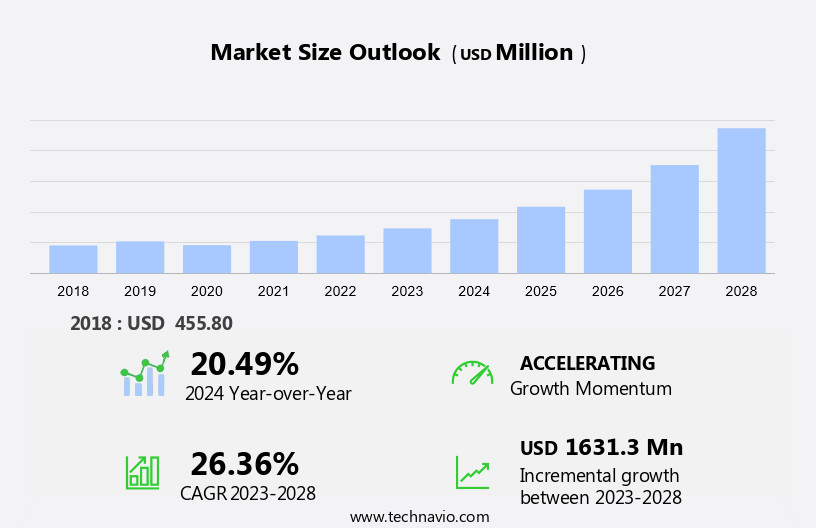
- Smart fabrics, a subset of the textiles industry, are gaining significant traction In the transportation market. These innovative materials integrate electronic components such as sensors, actuators, and conductive yarns, transforming traditional transportation systems. In automotive applications, these fabrics are being used in airbags and seat belt webbings for enhanced safety features. Additionally, they are incorporated into heated seats, offering improved comfort levels. Beyond road transportation, smart fabrics find application in various sectors such as airplanes, maritime, and trains. These materials exhibit properties like material color-changing, light-emitting, moving, and temperature-changing, providing real-time feedback on vital signs and ambient conditions. The integration of advanced fibers and nanotechnology further enhances their functionality. The market In the transportation sector is expected to grow steadily due to increasing demand for comfort, safety, and efficiency. The market also plays a crucial role in this growth, with controllers and sensor units driving the adoption of these fabrics in transportation applications.
How is this Smart Fabrics For Transportation Industry segmented and which is the largest segment?
The industry research report provides comprehensive data (region-wise segment analysis), with forecasts and estimates in "USD billion" for the period 2024-2028, as well as historical data from 2018-2022 for the following segments.
- Application
- Automobiles
- Aerospace
- Railways
- Shipping
- Geography
- North America
- US
- APAC
- China
- Japan
- Europe
- Germany
- UK
- South America
- Middle East and Africa
- North America
By Application Insights
- The automobiles segment is estimated to witness significant growth during the forecast period.
In the transportation sector, smart fabrics play a crucial role in various applications such as airbags, seat belt webbings, heated seats, and automotive interiors. These fabrics are engineered with advanced polymers, antistatic properties, and micro-electric components to enhance performance and functionality. They integrate with sensors, actuators, and electronic components to provide real-time feedback on vital signs, ambient conditions, and comfort levels. This technology is not limited to automobiles but extends to railways, aerospace, and maritime industries. These fabrics enable vehicle management systems, passenger information systems, and autonomous vehicles to offer improved safety, security, and user experience. The integration of big data, IoT, and nanotechnology further enhances the capabilities of smart fabrics, leading to innovations such as color-changing materials, light-emitting materials, moving materials, and temperature-changing materials.
The textile industry continues to evolve with the integration of controllers, sensor units, conductive materials, and advanced fibers to create intelligent transportation systems. These systems offer features such as gesture detection, voice control, biometric authentication, and haptic feedback. The European region is a significant market, with a growing demand for energy-efficient and eco-friendly solutions. The active segment of the market is expected to grow significantly due to the increasing adoption of these materials in various transportation applications.

Get a glance at the Industry report of share of various segments Request Free Sample
The automobiles segment was valued at USD 291.00 million in 2018 and showed a gradual increase during the forecast period.
Regional Analysis
- North America is estimated to contribute 52% to the growth of the global market during the forecast period.
Technavio's analysts have elaborately explained the regional trends and drivers that shape the market during the forecast period.

For more insights on the market share of various regions, Request Free Sample
The North American market led the global smart fabrics for the transportation industry in 2023, driven by technological advancements and increasing penetration in sectors like aerospace, automobiles, shipping, and railways. Key contributors to this market's growth include the US, Canada, and Mexico, where developed economies and rising demand for advanced features in transportation systems are major factors. Smart fabrics, incorporating advanced polymers, antistatic properties, miniaturization, and sensors, are used in various applications such as automotive airbags, seat belt webbings, heated seats, and passenger information systems. These fabrics offer benefits like temperature-changing, color-changing, and light-emitting properties, enhancing user experience with real-time feedback and comfort levels. These fabrics are also used in military and healthcare applications, expanding their reach beyond traditional transportation sectors.
Market Dynamics
Our researchers analyzed the data with 2023 as the base year, along with the key drivers, trends, and challenges. A holistic analysis of drivers will help companies refine their marketing strategies to gain a competitive advantage.
What are the key market drivers leading to the rise In the adoption of Smart Fabrics For Transportation Industry?
Increasing adoption of BLE technology and miniaturization of electronic components is the key driver of the market.
- The market In the transportation sector is experiencing significant growth due to the integration of advanced technologies such as Bluetooth Low Energy (BLE) and Internet of Things (IoT). BLE technology enables wireless connectivity between textiles and mobile devices, allowing for real-time feedback on vital signs, ambient conditions, and user experience. This data can be utilized in various applications, including automotive airbags, seat belt webbings, heated seats, and passenger information systems. Advanced polymers and nanotechnology are used to develop smart fabrics with antistatic properties, temperature-changing materials, light-emitting materials, and moving materials. These fabrics offer enhanced performance in automobiles, railways, aerospace, and maritime industries.
- Sensors, actuators, and electronic components are integrated into these fabrics to provide advanced functionalities such as gesture detection, voice control, biometric authentication, and haptic feedback. Intelligent transportation systems are being developed with sensor fusion, pressure sensors, temperature sensors, and biometric sensors to improve safety and security. The integration of these smart fabrics in automobiles, railways, and aerospace industries can lead to significant improvements in energy efficiency and environmental sustainability. The transportation business is embracing modern technology to enhance comfort levels and user experience. Traditional textiles are being replaced with these fabrics in automobile seats, interior panels, and cabin interiors. Wearable technology is also gaining popularity in the transportation sector, with applications in autonomous vehicles, electric vehicles, and micro-mobility.
What are the market trends shaping the Smart Fabrics For Transportation Industry?
The rising adoption of mobility management is the upcoming market trend.
- Smart fabrics are revolutionizing the transportation industry by enhancing vehicle features and improving mobility management. Incorporating advanced polymers and conductive materials into automotive airbags, seat belt webbings, and heated seats, these fabrics offer temperature-changing, color-changing, and light-emitting properties. These materials enable real-time feedback on vital signs and ambient conditions, providing enhanced safety and security for passengers. Moreover, these fabrics offer comfort levels through haptic feedback and gesture detection, voice control, and biometric authentication. The integration of sensors, actuators, and electronic components into these fabrics allows for user experience customization and improved performance in various transportation applications, including automobiles, railways, aerospace, and maritime.
- The transportation business is increasingly adopting intelligent transportation systems, incorporating sensor fusion, pressure sensors, temperature sensors, and biometric sensors to optimize vehicle management. Smart textiles/fabrics are also being used in wearable technology, textile manufacturing, military applications, and healthcare applications. Real-time data analytics, enabled by the Internet of Things and big data capabilities, can improve mobility systems and ensure concentrated device uptime. Advanced fibers, nanotechnology, and energy harvesting are some of the technologies driving the growth of the market In the European region and other active segments.
What challenges does the Smart Fabrics For Transportation Industry face during its growth?
High manufacturing cost is a key challenge affecting the industry growth.
- Smart fabrics, a fusion of textiles and advanced technology, are revolutionizing the transportation industry. Automotive companies are integrating these innovative materials into airbags, seat belt webbings, and heated seats. These fabrics come in various forms, including material color-changing, light-emitting, moving, and temperature-changing. These fabrics offer enhanced safety and security features through vehicle management systems, passenger information systems, and real-time feedback. The transportation sector, including automobiles, railways, aerospace, and maritime, is adopting these advanced polymers with antistatic properties, miniaturization, and micro-electric vehicles. The integration of the Internet of Things (IoT), sensors, actuators, electronic components, and haptic feedback is transforming transportation systems.
- Smart fabrics are used in various applications, such as intelligent transportation systems, gesture detection, voice control, biometric authentication, and sensor fusion. These fabrics incorporate conductive materials, advanced fibers, and nanotechnology for sensing, energy harvesting, and luminescence & aesthetics. The market is growing, with Europe being an active region. Passive smart fabrics, such as temperature-changing materials, are gaining popularity in medical applications. The market is driven by factors like user experience, on-board diagnostics, and navigation systems. However, the high production cost and R&D investments are potential challenges.
Exclusive Customer Landscape
The market forecasting report includes the adoption lifecycle of the market, covering from the innovator's stage to the laggard's stage. It focuses on adoption rates in different regions based on penetration. Furthermore, the market report also includes key purchase criteria and drivers of price sensitivity to help companies evaluate and develop their market growth analysis strategies.

Customer Landscape
Key Companies & Market Insights
Companies are implementing various strategies, such as strategic alliances, market forecast, partnerships, mergers and acquisitions, geographical expansion, and product/service launches, to enhance their presence In the industry.
The industry research and growth report includes detailed analyses of the competitive landscape of the market and information about key companies, including:
- Ashimori Industry Co. Ltd.
- Camira
- Freudenberg Performance Materials
- Kolon Industries Inc.
- Schoeller Textil AG
- Sefar AG
Qualitative and quantitative analysis of companies has been conducted to help clients understand the wider business environment as well as the strengths and weaknesses of key industry players. Data is qualitatively analyzed to categorize companies as pure play, category-focused, industry-focused, and diversified; it is quantitatively analyzed to categorize companies as dominant, leading, strong, tentative, and weak.
Research Analyst Overview
Smart fabrics, a branch of advanced textiles, have gained significant attention In the transportation industry due to their ability to enhance safety, comfort, and efficiency in various transportation applications. These fabrics incorporate functional elements such as sensors, actuators, electronic components, and advanced polymers, transforming traditional textiles into intelligent materials. They offer numerous benefits for the transportation market. In automobiles, they can be integrated into airbags, seat belt webbings, and heated seats. These fabrics can change color based on temperature, providing passengers with visual cues regarding seat temperature settings. Light-emitting materials integrated into fabrics can be used for passenger information systems, offering real-time feedback and enhancing user experience.
Moreover. moving beyond automobiles, smart fabrics find applications in railways and aerospace. In railways, these fabrics can be used for temperature regulation in passenger cabins, improving comfort levels. In the aerospace industry, they can be used for temperature control in cabin interiors and for haptic feedback in seats, enhancing the overall flying experience. The integration of smart fabrics in transportation systems is driven by the Internet of Things (IoT) and the increasing demand for advanced technology in vehicles. They can be used for vehicle management, safety, and security. For instance, they can be used for gesture detection and voice control, allowing passengers to interact with their vehicles without physical contact.
Furthermore, biometric authentication can also be integrated into smart fabrics, enhancing security. The transportation business is witnessing a shift towards intelligent transportation systems, and they play a crucial role in this transition. Sensor fusion, a technology that combines data from multiple sensors, is used to enhance the performance of smart fabrics. Pressure sensors, temperature sensors, and biometric sensors can be integrated into smart fabrics to collect vital signs and ambient conditions in real time. They also offer environmental efficiency benefits. For instance, thermoelectricity can be used to generate electricity from waste heat, reducing the energy consumption of transportation systems.
|
Market Scope |
|
|
Report Coverage |
Details |
|
Page number |
128 |
|
Base year |
2023 |
|
Historic period |
2018-2022 |
|
Forecast period |
2024-2028 |
|
Growth momentum & CAGR |
Accelerate at a CAGR of 26.36% |
|
Market Growth 2024-2028 |
USD 1.63 billion |
|
Market structure |
Concentrated |
|
YoY growth 2023-2024(%) |
20.49 |
|
Key countries |
US, China, Germany, Japan, and UK |
|
Competitive landscape |
Leading Companies, Market Positioning of Companies, Competitive Strategies, and Industry Risks |
What are the Key Data Covered in this Market Research and Growth Report?
- CAGR of the industry during the forecast period
- Detailed information on factors that will drive the market growth and forecasting between 2024 and 2028
- Precise estimation of the size of the market and its contribution of the industry in focus to the parent market
- Accurate predictions about upcoming growth and trends and changes in consumer behaviour
- Growth of the market across North America, APAC, Europe, South America, and Middle East and Africa
- Thorough analysis of the market's competitive landscape and detailed information about companies
- Comprehensive analysis of factors that will challenge the market growth of industry companies
We can help! Our analysts can customize this market research report to meet your requirements.