
Brazil Textile Manufacturing Market Size 2025-2029
The Brazil textile manufacturing market size is forecast to increase by USD 9.1 billion at a CAGR of 3.3% between 2024 and 2029.
The textile manufacturing market in Brazil is undergoing a strategic pivot, driven by a global realignment of supply chains toward near-shoring. This shift is creating opportunities for the local industry to serve as a reliable partner for North American and European brands seeking to diversify sourcing away from Asia. This is coupled with a deep integration of sustainable and circular economy principles, leveraging the nation's agricultural strengths to lead in sustainable fabrics. The apparel manufacturing sector is responding by investing in modernization and traceability to meet stringent ESG standards, positioning itself not on low-cost production, but on reliability, ethical frameworks, and reduced lead times. This virtuous cycle of investment and improvement is key to capitalizing on the evolving demands of the global fashion industry, with a focus on a more resilient and transparent farm-to-fashion ecosystem, including developments in the technical textiles market.Despite these positive dynamics, the industry confronts the persistent challenge of intense and structurally entrenched competition from Asian production hubs. These competitors benefit from massive economies of scale, lower labor costs, and supportive government policies, enabling them to exert significant price pressure on the domestic market. This competition is no longer confined to basic goods but is expanding into higher-value segments, limiting export potential and capping the pricing power of local manufacturers. The operationalization of major international trade agreements further solidifies this competitive disadvantage. Therefore, the sector's success hinges on its ability to navigate this environment by focusing on value-added differentiation through innovation, quality, and sustainability in textile manufacturing, rather than engaging in a direct cost competition where it is structurally disadvantaged.
What will be the size of the Brazil Textile Manufacturing Market during the forecast period?
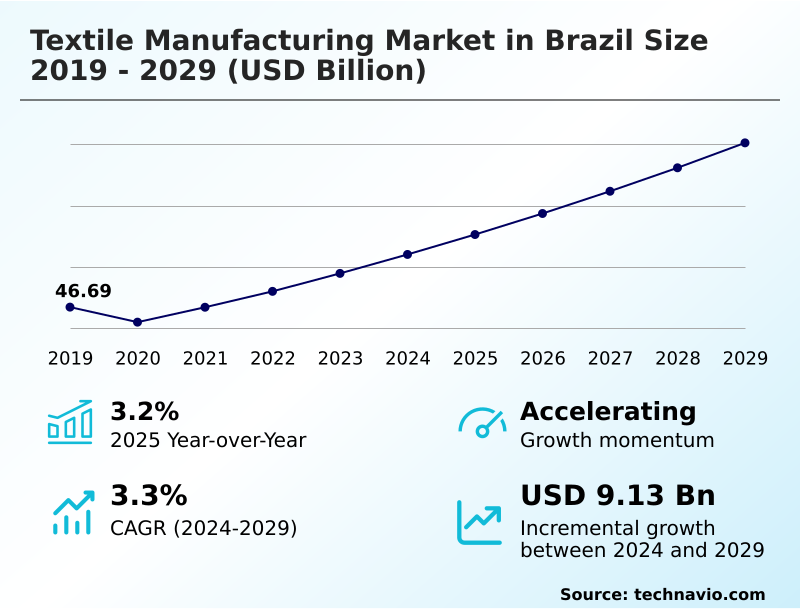
Explore in-depth regional segment analysis with market size data - historical 2019 - 2023 and forecasts 2025-2029 - in the full report.
Request Free Sample
The textile manufacturing market in Brazil continues to evolve, driven by a dual focus on modernization and sustainability. The integration of a circular economy is reshaping the apparel manufacturing landscape, with an emphasis on sustainable material sourcing and resource efficiency in textiles. Investments are flowing into yarn spinning technology and fabric weaving automation to enhance quality and compete in the global market.This shift is also evident in the technical textiles market, where demand for specialized products is growing. Innovations in functional fabric finishes and digital textile printing are creating new opportunities. However, the industry constantly navigates challenges like raw material price volatility and intense import competition pressure, necessitating a strategic focus on value-added production and agile supply chain management. The development of non-woven textile applications further diversifies the sector's portfolio.
How is this market segmented?
The market research report provides comprehensive data (region-wise segment analysis), with forecasts and estimates in "USD million" for the period 2025-2029, as well as historical data from 2019 - 2023 for the following segments.
- Application
- Fashion
- Technical
- Household
- Others
- Material type
- Natural fibers
- Polyesters
- Nylon
- Others
- Product type
- Fabrics
- Garments
- Yarns
- Knitted goods
- Non-woven textiles
- Geography
By Application Insights
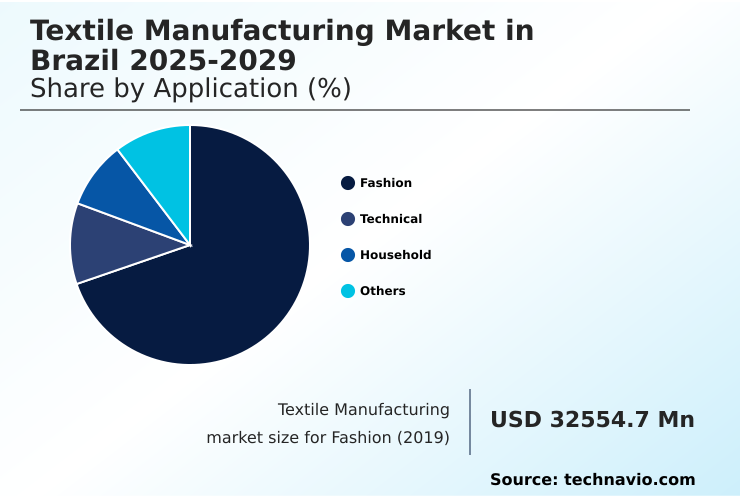
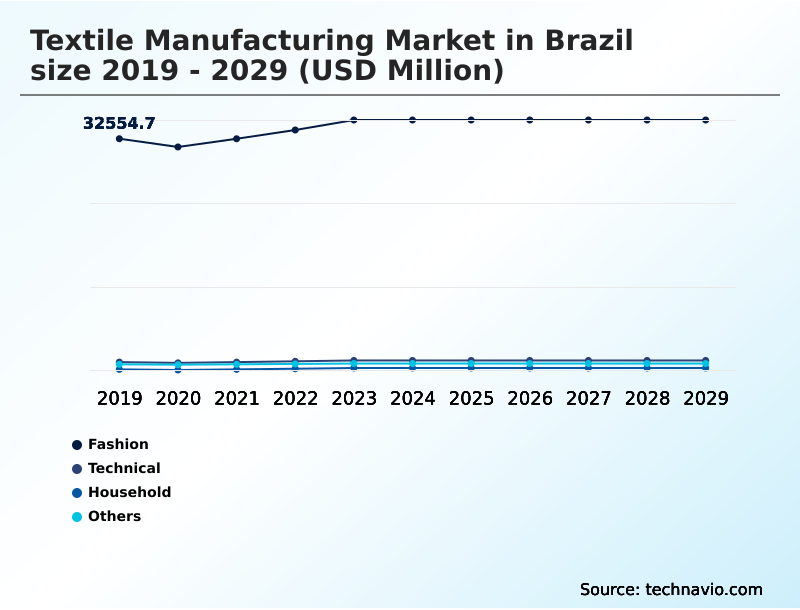
The fashion segment is estimated to witness significant growth during the forecast period.
The fashion segment is the most dynamic component of the textile manufacturing market in Brazil, defined by rapid trend cycles and the influence of large, vertically integrated domestic brands. The push toward sustainability is a dominant force, compelling manufacturers to adopt processes for recycled polyester and sustainably sourced cotton. This shift toward an ethical production framework is moving beyond marketing to verifiable production methods, with a significant portion of new collections, over 60%, now featuring some sustainable attribute.
Concurrently, a strategic reevaluation of sourcing is underway, positioning the domestic industry as a potential near-shoring partner for Western brands. This evolution is not merely about serving internal consumption but also about diversifying into export markets. The long-term viability for firms in this space hinges on balancing cost competitiveness with crucial investments in technology, sustainable material sourcing, and developing an agile response capability to meet fast-fashion demands.

Request Free Sample
The Fashion segment was valued at USD 32.6 billion in 2019 and showed a gradual increase during the forecast period.
Market Dynamics
Our researchers analyzed the data with 2024 as the base year, along with the key drivers, trends, and challenges. A holistic analysis of drivers will help companies refine their marketing strategies to gain a competitive advantage.
The Brazilian textile market is experiencing significant growth, driven by a confluence of factors including the rising demand for textiles in Brazil and an increasing demand for natural textile fibers. This expansion is supported by sector-specific trends such as the growing demand for geotextile materials and key innovations in the automotive textile industry. Concurrently, increasing healthcare spending for medical textiles is boosting the adoption of specialized products like antimicrobial textiles in healthcare products. The government is also playing a role through initiatives supporting sportech textiles. In response, the industry is witnessing rising innovations in the textile industry, with companies pursuing product innovations and product line extensions. This progress is underpinned by a comprehensive digital transformation in the textile sector and the implementation of automation solutions in the textile industry to enhance efficiency and competitiveness.Despite these opportunities, the market navigates a complex landscape of challenges. A major consideration is the strategic realignment of global supply chains, which intensifies the intense structurally advantaged international competition. Domestically, manufacturers grapple with the volatility of raw material textile prices and the rising costs of high-quality raw materials. Operational concerns are compounded by labor shortages in the textile industry and the imperative to mitigate health hazards in the textile industry, all while adhering to government regulations on worker safety apparel. While there is a strong push for the integration of sustainable circular economy principles, this is often stymied by a lack of effective textile recycling techniques, posing a significant hurdle to long-term environmental goals.

What are the key market drivers leading to the rise in the adoption of Brazil Textile Manufacturing Industry?
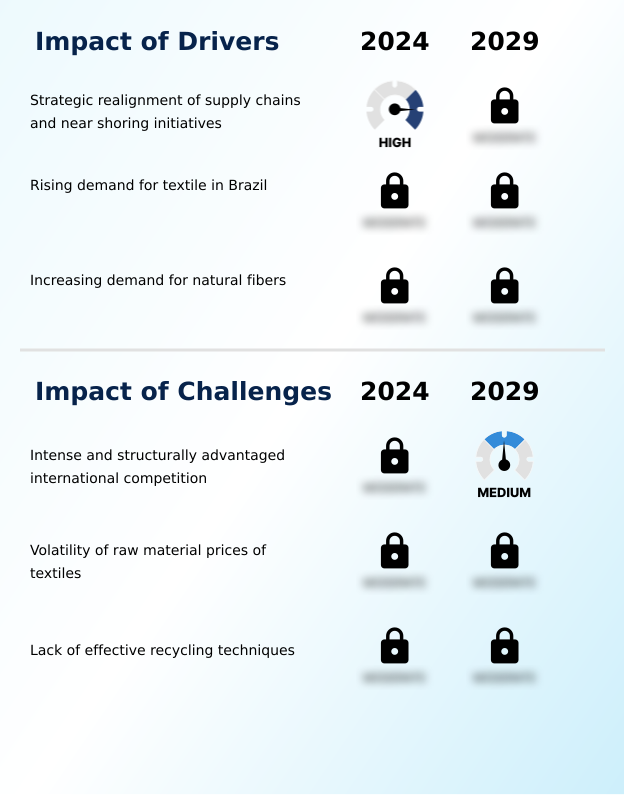
- The primary driver for the market is the strategic realignment of global supply chains, including near-shoring initiatives, which is creating new opportunities for local manufacturers.
The market is experiencing a significant shift due to the strategic realignment of global supply chains, with near-shoring initiatives creating new demand. Geopolitical and logistical factors are causing brands to diversify their sourcing base away from traditional hubs. This trend is not about cost-matching, but about offering reliability, shorter lead times, and adherence to environmental social governance standards. The industry is responding with modernization, investing in yarn spinning technology and digital printing to improve quality consistency and farm-to-fashion traceability. The prospect of reduced tariffs, with some trade dialogues showing progress, further incentivizes a focus on an ethical production framework to attract international partnerships.A substantial driver is the growing internal demand for textile products. This domestic consumption, accounting for a large portion of the market's activity, provides a stable foundation for manufacturers. The rising demand spans across various segments, including apparel garment production and home textile products. This internal market allows companies to test innovations in textile finishing techniques and sustainable material sourcing before scaling for export. It also mitigates some risks associated with raw material price volatility and global economic shifts. This consistent domestic appetite supports the entire vertically integrated operations, from fiber processing to finished goods, and encourages ongoing investment in the sector's capabilities.
What are the market trends shaping the Brazil Textile Manufacturing Industry?
- The rapid and strategic integration of sustainable and circular economy principles is becoming a core operational and strategic imperative for the market.
A paramount trend is the strategic integration of sustainable and circular economy principles, which is moving beyond marketing to become a core operational imperative. Driven by stringent regulations in key export markets and evolving consumer preferences, the industry is leveraging its assets to lead in sustainable fabrics. This shift in the apparel manufacturing space alters production processes, with a focus on textile waste reduction and resource efficiency in textiles. It is fostering innovative business models like product-as-a-service (PAAS), which incentivizes designing for durability and recyclability. This focus on the entire product lifecycle management, from sustainable material sourcing to end-of-life solutions, is becoming a key competitive differentiator.The increasing demand for textiles within the automotive sector presents a significant growth avenue, especially for the technical textiles market. As vehicles become more sophisticated, the need for advanced fabrics for interiors, safety components, and acoustic insulation is rising. This includes demand for high-performance circular knits and specialized non-woven textile applications. Manufacturers are innovating with functional fabric finishes to meet stringent automotive standards for durability, fire resistance, and aesthetics. This trend is driving R&D in synthetic fiber manufacturing and specialized material compositions, opening new, high-value opportunities for textile producers to diversify beyond traditional fashion and home goods segments.
What challenges does the Brazil Textile Manufacturing Industry face during its growth?
- The market faces a significant challenge from intense and structurally entrenched competition from Asian producers, which exerts persistent pressure on the local industry.
The most significant challenge is the intense and structurally entrenched import competition pressure from Asian producers. These competitors benefit from economies of scale, lower labor costs, and specialized industrial clusters that are difficult to match. This dynamic limits export growth and subjects the domestic market to an influx of lower-priced goods, capping the pricing power of local firms. The competition is also advancing into higher-value segments, including technical fabric development, threatening potential avenues for differentiation. This global supply chain dynamics creates a powerful headwind, making market share gains a difficult endeavor, with over 70% of certain imported categories originating from these hubs. Trade defense instruments offer some protection but are a long-term test against systemic advantages.Another major challenge is the volatility of raw material prices. Fluctuations in the costs of key inputs like cotton, polyesters, and nylon directly impact manufacturing costs and profitability. This raw material price volatility is influenced by global commodity markets, currency exchange rates, and supply chain disruptions, making it difficult for manufacturers to forecast expenses or maintain stable pricing. This issue is particularly acute for companies reliant on imported synthetic fibers or specialized chemicals for textile dyeing processes. The uncertainty can squeeze margins and affect the cost competitiveness balance, requiring agile sourcing strategies and efficient inventory management to mitigate financial risks and maintain operational stability.
Exclusive Customer Landscape
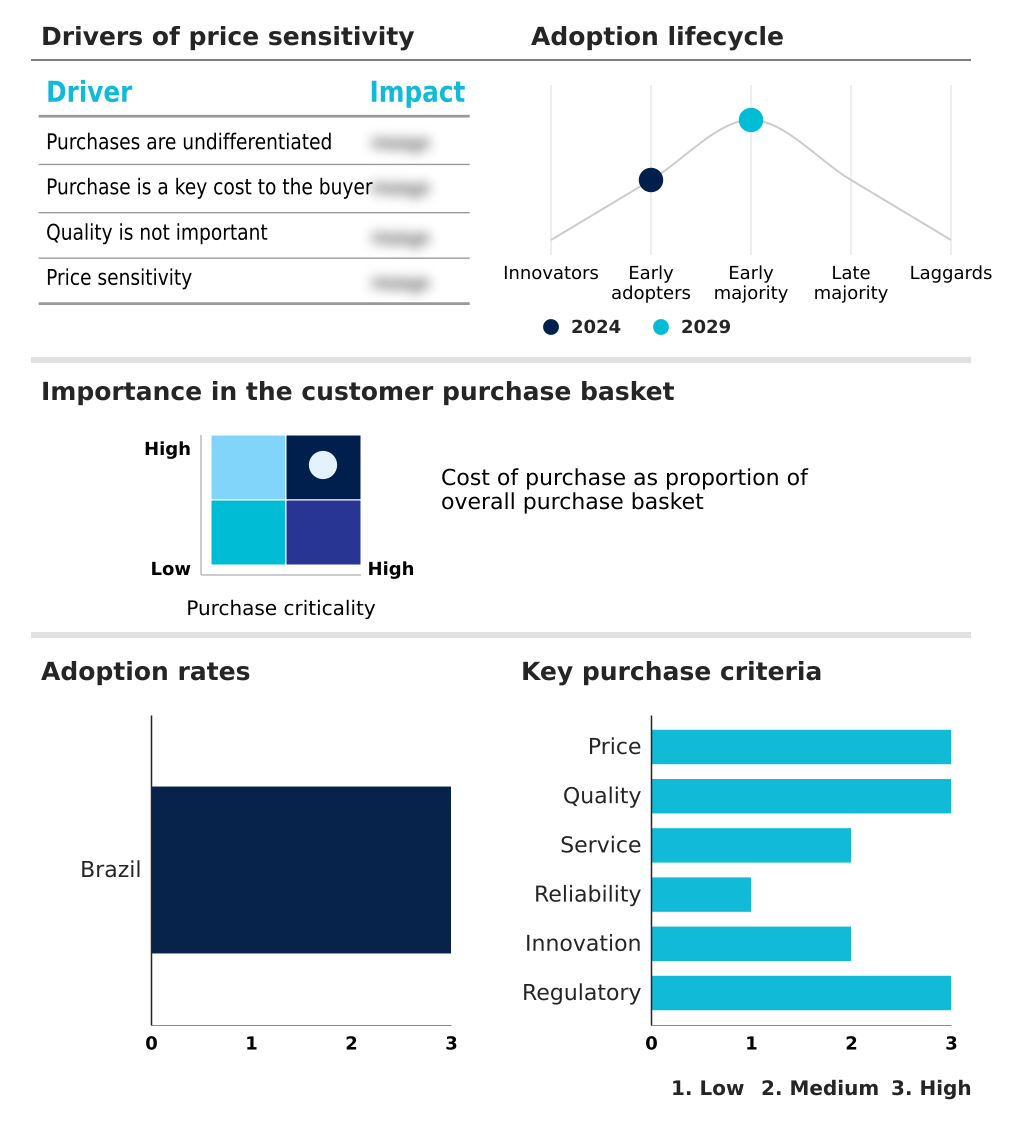
The Brazil textile manufacturing market forecasting report includes the adoption lifecycle of the market, covering from the innovator’s stage to the laggard’s stage. It focuses on adoption rates in different regions based on penetration. Furthermore, the Brazil textile manufacturing market report also includes key purchase criteria and drivers of price sensitivity to help companies evaluate and develop their market growth analysis strategies.
Customer Landscape
Key Companies & Market Insights
Companies are implementing various strategies, such as strategic alliances, Brazil textile manufacturing market forecast, partnerships, mergers and acquisitions, geographical expansion, and product/service launches, to enhance their presence in the industry.
ApparelnBags.com Inc - The core offering centers on providing bespoke textile manufacturing solutions. This includes the custom production of a wide range of goods, such as bed linens, blankets, shower curtains, duvets, and pillow covers, specifically tailored for wholesale and promotional applications. The service is designed to accommodate specific client requirements for bulk orders and branded merchandise, covering various stages from material sourcing to final product creation.
The industry research and growth report includes detailed analyses of the competitive landscape of the market and information about key companies, including:
- ApparelnBags.com Inc
- Blutextil Industria e Comercio Ltda.
- Cedro Textil S.A.
- Cia. Hering
- Elian Industria Textil Ltda.
- Evora SA
- Fabriclore Retail Pvt. Ltd.
- Fiacao Alpina Ltda.
- Hyosung Corp.
- Loyal Textile Mills Ltd.
- Marisol S.A.
- Merrow Sewing Machine Co.
- Pettenati Industria Textil SA
- Santana Textiles Group
- Santista Textil S.A.
- Springs Global Participacoes S.A.
- Sutlej Textiles and Industries Ltd.
- Tectextil Embalagens Industriais Ltda.
- Textil Canatiba Ltda.
- Toray Industries Inc.
Qualitative and quantitative analysis of companies has been conducted to help clients understand the wider business environment as well as the strengths and weaknesses of key industry players. Data is qualitatively analyzed to categorize companies as pure play, category-focused, industry-focused, and diversified; it is quantitatively analyzed to categorize companies as dominant, leading, strong, tentative, and weak.
Recent Development and News in Brazil Textile Manufacturing Market
In May 2024, Grupo SOMA, the parent company of Cia. Hering, reported a 4.9% growth in net revenue for the Hering brand in its first-quarter results, with the group's overall digital channel sales increasing by 21.6%.In February 2024, Cedro Textil participated in the Colombiatex de las Américas fair, a major textile event, where it showcased its latest denim collections with a strong emphasis on sustainable technologies and innovative fabric designs.In January 2024, Hyosung TNC announced a strategic partnership with the textile innovation company Ambercycle to produce recycled spandex from textile waste, a move that supports its global sustainability goals and impacts its worldwide operations.
Research Analyst Overview
In the textile manufacturing market in Brazil, an escalating focus on environmental social governance is driving the adoption of sustainable textile production and circular economy principles. This movement influences the entire value chain, prompting supply chain realignment to mitigate raw material price volatility and global supply chain dynamics. Core operations are adapting through improved resource efficiency in textiles, with an emphasis on sustainable material sourcing and textile waste reduction. Advancements in yarn spinning technology and fabric weaving automation are modernizing both natural fiber processing and synthetic fiber manufacturing. Concurrently, an ethical production framework is becoming integral, supported by recycled content verification and reformed textile dyeing processes to ensure compliance and market relevance.Vertically integrated operations are leveraging digital textile printing and advanced sewing systems to enhance efficiency in apparel garment production and the creation of home textile products. Specialized industrial clusters are fostering innovation in niche segments like denim fabric production and the development of high-performance circular knits. Diversification is evident in technical fabric development for non-woven textile applications, geotextile applications, and industrial packaging textiles. This includes sportech textile innovations and medical textile advancements featuring antimicrobial textile properties. As firms navigate import competition pressure, some advocate for trade defense instruments, while others explore new business strategies like the product as a service model, which requires robust product lifecycle management and specialized functional fabric finishes and textile finishing techniques. Industry expectations point toward a 4% expansion in production capacity.
Dive into Technavio’s robust research methodology, blending expert interviews, extensive data synthesis, and validated models for unparalleled Brazil Textile Manufacturing Market insights. See full methodology.
|
Market Scope
|
|
Report Coverage
|
Details
|
|
Page number
|
193
|
|
Base year
|
2024
|
|
Historic period
|
2019 - 2023 |
|
Forecast period
|
2025-2029
|
|
Growth momentum & CAGR
|
Accelerating at a CAGR of 3.3%
|
|
Market growth 2024-2029
|
USD 9.1 billion
|
|
Market structure
|
Fragmented
|
|
YoY growth 2024-2029(%)
|
3.2%
|
|
Key countries
|
Brazil
|
|
Competitive landscape
|
Leading Companies, Market Positioning of Companies, Competitive Strategies, and Industry Risks
|
Request Free Sample
What are the Key Data Covered in this Brazil Textile Manufacturing Market Research and Growth Report?
- CAGR of the Brazil Textile Manufacturing industry during the forecast period
- Detailed information on factors that will drive the growth and forecasting between 2024 and 2029
- Precise estimation of the size of the market and its contribution of the industry in focus to the parent market
- Accurate predictions about upcoming growth and trends and changes in consumer behaviour
- Growth of the market across South America
- Thorough analysis of the market’s competitive landscape and detailed information about companies
- Comprehensive analysis of factors that will challenge the Brazil textile manufacturing market growth of industry companies
We can help! Our analysts can customize this Brazil textile manufacturing market research report to meet your requirements.
Get in touch
1 Executive Summary
- 1 Executive Summary
- 1.1 Market overview
- Executive Summary - Chart on Market Overview
- Executive Summary - Data Table on Market Overview
- Executive Summary - Chart on Country Market Characteristics
- Executive Summary - Chart on Market Segmentation by Application
- Executive Summary - Chart on Market Segmentation by Material Type
- Executive Summary - Chart on Market Segmentation by Product Type
- Executive Summary - Chart on Company Market Positioning
2 Technavio Analysis
- 2 Technavio Analysis
- 2.1 Analysis of price sensitivity, lifecycle, customer purchase basket, adoption rates, and purchase criteria
- Analysis of price sensitivity, lifecycle, customer purchase basket, adoption rates, and purchase criteria
- 2.2 Criticality of inputs and Factors of differentiation
- Overview on criticality of inputs and factors of differentiation
- 2.3 Factors of disruption
- Overview on factors of disruption
- 2.4 Impact of drivers and challenges
- Impact of drivers and challenges in 2024 and 2029
3 Market Landscape
- 3 Market Landscape
- 3.1 Market ecosystem
- Chart on Parent Market
- Data Table on - Parent Market
- 3.2 Market characteristics
- Chart on Market characteristics analysis
- 3.3 Value chain analysis
- Chart on Value chain analysis
4 Market Sizing
- 4 Market Sizing
- 4.1 Market definition
- Data Table on Offerings of companies included in the market definition
- 4.2 Market segment analysis
- 4.3 Market size 2024
- 4.4 Market outlook: Forecast for 2024-2029
- Chart on Brazil - Market size and forecast 2024-2029 ($ billion)
- Data Table on Brazil - Market size and forecast 2024-2029 ($ billion)
- Chart on Brazil: Year-over-year growth 2024-2029 (%)
- Data Table on Brazil: Year-over-year growth 2024-2029 (%)
5 Historic Market Size
- 5 Historic Market Size
- 5.1 Textile Manufacturing Market in Brazil 2019 - 2023
- Historic Market Size - Data Table on Textile Manufacturing Market in Brazil 2019 - 2023 ($ billion)
- 5.2 Application segment analysis 2019 - 2023
- Historic Market Size - Application Segment 2019 - 2023 ($ billion)
- 5.3 Material Type segment analysis 2019 - 2023
- Historic Market Size - Material Type Segment 2019 - 2023 ($ billion)
- 5.4 Product Type segment analysis 2019 - 2023
- Historic Market Size - Product Type Segment 2019 - 2023 ($ billion)
6 Qualitative Analysis
- 6 Qualitative Analysis
- 6.1 The AI impact on Textile Manufacturing Market in Brazil
7 Five Forces Analysis
- 7 Five Forces Analysis
- 7.1 Five forces summary
- Five forces analysis - Comparison between 2024 and 2029
- 7.2 Bargaining power of buyers
- Bargaining power of buyers - Impact of key factors 2024 and 2029
- 7.3 Bargaining power of suppliers
- Bargaining power of suppliers - Impact of key factors in 2024 and 2029
- 7.4 Threat of new entrants
- Threat of new entrants - Impact of key factors in 2024 and 2029
- 7.5 Threat of substitutes
- Threat of substitutes - Impact of key factors in 2024 and 2029
- 7.6 Threat of rivalry
- Threat of rivalry - Impact of key factors in 2024 and 2029
- 7.7 Market condition
- Chart on Market condition - Five forces 2024 and 2029
8 Market Segmentation by Application
- 8 Market Segmentation by Application
- 8.1 Market segments
- Chart on Application - Market share 2024-2029 (%)
- Data Table on Application - Market share 2024-2029 (%)
- 8.2 Comparison by Application
- Chart on Comparison by Application
- Data Table on Comparison by Application
- 8.3 Fashion - Market size and forecast 2024-2029
- Chart on Fashion - Market size and forecast 2024-2029 ($ billion)
- Data Table on Fashion - Market size and forecast 2024-2029 ($ billion)
- Chart on Fashion - Year-over-year growth 2024-2029 (%)
- Data Table on Fashion - Year-over-year growth 2024-2029 (%)
- 8.4 Technical - Market size and forecast 2024-2029
- Chart on Technical - Market size and forecast 2024-2029 ($ billion)
- Data Table on Technical - Market size and forecast 2024-2029 ($ billion)
- Chart on Technical - Year-over-year growth 2024-2029 (%)
- Data Table on Technical - Year-over-year growth 2024-2029 (%)
- 8.5 Household - Market size and forecast 2024-2029
- Chart on Household - Market size and forecast 2024-2029 ($ billion)
- Data Table on Household - Market size and forecast 2024-2029 ($ billion)
- Chart on Household - Year-over-year growth 2024-2029 (%)
- Data Table on Household - Year-over-year growth 2024-2029 (%)
- 8.6 Others - Market size and forecast 2024-2029
- Chart on Others - Market size and forecast 2024-2029 ($ billion)
- Data Table on Others - Market size and forecast 2024-2029 ($ billion)
- Chart on Others - Year-over-year growth 2024-2029 (%)
- Data Table on Others - Year-over-year growth 2024-2029 (%)
- 8.7 Market opportunity by Application
- Market opportunity by Application ($ billion)
- Data Table on Market opportunity by Application ($ billion)
9 Market Segmentation by Material Type
- 9 Market Segmentation by Material Type
- 9.1 Market segments
- Chart on Market Segmentation by Material Type - Market share 2024-2029 (%)
- Data Table on Market Segmentation by Material Type - Market share 2024-2029 (%)
- 9.2 Comparison by Market Segmentation by Material Type
- Chart on Comparison by Market Segmentation by Material Type
- Data Table on Comparison by Market Segmentation by Material Type
- 9.3 Natural fibers - Market size and forecast 2024-2029
- Chart on Natural fibers - Market size and forecast 2024-2029 ($ billion)
- Data Table on Natural fibers - Market size and forecast 2024-2029 ($ billion)
- Chart on Natural fibers - Year-over-year growth 2024-2029 (%)
- Data Table on Natural fibers - Year-over-year growth 2024-2029 (%)
- 9.4 Polyesters - Market size and forecast 2024-2029
- Chart on Polyesters - Market size and forecast 2024-2029 ($ billion)
- Data Table on Polyesters - Market size and forecast 2024-2029 ($ billion)
- Chart on Polyesters - Year-over-year growth 2024-2029 (%)
- Data Table on Polyesters - Year-over-year growth 2024-2029 (%)
- 9.5 Nylon - Market size and forecast 2024-2029
- Chart on Nylon - Market size and forecast 2024-2029 ($ billion)
- Data Table on Nylon - Market size and forecast 2024-2029 ($ billion)
- Chart on Nylon - Year-over-year growth 2024-2029 (%)
- Data Table on Nylon - Year-over-year growth 2024-2029 (%)
- 9.6 Others - Market size and forecast 2024-2029
- Chart on Others - Market size and forecast 2024-2029 ($ billion)
- Data Table on Others - Market size and forecast 2024-2029 ($ billion)
- Chart on Others - Year-over-year growth 2024-2029 (%)
- Data Table on Others - Year-over-year growth 2024-2029 (%)
- 9.7 Market opportunity by Market Segmentation by Material Type
- Market opportunity by Market Segmentation by Material Type ($ billion)
- Data Table on Market opportunity by Market Segmentation by Material Type ($ billion)
10 Market Segmentation by Product Type
- 10 Market Segmentation by Product Type
- 10.1 Market segments
- Chart on Product Type - Market share 2024-2029 (%)
- Data Table on Product Type - Market share 2024-2029 (%)
- 10.2 Comparison by Product Type
- Chart on Comparison by Product Type
- Data Table on Comparison by Product Type
- 10.3 Fabrics - Market size and forecast 2024-2029
- Chart on Fabrics - Market size and forecast 2024-2029 ($ billion)
- Data Table on Fabrics - Market size and forecast 2024-2029 ($ billion)
- Chart on Fabrics - Year-over-year growth 2024-2029 (%)
- Data Table on Fabrics - Year-over-year growth 2024-2029 (%)
- 10.4 Garments - Market size and forecast 2024-2029
- Chart on Garments - Market size and forecast 2024-2029 ($ billion)
- Data Table on Garments - Market size and forecast 2024-2029 ($ billion)
- Chart on Garments - Year-over-year growth 2024-2029 (%)
- Data Table on Garments - Year-over-year growth 2024-2029 (%)
- 10.5 Yarns - Market size and forecast 2024-2029
- Chart on Yarns - Market size and forecast 2024-2029 ($ billion)
- Data Table on Yarns - Market size and forecast 2024-2029 ($ billion)
- Chart on Yarns - Year-over-year growth 2024-2029 (%)
- Data Table on Yarns - Year-over-year growth 2024-2029 (%)
- 10.6 Knitted goods - Market size and forecast 2024-2029
- Chart on Knitted goods - Market size and forecast 2024-2029 ($ billion)
- Data Table on Knitted goods - Market size and forecast 2024-2029 ($ billion)
- Chart on Knitted goods - Year-over-year growth 2024-2029 (%)
- Data Table on Knitted goods - Year-over-year growth 2024-2029 (%)
- 10.7 Non-woven textiles - Market size and forecast 2024-2029
- Chart on Non-woven textiles - Market size and forecast 2024-2029 ($ billion)
- Data Table on Non-woven textiles - Market size and forecast 2024-2029 ($ billion)
- Chart on Non-woven textiles - Year-over-year growth 2024-2029 (%)
- Data Table on Non-woven textiles - Year-over-year growth 2024-2029 (%)
- 10.8 Market opportunity by Product Type
- Market opportunity by Product Type ($ billion)
- Data Table on Market opportunity by Product Type ($ billion)
11 Customer Landscape
- 11 Customer Landscape
- 11.1 Customer landscape overview
- Analysis of price sensitivity, lifecycle, customer purchase basket, adoption rates, and purchase criteria
12 Drivers, Challenges, and Opportunity
- 12 Drivers, Challenges, and Opportunity
- 12.1 Market drivers
- Strategic realignment of supply chains and near shoring initiatives
- Rising demand for textile in Brazil
- Increasing demand for natural fibers
- 12.2 Market challenges
- Intense and structurally advantaged international competition
- Volatility of raw material prices of textiles
- Lack of effective recycling techniques
- 12.3 Impact of drivers and challenges
- Impact of drivers and challenges in 2024 and 2029
- 12.4 Market opportunities
- Integration of sustainable and circular economy principles
- Increasing demand for textile in automotive industry
- Rising innovations in textile industry
13 Competitive Landscape
- 13 Competitive Landscape
- 13.1 Overview
- 13.2 Competitive Landscape
- Overview on criticality of inputs and factors of differentiation
- 13.3 Landscape disruption
- Overview on factors of disruption
- 13.4 Industry risks
- Impact of key risks on business
14 Competitive Analysis
- 14 Competitive Analysis
- 14.1 Companies profiled
- 14.2 Company ranking index
- 14.3 Market positioning of companies
- Matrix on companies position and classification
- 14.4 ApparelnBags.com Inc
- ApparelnBags.com Inc - Overview
- ApparelnBags.com Inc - Product / Service
- ApparelnBags.com Inc - Key offerings
- SWOT
- 14.5 Blutextil Industria e Comercio Ltda.
- Blutextil Industria e Comercio Ltda. - Overview
- Blutextil Industria e Comercio Ltda. - Product / Service
- Blutextil Industria e Comercio Ltda. - Key offerings
- SWOT
- 14.6 Cedro Textil S.A.
- Cedro Textil S.A. - Overview
- Cedro Textil S.A. - Product / Service
- Cedro Textil S.A. - Key offerings
- SWOT
- 14.7 Cia. Hering
- Cia. Hering - Overview
- Cia. Hering - Product / Service
- Cia. Hering - Key offerings
- SWOT
- 14.8 Elian Industria Textil Ltda.
- Elian Industria Textil Ltda. - Overview
- Elian Industria Textil Ltda. - Product / Service
- Elian Industria Textil Ltda. - Key offerings
- SWOT
- 14.9 Evora SA
- Evora SA - Overview
- Evora SA - Product / Service
- Evora SA - Key offerings
- SWOT
- 14.10 Fabriclore Retail Pvt. Ltd.
- Fabriclore Retail Pvt. Ltd. - Overview
- Fabriclore Retail Pvt. Ltd. - Product / Service
- Fabriclore Retail Pvt. Ltd. - Key offerings
- SWOT
- 14.11 Fiacao Alpina Ltda.
- Fiacao Alpina Ltda. - Overview
- Fiacao Alpina Ltda. - Product / Service
- Fiacao Alpina Ltda. - Key offerings
- SWOT
- 14.12 Hyosung Corp.
- Hyosung Corp. - Overview
- Hyosung Corp. - Product / Service
- Hyosung Corp. - Key offerings
- SWOT
- 14.13 Loyal Textile Mills Ltd.
- Loyal Textile Mills Ltd. - Overview
- Loyal Textile Mills Ltd. - Business segments
- Loyal Textile Mills Ltd. - Key offerings
- Loyal Textile Mills Ltd. - Segment focus
- SWOT
- 14.14 Marisol S.A.
- Marisol S.A. - Overview
- Marisol S.A. - Product / Service
- Marisol S.A. - Key offerings
- SWOT
- 14.15 Merrow Sewing Machine Co.
- Merrow Sewing Machine Co. - Overview
- Merrow Sewing Machine Co. - Product / Service
- Merrow Sewing Machine Co. - Key offerings
- SWOT
- 14.16 Pettenati Industria Textil SA
- Pettenati Industria Textil SA - Overview
- Pettenati Industria Textil SA - Product / Service
- Pettenati Industria Textil SA - Key offerings
- SWOT
- 14.17 Santana Textiles Group
- Santana Textiles Group - Overview
- Santana Textiles Group - Product / Service
- Santana Textiles Group - Key offerings
- SWOT
- 14.18 Santista Textil S.A.
- Santista Textil S.A. - Overview
- Santista Textil S.A. - Product / Service
- Santista Textil S.A. - Key offerings
- SWOT
15 Appendix
- 15 Appendix
- 15.1 Scope of the report
- Market definition
- Objectives
- Notes and caveats
- 15.2 Inclusions and exclusions checklist
- Inclusions checklist
- Exclusions checklist
- 15.3 Currency conversion rates for US$
- Currency conversion rates for US$
- 15.4 Research methodology
- 15.5 Data procurement
- 15.6 Data validation
- 15.7 Validation techniques employed for market sizing
- Validation techniques employed for market sizing
- 15.8 Data synthesis
- 15.9 360 degree market analysis
- 360 degree market analysis
- 15.10 List of abbreviations
Research Framework
Technavio presents a detailed picture of the market by way of study, synthesis, and summation of data from multiple sources. The analysts have presented the various facets of the market with a particular focus on identifying the key industry influencers. The data thus presented is comprehensive, reliable, and the result of extensive research, both primary and secondary.
INFORMATION SOURCES
Primary sources
- Manufacturers and suppliers
- Channel partners
- Industry experts
- Strategic decision makers
Secondary sources
- Industry journals and periodicals
- Government data
- Financial reports of key industry players
- Historical data
- Press releases

DATA ANALYSIS
Data Synthesis
- Collation of data
- Estimation of key figures
- Analysis of derived insights
Data Validation
- Triangulation with data models
- Reference against proprietary databases
- Corroboration with industry experts

REPORT WRITING
Qualitative
- Market drivers
- Market challenges
- Market trends
- Five forces analysis
Quantitative
- Market size and forecast
- Market segmentation
- Geographical insights
- Competitive landscape