


Toilet Paper Market Size 2026-2030
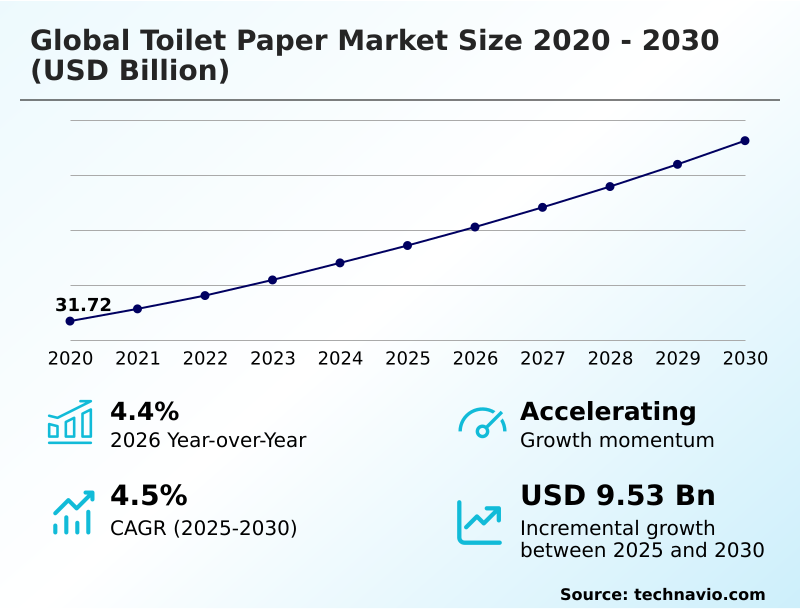
The toilet paper market size is valued to increase by USD 9.53 billion, at a CAGR of 4.5% from 2025 to 2030. Regulatory decarbonization and industrialization of deforestation-free supply will drive the toilet paper market.
Major Market Trends & Insights
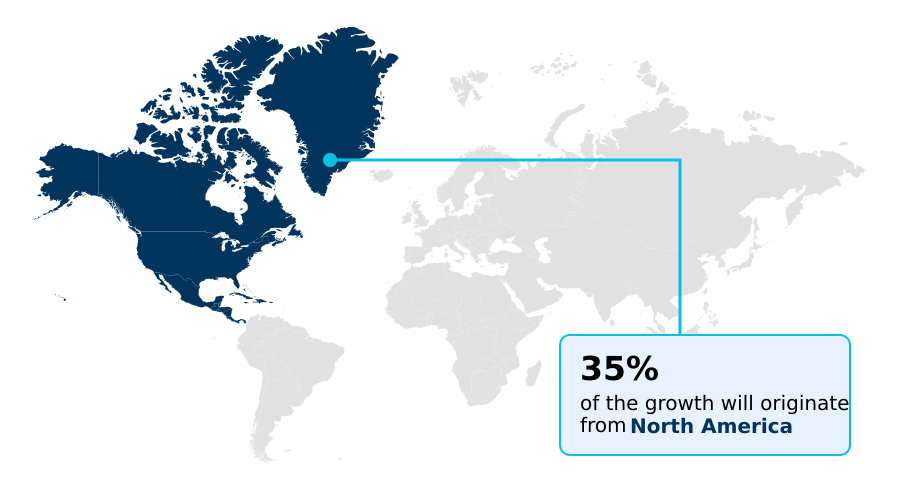
- North America dominated the market and accounted for a 35.1% growth during the forecast period.
- By Distribution Channel - Offline segment was valued at USD 25.48 billion in 2024
- By End-user - Residential segment accounted for the largest market revenue share in 2024
Market Size & Forecast
- Market Opportunities: USD 16.40 billion
- Market Future Opportunities: USD 9.53 billion
- CAGR from 2025 to 2030 : 4.5%
Market Summary
- The toilet paper market is advancing beyond its commodity origins, driven by a global focus on personal hygiene, sustainability, and product innovation. This evolution is characterized by a strategic pivot toward value-added offerings, including multi-ply tissues with enhanced softness, skin-soothing additives, and advanced embossing technologies.
- In emerging economies, rising disposable incomes are accelerating the shift from traditional hygiene methods to standardized paper products. Concurrently, in mature markets, the demand for eco-conscious products is compelling manufacturers to adopt certified sustainable sourcing and post-consumer waste materials.
- A key operational scenario involves the integration of digital tracking systems to ensure deforestation-free fiber throughout the supply chain, a response to stringent regulatory frameworks that mandate end-to-end traceability. This requires significant investment in technology to verify the origin of cellulosic fibers, manage compliance data, and mitigate financial risks.
- The expansion of e-commerce and subscription-based models is also reshaping distribution, providing consumers with convenient access to bulk goods while enabling niche brands to compete effectively. The industry's trajectory is defined by this balance between premiumization, regulatory adherence, and supply chain resilience.
What will be the Size of the Toilet Paper Market during the forecast period?
Get Key Insights on Market Forecast (PDF) Get Free Sample
How is the Toilet Paper Market Segmented?
The toilet paper industry research report provides comprehensive data (region-wise segment analysis), with forecasts and estimates in "USD million" for the period 2026-2030, as well as historical data from 2020-2024 for the following segments.
- Distribution channel
- Offline
- Online
- End-user
- Residential
- Commercial
- Type
- Rolled
- Folded
- Geography
- North America
- US
- Canada
- Mexico
- Europe
- Germany
- UK
- France
- APAC
- China
- India
- Japan
- South America
- Brazil
- Argentina
- Middle East and Africa
- South Africa
- Saudi Arabia
- UAE
- Rest of World (ROW)
- North America
By Distribution Channel Insights
The offline segment is estimated to witness significant growth during the forecast period.
The toilet paper market segmentation reveals that offline channels, including hypermarkets and supermarkets, remain the dominant distribution path.
This segment's resilience is built on consumer habits favoring in-person procurement of bulk-packaged hygiene products and the immediate availability of diverse stock-keeping units.
Major retailers are leveraging their physical footprint to expand private-label tissue brands, offering cost-effective alternatives to established names. These private labels are increasingly focused on high-ply tissue paper manufacturing and incorporating deforestation-free fiber to meet consumer demand.
Strategic in-store promotions and the introduction of bamboo-based product alternatives further solidify the offline segment's position, which consistently accounts for over 65% of total sales volume, demonstrating its foundational role in the market's value chain and its function in the away-from-home tissue market.
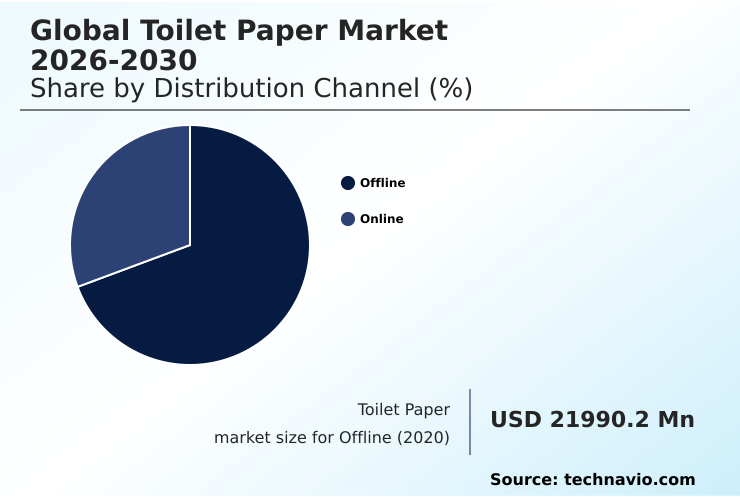
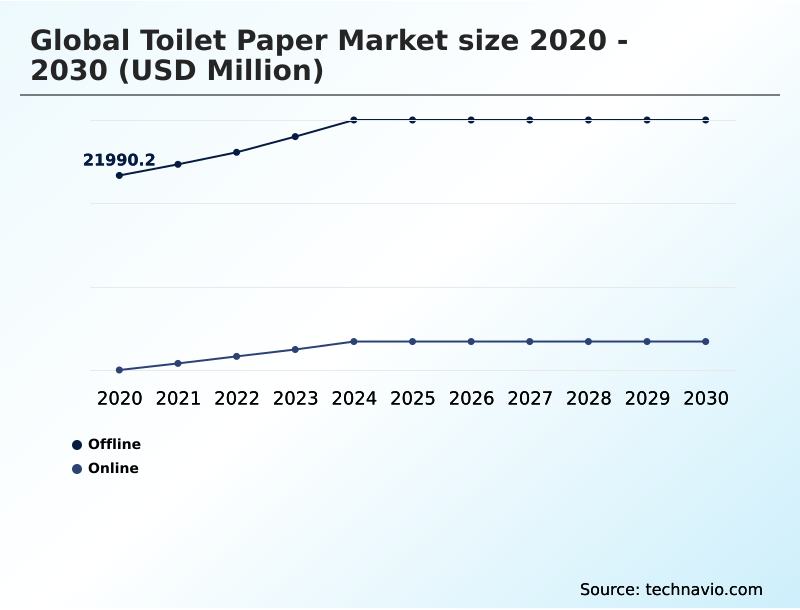
The Offline segment was valued at USD 25.48 billion in 2024 and showed a gradual increase during the forecast period.
Regional Analysis
North America is estimated to contribute 35.1% to the growth of the global market during the forecast period.Technavio’s analysts have elaborately explained the regional trends and drivers that shape the market during the forecast period.
See How Toilet Paper Market Demand is Rising in North America Get Free Sample
The geographic landscape of the toilet paper market is characterized by distinct regional dynamics and growth opportunities.
North America represents a 35.09% share of the incremental growth opportunity, driven by high per capita consumption and a strong preference for premium, multi-ply tissue. In this region, eco-conscious product formulation is a primary focus.
Europe, accounting for 31.42% of the opportunity, is heavily influenced by stringent environmental regulations like the EU Deforestation Regulation (EUDR), compelling a rapid shift toward certified sustainable sourcing.
The APAC region is a key growth engine, where rising urbanization and hygiene awareness are expanding the consumer base. This has resulted in a significant demand for commercial hygiene solutions and institutional hygiene protocols.
However, this growth is tempered by challenges related to pulp supply chain fragility, prompting investment in local production and alternative materials.
Market Dynamics
Our researchers analyzed the data with 2025 as the base year, along with the key drivers, trends, and challenges. A holistic analysis of drivers will help companies refine their marketing strategies to gain a competitive advantage.
- Strategic decision-making in the toilet paper market is increasingly complex, balancing production technologies like through-air drying vs wet-pressing with evolving consumer and regulatory demands. The growing interest in bamboo fiber toilet paper benefits is pushing manufacturers to diversify their pulp sources, navigating the intricate recycled fiber de-inking process to achieve premium softness.
- Simultaneously, ensuring EUDR compliance for pulp sourcing has become a non-negotiable aspect of market access in Europe, adding layers of cost and complexity. In the consumer space, the demand for high-ply tissue paper manufacturing continues, even as consumer preference for scented tissue fluctuates.
- This is happening alongside supply chain impact of pulp prices, which forces companies to optimize logistics and explore new business models. The smart dispenser adoption in commercial settings is reshaping the away-from-home segment, while the long-term impact of bidet use on paper consumption patterns remains a critical variable for forecasting.
- Competitive pressures are also mounting, with the private label vs brand name quality debate intensifying. To build resilience, leading firms are adopting a circular economy in tissue production, managing the cost of deforestation-free certification, and improving operational efficiency in paper mills.
- Innovations in sustainability in tissue paper packaging and the steady toilet paper subscription model growth are creating new avenues for value creation and customer retention.
What are the key market drivers leading to the rise in the adoption of Toilet Paper Industry?
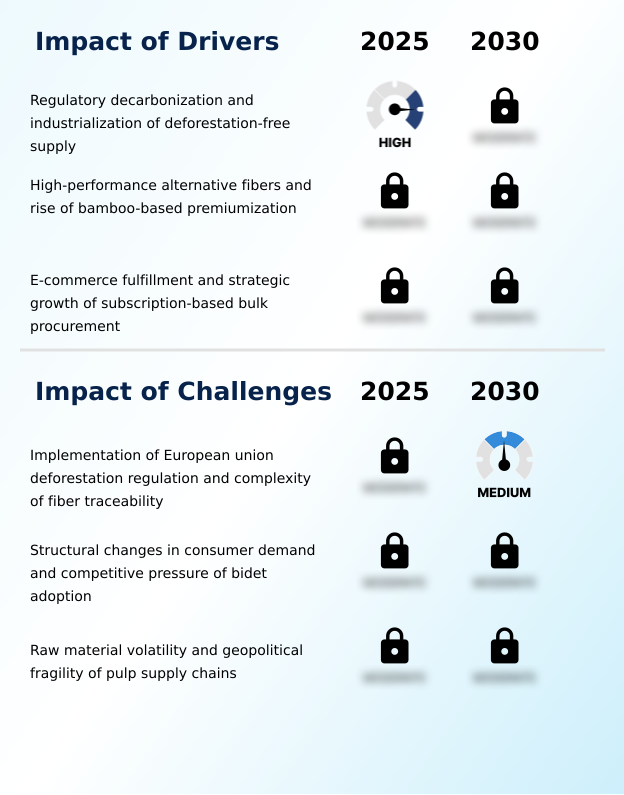
- Market growth is significantly driven by regulatory decarbonization mandates and the corresponding industrialization of deforestation-free supply chains.
- Market growth is fundamentally driven by the industrialization of deforestation-free supply chains, mandated by strict environmental regulations.
- This requires the deployment of advanced digital tracking systems for geolocation fiber tracking, a technical hurdle that adds an estimated 5-8% to logistical overheads but is essential for market access in key regions.
- The complexity of fiber traceability is compelling a shift toward high-performance alternative fibers and verified post-consumer waste. E-commerce fulfillment and subscription-based bulk procurement models are also key drivers, expanding consumer access and creating new revenue streams.
- The rise of bamboo-based premiumization further propels the market, meeting demand from eco-conscious consumers. These drivers collectively push the industry toward greater transparency, sustainability, and supply chain resilience, making environmental compliance a prerequisite for competitive positioning.
What are the market trends shaping the Toilet Paper Industry?
- The market is experiencing a structural realignment toward circular economy principles, driven by the premiumization of products made from recycled fibers.
- Key trends are reshaping the market, led by the institutionalization of water-free and energy-efficient manufacturing. This pivot helps mitigate raw material volatility and aligns with stringent environmental standards. The implementation of smart dispensing systems in commercial spaces is another significant trend, improving hygiene and reducing waste, with some systems demonstrating a 20% reduction in paper consumption.
- Concurrently, circular economy principles are gaining traction through recycled-fiber premiumization, where advancements in fiber processing now yield high-quality, soft tissues from recycled sources. The adoption of high-performance alternative fibers, such as bamboo, is also accelerating, driven by consumer demand for sustainable options.
- These shifts indicate that environmental stewardship is no longer a niche strategy but a core component of market competitiveness, influencing everything from product design to supply chain management.
What challenges does the Toilet Paper Industry face during its growth?
- The complexity of fiber traceability and the stringent implementation of the European Union Deforestation Regulation present a key challenge to industry growth.
- The market faces significant challenges, primarily from the implementation of the EU Deforestation Regulation (EUDR), which mandates complex fiber traceability and adds considerable administrative costs. The risk of non-compliance, which includes fines of up to 4% of annual turnover, is forcing a re-evaluation of sourcing strategies.
- Structural changes in consumer demand, including the competitive pressure from increased bidet adoption, pose another challenge by altering traditional consumption patterns. Additionally, the industry contends with persistent raw material volatility and the geopolitical fragility of pulp supply chains.
- These factors create an operational environment where managing cost, ensuring a deforestation-free supply chain, and adapting to shifting consumer habits are critical for sustained viability. This has led to an increased focus on closed-loop recycling systems and alternative fibers.
Exclusive Technavio Analysis on Customer Landscape
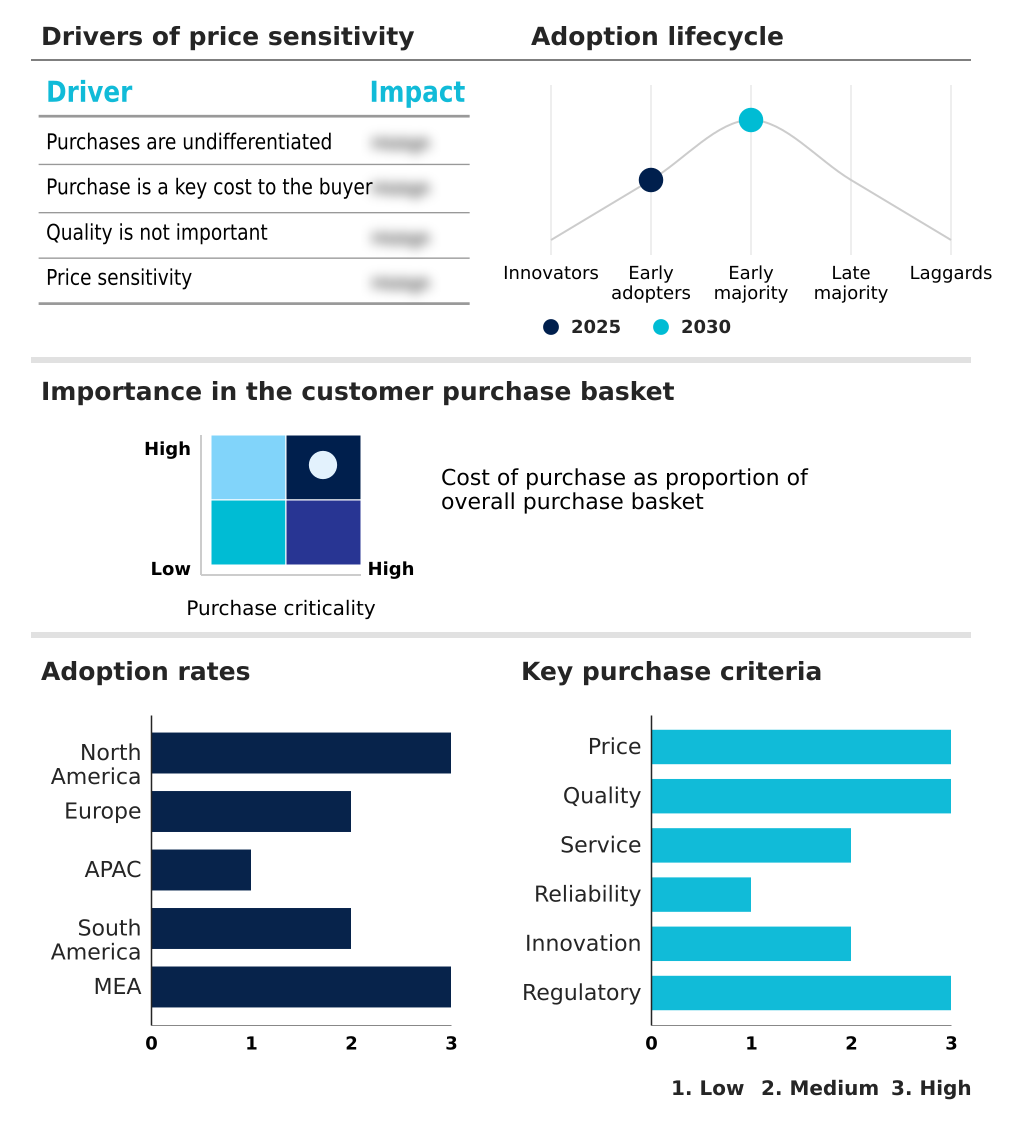
The toilet paper market forecasting report includes the adoption lifecycle of the market, covering from the innovator’s stage to the laggard’s stage. It focuses on adoption rates in different regions based on penetration. Furthermore, the toilet paper market report also includes key purchase criteria and drivers of price sensitivity to help companies evaluate and develop their market growth analysis strategies.
Customer Landscape of Toilet Paper Industry
Competitive Landscape
Companies are implementing various strategies, such as strategic alliances, toilet paper market forecast, partnerships, mergers and acquisitions, geographical expansion, and product/service launches, to enhance their presence in the industry.
Asia Pulp and Paper - Key offerings include a diverse range of hygienic tissue products, from premium multi-ply rolls to specialized commercial dispensing systems, emphasizing sustainability and material innovation.
The industry research and growth report includes detailed analyses of the competitive landscape of the market and information about key companies, including:
- Asia Pulp and Paper
- Caprice Paper Products Pty Ltd.
- Cascades Inc.
- Clearwater Paper Corp.
- Empresas CMPC SA
- Essity AB
- Georgia Pacific LLC
- Hengan Group Co. Ltd.
- Kimberly Clark Corp.
- Kruger Inc.
- Marcal Paper
- Naturelle Consumer Products Ltd.
- Orchids Tissue Paper Products
- Procter and Gamble Co.
- Seventh Generation Inc.
- Sofidel Group
- Traidcraft International Ltd.
- Unilever PLC
- Velvet CARE sp zoo
- WEPA Hygieneprodukte GmbH
Qualitative and quantitative analysis of companies has been conducted to help clients understand the wider business environment as well as the strengths and weaknesses of key industry players. Data is qualitatively analyzed to categorize companies as pure play, category-focused, industry-focused, and diversified; it is quantitatively analyzed to categorize companies as dominant, leading, strong, tentative, and weak.
Recent Development and News in Toilet paper market
- In October, 2024, Essity AB initiated a significant organizational restructuring to enhance operational agility, decentralizing its operations into four business units, including Consumer Tissue and Professional Hygiene, to accelerate profitable growth.
- In January, 2025, Kimberly-Clark Corp. reported positive operating growth and projected higher earnings, citing advancements in product design and strategic supply chain management as key drivers of its performance in the North American market.
- In February, 2025, Procter and Gamble Co. detailed its Supply Chain 3.0 initiative, which leverages artificial intelligence and structured data platforms to create a more integrated and responsive value chain.
- In March, 2025, Essity AB announced the expansion of its proprietary coreless toilet paper technology to new European markets, a move designed to reduce packaging waste and lower carbon emissions associated with logistics.
Dive into Technavio’s robust research methodology, blending expert interviews, extensive data synthesis, and validated models for unparalleled Toilet Paper Market insights. See full methodology.
| Market Scope | |
|---|---|
| Page number | 278 |
| Base year | 2025 |
| Historic period | 2020-2024 |
| Forecast period | 2026-2030 |
| Growth momentum & CAGR | Accelerate at a CAGR of 4.5% |
| Market growth 2026-2030 | USD 9529.1 million |
| Market structure | Fragmented |
| YoY growth 2025-2026(%) | 4.4% |
| Key countries | US, Canada, Mexico, Germany, UK, France, Italy, Spain, The Netherlands, China, India, Japan, South Korea, Indonesia, Australia, Brazil, Argentina, Chile, South Africa, Saudi Arabia, UAE, Turkey and Israel |
| Competitive landscape | Leading Companies, Market Positioning of Companies, Competitive Strategies, and Industry Risks |
Research Analyst Overview
- The toilet paper market is undergoing a fundamental transformation, moving from a volume-driven commodity to a value-centric industry defined by material science and sustainability. The integration of through-air drying (TAD) and conventional wet-pressing technologies is pivotal for creating products with superior multi-ply strength and softness.
- This manufacturing focus is coupled with a strategic shift in raw materials, where the use of virgin wood pulp is increasingly scrutinized in favor of recycled paper, bamboo-based materials, and other deforestation-free fiber. A key boardroom-level consideration is aligning product portfolios with stringent environmental mandates, which necessitates investment in technologies like de-inking processes and fiber-softening techniques for post-consumer waste.
- For instance, facilities that upgrade to high-speed converting lines capable of handling shorter, recycled fibers have reported a 10% improvement in material efficiency. The market is also seeing innovation in product features, such as skin-soothing additives and advanced embossing technologies, alongside the development of coreless roll technology to reduce waste.
- This evolution toward certified sustainable sourcing and advanced cellulosic fibers is reshaping the competitive landscape for low-grammage tissue.
What are the Key Data Covered in this Toilet Paper Market Research and Growth Report?
-
What is the expected growth of the Toilet Paper Market between 2026 and 2030?
-
USD 9.53 billion, at a CAGR of 4.5%
-
-
What segmentation does the market report cover?
-
The report is segmented by Distribution Channel (Offline, and Online), End-user (Residential, and Commercial), Type (Rolled, and Folded) and Geography (North America, Europe, APAC, South America, Middle East and Africa)
-
-
Which regions are analyzed in the report?
-
North America, Europe, APAC, South America and Middle East and Africa
-
-
What are the key growth drivers and market challenges?
-
Regulatory decarbonization and industrialization of deforestation-free supply, Implementation of European union deforestation regulation and complexity of fiber traceability
-
-
Who are the major players in the Toilet Paper Market?
-
Asia Pulp and Paper, Caprice Paper Products Pty Ltd., Cascades Inc., Clearwater Paper Corp., Empresas CMPC SA, Essity AB, Georgia Pacific LLC, Hengan Group Co. Ltd., Kimberly Clark Corp., Kruger Inc., Marcal Paper, Naturelle Consumer Products Ltd., Orchids Tissue Paper Products, Procter and Gamble Co., Seventh Generation Inc., Sofidel Group, Traidcraft International Ltd., Unilever PLC, Velvet CARE sp zoo and WEPA Hygieneprodukte GmbH
-
Market Research Insights
- Market dynamics are shaped by a pronounced shift toward high-performance alternative fibers and closed-loop recycling systems, driven by consumer ethics and regulatory pressures. The adoption of subscription-based procurement models is growing, with some services reporting a 15% increase in customer retention compared to single-purchase online sales. This trend reflects a move toward convenience and supply reliability.
- Concurrently, the operational impact of bidet adoption is becoming more evident, with analyses showing a potential reduction in per-capita paper consumption by up to 30% in households with electronic washlets. Manufacturers are responding by focusing on premiumization and specialized commercial hygiene solutions.
- Furthermore, efforts to mitigate raw material volatility have led to innovations in energy-efficient manufacturing, reducing production costs by an average of 5-7% at modernized facilities, thereby protecting margins against pulp supply chain fragility.
We can help! Our analysts can customize this toilet paper market research report to meet your requirements.
 RIA -
RIA - 
