



Two-Photon Laser Scanning Confocal Microscope Market Size 2025-2029
The two-photon laser scanning confocal microscope market size is forecast to increase by USD 303.2 million, at a CAGR of 5.7% between 2024 and 2029.
- The market is experiencing significant growth due to the increasing applications in life science research. This technology's ability to provide high-resolution, three-dimensional images of biological specimens has made it an indispensable tool in this field. 3D optical microscope can be applied as a part of cellular imaging systems used in drug discovery and toxicology screening. Furthermore, the ongoing advances in 3D printing are expanding the potential applications of two-photon laser scanning confocal microscopes, offering new opportunities for innovation and growth. However, the market faces a challenge with the low frequency of repurchase of these microscopes.
- Companies seeking to capitalize on market opportunities should focus on developing innovative applications, enhancing the user experience, and providing exceptional customer service to differentiate themselves from competitors and maintain a competitive edge. As these instruments are expensive and have long lifetimes, customers often keep them for extended periods, leading to infrequent replacement cycles. This trend poses a challenge for market growth but also presents an opportunity for companies to focus on providing superior after-sales service and support to retain customers and ensure the long-term success of their investments. However, standard 2D cultures are inadequate for imaging 3D bioprinting cell cultures, which are usually thick and highly scattering, preventing light from penetrating without significant distortion.
What will be the Size of the Two-Photon Laser Scanning Confocal Microscope Market during the forecast period?
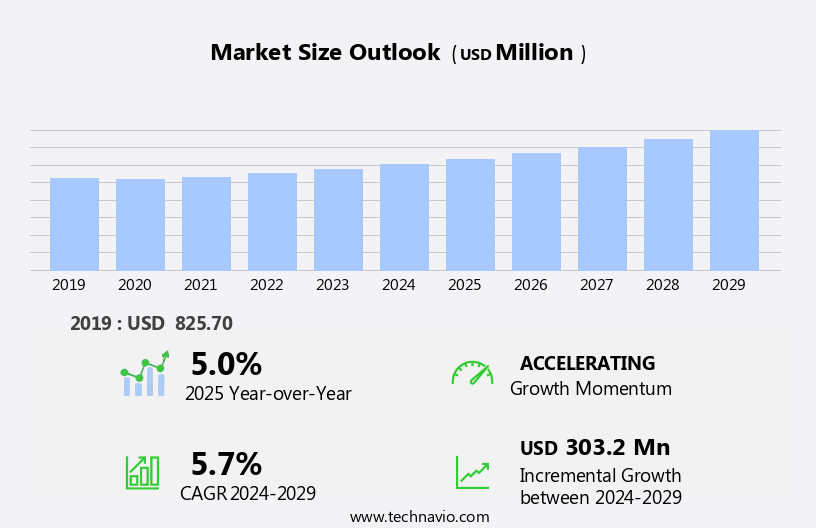
Explore in-depth regional segment analysis with market size data - historical 2019-2023 and forecasts 2025-2029 - in the full report.
Request Free Sample
- The market exhibits dynamic growth, driven by advancements in various microscopy techniques and technologies. Statistical analysis of market trends reveals significant interest in fluorescence lifetime imaging, a nonlinear microscopy method that enhances contrast and enables quantitative analysis. Machine learning and deep learning algorithms are increasingly integrated into microscopy systems for image registration, segmentation, and quantitative analysis. Adaptive optics technology improves image quality in real-time, while stimulated emission depletion and third/second harmonic generation offer superior depth resolution.
- Microscope manufacturing companies invest in microscopy automation and software development to cater to the evolving needs of researchers in diverse fields. Time-resolved microscopy and spectral imaging provide additional dimensions to microscopic analysis, further expanding the market's scope. Single-molecule imaging and super-resolution microscopy push the boundaries of microscope design, enabling 3D reconstruction and high-throughput screening. The US is home to some of the key companies in the market, particularly in laboratory supply wholesaling.
How is this Two-Photon Laser Scanning Confocal Microscope Industry segmented?
The two-photon laser scanning confocal microscope industry research report provides comprehensive data (region-wise segment analysis), with forecasts and estimates in "USD million" for the period 2025-2029, as well as historical data from 2019-2023 for the following segments.
- End-user
- Pharmaceutical
- Academic and research
- Contract research organizations
- Product
- Laser scanning
- Multiphoton laser
- Spinning disk
- Application
- Neuroscience
- Cancer research
- Immunology
- Developmental biology
- Cardiovascular studies
- Geography
- North America
- US
- Canada
- Europe
- France
- Germany
- Italy
- UK
- APAC
- China
- India
- Japan
- South Korea
- Rest of World (ROW)
- North America
By End-user Insights
The pharmaceutical segment is estimated to witness significant growth during the forecast period. Two-photon laser scanning confocal microscopes have become indispensable tools in material science research, particularly in the fields of biomedical research and pharmaceutical development. These microscopes employ two-photon excitation, a process that allows for high-resolution imaging deep within specimens, making them invaluable for studying cellular structures and processes in three dimensions. In the realm of biomedical research, they are used extensively in live cell imaging, image Recognition, disease modeling, and drug discovery. The pharmaceutical and biotechnology industries are significant contributors to the market's revenue growth, as the demand for advanced imaging techniques to aid in drug discovery and development continues to rise.
The microscopes' high spatial resolution, depth penetration, and temporal resolution make them ideal for imaging the complex structures of the eye, enabling early and accurate diagnosis and treatment of various eye conditions. System maintenance and calibration are essential aspects of using two-photon laser scanning confocal microscopes. Regular maintenance ensures the microscope's optimal performance and longevity, while calibration ensures accurate and reliable image acquisition. This is particularly important in research applications, where precise and accurate data are essential for scientific publications and advancing the field. In summary, the market is driven by the expanding scope of research in various fields, including biotech, biomedical research, pharmaceutical development, and clinical diagnostics.
The microscopes' unique features, such as optical sectioning, fluorescence microscopy, and data management, make them indispensable tools for researchers and clinicians alike. The ongoing advancements in microscope technology, driven by research funding, industry partnerships, and collaborations, continue to expand the applications and capabilities of these microscopes, making them a vital investment for organizations in the life sciences sector.
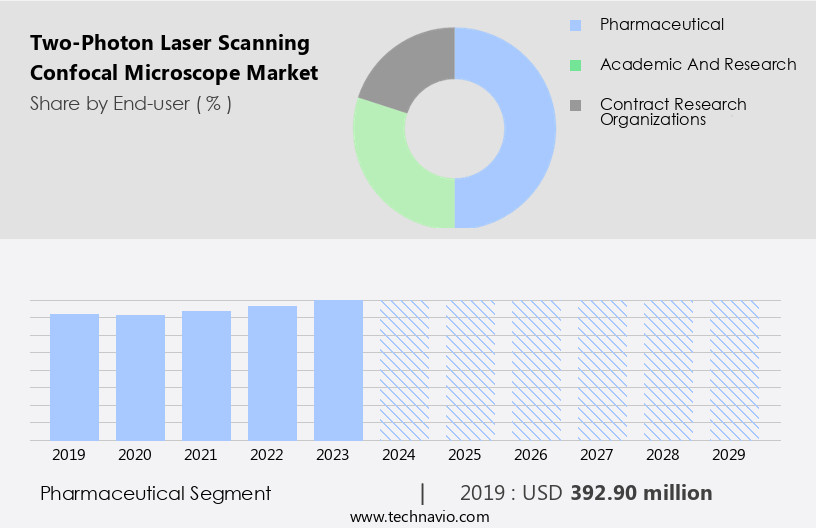
The Pharmaceutical segment was valued at USD 392.90 million in 2019 and showed a gradual increase during the forecast period.
Two-photon laser scanning confocal microscopes offer unique advantages, such as optical sectioning, which enables researchers to obtain detailed images of subcellular structures without the interference of out-of-focus light. This feature is crucial in the drug discovery process, where identifying and localizing individual cell elements is essential for target identification. Moreover, these microscopes are equipped with features like fluorescence microscopy, data management, and software interface, which facilitate data acquisition, image processing, and analysis. In the field of neuroscience research, two-photon laser scanning confocal microscopy has proven to be an essential tool for studying the complex structures and functions of the brain.
Similarly, in the field of developmental biology research, these microscopes are used for tissue sectioning and imaging, providing valuable insights into the intricacies of embryonic development. Industry partnerships and research funding have been instrumental in driving innovation and advancing the capabilities of two-photon laser scanning confocal microscopes. For instance, collaborations between academic institutions and industry partners have led to the development of new imaging techniques and applications. Additionally, research funding from government agencies and private foundations has supported the development of new microscope technologies and the expansion of their applications in various fields. In the clinical setting, two-photon laser scanning confocal microscopes are used for diagnostic imaging, particularly in ophthalmology, where they are employed for the clinical diagnosis of eye diseases.
The Two-Photon Laser Scanning Confocal Microscope Market is advancing with cutting-edge technologies such as multiphoton microscopy, enabling deeper tissue imaging. Innovations in second harmonic generation and third harmonic generation enhance contrast mechanisms for precise visualization. The adoption of light sheet microscopy and optical coherence tomography improves resolution for biomedical applications. Researchers leverage fluorescence correlation spectroscopy for dynamic molecular analysis, supported by image segmentation and quantitative image analysis for detailed structural insights. Artificial intelligence integration optimizes imaging workflows, driving demand for microscopy software development. Improvements in microscope engineering boost system reliability, while expanding microscope sales reflects the growing market interest.
Regional Analysis
North America is estimated to contribute 35% to the growth of the global market during the forecast period. Technavio's analysts have elaborately explained the regional trends and drivers that shape the market during the forecast period.

The market experiences significant growth, particularly in North America, due to the region's advanced technology and infrastructure support. Government investments in healthcare structure enhancement fuel the demand for these microscopes in the healthcare sector, as they are indispensable for drug screening discovery research in fields such as cancer, neuroscience, and more. The US and Canada, as key countries in North America, offer substantial growth opportunities. Microscopy research expansion in academic institutions and the presence of leading companies further propel market growth. Two-photon laser scanning confocal microscopes enable high-resolution imaging, optical sectioning, and subcellular imaging, making them essential tools for material science research, biomedical research, and live cell imaging.
Industry partnerships and research funding facilitate advancements in 3D imaging, data visualization, and image recognition processing. Avalanche photodiodes, photomultiplier tubes, and ti:sapphire lasers are integral components, providing superior signal-to-noise ratios and temporal resolution. The market also caters to tissue imaging, disease modeling, and developmental biology research, utilizing acousto-optic deflectors, galvanometer mirrors, and objective lenses. Emission wavelength and excitation wavelength customization cater to diverse research applications. System maintenance and calibration ensure the microscopes' continued performance, contributing to the market's sustainability.
Market Dynamics
Our researchers analyzed the data with 2024 as the base year, along with the key drivers, trends, and challenges. A holistic analysis of drivers will help companies refine their marketing strategies to gain a competitive advantage.
What are the Two-Photon Laser Scanning Confocal Microscope market drivers leading to the rise in the adoption of Industry?
- The significant rise in life science research applications serves as the primary market catalyst. Two-photon laser scanning confocal microscopes have gained significant attention in material science research and biomedical fields due to their ability to provide high-resolution, three-dimensional images of living specimens. This technology utilizes two-photon excitation, which allows for deeper penetration and improved spatial resolution compared to traditional confocal imaging methods. Dye labeling is often used to enhance the contrast of the samples, enabling researchers to study intricate cellular structures and processes. The importance of two-photon laser scanning confocal microscopy is underscored by its role in image reconstruction and data management in scientific publications. For instance, it has been instrumental in intravital microscopy, a technique used to observe biological processes in live animals at a high resolution.
- In a recent study, scientists from the National University of Science and Technology MISiS and the University of Calgary, Canada, employed this technique to investigate the interaction of oncolytic viruses with both tumors and the healthy cells of the body. Two-photon laser scanning confocal microscopes require precise calibration and a reliable laser source to ensure accurate and consistent results. The market for these microscopes is driven by the increasing demand for advanced imaging techniques in research and development, particularly in biomedical applications. Effective data management and analysis are crucial for gaining insights from the vast amounts of data generated by these microscopes.
What are the Two-Photon Laser Scanning Confocal Microscope market trends shaping the Industry?
- The trend in the market is being shaped by significant progress in 3D printing technology. This innovative field continues to advance, offering new possibilities for various industries. Two-photon laser scanning confocal microscopes have gained significant attention in the research community due to their ability to image thick biological specimens with high resolution. The importance of three-dimensional (3D) cell cultures in cell biology research and tissue engineering is undeniable, as they closely mimic the architectural microenvironment of natural tissues. To address this challenge, researchers at the University of Twente in Europe developed a technique for printing 3D structures with living cells seeded throughout them.
- This technique, known as micro-contact printing, involves precisely squirting two liquid solutions together, one containing living cells. The two liquids quickly interact and solidify into the desired shape, creating a 3D structure with living cells. Two-photon laser scanning confocal microscopes are essential for imaging these complex 3D structures. These microscopes use infrared laser light to excite fluorescent molecules in the sample, allowing for deep tissue imaging with minimal photodamage. Furthermore, the software interface of these microscopes enables researchers to analyze and visualize the data in real-time, facilitating live cell imaging and disease modeling. Industry partnerships and research funding have been instrumental in advancing the development and application of two-photon laser scanning confocal microscopes.
How does Two-Photon Laser Scanning Confocal Microscope market face challenges during its growth?
- The infrequent purchasing behavior of two-photon laser scanning microscopes poses a significant challenge to the growth of the industry. This trend, which is a common issue in the market for two-photon laser scanning microscopes, necessitates finding effective solutions to encourage more frequent replacements or upgrades. Two-photon laser scanning confocal microscopes are renowned for their high-resolution imaging capabilities in various research applications, particularly in cell biology. These advanced microscopes employ a femtosecond laser and a scanning mechanism, which includes acousto-optic deflectors and galvanometer mirrors, to achieve intricate depth penetration and precise image processing.
- Manufacturers and dealers typically provide assembly services, leaving customers to source accessories, such as slides, cover glasses, and digital cables, from third-party providers to maintain the microscope's functionality over its lifetime. This approach can result in reduced customer engagement and potential missed opportunities for additional sales or services. While the microscopes have an average useful life of approximately eight years, they require minimal system maintenance during this period to ensure accurate results. Despite their long life and high prices, the market for two-photon laser scanning confocal microscopes experiences limited customer interaction due to the nature of the sale being primarily one-time transactions.
Exclusive Customer Landscape
The two-photon laser scanning confocal microscope market forecasting report includes the adoption lifecycle of the market, covering from the innovator's stage to the laggard's stage. It focuses on adoption rates in different regions based on penetration. Furthermore, the two-photon laser scanning confocal microscope market report also includes key purchase criteria and drivers of price sensitivity to help companies evaluate and develop their market growth analysis strategies.

Customer Landscape
Key Companies & Market Insights
Companies are implementing various strategies, such as strategic alliances, two-photon laser scanning confocal microscope market forecast, partnerships, mergers and acquisitions, geographical expansion, and product/service launches, to enhance their presence in the industry.
Agilent Technologies Inc. - The company introduces Ultima 2Pplus, a versatile imaging solution that optimally balances flexibility, high resolution, imaging depth, and swift speed.
The industry research and growth report includes detailed analyses of the competitive landscape of the market and information about key companies, including:
- Agilent Technologies Inc.
- Bruker Corp.
- Carl Zeiss AG
- Danaher Corp.
- Femtonics Ltd.
- Intelligent Imaging Innovations Inc.
- Judges Scientific plc
- Keyence Corp.
- Miltenyi Biotec B.V. and Co. KG
- Nikon Corp.
- Olympus Corp.
- Oxford Instruments plc
- Perkin Elmer Inc.
- PicoQuant GmbH
- Thermo Fisher Scientific Inc.
- Thorlabs Inc.
- IVIM Technology Inc.
Qualitative and quantitative analysis of companies has been conducted to help clients understand the wider business environment as well as the strengths and weaknesses of key industry players. Data is qualitatively analyzed to categorize companies as pure play, category-focused, industry-focused, and diversified; it is quantitatively analyzed to categorize companies as dominant, leading, strong, tentative, and weak.
Recent Development and News in Two-Photon Laser Scanning Confocal Microscope Market
- In March 2023, Zeiss, a leading microscopy solutions provider, introduced the new LSM 880 Airyscan 3 two-photon laser scanning confocal microscope. This advanced system offers improved imaging speed and resolution, making it an essential tool for research in various fields, including neuroscience and materials science (Zeiss press release).
- In July 2024, Nikon Corporation and Carl Zeiss AG announced a strategic partnership to develop and manufacture two-photon laser scanning microscopes. This collaboration aims to combine Nikon's expertise in microscope design and manufacturing with Zeiss's two-photon laser technology, potentially leading to innovative and high-performance products (Nikkei Asia).
- In November 2024, Thermo Fisher Scientific, a global biotechnology product development and manufacturing company, acquired Photonic Instruments, a leading provider of two-photon microscopy systems. This acquisition will expand Thermo Fisher's life sciences offerings and strengthen its position in the microscopy market (Thermo Fisher Scientific press release).
- In February 2025, the European Commission approved a â¬10 million grant for the development of a new two-photon microscopy platform at the European Molecular Biology Laboratory (EMBL). This project, called "NanoLive," aims to create a versatile and user-friendly system for real-time imaging of living cells and tissues, enabling significant advancements in biomedical research (EMBL press release).
Research Analyst Overview
The market continues to evolve, driven by the ongoing advancements in various research sectors. Live cell imaging applications, for instance, are pushing the boundaries of real-time data acquisition and analysis, requiring high-speed image processing and sophisticated software interfaces. Disease modeling and drug discovery are also significant areas of focus, with the need for three-dimensional imaging, superior spatial resolution, and signal-to-noise ratio. Industry partnerships and research funding play a crucial role in driving innovation in this field. Avalanche photodiodes, for example, have emerged as a key component in enhancing sensitivity and reducing background noise, while the integration of acousto-optic deflectors and galvanometer mirrors enables faster scanning and improved depth penetration.
The use of two-photon excitation in microscopy has expanded beyond traditional fluorescence microscopy to include material science research, cell culture, and even neuroscience. The development of femtosecond lasers and ti:sapphire lasers has further expanded the excitation wavelength range, enabling subcellular imaging and temporal resolution studies. Microscope calibration and system maintenance are essential aspects of this market, ensuring accurate and reliable data acquisition and analysis. Objective lens selection and emission wavelength tuning are critical factors in achieving optimal image quality. Genetically encoded reporters and fluorescent probes have also emerged as valuable tools for labeling specific cellular components and enhancing contrast in imaging studies.
These collaborations have led to improvements in signal-to-noise ratio, data visualization, and drug discovery. Neuroscience research has particularly benefited from these advancements, as the technique allows for the imaging of neural structures in their native environment. The ability to image 3D cell cultures with high resolution is crucial for advancing our understanding of biological processes and developing new therapeutic interventions. Two-photon laser scanning confocal microscopes have proven to be invaluable tools in this regard, and ongoing research and development efforts are expected to further expand their applications.
The ongoing advancements in data management, image reconstruction, and data visualization are essential in enabling researchers to make sense of the vast amounts of data generated by these sophisticated microscopes. The potential applications of two-photon laser scanning confocal microscopy are vast, from cell biology research to diagnostic imaging, making it an exciting and dynamic market to watch. The use of two-photon laser scanning confocal microscopes in life science research is on the rise, as they offer unparalleled imaging capabilities for studying living specimens. The technology's role in intravital microscopy and its potential for advancing diagnostics in cancer and neurological disorders underscores its importance in scientific research. Enhancements in data management and analysis will further expand the potential applications and impact of this technology.
Dive into Technavio's strong research methodology, blending expert interviews, extensive data synthesis, and validated models for unparalleled Two-Photon Laser Scanning Confocal Microscope Market insights. See full methodology.
|
Market Scope |
|
|
Report Coverage |
Details |
|
Page number |
228 |
|
Base year |
2024 |
|
Historic period |
2019-2023 |
|
Forecast period |
2025-2029 |
|
Growth momentum & CAGR |
Accelerate at a CAGR of 5.7% |
|
Market growth 2025-2029 |
USD 303.2 million |
|
Market structure |
Fragmented |
|
YoY growth 2024-2025(%) |
5.0 |
|
Key countries |
US, Germany, China, UK, Canada, Italy, France, India, Japan, and South Korea |
|
Competitive landscape |
Leading Companies, Market Positioning of Companies, Competitive Strategies, and Industry Risks |
What are the Key Data Covered in this Two-Photon Laser Scanning Confocal Microscope Market Research and Growth Report?
- CAGR of the Two-Photon Laser Scanning Confocal Microscope industry during the forecast period
- Detailed information on factors that will drive the growth and forecasting between 2025 and 2029
- Precise estimation of the size of the market and its contribution of the industry in focus to the parent market
- Accurate predictions about upcoming growth and trends and changes in consumer behaviour
- Growth of the market across North America, Europe, Asia, and Rest of World (ROW)
- Thorough analysis of the market's competitive landscape and detailed information about companies
- Comprehensive analysis of factors that will challenge the two-photon laser scanning confocal microscope market growth of industry companies
We can help! Our analysts can customize this two-photon laser scanning confocal microscope market research report to meet your requirements.
 RIA -
RIA - 
