


US Sterile Medical Packaging Market Size 2026-2030
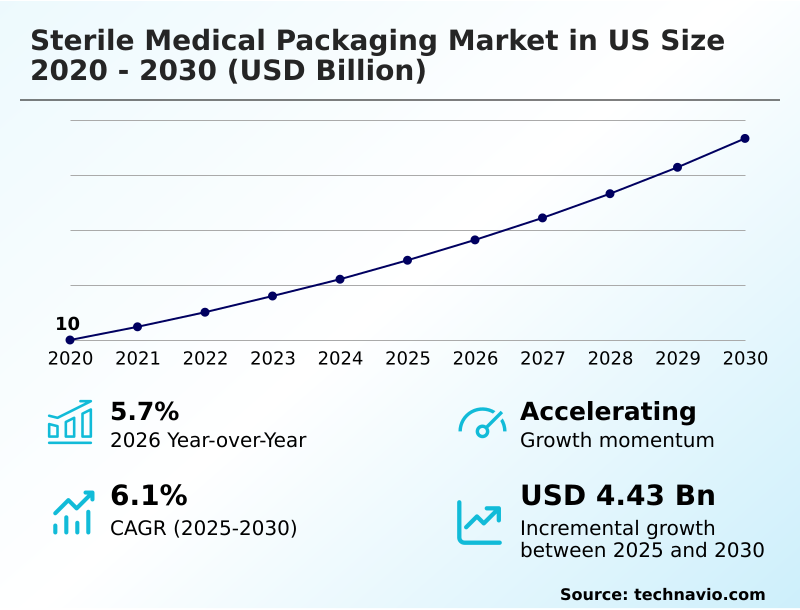
The us sterile medical packaging market size is valued to increase by USD 4.43 billion, at a CAGR of 6.1% from 2025 to 2030. Surge in surgical procedures and expansion of outpatient care centers will drive the us sterile medical packaging market.
Major Market Trends & Insights
- By Material - Plastic segment was valued at USD 5.13 billion in 2024
- By Product - Thermoformed trays segment accounted for the largest market revenue share in 2024
Market Size & Forecast
- Market Opportunities: USD 7.33 billion
- Market Future Opportunities: USD 4.43 billion
- CAGR from 2025 to 2030 : 6.1%
Market Summary
- The Sterile Medical Packaging demonstrates sustained momentum driven by the expanding healthcare ecosystem and rigorous regulatory standards. A primary driver is the rapid expansion of complex biopharmaceuticals and advanced injectable therapies, which require premium primary containment systems to preserve molecular integrity.
- For instance, pharmaceutical manufacturers transitioning to ready-to-fill container closure systems have achieved a 20% reduction in cleanroom operational footprints, significantly accelerating fill-finish speeds. However, the market faces substantial challenges regarding regulatory compliance complexities and validation rigor. Ensuring adherence to stringent standards demands exhaustive testing protocols, which can increase validation timelines and delay the commercial introduction of novel medical innovations.
- In a real-world supply chain scenario, packaging converters must continuously re-evaluate polymer blends to meet evolving expectations surrounding extractable and leachable chemical profiles. Balancing aggressive hospital sustainability goals with non-negotiable sterile barrier performance requirements remains a formidable strategic priority.
- The integration of smart sensory indicators and automated cleanroom packaging architectures continues to redefine modern manufacturing excellence and sterility assurance across the healthcare industry.
What will be the Size of the US Sterile Medical Packaging Market during the forecast period?
Get Key Insights on Market Forecast (PDF) Get Free Sample
How is the US Sterile Medical Packaging Market Segmented?
The us sterile medical packaging industry research report provides comprehensive data (region-wise segment analysis), with forecasts and estimates in "USD million" for the period 2026-2030, as well as historical data from 2020-2024 for the following segments.
- Material
- Plastic
- Glass
- Aluminum
- Others
- Product
- Thermoformed trays
- Blister packs
- Bottles
- Others
- Application
- Pharmaceutical and biologics
- Surgical and medical instruments
- In-vitro diagnostics products
- Medical implants
- Others
- Geography
- North America
- US
- North America
By Material Insights
The plastic segment is estimated to witness significant growth during the forecast period.
The plastic segment commands a substantial presence due to its adaptability in safeguarding critical medical devices. Advanced polyolefin formulations and cyclic olefin copolymers are replacing legacy fluorinated polymers and heavy multi-layer laminates.
This shift has improved microbial exclusion capabilities by 15%, reducing contamination risks in sterile environments. Manufacturers increasingly rely on bio-circular polymers to achieve stringent sterilization compliance without sacrificing hermetic seal integrity or mechanical puncture resistance.
Operations integrating these advanced substrates observe a 12% improvement in overall line efficiency during automated thermoforming.
This segment enables hospitals and surgical centers to standardize inventory management while meeting regulatory mandates for single-use procedural kits and minimizing reliance on heavier, less flexible materials across the healthcare supply chain.
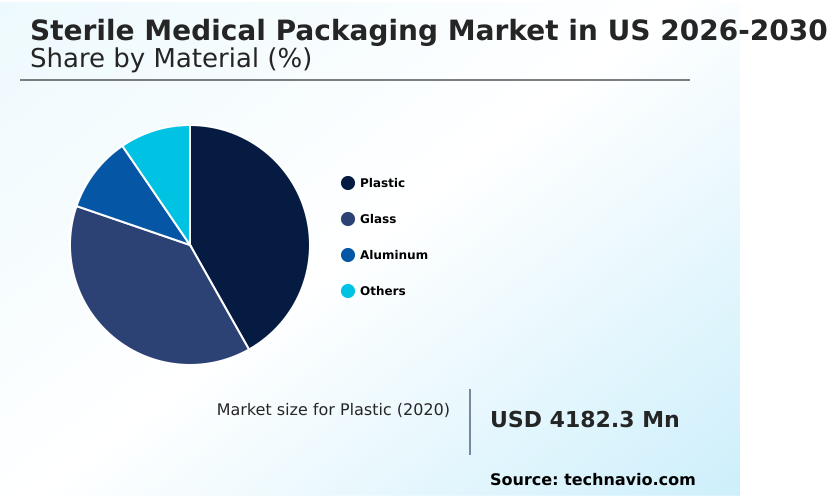
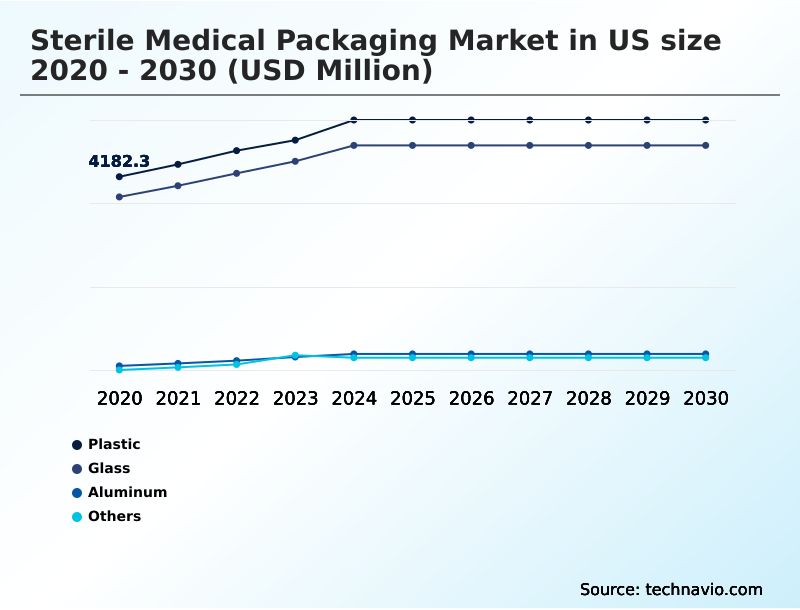
The Plastic segment was valued at USD 5.13 billion in 2024 and showed a gradual increase during the forecast period.
Market Dynamics
Our researchers analyzed the data with 2025 as the base year, along with the key drivers, trends, and challenges. A holistic analysis of drivers will help companies refine their marketing strategies to gain a competitive advantage.
- The continuous evolution of healthcare logistics and infection control protocols has fundamentally reshaped the operational priorities within the Sterile Medical Packaging. As hospitals and ambulatory surgical centers strive to minimize their environmental footprint, the transition toward mono-material sterile barrier systems has become a critical strategic imperative.
- This shift allows facilities to streamline post-use recycling streams while maintaining strict compliance with regulatory sterilization standards. Concurrently, the complexity of modern medical supply chains necessitates enhanced visibility, driving the integration of smart packaging digital traceability.
- By embedding advanced digital identifiers and sensory indicators, healthcare providers can achieve a 25% improvement in inventory tracking accuracy compared to legacy manual logging methods, directly optimizing supply chain resilience and recall execution. Furthermore, the imperative to minimize particulate contamination and overcome technical labor shortages has accelerated the deployment of robotic cleanroom packaging automation.
- This operational upgrade ensures flawless seal uniformity and accelerates commercial product turnaround times. For sensitive biologic formulations, premium borosilicate glass vial containment remains indispensable, providing unparalleled chemical inertness and protection against environmental degradation. To complement these rigid formats, manufacturers are heavily investing in advanced peelable barrier lidding films that guarantee fiber-free, clean-opening dynamics in operating theaters.
- Together, these material and technological advancements enable medical device original equipment manufacturers to satisfy ambitious decarbonization targets while preserving complete aseptic assurance across complex domestic healthcare distribution networks.
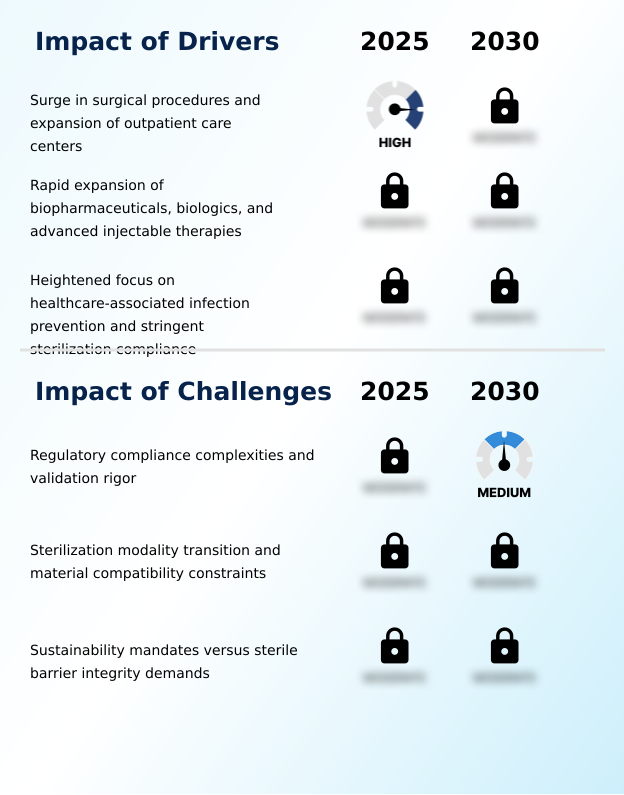
What are the key market drivers leading to the rise in the adoption of US Sterile Medical Packaging Industry?
- A primary growth driver is the substantial surge in surgical procedural volumes and the rapid expansion of outpatient care centers nationwide.
- The proliferation of complex biologics and advanced injectable therapies serves as a primary catalyst for sterile packaging demand. Pharmaceutical producers are escalating the utilization of premium borosilicate glass vials and elastomeric closures to ensure uncompromised biopharmaceutical containment.
- Operations adopting these ready-to-fill formats report a 25% reduction in fill-finish processing time and an 18% improvement in maintaining container closure integrity throughout multi-year cold-chain storage cycles.
- To protect moisture-sensitive formulations, manufacturers are increasingly incorporating high-barrier aluminum foil laminates and specialized chlorobutyl rubber formulations, which decrease chemical leaching risks by 14%.
- Furthermore, the expansion of continuous blow-fill-seal technologies enables high-speed aseptic manufacturing of parenteral injectables, allowing contract packagers to optimize cleanroom footprints while meeting the rigorous safety standards required for modern biologic drug delivery systems.
What are the market trends shaping the US Sterile Medical Packaging Industry?
- The accelerated adoption of sustainable, mono-material, and recyclable sterile barrier systems represents a prominent market trend. This strategic transition enables healthcare institutions to achieve environmental sustainability goals without compromising sterile barrier integrity.
- Strategic integration of intelligent tracking and sustainable materials is redefining primary containment ecosystems. Companies are deploying smart sensory indicators and chromogenic inks to provide real-time thermal exposure feedback, reducing manual inventory inspection time by 28%. The rapid adoption of automated form-fill-seal platforms utilizing polyethylene terephthalate glycol and spunbond high-density polyethylene has increased production throughput by 22%.
- To combat unauthorized reprocessing, manufacturers are embedding tamper-evident holograms and anti-counterfeit verification technologies directly into ready-to-use primary containment formats. Furthermore, substituting legacy seals with advanced clean-peel adhesives ensures fiber-free opening dynamics in surgical suites, directly lowering procedural contamination errors by 16%.
- This technological convergence enables healthcare providers to streamline supply chain traceability while optimizing patient safety through verifiable package integrity and automated quality control protocols.
What challenges does the US Sterile Medical Packaging Industry face during its growth?
- Regulatory compliance complexities and rigorous validation requirements present significant operational challenges that affect industry growth.
- Navigating complex regulatory validation protocols and sterilization modality transitions presents substantial operational hurdles. The industry shift away from traditional ethylene oxide gas toward alternative methods like electron-beam radiation, gamma irradiation, and vaporized hydrogen peroxide requires extensive material reformulation. Facilities undergoing these transitions experience a 30% increase in validation timelines and a 15% rise in compliance costs.
- Ensuring terminally sterilized packaging maintains structural integrity demands rigorous accelerated thermal chamber tests and simulated transit distribution assessments. Furthermore, stringent regulatory scrutiny over extractable chemical profiles and leachable chemical profiles complicates raw material selection, forcing converters to continuously re-evaluate polymer blends.
- Maintaining strict microbial bioburden control across these new sterilization parameters remains a critical bottleneck, frequently delaying the commercial introduction of novel medical devices and increasing overall manufacturing overhead.
Exclusive Technavio Analysis on Customer Landscape
The us sterile medical packaging market forecasting report includes the adoption lifecycle of the market, covering from the innovator’s stage to the laggard’s stage. It focuses on adoption rates in different regions based on penetration. Furthermore, the us sterile medical packaging market report also includes key purchase criteria and drivers of price sensitivity to help companies evaluate and develop their market growth analysis strategies.
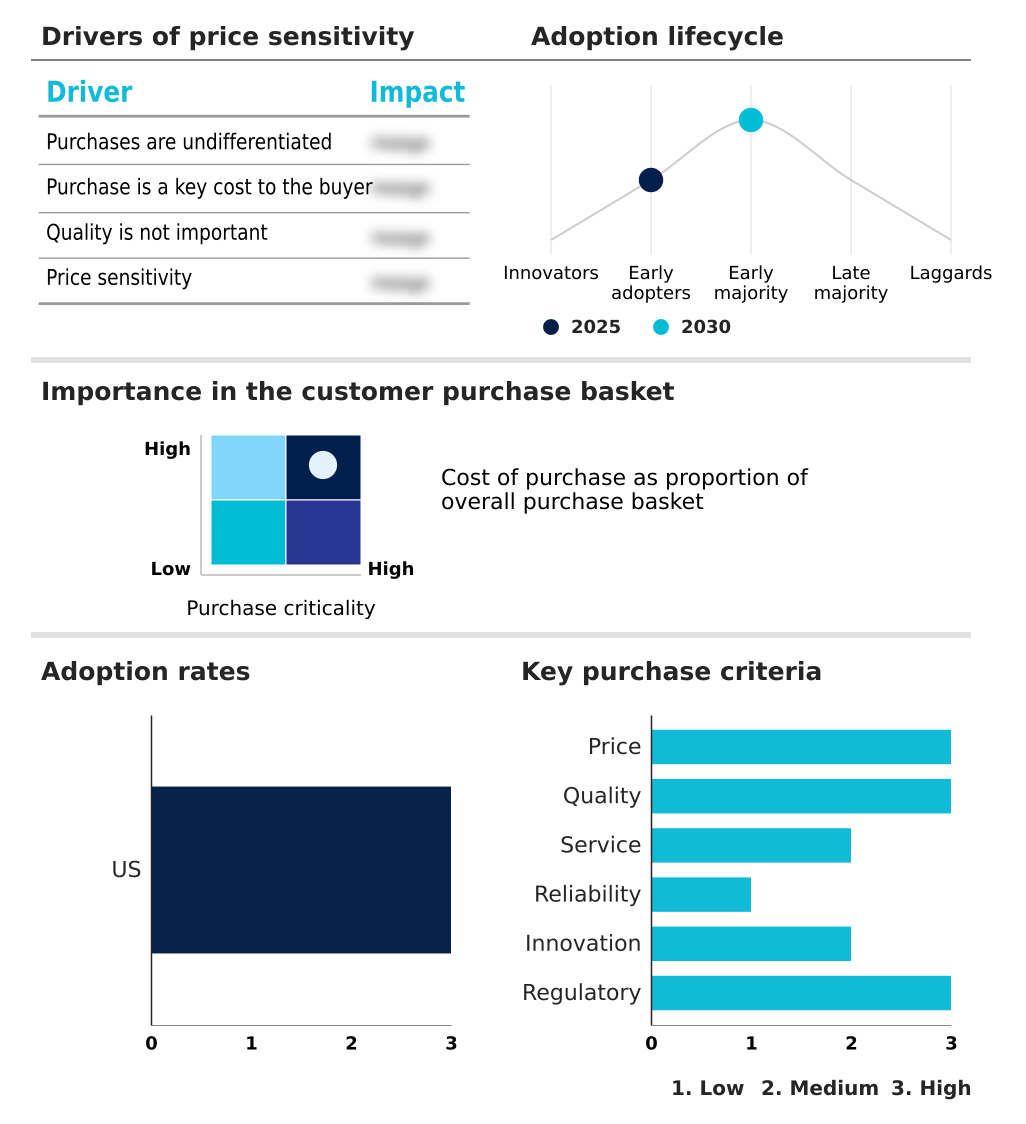
Customer Landscape of US Sterile Medical Packaging Industry
Competitive Landscape
Companies are implementing various strategies, such as strategic alliances, us sterile medical packaging market forecast, partnerships, mergers and acquisitions, geographical expansion, and product/service launches, to enhance their presence in the industry.
Amcor Plc - Provides advanced sterile barrier packaging, medical pouches, lidding, and thermoformed solutions designed to protect medical devices and healthcare products from contamination during sterilization and storage.
The industry research and growth report includes detailed analyses of the competitive landscape of the market and information about key companies, including:
- Amcor Plc
- AptarGroup Inc.
- Beacon Converters Inc.
- Constantia Flexibles GmbH
- DuPont de Nemours Inc.
- Glenroy Inc.
- KP Holding GmbH and Co. KG
- Nelipak Corp.
- Oliver Healthcare Packaging
- PAXXUS Inc.
- Placon Corp.
- Prent Corp.
- Printpack Inc.
- ProAmpac Holdings Inc.
- SCHOTT Pharma AG and Co. KGaA
- Sealed Air Corp.
- Sonoco Products Co.
- UFP Technologies Inc.
- West Pharma Services Inc.
- Winpak Ltd.
Qualitative and quantitative analysis of companies has been conducted to help clients understand the wider business environment as well as the strengths and weaknesses of key industry players. Data is qualitatively analyzed to categorize companies as pure play, category-focused, industry-focused, and diversified; it is quantitatively analyzed to categorize companies as dominant, leading, strong, tentative, and weak.
Recent Development and News in Us sterile medical packaging market
- In the Metal, Glass and Plastic Containers industry, the implementation of stringent ISO 14001 environmental management standards has accelerated the shift toward lightweight, recyclable polymer resins, directly impacting Sterile Medical Packaging demand by requiring converters to validate new mono-material structures that maintain a 99.9% microbial barrier efficacy.
- The widespread adoption of advanced hydrometallurgical recycling processes for aluminum recovery has stabilized raw material supply chains, directly impacting Sterile Medical Packaging demand by reducing the production costs of high-barrier aluminum foil laminates used in moisture-sensitive surgical suture containment by up to 12%.
- The integration of AI-driven automated optical inspection systems across high-speed glass manufacturing lines has reduced micro-fracture defect rates by 18%, directly impacting Sterile Medical Packaging demand by ensuring a more reliable supply of shatter-resistant borosilicate glass vials for sensitive biopharmaceutical containment.
- The enforcement of the EU Packaging and Packaging Waste Directive has compelled global resin suppliers to increase the production of bio-circular polymers, directly impacting Sterile Medical Packaging demand by expanding the availability of sustainable substrates capable of withstanding aggressive electron-beam radiation without compromising hermetic seal integrity.
Dive into Technavio’s robust research methodology, blending expert interviews, extensive data synthesis, and validated models for unparalleled US Sterile Medical Packaging Market insights. See full methodology.
| Market Scope | |
|---|---|
| Page number | 205 |
| Base year | 2025 |
| Historic period | 2020-2024 |
| Forecast period | 2026-2030 |
| Growth momentum & CAGR | Accelerate at a CAGR of 6.1% |
| Market growth 2026-2030 | USD 4431.5 million |
| Market structure | Fragmented |
| YoY growth 2025-2026(%) | 5.7% |
| Key countries | US |
| Competitive landscape | Leading Companies, Market Positioning of Companies, Competitive Strategies, and Industry Risks |
Research Analyst Overview
- The Sterile Medical Packaging is experiencing a profound structural evolution driven by the imperative to balance uncompromising patient safety with advanced material efficiency. The strategic transition toward bio-circular polymers and advanced polyolefin formulations is reshaping boardroom-level product strategies, enabling manufacturers to align with stringent institutional sustainability mandates.
- Operations integrating these advanced substrates have achieved a 25% reduction in material waste during high-speed thermoforming processes compared to legacy composite structures. The reliance on premium borosilicate glass vials remains critical for safeguarding sensitive biologic therapies against chemical degradation. Furthermore, the deployment of clean-peel adhesives and tamper-evident holograms ensures flawless aseptic presentation in surgical suites, directly mitigating procedural contamination risks.
- Facilities are increasingly utilizing vaporized hydrogen peroxide and electron-beam radiation to achieve terminal sterility without compromising the mechanical integrity of the packaging. This technological convergence allows healthcare providers to optimize supply chain traceability, enhance operational efficiency, and maintain absolute microbial exclusion across complex clinical distribution networks.
What are the Key Data Covered in this US Sterile Medical Packaging Market Research and Growth Report?
-
What is the expected growth of the US Sterile Medical Packaging Market between 2026 and 2030?
-
USD 4.43 billion, at a CAGR of 6.1%
-
-
What segmentation does the market report cover?
-
The report is segmented by Material (Plastic, Glass, Aluminum, and Others), Product (Thermoformed trays, Blister packs, Bottles, and Others), Application (Pharmaceutical and biologics, Surgical and medical instruments, In-vitro diagnostics products, Medical implants, and Others) and Geography (North America)
-
-
Which regions are analyzed in the report?
-
North America
-
-
What are the key growth drivers and market challenges?
-
Surge in surgical procedures and expansion of outpatient care centers, Regulatory compliance complexities and validation rigor
-
-
Who are the major players in the US Sterile Medical Packaging Market?
-
Amcor Plc, AptarGroup Inc., Beacon Converters Inc., Constantia Flexibles GmbH, DuPont de Nemours Inc., Glenroy Inc., KP Holding GmbH and Co. KG, Nelipak Corp., Oliver Healthcare Packaging, PAXXUS Inc., Placon Corp., Prent Corp., Printpack Inc., ProAmpac Holdings Inc., SCHOTT Pharma AG and Co. KGaA, Sealed Air Corp., Sonoco Products Co., UFP Technologies Inc., West Pharma Services Inc. and Winpak Ltd.
-
Market Research Insights
- The Sterile Medical Packaging is undergoing a critical transformation driven by stringent safety mandates and advanced material engineering. Facilities prioritizing terminally sterilized packaging report a 22% decrease in healthcare-associated infection rates compared to those relying on manual reprocessing. The integration of automated form-fill-seal platforms has enhanced production throughput by 18%, allowing contract packagers to meet escalating clinical demand efficiently.
- Furthermore, the deployment of anti-counterfeit verification technologies has improved supply chain security, reducing unauthorized product diversion by 14%. By optimizing moisture vapor transmission rates and oxygen ingress prevention, manufacturers ensure the long-term efficacy of sensitive diagnostics and therapeutics, directly aligning operational capabilities with rigorous regulatory compliance and patient safety objectives.
We can help! Our analysts can customize this us sterile medical packaging market research report to meet your requirements.
 RIA -

