



South Korea Virtual Desktop Infrastructure (VDI) Market Size 2026-2030
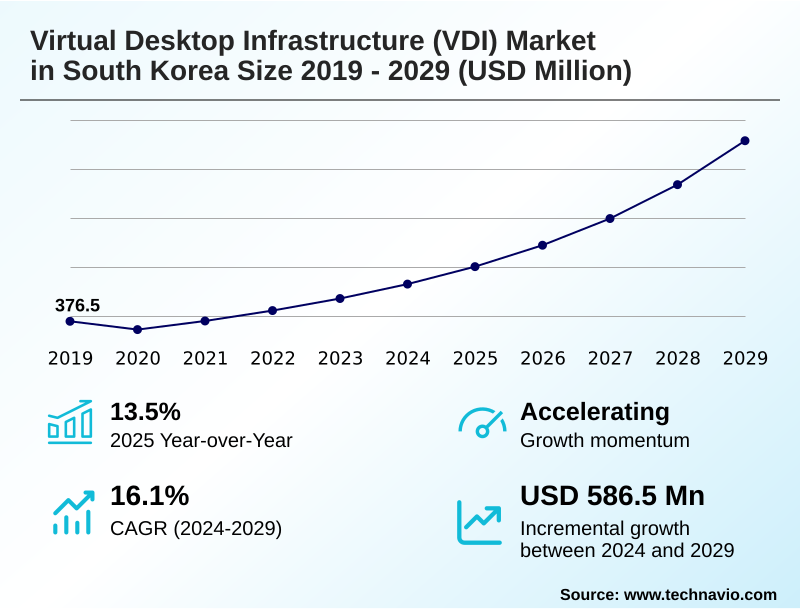
The south korea virtual desktop infrastructure (vdi) market size is valued to increase by USD 734.4 million, at a CAGR of 17.3% from 2025 to 2030. Rising demand for secure remote and hybrid work environments will drive the south korea virtual desktop infrastructure (vdi) market.
Major Market Trends & Insights
- By End-user - IT services segment was valued at USD 229.9 million in 2024
- By Deployment - On-premises segment accounted for the largest market revenue share in 2024
Market Size & Forecast
- Market Opportunities: USD 991.9 million
- Market Future Opportunities: USD 734.4 million
- CAGR from 2025 to 2030 : 17.3%
Market Summary
- The virtual desktop infrastructure (VDI) market in South Korea is defined by its role in advancing digital transformation and enabling secure, flexible work models. This technology facilitates centralized data management by hosting desktop environments on central servers, which is crucial for industries prioritizing intellectual property protection and regulatory compliance.
- Key drivers include strong government support for smart work initiatives and the widespread availability of high-speed 5G networks, which ensures a responsive end-user computing experience. Organizations are increasingly adopting desktop virtualization to support a hybrid workforce, enhance business continuity strategies, and modernize their IT infrastructure.
- For instance, a manufacturing firm can provide its global research and development teams with secure remote access to proprietary design software using virtual workspace solutions, ensuring that sensitive data never leaves the secure data center. This approach not only strengthens endpoint security but also provides a consistent user session consistency across devices.
- However, challenges such as the complexity of proprietary groupware integration and the initial capital expenditure for backend server infrastructure persist.
What will be the Size of the South Korea Virtual Desktop Infrastructure (VDI) Market during the forecast period?
Get Key Insights on Market Forecast (PDF) Get Free Sample
How is the South Korea Virtual Desktop Infrastructure (VDI) Market Segmented?
The south korea virtual desktop infrastructure (vdi) industry research report provides comprehensive data (region-wise segment analysis), with forecasts and estimates in "USD million" for the period 2026-2030, as well as historical data from 2020-2024 for the following segments.
- End-user
- IT services
- BFSI sector
- Healthcare sector
- Deployment
- On-premises
- Cloud-based
- Component
- Platform
- Services
- Hardware
- Geography
- APAC
- South Korea
- APAC
By End-user Insights
The it services segment is estimated to witness significant growth during the forecast period.
The IT services sector is a primary adopter of virtual desktop infrastructure (VDI), utilizing desktop virtualization to create secure, adaptable environments for developers and engineers.
Firms leverage virtual lab environments and connection broker software for agile software testing and development, which improves project deployment times by over 20%.
This approach enables centralized IT administration and robust user profile management, ensuring intellectual property within source code remains protected on central servers.
The use of non-persistent VDI allows for the rapid onboarding of external staff and secure contractor access, eliminating hardware logistics.
Advanced features like virtual GPU allocation are also employed, supporting specialized projects and maintaining a zero-trust architecture to address cyber threat mitigation effectively within a dynamic workforce.
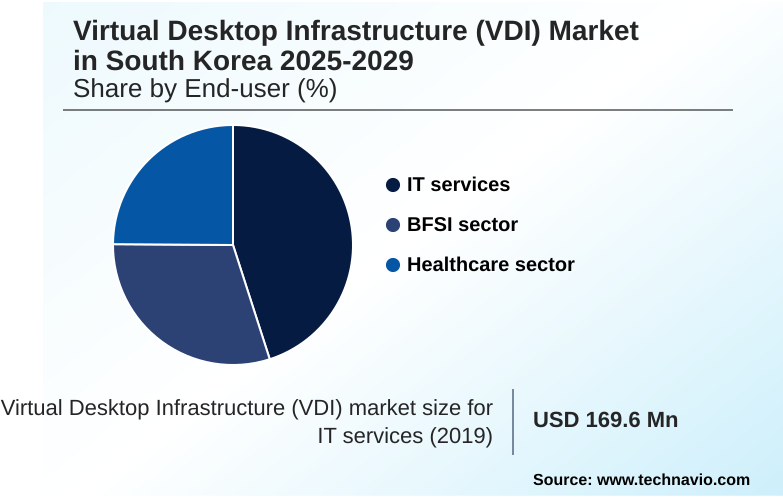
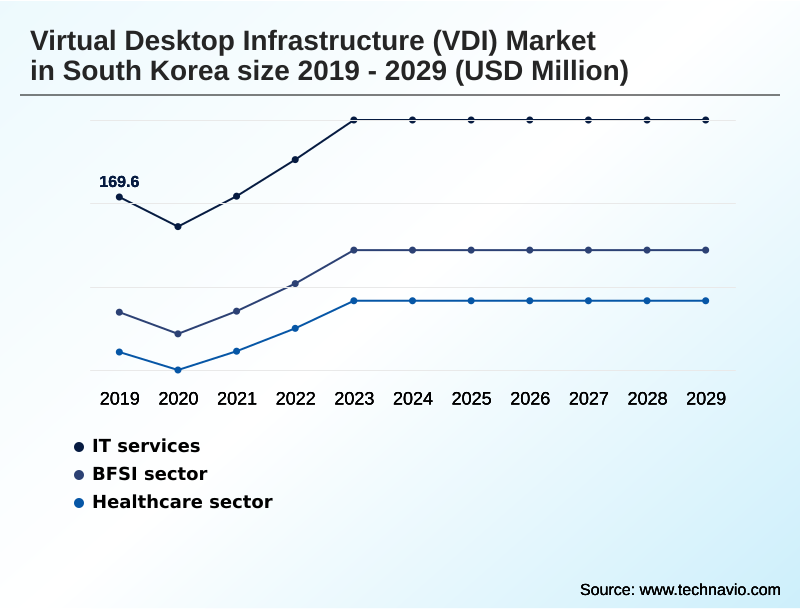
The IT services segment was valued at USD 229.9 million in 2024 and showed a gradual increase during the forecast period.
Market Dynamics
Our researchers analyzed the data with 2025 as the base year, along with the key drivers, trends, and challenges. A holistic analysis of drivers will help companies refine their marketing strategies to gain a competitive advantage.
- Strategic decision-making in the virtual desktop infrastructure (VDI) market in South Korea increasingly revolves around a nuanced cost-benefit analysis of DaaS adoption versus traditional deployments. The debate over on-premises vs cloud-based VDI costs is a central theme, with many enterprises now migrating from physical PCs to VDI to enhance security and operational flexibility.
- For specific sectors, the choice is clear; secure VDI for financial services has become a standard for ensuring compliance with PIPA regulations. Similarly, VDI in healthcare for EMR access is critical for protecting patient data while enabling provider mobility.
- Performance considerations are also paramount, with extensive analysis of VDI performance on 5G networks and the implementation of GPU virtualization for CAD applications in engineering. Managing BYOD with VDI solutions remains a complex but necessary task, often involving sophisticated policies for securing intellectual property with VDI.
- Automating VDI with AI-driven analytics is another key trend, as organizations that leverage this achieve a reduction in IT support tickets that is more than double that of those using manual processes. This is especially true when tackling the challenge of VDI integration with proprietary groupware.
- For high-demand scenarios like VDI for high-performance computing or non-persistent VDI for call centers, reducing VDI latency with HCI is essential. These strategic choices also extend to VDI security in government agencies and deploying tailored VDI solutions for educational institutions, while developers increasingly favor persistent VDI for consistent coding environments.
What are the key market drivers leading to the rise in the adoption of South Korea Virtual Desktop Infrastructure (VDI) Industry?
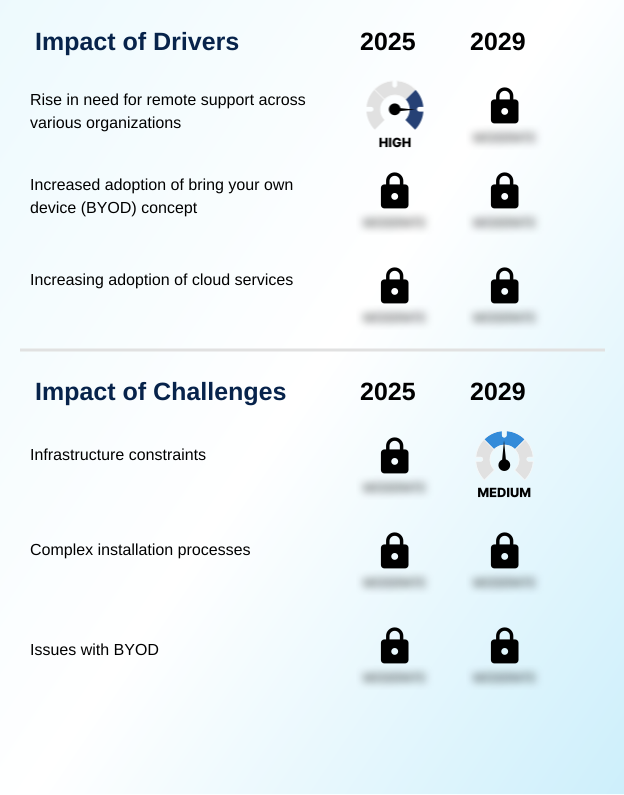
- The rising demand for secure remote and hybrid work environments is a key driver propelling market growth.
- The market is primarily driven by the enterprise-wide need for hybrid work enablement, which necessitates a complete digital workspace transformation.
- The core of this shift is the demand for secure remote access, which is delivered through virtual workspace solutions and DaaS platforms.
- Organizations are adopting a zero-trust security framework to protect intellectual property, using tools like data loss prevention and multi-factor authentication to fortify their environments.
- This centralized data management approach has led to a 50% reduction in endpoint data breaches for adopting firms. The implementation of a robust business continuity strategy is another significant factor, ensuring remote workforce productivity even during disruptions.
- This trend also supports the contactless economy support, where secure digital interactions are critical.
What are the market trends shaping the South Korea Virtual Desktop Infrastructure (VDI) Industry?
- The ongoing trend of growing digitalization in South Korea is significantly influencing the market. It is profoundly shaping business processes and service delivery across all sectors.
- Technological advancements are reshaping the market, with innovations enhancing both performance and manageability. The integration of GPU virtualization and AI-driven analytics for VDI is becoming standard for handling graphics-intensive applications and resource-intensive workloads. These systems, overseen by a unified VDI management console, can improve resource allocation efficiency by up to 35%.
- Innovations in remote display protocol and OS streaming technology are creating a more fluid end-user computing experience, while the adoption of containerized desktops supports a more agile enterprise infrastructure. This focus on improving user session consistency allows for the development of sophisticated digital native operations, where performance is paramount.
- User experience monitoring tools now provide insights that reduce user-reported issues by 20%, ensuring productivity.
What challenges does the South Korea Virtual Desktop Infrastructure (VDI) Industry face during its growth?
- Infrastructure constraints that hinder market expansion represent a key challenge affecting industry growth.
- Significant challenges persist, particularly around the complexity of proprietary groupware integration with virtualized environments. This often requires substantial IT infrastructure modernization and complicates the management of persistent VDI deployments. Organizations frequently face difficulties with legacy application support, where compatibility issues can delay projects by up to 40%.
- The initial investment in high-performance backend server infrastructure and high-speed storage arrays presents a barrier, countering the goal of capital expenditure reduction. Moreover, managing BYOD security challenges remains a primary concern, as ensuring endpoint security across diverse devices requires sophisticated endpoint device management and constant vigilance to adhere to smart work policy compliance.
- Optimizing the network virtualization layer with effective load balancing algorithms is crucial but complex.
Exclusive Technavio Analysis on Customer Landscape
The south korea virtual desktop infrastructure (vdi) market forecasting report includes the adoption lifecycle of the market, covering from the innovator’s stage to the laggard’s stage. It focuses on adoption rates in different regions based on penetration. Furthermore, the south korea virtual desktop infrastructure (vdi) market report also includes key purchase criteria and drivers of price sensitivity to help companies evaluate and develop their market growth analysis strategies.
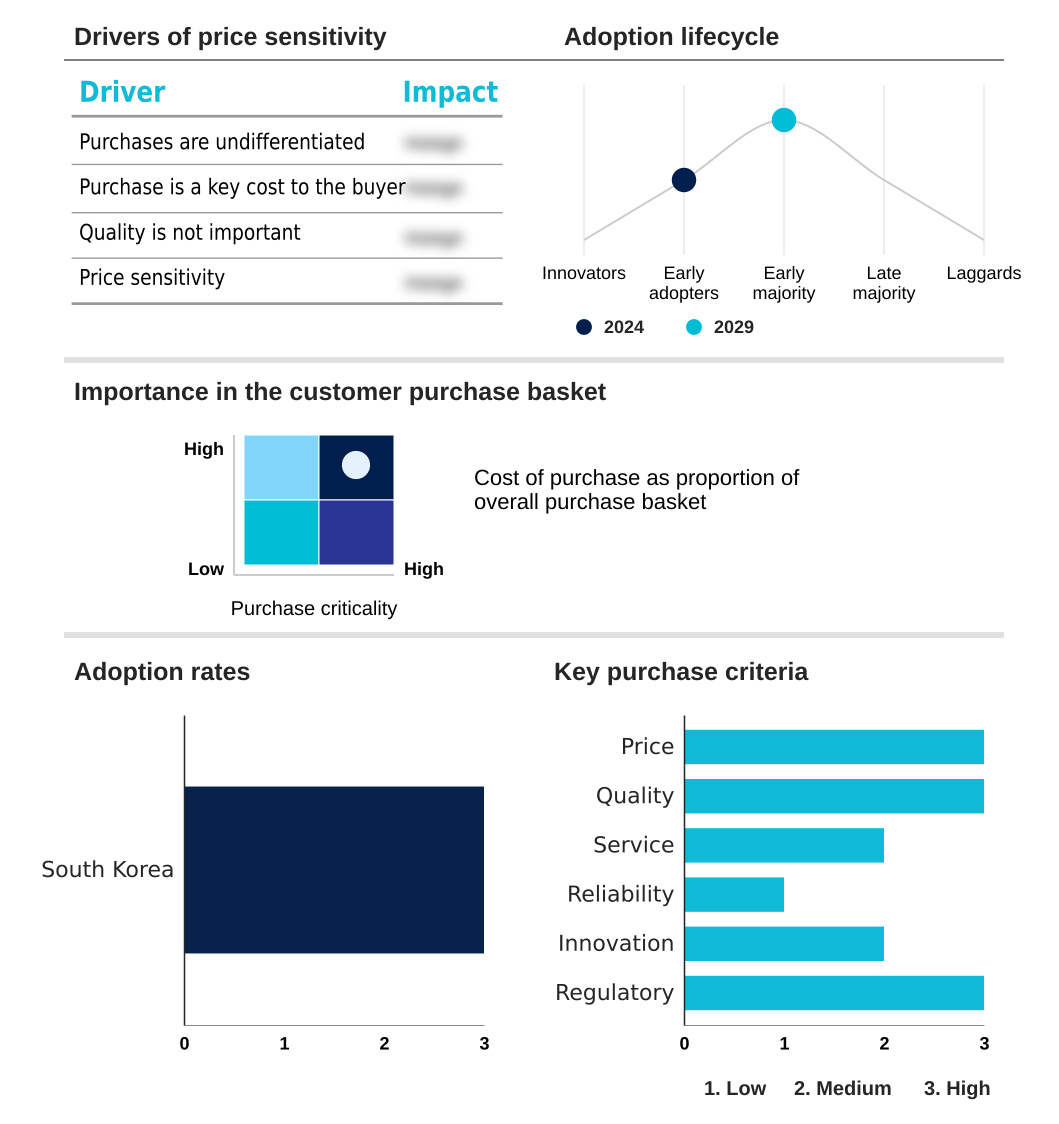
Customer Landscape of South Korea Virtual Desktop Infrastructure (VDI) Industry
Competitive Landscape
Companies are implementing various strategies, such as strategic alliances, south korea virtual desktop infrastructure (vdi) market forecast, partnerships, mergers and acquisitions, geographical expansion, and product/service launches, to enhance their presence in the industry.
DOUZONE BIZON - Key offerings deliver centralized desktop virtualization and secure remote access, enhancing data security and operational agility for modern hybrid work environments and digital workspaces.
The industry research and growth report includes detailed analyses of the competitive landscape of the market and information about key companies, including:
- DOUZONE BIZON
- Gabia Co. Ltd.
- HANCOM Inc.
- Kakao Corp.
- Kt Corp.
- LG Corp.
- LOTTE INNOVATE COMPANY
- NAMUTECH CO. LTD.
- NAVER Cloud Corp.
- NHN Cloud Corp.
- Samsung Electronics Co. Ltd.
- SOFTonNET Inc.
- somansa.co. ltd.
- SysOne
- Uplex Soft Co. Ltd.
Qualitative and quantitative analysis of companies has been conducted to help clients understand the wider business environment as well as the strengths and weaknesses of key industry players. Data is qualitatively analyzed to categorize companies as pure play, category-focused, industry-focused, and diversified; it is quantitatively analyzed to categorize companies as dominant, leading, strong, tentative, and weak.
Recent Development and News in South korea virtual desktop infrastructure (vdi) market
- In March 2025, Omnissa launched a new Partner Program designed to streamline partner engagement and accelerate the adoption of its digital workspace and VDI solutions in key Asia-Pacific markets.
- In January 2025, Tilon introduced its next-generation DaaS solution, featuring advanced GPU virtualization and a proprietary remote display protocol tailored for high-performance, graphics-intensive workloads.
- In September 2024, Xenosolution Co. unveiled its VDeX virtual desktop management solution, which aims to reduce infrastructure costs by leveraging existing user PC resources while enhancing security through network separation.
- In November 2024, Arcfra hosted its Solution Day in Seoul to showcase its virtualization and cloud infrastructure technologies, presenting its strategy to support local enterprises with flexible, software-defined platforms.
Dive into Technavio’s robust research methodology, blending expert interviews, extensive data synthesis, and validated models for unparalleled South Korea Virtual Desktop Infrastructure (VDI) Market insights. See full methodology.
| Market Scope | |
|---|---|
| Page number | 176 |
| Base year | 2025 |
| Historic period | 2020-2024 |
| Forecast period | 2026-2030 |
| Growth momentum & CAGR | Accelerate at a CAGR of 17.3% |
| Market growth 2026-2030 | USD 734.4 million |
| Market structure | Fragmented |
| YoY growth 2025-2026(%) | 14.6% |
| Key countries | South Korea |
| Competitive landscape | Leading Companies, Market Positioning of Companies, Competitive Strategies, and Industry Risks |
Research Analyst Overview
- The virtual desktop infrastructure (VDI) market in South Korea is advancing through the integration of sophisticated technologies that redefine end-user computing. Core to this evolution is desktop virtualization and application virtualization, supported by thin client hardware and zero client devices that secure endpoints. The adoption of hyper-converged infrastructure is accelerating the shift to DaaS models, offering scalability.
- A pivotal boardroom consideration is the implementation of a zero-trust security framework, which, when combined with data loss prevention and multi-factor authentication, directly addresses corporate risk and compliance mandates. For instance, firms using GPU virtualization for design workloads have reported a 30% increase in project completion speeds.
- This market also sees innovation in user experience monitoring, persistent and non-persistent VDI configurations in virtual desktop pools, and the use of a VDI management console to oversee operations. Technologies such as OS streaming technology, remote display protocol, and containerized desktops, managed by a connection broker software, are becoming standard.
- The underlying backend server infrastructure, featuring high-speed storage arrays and a robust network virtualization layer, is critical for performance, as are AI-driven analytics for VDI and advanced load balancing algorithms for optimizing resource-intensive virtual workspace solutions.
What are the Key Data Covered in this South Korea Virtual Desktop Infrastructure (VDI) Market Research and Growth Report?
-
What is the expected growth of the South Korea Virtual Desktop Infrastructure (VDI) Market between 2026 and 2030?
-
USD 734.4 million, at a CAGR of 17.3%
-
-
What segmentation does the market report cover?
-
The report is segmented by End-user (IT services, BFSI sector, and Healthcare sector), Deployment (On-premises, and Cloud-based), Component (Platform, Services, and Hardware) and Geography (APAC)
-
-
Which regions are analyzed in the report?
-
APAC
-
-
What are the key growth drivers and market challenges?
-
Rising demand for secure remote and hybrid work environments, Infrastructure constraints hinder market growth
-
-
Who are the major players in the South Korea Virtual Desktop Infrastructure (VDI) Market?
-
DOUZONE BIZON, Gabia Co. Ltd., HANCOM Inc., Kakao Corp., Kt Corp., LG Corp., LOTTE INNOVATE COMPANY, NAMUTECH CO. LTD., NAVER Cloud Corp., NHN Cloud Corp., Samsung Electronics Co. Ltd., SOFTonNET Inc., somansa.co. ltd., SysOne and Uplex Soft Co. Ltd.
-
Market Research Insights
- The market's dynamics are shaped by a strategic push toward digital workspace transformation, where organizations prioritize agility and security. This shift is fueling the adoption of hybrid work enablement strategies, with an emphasis on creating resilient and productive remote work environments.
- The move to an operational expenditure model through DaaS is gaining traction, with adoption rates showing a 40% higher preference among SMBs compared to traditional capital-intensive setups. Furthermore, firms implementing centralized IT administration for their virtual desktops report a 25% reduction in endpoint security incidents.
- This focus on security and efficiency underscores the market's response to evolving business needs and the increasing importance of robust, scalable end-user computing solutions.
We can help! Our analysts can customize this south korea virtual desktop infrastructure (vdi) market research report to meet your requirements.
 RIA -
RIA - 
