


Welding Power Supply Market Analysis APAC, North America, Europe, South America, Middle East and Africa - China, US, Germany, Japan, India - Size and Forecast 2024-2028

Welding Power Supply Market Analysis APAC, North America, Europe, South America, Middle East and Africa - China, US, Germany, Japan, India - Size and Forecast 2024-2028

Published: Oct 2024 150 Pages SKU: IRTNTR70322

Market Overview at a Glance

$2.99 B
Market Opportunity
6.6%
CAGR
6.0
YoY growth 2023-2024(%)

Welding Power Supply Market Size 2024-2028

The welding power supply market size is forecast to increase by USD 2.99 billion, at a CAGR of 6.6% between 2023 and 2028.

  • The market is driven by the increasing adoption of energy-efficient inverter-based welding power supplies, which offer improved power efficiency and reduced energy consumption. This trend is particularly prominent in industries with high welding requirements, such as automotive and construction. Another key driver is the growing utilization of magnesium alloys in the automotive industry, which necessitates the use of specialized welding power supplies capable of handling the unique properties of magnesium. However, the market also faces intense competition, with numerous players vying for market share. Companies must differentiate themselves through product innovation, cost competitiveness, and customer service to gain a competitive edge.
  • Additionally, regulatory compliance and safety standards pose challenges, requiring continuous investment in research and development to ensure products meet evolving industry requirements. To capitalize on market opportunities and navigate challenges effectively, companies should focus on developing energy-efficient, cost-effective, and versatile welding power supplies that cater to the diverse needs of various industries.

What will be the Size of the Welding Power Supply Market during the forecast period?

Welding Power Supply Market Size

Explore in-depth regional segment analysis with market size data - historical 2018-2022 and forecasts 2024-2028 - in the full report.  
Request Free Sample

The market is characterized by its continuous evolution and dynamic nature, driven by advancements in technology and the diverse applications across various sectors. Solid wire and flux-cored wire continue to dominate the welding process landscape, with pulse welding and arc welding being key techniques. The welding gun, control panel, and welding feeder are essential components of the welding power source, ensuring optimal performance and safety. Heavy equipment manufacturing and pipeline construction rely heavily on welding for production and maintenance. Weld bead quality and strength are paramount in these industries, with welding automation and non-destructive testing playing crucial roles in ensuring consistency and reliability.

Repair and maintenance applications also benefit from the versatility of welding, with resistance welding and synergic welding being popular methods. Projection welding and welding clamping techniques are used in various industries, including automotive manufacturing and aerospace, to create precise and strong welds. Energy industry applications require specialized welding processes, such as DC power supply and helium gas welding, for their unique demands. Weld inspection, certification, and safety standards are essential in maintaining the integrity of welded structures and ensuring the highest quality. Welding processes, including welding torch and helmet technology, continue to advance, with weld penetration, seam tracking, and welding apparel innovations enhancing productivity and safety.

The market's ongoing unfolding is shaped by the interplay of various factors, including weld fatigue, welding process control, and energy efficiency. Mixed gases and their applications in welding further expand the market's scope and complexity.

How is this Welding Power Supply Industry segmented?

The welding power supply industry research report provides comprehensive data (region-wise segment analysis), with forecasts and estimates in "USD million" for the period 2024-2028, as well as historical data from 2018-2022 for the following segments.

  • End-user
    • Automotive
    • Construction
    • Shipbuilding
    • Aerospace and defense
    • Others
  • Geography
    • North America
      • US
    • Europe
      • Germany
    • APAC
      • China
      • India
      • Japan
    • Rest of World (ROW)

By End-user Insights

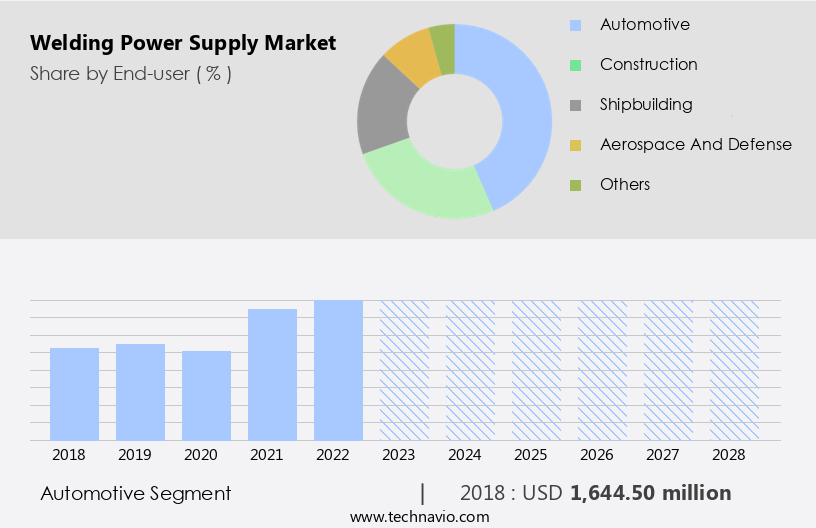
The automotive segment is estimated to witness significant growth during the forecast period.

The market is witnessing significant growth due to the increasing demand from various industries, particularly automotive manufacturing and aerospace. The automotive industry's focus on producing lighter, stronger, and fuel-efficient vehicles using advanced materials has led to the adoption of efficient welding techniques for producing lighter weld joints. The automotive segment is expected to dominate the market during the forecast period. The aerospace industry also contributes to the market's growth due to the high demand for lightweight and durable components in aircraft manufacturing. Advancements in welding technologies, such as synergic welding, pulse welding, and resistance welding, have improved weld penetration and seam tracking, ensuring higher weld strength and quality.

The energy industry also utilizes welding power supplies for pipeline construction and repair and maintenance. Welding safety is a significant concern in the industry, leading to the development of welding safety standards and the use of welding apparel, gloves, and helmets. Non-destructive testing techniques, such as ultrasonic testing and radiographic testing, are employed to ensure weld quality and detect weld defects, including weld fatigue and distortion. The market also includes the use of various gases, such as argon, helium, and carbon dioxide, in welding processes. Welding automation and the integration of welding power supplies with control panels, wire feeders, and welding guns have streamlined the manufacturing process and increased productivity.

In the automotive industry, spot welding and projection welding are widely used for assembling various components. The market is expected to continue its growth trajectory due to the increasing demand from various industries and the continuous advancements in welding technologies.
Welding Power Supply Market Size

Request Free Sample

The Automotive segment was valued at USD 1.64 billion in 2018 and showed a gradual increase during the forecast period.

Regional Analysis

APAC is estimated to contribute 60% to the growth of the global market during the forecast period.Technavio's analysts have elaborately explained the regional trends and drivers that shape the market during the forecast period.

Welding Power Supply Market Share by Geography

 Request Free Sample

The market is experiencing significant growth, particularly in the Asia Pacific (APAC) region. APAC is anticipated to be the largest market and is expected to expand at a notable rate from 2023 to 2028. The expansion of end-user industries such as automotive manufacturing, construction, and power in APAC is driving the demand for welding equipment. In addition, several government and public-private partnership (PPP) projects aimed at infrastructure development in the region, like the Philippines' planned investment of over USD400 billion, further boost the market. Welding processes such as solid wire, flux-cored wire, pulse welding, and synergic welding are integral to various industries.

Automotive manufacturing relies on resistance welding and arc welding for vehicle production. Aerospace manufacturing utilizes welding techniques for aircraft assembly, while the energy industry employs welding for pipeline construction and power generation. Welding safety is a crucial aspect of the market, with safety standards and certifications ensuring the quality and durability of welds. Welding processes like arc welding, MIG, TIG, and spot welding require protective equipment, including welding gloves, helmets, and torches. Ultrasonic testing (UT), radiographic testing (RT), and visual inspection are essential for weld quality control. The market encompasses various components, including welding control panels, wire feeders, power sources, and welding cables.

Helium gas, argon gas, and carbon dioxide (CO2) are commonly used welding gases. Tungsten electrodes are utilized in TIG welding, while mixed gases are employed in MIG welding. Welding automation and welding apparel are emerging trends in the market. Welding automation enhances productivity and reduces labor costs, while welding apparel ensures the safety and comfort of welders. Weld distortion, weld fatigue, and weld strength are essential considerations in welding process control. The market also caters to repair and maintenance, projection welding, and heavy equipment manufacturing. The market's growth is influenced by factors like increasing industrialization, urbanization, and infrastructure development.

Market Dynamics

Our researchers analyzed the data with 2023 as the base year, along with the key drivers, trends, and challenges. A holistic analysis of drivers will help companies refine their marketing strategies to gain a competitive advantage.

What are the key market drivers leading to the rise in the adoption of Welding Power Supply Industry?

  • Inverter-based welding power supplies are a significant market driver due to their energy efficiency advantages. 
  • Inverter-based welding power supplies offer several advantages over traditional transformer-style power sources. While transformer-style power sources are larger and draw a substantial amount of power, inverter-based power supplies have a lower power draw and greater flexibility. For instance, a 350-amp conventional TIG power source consumes 128 amps of input power under a rated load of 230-volt single-phase power. In contrast, a comparable TIG inverter only draws 32 amps. This difference enables companies to add more welding machines and workstations without expanding or building in additional power infrastructure. Welding safety standards are essential in various industries, including the energy sector.
  • Welding processes such as TIG and MIG require welding gases like argon and carbon dioxide (CO2). Weld fatigue, a critical issue in welding, can be mitigated through non-destructive testing (NDT) techniques like radiographic testing (RT) and welding process control. Tungsten electrodes are commonly used in TIG welding, while CO2 is often used as a shielding gas in MIG welding. Proper welding cable selection is crucial to ensure efficient power transfer and prevent potential hazards. Inverter-based power sources also help reduce weld distortion, ensuring better quality welds. In conclusion, the adoption of inverter-based welding power supplies offers several benefits, including lower power consumption, flexibility, and improved weld quality.
  • Welding safety standards, gas selection, and proper cable selection are essential considerations for welding processes. The energy industry relies heavily on welding and requires continuous innovation to address challenges like weld fatigue and distortion.

What are the market trends shaping the Welding Power Supply Industry?

  • The use of magnesium alloys is becoming increasingly popular in the automotive welding industry, representing a significant market trend. This material's adoption offers several advantages, including lightweight properties and enhanced fuel efficiency, making it an attractive option for automakers.
  • The market is experiencing significant growth due to the increasing demand for visual inspection technologies in various industries, such as heavy equipment manufacturing and pipeline construction. The use of advanced welding equipment, including welding torches and helmets, enables precise and efficient welding processes, ensuring the highest weld strength and quality. Welding automation is another key trend driving market growth, as it increases productivity and reduces labor costs. Technologies like projection welding and resistance welding, which utilize ac power supplies and mixed gases, are gaining popularity due to their ability to produce strong welds with minimal distortion.
  • In the realm of repair and maintenance, welding plays a crucial role in extending the life cycle of equipment and infrastructure. The need for efficient and cost-effective welding solutions is driving innovation in the market, with a focus on developing more robust and immersive welding processes that are harmonious with different materials and applications. Magnesium alloys, which are lighter than steel and aluminum, are increasingly being used in industrial applications, particularly in the automotive industry, due to their potential to significantly reduce vehicle weight and improve energy efficiency. The development of magnesium alloys for welding purposes is a promising area of research, as it could lead to even greater weight reductions and improved weld strength.
  • In conclusion, the market is poised for continued growth due to the increasing demand for advanced welding technologies in various industries, as well as the ongoing research and development efforts aimed at improving the efficiency, strength, and versatility of welding processes.

What challenges does the Welding Power Supply Industry face during its growth?

  • The intense competition prevalent in the industry poses a significant challenge to its growth. 
  • The market experiences intense competition among various companies, with major players like COLFAX and Fronius holding a significant market share. Companies are focusing on innovation to maintain their position, as new entrants emerge, driven by cost-conscious end-users in industries such as automotive manufacturing and welding training. In this market, solid wire and flux-cored wire continue to dominate, with applications in arc welding and pulse welding.
  • The welding control panel, welding wire feeder, welding gun, and welding power source are essential components. Safety measures, including welding gloves and ultrasonic testing (UT), are crucial in this industry. Despite the competitive landscape, the market growth remains steady, driven by the increasing demand for efficient and cost-effective welding solutions.

Exclusive Customer Landscape

The welding power supply market forecasting report includes the adoption lifecycle of the market, covering from the innovator's stage to the laggard's stage. It focuses on adoption rates in different regions based on penetration. Furthermore, the welding power supply market report also includes key purchase criteria and drivers of price sensitivity to help companies evaluate and develop their market growth analysis strategies.

Welding Power Supply Market Share by Geography

 Customer Landscape

Key Companies & Market Insights

Companies are implementing various strategies, such as strategic alliances, welding power supply market forecast, partnerships, mergers and acquisitions, geographical expansion, and product/service launches, to enhance their presence in the industry.

Ador Welding Ltd. - The company provides an advanced iQ auto plus ultrasonic generator welding power supply, catering to the demands of the automotive, aerospace, packaging, and textile industries.

The industry research and growth report includes detailed analyses of the competitive landscape of the market and information about key companies, including:

  • Ador Welding Ltd.
  • AXXAIR
  • Dukane IAS LLC
  • Enovis Corp.
  • Fronius International GmbH
  • GALA GAR SL
  • HBS Bolzenschweiss Systeme GmbH and Co. KG
  • Illinois Tool Works Inc.
  • Jasic Technology Co., Ltd.
  • Kemppi Oy
  • KUHTREIBER Ltd.
  • MTM Power Messtechnik Mellenbach GmbH
  • Orbitec GmbH
  • Panasonic Holdings Corp.
  • Rinco Ultrasonics AG
  • Telwin Spa
  • The Lincoln Electric Co.
  • Weber Ultrasonics AG
  • XP Power

Qualitative and quantitative analysis of companies has been conducted to help clients understand the wider business environment as well as the strengths and weaknesses of key industry players. Data is qualitatively analyzed to categorize companies as pure play, category-focused, industry-focused, and diversified; it is quantitatively analyzed to categorize companies as dominant, leading, strong, tentative, and weak.

Recent Development and News in Welding Power Supply Market

  • In February 2024, Esab, a leading global manufacturer of welding and cutting equipment, introduced its new Gen4 TIG (Tungsten Inert Gas) welding power supply, the CyroFlex 350i. This innovative product offers increased power density and improved arc stability, setting a new standard in the welding industry (Esab Press Release, 2024).
  • In May 2024, Linde plc, a world-class gases and engineering company, announced a strategic partnership with Fronius, an Austrian manufacturer of welding technology. This collaboration aims to develop advanced welding solutions that integrate Linde's gases with Fronius' power sources, enhancing productivity and efficiency for their customers (Linde Press Release, 2024).

Research Analyst Overview

  • The market is characterized by ongoing efforts to optimize welding processes and minimize defects. Protective gases, such as shielding gases and welding gases, play a crucial role in this regard, shielding the weld zone from atmospheric contaminants during various welding processes like TIG welding, MIG welding, and Flux-cored arc welding. Incomplete fusion, a common welding defect, can be mitigated through process optimization and the use of appropriate filler metals and welding consumables. Output current, duty cycle, and electrode classification are essential factors in selecting the right welding power supply for specific applications. Weldability testing is another critical aspect of the market, ensuring the quality of welded joints and identifying potential issues such as slag inclusion and welding defects.
  • Plasma cutting and waterjet cutting are alternative processes that offer advantages in certain applications, while welding automation software streamlines production and enhances efficiency. Welding metallurgy continues to evolve, with advancements in welding processes and the development of new alloys and filler metals. Pulsed MIG welding, for instance, offers improved weld quality and reduced spatter. Shielding gases and welding consumables are continually being refined to cater to the evolving needs of the industry. Overall, the market is dynamic, with a focus on innovation, efficiency, and quality.

Dive into Technavio's robust research methodology, blending expert interviews, extensive data synthesis, and validated models for unparalleled Welding Power Supply Market insights. See full methodology.

Market Scope

Report Coverage

Details

Page number

150

Base year

2023

Historic period

2018-2022

Forecast period

2024-2028

Growth momentum & CAGR

Accelerate at a CAGR of 6.6%

Market growth 2024-2028

USD 2993.3 million

Market structure

Fragmented

YoY growth 2023-2024(%)

6.0

Key countries

China, US, Germany, Japan, and India

Competitive landscape

Leading Companies, Market Positioning of Companies, Competitive Strategies, and Industry Risks

Request Free Sample

What are the Key Data Covered in this Welding Power Supply Market Research and Growth Report?

  • CAGR of the Welding Power Supply industry during the forecast period
  • Detailed information on factors that will drive the growth and forecasting between 2024 and 2028
  • Precise estimation of the size of the market and its contribution of the industry in focus to the parent market
  • Accurate predictions about upcoming growth and trends and changes in consumer behaviour
  • Growth of the market across APAC, North America, Europe, South America, and Middle East and Africa
  • Thorough analysis of the market's competitive landscape and detailed information about companies
  • Comprehensive analysis of factors that will challenge the welding power supply market growth of industry companies

We can help! Our analysts can customize this welding power supply market research report to meet your requirements.

Get in touch

1 Executive Summary

  • 1.1 Market overview
    • Executive Summary - Chart on Market Overview
    • Executive Summary - Data Table on Market Overview
    • Executive Summary - Chart on Global Market Characteristics
    • Executive Summary - Chart on Market by Geography
    • Executive Summary - Chart on Market Segmentation by End-user
    • Executive Summary - Chart on Incremental Growth
    • Executive Summary - Data Table on Incremental Growth
    • Executive Summary - Chart on Company Market Positioning

2 Market Landscape

  • 2.1 Market ecosystem
    • Parent Market
    • Data Table on - Parent Market
  • 2.2 Market characteristics
    • Market characteristics analysis
  • 2.3 Value chain analysis
    • Value Chain Analysis

3 Market Sizing

  • 3.1 Market definition
    • Offerings of companies included in the market definition
  • 3.2 Market segment analysis
    • Market segments
  • 3.3 Market size 2023
    • 3.4 Market outlook: Forecast for 2023-2028
      • Chart on Global - Market size and forecast 2023-2028 ($ million)
      • Data Table on Global - Market size and forecast 2023-2028 ($ million)
      • Chart on Global Market: Year-over-year growth 2023-2028 (%)
      • Data Table on Global Market: Year-over-year growth 2023-2028 (%)

    4 Historic Market Size

    • 4.1 Global Welding Power Supply Market 2018 - 2022
      • Historic Market Size - Data Table on Global Welding Power Supply Market 2018 - 2022 ($ million)
    • 4.2 End-user segment analysis 2018 - 2022
      • Historic Market Size - End-user Segment 2018 - 2022 ($ million)
    • 4.3 Geography segment analysis 2018 - 2022
      • Historic Market Size - Geography Segment 2018 - 2022 ($ million)
    • 4.4 Country segment analysis 2018 - 2022
      • Historic Market Size - Country Segment 2018 - 2022 ($ million)

    5 Five Forces Analysis

    • 5.1 Five forces summary
      • Five forces analysis - Comparison between 2023 and 2028
    • 5.2 Bargaining power of buyers
      • Bargaining power of buyers - Impact of key factors 2023 and 2028
    • 5.3 Bargaining power of suppliers
      • Bargaining power of suppliers - Impact of key factors in 2023 and 2028
    • 5.4 Threat of new entrants
      • Threat of new entrants - Impact of key factors in 2023 and 2028
    • 5.5 Threat of substitutes
      • Threat of substitutes - Impact of key factors in 2023 and 2028
    • 5.6 Threat of rivalry
      • Threat of rivalry - Impact of key factors in 2023 and 2028
    • 5.7 Market condition
      • Chart on Market condition - Five forces 2023 and 2028

    6 Market Segmentation by End-user

    • 6.1 Market segments
      • Chart on End-user - Market share 2023-2028 (%)
      • Data Table on End-user - Market share 2023-2028 (%)
    • 6.2 Comparison by End-user
      • Chart on Comparison by End-user
      • Data Table on Comparison by End-user
    • 6.3 Automotive - Market size and forecast 2023-2028
      • Chart on Automotive - Market size and forecast 2023-2028 ($ million)
      • Data Table on Automotive - Market size and forecast 2023-2028 ($ million)
      • Chart on Automotive - Year-over-year growth 2023-2028 (%)
      • Data Table on Automotive - Year-over-year growth 2023-2028 (%)
    • 6.4 Construction - Market size and forecast 2023-2028
      • Chart on Construction - Market size and forecast 2023-2028 ($ million)
      • Data Table on Construction - Market size and forecast 2023-2028 ($ million)
      • Chart on Construction - Year-over-year growth 2023-2028 (%)
      • Data Table on Construction - Year-over-year growth 2023-2028 (%)
    • 6.5 Shipbuilding - Market size and forecast 2023-2028
      • Chart on Shipbuilding - Market size and forecast 2023-2028 ($ million)
      • Data Table on Shipbuilding - Market size and forecast 2023-2028 ($ million)
      • Chart on Shipbuilding - Year-over-year growth 2023-2028 (%)
      • Data Table on Shipbuilding - Year-over-year growth 2023-2028 (%)
    • 6.6 Aerospace and defense - Market size and forecast 2023-2028
      • Chart on Aerospace and defense - Market size and forecast 2023-2028 ($ million)
      • Data Table on Aerospace and defense - Market size and forecast 2023-2028 ($ million)
      • Chart on Aerospace and defense - Year-over-year growth 2023-2028 (%)
      • Data Table on Aerospace and defense - Year-over-year growth 2023-2028 (%)
    • 6.7 Others - Market size and forecast 2023-2028
      • Chart on Others - Market size and forecast 2023-2028 ($ million)
      • Data Table on Others - Market size and forecast 2023-2028 ($ million)
      • Chart on Others - Year-over-year growth 2023-2028 (%)
      • Data Table on Others - Year-over-year growth 2023-2028 (%)
    • 6.8 Market opportunity by End-user
      • Market opportunity by End-user ($ million)
      • Data Table on Market opportunity by End-user ($ million)

    7 Customer Landscape

    • 7.1 Customer landscape overview
      • Analysis of price sensitivity, lifecycle, customer purchase basket, adoption rates, and purchase criteria

    8 Geographic Landscape

    • 8.1 Geographic segmentation
      • Chart on Market share by geography 2023-2028 (%)
      • Data Table on Market share by geography 2023-2028 (%)
    • 8.2 Geographic comparison
      • Chart on Geographic comparison
      • Data Table on Geographic comparison
    • 8.3 APAC - Market size and forecast 2023-2028
      • Chart on APAC - Market size and forecast 2023-2028 ($ million)
      • Data Table on APAC - Market size and forecast 2023-2028 ($ million)
      • Chart on APAC - Year-over-year growth 2023-2028 (%)
      • Data Table on APAC - Year-over-year growth 2023-2028 (%)
    • 8.4 North America - Market size and forecast 2023-2028
      • Chart on North America - Market size and forecast 2023-2028 ($ million)
      • Data Table on North America - Market size and forecast 2023-2028 ($ million)
      • Chart on North America - Year-over-year growth 2023-2028 (%)
      • Data Table on North America - Year-over-year growth 2023-2028 (%)
    • 8.5 Europe - Market size and forecast 2023-2028
      • Chart on Europe - Market size and forecast 2023-2028 ($ million)
      • Data Table on Europe - Market size and forecast 2023-2028 ($ million)
      • Chart on Europe - Year-over-year growth 2023-2028 (%)
      • Data Table on Europe - Year-over-year growth 2023-2028 (%)
    • 8.6 South America - Market size and forecast 2023-2028
      • Chart on South America - Market size and forecast 2023-2028 ($ million)
      • Data Table on South America - Market size and forecast 2023-2028 ($ million)
      • Chart on South America - Year-over-year growth 2023-2028 (%)
      • Data Table on South America - Year-over-year growth 2023-2028 (%)
    • 8.7 Middle East and Africa - Market size and forecast 2023-2028
      • Chart on Middle East and Africa - Market size and forecast 2023-2028 ($ million)
      • Data Table on Middle East and Africa - Market size and forecast 2023-2028 ($ million)
      • Chart on Middle East and Africa - Year-over-year growth 2023-2028 (%)
      • Data Table on Middle East and Africa - Year-over-year growth 2023-2028 (%)
    • 8.8 China - Market size and forecast 2023-2028
      • Chart on China - Market size and forecast 2023-2028 ($ million)
      • Data Table on China - Market size and forecast 2023-2028 ($ million)
      • Chart on China - Year-over-year growth 2023-2028 (%)
      • Data Table on China - Year-over-year growth 2023-2028 (%)
    • 8.9 US - Market size and forecast 2023-2028
      • Chart on US - Market size and forecast 2023-2028 ($ million)
      • Data Table on US - Market size and forecast 2023-2028 ($ million)
      • Chart on US - Year-over-year growth 2023-2028 (%)
      • Data Table on US - Year-over-year growth 2023-2028 (%)
    • 8.10 Germany - Market size and forecast 2023-2028
      • Chart on Germany - Market size and forecast 2023-2028 ($ million)
      • Data Table on Germany - Market size and forecast 2023-2028 ($ million)
      • Chart on Germany - Year-over-year growth 2023-2028 (%)
      • Data Table on Germany - Year-over-year growth 2023-2028 (%)
    • 8.11 Japan - Market size and forecast 2023-2028
      • Chart on Japan - Market size and forecast 2023-2028 ($ million)
      • Data Table on Japan - Market size and forecast 2023-2028 ($ million)
      • Chart on Japan - Year-over-year growth 2023-2028 (%)
      • Data Table on Japan - Year-over-year growth 2023-2028 (%)
    • 8.12 India - Market size and forecast 2023-2028
      • Chart on India - Market size and forecast 2023-2028 ($ million)
      • Data Table on India - Market size and forecast 2023-2028 ($ million)
      • Chart on India - Year-over-year growth 2023-2028 (%)
      • Data Table on India - Year-over-year growth 2023-2028 (%)
    • 8.13 Market opportunity by geography
      • Market opportunity by geography ($ million)
      • Data Tables on Market opportunity by geography ($ million)

    9 Drivers, Challenges, and Opportunity/Restraints

    • 9.1 Market drivers
      • 9.2 Market challenges
        • 9.3 Impact of drivers and challenges
          • Impact of drivers and challenges in 2023 and 2028
        • 9.4 Market opportunities/restraints

          10 Competitive Landscape

          • 10.1 Overview
            • 10.2 Competitive Landscape
              • Overview on criticality of inputs and factors of differentiation
            • 10.3 Landscape disruption
              • Overview on factors of disruption
            • 10.4 Industry risks
              • Impact of key risks on business

            11 Competitive Analysis

            • 11.1 Companies profiled
              • Companies covered
            • 11.2 Market positioning of companies
              • Matrix on companies position and classification
            • 11.3 Dukane IAS LLC
              • Dukane IAS LLC - Overview
              • Dukane IAS LLC - Product / Service
              • Dukane IAS LLC - Key offerings
            • 11.4 Enovis Corp.
              • Enovis Corp. - Overview
              • Enovis Corp. - Business segments
              • Enovis Corp. - Key news
              • Enovis Corp. - Key offerings
              • Enovis Corp. - Segment focus
            • 11.5 Fronius International GmbH
              • Fronius International GmbH - Overview
              • Fronius International GmbH - Product / Service
              • Fronius International GmbH - Key offerings
            • 11.6 Illinois Tool Works Inc.
              • Illinois Tool Works Inc. - Overview
              • Illinois Tool Works Inc. - Business segments
              • Illinois Tool Works Inc. - Key news
              • Illinois Tool Works Inc. - Key offerings
              • Illinois Tool Works Inc. - Segment focus
            • 11.7 KUHTREIBER Ltd.
              • KUHTREIBER Ltd. - Overview
              • KUHTREIBER Ltd. - Product / Service
              • KUHTREIBER Ltd. - Key offerings
            • 11.8 Rinco Ultrasonics AG
              • Rinco Ultrasonics AG - Overview
              • Rinco Ultrasonics AG - Product / Service
              • Rinco Ultrasonics AG - Key offerings
            • 11.9 Telwin Spa
              • Telwin Spa - Overview
              • Telwin Spa - Product / Service
              • Telwin Spa - Key offerings
            • 11.10 The Lincoln Electric Co.
              • The Lincoln Electric Co. - Overview
              • The Lincoln Electric Co. - Business segments
              • The Lincoln Electric Co. - Key news
              • The Lincoln Electric Co. - Key offerings
              • The Lincoln Electric Co. - Segment focus
            • 11.11 Weber Ultrasonics AG
              • Weber Ultrasonics AG - Overview
              • Weber Ultrasonics AG - Product / Service
              • Weber Ultrasonics AG - Key offerings
            • 11.12 XP Power
              • XP Power - Overview
              • XP Power - Business segments
              • XP Power - Key offerings
              • XP Power - Segment focus

            12 Appendix

            • 12.1 Scope of the report
              • 12.2 Inclusions and exclusions checklist
                • Inclusions checklist
                • Exclusions checklist
              • 12.3 Currency conversion rates for US$
                • Currency conversion rates for US$
              • 12.4 Research methodology
                • Research methodology
              • 12.5 Data procurement
                • Information sources
              • 12.6 Data validation
                • Data validation
              • 12.7 Validation techniques employed for market sizing
                • Validation techniques employed for market sizing
              • 12.8 Data synthesis
                • Data synthesis
              • 12.9 360 degree market analysis
                • 360 degree market analysis
              • 12.10 List of abbreviations
                • List of abbreviations

              Research Methodology

              Technavio presents a detailed picture of the market by way of study, synthesis, and summation of data from multiple sources. The analysts have presented the various facets of the market with a particular focus on identifying the key industry influencers. The data thus presented is comprehensive, reliable, and the result of extensive research, both primary and secondary.

              INFORMATION SOURCES

              Primary sources

              • Manufacturers and suppliers
              • Channel partners
              • Industry experts
              • Strategic decision makers

              Secondary sources

              • Industry journals and periodicals
              • Government data
              • Financial reports of key industry players
              • Historical data
              • Press releases

              DATA ANALYSIS

              Data Synthesis

              • Collation of data
              • Estimation of key figures
              • Analysis of derived insights

              Data Validation

              • Triangulation with data models
              • Reference against proprietary databases
              • Corroboration with industry experts

              REPORT WRITING

              Qualitative

              • Market drivers
              • Market challenges
              • Market trends
              • Five forces analysis

              Quantitative

              • Market size and forecast
              • Market segmentation
              • Geographical insights
              • Competitive landscape

              Interested in this report?

              Get your sample now to see our research methodology and insights!

              Download Now

              Frequently Asked Questions

              Welding Power Supply market growth will increase by $ 2993.3 mn during 2024-2028 .

              The Welding Power Supply market is expected to grow at a CAGR of 6.6% during 2024-2028 .

              Welding Power Supply market is segmented by End-user( Automotive, Construction, Shipbuilding, Aerospace and defense, Others)

              Ador Welding Ltd., AXXAIR, Dukane IAS LLC, Enovis Corp., Fronius International GmbH, GALA GAR SL, HBS Bolzenschweiss Systeme GmbH and Co. KG, Illinois Tool Works Inc., Jasic Technology Co., Ltd., Kemppi Oy, KUHTREIBER Ltd., MTM Power Messtechnik Mellenbach GmbH, Orbitec GmbH, Panasonic Holdings Corp., Rinco Ultrasonics AG, Telwin Spa, The Lincoln Electric Co., Weber Ultrasonics AG, XP Power are a few of the key vendors in the Welding Power Supply market.

              APAC will register the highest growth rate of 60% among the other regions. Therefore, the Welding Power Supply market in APAC is expected to garner significant business opportunities for the vendors during the forecast period.

              China, US, Germany, Japan, India

              • Energy efficiency due to inverter-based welding power supplyTraditional transformer-style welding power sources are considerably larger and draw a large amount of power as compared to inverter-based welding power supplies. This leads to a higher utility bill and limits the number of power sources. Inverter-based power sources for welding is the driving factor this market.
              • however is the driving factor this market.
              • offer a lower power draw and more flexibility in terms of the number of units that can be run on the existing power. For instance is the driving factor this market.
              • a 350-amp conventional TIG power source draws 128 amps of input power under a rated load of 230-volt single-phase power. Under the same circumstances is the driving factor this market.
              • a comparable TIG inverter only draws 32 amps. This offers companies the flexibility to add more machines and workstations to existing power without having to expand or build in more power. Another advantage of the inverter over transformer-based power sources in welding is space savings. An inverter power supply is smaller in height and width is the driving factor this market.
              • making it much easier to fit into weld cells and move around. As lower power draw allows for more units to be added to existing breakers is the driving factor this market.
              • smaller units also provide more flexibility to expand by allowing for more arcs. Therefore is the driving factor this market.
              • inverter power sources for welding are more portable and lighter in weight is the driving factor this market.
              • making them easier to maneuver around the job site. In addition is the driving factor this market.
              • these sources offer high-quality is the driving factor this market.
              • multi-process welding capabilities so that one machine can handle Stick is the driving factor this market.
              • MIG is the driving factor this market.
              • TIG is the driving factor this market.
              • FCAW is the driving factor this market.
              • arc gouging is the driving factor this market.
              • and even pulsing. Each year about $99 million of electricity is consumed worldwide for welding. Moreover is the driving factor this market.
              • inverter-based power sources for welding offer new settings is the driving factor this market.
              • functions is the driving factor this market.
              • and operating ranges with a number of benefits is the driving factor this market.
              • including increased travel speeds is the driving factor this market.
              • better arc control is the driving factor this market.
              • reduced heat input and distortion is the driving factor this market.
              • reduced pre- and post-weld cleanup is the driving factor this market.
              • establishing the weld puddle faster is the driving factor this market.
              • more easily managing the weld puddle is the driving factor this market.
              • and providing extensive memory functions. Therefore is the driving factor this market.
              • to increase the efficiencies in welding processes and cut down on the overall energy consumption during the welding process is the driving factor this market.
              • the demand for inverter-based supply systems has increased is the driving factor this market.
              • and the same trend is expected during the forecast period. is the driving factor this market.

              The Welding Power Supply market vendors should focus on grabbing business opportunities from the Automotive segment as it accounted for the largest market share in the base year.
