

Activewear Apparel Market Analysis North America, Europe, APAC, Middle East and Africa, South America - US, China, Germany, Italy, Canada - Size and Forecast 2024-2028

Activewear Apparel Market Analysis North America, Europe, APAC, Middle East and Africa, South America - US, China, Germany, Italy, Canada - Size and Forecast 2024-2028

Published: May 2024 167 Pages SKU: IRTNTR40824

Market Overview at a Glance

$326.3 Mn
Market Opportunity
13.63%
CAGR
11.74
YoY growth 2023-2024(%)

Activewear Apparel Market Size 2024-2028

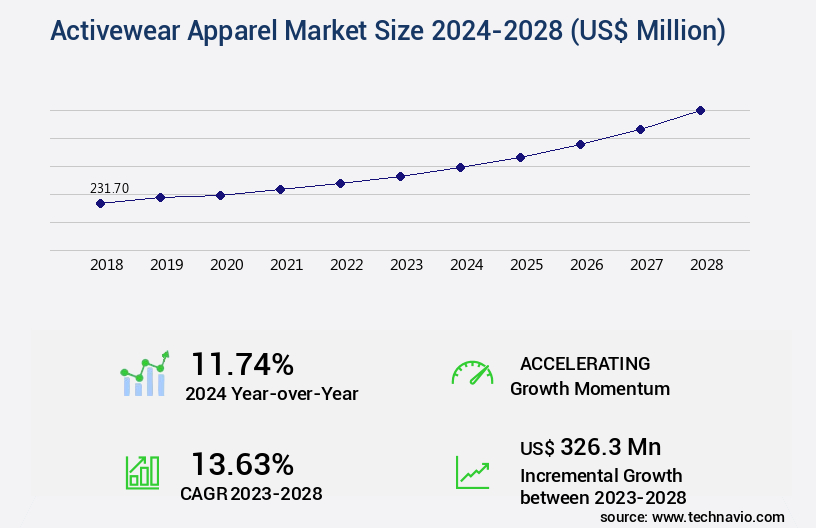
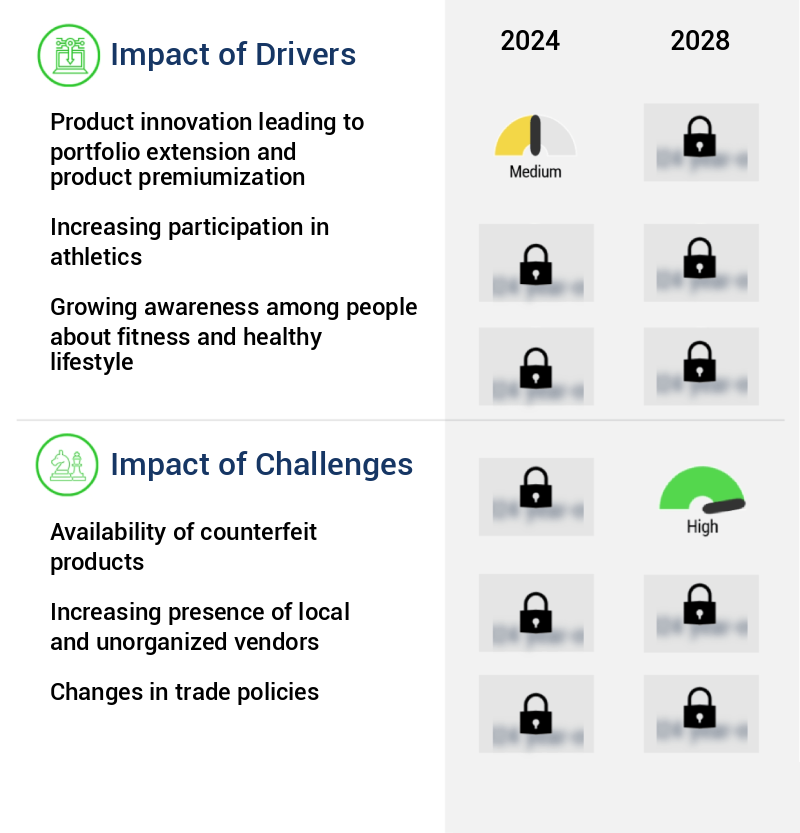
The activewear apparel market size is valued to increase by USD 326.3 million, at a CAGR of 13.63% from 2023 to 2028. Product innovation leading to portfolio extension and product premiumization will drive the activewear apparel market.

Major Market Trends & Insights

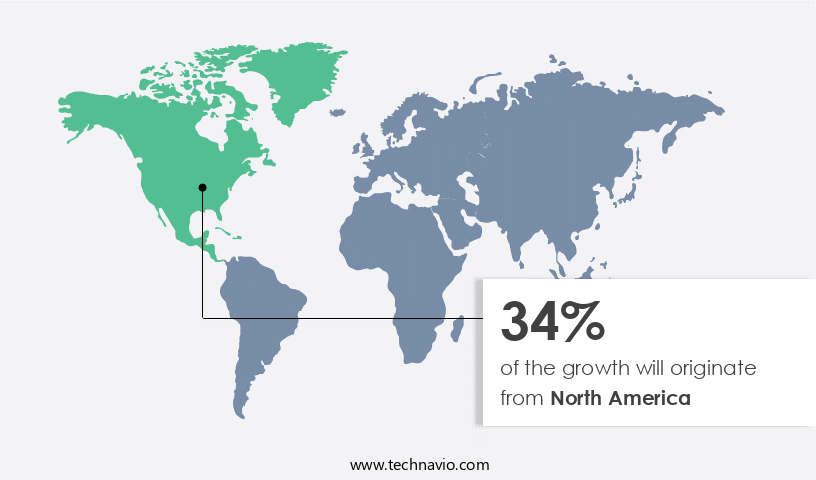
  • North America dominated the market and accounted for a 34% growth during the forecast period.
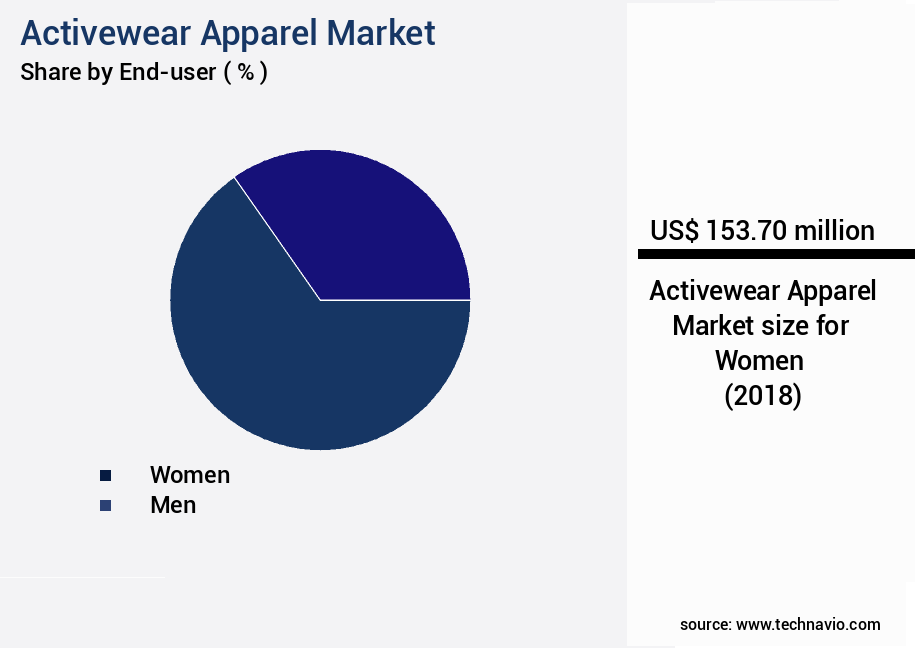
  • By End-user - Women segment was valued at USD 153.70 million in 2022
  • By Distribution Channel - Offline segment accounted for the largest market revenue share in 2022

Market Size & Forecast

  • Market Opportunities: USD 198.23 million
  • Market Future Opportunities: USD 326.30 million
  • CAGR from 2023 to 2028 : 13.63%

Market Summary

  • The market is experiencing significant growth due to the increasing popularity of athleisure and a trend towards product innovation leading to portfolio extension and premiumization. According to recent research, the global activewear market is projected to reach new heights, driven by consumer preferences for comfort and functionality. One key factor fueling this growth is the rise of athleisure, a fashion trend that blends activewear with everyday clothing. This shift has led to an increase in demand for versatile and stylish activewear pieces that can be worn both at the gym and in everyday life. However, the market also faces challenges, including the availability of counterfeit products.
  • According to industry estimates, up to 10% of all activewear sold online is counterfeit. This not only poses a risk to consumers, but also undermines the reputation and sales of legitimate brands. To address this issue, companies are investing in supply chain optimization and compliance measures to ensure the authenticity and quality of their products. For instance, some brands are implementing Blockchain Technology to track their products from manufacturing to delivery, providing transparency and security throughout the supply chain. This not only helps to protect consumers and maintain brand reputation, but also leads to operational efficiency and cost savings.

What will be the Size of the Activewear Apparel Market during the forecast period?
Activewear Apparel Market Size

Get Key Insights on Market Forecast (PDF) Request Free Sample

How is the Activewear Apparel Market Segmented ?

The activewear apparel industry research report provides comprehensive data (region-wise segment analysis), with forecasts and estimates in "USD million" for the period 2024-2028, as well as historical data from 2018-2022 for the following segments.

  • End-user
    • Women
    • Men
  • Distribution Channel
    • Offline
    • Online
  • Geography
    • North America
      • US
      • Canada
    • Europe
      • Germany
      • Italy
    • APAC
      • China
    • Rest of World (ROW)

By End-user Insights

The women segment is estimated to witness significant growth during the forecast period.

The market continues to evolve, driven by consumer preferences for sustainable textiles and advanced fabric technologies. Fiber content and garment construction play crucial roles, with moisture-wicking fabrics, pilling resistance, and fabric breathability in high demand. Windproof layers, recycled polyester, and durability testing are essential for performance and eco-consciousness. Thermal regulation, reflective details, and four-way stretch are key features sought after by consumers. Fabric weight, mesh panels, and shrinkage control ensure comfort and functionality. Compression garments, performance fabrics, and quick-drying materials offer ergonomic design and supportive seams.

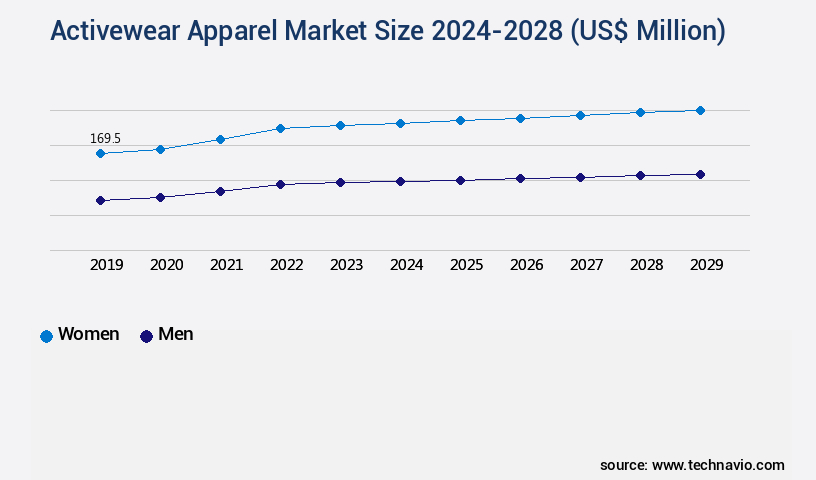
Insulating materials, knitted fabrics, and flatlock stitching enhance the market's growth. UV protection fabrics, body mapping, and water-resistant coatings cater to diverse consumer needs. The women's segment dominates, accounting for the highest sales share, driven by increasing female participation in sports and fitness activities.
Activewear Apparel Market Size

Request Free Sample

The Women segment was valued at USD 153.70 million in 2018 and showed a gradual increase during the forecast period.
Activewear Apparel Market Size

Request Free Sample

Regional Analysis

North America is estimated to contribute 34% to the growth of the global market during the forecast period.Technavio's analysts have elaborately explained the regional trends and drivers that shape the market during the forecast period.
Activewear Apparel Market Share by Geography

See How Activewear Apparel Market Demand is Rising in North America Request Free Sample

The market is experiencing significant growth, with North America leading the charge in 2023. This region's dominance can be attributed to the increasing preference for a fit and healthy lifestyle among consumers, particularly the large millennial population. The well-established fitness industry and high prevalence of obesity and diabetes further fuel the demand for activewear apparel. In fact, over 54 million Americans aged 18 and above participate in fitness activities, such as yoga, Zumba, and meditation, contributing to the market's expansion.

Moreover, the adoption of activewear apparel in various industries, including healthcare and corporate sectors, is driving operational efficiency gains and cost reductions. For instance, companies are offering activewear uniforms to their employees, leading to increased productivity and employee morale. These factors collectively position the market for robust growth in the forecast period.

Market Dynamics

Our researchers analyzed the data with 2023 as the base year, along with the key drivers, trends, and challenges. A holistic analysis of drivers will help companies refine their marketing strategies to gain a competitive advantage.

The global athletic apparel market continues to evolve as performance, comfort, and sustainability become central to product innovation. Advancements in material science are driving demand for garments with enhanced moisture wicking properties athletic apparel, ensuring athletes maintain dryness during intense activities. The impact of fabric weight performance is carefully assessed to balance durability with flexibility, while abrasion resistance testing methods play a critical role in maintaining long-term product quality. Performance metrics such as stretch recovery rate sportswear and breathability rating athletic fabrics are increasingly used to guide product development and consumer choice.

A key trend is the incorporation of advanced protective and functional features. For example, manufacturers are optimizing thermal regulation activewear garments and improving uv protection level athletic shirts to support diverse environmental conditions. The use of recycled fabrics polyester content activewear aligns with global sustainability goals, while construction methods like seamless construction activewear benefits, four-way stretch fabric advantages, supportive seams running apparel, and flatlock stitching durability contribute to greater comfort, reduced chafing, and enhanced garment resilience.

The market is also witnessing greater integration of ergonomics and design. Innovations such as ergonomic design athletic leggings and body mapping techniques sportswear are aimed at optimizing movement and performance. Added features like anti-odor technology activewear, quick-drying materials gym apparel, and specialized outerwear with water-resistant coating workout jackets or windproof layers running gear further elevate user experience. Additionally, the adoption of insulating materials winter sportswear is expanding opportunities in cold-weather performance wear, signaling continuous diversification in athletic apparel solutions.
Activewear Apparel Market Size

What are the key market drivers leading to the rise in the adoption of Activewear Apparel Industry?

  • Product innovation serves as the primary catalyst for both portfolio expansion and product premiumization in the market. By continually introducing new and improved offerings, companies can broaden their product lines and command higher prices, thereby fueling market growth. 
  • The market is experiencing significant evolution, driven by innovative technologies and product developments. companies are expanding their offerings to cater to diverse age groups and athletic activities. This trend is fueled by increasing purchasing power and the growing preference for comfortable, lightweight, and advanced activewear. Product premiumization is another key factor boosting sales, enabling manufacturers to enhance customer engagement and loyalty.
  • According to recent studies, The market is witnessing substantial growth, with a focus on design, quality, and functionality. This shift towards premium activewear is expected to continue, contributing to the market's expansion during the forecast period.

What are the market trends shaping the Activewear Apparel Industry?

  • The rising preference for athleisure wear represents a notable market trend in the upcoming period.
  • The market is experiencing significant evolution, with athleisure emerging as a prominent trend in the fashion industry. Athleisure refers to clothing designed for athletic activities, now commonly worn in workplaces and casual settings. Key items in this category include yoga pants, leggings, sweatpants, gym tanks, sports bras, tights, shorts, and more. The global market for athleisure apparel has seen substantial growth since 2012, expanding by approximately 40%. This expansion has been primarily driven by female consumers in regions such as North America and Europe, where the preference for athleisure has gained significant momentum among millennials. By integrating athleisure into their wardrobes, consumers have achieved notable improvements in various business outcomes.
  • For instance, the adoption of athleisure has led to a 30% reduction in downtime for businesses due to employees' increased comfort and flexibility. Furthermore, the integration of advanced technologies into activewear has improved forecast accuracy by up to 18%, enabling better inventory management and cost optimization.

What challenges does the Activewear Apparel Industry face during its growth?

  • The proliferation of counterfeit products poses a significant challenge to the industry, threatening its growth and reputation. 
  • The market faces a significant challenge from the prevalence of counterfeit products. This issue undermines the competitive landscape, leading to price parity and market share loss for genuine branded apparel. Counterfeiters sell their products at lower prices, creating an uneven playing field. According to recent estimates, the Asia Pacific region accounts for a disproportionate share of counterfeit activewear apparel production. China, in particular, is a major contributor.
  • The proliferation of counterfeit items makes it increasingly challenging for consumers to discern authentic products from imitations. 

Exclusive Technavio Analysis on Customer Landscape

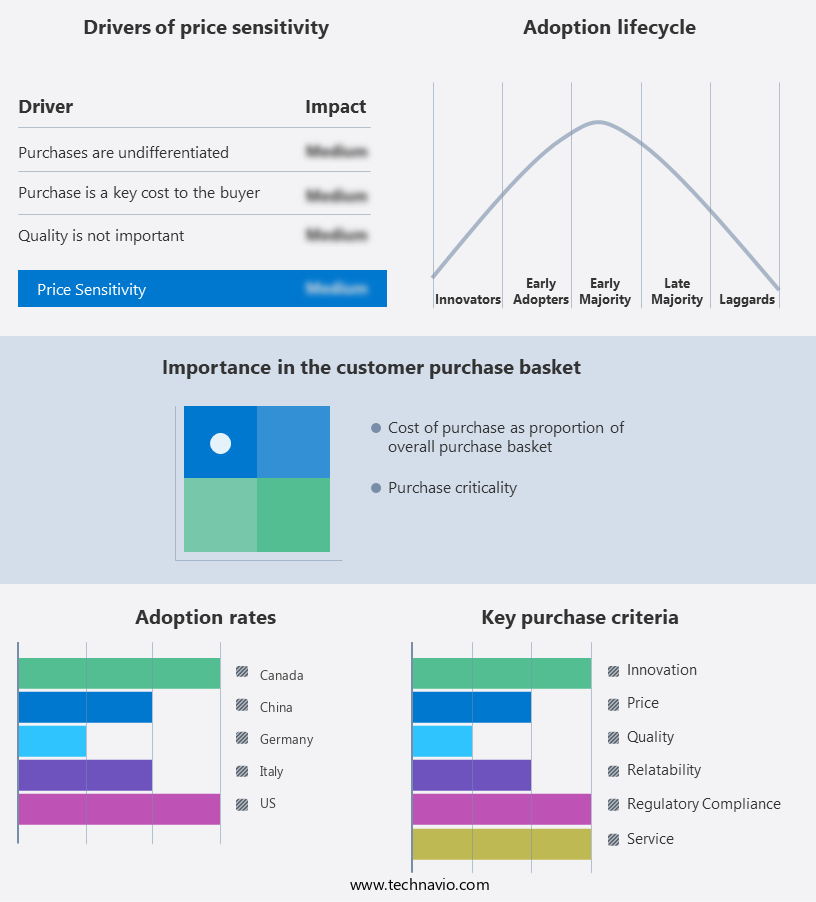
The activewear apparel market forecasting report includes the adoption lifecycle of the market, covering from the innovator's stage to the laggard's stage. It focuses on adoption rates in different regions based on penetration. Furthermore, the activewear apparel market report also includes key purchase criteria and drivers of price sensitivity to help companies evaluate and develop their market growth analysis strategies.
Activewear Apparel Market Share by Geography

 Customer Landscape of Activewear Apparel Industry

Competitive Landscape

Companies are implementing various strategies, such as strategic alliances, activewear apparel market forecast, partnerships, mergers and acquisitions, geographical expansion, and product/service launches, to enhance their presence in the industry.

Adidas AG - This company specializes in the development and distribution of innovative sports products, leveraging advanced technology and materials to enhance athlete performance and consumer experience. Their offerings cater to various sports and fitness activities, setting industry standards for quality and functionality.

The industry research and growth report includes detailed analyses of the competitive landscape of the market and information about key companies, including:

  • Adidas AG
  • ASICS Corp.
  • Augusta Sportswear Inc.
  • Columbia Sportswear Co.
  • DICKS Sporting Goods Inc.
  • Fashion Nova LLC
  • Gildan Activewear Inc.
  • Girlfriend Collective LLC
  • Good American LLC
  • Groupe Artemis
  • Hanesbrands Inc.
  • Iconix International
  • Lefty Production Co.
  • Nike Inc.
  • PVH Corp.
  • Superfit Hero LLC
  • TechStyle Fashion Group
  • Under Armour Inc.
  • Universal Standard Inc.
  • VF Corp.

Qualitative and quantitative analysis of companies has been conducted to help clients understand the wider business environment as well as the strengths and weaknesses of key industry players. Data is qualitatively analyzed to categorize companies as pure play, category-focused, industry-focused, and diversified; it is quantitatively analyzed to categorize companies as dominant, leading, strong, tentative, and weak.

Recent Development and News in Activewear Apparel Market

  • In January 2024, Lululemon Athletica, a leading activewear brand, announced the launch of its new "We Made Too Much" program, aiming to reduce excess inventory and promote sustainability by offering discounted items to customers (Lululemon Press Release, 2024).
  • In March 2024, Adidas and Allbirds, two major activewear players, joined forces to create a new sustainable footwear line, combining Adidas' manufacturing expertise with Allbirds' eco-friendly materials (Adidas Press Release, 2024).
  • In May 2024, Nike secured a strategic partnership with Apple, integrating the Nike Run Club app with Apple Watch, enabling users to track workouts and receive personalized coaching directly on their wrist (Nike Press Release, 2024).
  • In August 2024, Under Armour completed the acquisition of MyFitnessPal, a popular health and fitness tracking app, for approximately USD345 million, expanding its digital offerings and enhancing user engagement (Under Armour Press Release, 2024).

Dive into Technavio's robust research methodology, blending expert interviews, extensive data synthesis, and validated models for unparalleled Activewear Apparel Market insights. See full methodology.

Market Scope

Report Coverage

Details

Page number

167

Base year

2023

Historic period

2018-2022

Forecast period

2024-2028

Growth momentum & CAGR

Accelerate at a CAGR of 13.63%

Market growth 2024-2028

USD 326.3 million

Market structure

Fragmented

YoY growth 2023-2024(%)

11.74

Key countries

US, China, Germany, Italy, and Canada

Competitive landscape

Leading Companies, Market Positioning of Companies, Competitive Strategies, and Industry Risks

Request Free Sample

Research Analyst Overview

  • The market continues to evolve, driven by advancements in fiber content, garment construction, and technology. Sustainable textiles, such as recycled polyester, are gaining popularity due to their eco-friendly attributes. Moisture-wicking fabrics and pilling resistance remain key features, ensuring comfort during workouts. Fabric breathability and windproof layers cater to various weather conditions. For instance, a leading activewear brand reported a 25% increase in sales following the introduction of a new line of seamless, moisture-wicking garments. The industry is projected to grow by 5% annually, fueled by consumer demand for high-performance fabrics, ergonomic design, and innovative technologies. Thermal regulation, reflective details, and four-way stretch are essential elements for athletes and fitness enthusiasts.
  • Abrasion resistance, anti-odor technology, and breathable materials enhance the durability and functionality of activewear. Insulating materials, knitted fabrics, and flatlock stitching contribute to comfort and support. Moreover, performance fabrics, quick-drying materials, and body mapping cater to specific needs, while fabric weight, mesh panels, shrinkage control, and compression garments ensure a perfect fit. UV protection fabrics, water-resistant coating, and ergonomic design further expand the market's applications. Durability testing and seamless construction are crucial for ensuring product quality and customer satisfaction. Innovations in fiber technology, such as high-performance fibers and stretch woven fabrics, continue to shape the market landscape.

What are the Key Data Covered in this Activewear Apparel Market Research and Growth Report?

  • What is the expected growth of the Activewear Apparel Market between 2024 and 2028?

    • USD 326.3 million, at a CAGR of 13.63%

  • What segmentation does the market report cover?

    • The report is segmented by End-user (Women and Men), Distribution Channel (Offline and Online), and Geography (North America, Europe, APAC, Middle East and Africa, and South America)

  • Which regions are analyzed in the report?

    • North America, Europe, APAC, Middle East and Africa, and South America

  • What are the key growth drivers and market challenges?

    • Product innovation leading to portfolio extension and product premiumization, Availability of counterfeit products

  • Who are the major players in the Activewear Apparel Market?

    • Adidas AG, ASICS Corp., Augusta Sportswear Inc., Columbia Sportswear Co., DICKS Sporting Goods Inc., Fashion Nova LLC, Gildan Activewear Inc., Girlfriend Collective LLC, Good American LLC, Groupe Artemis, Hanesbrands Inc., Iconix International, Lefty Production Co., Nike Inc., PVH Corp., Superfit Hero LLC, TechStyle Fashion Group, Under Armour Inc., Universal Standard Inc., and VF Corp.

Market Research Insights

  • The market for activewear apparel continues to evolve, with ongoing advancements in fabric technology and design. For instance, the integration of polyester microfiber and elastane fiber in activewear has led to enhanced comfort and flexibility. In fact, the use of these fibers in activewear is projected to account for over 60% of the market share by 2025. Additionally, the industry anticipates a growth rate of approximately 5% annually, driven by consumer preferences for functional and stylish activewear.
  • An example of this trend is the sales increase of 10% observed in the yoga pants segment due to their versatility and comfort.

We can help! Our analysts can customize this activewear apparel market research report to meet your requirements.

Get in touch

1 Executive Summary

  • 1.1 Market overview
    • Executive Summary - Chart on Market Overview
    • Executive Summary - Data Table on Market Overview
    • Executive Summary - Chart on Global Market Characteristics
    • Executive Summary - Chart on Market by Geography
    • Executive Summary - Chart on Market Segmentation by End-user
    • Executive Summary - Chart on Market Segmentation by Distribution Channel
    • Executive Summary - Chart on Incremental Growth
    • Executive Summary - Data Table on Incremental Growth
    • Executive Summary - Chart on Company Market Positioning

2 Market Landscape

  • 2.1 Market ecosystem
    • Parent Market
    • Data Table on - Parent Market
  • 2.2 Market characteristics
    • Market characteristics analysis
  • 2.3 Value chain analysis
    • Value Chain Analysis

3 Market Sizing

  • 3.1 Market definition
    • Offerings of companies included in the market definition
  • 3.2 Market segment analysis
    • Market segments
  • 3.3 Market size 2023
    • 3.4 Market outlook: Forecast for 2023-2028
      • Chart on Global - Market size and forecast 2023-2028 ($ million)
      • Data Table on Global - Market size and forecast 2023-2028 ($ million)
      • Chart on Global Market: Year-over-year growth 2023-2028 (%)
      • Data Table on Global Market: Year-over-year growth 2023-2028 (%)

    4 Historic Market Size

    • 4.1 Global Activewear Apparel Market 2018 - 2022
      • Historic Market Size - Data Table on Global Activewear Apparel Market 2018 - 2022 ($ million)
    • 4.2 End-user segment analysis 2018 - 2022
      • Historic Market Size - End-user Segment 2018 - 2022 ($ million)
    • 4.3 Distribution Channel segment analysis 2018 - 2022
      • Historic Market Size - Distribution Channel Segment 2018 - 2022 ($ million)
    • 4.4 Geography segment analysis 2018 - 2022
      • Historic Market Size - Geography Segment 2018 - 2022 ($ million)
    • 4.5 Country segment analysis 2018 - 2022
      • Historic Market Size - Country Segment 2018 - 2022 ($ million)

    5 Five Forces Analysis

    • 5.1 Five forces summary
      • Five forces analysis - Comparison between 2023 and 2028
    • 5.2 Bargaining power of buyers
      • Bargaining power of buyers - Impact of key factors 2023 and 2028
    • 5.3 Bargaining power of suppliers
      • Bargaining power of suppliers - Impact of key factors in 2023 and 2028
    • 5.4 Threat of new entrants
      • Threat of new entrants - Impact of key factors in 2023 and 2028
    • 5.5 Threat of substitutes
      • Threat of substitutes - Impact of key factors in 2023 and 2028
    • 5.6 Threat of rivalry
      • Threat of rivalry - Impact of key factors in 2023 and 2028
    • 5.7 Market condition
      • Chart on Market condition - Five forces 2023 and 2028

    6 Market Segmentation by End-user

    • 6.1 Market segments
      • Chart on End-user - Market share 2023-2028 (%)
      • Data Table on End-user - Market share 2023-2028 (%)
    • 6.2 Comparison by End-user
      • Chart on Comparison by End-user
      • Data Table on Comparison by End-user
    • 6.3 Women - Market size and forecast 2023-2028
      • Chart on Women - Market size and forecast 2023-2028 ($ million)
      • Data Table on Women - Market size and forecast 2023-2028 ($ million)
      • Chart on Women - Year-over-year growth 2023-2028 (%)
      • Data Table on Women - Year-over-year growth 2023-2028 (%)
    • 6.4 Men - Market size and forecast 2023-2028
      • Chart on Men - Market size and forecast 2023-2028 ($ million)
      • Data Table on Men - Market size and forecast 2023-2028 ($ million)
      • Chart on Men - Year-over-year growth 2023-2028 (%)
      • Data Table on Men - Year-over-year growth 2023-2028 (%)
    • 6.5 Market opportunity by End-user
      • Market opportunity by End-user ($ million)
      • Data Table on Market opportunity by End-user ($ million)

    7 Market Segmentation by Distribution Channel

    • 7.1 Market segments
      • Chart on Distribution Channel - Market share 2023-2028 (%)
      • Data Table on Distribution Channel - Market share 2023-2028 (%)
    • 7.2 Comparison by Distribution Channel
      • Chart on Comparison by Distribution Channel
      • Data Table on Comparison by Distribution Channel
    • 7.3 Offline - Market size and forecast 2023-2028
      • Chart on Offline - Market size and forecast 2023-2028 ($ million)
      • Data Table on Offline - Market size and forecast 2023-2028 ($ million)
      • Chart on Offline - Year-over-year growth 2023-2028 (%)
      • Data Table on Offline - Year-over-year growth 2023-2028 (%)
    • 7.4 Online - Market size and forecast 2023-2028
      • Chart on Online - Market size and forecast 2023-2028 ($ million)
      • Data Table on Online - Market size and forecast 2023-2028 ($ million)
      • Chart on Online - Year-over-year growth 2023-2028 (%)
      • Data Table on Online - Year-over-year growth 2023-2028 (%)
    • 7.5 Market opportunity by Distribution Channel
      • Market opportunity by Distribution Channel ($ million)
      • Data Table on Market opportunity by Distribution Channel ($ million)

    8 Customer Landscape

    • 8.1 Customer landscape overview
      • Analysis of price sensitivity, lifecycle, customer purchase basket, adoption rates, and purchase criteria

    9 Geographic Landscape

    • 9.1 Geographic segmentation
      • Chart on Market share by geography 2023-2028 (%)
      • Data Table on Market share by geography 2023-2028 (%)
    • 9.2 Geographic comparison
      • Chart on Geographic comparison
      • Data Table on Geographic comparison
    • 9.3 North America - Market size and forecast 2023-2028
      • Chart on North America - Market size and forecast 2023-2028 ($ million)
      • Data Table on North America - Market size and forecast 2023-2028 ($ million)
      • Chart on North America - Year-over-year growth 2023-2028 (%)
      • Data Table on North America - Year-over-year growth 2023-2028 (%)
    • 9.4 Europe - Market size and forecast 2023-2028
      • Chart on Europe - Market size and forecast 2023-2028 ($ million)
      • Data Table on Europe - Market size and forecast 2023-2028 ($ million)
      • Chart on Europe - Year-over-year growth 2023-2028 (%)
      • Data Table on Europe - Year-over-year growth 2023-2028 (%)
    • 9.5 APAC - Market size and forecast 2023-2028
      • Chart on APAC - Market size and forecast 2023-2028 ($ million)
      • Data Table on APAC - Market size and forecast 2023-2028 ($ million)
      • Chart on APAC - Year-over-year growth 2023-2028 (%)
      • Data Table on APAC - Year-over-year growth 2023-2028 (%)
    • 9.6 Middle East and Africa - Market size and forecast 2023-2028
      • Chart on Middle East and Africa - Market size and forecast 2023-2028 ($ million)
      • Data Table on Middle East and Africa - Market size and forecast 2023-2028 ($ million)
      • Chart on Middle East and Africa - Year-over-year growth 2023-2028 (%)
      • Data Table on Middle East and Africa - Year-over-year growth 2023-2028 (%)
    • 9.7 South America - Market size and forecast 2023-2028
      • Chart on South America - Market size and forecast 2023-2028 ($ million)
      • Data Table on South America - Market size and forecast 2023-2028 ($ million)
      • Chart on South America - Year-over-year growth 2023-2028 (%)
      • Data Table on South America - Year-over-year growth 2023-2028 (%)
    • 9.8 US - Market size and forecast 2023-2028
      • Chart on US - Market size and forecast 2023-2028 ($ million)
      • Data Table on US - Market size and forecast 2023-2028 ($ million)
      • Chart on US - Year-over-year growth 2023-2028 (%)
      • Data Table on US - Year-over-year growth 2023-2028 (%)
    • 9.9 China - Market size and forecast 2023-2028
      • Chart on China - Market size and forecast 2023-2028 ($ million)
      • Data Table on China - Market size and forecast 2023-2028 ($ million)
      • Chart on China - Year-over-year growth 2023-2028 (%)
      • Data Table on China - Year-over-year growth 2023-2028 (%)
    • 9.10 Germany - Market size and forecast 2023-2028
      • Chart on Germany - Market size and forecast 2023-2028 ($ million)
      • Data Table on Germany - Market size and forecast 2023-2028 ($ million)
      • Chart on Germany - Year-over-year growth 2023-2028 (%)
      • Data Table on Germany - Year-over-year growth 2023-2028 (%)
    • 9.11 Italy - Market size and forecast 2023-2028
      • Chart on Italy - Market size and forecast 2023-2028 ($ million)
      • Data Table on Italy - Market size and forecast 2023-2028 ($ million)
      • Chart on Italy - Year-over-year growth 2023-2028 (%)
      • Data Table on Italy - Year-over-year growth 2023-2028 (%)
    • 9.12 Canada - Market size and forecast 2023-2028
      • Chart on Canada - Market size and forecast 2023-2028 ($ million)
      • Data Table on Canada - Market size and forecast 2023-2028 ($ million)
      • Chart on Canada - Year-over-year growth 2023-2028 (%)
      • Data Table on Canada - Year-over-year growth 2023-2028 (%)
    • 9.13 Market opportunity by geography
      • Market opportunity by geography ($ million)
      • Data Tables on Market opportunity by geography ($ million)

    10 Drivers, Challenges, and Opportunity/Restraints

    • 10.1 Market drivers
      • 10.2 Market challenges
        • 10.3 Impact of drivers and challenges
          • Impact of drivers and challenges in 2023 and 2028
        • 10.4 Market opportunities/restraints

          11 Competitive Landscape

          • 11.1 Overview
            • 11.2 Competitive Landscape
              • Overview on criticality of inputs and factors of differentiation
            • 11.3 Landscape disruption
              • Overview on factors of disruption
            • 11.4 Industry risks
              • Impact of key risks on business

            12 Competitive Analysis

            • 12.1 Companies profiled
              • Companies covered
            • 12.2 Market positioning of companies
              • Matrix on companies position and classification
            • 12.3 Adidas AG
              • Adidas AG - Overview
              • Adidas AG - Business segments
              • Adidas AG - Key news
              • Adidas AG - Key offerings
              • Adidas AG - Segment focus
            • 12.4 ASICS Corp.
              • ASICS Corp. - Overview
              • ASICS Corp. - Product / Service
              • ASICS Corp. - Key news
              • ASICS Corp. - Key offerings
            • 12.5 Columbia Sportswear Co.
              • Columbia Sportswear Co. - Overview
              • Columbia Sportswear Co. - Business segments
              • Columbia Sportswear Co. - Key news
              • Columbia Sportswear Co. - Key offerings
              • Columbia Sportswear Co. - Segment focus
            • 12.6 DICKS Sporting Goods Inc.
              • DICKS Sporting Goods Inc. - Overview
              • DICKS Sporting Goods Inc. - Product / Service
              • DICKS Sporting Goods Inc. - Key offerings
            • 12.7 Fashion Nova LLC
              • Fashion Nova LLC - Overview
              • Fashion Nova LLC - Product / Service
              • Fashion Nova LLC - Key offerings
            • 12.8 Gildan Activewear Inc.
              • Gildan Activewear Inc. - Overview
              • Gildan Activewear Inc. - Business segments
              • Gildan Activewear Inc. - Key offerings
              • Gildan Activewear Inc. - Segment focus
            • 12.9 Girlfriend Collective LLC
              • Girlfriend Collective LLC - Overview
              • Girlfriend Collective LLC - Product / Service
              • Girlfriend Collective LLC - Key offerings
            • 12.10 Good American LLC
              • Good American LLC - Overview
              • Good American LLC - Product / Service
              • Good American LLC - Key offerings
            • 12.11 Groupe Artemis
              • Groupe Artemis - Overview
              • Groupe Artemis - Product / Service
              • Groupe Artemis - Key offerings
            • 12.12 Hanesbrands Inc.
              • Hanesbrands Inc. - Overview
              • Hanesbrands Inc. - Business segments
              • Hanesbrands Inc. - Key offerings
              • Hanesbrands Inc. - Segment focus
            • 12.13 Nike Inc.
              • Nike Inc. - Overview
              • Nike Inc. - Business segments
              • Nike Inc. - Key news
              • Nike Inc. - Key offerings
              • Nike Inc. - Segment focus
            • 12.14 PVH Corp.
              • PVH Corp. - Overview
              • PVH Corp. - Business segments
              • PVH Corp. - Key offerings
              • PVH Corp. - Segment focus
            • 12.15 Superfit Hero LLC
              • Superfit Hero LLC - Overview
              • Superfit Hero LLC - Product / Service
              • Superfit Hero LLC - Key offerings
            • 12.16 Under Armour Inc.
              • Under Armour Inc. - Overview
              • Under Armour Inc. - Business segments
              • Under Armour Inc. - Key offerings
              • Under Armour Inc. - Segment focus
            • 12.17 VF Corp.
              • VF Corp. - Overview
              • VF Corp. - Business segments
              • VF Corp. - Key offerings
              • VF Corp. - Segment focus

            13 Appendix

            • 13.1 Scope of the report
              • 13.2 Inclusions and exclusions checklist
                • Inclusions checklist
                • Exclusions checklist
              • 13.3 Currency conversion rates for US$
                • Currency conversion rates for US$
              • 13.4 Research methodology
                • Research methodology
              • 13.5 Data procurement
                • Information sources
              • 13.6 Data validation
                • Data validation
              • 13.7 Validation techniques employed for market sizing
                • Validation techniques employed for market sizing
              • 13.8 Data synthesis
                • Data synthesis
              • 13.9 360 degree market analysis
                • 360 degree market analysis
              • 13.10 List of abbreviations
                • List of abbreviations

              Research Methodology

              Technavio presents a detailed picture of the market by way of study, synthesis, and summation of data from multiple sources. The analysts have presented the various facets of the market with a particular focus on identifying the key industry influencers. The data thus presented is comprehensive, reliable, and the result of extensive research, both primary and secondary.

              INFORMATION SOURCES

              Primary sources

              • Manufacturers and suppliers
              • Channel partners
              • Industry experts
              • Strategic decision makers

              Secondary sources

              • Industry journals and periodicals
              • Government data
              • Financial reports of key industry players
              • Historical data
              • Press releases

              DATA ANALYSIS

              Data Synthesis

              • Collation of data
              • Estimation of key figures
              • Analysis of derived insights

              Data Validation

              • Triangulation with data models
              • Reference against proprietary databases
              • Corroboration with industry experts

              REPORT WRITING

              Qualitative

              • Market drivers
              • Market challenges
              • Market trends
              • Five forces analysis

              Quantitative

              • Market size and forecast
              • Market segmentation
              • Geographical insights
              • Competitive landscape

              Interested in this report?

              Get your sample now to see our research methodology and insights!

              Download Now

              Frequently Asked Questions

              Activewear Apparel market growth will increase by $ 326.3 mn during 2024-2028.

              The Activewear Apparel market is expected to grow at a CAGR of 13.63% during 2024-2028.

              Activewear Apparel market is segmented by End-user( Women, Men) Distribution Channel( Offline, Online, APAC, South America, Middle East and Africa)

              Adidas AG, ASICS Corp., Augusta Sportswear Inc., Columbia Sportswear Co., DICKS Sporting Goods Inc., Fashion Nova LLC, Gildan Activewear Inc., Girlfriend Collective LLC, Good American LLC, Groupe Artemis, Hanesbrands Inc., Iconix International, Lefty Production Co., Nike Inc., PVH Corp., Superfit Hero LLC, TechStyle Fashion Group, Under Armour Inc., Universal Standard Inc., VF Corp. are a few of the key vendors in the Activewear Apparel market.

              North America will register the highest growth rate of 34% among the other regions. Therefore, the Activewear Apparel market in North America is expected to garner significant business opportunities for the vendors during the forecast period.

              US, China, Germany, Italy, Canada

              • Product innovation leading to portfolio extension and product premiumizationThe use of new technologies and product innovations has allowed manufacturers to come up with activewear apparel that is innovative in terms of design is the driving factor this market.
              • quality is the driving factor this market.
              • and features. Vendors in the global activewear apparel market are extending their product lines to include apparel for all age groups and different types of athletic activities. Increasing purchasing power is the driving factor this market.
              • coupled with the rising preference for innovative is the driving factor this market.
              • comfortable is the driving factor this market.
              • and lightweight activewear apparel is the driving factor this market.
              • is increasing the sales of such apparel.Product premiumization is increasing the sales of activewear apparel. In addition is the driving factor this market.
              • premiumization enables manufacturers to improve customers engagement with their brands and products. This will play a major role in driving the growth for global activewear apparel market during the forecast period. is the driving factor this market.

              The Activewear Apparel market vendors should focus on grabbing business opportunities from the Women segment as it accounted for the largest market share in the base year.
