


Agriculture Analytics Market Size 2026-2030
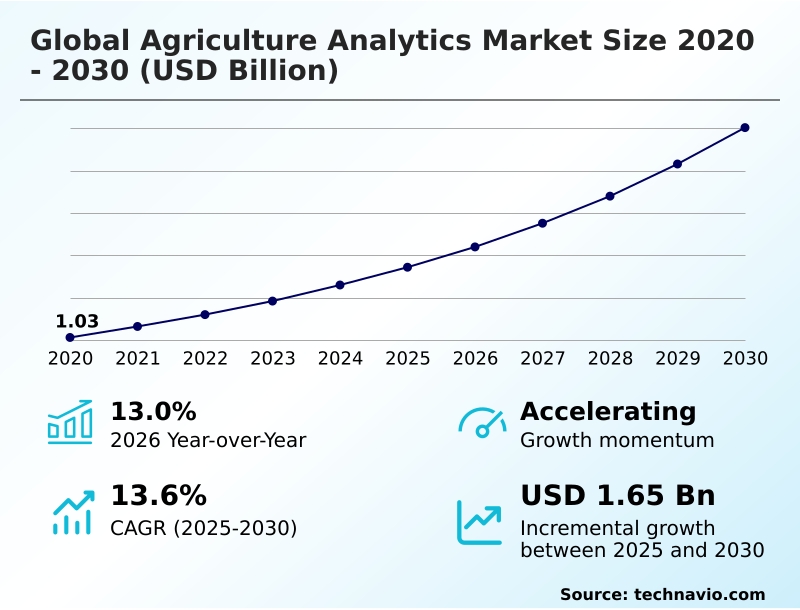
The agriculture analytics market size is valued to increase by USD 1.65 billion, at a CAGR of 13.6% from 2025 to 2030. Convergence of advanced technologies and enhanced data integration will drive the agriculture analytics market.
Major Market Trends & Insights
- North America dominated the market and accounted for a 43.4% growth during the forecast period.
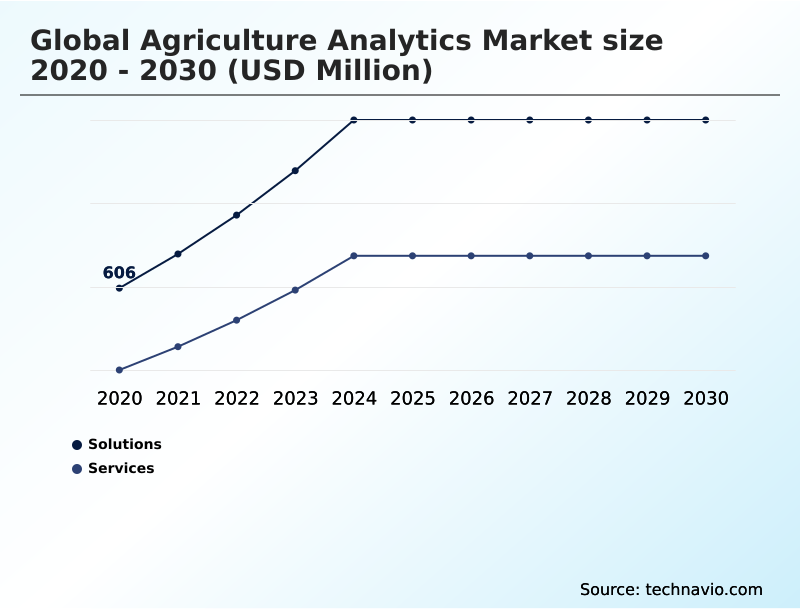
- By Type - Solutions segment was valued at USD 971.1 million in 2024
- By Application - Precision farming segment accounted for the largest market revenue share in 2024
Market Size & Forecast
- Market Opportunities: USD 2.48 billion
- Market Future Opportunities: USD 1.65 billion
- CAGR from 2025 to 2030 : 13.6%
Market Summary
- The agriculture analytics market is undergoing a fundamental transformation, shifting from traditional practices to a data-centric, precision-driven model. This evolution is propelled by the need to enhance food production efficiency and sustainability for a growing global population.
- Key technologies such as precision agriculture software, IoT in farming, and AI for crop management enable the collection and analysis of vast datasets related to soil conditions, weather patterns, and crop health. By leveraging data-driven agriculture principles, agribusinesses can make more informed decisions.
- For instance, an operator can use an integrated agriculture analytics platform to synthesize real-time drone data and satellite imagery to create precise variable rate application maps for fertilizers, optimizing input costs while complying with environmental regulations. The rise of sustainable farming technology and the demand for food traceability solutions further drive adoption.
- However, challenges related to data fragmentation and the need for new data interoperability standards can hinder the seamless flow of information across different systems, impacting the full potential of agribusiness intelligence and smart farming solutions.
What will be the Size of the Agriculture Analytics Market during the forecast period?
Get Key Insights on Market Forecast (PDF) Get Free Sample
How is the Agriculture Analytics Market Segmented?
The agriculture analytics industry research report provides comprehensive data (region-wise segment analysis), with forecasts and estimates in "USD million" for the period 2026-2030, as well as historical data from 2020-2024 for the following segments.
- Type
- Solutions
- Services
- Application
- Precision farming
- Livestock farming
- Aquaculture farming
- Vertical farming
- Others
- Deployment
- Cloud based
- On premises
- Geography
- North America
- US
- Canada
- Mexico
- Europe
- Germany
- UK
- France
- APAC
- China
- Japan
- India
- South America
- Brazil
- Argentina
- Colombia
- Middle East and Africa
- Saudi Arabia
- UAE
- South Africa
- Rest of World (ROW)
- North America
By Type Insights
The solutions segment is estimated to witness significant growth during the forecast period.
The solutions segment is defined by a shift toward integrated systems that provide actionable intelligence. Modern offerings encompass comprehensive agriculture analytics platforms and holistic smart farming solutions that leverage agritech data integration to create a unified operational view.
These systems utilize AI algorithms and machine learning for data-driven agriculture, moving beyond simple data collection. Core functionalities include real-time livestock monitoring and precision farming capabilities powered by a network of IoT sensors.
The adoption of AI for crop management has demonstrated tangible results, with some applications achieving up to a 4% reduction in critical inputs like feed.
This evolution from standalone tools to cohesive, intelligent platforms is central to improving on-farm efficiency and decision-making accuracy.
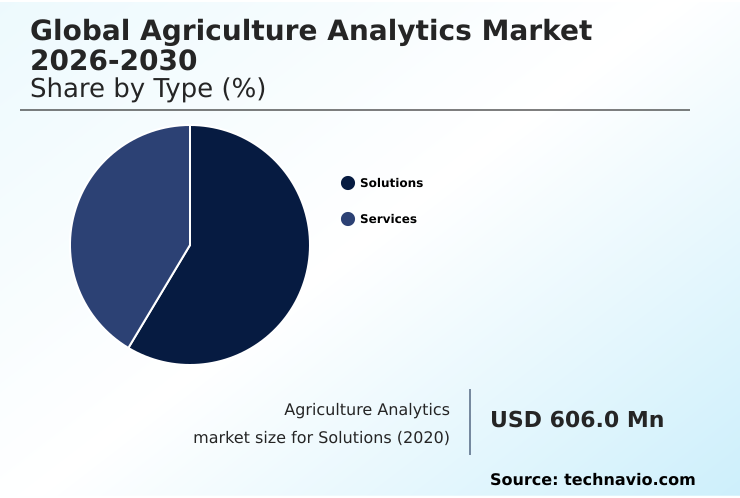
The Solutions segment was valued at USD 971.1 million in 2024 and showed a gradual increase during the forecast period.
Regional Analysis
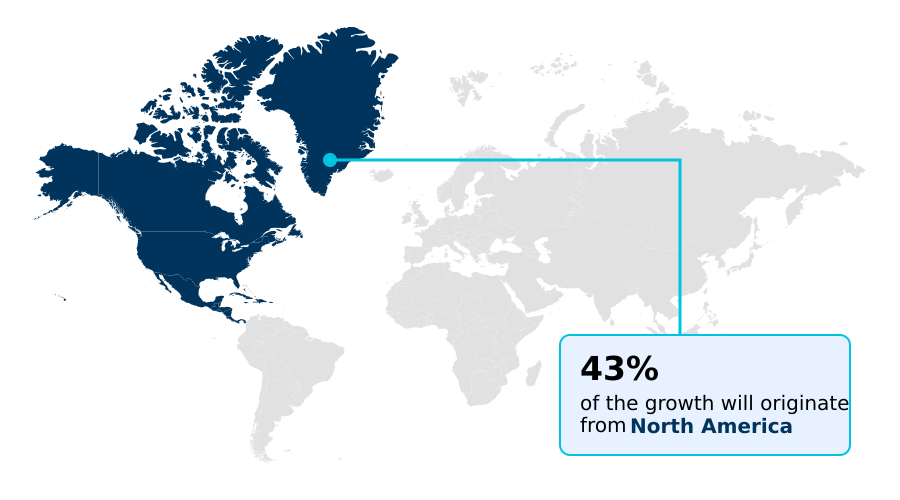
North America is estimated to contribute 43.4% to the growth of the global market during the forecast period.Technavio’s analysts have elaborately explained the regional trends and drivers that shape the market during the forecast period.
See How Agriculture Analytics Market Demand is Rising in North America Get Free Sample
The geographic landscape is led by North America, which accounts for over 43% of the market's incremental growth, driven by large-scale adoption of integrated farm management systems (FMS) and digital twin models for operational planning.
In Europe, policy mandates are accelerating the use of platforms for ESG tracking and supply chain traceability, often leveraging blockchain in agriculture.
The APAC region shows the fastest expansion, with a focus on deploying farm robotics analytics to address labor shortages. Demand for agricultural supply chain visibility is global, compelling producers to adopt carbon credit verification tech and regenerative agriculture data platforms.
The maturity of on-farm data processing varies, but the overall trend is toward greater data integration to enhance productivity and meet international standards.
Market Dynamics
Our researchers analyzed the data with 2025 as the base year, along with the key drivers, trends, and challenges. A holistic analysis of drivers will help companies refine their marketing strategies to gain a competitive advantage.
- The practical implementation of advanced technology is reshaping modern agriculture, with a focus on achieving tangible outcomes. The practice of using ai for pest outbreak prediction is becoming a cornerstone of proactive crop management, moving beyond reactive treatments.
- Similarly, leveraging iot sensor data for precise irrigation and satellite imagery for crop health monitoring are key tactics for resource optimization and reducing water usage with analytics tools. The primary goal remains improving farm yield with precision farming, a task increasingly supported by real-time crop monitoring solutions and alerts.
- In animal agriculture, livestock health monitoring using wearables and software for analyzing livestock behavior with software offer unprecedented insights. The entire value chain is being transformed by blockchain for food supply chain traceability. Despite these advances, calculating roi of agriculture analytics software remains a critical concern for producers.
- A significant technical hurdle is solving data interoperability in agritech platforms, which currently limits the effectiveness of using cloud platforms for farm data analysis. Farms with integrated, ai-powered farm management systems show resource efficiency gains that are often double those of operations still struggling with siloed data.
- The industry is also seeing specialized tools, such as those for drone analytics for high-value crop management and creating digital twins for farm simulation, becoming more common.
- Ultimately, success hinges on machine learning for accurate yield forecasting, optimizing fertilizer with variable rate application, integrating weather forecast data in farming, and ensuring ESG reporting automation in agriculture is seamless, which all contribute to implementing data-driven sustainable farming practices.
What are the key market drivers leading to the rise in the adoption of Agriculture Analytics Industry?
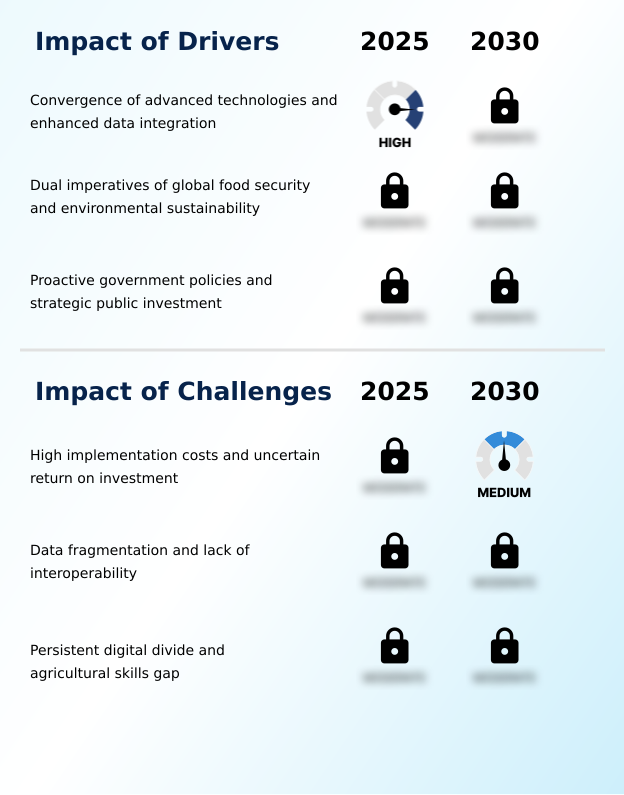
- The convergence of advanced technologies, including AI, IoT, and cloud computing, coupled with enhanced data integration, serves as the primary driver accelerating market expansion.
- A primary market driver is the synergistic convergence of advanced technologies. The expansion is fueled by the integration of cloud computing for scalable data processing, high-resolution satellite imagery, and granular drone data into user-friendly platforms.
- This fusion of hardware and software enables precise yield forecasting and early pest detection, transforming farm management. The proliferation of IoT in farming provides the continuous data stream necessary for these advanced analytics.
- Specialized precision agriculture software and livestock analytics tools are becoming essential.
- Moreover, the growth in controlled environments is supported by sophisticated aquaculture monitoring systems and vertical farming analytics, with some farms reporting a 20% increase in productivity through optimized resource management, underscoring the shift toward data-centric operations.
What are the market trends shaping the Agriculture Analytics Industry?
- A defining trend is the market's evolution from descriptive analytics toward advanced predictive and prescriptive capabilities, equipping stakeholders with forward-looking insights and actionable recommendations for proactive decision-making.
- A defining trend is the evolution toward proactive management through predictive pest modeling and remote sensing technology. The market is shifting from reactive measures to climate-resilient agriculture strategies guided by advanced analytics. This transition is powered by autonomous machinery and agricultural robotics, which depend on real-time analysis of hyperspectral imaging and genomic data analysis.
- The implementation of a digital agriculture mission in several nations aims to standardize data, promoting the adoption of food traceability solutions and smart greenhouse controls. However, achieving true data interoperability standards remains a critical goal, with current fragmentation limiting the full potential of integrated systems and causing inefficiencies that can reduce operational cost savings by up to 15%.
What challenges does the Agriculture Analytics Industry face during its growth?
- High implementation costs and the difficulty in forecasting a clear return on investment present a significant challenge to widespread market adoption and industry growth.
- Key challenges temper the market’s growth trajectory, primarily centered on implementation hurdles and skill gaps. While the benefits of sustainable farming technology and robust farm data management are recognized, the high upfront cost of equipment for variable rate application and systems that manage telematics data is a major barrier; nearly 50% of farmers cite cost as a primary deterrent.
- A significant skills deficit also exists, with 52% of the workforce lacking advanced technical knowledge. Effective water management and crop scouting require data literacy, yet only 40% feel confident using these tools. This gap hinders the potential of agribusiness intelligence and advanced crop yield prediction models powered by technologies like automated irrigation systems and detailed soil health analysis.
Exclusive Technavio Analysis on Customer Landscape
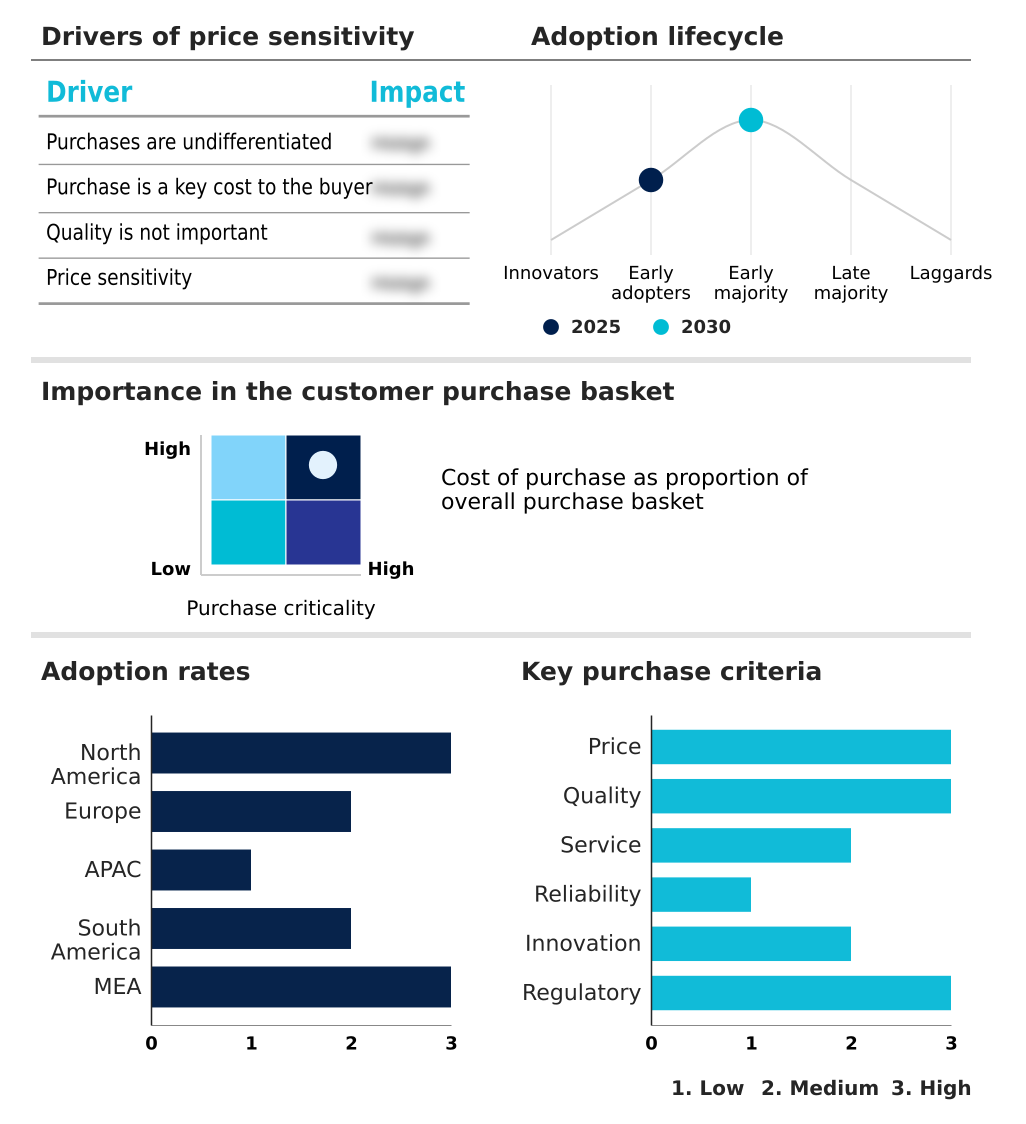
The agriculture analytics market forecasting report includes the adoption lifecycle of the market, covering from the innovator’s stage to the laggard’s stage. It focuses on adoption rates in different regions based on penetration. Furthermore, the agriculture analytics market report also includes key purchase criteria and drivers of price sensitivity to help companies evaluate and develop their market growth analysis strategies.
Customer Landscape of Agriculture Analytics Industry
Competitive Landscape
Companies are implementing various strategies, such as strategic alliances, agriculture analytics market forecast, partnerships, mergers and acquisitions, geographical expansion, and product/service launches, to enhance their presence in the industry.
A.A.A Taranis Visual Ltd. - Offerings focus on integrated platforms for precision farming, delivering AI-driven insights for yield forecasting, resource optimization, and automated operational control.
The industry research and growth report includes detailed analyses of the competitive landscape of the market and information about key companies, including:
- A.A.A Taranis Visual Ltd.
- Accenture PLC
- AGCO Corp.
- Agribotix
- Bayer AG
- Conservis Corp.
- Corteva Inc.
- Cropin Technology
- Deere and Co.
- Farmers Edge Inc.
- IBM Corp.
- Iteris Inc.
- Microsoft Corp.
- Oracle Corp.
- PrecisionHawk Inc.
- SAP SE
- Trimble Inc.
- Vistex Inc.
- Wipro Ltd.
- Xylem Inc.
Qualitative and quantitative analysis of companies has been conducted to help clients understand the wider business environment as well as the strengths and weaknesses of key industry players. Data is qualitatively analyzed to categorize companies as pure play, category-focused, industry-focused, and diversified; it is quantitatively analyzed to categorize companies as dominant, leading, strong, tentative, and weak.
Recent Development and News in Agriculture analytics market
- In March 2025, a major European grocery retail conglomerate mandated that its fresh produce suppliers implement certified analytics platforms to track and report on key sustainability metrics, including water usage and on-farm carbon emissions.
- In April 2025, a leading autonomous agricultural machinery manufacturer announced a strategic partnership with a global cloud computing provider to launch an integrated farm management platform utilizing AI for predictive modeling of pest outbreaks.
- In January 2025, Lindsay Corp. formed a strategic partnership with Pessl Instruments to integrate field-level weather and soil data directly into its advanced irrigation management platform, enhancing decision-making capabilities for farmers.
- In May 2025, an international consortium of impact investors launched a multi-billion dollar fund dedicated to scaling technologies for regenerative agriculture, with a core funding requirement for companies to use advanced analytics to quantify environmental impacts.
Dive into Technavio’s robust research methodology, blending expert interviews, extensive data synthesis, and validated models for unparalleled Agriculture Analytics Market insights. See full methodology.
| Market Scope | |
|---|---|
| Page number | 308 |
| Base year | 2025 |
| Historic period | 2020-2024 |
| Forecast period | 2026-2030 |
| Growth momentum & CAGR | Accelerate at a CAGR of 13.6% |
| Market growth 2026-2030 | USD 1651.7 million |
| Market structure | Fragmented |
| YoY growth 2025-2026(%) | 13.0% |
| Key countries | US, Canada, Mexico, Germany, UK, France, Italy, The Netherlands, Spain, China, Japan, India, South Korea, Australia, Indonesia, Brazil, Argentina, Colombia, Saudi Arabia, UAE, South Africa, Israel and Turkey |
| Competitive landscape | Leading Companies, Market Positioning of Companies, Competitive Strategies, and Industry Risks |
Research Analyst Overview
- The agriculture analytics market is characterized by the continuous integration of advanced digital tools into core farming operations. The adoption of precision farming is foundational, supported by a network of IoT sensors, satellite imagery, and drone data that feed sophisticated AI algorithms. These systems utilize machine learning and cloud computing to enable precise yield forecasting and early pest detection.
- In animal agriculture, livestock monitoring is becoming increasingly sophisticated. For boardroom-level strategy, the implementation of blockchain in agriculture for supply chain traceability is critical for meeting ESG tracking mandates. On the operational side, farm management systems (FMS) are evolving to incorporate digital twin models for simulation and telematics data from autonomous machinery for efficiency gains.
- These integrated platforms have demonstrated significant impact, with some users reporting a 4% reduction in key input costs. The use of hyperspectral imaging and remote sensing technology is advancing crop scouting and soil health analysis, while agricultural robotics and predictive pest modeling are automating complex tasks, including variable rate application based on genomic data analysis.
What are the Key Data Covered in this Agriculture Analytics Market Research and Growth Report?
-
What is the expected growth of the Agriculture Analytics Market between 2026 and 2030?
-
USD 1.65 billion, at a CAGR of 13.6%
-
-
What segmentation does the market report cover?
-
The report is segmented by Type (Solutions, and Services), Application (Precision farming, Livestock monitoring, Aquaculture farming, Vertical farming, and Others), Deployment (Cloud based, and On premises) and Geography (North America, Europe, APAC, South America, Middle East and Africa)
-
-
Which regions are analyzed in the report?
-
North America, Europe, APAC, South America and Middle East and Africa
-
-
What are the key growth drivers and market challenges?
-
Convergence of advanced technologies and enhanced data integration, High implementation costs and uncertain return on investment
-
-
Who are the major players in the Agriculture Analytics Market?
-
A.A.A Taranis Visual Ltd., Accenture PLC, AGCO Corp., Agribotix, Bayer AG, Conservis Corp., Corteva Inc., Cropin Technology, Deere and Co., Farmers Edge Inc., IBM Corp., Iteris Inc., Microsoft Corp., Oracle Corp., PrecisionHawk Inc., SAP SE, Trimble Inc., Vistex Inc., Wipro Ltd. and Xylem Inc.
-
Market Research Insights
- The dynamics of the agriculture analytics market are shaped by the drive for operational efficiency and sustainability. The adoption of smart farming solutions and agritech data integration is critical, yet significant hurdles remain.
- A notable skills gap persists, with 52% of the agricultural workforce lacking advanced technical knowledge, which hinders the effective use of sophisticated AI for crop management and data-driven agriculture techniques. Furthermore, high implementation costs are a primary barrier for nearly half of all producers, creating uncertainty around the ROI for precision agriculture software and livestock analytics tools.
- Despite these challenges, platforms that improve resource use, such as those achieving a 4% reduction in feed consumption through monitoring, demonstrate a clear value proposition, encouraging further investment in sustainable farming technology.
We can help! Our analysts can customize this agriculture analytics market research report to meet your requirements.
 RIA -
RIA - 
