
AI In Aerospace And Defense Industry Market Size 2025-2029
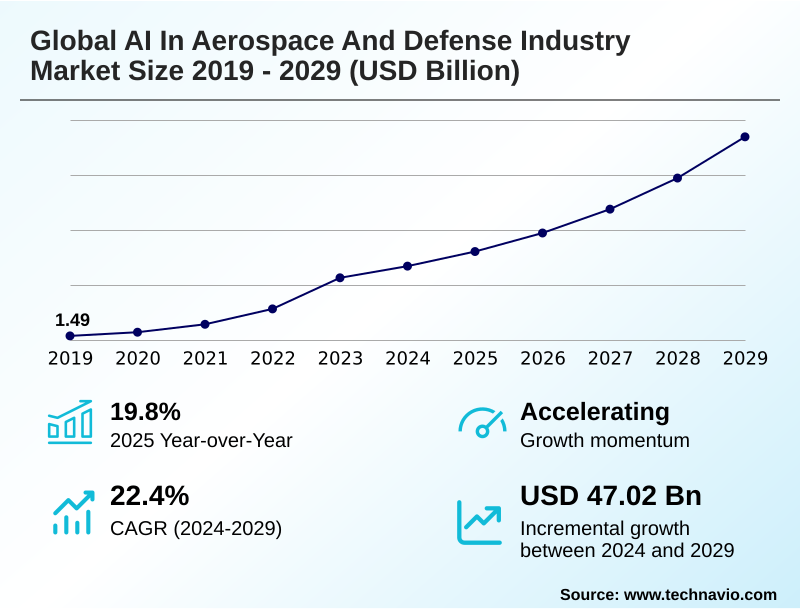
The ai in aerospace and defense industry market size is forecast to increase by USD 47.0 billion, at a CAGR of 22.4% between 2024 and 2029.
The global AI in aerospace and defense industry market is shaped by the strategic imperative for military modernization, driving investment in advanced technologies to maintain a decisive advantage. This push for technological superiority is reflected in the development of ai-piloted systems and autonomous combat platforms. A key trend within this landscape is the proliferation of generative artificial intelligence and foundation models, which are moving beyond simple analytics to influence ai engineering and ai in hardware. These models are being used to create novel designs and strategic insights. The progress in aerospace artificial intelligence (AI) is evident in its application across various domains, contributing to more sophisticated defense capabilities.However, a formidable challenge in the global AI in aerospace and defense industry market is navigating the complexities of data security, integrity, and management. The effectiveness of any AI system depends on the quality and security of its training data, making systems vulnerable to data poisoning attacks and other cyber threats. This issue is particularly critical in ai in modern warfare, where corrupted data could lead to catastrophic errors. Ensuring robust data integrity across distributed networks and overcoming the challenges of siloed legacy data are persistent issues. Effective applied ai in cybersecurity is therefore essential to safeguard sensitive military data and ensure the reliability of AI-enabled operations.
What will be the Size of the AI In Aerospace And Defense Industry Market during the forecast period?
Explore in-depth regional segment analysis with market size data - historical 2019 - 2023 and forecasts 2025-2029 - in the full report.
Request Free Sample
The global AI in aerospace and defense industry market is characterized by the continuous integration of advanced computational technologies to automate and enhance complex operations. This includes the application of machine learning, computer vision, and natural language processing to process vast datasets from various platforms. The development of ai-driven predictive maintenance for fleets is ongoing, aiming to improve equipment readiness and reduce operational costs. The market is also seeing advancements in ai engineering, focusing on creating more sophisticated and reliable systems for both commercial and military applications.A key dynamic in the market is the evolving development of autonomous unmanned aerial systems, which are transforming intelligence, surveillance, and reconnaissance missions. These systems increasingly rely on real-time threat detection algorithms and autonomous navigation in GPS-denied environments to operate effectively. The progression toward collaborative combat aircraft architectures signifies a shift in military strategy, emphasizing the synergy between manned and unmanned platforms. This continuous evolution is also present in the artificial intelligence in aviation market, where AI is used to optimize flight paths and improve safety.
How is this AI In Aerospace And Defense Industry Industry segmented?
The ai in aerospace and defense industry industry research report provides comprehensive data (region-wise segment analysis), with forecasts and estimates in "USD million" for the period 2025-2029, as well as historical data from 2019 - 2023 for the following segments.
- Type
- Application
- Military systems
- Commercial aviation
- Space
- End-user
- OEMs and Tier 1 suppliers
- Defense primes
- Space agencies and commercial operators
- Geography
- North America
- Europe
- Germany
- UK
- France
- Italy
- Spain
- The Netherlands
- APAC
- China
- India
- Japan
- South Korea
- Australia
- Indonesia
- Middle East and Africa
- South America
- Rest of World (ROW)
By Type Insights
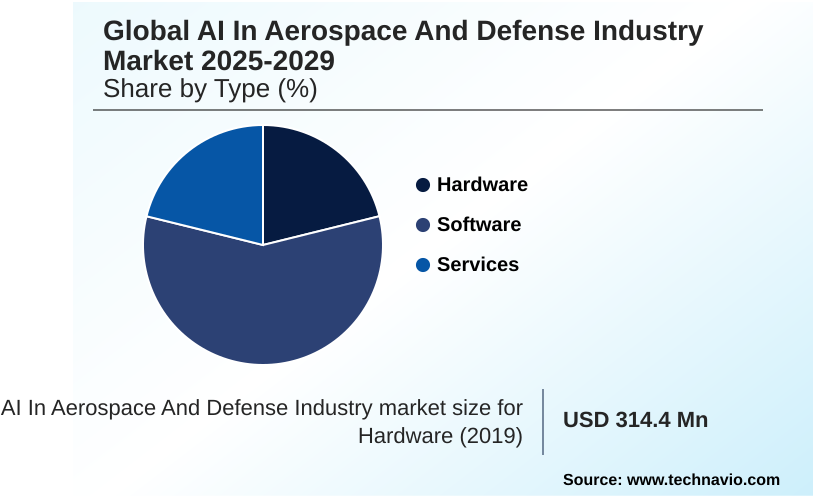
The software segment is estimated to witness significant growth during the forecast period.
The software segment is a cornerstone of the global AI in aerospace and defense industry market, encompassing the algorithms, platforms, and applications that enable intelligent operations. This category includes machine learning frameworks and specialized applications for predictive maintenance, autonomous navigation, and generative design. With some applications showing a potential to reduce operational costs by over 15%, AI software is instrumental in enhancing efficiency and safety in both commercial aviation and defense sectors by enabling proactive maintenance and optimizing complex designs.
In the defense sector, AI software is critical for modernizing command and control systems and enabling autonomous mission capabilities. These AI-driven systems process and synthesize vast amounts of data from disparate sources like drones and satellites to provide a unified, real-time operational picture. This facilitates more rapid and informed decision-making. Furthermore, AI software is at the heart of autonomous systems, enabling advanced navigation and adaptive mission planning, which is fundamental to the ongoing transformation of the industry.

Request Free Sample
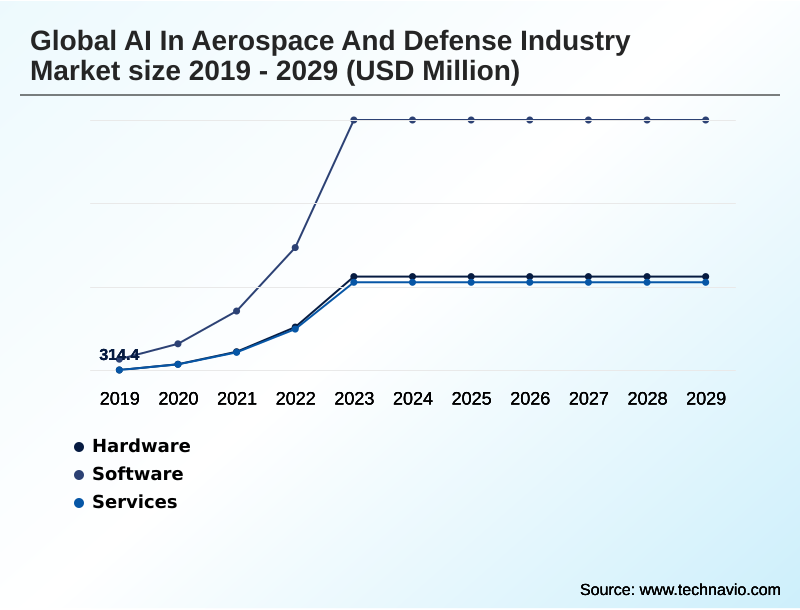
The Software segment was valued at USD 858.30 million in 2019 and showed a gradual increase during the forecast period.
Regional Analysis
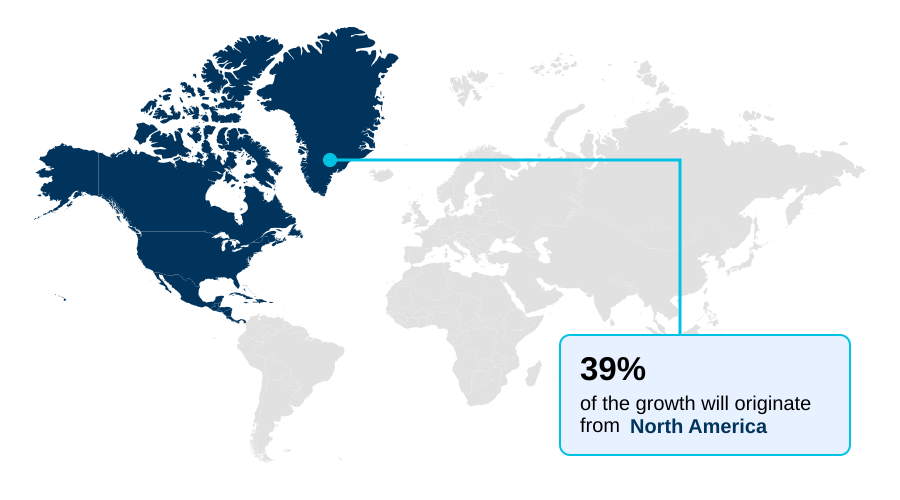
North America is estimated to contribute 39.3% to the growth of the global market during the forecast period.Technavio’s analysts have elaborately explained the regional trends and drivers that shape the market during the forecast period.
Request Free Sample
The North America market for AI in aerospace and defense is the global epicenter, sustained by unparalleled defense spending and a uniquely dynamic innovation ecosystem. This region's dominance is driven by a clear strategic vision to maintain a technological advantage, with high-profile initiatives catalyzing significant investment in autonomous systems and ai-piloted systems. Contributing over 39% of the market's incremental growth, North America's leadership is solidified by robust government funding and a strategic focus on integrating AI across all defense domains.
The landscape in North America is further characterized by a powerful synergy between government, established defense contractors, and a new generation of AI-native technology companies. In the commercial aerospace sector, major OEMs and suppliers are aggressively integrating AI to enhance efficiency and safety through applications like predictive maintenance and operational optimization. This comprehensive ecosystem, which fosters deep collaboration and continuous innovation, ensures North America's position as the leading market for AI in aerospace and defense, shaping the trajectory of the entire industry.
Market Dynamics
Our researchers analyzed the data with 2024 as the base year, along with the key drivers, trends, and challenges. A holistic analysis of drivers will help companies refine their marketing strategies to gain a competitive advantage.
The global AI in aerospace and defense market is rapidly expanding, driven by innovations like generative AI in aerospace component design and operational efficiencies from machine learning for aircraft fuel optimization. Airlines and logistics providers are heavily investing in AI-powered predictive maintenance for fleets, while the industry grapples with the complexities of certifying AI systems for commercial aviation. To support this shift, advanced AI-based simulation for pilot training is becoming standard. Concurrently, efforts in AI-enabled air traffic control optimization aim to enhance airspace safety and capacity. A significant challenge remains the AI integration in legacy defense infrastructure, which is being addressed alongside advancements in edge computing for unmanned aerial vehicles and the development of swarm intelligence for drone coordination for complex missions.In the defense sector, the focus is on enhancing strategic capabilities through AI in command and control decision-making, supported by powerful AI for real-time intelligence data analysis. The emergence of large language models for military intelligence is revolutionizing how information is processed, demanding sophisticated data management for military AI applications. On the tactical front, advanced sensor fusion with AI algorithms facilitates better human-machine collaboration in combat scenarios and enables autonomous navigation in GPS-denied environments. To secure these advanced systems, AI-driven cyber threat detection for defense and effective counter-UAS systems using AI are critical. However, the success of these initiatives hinges on developing AI talent for defense sector and carefully navigating the ethical considerations for autonomous weapons.

What are the key market drivers leading to the rise in the adoption of AI In Aerospace And Defense Industry Industry?
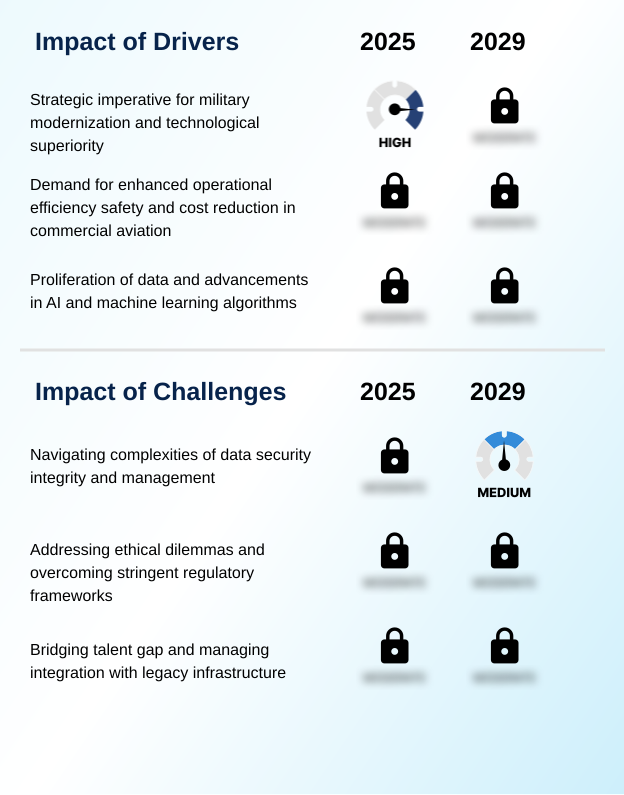
- The strategic imperative for military modernization and the need to maintain technological superiority are key drivers for the adoption of AI in the aerospace and defense industry.
The strategic imperative for military modernization and technological superiority is a primary driver of the global AI in aerospace and defense industry market. Escalating geopolitical competition compels nations to invest heavily in AI as a critical enabling technology for achieving decision superiority and augmenting human capabilities. Governments view AI as a force multiplier, capable of enhancing lethality and improving operational tempo. This has led to the proliferation of national AI strategies and large-scale defense programs centered on autonomous systems. In key markets, which account for over 39% of the opportunity, this drive is evident in the development of ai-piloted systems and advanced command and control systems that leverage real-time data analysis to maintain a decisive advantage in contemporary security environments.In commercial aviation, the pursuit of enhanced operational efficiency, safety, and cost reduction is a powerful and pragmatic driver. Airlines, OEMs, and maintenance providers operate in a competitive and regulated environment where marginal performance improvements significantly impact profitability. AI provides a suite of tools to address these needs, with predictive maintenance being one of the most impactful applications. By analyzing real-time data from aircraft sensors, ai-driven predictive maintenance for fleets allows a shift from reactive to proactive maintenance, reducing unplanned downtime and optimizing spare parts inventory. This focus on efficiency extends to fuel optimization and air traffic management, underscoring how fundamental business imperatives are driving AI integration.
What are the market trends shaping the AI In Aerospace And Defense Industry Industry?
- The proliferation of generative AI and foundation models is a key trend that is shaping the future of the aerospace and defense industry.
A dominant trend in the global AI in aerospace and defense industry market is the rapid expansion of generative artificial intelligence and foundation models into specialized domains. This marks a shift from using AI primarily for predictive analytics to leveraging it for complex content creation and problem-solving. In aerospace engineering, generative design algorithms are creating novel, lightweight components. In operations, generative AI functions as an intelligent assistant for technicians, accelerating repair times. For defense and intelligence, these models analyze vast quantities of unstructured data to generate strategic insights. This trend is shaping the industrial ai software landscape as companies develop sovereign generative AI capabilities to secure a competitive edge.A defining strategic trend is the shift toward human-machine teaming and collaborative combat architectures, where crewed and uncrewed platforms operate in a synchronized manner. This concept aims to augment, not replace, human warfighters by expanding their reach and increasing force lethality and survivability, with over 20% of the market opportunity concentrated in regions actively developing these capabilities. Flagship initiatives focus on developing autonomous uncrewed aircraft that fly in concert with next-generation fighters, where the human pilot acts as a mission commander. This move from a platform-centric model to a network-centric, system-of-systems approach is a paradigm shift in military doctrine, making AI-enabled collaboration key to operational superiority in ai in modern warfare.
What challenges does the AI In Aerospace And Defense Industry Industry face during its growth?
- Navigating the complexities of data security, integrity, and management is a significant challenge for the aerospace and defense industry.
A formidable challenge in the global AI in aerospace and defense industry market is the multifaceted issue of data security, integrity, and management. AI systems' effectiveness is dependent on the quality and integrity of training data, which is often highly sensitive and a prime target for cyberattacks. The integration of AI introduces vulnerabilities such as data poisoning attacks, which can lead to catastrophic errors. Furthermore, vast amounts of critical data are often siloed in disparate legacy systems, making aggregation and cleaning a resource-intensive task. With certain regions representing over 6% of the market opportunity yet facing significant data infrastructure hurdles, addressing data quality and accessibility is a persistent and deeply entrenched challenge for the industry.The intertwined domains of ethics and regulation present a profound and pervasive challenge. The increasing autonomy of military systems, particularly the prospect of lethal autonomous weapons systems, raises fundamental questions about accountability and human control in warfare. The 'black box' nature of some advanced AI models creates an accountability gap, making it difficult to assign responsibility for errors. In commercial aviation, certifying AI for flight-critical applications is an unprecedented regulatory hurdle, as the emergent behavior of AI systems is not fully predictable with conventional methods. Aviation authorities are taking a cautious, incremental approach, but the long path to certification for safety-critical AI remains a significant constraint.
Exclusive Customer Landscape
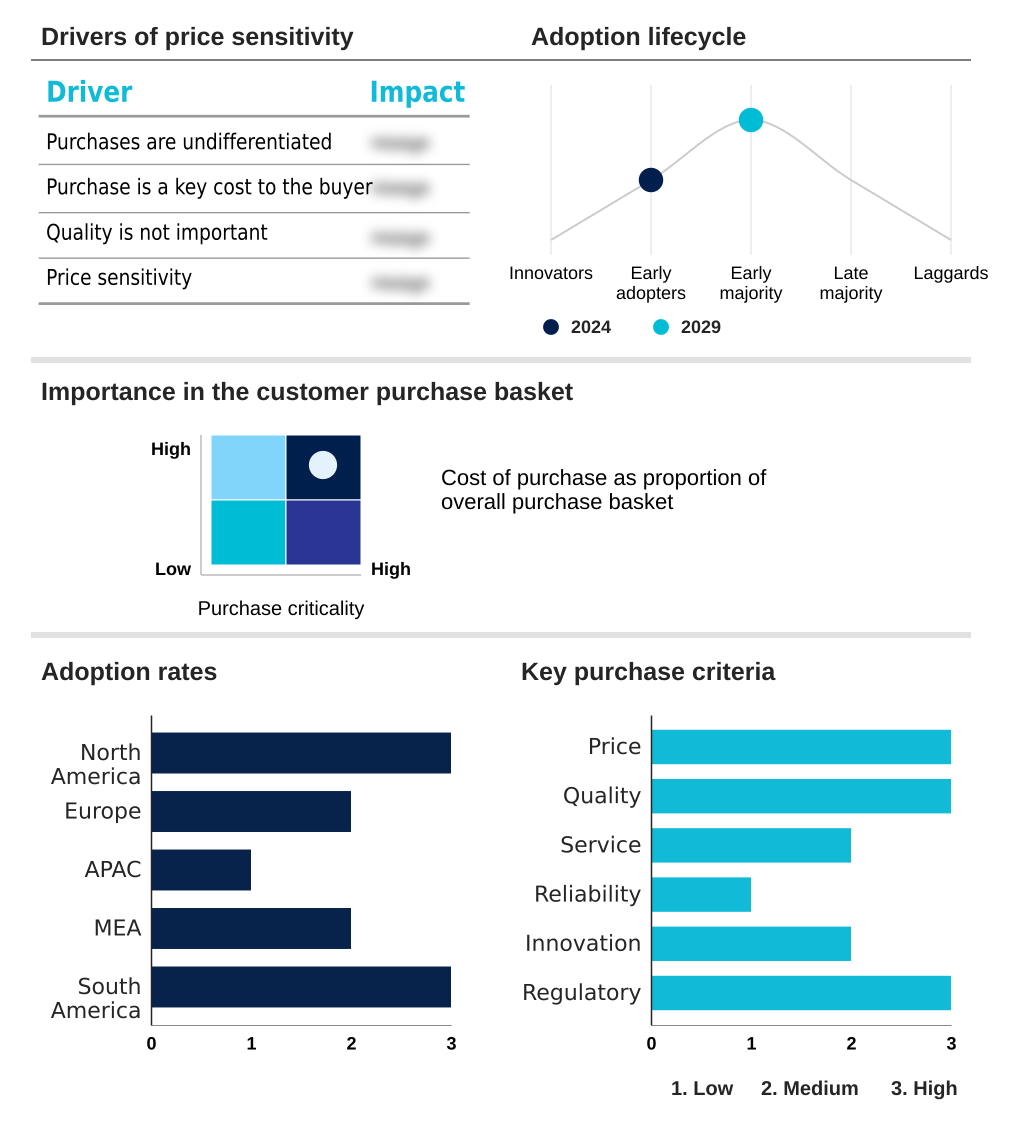
The ai in aerospace and defense industry market forecasting report includes the adoption lifecycle of the market, covering from the innovator’s stage to the laggard’s stage. It focuses on adoption rates in different regions based on penetration. Furthermore, the ai in aerospace and defense industry market report also includes key purchase criteria and drivers of price sensitivity to help companies evaluate and develop their market growth analysis strategies.
Customer Landscape
Key Companies & Market Insights
Companies are implementing various strategies, such as strategic alliances, ai in aerospace and defense industry market forecast, partnerships, mergers and acquisitions, geographical expansion, and product/service launches, to enhance their presence in the industry.
Anduril Industries Inc. - Offerings in the market center on integrating advanced computational intelligence to automate and enhance complex operations. This includes a broad spectrum of capabilities, from machine learning and computer vision to natural language processing and sophisticated data analytics. These technologies are applied to process vast datasets from aircraft, satellites, and unmanned systems, enabling capabilities such as predictive maintenance, optimized flight paths, and improved situational awareness. In the defense sector, offerings are crucial for intelligence analysis, autonomous vehicle navigation, real-time threat detection, and the operation of advanced weapons systems. The core function is to accelerate decision-making, increase safety, and ensure superior performance and reliability of assets in highly demanding environments.
The industry research and growth report includes detailed analyses of the competitive landscape of the market and information about key companies, including:
- Anduril Industries Inc.
- BAE Systems Plc
- Epirus Inc.
- Firestorm Solutions LLC
- General Dynamics Corp.
- Helsing GmbH
- Kratos Defense and Security Solutions Inc.
- L3Harris Technologies Inc.
- Leidos Holdings Inc.
- Lockheed Martin Corp.
- Northrop Grumman Corp.
- Palantir Technologies Inc.
- Rebellion Defense Inc.
- RTX Corp.
- Science Applications International Corp. Inc
- Shield AI
- The Boeing Co.
Qualitative and quantitative analysis of companies has been conducted to help clients understand the wider business environment as well as the strengths and weaknesses of key industry players. Data is qualitatively analyzed to categorize companies as pure play, category-focused, industry-focused, and diversified; it is quantitatively analyzed to categorize companies as dominant, leading, strong, tentative, and weak.
Recent Development and News in Ai In Aerospace And Defense Industry Market
In June 2024, Helsing announced a partnership with a Ukrainian drone manufacturer to integrate its AI software into their systems for battlefield operations.In May 2024, Shield AI's V-BAT unmanned aircraft, equipped with its Hivemind AI pilot, was selected for a U.S. Special Operations Command program to provide advanced intelligence, surveillance, and reconnaissance capabilities.In May 2024, Palantir Technologies was awarded a USD 480 million contract by the U.S. Army for its Maven Smart System, which uses AI to identify targets from sensor data.In April 2024, Lockheed Martin's Skunk Works successfully demonstrated advanced autonomous capabilities, including AI-based distributed sensing and targeting, on its Speedracer unmanned aerial system.In March 2024, Anduril Industries was selected by the Defense Innovation Unit (DIU) for the Enterprise Test, Validation, and Verification (ETV2) program to provide an AI-powered software platform for testing autonomous systems.
Research Analyst Overview
The global AI in aerospace and defense industry market is evolving through the integration of sophisticated systems aimed at enhancing operational effectiveness. The application of generative design algorithms and predictive maintenance platforms optimizes asset lifecycles, while advancements in autonomous navigation systems are central to modern unmanned aerial vehicles and air traffic management. Core command and control systems leverage predictive analytics models and data fusion techniques to improve situational awareness and enable decision superiority. With expectations for market expansion exceeding 22% in the near term, this shift supports complex intelligence surveillance reconnaissance missions, utilizing human-machine teaming and manned-unmanned teaming to create significant force multiplier capabilities through sensor fusion applications and target recognition algorithms for real-time threat detection.This progression is characterized by a system-of-systems approach and collaborative combat architectures that define emerging digital battlefield concepts. The deployment of AI-piloted systems and robotic combat vehicles for swarm operations and beyond-visual-range combat is becoming prevalent, while advanced foundation models and large language models are explored for sophisticated mission planning tools. The emphasis on tactical edge computing and edge AI deployment using AI-specific processors is crucial. Concurrently, addressing vulnerabilities such as data poisoning attacks through robust cyber warfare defense is paramount. The integration of electronic warfare systems, counter-drone technology, and high-power microwave systems within open-architecture systems is critical, navigating considerations surrounding lethal autonomous weapons.
Dive into Technavio’s robust research methodology, blending expert interviews, extensive data synthesis, and validated models for unparalleled AI In Aerospace And Defense Industry Market insights. See full methodology.
|
Market Scope
|
|
Report Coverage
|
Details
|
|
Page number
|
322
|
|
Base year
|
2024
|
|
Historic period
|
2019 - 2023 |
|
Forecast period
|
2025-2029
|
|
Growth momentum & CAGR
|
Accelerating at a CAGR of 22.4%
|
|
Market growth 2024-2029
|
USD 47.0 billion
|
|
Market structure
|
Fragmented
|
|
YoY growth 2024-2029(%)
|
19.8%
|
|
Key countries
|
US, Canada, Mexico, Germany, UK, France, Italy, Spain, The Netherlands, China, India, Japan, South Korea, Australia, Indonesia, Israel, Saudi Arabia, UAE, South Africa, Turkey, Brazil, Argentina, Colombia
|
|
Competitive landscape
|
Leading Companies, Market Positioning of Companies, Competitive Strategies, and Industry Risks
|
Request Free Sample
What are the Key Data Covered in this AI In Aerospace And Defense Industry Market Research and Growth Report?
- CAGR of the AI In Aerospace And Defense Industry industry during the forecast period
- Detailed information on factors that will drive the growth and forecasting between 2024 and 2029
- Precise estimation of the size of the market and its contribution of the industry in focus to the parent market
- Accurate predictions about upcoming growth and trends and changes in consumer behaviour
- Growth of the market across North America, Europe, APAC, Middle East and Africa, South America
- Thorough analysis of the market’s competitive landscape and detailed information about companies
- Comprehensive analysis of factors that will challenge the ai in aerospace and defense industry market growth of industry companies
We can help! Our analysts can customize this ai in aerospace and defense industry market research report to meet your requirements.
Get in touch
1 Executive Summary
- 1 Executive Summary
- 1.1 Market overview
- Executive Summary - Chart on Market Overview
- Executive Summary - Data Table on Market Overview
- Executive Summary - Chart on Global Market Characteristics
- Executive Summary - Chart on Market by Geography
- Executive Summary - Chart on Market Segmentation by Type
- Executive Summary - Chart on Market Segmentation by Application
- Executive Summary - Chart on Market Segmentation by End-user
- Executive Summary - Chart on Incremental Growth
- Executive Summary - Data Table on Incremental Growth
- Executive Summary - Chart on Company Market Positioning
2 Technavio Analysis
- 2 Technavio Analysis
- 2.1 Analysis of price sensitivity, lifecycle, customer purchase basket, adoption rates, and purchase criteria
- Analysis of price sensitivity, lifecycle, customer purchase basket, adoption rates, and purchase criteria
- 2.2 Criticality of inputs and Factors of differentiation
- Chart on Overview on criticality of inputs and factors of differentiation
- 2.3 Factors of disruption
- Chart on Overview on factors of disruption
- 2.4 Impact of drivers and challenges
- Chart on Impact of drivers and challenges in 2024 and 2029
3 Market Landscape
- 3 Market Landscape
- 3.1 Market ecosystem
- Chart on Parent Market
- Data Table on - Parent Market
- 3.2 Market characteristics
- Chart on Market characteristics analysis
- 3.3 Value chain analysis
- Chart on Value chain analysis
4 Market Sizing
- 4 Market Sizing
- 4.1 Market definition
- Data Table on Offerings of companies included in the market definition
- 4.2 Market segment analysis
- 4.3 Market size 2024
- 4.4 Market outlook: Forecast for 2024-2029
- Chart on Global - Market size and forecast 2024-2029 ($ billion)
- Data Table on Global - Market size and forecast 2024-2029 ($ billion)
- Chart on Global Market: Year-over-year growth 2024-2029 (%)
- Data Table on Global Market: Year-over-year growth 2024-2029 (%)
5 Historic Market Size
- 5 Historic Market Size
- 5.1 Global AI In Aerospace And Defense Industry Market 2019 - 2023
- Historic Market Size - Data Table on Global AI In Aerospace And Defense Industry Market 2019 - 2023 ($ billion)
- 5.2 Type segment analysis 2019 - 2023
- Historic Market Size - Type Segment 2019 - 2023 ($ billion)
- 5.3 Application segment analysis 2019 - 2023
- Historic Market Size - Application Segment 2019 - 2023 ($ billion)
- 5.4 End-user segment analysis 2019 - 2023
- Historic Market Size - End-user Segment 2019 - 2023 ($ billion)
- 5.5 Geography segment analysis 2019 - 2023
- Historic Market Size - Geography Segment 2019 - 2023 ($ billion)
- 5.6 Country segment analysis 2019 - 2023
- Historic Market Size - Country Segment 2019 - 2023 ($ billion)
6 Five Forces Analysis
- 6 Five Forces Analysis
- 6.1 Five forces summary
- Five forces analysis - Comparison between 2024 and 2029
- 6.2 Bargaining power of buyers
- Bargaining power of buyers - Impact of key factors 2024 and 2029
- 6.3 Bargaining power of suppliers
- Bargaining power of suppliers - Impact of key factors in 2024 and 2029
- 6.4 Threat of new entrants
- Threat of new entrants - Impact of key factors in 2024 and 2029
- 6.5 Threat of substitutes
- Threat of substitutes - Impact of key factors in 2024 and 2029
- 6.6 Threat of rivalry
- Threat of rivalry - Impact of key factors in 2024 and 2029
- 6.7 Market condition
- Chart on Market condition - Five forces 2024 and 2029
7 Market Segmentation by Type
- 7 Market Segmentation by Type
- 7.1 Market segments
- Chart on Type - Market share 2024-2029 (%)
- Data Table on Type - Market share 2024-2029 (%)
- 7.2 Comparison by Type
- Chart on Comparison by Type
- Data Table on Comparison by Type
- 7.3 Software - Market size and forecast 2024-2029
- Chart on Software - Market size and forecast 2024-2029 ($ billion)
- Data Table on Software - Market size and forecast 2024-2029 ($ billion)
- Chart on Software - Year-over-year growth 2024-2029 (%)
- Data Table on Software - Year-over-year growth 2024-2029 (%)
- 7.4 Hardware - Market size and forecast 2024-2029
- Chart on Hardware - Market size and forecast 2024-2029 ($ billion)
- Data Table on Hardware - Market size and forecast 2024-2029 ($ billion)
- Chart on Hardware - Year-over-year growth 2024-2029 (%)
- Data Table on Hardware - Year-over-year growth 2024-2029 (%)
- 7.5 Services - Market size and forecast 2024-2029
- Chart on Services - Market size and forecast 2024-2029 ($ billion)
- Data Table on Services - Market size and forecast 2024-2029 ($ billion)
- Chart on Services - Year-over-year growth 2024-2029 (%)
- Data Table on Services - Year-over-year growth 2024-2029 (%)
- 7.6 Market opportunity by Type
- Market opportunity by Type ($ billion)
- Data Table on Market opportunity by Type ($ billion)
8 Market Segmentation by Application
- 8 Market Segmentation by Application
- 8.1 Market segments
- Chart on Application - Market share 2024-2029 (%)
- Data Table on Application - Market share 2024-2029 (%)
- 8.2 Comparison by Application
- Chart on Comparison by Application
- Data Table on Comparison by Application
- 8.3 Military systems - Market size and forecast 2024-2029
- Chart on Military systems - Market size and forecast 2024-2029 ($ billion)
- Data Table on Military systems - Market size and forecast 2024-2029 ($ billion)
- Chart on Military systems - Year-over-year growth 2024-2029 (%)
- Data Table on Military systems - Year-over-year growth 2024-2029 (%)
- 8.4 Commercial aviation - Market size and forecast 2024-2029
- Chart on Commercial aviation - Market size and forecast 2024-2029 ($ billion)
- Data Table on Commercial aviation - Market size and forecast 2024-2029 ($ billion)
- Chart on Commercial aviation - Year-over-year growth 2024-2029 (%)
- Data Table on Commercial aviation - Year-over-year growth 2024-2029 (%)
- 8.5 Space - Market size and forecast 2024-2029
- Chart on Space - Market size and forecast 2024-2029 ($ billion)
- Data Table on Space - Market size and forecast 2024-2029 ($ billion)
- Chart on Space - Year-over-year growth 2024-2029 (%)
- Data Table on Space - Year-over-year growth 2024-2029 (%)
- 8.6 Market opportunity by Application
- Market opportunity by Application ($ billion)
- Data Table on Market opportunity by Application ($ billion)
9 Market Segmentation by End-user
- 9 Market Segmentation by End-user
- 9.1 Market segments
- Chart on End-user - Market share 2024-2029 (%)
- Data Table on End-user - Market share 2024-2029 (%)
- 9.2 Comparison by End-user
- Chart on Comparison by End-user
- Data Table on Comparison by End-user
- 9.3 OEMs and Tier 1 suppliers - Market size and forecast 2024-2029
- Chart on OEMs and Tier 1 suppliers - Market size and forecast 2024-2029 ($ billion)
- Data Table on OEMs and Tier 1 suppliers - Market size and forecast 2024-2029 ($ billion)
- Chart on OEMs and Tier 1 suppliers - Year-over-year growth 2024-2029 (%)
- Data Table on OEMs and Tier 1 suppliers - Year-over-year growth 2024-2029 (%)
- 9.4 Defense primes - Market size and forecast 2024-2029
- Chart on Defense primes - Market size and forecast 2024-2029 ($ billion)
- Data Table on Defense primes - Market size and forecast 2024-2029 ($ billion)
- Chart on Defense primes - Year-over-year growth 2024-2029 (%)
- Data Table on Defense primes - Year-over-year growth 2024-2029 (%)
- 9.5 Space agencies and commercial operators - Market size and forecast 2024-2029
- Chart on Space agencies and commercial operators - Market size and forecast 2024-2029 ($ billion)
- Data Table on Space agencies and commercial operators - Market size and forecast 2024-2029 ($ billion)
- Chart on Space agencies and commercial operators - Year-over-year growth 2024-2029 (%)
- Data Table on Space agencies and commercial operators - Year-over-year growth 2024-2029 (%)
- 9.6 Market opportunity by End-user
- Market opportunity by End-user ($ billion)
- Data Table on Market opportunity by End-user ($ billion)
10 Customer Landscape
- 10 Customer Landscape
- 10.1 Customer landscape overview
- Analysis of price sensitivity, lifecycle, customer purchase basket, adoption rates, and purchase criteria
11 Geographic Landscape
- 11 Geographic Landscape
- 11.1 Geographic segmentation
- Chart on Market share by geography 2024-2029 (%)
- Data Table on Market share by geography 2024-2029 (%)
- 11.2 Geographic comparison
- Chart on Geographic comparison
- Data Table on Geographic comparison
- 11.3 North America - Market size and forecast 2024-2029
- Chart on North America - Market size and forecast 2024-2029 ($ billion)
- Data Table on North America - Market size and forecast 2024-2029 ($ billion)
- Chart on North America - Year-over-year growth 2024-2029 (%)
- Data Table on North America - Year-over-year growth 2024-2029 (%)
- Chart on Regional Comparison - North America
- Data Table on Regional Comparison - North America
- 11.3.1 US - Market size and forecast 2024-2029
- Chart on US - Market size and forecast 2024-2029 ($ billion)
- Data Table on US - Market size and forecast 2024-2029 ($ billion)
- Chart on US - Year-over-year growth 2024-2029 (%)
- Data Table on US - Year-over-year growth 2024-2029 (%)
- 11.3.2 Canada - Market size and forecast 2024-2029
- Chart on Canada - Market size and forecast 2024-2029 ($ billion)
- Data Table on Canada - Market size and forecast 2024-2029 ($ billion)
- Chart on Canada - Year-over-year growth 2024-2029 (%)
- Data Table on Canada - Year-over-year growth 2024-2029 (%)
- 11.3.3 Mexico - Market size and forecast 2024-2029
- Chart on Mexico - Market size and forecast 2024-2029 ($ billion)
- Data Table on Mexico - Market size and forecast 2024-2029 ($ billion)
- Chart on Mexico - Year-over-year growth 2024-2029 (%)
- Data Table on Mexico - Year-over-year growth 2024-2029 (%)
- 11.4 Europe - Market size and forecast 2024-2029
- Chart on Europe - Market size and forecast 2024-2029 ($ billion)
- Data Table on Europe - Market size and forecast 2024-2029 ($ billion)
- Chart on Europe - Year-over-year growth 2024-2029 (%)
- Data Table on Europe - Year-over-year growth 2024-2029 (%)
- Chart on Regional Comparison - Europe
- Data Table on Regional Comparison - Europe
- 11.4.1 Germany - Market size and forecast 2024-2029
- Chart on Germany - Market size and forecast 2024-2029 ($ billion)
- Data Table on Germany - Market size and forecast 2024-2029 ($ billion)
- Chart on Germany - Year-over-year growth 2024-2029 (%)
- Data Table on Germany - Year-over-year growth 2024-2029 (%)
- 11.4.2 UK - Market size and forecast 2024-2029
- Chart on UK - Market size and forecast 2024-2029 ($ billion)
- Data Table on UK - Market size and forecast 2024-2029 ($ billion)
- Chart on UK - Year-over-year growth 2024-2029 (%)
- Data Table on UK - Year-over-year growth 2024-2029 (%)
- 11.4.3 France - Market size and forecast 2024-2029
- Chart on France - Market size and forecast 2024-2029 ($ billion)
- Data Table on France - Market size and forecast 2024-2029 ($ billion)
- Chart on France - Year-over-year growth 2024-2029 (%)
- Data Table on France - Year-over-year growth 2024-2029 (%)
- 11.4.4 Italy - Market size and forecast 2024-2029
- Chart on Italy - Market size and forecast 2024-2029 ($ billion)
- Data Table on Italy - Market size and forecast 2024-2029 ($ billion)
- Chart on Italy - Year-over-year growth 2024-2029 (%)
- Data Table on Italy - Year-over-year growth 2024-2029 (%)
- 11.4.5 Spain - Market size and forecast 2024-2029
- Chart on Spain - Market size and forecast 2024-2029 ($ billion)
- Data Table on Spain - Market size and forecast 2024-2029 ($ billion)
- Chart on Spain - Year-over-year growth 2024-2029 (%)
- Data Table on Spain - Year-over-year growth 2024-2029 (%)
- 11.4.6 The Netherlands - Market size and forecast 2024-2029
- Chart on The Netherlands - Market size and forecast 2024-2029 ($ billion)
- Data Table on The Netherlands - Market size and forecast 2024-2029 ($ billion)
- Chart on The Netherlands - Year-over-year growth 2024-2029 (%)
- Data Table on The Netherlands - Year-over-year growth 2024-2029 (%)
- 11.5 APAC - Market size and forecast 2024-2029
- Chart on APAC - Market size and forecast 2024-2029 ($ billion)
- Data Table on APAC - Market size and forecast 2024-2029 ($ billion)
- Chart on APAC - Year-over-year growth 2024-2029 (%)
- Data Table on APAC - Year-over-year growth 2024-2029 (%)
- Chart on Regional Comparison - APAC
- Data Table on Regional Comparison - APAC
- 11.5.1 China - Market size and forecast 2024-2029
- Chart on China - Market size and forecast 2024-2029 ($ billion)
- Data Table on China - Market size and forecast 2024-2029 ($ billion)
- Chart on China - Year-over-year growth 2024-2029 (%)
- Data Table on China - Year-over-year growth 2024-2029 (%)
- 11.5.2 India - Market size and forecast 2024-2029
- Chart on India - Market size and forecast 2024-2029 ($ billion)
- Data Table on India - Market size and forecast 2024-2029 ($ billion)
- Chart on India - Year-over-year growth 2024-2029 (%)
- Data Table on India - Year-over-year growth 2024-2029 (%)
- 11.5.3 Japan - Market size and forecast 2024-2029
- Chart on Japan - Market size and forecast 2024-2029 ($ billion)
- Data Table on Japan - Market size and forecast 2024-2029 ($ billion)
- Chart on Japan - Year-over-year growth 2024-2029 (%)
- Data Table on Japan - Year-over-year growth 2024-2029 (%)
- 11.5.4 South Korea - Market size and forecast 2024-2029
- Chart on South Korea - Market size and forecast 2024-2029 ($ billion)
- Data Table on South Korea - Market size and forecast 2024-2029 ($ billion)
- Chart on South Korea - Year-over-year growth 2024-2029 (%)
- Data Table on South Korea - Year-over-year growth 2024-2029 (%)
- 11.5.5 Australia - Market size and forecast 2024-2029
- Chart on Australia - Market size and forecast 2024-2029 ($ billion)
- Data Table on Australia - Market size and forecast 2024-2029 ($ billion)
- Chart on Australia - Year-over-year growth 2024-2029 (%)
- Data Table on Australia - Year-over-year growth 2024-2029 (%)
- 11.5.6 Indonesia - Market size and forecast 2024-2029
- Chart on Indonesia - Market size and forecast 2024-2029 ($ billion)
- Data Table on Indonesia - Market size and forecast 2024-2029 ($ billion)
- Chart on Indonesia - Year-over-year growth 2024-2029 (%)
- Data Table on Indonesia - Year-over-year growth 2024-2029 (%)
- 11.6 Middle East and Africa - Market size and forecast 2024-2029
- Chart on Middle East and Africa - Market size and forecast 2024-2029 ($ billion)
- Data Table on Middle East and Africa - Market size and forecast 2024-2029 ($ billion)
- Chart on Middle East and Africa - Year-over-year growth 2024-2029 (%)
- Data Table on Middle East and Africa - Year-over-year growth 2024-2029 (%)
- Chart on Regional Comparison - Middle East and Africa
- Data Table on Regional Comparison - Middle East and Africa
- 11.6.1 Israel - Market size and forecast 2024-2029
- Chart on Israel - Market size and forecast 2024-2029 ($ billion)
- Data Table on Israel - Market size and forecast 2024-2029 ($ billion)
- Chart on Israel - Year-over-year growth 2024-2029 (%)
- Data Table on Israel - Year-over-year growth 2024-2029 (%)
- 11.6.2 Saudi Arabia - Market size and forecast 2024-2029
- Chart on Saudi Arabia - Market size and forecast 2024-2029 ($ billion)
- Data Table on Saudi Arabia - Market size and forecast 2024-2029 ($ billion)
- Chart on Saudi Arabia - Year-over-year growth 2024-2029 (%)
- Data Table on Saudi Arabia - Year-over-year growth 2024-2029 (%)
- 11.6.3 UAE - Market size and forecast 2024-2029
- Chart on UAE - Market size and forecast 2024-2029 ($ billion)
- Data Table on UAE - Market size and forecast 2024-2029 ($ billion)
- Chart on UAE - Year-over-year growth 2024-2029 (%)
- Data Table on UAE - Year-over-year growth 2024-2029 (%)
- 11.6.4 South Africa - Market size and forecast 2024-2029
- Chart on South Africa - Market size and forecast 2024-2029 ($ billion)
- Data Table on South Africa - Market size and forecast 2024-2029 ($ billion)
- Chart on South Africa - Year-over-year growth 2024-2029 (%)
- Data Table on South Africa - Year-over-year growth 2024-2029 (%)
- 11.6.5 Turkey - Market size and forecast 2024-2029
- Chart on Turkey - Market size and forecast 2024-2029 ($ billion)
- Data Table on Turkey - Market size and forecast 2024-2029 ($ billion)
- Chart on Turkey - Year-over-year growth 2024-2029 (%)
- Data Table on Turkey - Year-over-year growth 2024-2029 (%)
- 11.7 South America - Market size and forecast 2024-2029
- Chart on South America - Market size and forecast 2024-2029 ($ billion)
- Data Table on South America - Market size and forecast 2024-2029 ($ billion)
- Chart on South America - Year-over-year growth 2024-2029 (%)
- Data Table on South America - Year-over-year growth 2024-2029 (%)
- Chart on Regional Comparison - South America
- Data Table on Regional Comparison - South America
- 11.7.1 Brazil - Market size and forecast 2024-2029
- Chart on Brazil - Market size and forecast 2024-2029 ($ billion)
- Data Table on Brazil - Market size and forecast 2024-2029 ($ billion)
- Chart on Brazil - Year-over-year growth 2024-2029 (%)
- Data Table on Brazil - Year-over-year growth 2024-2029 (%)
- 11.7.2 Argentina - Market size and forecast 2024-2029
- Chart on Argentina - Market size and forecast 2024-2029 ($ billion)
- Data Table on Argentina - Market size and forecast 2024-2029 ($ billion)
- Chart on Argentina - Year-over-year growth 2024-2029 (%)
- Data Table on Argentina - Year-over-year growth 2024-2029 (%)
- 11.7.3 Colombia - Market size and forecast 2024-2029
- Chart on Colombia - Market size and forecast 2024-2029 ($ billion)
- Data Table on Colombia - Market size and forecast 2024-2029 ($ billion)
- Chart on Colombia - Year-over-year growth 2024-2029 (%)
- Data Table on Colombia - Year-over-year growth 2024-2029 (%)
- 11.8 Market opportunity by geography
- Market opportunity by geography ($ billion)
- Data Tables on Market opportunity by geography ($ billion)
12 Drivers, Challenges, and Opportunity
- 12 Drivers, Challenges, and Opportunity
- 12.1 Market drivers
- Strategic imperative for military modernization and technological superiority
- Demand for enhanced operational efficiency safety and cost reduction in commercial aviation
- Proliferation of data and advancements in AI and machine learning algorithms
- 12.2 Market challenges
- Navigating complexities of data security integrity and management
- Addressing ethical dilemmas and overcoming stringent regulatory frameworks
- Bridging talent gap and managing integration with legacy infrastructure
- 12.3 Impact of drivers and challenges
- Impact of drivers and challenges in 2024 and 2029
- 12.4 Market opportunities
- Proliferation of generative artificial intelligence and foundation models
- Strategic shift towards human-machine teaming and collaborative combat
- Technological acceleration of artificial intelligence at edge
13 Competitive Landscape
- 13 Competitive Landscape
- 13.1 Overview
- 13.2 Competitive Landscape
- Overview on criticality of inputs and factors of differentiation
- 13.3 Landscape disruption
- Overview on factors of disruption
- 13.4 Industry risks
- Impact of key risks on business
14 Competitive Analysis
- 14 Competitive Analysis
- 14.1 Companies profiled
- 14.2 Company ranking index
- 14.3 Market positioning of companies
- Matrix on companies position and classification
- 14.4 Anduril Industries Inc.
- Anduril Industries Inc. - Overview
- Anduril Industries Inc. - Product / Service
- Anduril Industries Inc. - Key offerings
- SWOT
- 14.5 BAE Systems Plc
- BAE Systems Plc - Overview
- BAE Systems Plc - Business segments
- BAE Systems Plc - Key news
- BAE Systems Plc - Key offerings
- BAE Systems Plc - Segment focus
- SWOT
- 14.6 Epirus Inc.
- Epirus Inc. - Overview
- Epirus Inc. - Product / Service
- Epirus Inc. - Key offerings
- SWOT
- 14.7 Firestorm Solutions LLC
- Firestorm Solutions LLC - Overview
- Firestorm Solutions LLC - Product / Service
- Firestorm Solutions LLC - Key offerings
- SWOT
- 14.8 General Dynamics Corp.
- General Dynamics Corp. - Overview
- General Dynamics Corp. - Business segments
- General Dynamics Corp. - Key news
- General Dynamics Corp. - Key offerings
- General Dynamics Corp. - Segment focus
- SWOT
- 14.9 Helsing GmbH
- Helsing GmbH - Overview
- Helsing GmbH - Product / Service
- Helsing GmbH - Key offerings
- SWOT
- 14.10 Kratos Defense and Security Solutions Inc.
- Kratos Defense and Security Solutions Inc. - Overview
- Kratos Defense and Security Solutions Inc. - Business segments
- Kratos Defense and Security Solutions Inc. - Key offerings
- Kratos Defense and Security Solutions Inc. - Segment focus
- SWOT
- 14.11 Lockheed Martin Corp.
- Lockheed Martin Corp. - Overview
- Lockheed Martin Corp. - Business segments
- Lockheed Martin Corp. - Key news
- Lockheed Martin Corp. - Key offerings
- Lockheed Martin Corp. - Segment focus
- SWOT
- 14.12 Northrop Grumman Corp.
- Northrop Grumman Corp. - Overview
- Northrop Grumman Corp. - Business segments
- Northrop Grumman Corp. - Key news
- Northrop Grumman Corp. - Key offerings
- Northrop Grumman Corp. - Segment focus
- SWOT
- 14.13 Palantir Technologies Inc.
- Palantir Technologies Inc. - Overview
- Palantir Technologies Inc. - Product / Service
- Palantir Technologies Inc. - Key offerings
- SWOT
- 14.14 Rebellion Defense Inc.
- Rebellion Defense Inc. - Overview
- Rebellion Defense Inc. - Product / Service
- Rebellion Defense Inc. - Key offerings
- SWOT
- 14.15 RTX Corp.
- RTX Corp. - Overview
- RTX Corp. - Business segments
- RTX Corp. - Key news
- RTX Corp. - Key offerings
- RTX Corp. - Segment focus
- SWOT
- 14.16 Science Applications International Corp. Inc
- Science Applications International Corp. Inc - Overview
- Science Applications International Corp. Inc - Product / Service
- Science Applications International Corp. Inc - Key offerings
- SWOT
- 14.17 Shield AI
- Shield AI - Overview
- Shield AI - Product / Service
- Shield AI - Key offerings
- SWOT
- 14.18 The Boeing Co.
- The Boeing Co. - Overview
- The Boeing Co. - Business segments
- The Boeing Co. - Key news
- The Boeing Co. - Key offerings
- The Boeing Co. - Segment focus
- SWOT
15 Appendix
- 15 Appendix
- 15.1 Scope of the report
- Market definition
- Objectives
- Notes and caveats
- 15.2 Inclusions and exclusions checklist
- Inclusions checklist
- Exclusions checklist
- 15.3 Currency conversion rates for US$
- Currency conversion rates for US$
- 15.4 Research methodology
- 15.5 Data procurement
- 15.6 Data validation
- 15.7 Validation techniques employed for market sizing
- Validation techniques employed for market sizing
- 15.8 Data synthesis
- 15.9 360 degree market analysis
- 360 degree market analysis
- 15.10 List of abbreviations