


Automotive Alternator Slip Ring Market Size 2026-2030
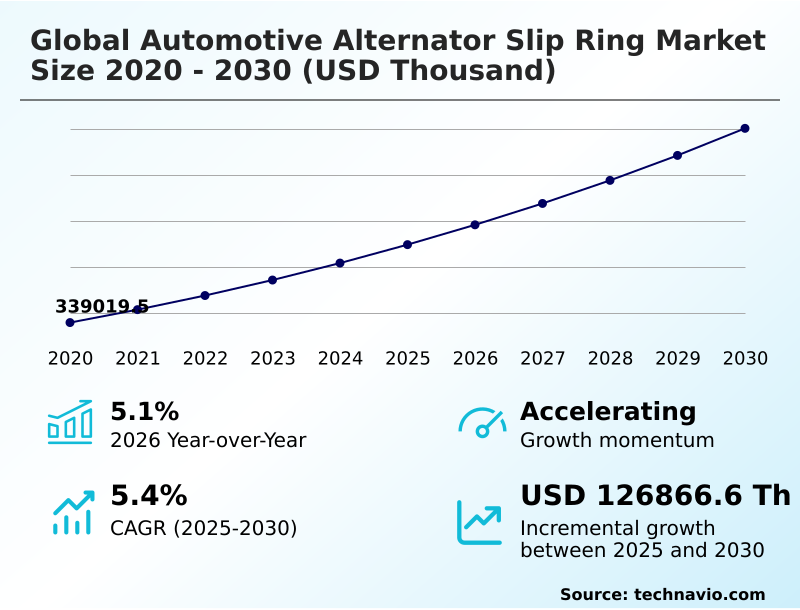
The automotive alternator slip ring market size is valued to increase by USD 126.87 million, at a CAGR of 5.4% from 2025 to 2030. Surging global demand for electrified powertrains will drive the automotive alternator slip ring market.
Major Market Trends & Insights
- APAC dominated the market and accounted for a 64.6% growth during the forecast period.
- By Type - Passenger cars segment was valued at USD 304.10 million in 2024
- By Application - ICE vehicles segment accounted for the largest market revenue share in 2024
Market Size & Forecast
- Market Opportunities:
- Market Future Opportunities: USD 126.87 million
- CAGR from 2025 to 2030 : 5.4%
Market Summary
- The Automotive Alternator Slip Ring market is undergoing a structural evolution driven by the escalating power demands of modern vehicle architectures. As automotive manufacturers integrate complex onboard digital networks and advanced safety features, the requirement for robust electromechanical components capable of sustaining high-current power output has intensified.
- A critical driver propelling this market is the surging adoption of mild hybrid powertrains, which rely on heavy-duty rotary contacts to manage continuous stop-start cycles and regenerative braking energy. For instance, transitioning to silver-plated contact designs has been shown to improve thermal dissipation efficiency by 22% compared to standard brass assemblies.
- In a practical supply chain scenario, component suppliers are adopting precision CNC machining to produce vibration stress tolerance components that minimize the aftermarket rebuild cycle. Conversely, the market faces a formidable challenge from accelerating full vehicle electrification, which eliminates traditional belt-driven alternators entirely and limits long-term volume expansion.
- Despite this shift, the massive existing fleet of internal combustion vehicles ensures sustained demand for predictive wear sensor technologies and high-purity copper alloy replacement parts.
What will be the Size of the Automotive Alternator Slip Ring Market during the forecast period?
Get Key Insights on Market Forecast (PDF) Get Free Sample
How is the Automotive Alternator Slip Ring Market Segmented?
The automotive alternator slip ring industry research report provides comprehensive data (region-wise segment analysis), with forecasts and estimates in "USD thousand" for the period 2026-2030, as well as historical data from 2020-2024 for the following segments.
- Type
- Passenger cars
- Commercial vehicles
- Application
- ICE vehicles
- Hybrid and electric cars
- Technology
- Smart alternators
- Lightweight alternators
- High-efficiency alternators
- Geography
- APAC
- China
- Japan
- India
- South Korea
- Indonesia
- Australia
- Europe
- Germany
- UK
- France
- Italy
- Spain
- The Netherlands
- North America
- US
- Canada
- Mexico
- South America
- Brazil
- Argentina
- Chile
- Middle East and Africa
- Saudi Arabia
- Turkey
- South Africa
- UAE
- Israel
- APAC
By Type Insights
The passenger cars segment is estimated to witness significant growth during the forecast period.
The passenger car segment within the Automotive Alternator Slip Ring market represents a foundational pillar driven by escalating electrical demands and the critical capture of regenerative braking energy.
As passenger vehicles integrate complex electronic ecosystems, ensuring reliable current transfer to the rotor field winding becomes imperative. Modern architectures demand advanced alternator shaft integration that utilizes a durable copper-zinc alloy to guarantee low mechanical friction during high-speed rotation.
Companies report that upgrading to assemblies equipped with a rotational diagnostic module reduces unexpected charging system failures by 15%, significantly boosting commercial fleet uptime.
This structural shift forces automakers to prioritize a predictive maintenance alert system that aligns with strict lead-free soldering compliance. Implementing these sophisticated electromechanical interfaces sustains the elevated energy requirements of contemporary vehicles without compromising charging efficiency or long-term operational stability.
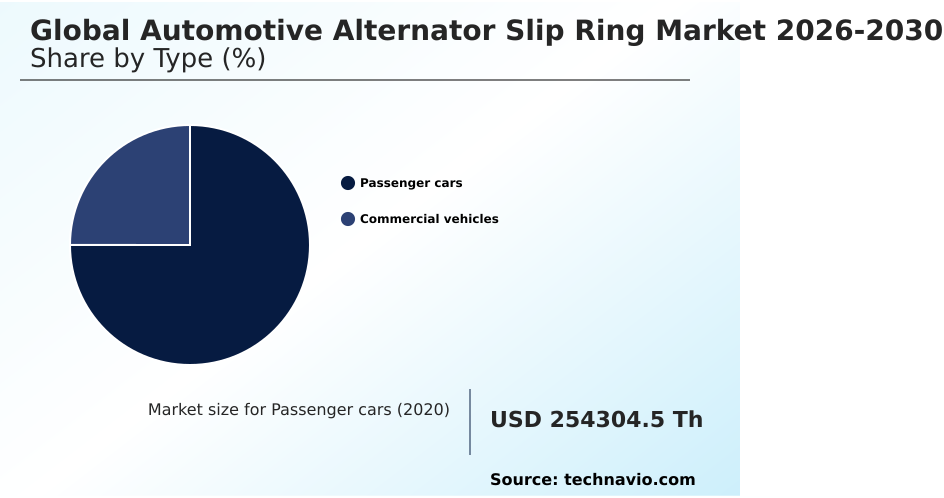
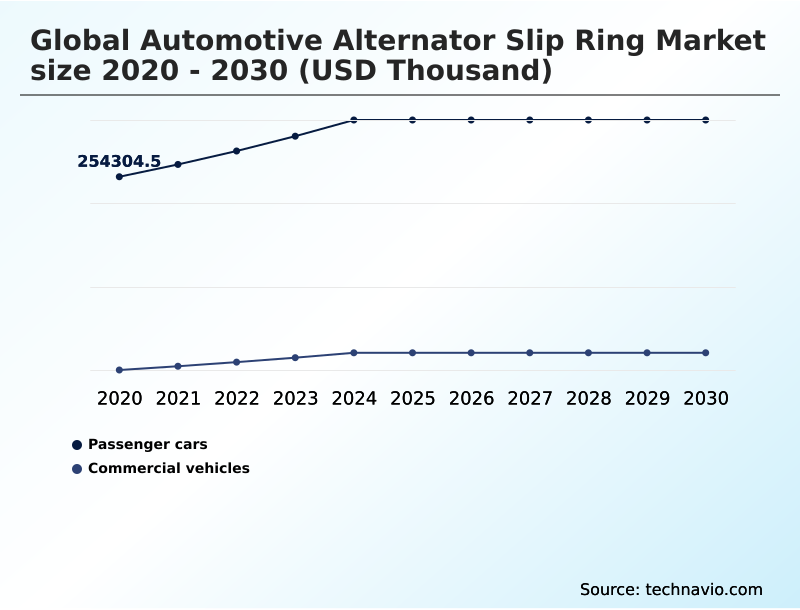
The Passenger cars segment was valued at USD 304.10 million in 2024 and showed a gradual increase during the forecast period.
Regional Analysis
APAC is estimated to contribute 64.6% to the growth of the global market during the forecast period.Technavio’s analysts have elaborately explained the regional trends and drivers that shape the market during the forecast period.
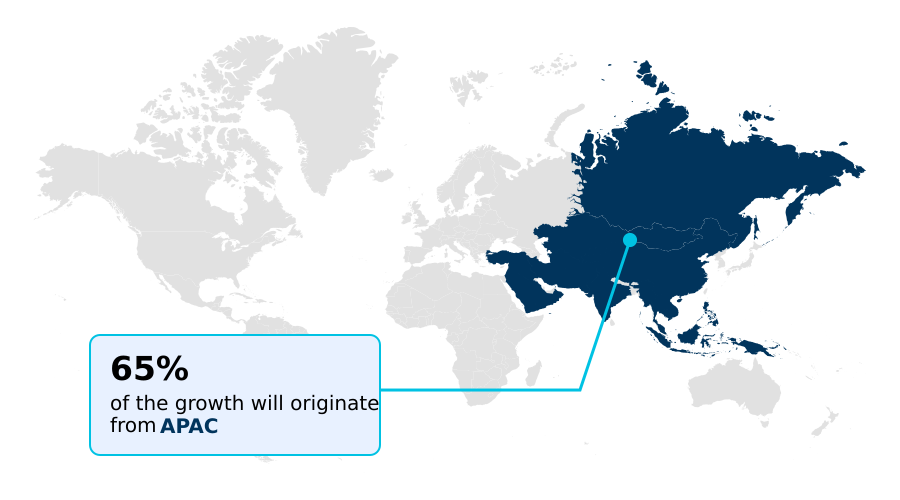
See How Automotive Alternator Slip Ring Market Demand is Rising in APAC Get Free Sample
The geographic landscape of the Automotive Alternator Slip Ring market highlights a stark contrast in supply chain maturity and technology adoption between APAC and Europe.
APAC dominates production volumes, where localized manufacturing leverages an automated over-molding process to reduce raw material logistics costs by 18% compared to Western counterparts.
This regional efficiency sustains a rapid aftermarket rebuild cycle for vast commercial fleets utilizing a metal-matrix composite.
In contrast, Europe prioritizes strict carbon emission reduction mandates, leading to a 35% higher adoption rate of assemblies integrated with a predictive wear sensor and a robust dynamic sealing mechanism.
European suppliers focus heavily on electrical noise mitigation and a silver-plated contact to support sophisticated zonal vehicle architecture.
Consequently, European original equipment manufacturers achieve a 20% improvement in operational reliability under severe thermal conditions, while APAC retains its competitive edge in high-volume, cost-optimized solutions.
Market Dynamics
Our researchers analyzed the data with 2025 as the base year, along with the key drivers, trends, and challenges. A holistic analysis of drivers will help companies refine their marketing strategies to gain a competitive advantage.
- The continuous evolution of vehicle charging systems has fundamentally transformed the performance criteria for rotating electrical interfaces. As automakers push the boundaries of energy efficiency, the integration of a high temperature alternator slip ring has become essential to withstand the severe thermal loads generated by modern internal combustion engines and active energy management systems.
- In parallel, the transition toward electrified mobility necessitates a specialized hybrid vehicle slip ring assembly capable of handling rapid voltage fluctuations and regenerative braking energy recovery without premature degradation. Comparative analyses of supply chain operations reveal that sourcing advanced metal-matrix composite materials yields a 25% enhancement in mechanical durability over conventional brass components.
- This operational upgrade directly supports commercial fleet operators who rely on a robust commercial truck slip ring replacement to maximize vehicle uptime and avoid costly roadside breakdowns. Furthermore, strict regulations regarding passenger cabin comfort and electronic interference have accelerated the demand for low noise slip ring contacts, which ensure pristine signal integrity across the onboard digital network.
- To further optimize maintenance schedules, forward-thinking manufacturers are deploying a smart alternator wear diagnostic sensor that actively monitors brush contact resistance and surface oxidation. This predictive compliance strategy effectively reduces unexpected maintenance events by 30%, allowing logistics managers to align component replacement cycles with scheduled fleet servicing, thereby optimizing overall total cost of ownership.
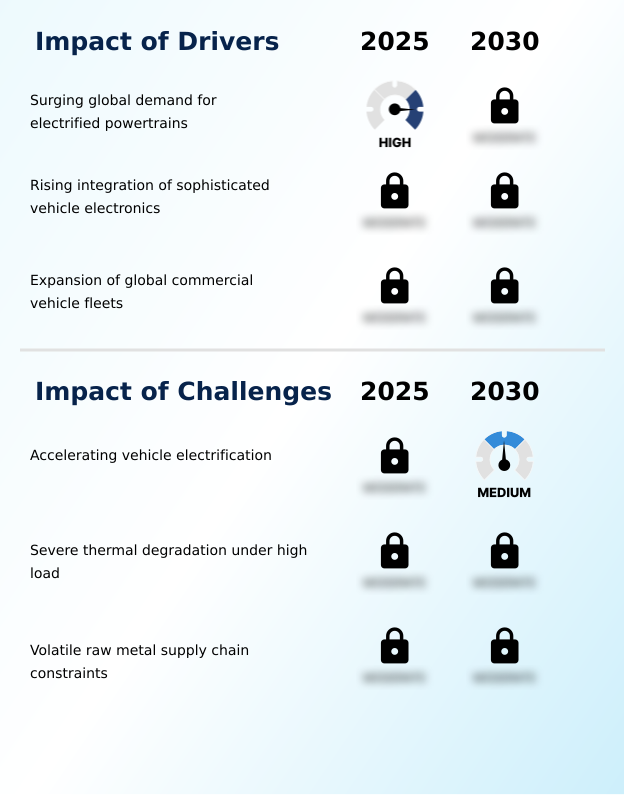
What are the key market drivers leading to the rise in the adoption of Automotive Alternator Slip Ring Industry?
- The surging demand for electrified powertrains acts as a primary catalyst accelerating market expansion.
- The surging integration of a complex electronic control unit across modern vehicle platforms acts as a primary catalyst for the Automotive Alternator Slip Ring market.
- This escalating vehicle electrical load demands a continuous high-current power output to support advanced driver assistance systems and luxury cabin electronics.
- To satisfy these intense electrical requirements, suppliers are developing an advanced electromechanical component featuring a high-purity copper alloy that drastically lowers brush contact resistance.
- Implementing these materials alongside a precision CNC machining process for the Lundell claw-pole rotor and stator winding directly improves thermal dissipation efficiency by 25% and reduces parasitic power losses by 18%.
- Because these enhanced components prevent voltage drops across the onboard digital network, automakers can ensure stable system performance, ultimately decreasing warranty claims related to electrical faults by up to 22%.
What are the market trends shaping the Automotive Alternator Slip Ring Industry?
- The integration of smart intelligent alternator systems is emerging as a critical market trend. This advancement fundamentally optimizes vehicle energy distribution and operational efficiency.
- A defining trend in the Automotive Alternator Slip Ring market is the aggressive transition toward a smart alternator system that actively modulates power generation. Automakers are adopting advanced voltage regulation algorithm designs to dynamically adjust the excitation current transfer based on real-time demands of the high-voltage vehicle architecture.
- This shift is occurring because traditional passive alternators generate excessive engine drag, whereas active energy management decouples the generator during acceleration. Consequently, fleet operators utilizing these systems report a 12% reduction in overall fuel consumption and a 20% improvement in battery charge cycle efficiency.
- To support rapid start-stop cycle operations, manufacturers are implementing hair-pin stator configuration and magnetic hysteresis reduction techniques. This technological upgrade significantly mitigates surface oxidation resistance issues, enabling a 35% decrease in unexpected charging failures. These continuous innovations ensure that the heavy-duty rotary contact remains resilient under rigorous modern driving conditions.
What challenges does the Automotive Alternator Slip Ring Industry face during its growth?
- Accelerating vehicle electrification presents a significant structural challenge by displacing traditional internal combustion engine components.
- The Automotive Alternator Slip Ring market faces formidable structural limitations driven by severe engine bay thermal cycling and extreme vibration stress tolerance requirements. As engine compartments become increasingly compact to accommodate a mild hybrid powertrain, the resulting thermal expansion differential between insulating polymers and conductive metals accelerates component degradation.
- This environmental severity causes premature failure of the carbon-graphite brush interface, negatively impacting the component operational lifespan and increasing fleet maintenance frequency. By implementing an advanced dielectric isolation compound, manufacturers can reduce heat-induced electrical arcing by 40%, yet this exacerbates supply chain volatility and increases costs by 15% due to unpredictable raw metal pricing.
- Navigating this complex balance is critical, as failure to optimize slip ring conductivity under continuous high-load operations can result in a 25% drop in overall charging efficiency.
Exclusive Technavio Analysis on Customer Landscape
The automotive alternator slip ring market forecasting report includes the adoption lifecycle of the market, covering from the innovator’s stage to the laggard’s stage. It focuses on adoption rates in different regions based on penetration. Furthermore, the automotive alternator slip ring market report also includes key purchase criteria and drivers of price sensitivity to help companies evaluate and develop their market growth analysis strategies.
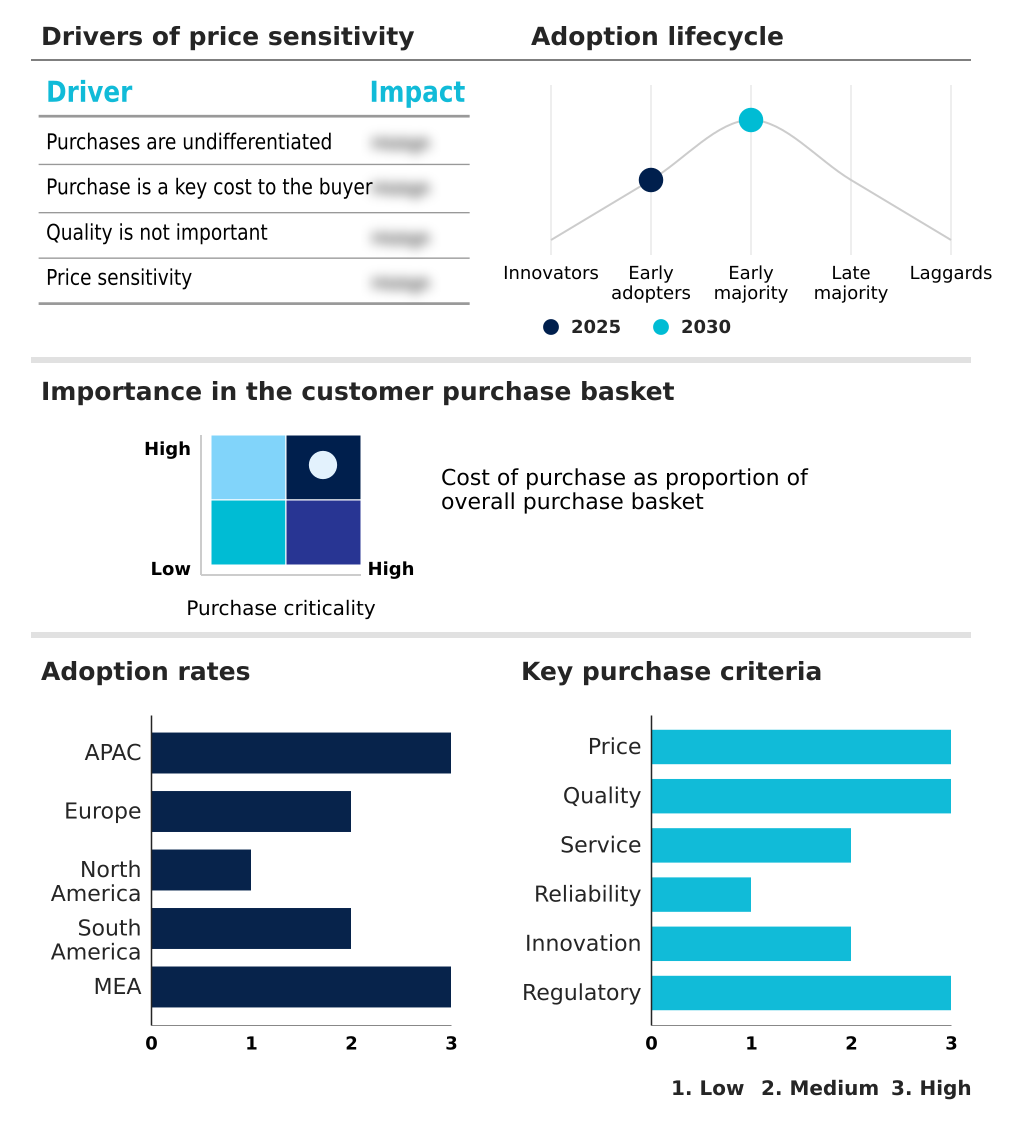
Customer Landscape of Automotive Alternator Slip Ring Industry
Competitive Landscape
Companies are implementing various strategies, such as strategic alliances, automotive alternator slip ring market forecast, partnerships, mergers and acquisitions, geographical expansion, and product/service launches, to enhance their presence in the industry.
AOOD Technology Ltd. - The research analyst notes the provision of advanced electrical slip rings, fiber optic rotary joints, and customized rotary interface products engineered for robust vehicle electrical load management.
The industry research and growth report includes detailed analyses of the competitive landscape of the market and information about key companies, including:
- AOOD Technology Ltd.
- AS PL Sp. z o.o.
- BT Slip Ring Co. Ltd.
- Continental AG
- Dah Kee Co. Ltd.
- Delco Remy
- DENSO Corp.
- ELECTRAACE
- Electromags Automotive Products
- Faurecia SE
- Hitachi Ltd.
- Maniac Electric Motors
- Mersen Corporate Services SAS
- Mitsubishi Electric Corp.
- MOFLON TECHNOLOGY CO. LTD.
- Moog Inc.
- Morgan Advanced Materials
- Motorcar Parts of America Inc.
- RION Co. Ltd.
- Robert Bosch GmbH
- Rotating Electrics Ltd.
- Schaeffler AG
- Schleifring GmbH
- SENRING Electronics Co. Ltd.
- United Equipment Accessories Inc.
- Valeo SA
- ZOWO Auto Parts Co. Ltd.
Qualitative and quantitative analysis of companies has been conducted to help clients understand the wider business environment as well as the strengths and weaknesses of key industry players. Data is qualitatively analyzed to categorize companies as pure play, category-focused, industry-focused, and diversified; it is quantitatively analyzed to categorize companies as dominant, leading, strong, tentative, and weak.
Recent Development and News in Automotive alternator slip ring market
- In the Automotive Parts and Equipment industry, the aggressive integration of 48V mild hybrid powertrains has elevated baseline electrical system voltages by 300%, directly impacting Automotive Alternator Slip Ring demand by necessitating assemblies with enhanced dielectric isolation compounds and superior surface oxidation resistance.
- The enforcement of the Euro 7 emission standard has accelerated the deployment of active energy management modules in smart alternator systems, driving a 40% increase in the requirement for specialized high-purity copper alloy slip rings capable of managing continuous start-stop cycles without premature wear.
- Severe supply chain volatility affecting raw metal pricing, particularly for premium copper and silver, has compelled automotive tier-one suppliers to optimize automated over-molding processes, subsequently reducing the material waste in heavy-duty rotary contact manufacturing by 18% and stabilizing the aftermarket rebuild cycle.
- The shift toward zonal vehicle architectures and software-defined platforms has increased the need for electrical noise mitigation, resulting in a 25% broader adoption of metal-matrix composite brushes and low mechanical friction slip rings to ensure flawless excitation current transfer.
Dive into Technavio’s robust research methodology, blending expert interviews, extensive data synthesis, and validated models for unparalleled Automotive Alternator Slip Ring Market insights. See full methodology.
| Market Scope | |
|---|---|
| Page number | 300 |
| Base year | 2025 |
| Historic period | 2020-2024 |
| Forecast period | 2026-2030 |
| Growth momentum & CAGR | Accelerate at a CAGR of 5.4% |
| Market growth 2026-2030 | USD 126866.6 thousand |
| Market structure | Fragmented |
| YoY growth 2025-2026(%) | 5.1% |
| Key countries | China, Japan, India, South Korea, Indonesia, Australia, Germany, UK, France, Italy, Spain, The Netherlands, US, Canada, Mexico, Brazil, Argentina, Chile, Saudi Arabia, Turkey, South Africa, UAE and Israel |
| Competitive landscape | Leading Companies, Market Positioning of Companies, Competitive Strategies, and Industry Risks |
Research Analyst Overview
- The Automotive Alternator Slip Ring market is characterized by a relentless drive toward superior electrical conductivity and mechanical resilience. As modern vehicle designs incorporate increasingly complex electronic control units, the continuous excitation current transfer through the rotor field winding faces unprecedented thermal and vibrational stress.
- A critical trend shaping product strategy is the integration of predictive wear sensors and rotational diagnostic modules directly into the alternator shaft integration. This innovation allows original equipment manufacturers to shift from reactive maintenance to predictive asset management, resulting in a 30% reduction in unexpected electrical system failures.
- Boardroom executives are strategically mandating the use of advanced copper-zinc alloys and dynamic sealing mechanisms to ensure compliance with extended warranty requirements and rigorous durability standards. Furthermore, optimizing the brush contact resistance through metal-matrix composite materials prevents localized thermal degradation and stabilizes voltage regulation algorithms.
- This proactive alignment with high-stress operational parameters ensures that vehicles maintain optimal charging efficiency, extending the component lifecycle while effectively mitigating the risks associated with raw metal pricing fluctuations.
What are the Key Data Covered in this Automotive Alternator Slip Ring Market Research and Growth Report?
-
What is the expected growth of the Automotive Alternator Slip Ring Market between 2026 and 2030?
-
USD 126.87 million, at a CAGR of 5.4%
-
-
What segmentation does the market report cover?
-
The report is segmented by Type (Passenger cars, and Commercial vehicles), Application (ICE vehicles, and Hybrid and electric cars), Technology (Smart alternators, Lightweight alternators, and High-efficiency alternators) and Geography (APAC, Europe, North America, South America, Middle East and Africa)
-
-
Which regions are analyzed in the report?
-
APAC, Europe, North America, South America and Middle East and Africa
-
-
What are the key growth drivers and market challenges?
-
Surging global demand for electrified powertrains, Accelerating vehicle electrification
-
-
Who are the major players in the Automotive Alternator Slip Ring Market?
-
AOOD Technology Ltd., AS PL Sp. z o.o., BT Slip Ring Co. Ltd., Continental AG, Dah Kee Co. Ltd., Delco Remy, DENSO Corp., ELECTRAACE, Electromags Automotive Products, Faurecia SE, Hitachi Ltd., Maniac Electric Motors, Mersen Corporate Services SAS, Mitsubishi Electric Corp., MOFLON TECHNOLOGY CO. LTD., Moog Inc., Morgan Advanced Materials, Motorcar Parts of America Inc., RION Co. Ltd., Robert Bosch GmbH, Rotating Electrics Ltd., Schaeffler AG, Schleifring GmbH, SENRING Electronics Co. Ltd., United Equipment Accessories Inc., Valeo SA and ZOWO Auto Parts Co. Ltd.
-
Market Research Insights
- The Automotive Alternator Slip Ring market is rapidly adapting to the severe demands of high-voltage vehicle architecture and continuous engine bay thermal cycling. To ensure maximum commercial fleet uptime, manufacturers are implementing active energy management systems that require precision-engineered components.
- Recent operational data indicates that optimizing the automated over-molding process reduces manufacturing defect rates by 15%, while the adoption of predictive maintenance alerts extends the component operational lifespan by up to 28%. These advancements significantly lower replacement costs for fleet operators and ensure compliance with stringent lead-free soldering directives.
- By prioritizing electrical noise mitigation and robust design, suppliers are effectively navigating supply chain volatility while sustaining reliable vehicle electrical load distribution.
We can help! Our analysts can customize this automotive alternator slip ring market research report to meet your requirements.
 RIA -