


Aviation Cyber Security Market Analysis North America, APAC, Europe, Middle East and Africa, South America - US, China, Germany, Japan, India - Size and Forecast 2024-2028

Aviation Cyber Security Market Analysis North America, APAC, Europe, Middle East and Africa, South America - US, China, Germany, Japan, India - Size and Forecast 2024-2028

Published: Jul 2024 171 Pages SKU: IRTNTR75812

Market Overview at a Glance

$49.4 B
Market Opportunity
10.85%
CAGR
9.55
YoY growth 2023-2024(%)

Aviation Cyber Security Market Size 2024-2028 

The aviation cyber security market size is forecast to increase by USD 49.4 billion at a CAGR of 10.85% between 2023 and 2028. The aviation industry's increasing reliance on technology for airline management, air cargo management, and airport management has led to a heightened focus on cyber security. Two primary models, cloud-based and on-premises, are being adopted to address this need. The hybrid model, combining both approaches, is gaining traction due to its flexibility and cost-effectiveness. Cloud-based services are increasingly popular due to their scalability and ease of implementation. However, the high cost of deploying cyber security solutions remains a challenge. Key trends in aviation cyber security include the adoption of cloud-based services, the integration of connectivity for improved customer service and flight efficiency, and the need for strong cyber security to enhance passenger experience.
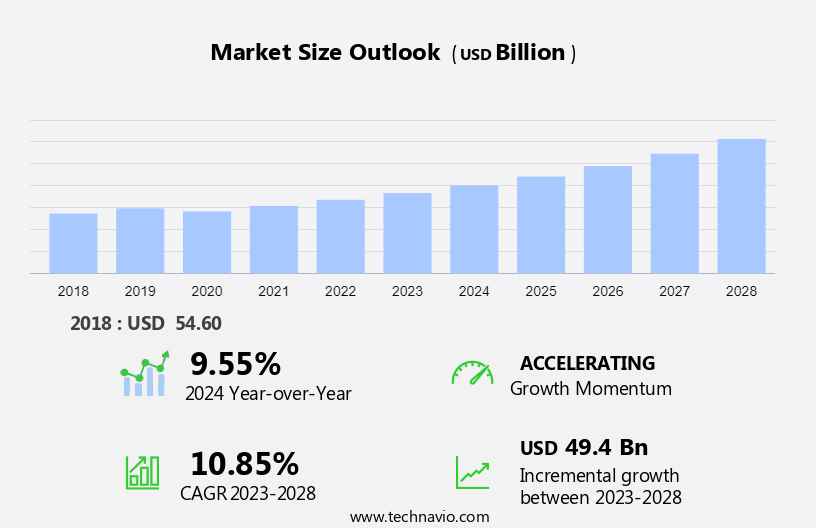
Aviation Cyber Security Market Size

 Request Free Sample

The aviation industry's increasing reliance on internet-connected systems for ground and flight operations has brought about new cyber vulnerabilities. Airline companies are recognizing the importance of securing their in-flight entertainment, connectivity systems, cabin crew devices, application airline management, and customer service platforms from malicious malware activities and cyber attacks. Cyber security threats pose a significant risk to various aspects of the aviation sector. Ground operations, including check-in systems and flight ticketing, are increasingly digitized, making them susceptible to cyber intrusions. Flight operations, such as navigation and communication systems, are also at risk, which could impact flight efficiency and passenger experience.

The aviation cyber security market is growing rapidly as the industry faces increasing threats to in-flight entertainment systems, e-enabled ground systems, and flight ticketing platforms. To protect sensitive data and operations, aviation companies are investing in strong cyber security software and implementing comprehensive cyber security programs. Identity and Access Management (IAM) solutions are critical for safeguarding passenger and flight data across new airports and aviation platforms. With evolving standards and regulations, the market is also seeing increased demand for threat intelligence and response solutions to counter emerging cyber risks. As aviation infrastructure becomes more connected, the need for secure and resilient systems to protect computers, networks, and passenger information remains a top priority for the industry.

Market Segmentation

The market research report provides comprehensive data (region-wise segment analysis), with forecasts and estimates in "USD billion" for the period 2024-2028, as well as historical data from 2018-2022 for the following segments.

  • Type
    • Network security
    • Wireless security
    • Cloud security
    • Content and application security
  • Deployment
    • On-premise
    • Cloud-based
  • Geography
    • North America
      • US
    • APAC
      • China
      • India
      • Japan
    • Europe
      • Germany
    • Middle East and Africa
    • South America

By Type Insights

The network security segment is estimated to witness significant growth during the forecast period. Network security is an essential aspect of the aviation industry, ensuring the protection of sensitive data and maintaining the usability and integrity of computer networks. With the increasing reliance on aviation technologies, such as real-time information systems for flight schedules and passenger services, the risk of data breaches becomes more significant. Air travel passengers and commercial flight airports are prime targets for cyber-attacks, which can lead to financial losses, reputational damage, and potential harm. Civil aviation authorities recognize the importance of advanced security capabilities to safeguard against these threats. Network security measures include detection systems, encryption, firewalls, and access control. Further, cybersecurity threats are a constant concern for the aviation industry, and implementing vigorous security measures is essential to mitigate these risks.
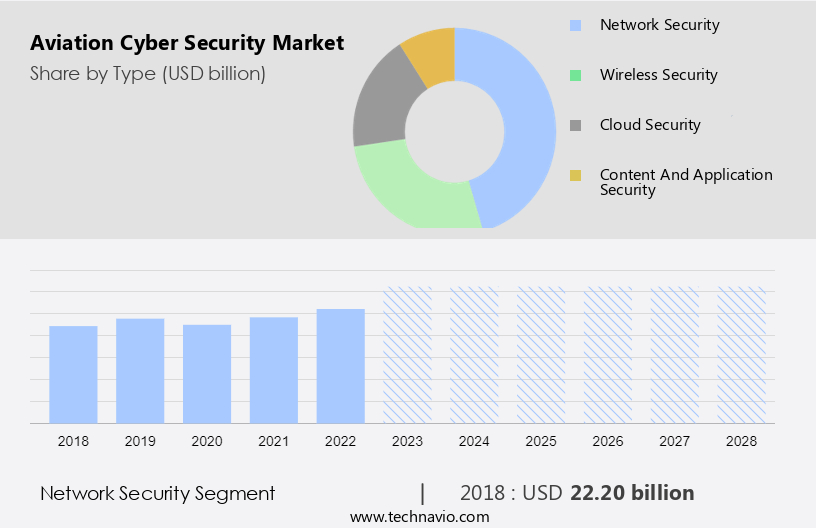
Aviation Cyber Security Market Size

Get a glance at the market share of various segments Request Free Sample

The network security segment accounted for USD 22.20 billion in 2018 and showed a gradual increase during the forecast period.

Regional Insights

APAC is estimated to contribute 34% to the growth of the global market during the forecast period. Technavio's analysts have elaborately explained the regional trends and drivers that shape the market during the forecast period.
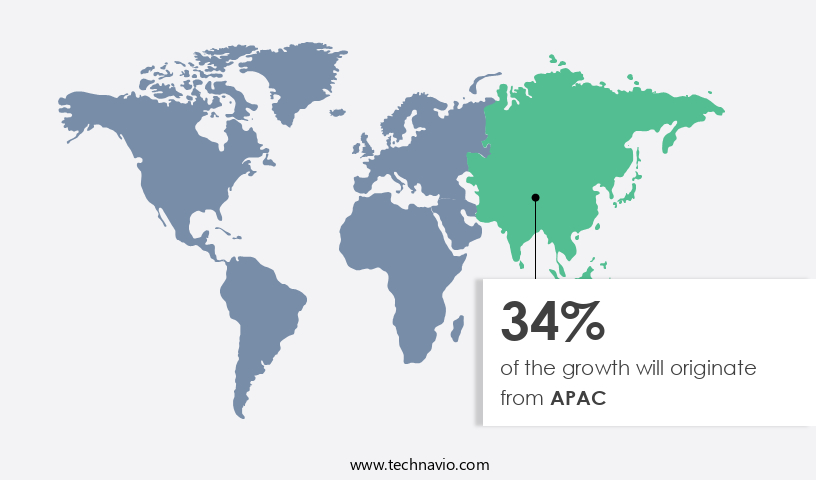
Aviation Cyber Security Market Share by Geography

For more insights on the market share of various regions Request Free Sample

The North American region dominates the market and is projected to maintain its leading position throughout the forecast period. The US is the primary market in North America, driven by several factors. These include the expanding use of aviation cyber security technologies such as firewalls, intrusion detection systems, and intrusion prevention systems to safeguard network users and critical infrastructure from cyber threats. Additionally, the shift towards advanced biometric technologies like identity recognition through facial recognition systems for secure biometric computer applications is gaining momentum. The growing number of suspected criminals and jaywalkers, along with increased government initiatives and the presence of numerous IT companies and startups, further fuel the market growth in North America.

Our researchers analyzed the data with 2023 as the base year, along with the key drivers, trends, and challenges. A holistic analysis of drivers will help companies refine their marketing strategies to gain a competitive advantage.

Market Driver

The adoption of hybrid model in the aviation industry is the key driver of the market. The aviation industry's reliance on internet-connected systems for ground and flight operations has increased cyber vulnerabilities. Airline companies must secure in-flight entertainment, connectivity systems, cabin crew devices, onboard systems, electronic flight bags, and cargo handling. Traditional deployment models for aviation cyber security solutions were on-premises and cloud-based. While on-premises models offered more control, they required significant investment. Cloud-based models were cost-effective but lacked customization. To address these concerns, hybrid deployment models have emerged. These models offer the benefits of both on-premises and cloud-based solutions. Hybrid cyber security solutions follow a pay-per-use model, making them less expensive than full-license security solutions.

They provide ease of installation and upgradation, which is essential for small businesses with limited IT resources. Hybrid deployment models enable organizations to protect on-premises data without the need for a large IT team. This results in a lower total cost of ownership. The advantages of hybrid cyber security solutions are particularly crucial in the aviation industry, where the consequences of a cyber attack can be catastrophic. Therefore, hybrid deployment models are an effective solution for securing aviation industry's critical systems.

Market Trends

The adoption of cloud-based services in aviation cyber security is the upcoming trend in the market. In the aviation industry, the adoption of cloud-based technology has become increasingly crucial for managing various operations, including airline management, air cargo management, and airport management. Cloud solutions enable data storage and access via the internet, allowing real-time information sharing among relevant personnel. This technology enhances operational efficiency by modernizing and updating security systems.

Applications of cloud-based services in aviation cyber security include authentication, video management systems, and biometric information storage. Given the sensitive nature of data involved, it is essential to secure cloud-based data from cyber attacks and malicious malware activities. The implementation of advanced security measures, such as encryption and multi-factor authentication, is vital to safeguarding data in the cloud. Overall, cloud-based technology plays a significant role in improving connectivity, customer service, and flight efficiency while providing a better passenger experience in the aviation sector.

Market Challenge

The high cost of deployment of cyber security in aviation is a key challenge affecting the market growth. The aviation industry's reliance on legacy systems and increasing passenger traffic creates a significant risk for cyberattacks, threatening the safety and security of aircraft infrastructure. Cyber regulatory frameworks are essential to mitigate these risks, and technological solutions, such as threat intelligence, response identity, access management, data loss prevention, and managed security services, are crucial for effective cybersecurity.

However, the high cost of implementing these solutions is a major challenge. This includes expenses for software licensing, system design and customization, implementation, training, and ongoing maintenance. Hiring IT staff for proper implementation and training, as well as maintaining in-house IT administration for on-premises solutions, further increases costs.

Exclusive Customer Landscape

The market forecasting report includes the adoption lifecycle of the market, covering from the innovator's stage to the laggard's stage. It focuses on adoption rates in different regions based on penetration. Furthermore, the report also includes key purchase criteria and drivers of price sensitivity to help companies evaluate and develop their market growth analysis strategies.
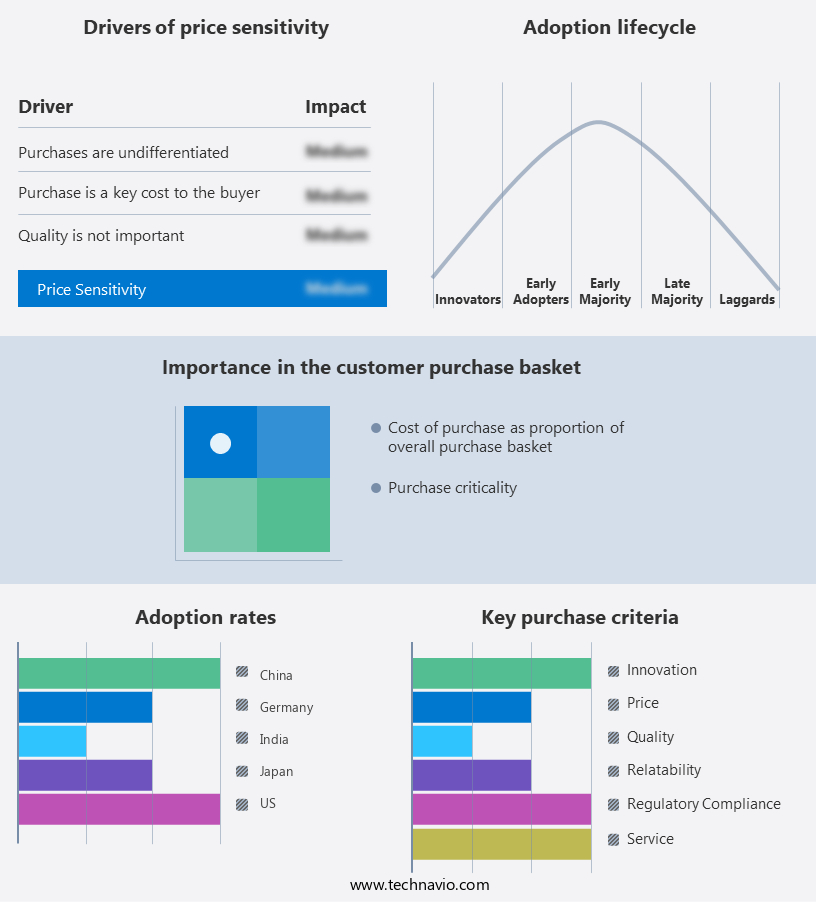
Aviation Cyber Security Market Share by Geography

 Customer Landscape

Key Companies & Market Insights

Companies are implementing various strategies, such as strategic alliances, partnerships, mergers and acquisitions, geographical expansion, and product/service launches, to enhance their presence in the market.

Airbus SE - The company offers Airbus cyber security which protects the government, defense, critical infrastructure, and enterprise from increasingly complex cyber threats.

The market research and growth report includes detailed analyses of the competitive landscape of the market and information about key companies, including:

  • Astronautics Corp. of America
  • BAE Systems Plc
  • Booz Allen Hamilton Holding Corp.
  • Cisco Systems Inc.
  • Fortinet Inc.
  • General Dynamics Corp.
  • General Electric Co.
  • Honeywell International Inc.
  • International Business Machines Corp.
  • Israel Aerospace Industries Ltd.
  • L3Harris Technologies Inc.
  • Lockheed Martin Corp.
  • Northrop Grumman Corp.
  • Palo Alto Networks Inc.
  • RTX Corp.
  • SITA
  • Thales Group
  • Unisys Corp.

Qualitative and quantitative analysis of companies has been conducted to help clients understand the wider business environment as well as the strengths and weaknesses of key market players. Data is qualitatively analyzed to categorize companies as pure play, category-focused, industry-focused, and diversified; it is quantitatively analyzed to categorize companies as dominant, leading, strong, tentative, and weak.

Research Analyst Overview

The aviation industry's increasing reliance on internet-connected systems for ground and flight operations has led to heightened cyber vulnerabilities. Airline companies utilize connectivity systems for in-flight entertainment, cabin crew devices, onboard systems, electronic flight bags, and cargo handling. These systems, including legacy systems and data links, are susceptible to cyberattacks, posing risks to sensitive security data and passenger information. Cybercrime targeting the aviation sector has been on the rise, with malicious malware activities leading to data breaches. Aviation technologies, such as real-time information systems for flight schedules and passenger services, are essential for air travelers and airports. However, they also present advanced security challenges.

Further, civil aviation authorities and governing authorities have implemented cyber regulatory frameworks, threat intelligence, response identity, access management, data loss prevention, managed security, and cyber security standards to mitigate risks. Cloud-based and on-premises cyber security solutions are employed to protect airline management, air cargo management, airport management, application airline management, and connectivity. The global airline industry, including airline service providers, airline bookings, aircraft manufacturers, and aircraft components, faces cyber threats from the finance sector, telecommunications sector, energy sector, and transport sector. Biometric technology, such as facial recognition systems, is employed to enhance cyber safety and identity recognition for suspected criminals and jaywalkers. Firewalls, intrusion detection systems, and intrusion prevention systems are crucial components of cyber security programs to safeguard aviation infrastructure.

Market Scope

Report Coverage

Details

Page number

171

Base year

2023

Historic period

2018-2022

Forecast period

2024-2028

Growth momentum & CAGR

Accelerate at a CAGR of 10.85%

Market Growth 2024-2028

USD 49.4 billion

Market structure

Fragmented

YoY growth 2023-2024(%)

9.55

Regional analysis

North America, APAC, Europe, Middle East and Africa, and South America

Performing market contribution

APAC at 34%

Key countries

US, China, Germany, Japan, and India

Competitive landscape

Leading Companies, Market Positioning of Companies, Competitive Strategies, and Industry Risks

Key companies profiled

Airbus SE, Astronautics Corp. of America, BAE Systems Plc, Booz Allen Hamilton Holding Corp., Cisco Systems Inc., Fortinet Inc., General Dynamics Corp., General Electric Co., Honeywell International Inc., International Business Machines Corp., Israel Aerospace Industries Ltd., L3Harris Technologies Inc., Lockheed Martin Corp., Northrop Grumman Corp., Palo Alto Networks Inc., RTX Corp., SITA, Thales Group, and Unisys Corp.

Market dynamics

Parent market analysis, market growth inducers and obstacles, market forecast, fast-growing and slow-growing segment analysis, COVID-19 impact and recovery analysis and future consumer dynamics, market condition analysis for the forecast period

Customization purview

If our market report has not included the data that you are looking for, you can reach out to our analysts and get segments customized.

Request Free Sample

What are the Key Data Covered in this Market Research and Growth Report?

  • CAGR of the market during the forecast period
  • Detailed information on factors that will drive the market growth and forecasting between 2024 and 2028
  • Precise estimation of the size of the market  and its contribution of the market in focus to the parent market
  • Accurate predictions about upcoming market growth and trends and changes in consumer behaviour
  • Growth of the market across North America, APAC, Europe, Middle East and Africa, and South America
  • Thorough analysis of the market's competitive landscape and detailed information about companies
  • Comprehensive analysis of factors that will challenge the growth of market companies

We can help! Our analysts can customize this market research report to meet your requirements. Get in touch

1 Executive Summary

  • 1.1 Market overview
    • Executive Summary - Chart on Market Overview
    • Executive Summary - Data Table on Market Overview
    • Executive Summary - Chart on Global Market Characteristics
    • Executive Summary - Chart on Market by Geography
    • Executive Summary - Chart on Market Segmentation by Type
    • Executive Summary - Chart on Market Segmentation by Deployment
    • Executive Summary - Chart on Incremental Growth
    • Executive Summary - Data Table on Incremental Growth
    • Executive Summary - Chart on Company Market Positioning

2 Market Landscape

  • 2.1 Market ecosystem
    • Parent Market
    • Data Table on - Parent Market
  • 2.2 Market characteristics
    • Market characteristics analysis
  • 2.3 Value chain analysis
    • Value Chain Analysis

3 Market Sizing

  • 3.1 Market definition
    • Offerings of companies included in the market definition
  • 3.2 Market segment analysis
    • Market segments
  • 3.3 Market size 2023
    • 3.4 Market outlook: Forecast for 2023-2028
      • Chart on Global - Market size and forecast 2023-2028 ($ billion)
      • Data Table on Global - Market size and forecast 2023-2028 ($ billion)
      • Chart on Global Market: Year-over-year growth 2023-2028 (%)
      • Data Table on Global Market: Year-over-year growth 2023-2028 (%)

    4 Historic Market Size

    • 4.1 Global Aviation Cyber Security Market 2018 - 2022
      • Historic Market Size - Data Table on Global Aviation Cyber Security Market 2018 - 2022 ($ billion)
    • 4.2 Type segment analysis 2018 - 2022
      • Historic Market Size - Type Segment 2018 - 2022 ($ billion)
    • 4.3 Deployment segment analysis 2018 - 2022
      • Historic Market Size - Deployment Segment 2018 - 2022 ($ billion)
    • 4.4 Geography segment analysis 2018 - 2022
      • Historic Market Size - Geography Segment 2018 - 2022 ($ billion)
    • 4.5 Country segment analysis 2018 - 2022
      • Historic Market Size - Country Segment 2018 - 2022 ($ billion)

    5 Five Forces Analysis

    • 5.1 Five forces summary
      • Five forces analysis - Comparison between 2023 and 2028
    • 5.2 Bargaining power of buyers
      • Bargaining power of buyers - Impact of key factors 2023 and 2028
    • 5.3 Bargaining power of suppliers
      • Bargaining power of suppliers - Impact of key factors in 2023 and 2028
    • 5.4 Threat of new entrants
      • Threat of new entrants - Impact of key factors in 2023 and 2028
    • 5.5 Threat of substitutes
      • Threat of substitutes - Impact of key factors in 2023 and 2028
    • 5.6 Threat of rivalry
      • Threat of rivalry - Impact of key factors in 2023 and 2028
    • 5.7 Market condition
      • Chart on Market condition - Five forces 2023 and 2028

    6 Market Segmentation by Type

    • 6.1 Market segments
      • Chart on Type - Market share 2023-2028 (%)
      • Data Table on Type - Market share 2023-2028 (%)
    • 6.2 Comparison by Type
      • Chart on Comparison by Type
      • Data Table on Comparison by Type
    • 6.3 Network security - Market size and forecast 2023-2028
      • Chart on Network security - Market size and forecast 2023-2028 ($ billion)
      • Data Table on Network security - Market size and forecast 2023-2028 ($ billion)
      • Chart on Network security - Year-over-year growth 2023-2028 (%)
      • Data Table on Network security - Year-over-year growth 2023-2028 (%)
    • 6.4 Wireless security - Market size and forecast 2023-2028
      • Chart on Wireless security - Market size and forecast 2023-2028 ($ billion)
      • Data Table on Wireless security - Market size and forecast 2023-2028 ($ billion)
      • Chart on Wireless security - Year-over-year growth 2023-2028 (%)
      • Data Table on Wireless security - Year-over-year growth 2023-2028 (%)
    • 6.5 Cloud security - Market size and forecast 2023-2028
      • Chart on Cloud security - Market size and forecast 2023-2028 ($ billion)
      • Data Table on Cloud security - Market size and forecast 2023-2028 ($ billion)
      • Chart on Cloud security - Year-over-year growth 2023-2028 (%)
      • Data Table on Cloud security - Year-over-year growth 2023-2028 (%)
    • 6.6 Content and application security - Market size and forecast 2023-2028
      • Chart on Content and application security - Market size and forecast 2023-2028 ($ billion)
      • Data Table on Content and application security - Market size and forecast 2023-2028 ($ billion)
      • Chart on Content and application security - Year-over-year growth 2023-2028 (%)
      • Data Table on Content and application security - Year-over-year growth 2023-2028 (%)
    • 6.7 Market opportunity by Type
      • Market opportunity by Type ($ billion)
      • Data Table on Market opportunity by Type ($ billion)

    7 Market Segmentation by Deployment

    • 7.1 Market segments
      • Chart on Deployment - Market share 2023-2028 (%)
      • Data Table on Deployment - Market share 2023-2028 (%)
    • 7.2 Comparison by Deployment
      • Chart on Comparison by Deployment
      • Data Table on Comparison by Deployment
    • 7.3 On-premise - Market size and forecast 2023-2028
      • Chart on On-premise - Market size and forecast 2023-2028 ($ billion)
      • Data Table on On-premise - Market size and forecast 2023-2028 ($ billion)
      • Chart on On-premise - Year-over-year growth 2023-2028 (%)
      • Data Table on On-premise - Year-over-year growth 2023-2028 (%)
    • 7.4 Cloud-based - Market size and forecast 2023-2028
      • Chart on Cloud-based - Market size and forecast 2023-2028 ($ billion)
      • Data Table on Cloud-based - Market size and forecast 2023-2028 ($ billion)
      • Chart on Cloud-based - Year-over-year growth 2023-2028 (%)
      • Data Table on Cloud-based - Year-over-year growth 2023-2028 (%)
    • 7.5 Market opportunity by Deployment
      • Market opportunity by Deployment ($ billion)
      • Data Table on Market opportunity by Deployment ($ billion)

    8 Customer Landscape

    • 8.1 Customer landscape overview
      • Analysis of price sensitivity, lifecycle, customer purchase basket, adoption rates, and purchase criteria

    9 Geographic Landscape

    • 9.1 Geographic segmentation
      • Chart on Market share by geography 2023-2028 (%)
      • Data Table on Market share by geography 2023-2028 (%)
    • 9.2 Geographic comparison
      • Chart on Geographic comparison
      • Data Table on Geographic comparison
    • 9.3 North America - Market size and forecast 2023-2028
      • Chart on North America - Market size and forecast 2023-2028 ($ billion)
      • Data Table on North America - Market size and forecast 2023-2028 ($ billion)
      • Chart on North America - Year-over-year growth 2023-2028 (%)
      • Data Table on North America - Year-over-year growth 2023-2028 (%)
    • 9.4 APAC - Market size and forecast 2023-2028
      • Chart on APAC - Market size and forecast 2023-2028 ($ billion)
      • Data Table on APAC - Market size and forecast 2023-2028 ($ billion)
      • Chart on APAC - Year-over-year growth 2023-2028 (%)
      • Data Table on APAC - Year-over-year growth 2023-2028 (%)
    • 9.5 Europe - Market size and forecast 2023-2028
      • Chart on Europe - Market size and forecast 2023-2028 ($ billion)
      • Data Table on Europe - Market size and forecast 2023-2028 ($ billion)
      • Chart on Europe - Year-over-year growth 2023-2028 (%)
      • Data Table on Europe - Year-over-year growth 2023-2028 (%)
    • 9.6 Middle East and Africa - Market size and forecast 2023-2028
      • Chart on Middle East and Africa - Market size and forecast 2023-2028 ($ billion)
      • Data Table on Middle East and Africa - Market size and forecast 2023-2028 ($ billion)
      • Chart on Middle East and Africa - Year-over-year growth 2023-2028 (%)
      • Data Table on Middle East and Africa - Year-over-year growth 2023-2028 (%)
    • 9.7 South America - Market size and forecast 2023-2028
      • Chart on South America - Market size and forecast 2023-2028 ($ billion)
      • Data Table on South America - Market size and forecast 2023-2028 ($ billion)
      • Chart on South America - Year-over-year growth 2023-2028 (%)
      • Data Table on South America - Year-over-year growth 2023-2028 (%)
    • 9.8 US - Market size and forecast 2023-2028
      • Chart on US - Market size and forecast 2023-2028 ($ billion)
      • Data Table on US - Market size and forecast 2023-2028 ($ billion)
      • Chart on US - Year-over-year growth 2023-2028 (%)
      • Data Table on US - Year-over-year growth 2023-2028 (%)
    • 9.9 China - Market size and forecast 2023-2028
      • Chart on China - Market size and forecast 2023-2028 ($ billion)
      • Data Table on China - Market size and forecast 2023-2028 ($ billion)
      • Chart on China - Year-over-year growth 2023-2028 (%)
      • Data Table on China - Year-over-year growth 2023-2028 (%)
    • 9.10 Germany - Market size and forecast 2023-2028
      • Chart on Germany - Market size and forecast 2023-2028 ($ billion)
      • Data Table on Germany - Market size and forecast 2023-2028 ($ billion)
      • Chart on Germany - Year-over-year growth 2023-2028 (%)
      • Data Table on Germany - Year-over-year growth 2023-2028 (%)
    • 9.11 Japan - Market size and forecast 2023-2028
      • Chart on Japan - Market size and forecast 2023-2028 ($ billion)
      • Data Table on Japan - Market size and forecast 2023-2028 ($ billion)
      • Chart on Japan - Year-over-year growth 2023-2028 (%)
      • Data Table on Japan - Year-over-year growth 2023-2028 (%)
    • 9.12 India - Market size and forecast 2023-2028
      • Chart on India - Market size and forecast 2023-2028 ($ billion)
      • Data Table on India - Market size and forecast 2023-2028 ($ billion)
      • Chart on India - Year-over-year growth 2023-2028 (%)
      • Data Table on India - Year-over-year growth 2023-2028 (%)
    • 9.13 Market opportunity by geography
      • Market opportunity by geography ($ billion)
      • Data Tables on Market opportunity by geography ($ billion)

    10 Drivers, Challenges, and Opportunity/Restraints

    • 10.1 Market drivers
      • 10.2 Market challenges
        • 10.3 Impact of drivers and challenges
          • Impact of drivers and challenges in 2023 and 2028
        • 10.4 Market opportunities/restraints

          11 Competitive Landscape

          • 11.1 Overview
            • 11.2 Competitive Landscape
              • Overview on criticality of inputs and factors of differentiation
            • 11.3 Landscape disruption
              • Overview on factors of disruption
            • 11.4 Industry risks
              • Impact of key risks on business

            12 Competitive Analysis

            • 12.1 Companies profiled
              • Companies covered
            • 12.2 Market positioning of companies
              • Matrix on companies position and classification
            • 12.3 Airbus SE
              • Airbus SE - Overview
              • Airbus SE - Business segments
              • Airbus SE - Key news
              • Airbus SE - Key offerings
              • Airbus SE - Segment focus
            • 12.4 BAE Systems Plc
              • BAE Systems Plc - Overview
              • BAE Systems Plc - Business segments
              • BAE Systems Plc - Key news
              • BAE Systems Plc - Key offerings
              • BAE Systems Plc - Segment focus
            • 12.5 Booz Allen Hamilton Holding Corp.
              • Booz Allen Hamilton Holding Corp. - Overview
              • Booz Allen Hamilton Holding Corp. - Product / Service
              • Booz Allen Hamilton Holding Corp. - Key offerings
            • 12.6 Cisco Systems Inc.
              • Cisco Systems Inc. - Overview
              • Cisco Systems Inc. - Business segments
              • Cisco Systems Inc. - Key news
              • Cisco Systems Inc. - Key offerings
              • Cisco Systems Inc. - Segment focus
            • 12.7 Fortinet Inc.
              • Fortinet Inc. - Overview
              • Fortinet Inc. - Product / Service
              • Fortinet Inc. - Key news
              • Fortinet Inc. - Key offerings
            • 12.8 General Dynamics Corp.
              • General Dynamics Corp. - Overview
              • General Dynamics Corp. - Business segments
              • General Dynamics Corp. - Key news
              • General Dynamics Corp. - Key offerings
              • General Dynamics Corp. - Segment focus
            • 12.9 Honeywell International Inc.
              • Honeywell International Inc. - Overview
              • Honeywell International Inc. - Business segments
              • Honeywell International Inc. - Key news
              • Honeywell International Inc. - Key offerings
              • Honeywell International Inc. - Segment focus
            • 12.10 International Business Machines Corp.
              • International Business Machines Corp. - Overview
              • International Business Machines Corp. - Business segments
              • International Business Machines Corp. - Key news
              • International Business Machines Corp. - Key offerings
              • International Business Machines Corp. - Segment focus
            • 12.11 L3Harris Technologies Inc.
              • L3Harris Technologies Inc. - Overview
              • L3Harris Technologies Inc. - Business segments
              • L3Harris Technologies Inc. - Key news
              • L3Harris Technologies Inc. - Key offerings
              • L3Harris Technologies Inc. - Segment focus
            • 12.12 Lockheed Martin Corp.
              • Lockheed Martin Corp. - Overview
              • Lockheed Martin Corp. - Business segments
              • Lockheed Martin Corp. - Key news
              • Lockheed Martin Corp. - Key offerings
              • Lockheed Martin Corp. - Segment focus
            • 12.13 Palo Alto Networks Inc.
              • Palo Alto Networks Inc. - Overview
              • Palo Alto Networks Inc. - Product / Service
              • Palo Alto Networks Inc. - Key news
              • Palo Alto Networks Inc. - Key offerings
            • 12.14 RTX Corp.
              • RTX Corp. - Overview
              • RTX Corp. - Business segments
              • RTX Corp. - Key news
              • RTX Corp. - Key offerings
              • RTX Corp. - Segment focus
            • 12.15 SITA
              • SITA - Overview
              • SITA - Product / Service
              • SITA - Key offerings
            • 12.16 Thales Group
              • Thales Group - Overview
              • Thales Group - Business segments
              • Thales Group - Key news
              • Thales Group - Key offerings
              • Thales Group - Segment focus
            • 12.17 Unisys Corp.
              • Unisys Corp. - Overview
              • Unisys Corp. - Business segments
              • Unisys Corp. - Key news
              • Unisys Corp. - Key offerings
              • Unisys Corp. - Segment focus

            13 Appendix

            • 13.1 Scope of the report
              • 13.2 Inclusions and exclusions checklist
                • Inclusions checklist
                • Exclusions checklist
              • 13.3 Currency conversion rates for US$
                • Currency conversion rates for US$
              • 13.4 Research methodology
                • Research methodology
              • 13.5 Data procurement
                • Information sources
              • 13.6 Data validation
                • Data validation
              • 13.7 Validation techniques employed for market sizing
                • Validation techniques employed for market sizing
              • 13.8 Data synthesis
                • Data synthesis
              • 13.9 360 degree market analysis
                • 360 degree market analysis
              • 13.10 List of abbreviations
                • List of abbreviations

              Research Methodology

              Technavio presents a detailed picture of the market by way of study, synthesis, and summation of data from multiple sources. The analysts have presented the various facets of the market with a particular focus on identifying the key industry influencers. The data thus presented is comprehensive, reliable, and the result of extensive research, both primary and secondary.

              INFORMATION SOURCES

              Primary sources

              • Manufacturers and suppliers
              • Channel partners
              • Industry experts
              • Strategic decision makers

              Secondary sources

              • Industry journals and periodicals
              • Government data
              • Financial reports of key industry players
              • Historical data
              • Press releases

              DATA ANALYSIS

              Data Synthesis

              • Collation of data
              • Estimation of key figures
              • Analysis of derived insights

              Data Validation

              • Triangulation with data models
              • Reference against proprietary databases
              • Corroboration with industry experts

              REPORT WRITING

              Qualitative

              • Market drivers
              • Market challenges
              • Market trends
              • Five forces analysis

              Quantitative

              • Market size and forecast
              • Market segmentation
              • Geographical insights
              • Competitive landscape

              Interested in this report?

              Get your sample now to see our research methodology and insights!

              Download Now

              Frequently Asked Questions

              Aviation Cyber Security market growth will increase by $ 49.4 bn during 2024-2028 .

              The Aviation Cyber Security market is expected to grow at a CAGR of 10.85% during 2024-2028 .

              Aviation Cyber Security market is segmented by Type( Network security, Wireless security, Cloud security, Content and application security) Deployment( On-premise, Cloud-based)

              Airbus SE, Astronautics Corp. of America, BAE Systems Plc, Booz Allen Hamilton Holding Corp., Cisco Systems Inc., Fortinet Inc., General Dynamics Corp., General Electric Co., Honeywell International Inc., International Business Machines Corp., Israel Aerospace Industries Ltd., L3Harris Technologies Inc., Lockheed Martin Corp., Northrop Grumman Corp., Palo Alto Networks Inc., RTX Corp., SITA, Thales Group, Unisys Corp. are a few of the key vendors in the Aviation Cyber Security market.

              APAC will register the highest growth rate of 34% among the other regions. Therefore, the Aviation Cyber Security market in APAC is expected to garner significant business opportunities for the vendors during the forecast period.

              US, China, Germany, Japan, India

              • Adoption of hybrid model in aviation industryTraditionally is the driving factor this market.
              • the deployment models for aviation cyber security solutions that were provided by vendors were on-premises and cloud-based models. The on-premises deployment model required high investment by the organization is the driving factor this market.
              • whereas the cloud-based deployment model was cost-effective for the organization.To overcome the issues with traditional deployment models is the driving factor this market.
              • hybrid deployment models were introduced. Many industries is the driving factor this market.
              • including small businesses is the driving factor this market.
              • are adopting hybrid deployment models to ensure on-premises data protection without the need for a skilled worker is the driving factor this market.
              • thus lowering their total cost of ownership. Hybrid cyber security solutions follow the pay-per-use model and are less expensive compared with traditional full-license security solutions. In addition is the driving factor this market.
              • hybrid cyber security solutions provide advantages such as ease of installation and upgradation. There is a growing demand for hybrid deployment models in different industries is the driving factor this market.
              • which will encourage emerging vendors to provide hybrid cloud-based security solutions during the forecast period. Thus is the driving factor this market.
              • such factors will spur the growth of the global aviation cyber security market during the forecast period. is the driving factor this market.

              The Aviation Cyber Security market vendors should focus on grabbing business opportunities from the Network security segment as it accounted for the largest market share in the base year.
