


Coating Additives Market Size 2026-2030
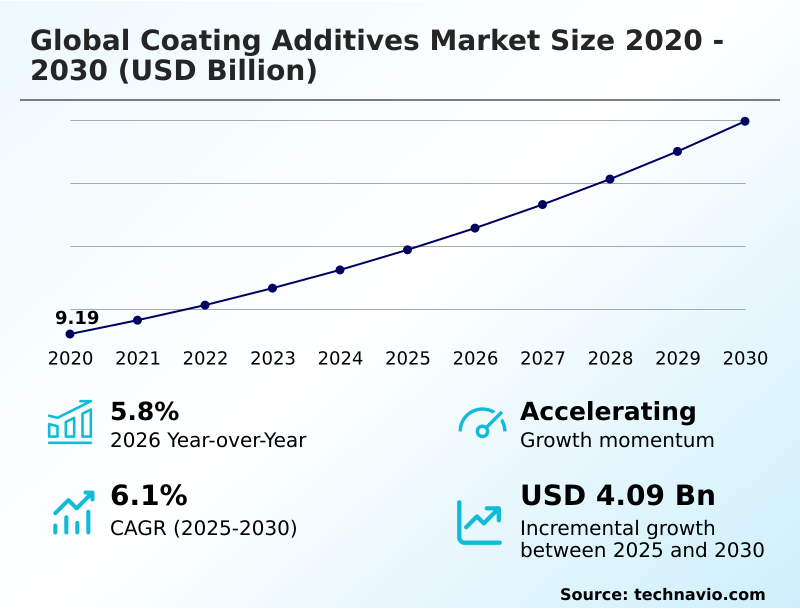
The coating additives market size is valued to increase by USD 4.09 billion, at a CAGR of 6.1% from 2025 to 2030. Increased demand for paints and coatings with functional benefits will drive the coating additives market.
Major Market Trends & Insights
- APAC dominated the market and accounted for a 41.2% growth during the forecast period.
- By Application - Architecture segment was valued at USD 4.42 billion in 2024
- By Formulation - Waterborne segment accounted for the largest market revenue share in 2024
Market Size & Forecast
- Market Opportunities: USD 6.77 billion
- Market Future Opportunities: USD 4.09 billion
- CAGR from 2025 to 2030 : 6.1%
Market Summary
- The Coating Additives Market is defined by a continuous drive for performance enhancement and regulatory compliance. The demand for advanced functional coatings propels innovation, pushing manufacturers to develop additives that impart specific properties like enhanced durability, UV resistance, and antimicrobial capabilities.
- A primary trend is the industry-wide shift toward sustainable solutions, with a strong focus on waterborne formulations and bio-based raw materials to reduce environmental impact. However, this transition introduces formulation complexities, as new additives must be compatible with different resin systems to avoid defects.
- For instance, a manufacturer transitioning to low-VOC architectural paints must navigate the challenge of selecting the right dispersants and defoamers to ensure excellent film formation and a flawless finish, all while managing the volatile costs of petrochemical-derived raw materials.
- The market's trajectory is therefore a balance between technological advancement, sustainability goals, and economic pressures, requiring constant research and development to create robust, multifunctional, and cost-effective solutions for a wide range of applications from automotive to industrial coatings.
What will be the Size of the Coating Additives Market during the forecast period?
Get Key Insights on Market Forecast (PDF) Get Free Sample
How is the Coating Additives Market Segmented?
The coating additives industry research report provides comprehensive data (region-wise segment analysis), with forecasts and estimates in "USD million" for the period 2026-2030, as well as historical data from 2020-2024 for the following segments.
- Application
- Architecture
- Industrial
- Automotive
- Wood and furniture
- Others
- Formulation
- Waterborne
- Solvent-borne
- Powder-based
- Type
- Acrylic
- Urethanes
- Fluoropolymers
- Metallic additives
- Others
- Geography
- APAC
- China
- India
- Japan
- North America
- US
- Canada
- Mexico
- Europe
- Germany
- France
- Italy
- South America
- Brazil
- Argentina
- Middle East and Africa
- Saudi Arabia
- UAE
- South Africa
- Rest of World (ROW)
- APAC
By Application Insights
The architecture segment is estimated to witness significant growth during the forecast period.
The architectural segment is shaped by global construction and renovation, with a strong push towards environmentally responsible products. The shift from traditional solvent-borne systems to `waterborne formulations` necessitates advanced `multifunctional additives` to achieve comparable durability.
Innovations focus on enhancing `architectural coating durability` through better `rheology modification` and `pigment dispersion`.
There is also a notable trend toward `smart coatings`, including those with `self-healing polymers` for extended surface life and `antimicrobial surface technology` for hygienic environments, a critical factor in healthcare and public spaces.
This demand for specialized `functional coatings` is especially pronounced in APAC, which accounts for 41.2% of the market’s incremental growth, driven by massive urbanization.
The use of `haptic additives` and `leveling agents` is also rising to improve the look and feel of interior paints.
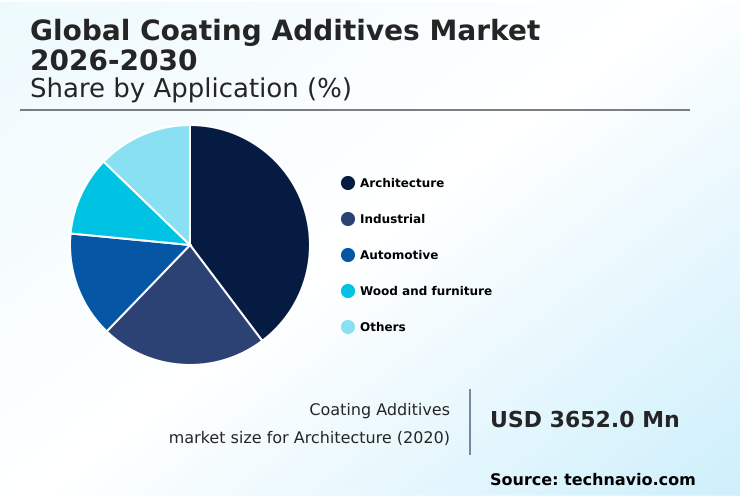
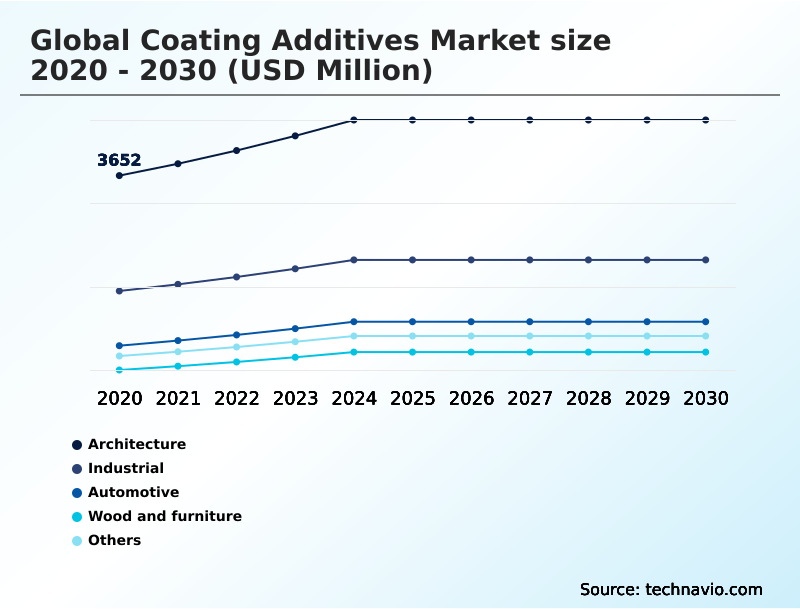
The Architecture segment was valued at USD 4.42 billion in 2024 and showed a gradual increase during the forecast period.
Regional Analysis
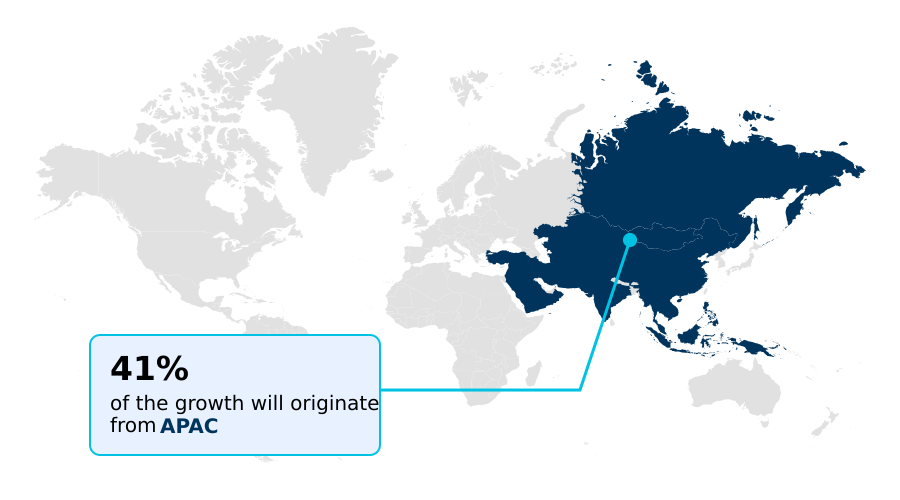
APAC is estimated to contribute 41.2% to the growth of the global market during the forecast period.Technavio’s analysts have elaborately explained the regional trends and drivers that shape the market during the forecast period.
See How Coating Additives Market Demand is Rising in APAC Get Free Sample
The geographic landscape is led by APAC, which accounts for over 41% of the market's growth opportunity, driven by its expansive construction and automotive industries.
In this region, there is immense demand for advanced solvent-borne systems and waterborne formulations that utilize fluoropolymer additives for enhanced durability. North America and Europe are mature markets focused on innovation in regulatory compliant formulations and nanoparticle reinforcement.
In these regions, a key focus is on chemical resistance enhancement for specialized applications in sectors like aerospace and healthcare. Demand for thermal insulation properties in architectural coatings is growing, improving building energy efficiency by up to 10%.
Across all regions, packaging coating safety remains a priority, driving the adoption of specialized epoxy resins and alkyd resins that meet stringent food contact standards.
Market Dynamics
Our researchers analyzed the data with 2025 as the base year, along with the key drivers, trends, and challenges. A holistic analysis of drivers will help companies refine their marketing strategies to gain a competitive advantage.
- Formulation expertise is becoming increasingly specialized to address niche performance requirements across various sectors. For architectural applications, the focus is on developing advanced additives for waterborne architectural coatings that deliver both sustainability and durability.
- In the high-stakes automotive industry, research is centered on improving scratch resistance in automotive clearcoats and utilizing silicone additives for slip and mar resistance to protect high-gloss finishes. For industrial settings, the development of low-VOC additives for industrial maintenance and anti-corrosion pigments for protective primers is critical for extending asset life.
- A core area of innovation involves rheology control in high-solids coatings and the creation of powder coating flow and leveling additives to ensure flawless application. Optimized formulations combining these specialized additives have demonstrated a reduction in application defects by over 15% compared to legacy systems, a significant gain for operational planning.
- The market is also advancing with new biocides for paint and coating preservation, UV absorbers for exterior wood finishes, and defoamers for high-speed coating applications. Further specialization is seen in matting agents for low-gloss furniture lacquers and adhesion promoters for plastic substrates, ensuring performance on challenging surfaces.
- The evolution of polyurethane dispersion technology and waterborne epoxy resin curing agents is pivotal for creating next-generation, high-performance systems. Efforts are also being directed toward formulating pfas-free surfactant alternatives and using nanoparticle additives for uv protection.
- Other key development areas include surfactants for pigment wetting and stabilization, leveling agents for flawless surface appearance, multifunctional additives for simplifying formulations, additives for enhanced chemical resistance, and intumescent additives for fire-retardant coatings.
What are the key market drivers leading to the rise in the adoption of Coating Additives Industry?
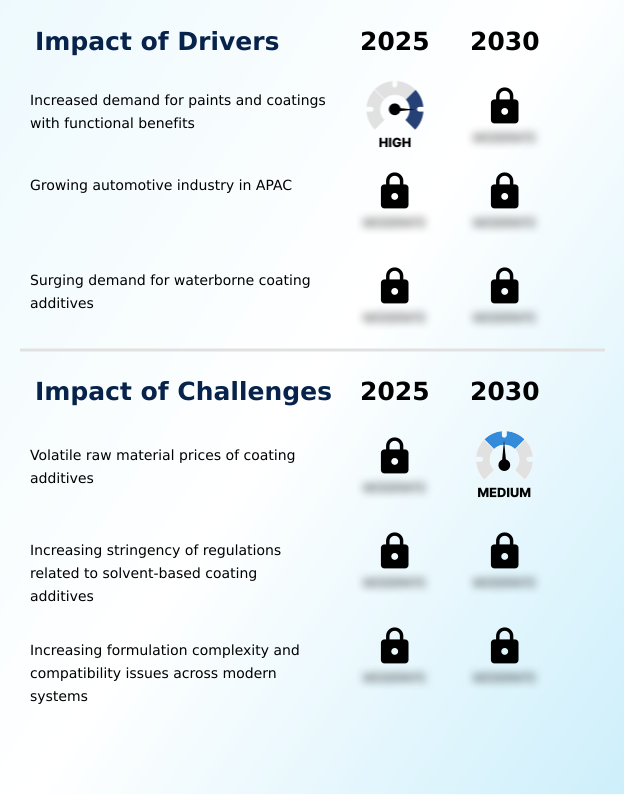
- A key market driver is the increased demand for paints and coatings that offer advanced functional benefits beyond simple aesthetic appeal and basic protection.
- The market is significantly driven by demand for high-performance coating systems that offer functional benefits beyond aesthetics.
- The automotive sector in APAC, which saw production volume grow by 2.9%, is a major consumer, requiring advanced acrylic additives and urethane additives for superior automotive clearcoat protection and durability.
- The need for enhanced corrosion protection mechanisms in industrial maintenance coatings and marine antifouling technology fuels demand for specialized anti-corrosion additives and intumescent coatings.
- Technological advancements in nanotechnology additives are enabling coatings with superior scratch resistance improvement and UV radiation resistance. These innovations are critical for demanding sectors like aerospace coating performance, where durability and reliability are non-negotiable.
What are the market trends shaping the Coating Additives Industry?
- A significant market trend is the increasing focus on bio-based and eco-friendly products, a shift driven by both stringent environmental regulations and rising consumer demand for sustainable solutions.
- A primary trend is the industry-wide pivot to sustainable coating solutions, driven by regulatory pressure and consumer demand. This is accelerating the development of eco-friendly coating additives and bio-based raw materials, with some new waterborne formulations featuring up to 97% renewable content.
- The focus on PFAS-free additive development is intense, as companies re-engineer products to eliminate persistent chemicals without compromising performance. Innovations in low-temperature-cure powders are also expanding application possibilities to heat-sensitive substrates, reducing energy consumption during manufacturing by over 15%.
- This green transition is further supported by the pursuit of a circular economy in coatings, where adhesion promoters and other polyurethane dispersion technologies are designed for easier recycling and reduced environmental impact.
What challenges does the Coating Additives Industry face during its growth?
- A key challenge affecting industry growth is the volatility of raw material prices for coating additives, which are often derived from fluctuating petrochemical markets.
- A major challenge stems from formulation complexity and raw material volatility, with some essential petrochemical derivatives seeing price increases of 12%. This instability is compounded by the technical difficulties of ensuring compatibility across modern systems like powder-based coatings and high-solids coatings.
- When combining different dispersants or matting agents, formulators can encounter issues like pigment flocculation or phase separation, which compromise finish quality. The transition to low-VOC formulations intensifies these issues, as new wetting agents and defoamers must perform effectively in different chemistries.
- With raw materials accounting for over 50% of operating costs for some manufacturers, price fluctuations directly impact profitability and necessitate continuous reformulation and optimization to maintain performance standards for wood coating enhancements.
Exclusive Technavio Analysis on Customer Landscape
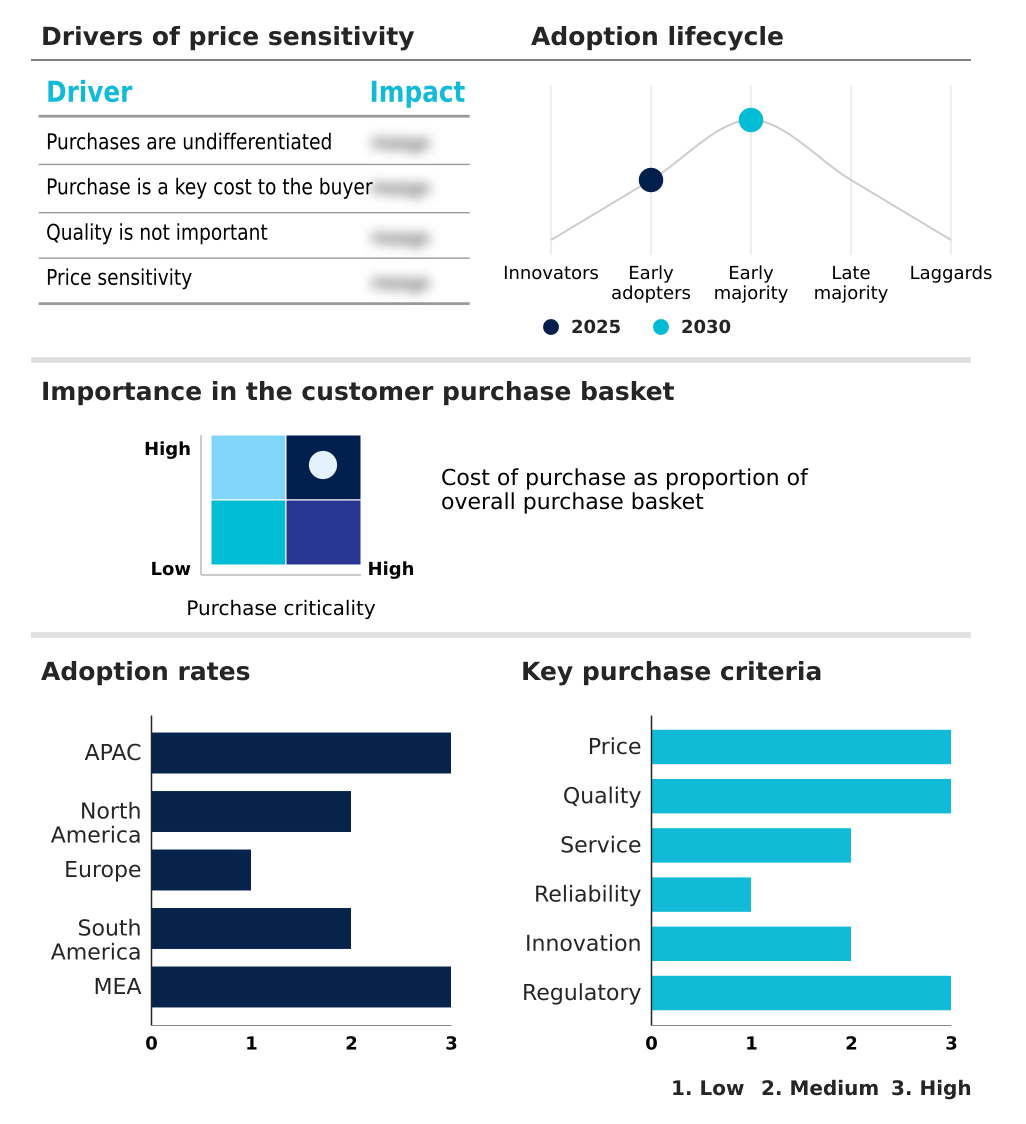
The coating additives market forecasting report includes the adoption lifecycle of the market, covering from the innovator’s stage to the laggard’s stage. It focuses on adoption rates in different regions based on penetration. Furthermore, the coating additives market report also includes key purchase criteria and drivers of price sensitivity to help companies evaluate and develop their market growth analysis strategies.
Customer Landscape of Coating Additives Industry
Competitive Landscape
Companies are implementing various strategies, such as strategic alliances, coating additives market forecast, partnerships, mergers and acquisitions, geographical expansion, and product/service launches, to enhance their presence in the industry.
Altana AG - Key offerings include advanced additives instrumental in enhancing product properties such as scratch resistance and surface gloss, catering to the high-performance coatings sector.
The industry research and growth report includes detailed analyses of the competitive landscape of the market and information about key companies, including:
- Altana AG
- Arkema Group
- Ashland Inc.
- BASF SE
- Cabot Corp.
- Clariant International Ltd.
- Daikin Industries Ltd.
- Double Bond Chemical Co. Ltd.
- Dow Chemical Co.
- Eastman Chemical Co.
- Elementis Plc
- Evonik Industries AG
- Huntsman International LLC
- Lanxess AG
- Momentive Materials Inc.
- Munzing Chemie GmbH
- Solvay SA
- The Lubrizol Corp.
- The Sherwin Williams Co.
Qualitative and quantitative analysis of companies has been conducted to help clients understand the wider business environment as well as the strengths and weaknesses of key industry players. Data is qualitatively analyzed to categorize companies as pure play, category-focused, industry-focused, and diversified; it is quantitatively analyzed to categorize companies as dominant, leading, strong, tentative, and weak.
Recent Development and News in Coating additives market
- In August 2024, Hexion and Clariant formed a strategic partnership aimed at co-developing advanced intumescent coatings for enhanced fire protection.
- In December 2024, Nouryon launched its first partially bio-based lightweight filler, designed to help coating manufacturers create more sustainable and efficient formulations.
- In January 2025, the U.S. Environmental Protection Agency enacted amended standards for aerosol coatings, incentivizing the use of less reactive volatile organic compounds in formulations.
- In March 2025, Evonik introduced its initial mass-balanced products, including TEGO Wet 270 eCO and TEGO Foamex 812 eCO, providing customers with additives that have a reduced carbon footprint.
Dive into Technavio’s robust research methodology, blending expert interviews, extensive data synthesis, and validated models for unparalleled Coating Additives Market insights. See full methodology.
| Market Scope | |
|---|---|
| Page number | 317 |
| Base year | 2025 |
| Historic period | 2020-2024 |
| Forecast period | 2026-2030 |
| Growth momentum & CAGR | Accelerate at a CAGR of 6.1% |
| Market growth 2026-2030 | USD 4092.6 million |
| Market structure | Fragmented |
| YoY growth 2025-2026(%) | 5.8% |
| Key countries | China, India, Japan, South Korea, Australia, Indonesia, US, Canada, Mexico, Germany, France, Italy, UK, Spain, The Netherlands, Brazil, Argentina, Chile, Saudi Arabia, UAE, South Africa, Israel and Turkey |
| Competitive landscape | Leading Companies, Market Positioning of Companies, Competitive Strategies, and Industry Risks |
Research Analyst Overview
- The Coating Additives Market is in a phase of dynamic evolution, driven by the dual pressures of regulatory compliance and the demand for high-performance materials. At the core of formulation, rheology modification, alongside advanced wetting and dispersion technologies, remains fundamental. The use of sophisticated dispersants and wetting agents is crucial for preventing defects like pigment flocculation.
- Effective foam control, managed by anti-foaming agents and specialized defoamers, is essential for flawless application. The industry is also heavily invested in protective solutions, including uv stabilizers, intumescent coatings for fire safety, biocides for preservation, and cutting-edge anti-corrosion additives.
- A major boardroom-level decision for manufacturers is the strategic investment in R&D to shift from traditional solvent-borne systems to waterborne formulations, powder-based coatings, or high-solids coatings to meet stringent low-VOC formulation standards. This transition requires innovation across polymer chemistries, from acrylic additives and urethane additives to specialized fluoropolymer additives and metallic additives.
- Advances in polyurethane dispersion, alkyd resins, and epoxy resins are enabling these new systems. Key to performance is achieving robust film formation and leveraging adhesion promoters, while matting agents and haptic additives create desired surface effects. Boardroom strategies are increasingly focused on leveraging nanotechnology additives and developing smart coatings, such as self-healing polymers and other functional coatings, as key differentiators.
- The complexity of these systems, where interactions between cross-linking agents and other components can lead to phase separation, necessitates advanced development processes. AI-driven formulation platforms have demonstrated the ability to reduce these development cycles by up to 25%, accelerating time-to-market for new surface property modifiers.
What are the Key Data Covered in this Coating Additives Market Research and Growth Report?
-
What is the expected growth of the Coating Additives Market between 2026 and 2030?
-
USD 4.09 billion, at a CAGR of 6.1%
-
-
What segmentation does the market report cover?
-
The report is segmented by Application (Architecture, Industrial, Automotive, Wood and furniture, and Others), Formulation (Waterborne, Solvent-borne, and Powder-based), Type (Acrylic, Urethanes, Fluoropolymers, Metallic additives, and Others) and Geography (APAC, North America, Europe, South America, Middle East and Africa)
-
-
Which regions are analyzed in the report?
-
APAC, North America, Europe, South America and Middle East and Africa
-
-
What are the key growth drivers and market challenges?
-
Increased demand for paints and coatings with functional benefits, Volatile raw material prices of coating additives
-
-
Who are the major players in the Coating Additives Market?
-
Altana AG, Arkema Group, Ashland Inc., BASF SE, Cabot Corp., Clariant International Ltd., Daikin Industries Ltd., Double Bond Chemical Co. Ltd., Dow Chemical Co., Eastman Chemical Co., Elementis Plc, Evonik Industries AG, Huntsman International LLC, Lanxess AG, Momentive Materials Inc., Munzing Chemie GmbH, Solvay SA, The Lubrizol Corp. and The Sherwin Williams Co.
-
Market Research Insights
- Market dynamics are increasingly shaped by the pursuit of high-performance and sustainable coating solutions. The adoption of eco-friendly coating additives is accelerating, with regulatory compliant formulations now achieving over a 20% reduction in volatile organic compound emissions compared to legacy systems.
- Innovations in low-temperature-cure powders are expanding applicability to new substrates while reducing energy consumption during application by up to 15%. The development of multifunctional additives allows formulators to achieve superior automotive clearcoat protection and industrial maintenance coating durability with fewer components, streamlining production.
- Furthermore, advancements in digital process monitoring are enhancing quality control, leading to a significant decrease in application defects and material waste. This focus on efficiency and sustainability is reshaping product development across the industry.
We can help! Our analysts can customize this coating additives market research report to meet your requirements.
 RIA -
RIA - 
