


Construction Safety Helmets Market Size 2026-2030
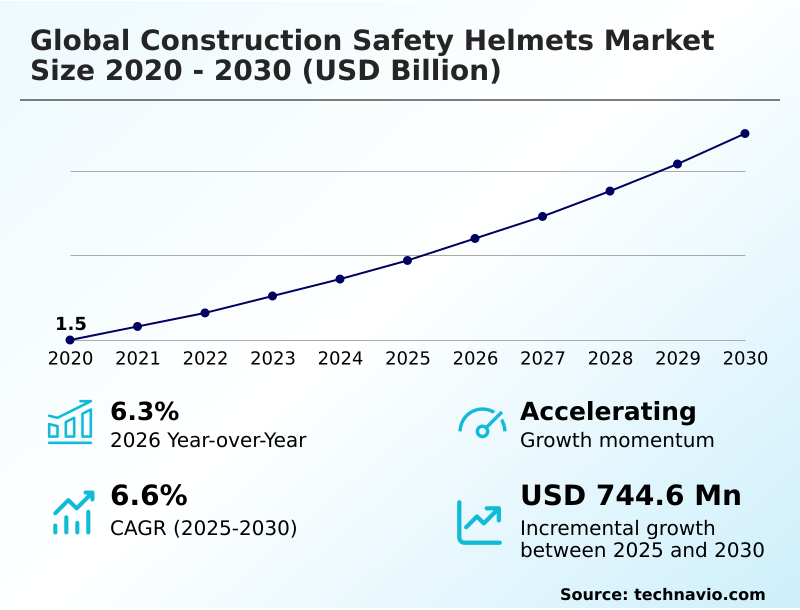
The construction safety helmets market size is valued to increase by USD 744.6 million, at a CAGR of 6.6% from 2025 to 2030. Growth in construction industry and infrastructure development will drive the construction safety helmets market.
Major Market Trends & Insights
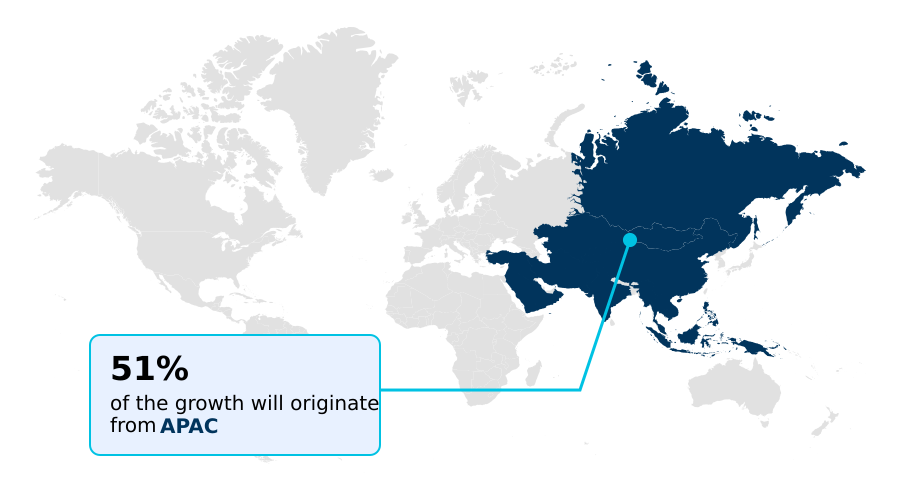
- APAC dominated the market and accounted for a 50.6% growth during the forecast period.
- By Material - HDPE segment was valued at USD 500.8 million in 2024
- By Product Type - Hard hats segment accounted for the largest market revenue share in 2024
Market Size & Forecast
- Market Opportunities: USD 1.22 billion
- Market Future Opportunities: USD 744.6 million
- CAGR from 2025 to 2030 : 6.6%
Market Summary
- The construction safety helmets market is characterized by a persistent focus on enhancing occupational head injury prevention through material innovation and technological integration. The demand is driven by stringent construction site safety protocols and a growing awareness of worker well-being, which has shifted purchasing criteria beyond basic compliance.
- Innovations in advanced polymer composites and fiberglass composite helmets are producing industrial safety headgear that is both lighter and stronger, improving user-centric helmet design and wearability. A significant trend is the evolution from passive protection to proactive hazard mitigation via connected PPE technology.
- For instance, a complex urban infrastructure project might deploy smart helmets equipped with environmental condition monitoring and real-time incident alerts, allowing site managers to perform data-driven safety management and dynamically re-route personnel away from detected hazards, thereby optimizing operational safety and minimizing downtime.
- This shift toward integrated safety solutions is reshaping product development, with a focus on modularity and advanced shock absorption to meet the demands of an increasingly complex and safety-conscious industry.
What will be the Size of the Construction Safety Helmets Market during the forecast period?
Get Key Insights on Market Forecast (PDF) Get Free Sample
How is the Construction Safety Helmets Market Segmented?
The construction safety helmets industry research report provides comprehensive data (region-wise segment analysis), with forecasts and estimates in "USD million" for the period 2026-2030, as well as historical data from 2020-2024 for the following segments.
- Material
- Polyethylene
- HDPE
- Fiberglass
- Polycarbonate
- Others
- Product type
- Hard hats
- Bump caps
- End-user
- Oil and gas
- Energy and power
- Automotive
- Others
- Geography
- APAC
- China
- Japan
- India
- North America
- US
- Canada
- Mexico
- Europe
- Germany
- UK
- France
- Middle East and Africa
- South Africa
- Saudi Arabia
- UAE
- South America
- Brazil
- Argentina
- Colombia
- Rest of World (ROW)
- APAC
By Material Insights
The polyethylene segment is estimated to witness significant growth during the forecast period.
The polyethylene segment is foundational to the construction safety helmets market, valued for its cost-effectiveness and reliable performance in general construction applications.
Helmets made from high-density polyethylene (hdpe) provide a strong balance of mechanical strength and impact resistance, meeting core construction site safety protocols.
Manufacturers leverage efficient production processes for this personal protective equipment (ppe), making it accessible for projects of all scales.
These helmets offer robust construction worker head protection and are designed with features like an adjustable suspension system design and options for chin strap integration. The material's adaptability also allows for high-visibility color coding.
Innovations are focused on improving the strength-to-weight ratio and uv degradation resistance, with firms reporting that enhanced ergonomic helmet fit systems can improve worker compliance by over 15%.
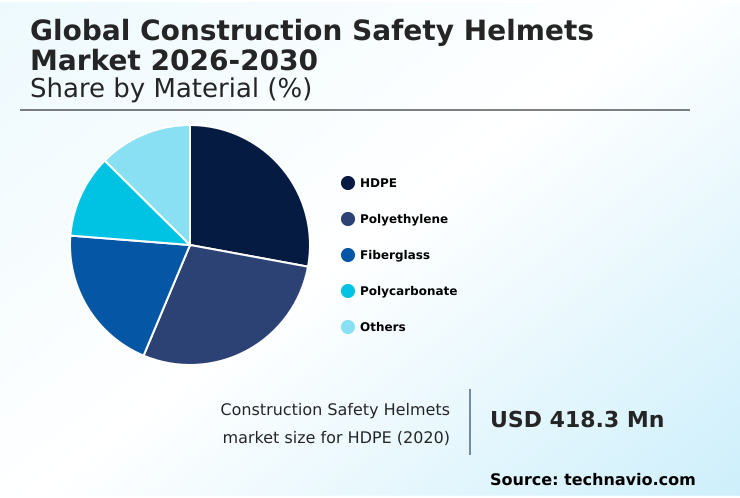
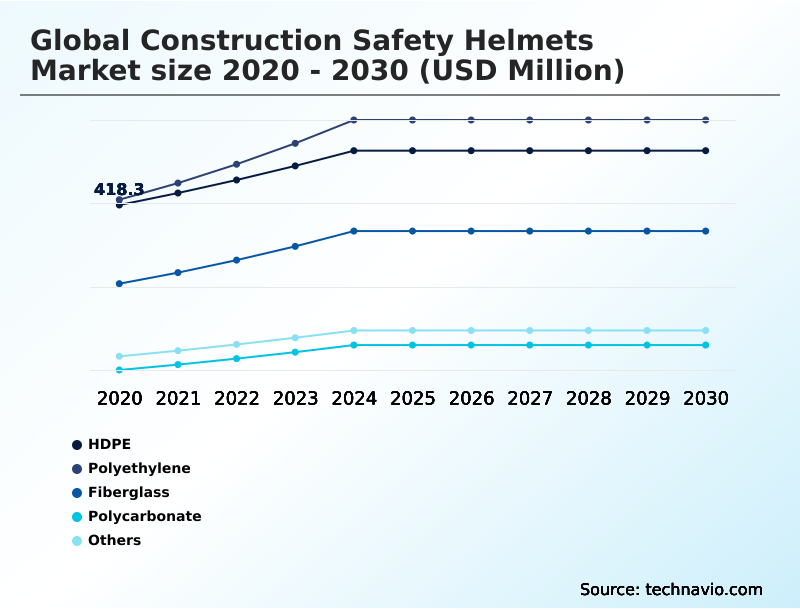
The Polyethylene segment was valued at USD 500.8 million in 2024 and showed a gradual increase during the forecast period.
Regional Analysis
APAC is estimated to contribute 50.6% to the growth of the global market during the forecast period.Technavio’s analysts have elaborately explained the regional trends and drivers that shape the market during the forecast period.
See How Construction Safety Helmets Market Demand is Rising in APAC Get Free Sample
The geographic landscape of the market is characterized by distinct regional dynamics. The APAC region is the most significant contributor to incremental growth, accounting for over 50% of the market opportunity, driven by massive infrastructure projects.
In contrast, North America and Europe, which together represent over 33% of the opportunity, are mature regions where demand is driven by technology upgrades and adherence to strict personal protective equipment (ppe) standards.
These regions show a high adoption rate for specialized equipment like electrical hazard rated helmets and products featuring advanced shock absorption. There's a strong focus on lightweight safety helmet design to improve worker comfort.
The adoption of energy-absorbing foam liners in these mature markets has been linked to a reduction in the severity of reported head impacts by a notable margin.
Market Dynamics
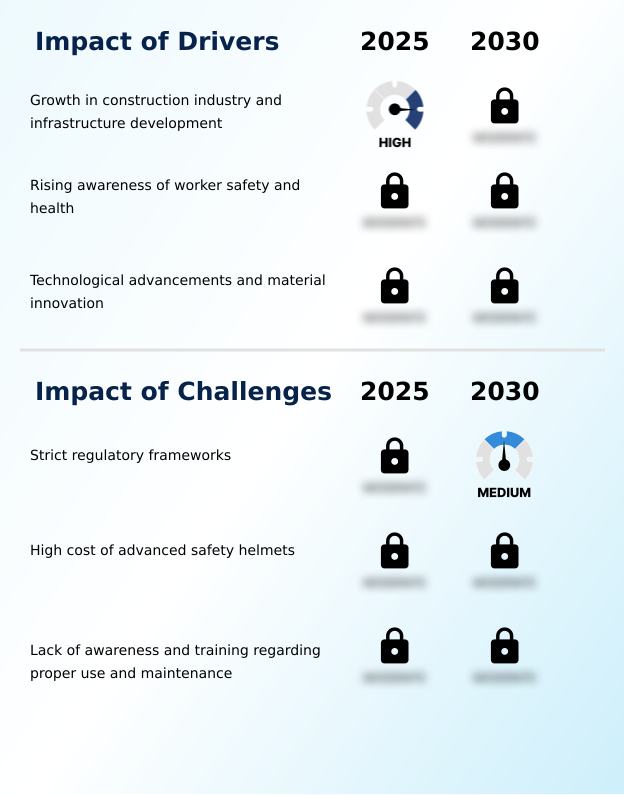
Our researchers analyzed the data with 2025 as the base year, along with the key drivers, trends, and challenges. A holistic analysis of drivers will help companies refine their marketing strategies to gain a competitive advantage.
- The strategic decision-making process for procuring head protection involves a complex evaluation beyond simple compliance. A critical aspect is comparing hdpe vs fiberglass helmets, where durability and heat resistance are weighed against cost and weight. Simultaneously, the benefits of smart helmets in construction are becoming undeniable, with smart helmet data for site safety analysis enabling proactive risk management.
- Organizations are performing a detailed cost-benefit analysis of advanced safety helmets to justify investment in features that enhance worker safety and efficiency. This includes choosing the best hard hats for high-heat environments and ensuring rotational impact protection for construction workers, which is crucial for mitigating severe injury.
- The challenges of smart helmet adoption are being addressed through comprehensive training programs for proper helmet use, which have proven to reduce non-compliance incidents by more than 40% compared to sites without such programs. Key considerations include selecting helmets based on safety helmet standards for electrical work and understanding the differences between ansi type ii vs type i helmets.
- The push for improving worker compliance with comfortable ppe is driving innovation in advanced suspension systems for hard hats and addressing the impact of helmet weight on worker fatigue. These efforts are pivotal in reducing head injuries on construction sites and demonstrate a commitment to worker well-being and operational excellence.
- The focus on sustainable materials in safety helmet production is also a growing factor in procurement decisions.
What are the key market drivers leading to the rise in the adoption of Construction Safety Helmets Industry?
- The primary market driver is the continuous growth in the global construction industry, fueled by significant investments in large-scale infrastructure development projects worldwide.
- The market is primarily propelled by the need for enhanced construction worker head protection and stringent regulatory standards such as ansi/isea z89.1 compliance.
- Growth in global construction is creating sustained demand for industrial safety headgear, with a focus on occupational head injury prevention.
- Technological advancements in lightweight safety helmet design, featuring improved ratcheting mechanisms and ventilated hard hat comfort, are driving adoption as they directly address worker fatigue.
- Companies that upgrade to helmets with superior suspension system design have noted a decrease in worker complaints related to discomfort by over 30%.
- Furthermore, the demand for high-performance fiber shells and task-specific head protection for specialized roles, such as those requiring an electrical insulation class rating, expands the market.
- The availability of helmets with full-brim coverage is another key factor, improving adoption rates by 10% in sun-exposed regions.
What are the market trends shaping the Construction Safety Helmets Industry?
- The integration of smart technology is a transformative trend, evolving traditional safety helmets into sophisticated devices for real-time monitoring and proactive hazard mitigation on worksites.
- Market evolution is heavily influenced by the push for sustainable PPE manufacturing and the adoption of connected ppe technology. Innovations in advanced hard hat materials now include recycled content helmets and experiments with bio-based polymer materials, aligning with corporate circular economy principles.
- This user-centric design approach is complemented by the integration of smart helmet sensors and impact detection accelerometers, which enable proactive hazard mitigation. Firms deploying these technologies report a 25% improvement in incident response times. Concurrently, the development of helmets with integrated eye protection and anti-fog visor technology enhances functionality.
- These trends are moving the industry toward integrated safety solutions, where a helmet serves as a central hub for worker safety monitoring, with some systems demonstrating a 15% reduction in minor on-site incidents.
What challenges does the Construction Safety Helmets Industry face during its growth?
- Strict and fragmented regulatory frameworks present a key challenge, potentially slowing innovation and market entry for new product designs and technologies.
- A significant challenge stems from complex regulatory pathways, where achieving en 397 certification or csa z94.1 standard for new products, like those with advanced polymer composites or a unique brimless helmet design, can be a lengthy process. The high cost of specialized industrial helmets incorporating mips technology or carbon fiber reinforced polymers presents another barrier, particularly for smaller firms.
- While these offer superior rotational impact protection, their adoption is slower, impacting the broad implementation of advanced safety measures. For example, the development cycle for helmets with integrated hands-free communication modules can be extended by up to 18 months due to electronic component certification.
- This delay can impede the rollout of technologies aimed at improving enhanced situational awareness and proactive safety management on job sites.
Exclusive Technavio Analysis on Customer Landscape
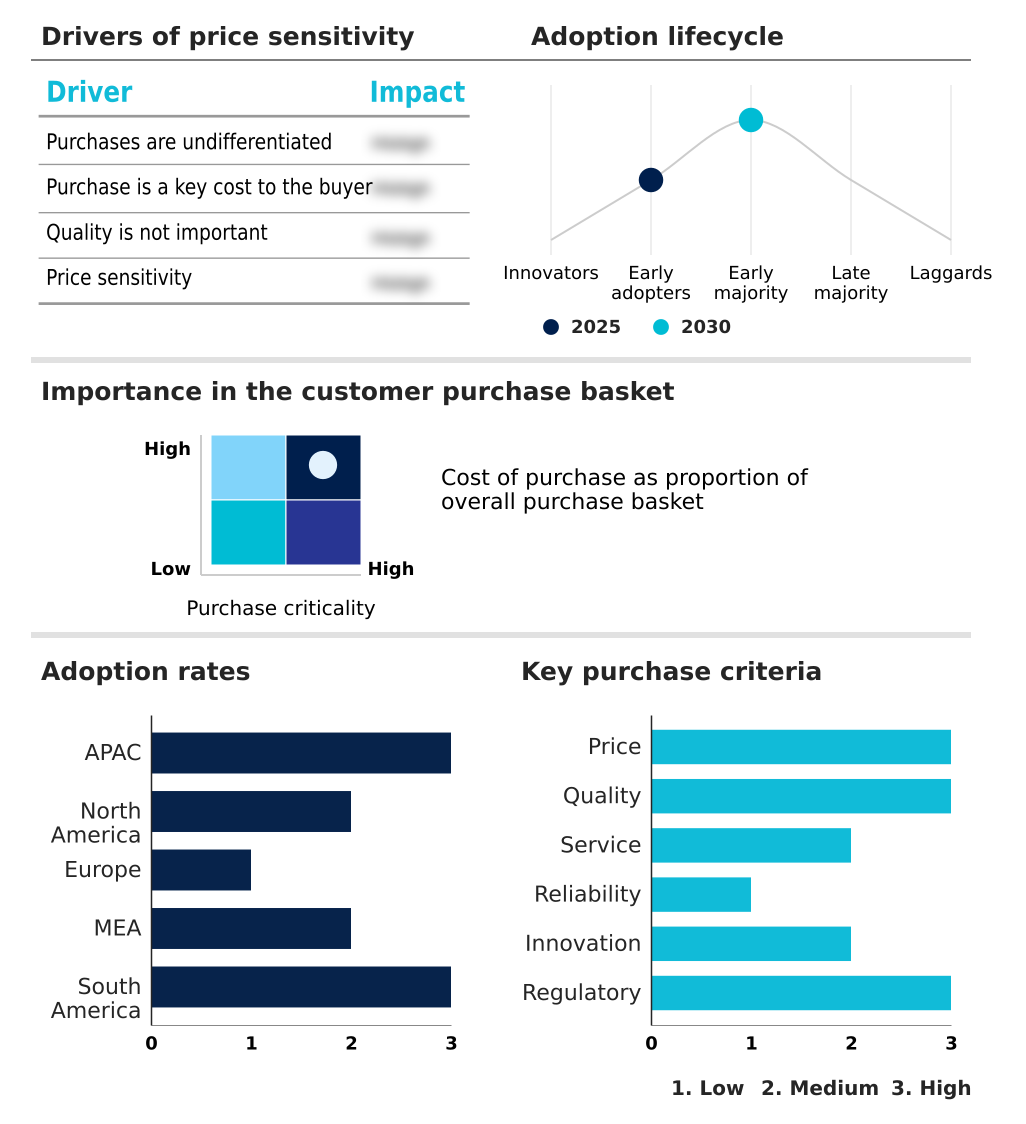
The construction safety helmets market forecasting report includes the adoption lifecycle of the market, covering from the innovator’s stage to the laggard’s stage. It focuses on adoption rates in different regions based on penetration. Furthermore, the construction safety helmets market report also includes key purchase criteria and drivers of price sensitivity to help companies evaluate and develop their market growth analysis strategies.
Customer Landscape of Construction Safety Helmets Industry
Competitive Landscape
Companies are implementing various strategies, such as strategic alliances, construction safety helmets market forecast, partnerships, mergers and acquisitions, geographical expansion, and product/service launches, to enhance their presence in the industry.
3M Co. - Key offerings include certified construction safety helmets, from standard HDPE models to advanced composites with integrated smart technology and modular helmet accessories for enhanced protection.
The industry research and growth report includes detailed analyses of the competitive landscape of the market and information about key companies, including:
- 3M Co.
- Anbu Safety Industrial Co. Ltd.
- Bullard
- Centurion Safety Products Ltd.
- Concord Safety Products LLC
- Delta Plus Group SA
- Dragerwerk AG and Co. KGaA
- Durasafety Materials Co. Ltd.
- Ergodyne
- Globus Shetland Ltd.
- Honeywell International Inc.
- KARAM Group
- KASK Spa
- MSA Safety Inc.
- OccuNomix International
- PETZL Distribution
- Polison Corp.
- Pyramex Safety Products LLC
- Schuberth GmbH
- UVEX GmbH and Co. KG
Qualitative and quantitative analysis of companies has been conducted to help clients understand the wider business environment as well as the strengths and weaknesses of key industry players. Data is qualitatively analyzed to categorize companies as pure play, category-focused, industry-focused, and diversified; it is quantitatively analyzed to categorize companies as dominant, leading, strong, tentative, and weak.
Recent Development and News in Construction safety helmets market
- In September, 2024, Honeywell International Inc. launched a new line of connected safety helmets featuring integrated real-time gas detection sensors and fall detection accelerometers, targeting high-risk industrial construction environments.
- In November, 2024, 3M Co. announced a strategic partnership with a leading polymer recycling firm to develop and scale production of construction safety helmets made from 100% certified post-consumer recycled HDPE, aiming to establish a circular economy model for PPE.
- In February, 2025, MSA Safety Inc. acquired a prominent software startup specializing in AI-powered worksite safety analytics, planning to integrate the platform with its V-Gard series of smart helmets to offer predictive hazard alerts.
- In April, 2025, Bullard, in collaboration with several major construction industry associations, launched a global virtual reality (VR) training module designed to educate workers on the proper fit, inspection, and maintenance of safety helmets.
Dive into Technavio’s robust research methodology, blending expert interviews, extensive data synthesis, and validated models for unparalleled Construction Safety Helmets Market insights. See full methodology.
| Market Scope | |
|---|---|
| Page number | 302 |
| Base year | 2025 |
| Historic period | 2020-2024 |
| Forecast period | 2026-2030 |
| Growth momentum & CAGR | Accelerate at a CAGR of 6.6% |
| Market growth 2026-2030 | USD 744.6 million |
| Market structure | Fragmented |
| YoY growth 2025-2026(%) | 6.3% |
| Key countries | China, Japan, India, South Korea, Australia, Indonesia, US, Canada, Mexico, Germany, UK, France, Spain, Italy, The Netherlands, South Africa, Saudi Arabia, UAE, Nigeria, Turkey, Brazil, Argentina and Colombia |
| Competitive landscape | Leading Companies, Market Positioning of Companies, Competitive Strategies, and Industry Risks |
Research Analyst Overview
- The construction safety helmets market is evolving beyond basic impact resistance standards, with a decisive shift toward holistic protection and data integration. Boardroom decisions are now heavily influenced by the capabilities of advanced head protection, particularly smart helmets.
- The integration of a smart helmet sensor, impact detection accelerometer, and gps and rfid tracking transforms a passive piece of equipment into an active node for site management. For instance, incorporating hands-free communication modules and mesh network integration directly enhances operational efficiency, with some projects achieving a 15% reduction in coordination-related delays.
- Material science is also critical, with a move from standard high-density polyethylene (hdpe) to polycarbonate shells, fiberglass composite helmets, and even carbon fiber reinforced polymers. These advanced polymer composites offer superior rotational impact protection, often incorporating mips technology and an expanded polystyrene (eps) liner.
- Key features now include dielectric properties, flame-retardant properties, uv degradation resistance, and compliance with multiple standards like ansi/isea z89.1, en 397, and csa z94.1, covering both type i and type ii protection.
What are the Key Data Covered in this Construction Safety Helmets Market Research and Growth Report?
-
What is the expected growth of the Construction Safety Helmets Market between 2026 and 2030?
-
USD 744.6 million, at a CAGR of 6.6%
-
-
What segmentation does the market report cover?
-
The report is segmented by Material (HDPE, Polyethylene, Fiberglass, Polycarbonate, and Others), Product Type (Hard hats, and Bump caps), End-user (Oil and gas, Energy and power, Automotive, and Others) and Geography (APAC, North America, Europe, Middle East and Africa, South America)
-
-
Which regions are analyzed in the report?
-
APAC, North America, Europe, Middle East and Africa and South America
-
-
What are the key growth drivers and market challenges?
-
Growth in construction industry and infrastructure development, Strict regulatory frameworks
-
-
Who are the major players in the Construction Safety Helmets Market?
-
3M Co., Anbu Safety Industrial Co. Ltd., Bullard, Centurion Safety Products Ltd., Concord Safety Products LLC, Delta Plus Group SA, Dragerwerk AG and Co. KGaA, Durasafety Materials Co. Ltd., Ergodyne, Globus Shetland Ltd., Honeywell International Inc., KARAM Group, KASK Spa, MSA Safety Inc., OccuNomix International, PETZL Distribution, Polison Corp., Pyramex Safety Products LLC, Schuberth GmbH and UVEX GmbH and Co. KG
-
Market Research Insights
- The market's dynamism is fueled by a push for integrated safety solutions and enhanced construction worker head protection. The emphasis on an ergonomic helmet fit system has been shown to boost worker compliance by over 20%, directly improving construction site safety protocols.
- Furthermore, the adoption of connected ppe technology for worker safety monitoring allows for real-time incident alerts and proactive hazard mitigation, with pilot programs reporting up to a 15% reduction in response times for on-site incidents.
- As the industry moves toward data-driven safety management, manufacturers are focusing on advanced hard hat materials and lightweight safety helmet design to enhance both protection and user acceptance, meeting the evolving demands for both compliance and operational efficiency.
We can help! Our analysts can customize this construction safety helmets market research report to meet your requirements.
 RIA -
RIA - 
