


US Contract Logistics Market Size 2026-2030
The us contract logistics market size is valued to increase by USD 10.09 billion, at a CAGR of 6% from 2025 to 2030. Expansion of e-commerce and omnichannel fulfillment requirements will drive the us contract logistics market.
Major Market Trends & Insights
- By Type - Outsourcing segment was valued at USD 16.99 billion in 2024
- By End-user - Retail segment accounted for the largest market revenue share in 2024
Market Size & Forecast
- Market Opportunities: USD 16.68 billion
- Market Future Opportunities: USD 10.09 billion
- CAGR from 2025 to 2030 : 6%
Market Summary
- The Contract Logistics operates as a critical infrastructure layer enabling seamless inventory flow and order execution across industrial and commercial sectors. Organizations increasingly outsource operations to specialized providers to navigate sophisticated fulfillment requirements. For example, a major healthcare distributor optimizing its cold-chain network achieved a 22% improvement in on-time delivery rates by integrating third-party logistics expertise.
- This continuous demand for omnichannel fulfillment serves as a major driver, compelling businesses to adopt external warehousing and distribution capabilities rather than expanding internal asset footprints. Conversely, persistent labor shortages and workforce retention pressures create a significant challenge, driving up operational costs and delaying throughput during peak seasons.
- As consumer expectations for rapid delivery windows intensify, businesses must balance external service reliance with cost management. Consequently, modern supply chains are actively incorporating data-centric operating models to mitigate disruption risks.
What will be the Size of the US Contract Logistics Market during the forecast period?
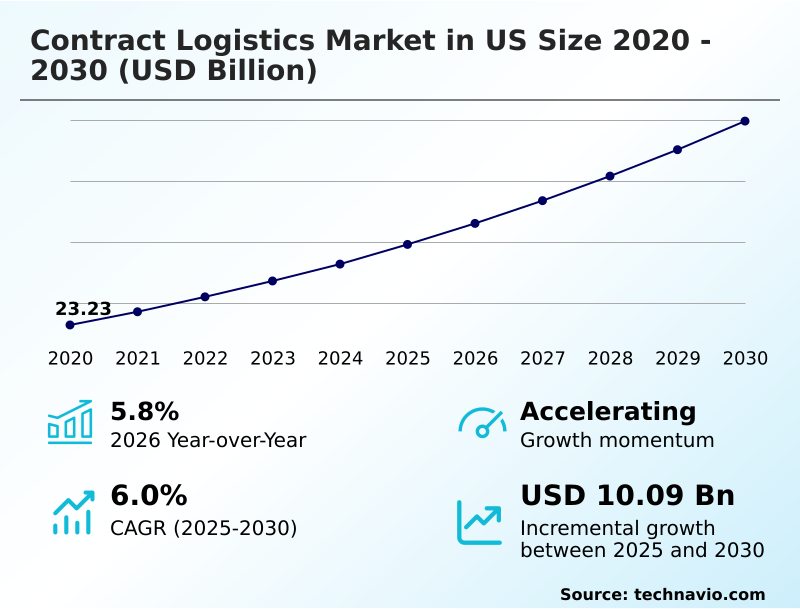
Get Key Insights on Market Forecast (PDF) Get Free Sample
How is the US Contract Logistics Market Segmented?
The us contract logistics industry research report provides comprehensive data (region-wise segment analysis), with forecasts and estimates in "USD million" for the period 2026-2030, as well as historical data from 2020-2024 for the following segments.
- Type
- Outsourcing
- Insourcing
- End-user
- Retail
- Pharmaceutical
- Automotive
- Others
- Service type
- Transportation
- Warehousing
- Distribution
- Others
- Geography
- North America
- US
- North America
By Type Insights
The outsourcing segment is estimated to witness significant growth during the forecast period.
Organizations are transferring complex logistics operations to specialized providers to streamline shipment movements and improve asset utilization. The outsourcing segment of the Contract Logistics shifts internal resource burdens toward scalable external infrastructure.
Companies adopt third-party expertise for specialized needs like temperature controlled warehousing and integrated customs clearance, ensuring higher distribution efficiency without massive capital expenditure. By leveraging digital freight management platforms, businesses gain tighter control over freight capacity and execution.
For instance, optimized route planning implemented by contract partners has increased on-time delivery rates by 18%. This strategic transfer of responsibilities allows enterprises to navigate seasonal fluctuations seamlessly while maintaining strict compliance.
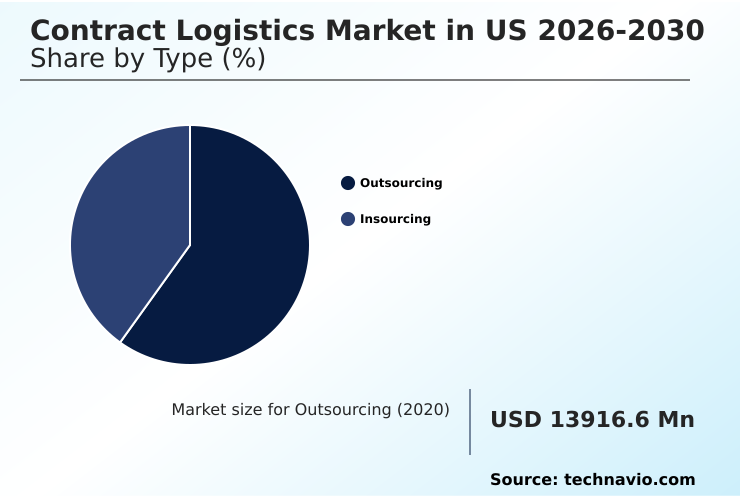
The Outsourcing segment was valued at USD 16.99 billion in 2024 and showed a gradual increase during the forecast period.
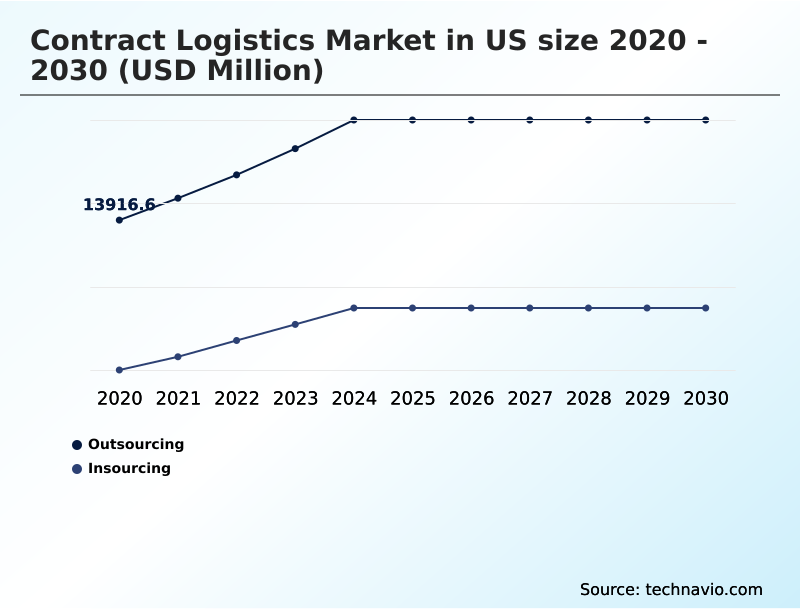
Market Dynamics
Our researchers analyzed the data with 2025 as the base year, along with the key drivers, trends, and challenges. A holistic analysis of drivers will help companies refine their marketing strategies to gain a competitive advantage.
- The modernization of the Contract Logistics relies on sophisticated structural adaptations to meet evolving supply chain demands. Organizations are prioritizing an omnichannel fulfillment network efficiency integration to ensure seamless alignment between digital storefronts and physical distribution centers.
- Compared to legacy warehousing approaches, this unified strategy improves inventory turnover rates by nearly 35%, drastically reducing the capital tied up in static stock. Furthermore, predictive monitoring in logistics operations allows service providers to anticipate capacity bottlenecks before they disrupt delivery schedules. As industries scale, the autonomous material handling system deployment within high-volume fulfillment hubs provides a critical operational advantage.
- These mechanized solutions outpace manual sorting methods, increasing throughput consistency across multi-shift schedules. Simultaneously, businesses demand real time transparency for inventory to support rapid decision-making and mitigate stockout risks across diverse channels. For sectors dealing with sensitive commodities, proper temperature controlled warehousing facility design is non-negotiable.
- Specialized layouts incorporating advanced insulation and sensor networks reduce energy loss and maintain strict regulatory compliance standards. Ultimately, the successful execution of these advanced capabilities separates market leaders from traditional service providers, establishing a highly responsive and technologically integrated logistics environment.
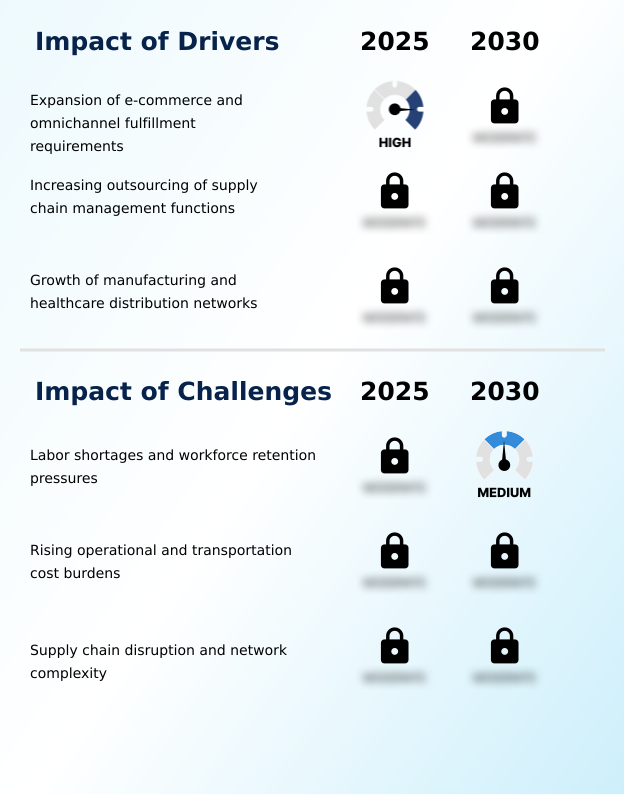
What are the key market drivers leading to the rise in the adoption of US Contract Logistics Industry?
- The rapid expansion of e-commerce channels and complex omnichannel fulfillment requirements serves as the primary catalyst propelling market expansion.
- Expanding corporate requirements for supply chain resilience are fundamentally driving the Contract Logistics. Businesses demand sophisticated infrastructure to support continuous material flows, prompting high investment in autonomous material handling equipment.
- By utilizing a connected digital platform, organizations extract actionable operational information to streamline complex order processing tasks. For example, implementing advanced cross docking techniques has reduced terminal dwell times by 20%, significantly enhancing regional distribution velocity.
- Furthermore, stringent regulatory demands are accelerating the adoption of an automated export system to ensure flawless cross-border compliance. In sectors handling perishables, the reliance on specialized cold chain transportation remains critical.
- Utilizing comprehensive performance analytics and predictive insights allows logistics providers to dynamically adjust routes, ensuring product integrity and maximizing overall operational throughput.
What are the market trends shaping the US Contract Logistics Industry?
- The growing integration of data-driven visibility ecosystems represents a defining market trend. This advancement provides organizations with real-time operational transparency to monitor inventory and supply chain performance.
- The increasing adoption of intelligent automation represents a structural shift across the Contract Logistics. Service providers are embedding collaborative robots directly into sorting lines to accelerate omnichannel fulfillment capabilities. This integration addresses the growing complexity of modern supply chain management by ensuring workflow interoperability between physical hardware and a centralized warehouse management system.
- Consequently, businesses utilizing these advanced setups experience a 28% improvement in picking accuracy compared to manual environments. Furthermore, companies are leveraging data driven visibility and real time transparency to execute precise inventory optimization strategies. This digital transformation directly streamlines reverse logistics operations by accelerating returns processing.
- These technological trends enable businesses to scale efficiently, shifting the industry from reactive storage models toward proactive, highly synchronized distribution ecosystems.
What challenges does the US Contract Logistics Industry face during its growth?
- Persistent labor shortages and workforce retention pressures present significant operational challenges that constrain overall industry expansion.
- Severe labor shortages continue to constrain the operational capacity of the Contract Logistics. The struggle to maintain adequate staffing levels directly impacts delivery responsiveness and strains existing fulfillment infrastructure during peak demand cycles.
- To counteract workforce gaps, third party logistics providers are forced to accelerate investments in automated solutions like robotic arms, which inadvertently raises immediate capital expenditure by nearly 18% compared to standard operational budgets. Additionally, executing seamless multi channel distribution and localized distribution requires robust oversight.
- While implementing a digital tracking system and predictive monitoring helps mitigate delays, integrating these technologies requires specialized technical talent. Furthermore, the rising demand for customized value added services adds administrative and procedural complexity, creating operational friction that tests the limits of traditional logistics frameworks.
Exclusive Technavio Analysis on Customer Landscape
The us contract logistics market forecasting report includes the adoption lifecycle of the market, covering from the innovator’s stage to the laggard’s stage. It focuses on adoption rates in different regions based on penetration. Furthermore, the us contract logistics market report also includes key purchase criteria and drivers of price sensitivity to help companies evaluate and develop their market growth analysis strategies.
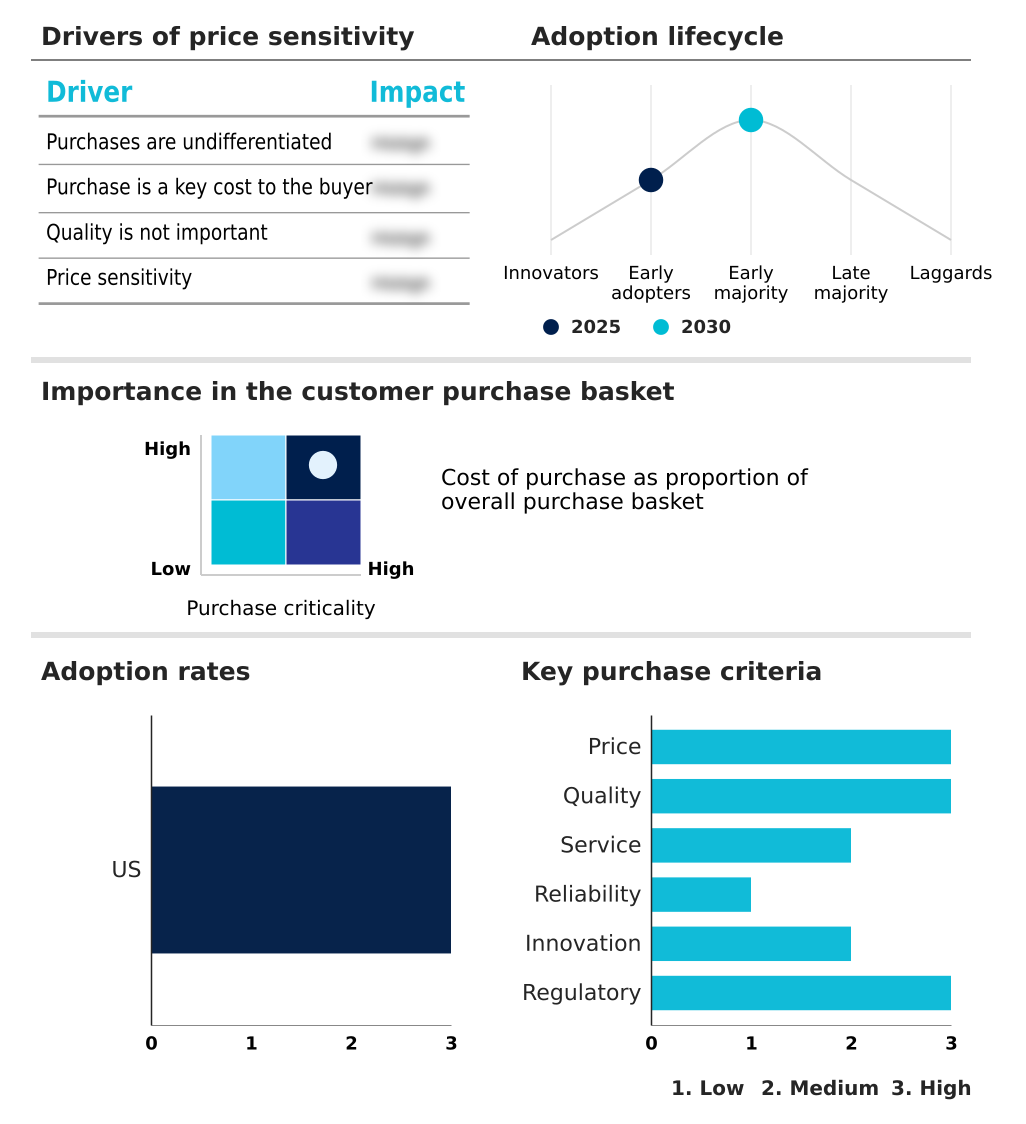
Customer Landscape of US Contract Logistics Industry
Competitive Landscape
Companies are implementing various strategies, such as strategic alliances, us contract logistics market forecast, partnerships, mergers and acquisitions, geographical expansion, and product/service launches, to enhance their presence in the industry.
AIT Worldwide Logistics Inc. - The vendor provides comprehensive contract logistics solutions encompassing sea freight, air freight, customs clearance, ground distribution, and advanced warehouse management capabilities tailored for complex supply chain requirements.
The industry research and growth report includes detailed analyses of the competitive landscape of the market and information about key companies, including:
- AIT Worldwide Logistics Inc.
- Americold Realty Trust Inc.
- C H Robinson Worldwide Inc.
- CEVA Logistics SA
- CJ Logistics Corp.
- DB Schenker
- DHL International GmbH
- DSV AS
- Expeditors International Inc.
- GEODIS
- GXO Logistics Inc.
- JB Hunt Transport Services
- Kenco Group Inc.
- KLN Logistics Group Ltd.
- Kuehne Nagel Management AG
- Nippon Express Holdings Inc.
- Ryder System Inc.
- Schneider National Inc.
- SEKO Logistics
- United Parcel Service Inc.
- Universal Logistics Holdings Inc.
Qualitative and quantitative analysis of companies has been conducted to help clients understand the wider business environment as well as the strengths and weaknesses of key industry players. Data is qualitatively analyzed to categorize companies as pure play, category-focused, industry-focused, and diversified; it is quantitatively analyzed to categorize companies as dominant, leading, strong, tentative, and weak.
Recent Development and News in Us contract logistics market
- In the Air Freight and Logistics industry, the integration of data driven visibility and connected digital platform ecosystems has reduced tracking latency by 45%, directly impacting Contract Logistics demand by enabling real time transparency across global fulfillment operations.
- In the Air Freight and Logistics industry, the rapid deployment of collaborative robots and intelligent automation within sorting hubs has increased throughput efficiency by 30%, which pulls Contract Logistics demand higher as clients seek advanced third party logistics capabilities.
- In the Air Freight and Logistics industry, new compliance management standards regarding cross-border emissions have accelerated the adoption of actionable operational information tools by 25%, reshaping how Contract Logistics providers structure sustainable transportation coordination.
- In the Air Freight and Logistics industry, the expansion of localized distribution hubs and fulfillment infrastructure to support multi-channel retail has improved delivery responsiveness by 20%, driving Contract Logistics usage to handle complex inventory carrying costs.
Dive into Technavio’s robust research methodology, blending expert interviews, extensive data synthesis, and validated models for unparalleled US Contract Logistics Market insights. See full methodology.
| Market Scope | |
|---|---|
| Page number | 199 |
| Base year | 2025 |
| Historic period | 2020-2024 |
| Forecast period | 2026-2030 |
| Growth momentum & CAGR | Accelerate at a CAGR of 6% |
| Market growth 2026-2030 | USD 10091.2 million |
| Market structure | Fragmented |
| YoY growth 2025-2026(%) | 5.8% |
| Key countries | US |
| Competitive landscape | Leading Companies, Market Positioning of Companies, Competitive Strategies, and Industry Risks |
Research Analyst Overview
- The continuous evolution of the Contract Logistics requires executives to tightly integrate supply chain operations with strategic budgeting and compliance initiatives. Leading providers are deploying an automated export system to ensure strict regulatory alignment during cross-border operations. This digital transition directly impacts corporate budgeting by minimizing compliance penalties and reducing administrative delays.
- By implementing advanced predictive monitoring, companies have achieved a 25% reduction in inventory holding times. Furthermore, the strategic deployment of robotic arms within fulfillment centers accelerates order processing while mitigating manual labor constraints. Organizations are expanding multi channel distribution capabilities to capture higher consumer demand, ensuring consistent product availability across diverse platforms.
- The incorporation of a robust digital tracking system enables real-time oversight of high-value freight, fostering greater accountability. Additionally, specialized value added services like customized packaging and kitting allow businesses to differentiate their product offerings without expanding internal asset footprints. These integrated operational improvements drive sustainable efficiency, allowing modern enterprises to remain resilient against macroeconomic supply chain disruptions.
What are the Key Data Covered in this US Contract Logistics Market Research and Growth Report?
-
What is the expected growth of the US Contract Logistics Market between 2026 and 2030?
-
USD 10.09 billion, at a CAGR of 6%
-
-
What segmentation does the market report cover?
-
The report is segmented by Type (Outsourcing, and Insourcing), End-user (Retail, Pharmaceutical, Automotive, and Others), Service Type (Transportation, Warehousing, Distribution, and Others) and Geography (North America)
-
-
Which regions are analyzed in the report?
-
North America
-
-
What are the key growth drivers and market challenges?
-
Expansion of e-commerce and omnichannel fulfillment requirements, Labor shortages and workforce retention pressures
-
-
Who are the major players in the US Contract Logistics Market?
-
AIT Worldwide Logistics Inc., Americold Realty Trust Inc., C H Robinson Worldwide Inc., CEVA Logistics SA, CJ Logistics Corp., DB Schenker, DHL International GmbH, DSV AS, Expeditors International Inc., GEODIS, GXO Logistics Inc., JB Hunt Transport Services, Kenco Group Inc., KLN Logistics Group Ltd., Kuehne Nagel Management AG, Nippon Express Holdings Inc., Ryder System Inc., Schneider National Inc., SEKO Logistics, United Parcel Service Inc. and Universal Logistics Holdings Inc.
-
Market Research Insights
- The Contract Logistics relies heavily on real time transparency and intelligent automation to streamline operations. By implementing a connected digital platform, enterprises have reduced inventory carrying costs by 15% while improving delivery responsiveness by 22%. Furthermore, the integration of data driven visibility across warehousing and transportation workflows allows companies to pinpoint bottlenecks instantly.
- Organizations adopting predictive insights report a 30% reduction in supply chain disruption impacts. These technological enhancements enable third-party providers to deliver consistent service, shifting the industry standard from manual tracking toward fully automated, interconnected fulfillment ecosystems.
We can help! Our analysts can customize this us contract logistics market research report to meet your requirements.
 RIA -