
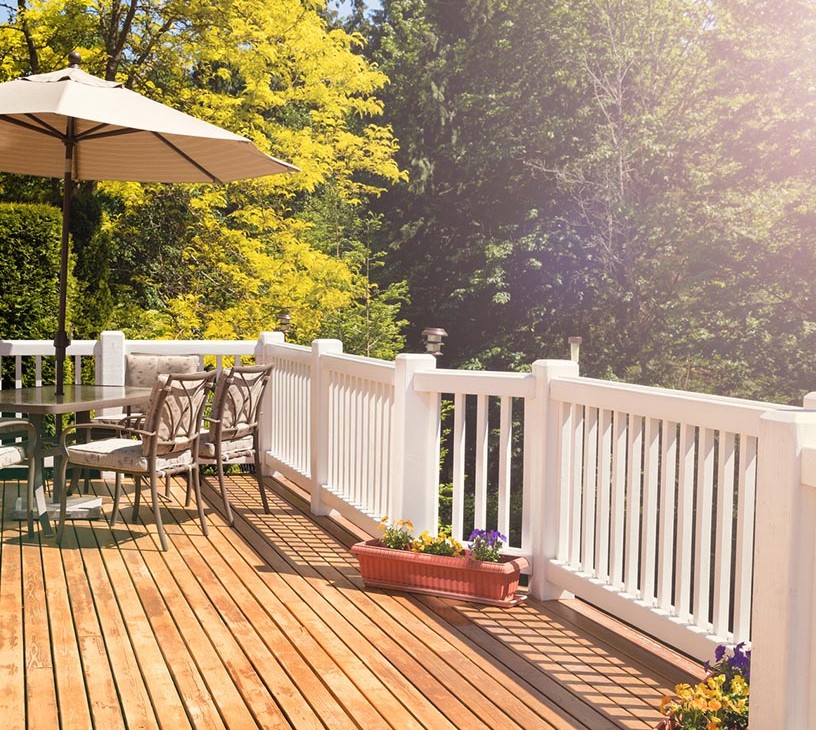


Decking Market Size 2026-2030
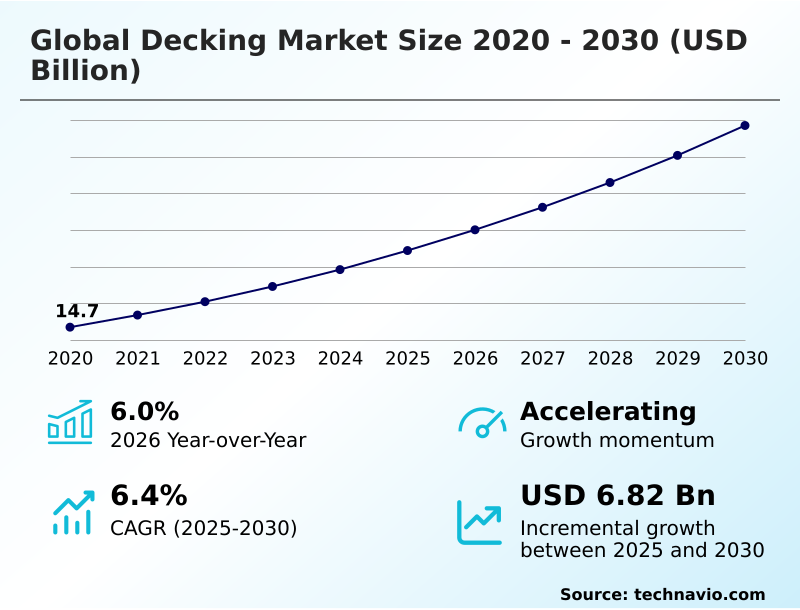
The decking market size is valued to increase by USD 6.82 billion, at a CAGR of 6.4% from 2025 to 2030. Changing lifestyles and increasing use of outdoor living spaces will drive the decking market.
Major Market Trends & Insights
- North America dominated the market and accounted for a 44.2% growth during the forecast period.
- By Application - Residential segment was valued at USD 10.59 billion in 2024
- By Product - Wood segment accounted for the largest market revenue share in 2024
Market Size & Forecast
- Market Opportunities: USD 11.00 billion
- Market Future Opportunities: USD 6.82 billion
- CAGR from 2025 to 2030 : 6.4%
Market Summary
- The Decking Market is undergoing a significant transformation, driven by evolving consumer lifestyles and technological advancements in materials. A primary driver is the increasing desire for versatile outdoor living spaces, turning decks into multifunctional extensions of the home for relaxation, work, and social gatherings.
- This is particularly evident in the residential sector, where home improvement projects that enhance property value and quality of life are prioritized. Concurrently, rapid urbanization is fueling demand for innovative solutions like interlocking deck tiles and modular systems for smaller balconies and rooftop terraces in high-density areas.
- The market is also seeing a decisive shift away from traditional wood toward high-performance materials like wood plastic composites and capped polymer boards. These modern alternatives, often incorporating realistic wood grain textures, offer superior durability and minimal maintenance, addressing key consumer pain points.
- A typical business scenario involves a commercial developer choosing non-combustible materials with high fire resistance ratings to comply with stringent urban building codes while creating premium rooftop amenities.
What will be the Size of the Decking Market during the forecast period?
Get Key Insights on Market Forecast (PDF) Get Free Sample
How is the Decking Market Segmented?
The decking industry research report provides comprehensive data (region-wise segment analysis), with forecasts and estimates in "USD million" for the period 2026-2030, as well as historical data from 2020-2024 for the following segments.
- Application
- Residential
- Non-residential
- Product
- Wood
- Composite
- Plastic
- Aluminum
- Distribution channel
- Retail
- Direct sales
- Online sales
- Geography
- North America
- US
- Canada
- Mexico
- Europe
- Germany
- UK
- France
- APAC
- China
- Japan
- India
- South America
- Brazil
- Argentina
- Middle East and Africa
- Saudi Arabia
- UAE
- South Africa
- Rest of World (ROW)
- North America
By Application Insights
The residential segment is estimated to witness significant growth during the forecast period.
The residential segment is driven by an increasing consumer focus on creating personalized outdoor living spaces that function as extensions of their indoor environments.
Homeowners are prioritizing investments in high-quality infrastructure, with a significant trend toward adopting capped polymer boards and other low-maintenance solutions.
This shift addresses a primary user concern, enhancing the functionality of decks for dining, relaxation, and social gatherings, particularly as property values appreciate.
Innovations in heat mitigation technology and modular, easy-to-install systems cater to this demand, with North America alone projected to account for 44.2% of the market's incremental growth.
This reflects a broader move toward high-performance synthetic materials that offer long-term durability and aesthetic appeal without requiring intensive seasonal upkeep.
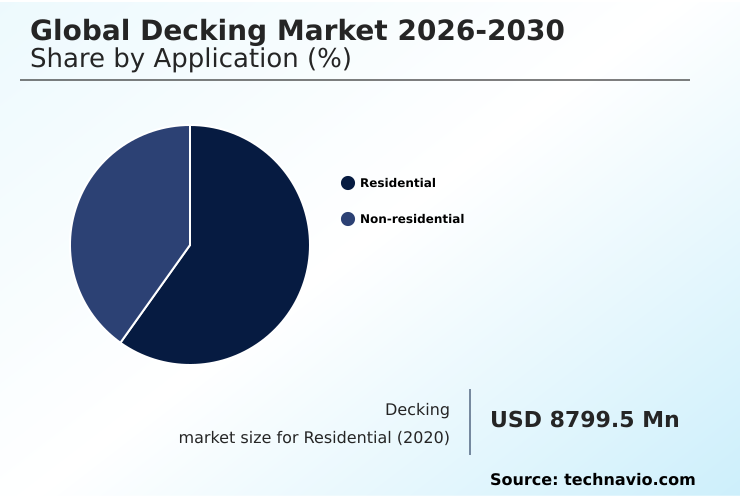
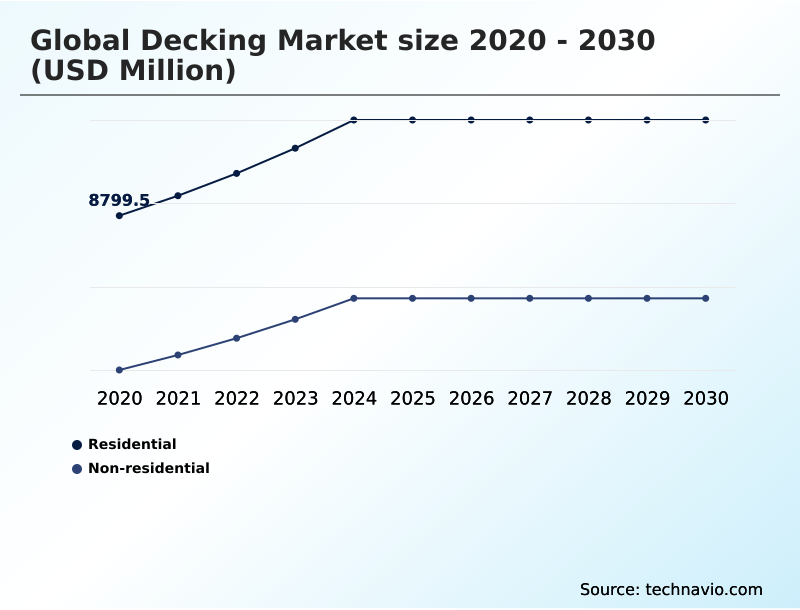
The Residential segment was valued at USD 10.59 billion in 2024 and showed a gradual increase during the forecast period.
Regional Analysis
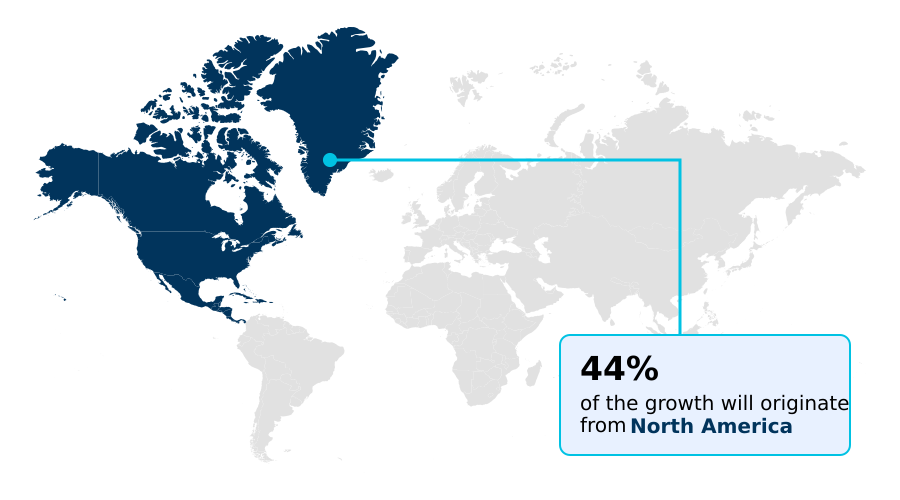
North America is estimated to contribute 44.2% to the growth of the global market during the forecast period.Technavio’s analysts have elaborately explained the regional trends and drivers that shape the market during the forecast period.
See How Decking Market Demand is Rising in North America Get Free Sample
The global decking market's geographic landscape is led by North America, which is forecast to contribute 44.2% of the market's incremental growth, demonstrating a CAGR of 6.8%.
This region's maturity is defined by a strong preference for high-performance composite materials and the expansion of outdoor living areas.
Europe follows, with an anticipated CAGR of 6.5%, driven by stringent environmental regulations and high demand for balcony solutions in dense urban centers.
The APAC region is projected to grow at a 5.8% CAGR, fueled by massive urbanization, a rising middle class, and extensive public infrastructure projects.
Key trends include the adoption of sustainable building materials and advanced extrusion technologies to meet diverse climatic needs and architectural styles across these key regions.
Market Dynamics
Our researchers analyzed the data with 2025 as the base year, along with the key drivers, trends, and challenges. A holistic analysis of drivers will help companies refine their marketing strategies to gain a competitive advantage.
- Strategic decisions in the decking market are increasingly complex, shaped by a variety of technical and application-specific considerations. For instance, the debate over composite decking vs traditional wood maintenance remains a central issue for residential homeowners, where the long-term investment value of composite decks, which require less upkeep, often outweighs higher initial costs.
- In commercial settings, the selection of decking materials for high-traffic commercial use is critical. The benefits of prefabricated deck panels in construction are realized through reduced labor costs and faster project timelines, a key factor in large-scale developments.
- For specialized applications, choices become even more focused; aluminum decking for high fire risk areas and non-combustible decking for urban high-rises are selected for their superior fire resistance ratings in decking materials. Similarly, plastic decking for marine and coastal applications is chosen for its moisture and salt resistance.
- The market impact of fluctuating timber costs and the impact of deforestation regulations on wood decking continue to push consumer choice toward sustainable decking materials. This includes examining the role of recycled materials in composite decking and exploring aesthetic options in modern composite decking, which are now more versatile than ever.
- Urban decking solutions for balconies and rooftops must address weight considerations for rooftop decking installations, while customized decking for luxury home designs focuses on unique aesthetics achieved with innovative fastening systems for seamless decks. Ultimately, selecting the right modular systems for DIY decking projects or professional-grade decking solutions for extreme weather climates depends on balancing these multiple factors.
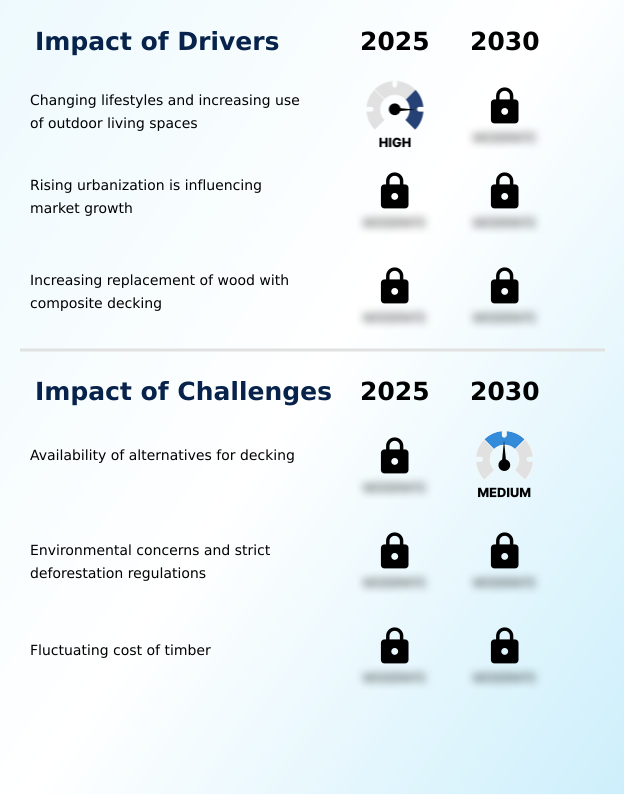
What are the key market drivers leading to the rise in the adoption of Decking Industry?
- Changing lifestyles and the increasing use of outdoor living spaces are key drivers propelling market growth.
- Market growth is primarily propelled by changing lifestyles and the increasing demand for versatile outdoor living spaces, effectively turning decks into multifunctional hubs for social gatherings and relaxation.
- This trend is particularly strong among younger homeowners, who see outdoor space as a key factor in property value, contributing to a return on investment that is often 10-15% higher than other home renovations.
- Concurrently, rising urbanization is fueling the creation of small-scale outdoor spaces on balconies and rooftops, requiring specialized materials like fiber cement decking. A major driver is the accelerating replacement of traditional wood with composite decking.
- These advanced materials offer superior resistance to fading and mold, with a lower total cost of ownership that justifies the initial investment, contributing to a market year-over-year growth rate of 6.0%.
What are the market trends shaping the Decking Industry?
- The growing home improvement industry is a significant upcoming trend in the market, driving demand for both new installations and renovation projects.
- Key market trends are driven by the expanding home improvement industry and the rising adoption of prefabricated construction solutions. Homeowners are increasingly viewing properties as long-term assets, fueling large-scale outdoor renovations and a demand for premium, aesthetically pleasing outdoor flooring. This trend is supported by the availability of DIY-friendly products and advanced software for professional deck builders.
- Prefabricated components, which can be installed in a fraction of the time compared to traditional methods, are addressing labor shortages and improving quality control, with builders reporting up to a 25% reduction in on-site construction time.
- The market is also seeing a growing need for customized decking, as consumers move toward complex designs with curves, multiple levels, and built-in features, driving innovation in flexible materials and digital design tools.
What challenges does the Decking Industry face during its growth?
- The availability of a wide range of alternative outdoor flooring solutions presents a key challenge that affects the industry's growth.
- The market faces significant challenges from the availability of alternative flooring solutions and complex environmental regulations. Materials such as natural stone, concrete pavers, and porcelain tiles compete directly with decking, offering perceived benefits in permanence and maintenance in certain climates; adoption of these alternatives has grown by nearly 5% in luxury landscaping projects.
- This forces decking manufacturers to constantly innovate on texture and color. Furthermore, strict deforestation regulations and growing environmental concerns are impacting the supply of traditional wood.
- Mandates requiring rigorous traceability for wood-based products and reporting on supply chain emissions can increase operational costs by as much as 10-12% for smaller suppliers, pushing the market toward certified, recycled, or bio-based materials to maintain a social license to operate.
Exclusive Technavio Analysis on Customer Landscape
The decking market forecasting report includes the adoption lifecycle of the market, covering from the innovator’s stage to the laggard’s stage. It focuses on adoption rates in different regions based on penetration. Furthermore, the decking market report also includes key purchase criteria and drivers of price sensitivity to help companies evaluate and develop their market growth analysis strategies.
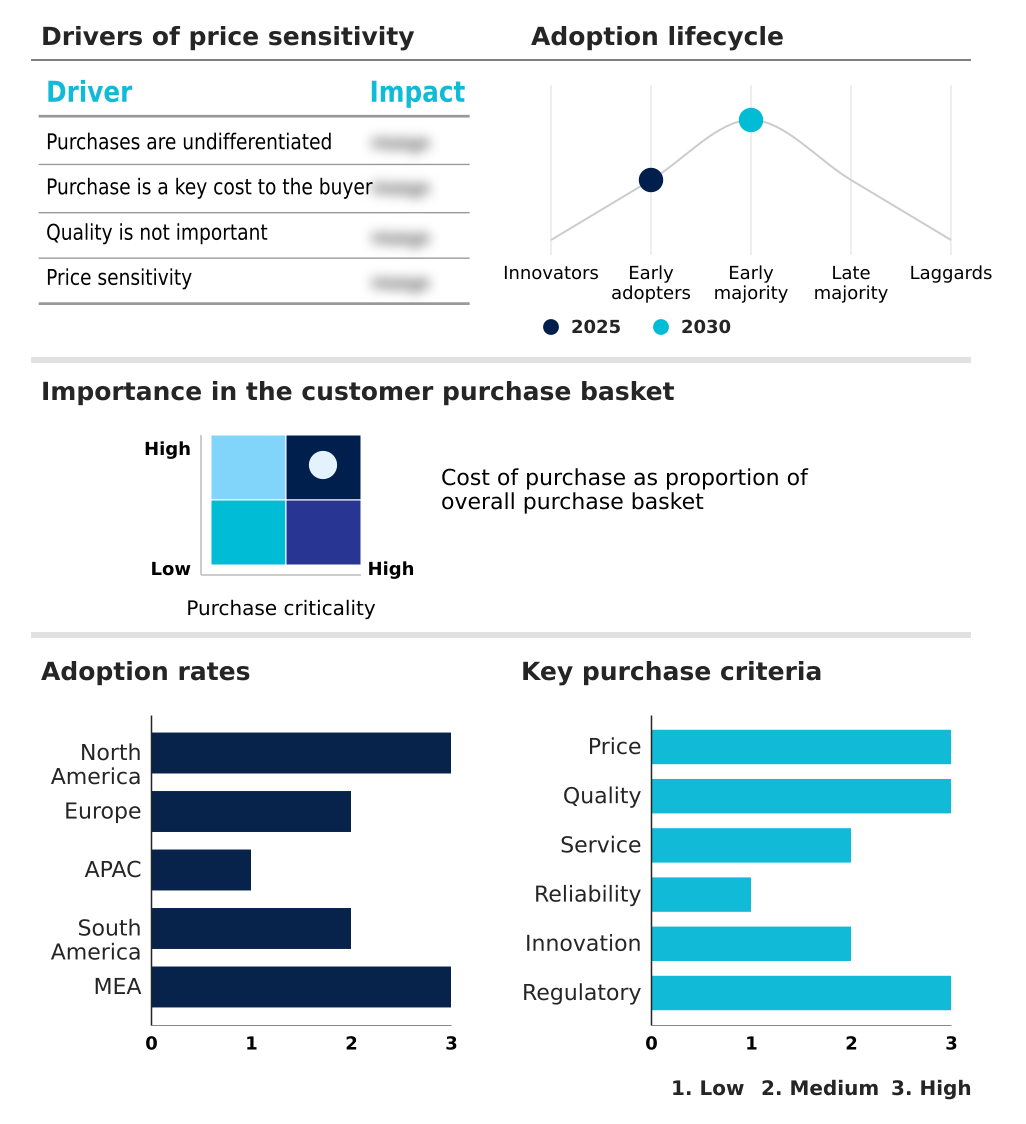
Customer Landscape of Decking Industry
Competitive Landscape
Companies are implementing various strategies, such as strategic alliances, decking market forecast, partnerships, mergers and acquisitions, geographical expansion, and product/service launches, to enhance their presence in the industry.
Cali Bamboo LLC - Key offerings encompass a diverse range of wood, composite, plastic, and aluminum decking systems engineered for durability, aesthetic versatility, and low-maintenance performance in various applications.
The industry research and growth report includes detailed analyses of the competitive landscape of the market and information about key companies, including:
- Cali Bamboo LLC
- CertainTeed
- Deckorators
- Eva Last Hong Kong Ltd.
- Fiberon
- Fortress Iron LP
- Humboldt Redwood Co. LLC
- Kebony AS
- Metsa Group
- MoistureShield
- NewTechWood America Inc.
- Resysta International GmbH
- Silvadec
- Tanwood Orman Urunleri
- The AZEK Group LLC
- The Millboard Co Ltd.
- Thermory AS
- Trex Co. Inc.
- West Fraser Timber Co. Ltd.
- Weyerhaeuser Co.
Qualitative and quantitative analysis of companies has been conducted to help clients understand the wider business environment as well as the strengths and weaknesses of key industry players. Data is qualitatively analyzed to categorize companies as pure play, category-focused, industry-focused, and diversified; it is quantitatively analyzed to categorize companies as dominant, leading, strong, tentative, and weak.
Recent Development and News in Decking market
- In April 2025, Trex Co. Inc. launched an expanded line of modular outdoor kitchen cabinets and integrated lighting systems to enhance the seamless transition between indoor and outdoor living spaces.
- In May 2025, James Hardie Industries introduced a new fiber cement decking board specifically engineered for high-density urban environments, focusing on fire resistance and low weight for architectural applications.
- In January 2025, Marshalls plc announced a strategic expansion of its vitrified porcelain outdoor range, designed to compete with high-end timber products by offering a slip-resistant and frost-proof surface.
- In February 2025, UPM ProFi achieved a zero-waste-to-landfill status at its main manufacturing site while ensuring compliance with new EU Deforestation Regulations for wood-based product traceability.
Dive into Technavio’s robust research methodology, blending expert interviews, extensive data synthesis, and validated models for unparalleled Decking Market insights. See full methodology.
| Market Scope | |
|---|---|
| Page number | 292 |
| Base year | 2025 |
| Historic period | 2020-2024 |
| Forecast period | 2026-2030 |
| Growth momentum & CAGR | Accelerate at a CAGR of 6.4% |
| Market growth 2026-2030 | USD 6822.8 million |
| Market structure | Fragmented |
| YoY growth 2025-2026(%) | 6.0% |
| Key countries | US, Canada, Mexico, Germany, UK, France, Italy, Spain, The Netherlands, China, Japan, India, South Korea, Australia, Indonesia, Brazil, Argentina, Chile, Saudi Arabia, UAE, South Africa, Israel and Turkey |
| Competitive landscape | Leading Companies, Market Positioning of Companies, Competitive Strategies, and Industry Risks |
Research Analyst Overview
- The decking market is undergoing significant material science evolution, with a strong industry pivot towards advanced engineered wood products. The proliferation of wood plastic composites and capped polymer boards is reshaping product standards, offering enhanced durability and realistic wood grain textures. Innovations such as heat mitigation technology and high density protective cap layers are becoming key differentiators.
- The adoption of mineral based composites and mineral-reinforced polyurethane is driven by demand for materials with a high fire resistance rating and superior load bearing capacity. Manufacturing is also advancing, with advanced extrusion technologies enabling the creation of lightweight yet strong boards, including cellular polyvinyl chloride and high-density polyethylene options.
- In sustainability, initiatives focused on carbon footprint reduction, zero waste to landfill, and sustainable forestry management are critical. For instance, companies that implement thermally modified wood or bio-based materials can achieve up to a 15% improvement in their sustainability scores compared to those using traditional treated lumber.
- This shift is complemented by functional enhancements like slip-resistant surfaces, frost proof surfaces, and integrated weather resistant electronics, all supported by structural components like oriented strand board and structural lumber.
What are the Key Data Covered in this Decking Market Research and Growth Report?
-
What is the expected growth of the Decking Market between 2026 and 2030?
-
USD 6.82 billion, at a CAGR of 6.4%
-
-
What segmentation does the market report cover?
-
The report is segmented by Application (Residential, and Non-residential), Product (Wood, Composite, Plastic, and Aluminum), Distribution Channel (Retail, Direct sales, and Online sales) and Geography (North America, Europe, APAC, South America, Middle East and Africa)
-
-
Which regions are analyzed in the report?
-
North America, Europe, APAC, South America and Middle East and Africa
-
-
What are the key growth drivers and market challenges?
-
Changing lifestyles and increasing use of outdoor living spaces, Availability of alternatives for decking
-
-
Who are the major players in the Decking Market?
-
Cali Bamboo LLC, CertainTeed, Deckorators, Eva Last Hong Kong Ltd., Fiberon, Fortress Iron LP, Humboldt Redwood Co. LLC, Kebony AS, Metsa Group, MoistureShield, NewTechWood America Inc., Resysta International GmbH, Silvadec, Tanwood Orman Urunleri, The AZEK Group LLC, The Millboard Co Ltd., Thermory AS, Trex Co. Inc., West Fraser Timber Co. Ltd. and Weyerhaeuser Co.
-
Market Research Insights
- The decking market is shaped by robust dynamics in the home improvement industry and commercial real estate development, where the creation of functional outdoor living spaces is paramount. The residential renovation sector is a significant driver, with do-it-yourself projects and professional deck builders fueling demand.
- This is supported by digital design tools and efficient job site delivery through international logistics networks. In urban infill projects and high-density urban environments, the focus is on smaller, high-value applications like rooftop bars and terraces.
- The building materials category is evolving, with material science innovations leading to products with a lower total cost of ownership and enhanced aesthetic appeal, driving return on investment in both the custom home sectors and multi-family housing developments.
- Overall, the market's momentum is bolstered by a focus on long-term durability and reduced seasonal upkeep, with project management support enhancing large-scale deployments.
We can help! Our analysts can customize this decking market research report to meet your requirements.
 RIA -
RIA - 
