



Digital Holography Market Size 2024-2028
The digital holography (DH) market size is forecast to increase by USD 8.6 billion at a CAGR of 23.71% between 2023 and 2028.
- Digital holography is a cutting-edge technology that has gained significant traction in various industries due to its ability to create three-dimensional images in real time. The market for digital holography is experiencing robust growth, driven by several key trends. One of the primary growth factors is the increasing applications of digital holography in the healthcare sector, where it is being used for medical imaging and diagnostics. Another trend is the emergence of 3D holograms, which offer enhanced user experience and have applications in advertising, education, and entertainment.
- However, the high cost of digital holography systems remains a major challenge for market growth. Despite this, the potential benefits of digital holography, such as its ability to provide high-resolution, interactive, and real-time 3D images, make it a promising technology for the future. The market is expected to continue its growth trajectory, driven by these trends and the increasing demand for advanced imaging technologies.
What will be the Size of the Market During the Forecast Period?
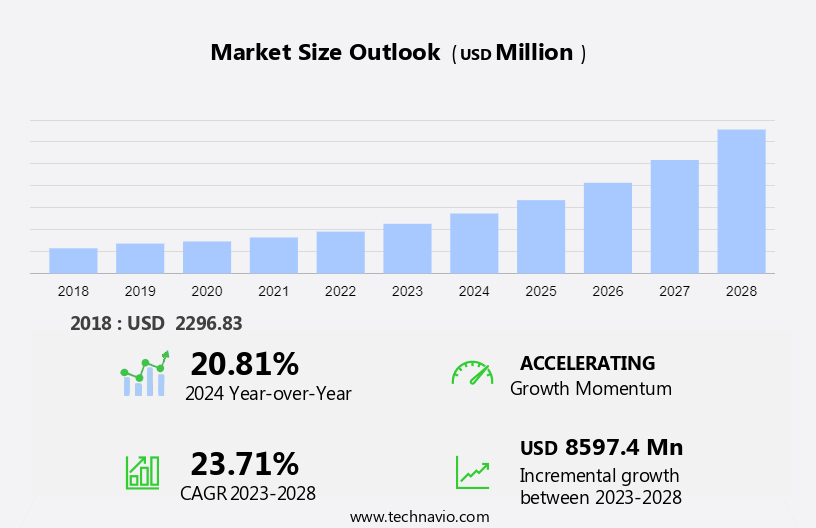
- The market encompasses a range of hardware and software solutions that enable the creation, manipulation, and display of three-dimensional (3D) geometries using holographic techniques. This technology leverages various components such as beam splitters, lasers, beam combiners, spatial filters, mirrors, and projection devices. Digital holography finds applications in diverse industries, including turbine engine components inspection in manufacturing, automobile production, and biomedical imaging. The initial capital investment for setting up digital holography systems can be substantial due to the requirement for specialized hardware.
- However, the benefits derived from enhanced inspection capabilities, improved metrology, and the potential for nanotechnology and material science advancements justify the investment. Beyond inspection, digital holography offers opportunities in various sectors. In the realm of holographic displays, this technology enables the creation of lifelike 3D visuals for remote collaboration, virtual experiences, and even counterfeit detection. Biological research stands to gain significantly from holography's ability to capture intricate structures at the microscopic level. The market also extends to industries like events and entertainment, where it can be used to create captivating reactions and dimensions for interactive experiences.
- In addition, it plays a crucial role in track-and-trace systems, ensuring product authenticity and security. As technology advances, digital holography is poised to revolutionize industries, offering innovative solutions in metrology, nanotechnology, material science, and more. Its potential applications are vast, making it an exciting area of research and development in the realm of technology and science.
How is this market segmented and which is the largest segment?
The market research report provides comprehensive data (region-wise segment analysis), with forecasts and estimates in "USD billion" for the period 2024-2028, as well as historical data from 2018-2022 for the following segments.
- Component
- Hardware
- Software
- Application
- Digital holographic display
- Digital holographic microscopy
- Holographic telepresence
- Geography
- North America
- US
- Europe
- Germany
- UK
- France
- APAC
- China
- South America
- Middle East and Africa
- North America
By Component Insights
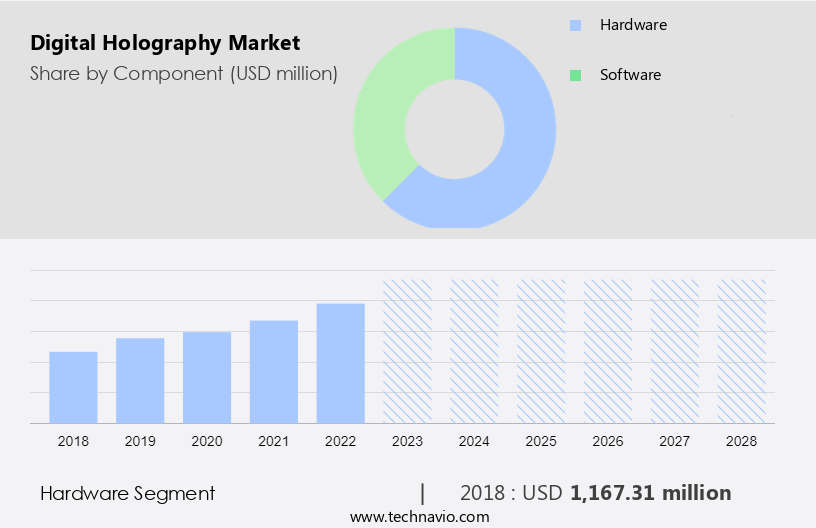
- The hardware segment is estimated to witness significant growth during the forecast period.
Digital holography is a cutting-edge technology that utilizes digital hardware components, including lasers, projectors, and CPU and storage systems, to create three-dimensional images. This technology offers enhanced safety features, such as displaying alerts for potential hazards without requiring user input. The market is witnessing significant growth due to increasing adoption in various industries, including Aerospace & Defense, Medical, Consumer, and Holographic telepresence. Furthermore, the application of digital holography in advertising and 3D microscopy is driving market expansion. Two prominent techniques, Off-Axis Holography and In-Line (Gabor) Holography, are used to capture and display these intricate 3D geometries.
Get a glance at the market report of share of various segments Request Free Sample
The hardware segment was valued at USD 1.17 billion in 2018 and showed a gradual increase during the forecast period.
Regional Analysis
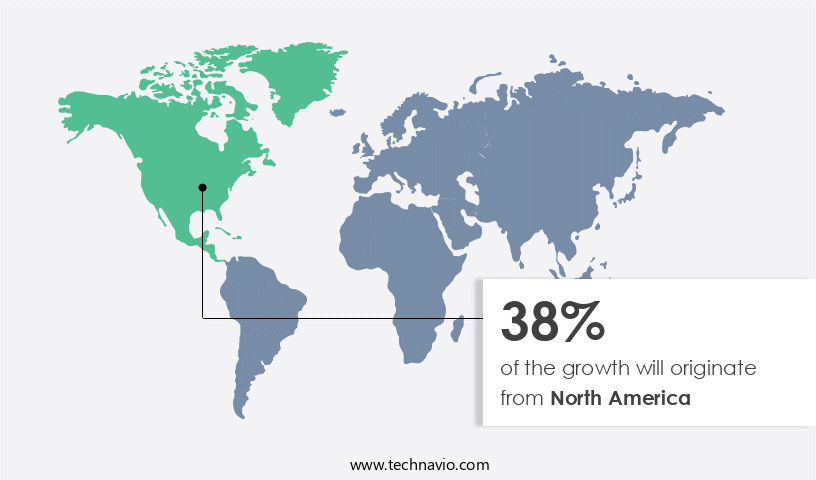
- North America is estimated to contribute 38% to the growth of the global market during the forecast period.
Technavio's analysts have elaborately explained the regional trends and drivers that shape the market during the forecast period.
For more insights on the market share of various regions, Request Free Sample
The market in North America is experiencing significant growth due to the increasing adoption of this technology in the healthcare and entertainment industries. With several key companies headquartered in the region, there is extensive access to distribution channels for digital holography devices. The consumer electronics and commercial sectors are major contributors to the market's expansion. Digital holograms are utilized in various industries to create innovative visual effects for shows, live events, advertising, and promotions. Fast computers and high-pixel density spatial light modulators enable the generation of realistic and detailed holograms. The use of digital holography in North America is expected to continue growing as it provides interactive experiences for consumers and enhances product promotion.
Market Dynamics
Our researchers analyzed the data with 2023 as the base year, along with the key drivers, trends, and challenges. A holistic analysis of drivers will help companies refine their marketing strategies to gain a competitive advantage.
What are the key market drivers leading to the rise in adoption of Digital Holography Market?
Increasing applications of digital holography in the healthcare sector is the key driver of the market.
- The market is experiencing significant growth due to its applications in various industries, particularly in the healthcare sector. Digital holography's use in medical imaging is a major factor driving market expansion. This technology is utilized by medical professionals for diagnostics and surgical procedures, as well as by medical students for educational purposes. The healthcare industry is undergoing rapid technological advancements, with 3D technologies such as 3D CT scans, 3D rotational angiography, and 3D ultrasound enabling doctors to examine patients' anatomy non-invasively. Conditions like heart diseases, liver diseases, and colon cancer can be diagnosed and studied without the need for invasive surgical procedures.
- Moreover, beyond healthcare, digital holography is also utilized in the aerospace & defense, consumer, and industrial sectors for applications such as holographic telepresence, inspection of turbine engine components, and automobile production. The technology's ability to create 3D images and provide fault detection capabilities makes it an essential tool for industries requiring high precision and quality control. The market's growth is influenced by several factors, including the increasing demand for high-pixel density holographic displays, the availability of advanced hardware such as beam splitters, lasers, beam combiners, spatial filters, mirrors, and projection devices, and the development of digital micromirror devices and spatial light modulators.
- Additionally, the market is driven by the increasing processing power, memory, and storage capabilities of computers, which are necessary for handling the complex computations required for holographic image processing and 3D visualization. Skilled technicians are required for the design, implementation, and maintenance of digital holography systems, which adds to the market's growth. The market also benefits from the increasing adoption of holographic displays in various commercial verticals such as advertising, promotions, and digital signage, as well as in biomedical imaging, metrology, nanotechnology, material science, and biological research.
- In conclusion, the market is experiencing significant growth due to its applications in various industries, particularly in medical imaging, and the increasing demand for high-precision, non-invasive diagnostic tools. The market's growth is driven by technological advancements, increasing processing power, and the availability of advanced hardware and software. The market's future potential is vast, with applications in virtual experiences, remote collaboration, counterfeiting authentication, and track-and-trace systems.
What are the market trends shaping the Digital Holography Market?
The emergence of 3D holograms is the upcoming trend in the market.
- The market is experiencing significant growth due to the increasing adoption of digital technology, micro- and nanotechnology, and optoelectronics. Digital holography technology enables innovative applications in fields such as 3D quantitative imaging and holographic 3D displays with photorealistic visualization. This technology is witnessing increasing demand in various end-user sectors, including medical, aerospace and defense, consumer, and industrial applications. Digital holography microscopy is used for high-resolution 3D digital images, providing the same contrast as classical optical microscopy. Additionally, phase images obtained through digital holography offer quantitative data at a sub-wavelength scale for accurate and stable 3D measurements. The technology utilizes various components such as beam splitters, lasers, beam combiners, spatial filters, mirrors, projection devices, digital micromirror devices, and objective lenses.
- Additionally, advancements in software, including algorithms for image processing and computation, have made digital holography more accessible. Fast computers with high-pixel density and skilled technicians are essential for processing holographic images and creating 3D visualizations. The market for digital holography is expanding into various commercial verticals, including entertainment, advertising, and promotions, as well as biomedical imaging, metrology, nanotechnology, material science, and biological research. Holographic telepresence, holographic displays, and holographic microscopy are some of the applications of digital holography.
- In conclusion, the technology is also used for fault detection, initial capital investment analysis, and remote collaboration. Digital holography is finding applications in industries such as automobile production, turbine engine components inspection, and virtual experiences. The market for digital holography is expected to continue growing as the technology becomes more accessible and affordable, offering numerous benefits in various sectors.
What challenges does Digital Holography Market face during the growth?
The high cost of digital holography is a key challenge affecting the market growth.
- The market encompasses hardware and software solutions for creating, processing, and displaying digital holograms. Key components include beam splitters, lasers, beam combiners, spatial filters, mirrors, and projection devices. Digital micromirror devices are utilized for image acquisition, while digital holographic displays offer three-dimensional (3D) visualization. Applications span various industries such as medical, aerospace & defense, consumer, and more. Techniques like Off-Axis Holography and In-Line (Gabor) Holography are employed for holography inspection in sectors like automobile production for fault detection. High capital investment is required for manufacturing and fabricating digital holograms and holographic devices.
- However, the benefits of digital holography technology, including optical data processing, aesthetic user experience, anti-counterfeiting, and security, make it an attractive option. Holograms are produced by manipulating light paths and magnetic fields, but the materials used to divide light rays are brittle, opaque, and costly. Moreover, commercialization of digital holography projectors, displays, and hologram machines is ongoing, with several still in development stages. Incorporating spatial filters, fast computers, high-pixel density, and software algorithms enhances image processing. Phase imaging and wavefields are essential in digital holography microscopy. Skilled technicians are required for the design, implementation, and maintenance of digital holographic systems. Holographic displays, objective lenses, and processing power, memory, and storage are crucial elements for the market's growth.
- In conclusion, the market caters to various commercial verticals, including visual effects for shows, live events, advertising, promotions, digital signage, biomedical imaging, metrology, nanotechnology, material science, biological research, remote collaboration, virtual experiences, counterfeiting authentication, and track-and-trace systems. Digital holography's potential applications extend to consumer electronics, entertainment, and RealView Imaging. Artificial intelligence (AI) integration enables advanced image processing and analysis. The market's future lies in the development of cost-effective solutions, improved processing power, and the integration of AI algorithms.
Exclusive Customer Landscape
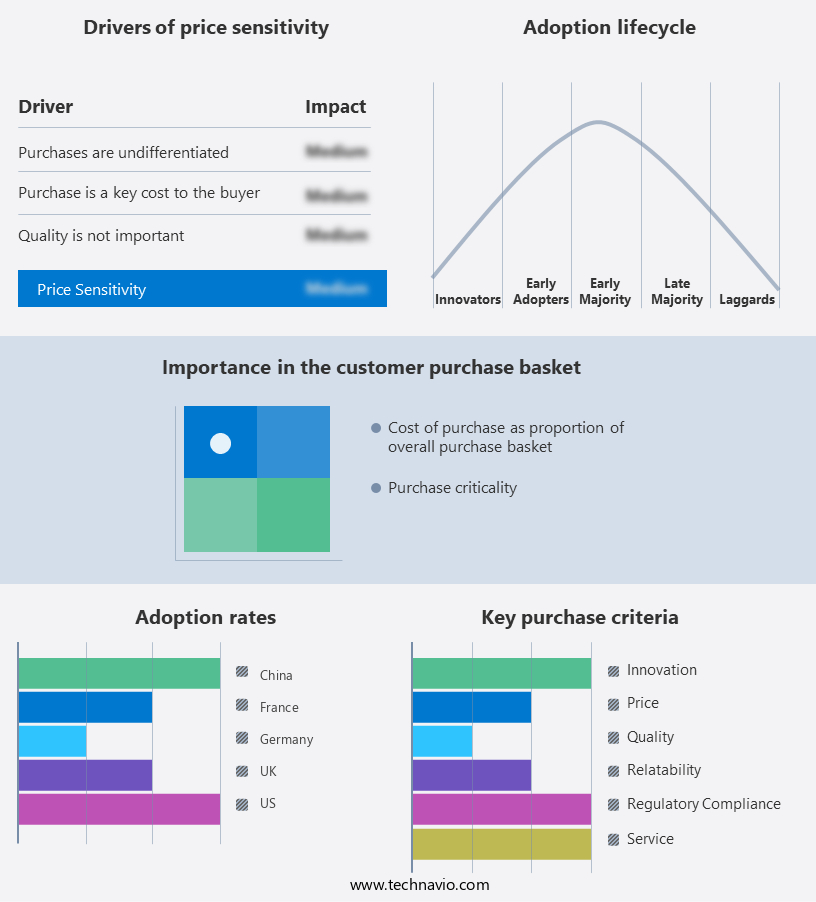
The market forecasting report includes the adoption lifecycle of the market, covering from the innovator's stage to the laggard's stage. It focuses on adoption rates in different regions based on penetration. Furthermore, the market report also includes key purchase criteria and drivers of price sensitivity to help companies evaluate and develop their market growth analysis strategies.
Customer Landscape
Key Companies & Market Insights
Companies are implementing various strategies, such as strategic alliances, market forecast, partnerships, mergers and acquisitions, geographical expansion, and product/service launches, to enhance their presence in the market. The market research and growth report includes detailed analyses of the competitive landscape of the market and information about key companies, including:
- ARHT
- Cisco Systems Inc.
- Geola Digital uab
- Holmarc Opto Mechatronics Ltd.
- Holo Industries LLC
- Holoxica Ltd.
- Holusion
- HYPERVSN
- IntraAction Corp.
- Kaleida
- Lyncee Tec SA
- MetroLaser
- Proto Inc.
- Realfiction ApS
- RealView Imaging Ltd.
- ShaikhTech Ltd.
- VIRTUAL ON LTD
- VividQ Ltd.
- IKIN Inc.
Qualitative and quantitative analysis of companies has been conducted to help clients understand the wider business environment as well as the strengths and weaknesses of key market players. Data is qualitatively analyzed to categorize companies as pure play, category-focused, industry-focused, and diversified; it is quantitatively analyzed to categorize companies as dominant, leading, strong, tentative, and weak.
Research Analyst Overview
Digital holography is an innovative technology that has gained significant traction in various industries due to its ability to generate three-dimensional (3D) images and holographic displays. This technology employs a combination of hardware and software components, including beam splitters, lasers, beam combiners, spatial filters, mirrors, and projection devices, to capture, process, and display holographic data. The market encompasses a wide range of applications, from medical and aerospace & defense to consumer and industrial sectors. In the medical field, digital holography microscopy is used for fault detection, inspection, and biomedical imaging. In the aerospace & defense industry, digital holography is employed for the inspection of turbine engine components and other critical parts. The consumer sector is witnessing an increasing demand for digital holographic displays, 3D visualization, and realview imaging in consumer electronics and entertainment. Off-axis holography and in-line (Gabor) holography are two primary techniques used in digital holography. Off-axis holography captures holographic data using a non-parallel light beam, while in-line holography uses a parallel light beam. Both techniques have their unique advantages and applications, contributing to the versatility of digital holography.
Additionally, the market is driven by several factors, including the increasing demand for non-contact inspection methods, the need for high-resolution 3D imaging, and the growing interest in virtual experiences and remote collaboration. The market is also influenced by technological advancements in hardware components, such as digital micromirror devices, spatial light modulators, and fast computers, as well as software algorithms and image processing capabilities. The initial capital investment required for digital holography systems can be substantial due to the need for high-performance hardware and skilled technicians. However, the benefits of digital holography, such as increased accuracy, improved efficiency, and enhanced visual cues, make it a valuable investment for businesses in various industries. Digital holography is also finding applications in emerging fields, such as nanotechnology, material science, and biological research, where the ability to visualize and analyze complex structures at the molecular level is crucial.
Moreover, digital holography is being explored for use in holographic telepresence, counterfeiting detection, authentication, and track-and-trace systems. In conclusion, the market is a dynamic and evolving field that offers numerous opportunities for innovation and growth. With its ability to generate high-resolution 3D images and holographic displays, digital holography is poised to revolutionize industries and create new applications in various sectors. As the technology continues to advance, we can expect to see digital holography becoming increasingly accessible and affordable, opening up new possibilities for businesses and consumers alike. The market is expected to grow significantly in the coming years, driven by the increasing demand for non-contact inspection methods, the need for high-resolution 3D imaging, and the growing interest in virtual experiences and remote collaboration. The market is also being fueled by technological advancements in hardware components, such as digital micromirror devices, spatial light modulators, and fast computers, as well as software algorithms and image processing capabilities. Digital holography is a versatile technology that has applications in various industries, including medical, aerospace & defense, consumer, and industrial sectors. In the medical field, digital holography microscopy is used for fault detection, inspection, and biomedical imaging. In the aerospace & defense industry, digital holography is employed for the inspection of turbine engine components and other critical parts. The consumer sector is witnessing an increasing demand for digital holographic displays, 3D visualization, and real-time imaging in consumer electronics and entertainment.
In summary, the market is influenced by several factors, including the increasing demand for non-contact inspection methods, the need for high-resolution 3D imaging, and the growing interest in virtual experiences and remote collaboration. The market is also being driven by technological advancements in hardware components, such as digital micromirror devices, spatial light modulators, and fast computers, as well as software algorithms and image processing capabilities. Digital holography offers numerous benefits, such as increased accuracy, improved efficiency, and enhanced visual cues, making it a valuable investment for businesses in various industries. The market is expected to grow significantly in the coming years, driven by these factors and the increasing adoption of digital holography in emerging fields, such as nanotechnology, material science, and biological research. In conclusion, digital holography is a dynamic and evolving field that offers numerous opportunities for innovation and growth. With its ability to generate high-resolution 3D images and holographic displays, digital holography is poised to revolutionize industries and create new applications in various sectors. As the technology continues to advance, we can expect to see digital holography becoming increasingly accessible and affordable, opening up new possibilities for businesses and consumers alike.
|
Market Scope |
|
|
Report Coverage |
Details |
|
Page number |
159 |
|
Base year |
2023 |
|
Historic period |
2018-2022 |
|
Forecast period |
2024-2028 |
|
Growth momentum & CAGR |
Accelerate at a CAGR of 23.71% |
|
Market growth 2024-2028 |
USD 8.6 billion |
|
Market structure |
Fragmented |
|
YoY growth 2023-2024(%) |
20.81 |
|
Key countries |
US, China, Germany, UK, and France |
|
Competitive landscape |
Leading Companies, Market Positioning of Companies, Competitive Strategies, and Industry Risks |
What are the Key Data Covered in this Market Research and Growth Report?
- CAGR of the market during the forecast period
- Detailed information on factors that will drive the market growth and forecasting between 2024 and 2028
- Precise estimation of the size of the market and its contribution of the market in focus to the parent market
- Accurate predictions about upcoming market growth and trends and changes in consumer behaviour
- Growth of the market across North America, Europe, APAC, South America, and Middle East and Africa
- Thorough analysis of the market's competitive landscape and detailed information about companies
- Comprehensive analysis of factors that will challenge the growth of market companies
We can help! Our analysts can customize this market research report to meet your requirements. Get in touch
 RIA -
RIA - 
