



Edge Data Center Market Size 2025-2029
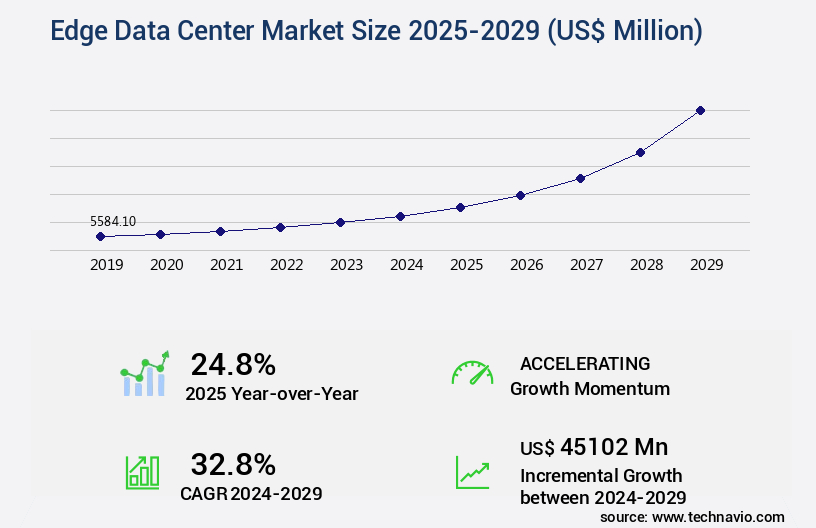
The edge data center market size is valued to increase USD 45.1 billion, at a CAGR of 32.8% from 2024 to 2029. Rising demand for video streaming services will drive the edge data center market.
Major Market Trends & Insights
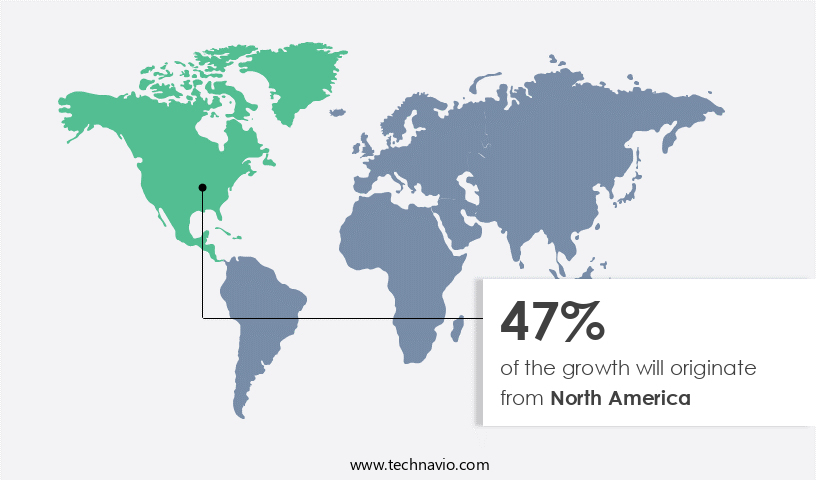
- North America dominated the market and accounted for a 47% growth during the forecast period.
- By End-user - IT and telecommunication segment was valued at USD 1.91 billion in 2023
- By Component - IT infrastructure segment accounted for the largest market revenue share in 2023
Market Size & Forecast
- Market Opportunities: USD 965.20 million
- Market Future Opportunities: USD 45102.00 million
- CAGR from 2024 to 2029 : 32.8%
Market Summary
- The market is a dynamic and evolving sector, driven by the increasing demand for low-latency data processing and the rising adoption of cloud services. Core technologies, such as 5G networks and the Internet of Things (IoT), are fueling the growth of edge computing, which enables data processing at the source rather than in traditional data centers. This trend is particularly evident in the implementation of AI in data centers and the monitoring of edge data center equipment across multiple locations.
- According to a recent study, the global edge computing market is projected to reach a 27% compound annual growth rate (CAGR) by 2027. This growth is being driven by the need for faster response times and the increasing volume of data being generated at the edge. Additionally, regulatory requirements, such as data privacy laws, are pushing organizations to adopt edge data centers to ensure compliance and reduce latency.
What will be the Size of the Edge Data Center Market during the forecast period?
Get Key Insights on Market Forecast (PDF) Request Free Sample
How is the Edge Data Center Market Segmented ?
The edge data center industry research report provides comprehensive data (region-wise segment analysis), with forecasts and estimates in "USD million" for the period 2025-2029, as well as historical data from 2019-2023 for the following segments.
- End-user
- IT and telecommunication
- Manufacturing and automotive
- BFSI
- Healthcare and life sciences
- Others
- Component
- IT infrastructure
- General construction
- Power management systems
- Cooling systems
- Others
- Geography
- North America
- US
- Canada
- Europe
- Germany
- UK
- APAC
- China
- Rest of World (ROW)
- North America
By End-user Insights
The it and telecommunication segment is estimated to witness significant growth during the forecast period.
The market in the IT sector represents the demand for edge data centers designed to address the requirements of the IT industry. Edge data centers are decentralized facilities that bring computing resources closer to end-users or data sources, thereby reducing network congestion and enhancing application performance. These data centers play a pivotal role in supporting various IT services, such as cloud computing, content delivery networks (CDNs), the Internet of Things (IoT), artificial intelligence (AI), and real-time analytics. According to recent studies, the adoption of edge data centers in the IT sector has witnessed a significant increase, with approximately 30% of enterprises implementing edge computing architecture in their IT infrastructure.
Furthermore, industry experts anticipate that the market for edge data centers will continue to expand, with an estimated 45% of enterprise-generated data being processed at the edge by 2025. Moreover, edge data centers are instrumental in enhancing the efficiency of IT infrastructure management by optimizing server rack density, capacity planning, and bandwidth optimization. They also facilitate the integration of hardware acceleration, software-defined networking, and virtual machine density, enabling high-density computing and improved power usage effectiveness. In addition, edge data centers offer enhanced cybersecurity protocols, remote data storage, and disaster recovery planning, making them an attractive option for businesses seeking to minimize network latency and ensure data center uptime.
Furthermore, the integration of 5G networks and hyperscale infrastructure is expected to drive further growth in the market. Edge data centers also cater to the evolving needs of various sectors, including healthcare, manufacturing, and retail, by providing micro data centers, colocation services, and remote monitoring systems. These facilities enable businesses to maintain physical security measures, data center automation, and cloud connectivity, ensuring optimal IT infrastructure performance and security.
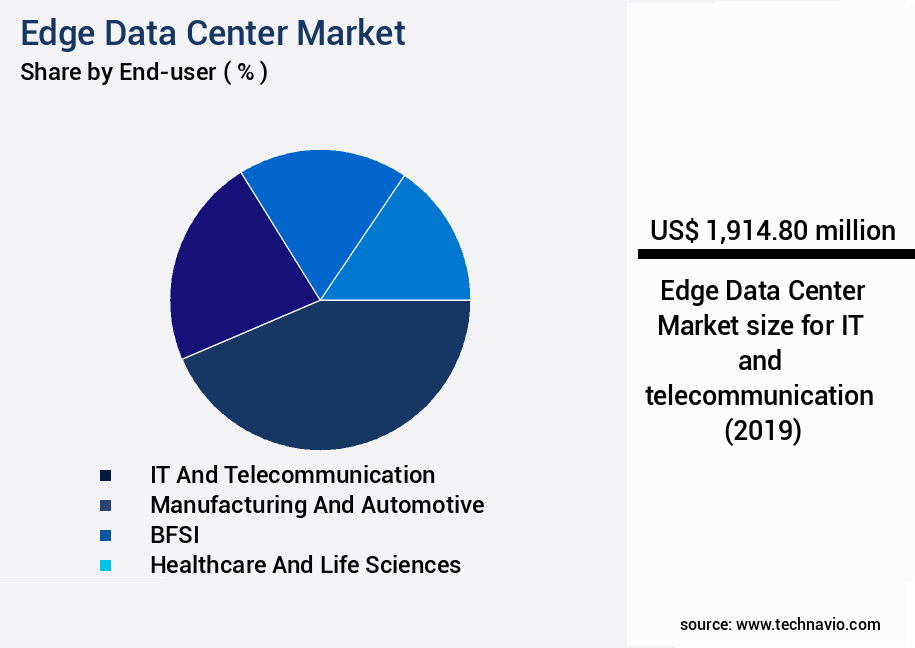
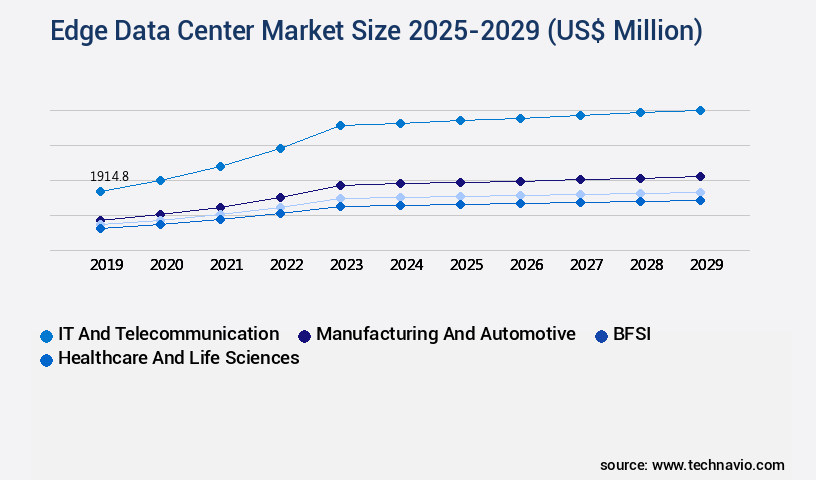
The IT and telecommunication segment was valued at USD 1.91 billion in 2019 and showed a gradual increase during the forecast period.
Regional Analysis
North America is estimated to contribute 47% to the growth of the global market during the forecast period.Technavio’s analysts have elaborately explained the regional trends and drivers that shape the market during the forecast period.
See How Edge Data Center Market Demand is Rising in North America Request Free Sample
The market in North America experiences significant growth due to the increasing preference for cloud services among US and Canadian enterprises. Enterprises seek cloud solutions from providers like AWS, Microsoft, and Oracle to minimize capital and operational expenses associated with on-premises data centers. Additionally, the region hosts numerous data centers from enterprises, such as Apple Inc., which operates six data centers within it.
The demand for edge data centers in North America is further fueled by the expanding adoption of high-performance computing systems in industries like government, BFSI, and healthcare.
Market Dynamics
Our researchers analyzed the data with 2024 as the base year, along with the key drivers, trends, and challenges. A holistic analysis of drivers will help companies refine their marketing strategies to gain a competitive advantage.
The market is experiencing significant growth as businesses strive to improve efficiency and reduce latency in data processing. Edge data centers, which process data closer to the source, are becoming essential for businesses seeking to optimize their operations and deliver real-time insights. One critical aspect of edge data center management is cooling systems optimization. According to market intelligence, more than 30% of IT infrastructure costs are attributed to cooling. By implementing energy-efficient cooling solutions, businesses can save on operational expenses and reduce their carbon footprint. Another crucial area of focus is security. With the increasing number of edge data centers, securing them against cyber threats becomes a top priority.
Implementing robust security protocols, such as multi-factor authentication and encryption, is essential to ensure data protection and compliance with industry standards. Power consumption is another challenge for edge data center operators. Scaling infrastructure while managing power consumption efficiently is a complex task. Energy-efficient hardware and virtualization strategies are becoming increasingly popular solutions to address this issue. Edge data center capacity planning is also a significant concern. Ensuring uptime and reliability while managing capacity requires advanced monitoring and automation solutions. Remote monitoring and disaster recovery strategies are essential to minimize downtime and maintain business continuity. The market is highly competitive, with a growing number of players focusing on innovation.
For instance, some companies are investing in edge data center network design to reduce latency and improve performance. Others are exploring edge data center automation solutions to streamline operations and optimize costs. In terms of market size, the industrial segment accounts for a significantly larger share than the academic segment. This trend is expected to continue as more industries adopt edge computing to enhance their operations and deliver better customer experiences. In conclusion, the market is a dynamic and evolving landscape, with businesses focusing on improving efficiency, optimizing cooling systems, implementing robust security, managing power consumption, scaling infrastructure, reducing latency, deploying applications, monitoring performance, ensuring uptime, planning capacity, exploring virtualization strategies, designing networks, meeting hardware requirements, and implementing disaster recovery and remote monitoring solutions.
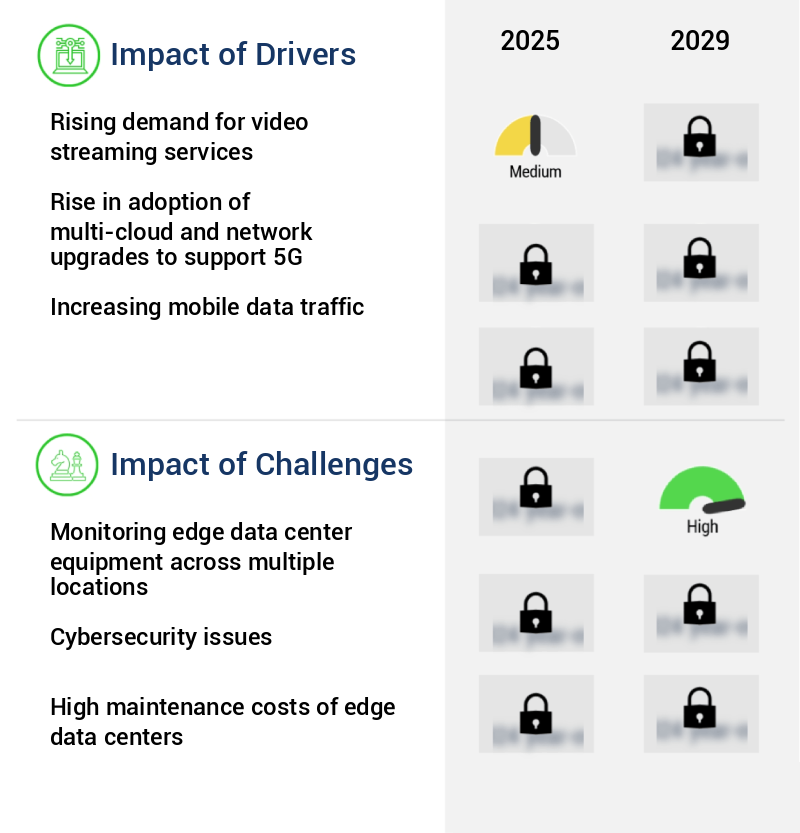
What are the key market drivers leading to the rise in the adoption of Edge Data Center Industry?
- The surge in consumer preference for video streaming services serves as the primary market catalyst.
- The expanding smartphone usage and Internet penetration fuel the rising demand for video streaming services. Providers are investing in creating exclusive in-house content, such as web series, movies, and documentaries, to cater to diverse genres like drama, comedy, sitcoms, action, and more. These original productions account for a significant portion of the most-watched digital videos on OTT platforms, including Netflix and YouTube. With the increasing global smartphone penetration, OTT content is increasingly accessed on mobile devices.
- This trend presents a substantial growth opportunity for OTT service providers. Additionally, the escalating demand for live-streaming videos worldwide is leading to increased investments in edge data centers to ensure seamless streaming experiences.
What are the market trends shaping the Edge Data Center Industry?
- The implementation of artificial intelligence in data centers is an emerging market trend. This technological advancement is set to revolutionize data center management and efficiency.
- Edge data centers are optimizing energy efficiency through the application of artificial intelligence (AI). By analyzing server, power system, and cooling system performance, AI enables faster decision-making and energy savings. Edge data center service providers utilize AI in automation software to minimize human intervention and enhance energy efficiency. Additionally, AI facilitates effective cooling management through supervised control over mechanical cooling systems.
- This approach allows for the efficient use of power in the overall data center process, ultimately contributing to the ongoing evolution and improvement of edge data center operations.
What challenges does the Edge Data Center Industry face during its growth?
- Monitoring the equipment in edge data centers situated at various locations is a significant challenge that can hinder industry growth. Effective management of these decentralized infrastructure systems requires constant surveillance to ensure optimal performance, security, and uptime. This complex task necessitates advanced monitoring tools and skilled IT personnel, making it a critical concern for organizations seeking to expand their digital footprint.
- Edge data centers, integral components of distributed IT infrastructure, present unique challenges due to their autonomous power and cooling systems. Effective management of these sites necessitates real-time monitoring of cabinet equipment, including servers, networking devices, power distribution units (PDUs), and patch panels, as well as infrastructure devices and structured cabling. This data enables administrators to identify potential issues, such as hot spot formation, power capacity constraints, and redundancy loss, before they escalate. However, managing IT assets from the core to the edge data center necessitates a dedicated team of Network Operations Center (NOC) technicians and experts.
- They ensure the continuous optimization and maintenance of the entire IT infrastructure. By leveraging advanced monitoring tools and real-time data analysis, these professionals proactively address potential issues and maintain the performance and reliability of the edge data center ecosystem.
Exclusive Technavio Analysis on Customer Landscape
The edge data center market forecasting report includes the adoption lifecycle of the market, covering from the innovator’s stage to the laggard’s stage. It focuses on adoption rates in different regions based on penetration. Furthermore, the edge data center market report also includes key purchase criteria and drivers of price sensitivity to help companies evaluate and develop their market growth analysis strategies.
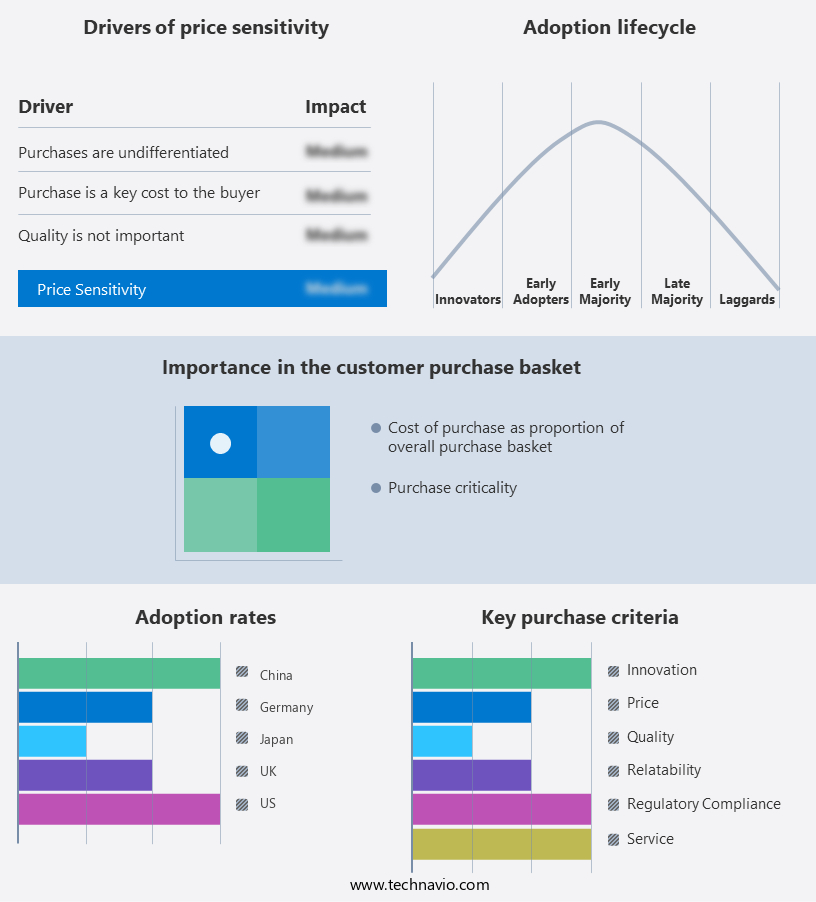
Customer Landscape of Edge Data Center Industry
Competitive Landscape
Companies are implementing various strategies, such as strategic alliances, edge data center market forecast, partnerships, mergers and acquisitions, geographical expansion, and product/service launches, to enhance their presence in the industry.
365 Data Centers - The company specializes in edge data centers, delivering highly connected facilities with colocation and interconnection services in various US markets. These centers ensure optimal latency and superior performance through robust infrastructure.
The industry research and growth report includes detailed analyses of the competitive landscape of the market and information about key companies, including:
- 365 Data Centers
- Compass Datacenters LLC
- DC BLOX Inc.
- Dell Technologies Inc.
- Digital Realty Trust Inc.
- Eaton Corp plc
- EdgeConneX Inc.
- Equinix Inc.
- Flexential Corp.
- Friedhelm Loh Stiftung and Co. KG
- Fujitsu Ltd.
- Hewlett Packard Enterprise Co.
- Hitachi Ltd.
- Huawei Technologies Co. Ltd.
- International Business Machines Corp.
- Johnson Controls International Plc
- Panduit Corp.
- Schneider Electric SE
- Vapor IO Inc.
- Vertiv Holdings Co.
Qualitative and quantitative analysis of companies has been conducted to help clients understand the wider business environment as well as the strengths and weaknesses of key industry players. Data is qualitatively analyzed to categorize companies as pure play, category-focused, industry-focused, and diversified; it is quantitatively analyzed to categorize companies as dominant, leading, strong, tentative, and weak.
Recent Development and News in Edge Data Center Market
- In January 2024, Equinix, a leading global data center provider, announced the acquisition of Verizon's international data center business for USD3.6 billion. This strategic move expanded Equinix's footprint in key markets and strengthened its position as a major player in the market (Equinix Press Release, 2024).
- In March 2024, IBM and Google Cloud formed a partnership to deliver edge computing services, combining IBM's edge infrastructure with Google Cloud's AI and machine learning capabilities. This collaboration aimed to provide businesses with faster data processing and analysis at the edge (IBM Press Release, 2024).
- In May 2024, Schneider Electric, a global energy management and automation company, launched its new Micro Data Center product line. These compact, pre-integrated solutions offer edge computing capabilities and simplify the deployment of edge infrastructure for businesses (Schneider Electric Press Release, 2024).
- In February 2025, the European Union approved the Digital Single Market Act, which includes provisions for data protection and privacy regulations. This initiative aims to create a unified digital market in Europe, potentially driving growth in the market as businesses seek to comply with data localization requirements (European Commission Press Release, 2025).
Dive into Technavio’s robust research methodology, blending expert interviews, extensive data synthesis, and validated models for unparalleled Edge Data Center Market insights. See full methodology.
|
Market Scope |
|
|
Report Coverage |
Details |
|
Page number |
224 |
|
Base year |
2024 |
|
Historic period |
2019-2023 |
|
Forecast period |
2025-2029 |
|
Growth momentum & CAGR |
Accelerate at a CAGR of 32.8% |
|
Market growth 2025-2029 |
USD 45102 million |
|
Market structure |
Fragmented |
|
YoY growth 2024-2025(%) |
24.8 |
|
Key countries |
US, Germany, China, Canada, and UK |
|
Competitive landscape |
Leading Companies, Market Positioning of Companies, Competitive Strategies, and Industry Risks |
Research Analyst Overview
- In the dynamic and ever-evolving landscape of IT infrastructure, the market continues to gain traction. Distributed computing, a key driver of this trend, enables data processing closer to the source, reducing network latency and enhancing responsiveness. Network monitoring tools play a crucial role in optimizing edge data centers, ensuring high-density computing environments maintain optimal performance. The data center footprint is expanding as businesses adopt software-defined networking and virtual machine density increases. Cloud connectivity and IoT device management are integral components of edge computing architecture, allowing for seamless integration of data from various sources. Power usage effectiveness and network throughput are critical efficiency metrics, with edge data centers striving for improvements through energy efficiency measures and hardware acceleration.
- Edge data centers also prioritize cybersecurity protocols and disaster recovery planning, as they handle sensitive data and require uninterrupted operations. Remote data storage and data center automation are essential for managing the vast amounts of data generated at the edge. Hyperscale infrastructure and server virtualization contribute to increased capacity planning and bandwidth optimization. Micro data centers, a popular choice for edge deployments, require careful consideration of physical security measures and colocation services. Remote monitoring systems enable real-time visibility into edge data center operations, ensuring data center uptime and network latency reduction. The integration of 5G networks further enhances the potential of edge computing, enabling faster data transfer and more efficient processing.
- In conclusion, the market is characterized by continuous innovation and evolution, with a focus on distributed computing, network optimization, and data security. As businesses increasingly rely on real-time data processing and analysis, the importance of edge data centers continues to grow.
What are the Key Data Covered in this Edge Data Center Market Research and Growth Report?
-
What is the expected growth of the Edge Data Center Market between 2025 and 2029?
-
USD 45.1 billion, at a CAGR of 32.8%
-
-
What segmentation does the market report cover?
-
The report is segmented by End-user (IT and telecommunication, Manufacturing and automotive, BFSI, Healthcare and life sciences, and Others), Component (IT infrastructure, General construction, Power management systems, Cooling systems, and Others), and Geography (North America, APAC, Europe, South America, and Middle East and Africa)
-
-
Which regions are analyzed in the report?
-
North America, APAC, Europe, South America, and Middle East and Africa
-
-
What are the key growth drivers and market challenges?
-
Rising demand for video streaming services, Monitoring edge data center equipment across multiple locations
-
-
Who are the major players in the Edge Data Center Market?
-
365 Data Centers, Compass Datacenters LLC, DC BLOX Inc., Dell Technologies Inc., Digital Realty Trust Inc., Eaton Corp plc, EdgeConneX Inc., Equinix Inc., Flexential Corp., Friedhelm Loh Stiftung and Co. KG, Fujitsu Ltd., Hewlett Packard Enterprise Co., Hitachi Ltd., Huawei Technologies Co. Ltd., International Business Machines Corp., Johnson Controls International Plc, Panduit Corp., Schneider Electric SE, Vapor IO Inc., and Vertiv Holdings Co.
-
Market Research Insights
- The market encompasses the design, migration, and operation of data centers to deliver IT services closer to end-users, enhancing network performance, system resilience, and IT service continuity. According to industry estimates, The market is projected to reach USD65 billion by 2025, growing at a compound annual growth rate of 20%. This growth is driven by the increasing demand for network bandwidth, compute resources, and data redundancy, as well as the need for system performance and network security. In contrast, traditional data centers consume an average of 30 kW per rack, whereas edge data centers consume only 5 kW per rack, thanks to advancements in power distribution units, cooling efficiency, and server maintenance.
- These improvements contribute significantly to reducing power consumption and enhancing resource allocation, making edge data centers a cost-effective and efficient solution for businesses.
We can help! Our analysts can customize this edge data center market research report to meet your requirements.
 RIA -
RIA - 
