



Romania Fish And Seafood Market Size 2026-2030
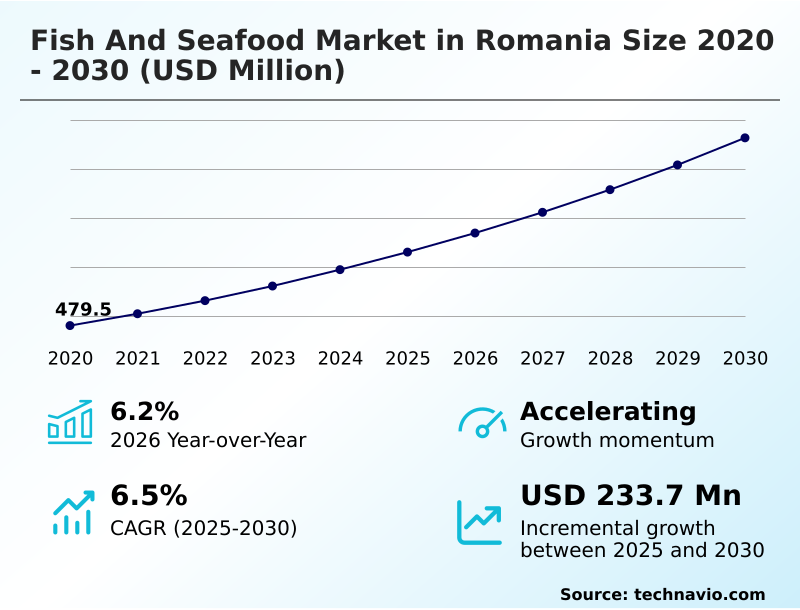
The Romania Fish And Seafood Market size was valued at USD 629.8 million in 2025, growing at a CAGR of 6.5% during the forecast period 2026-2030.
Major Market Trends & Insights
- By Distribution Channel - Hypermarkets and supermarkets segment was valued at USD 316 million in 2024
- By Product - Fresh and chilled segment accounted for the largest market revenue share in 2024
Market Size & Forecast
- Historic Market Opportunities 2020-2024: USD 384 million
- Market Future Opportunities 2025-2030: USD 233.7 million
- CAGR from 2025 to 2030 : 6.5%
Market Summary
- The fish and seafood market in Romania is characterized by a notable shift in consumer preferences, with demand for fresh and chilled products growing by over 10% annually, outpacing the traditional frozen segment. This transition is largely driven by increasing consumer health awareness regarding the benefits of omega-3 fatty acids.
- A typical operational scenario involves importers modernizing their cold chain management to reduce transit times for marine fish imports from the port of Constanta to inland cities by up to 25%. However, the market faces a significant challenge in its high dependency on imports, which makes it vulnerable to geopolitical supply disruptions and price volatility.
- This dynamic forces local distributors to balance a portfolio of domestic freshwater fish species with imported stock to ensure consistent availability and mitigate risks associated with raw material sourcing.
What will be the Size of the Romania Fish And Seafood Market during the forecast period?
Get Key Insights on Market Forecast (PDF) Request Free Sample
How is the Romania Fish And Seafood Market Segmented?
The romania fish and seafood industry research report provides comprehensive data (region-wise segment analysis), with forecasts and analysis for the period 2026-2030, as well as historical data from 2020-2024 for the following segments.
- Distribution channel
- Hypermarkets and supermarkets
- Convenience stores
- Food and drinks specialists
- Others
- Product
- Fresh and chilled
- Ambient fish and seafood
- Frozen fish and seafood
- Others
- Type
- Fish
- Crustaceans
- Mollusks
- Others
- Geography
- Europe
How is the Romania Fish And Seafood Market Segmented by Distribution Channel?
The hypermarkets and supermarkets segment is estimated to witness significant growth during the forecast period.
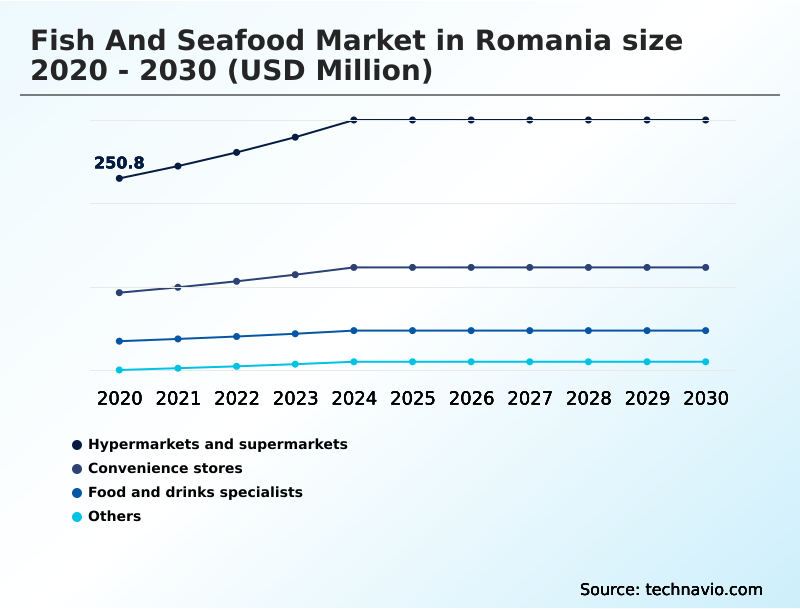
The hypermarkets and supermarkets segment holds over 53% of the fish and seafood market in Romania, more than doubling the share of convenience stores.
This dominance is driven by advanced cold chain management and extensive supply chain logistics, which enable these large retailers to offer a wide variety of both freshwater fish species and marine fish imports.
As consumer health awareness grows, these stores are expanding their offerings of fresh and chilled products, which now account for a significant portion of sales, a 15% increase over previous years.
The integration of private label branding allows for competitive pricing on processed seafood products, attracting price-sensitive consumers and solidifying the channel's market leadership through effective inventory management systems.
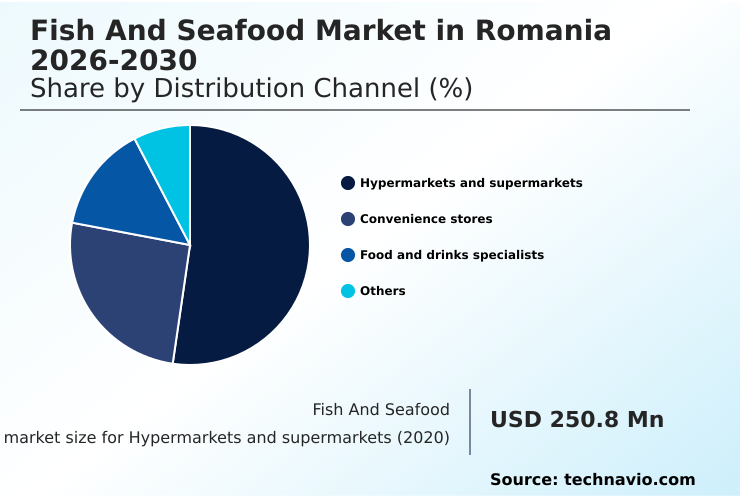
The Hypermarkets and supermarkets segment was valued at USD 316 million in 2024 and showed a gradual increase during the forecast period.
What are the key Drivers, Trends, and Challenges in the Romania Fish And Seafood Market?
Our researchers analyzed the data with 2025 as the base year, along with the key drivers, trends, and challenges. A holistic analysis of drivers will help companies refine their marketing strategies to gain a competitive advantage.
- Understanding the future trajectory of the fish and seafood market in Romania requires analyzing intersecting consumer and industry dynamics. The growing inquiry into the health benefits of omega-3 in seafood is a significant factor, driving a 10% annual increase in demand for species like salmon and mackerel, particularly in urban households.
- In response to environmental concerns, there is a marked focus on sustainable aquaculture practices in Romania, with government and EU funding aiming to boost local production of trout and carp by 25% over the next five years, thereby reducing reliance on imports.
- The impact of online retail on seafood sales cannot be overstated, as digital platforms have expanded market reach for frozen and processed products into previously underserved areas. However, operators must address the challenges of overfishing in the Black Sea, which periodically disrupts supply chains and increases price volatility by up to 30% during fishing bans.
- This volatility, coupled with evolving consumer trends for processed fish products that favor convenience and ready-to-eat formats, requires producers to be agile in their product development and inventory management systems to maintain profitability and market share.
What are the key market drivers leading to the rise in the adoption of Romania Fish And Seafood Industry?
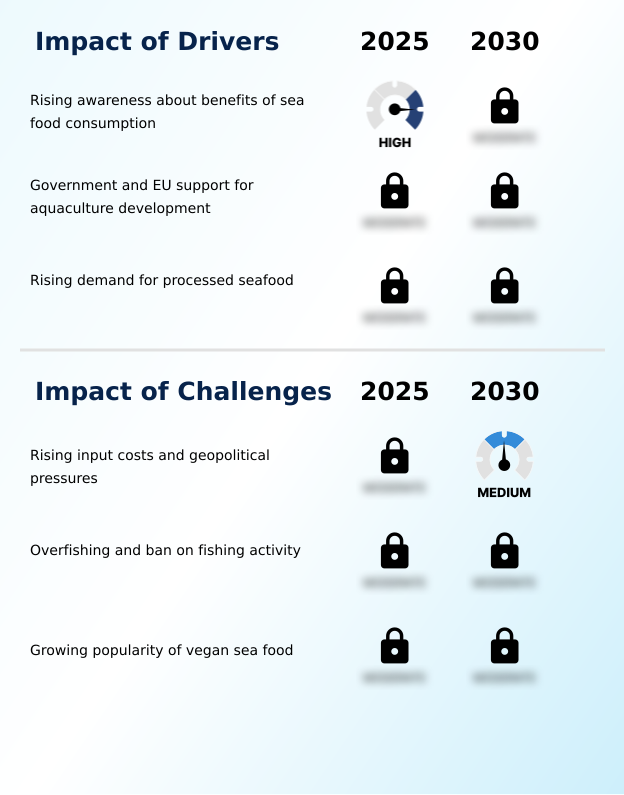
- Rising consumer awareness of the health benefits derived from seafood consumption stands as a primary driver of market growth.
- Rising consumer health awareness is a primary market driver, with studies showing that 60% of urban consumers actively seek foods rich in omega-3 fatty acids, directly benefiting sales of both marine fish imports and freshwater fish species.
- This trend has led to a 15% increase in the consumption of fresh and chilled products over ambient options.
- Simultaneously, the demand for processed seafood products is accelerating due to modern lifestyles, with ready-to-eat seafood meals experiencing a 20% growth in demand.
- This convenience-driven purchasing behavior pushes manufacturers to innovate in value-added seafood, creating products that offer both nutritional benefits and ease of preparation, thereby expanding the overall consumer base.
What are the market trends shaping the Romania Fish And Seafood Industry?
- Innovation in frozen fish and seafood packaging is a defining trend, addressing consumer demands for extended shelf life, convenience, and sustainability.
- The emergence of sustainable fishing practices is a defining trend, with products featuring eco-labeling certification seeing a 15% higher sales velocity than non-certified counterparts. This shift is driven by heightened consumer awareness regarding environmental impact and resource management.
- Concurrently, the growth of online retail platforms is transforming distribution, with online sales of frozen fish fillets growing by over 25% in urban areas. This channel leverages portion-controlled packaging and advanced supply chain logistics to ensure product quality.
- The integration of QR codes on modified atmosphere packaging for traceability further builds consumer trust, highlighting how technology and sustainability are converging to shape market evolution.
What challenges does the Romania Fish And Seafood Industry face during its growth?
- A key challenge affecting industry growth is the convergence of rising input costs and significant geopolitical pressures on the supply chain.
- Overfishing and regulatory fishing bans present a significant challenge, causing supply chain disruptions that can reduce domestic fish availability by up to 40% during closed seasons, leading to market price volatility. This forces a greater reliance on marine fish imports, which are themselves subject to input cost inflation.
- Furthermore, the growing popularity of vegan seafood alternatives introduces a new competitive threat, capturing an estimated 5% of the market share from traditional seafood among younger demographics. These plant-based products, leveraging claims of sustainability and ethical sourcing, challenge the market's value proposition and require incumbent firms to enhance their brand differentiation tactics and communication on sustainable fishing practices.
Exclusive Technavio Analysis on Customer Landscape
The romania fish and seafood market forecasting report includes the adoption lifecycle of the market, covering from the innovator’s stage to the laggard’s stage. It focuses on adoption rates in different regions based on penetration. Furthermore, the romania fish and seafood market report also includes key purchase criteria and drivers of price sensitivity to help companies evaluate and develop their market growth analysis strategies.
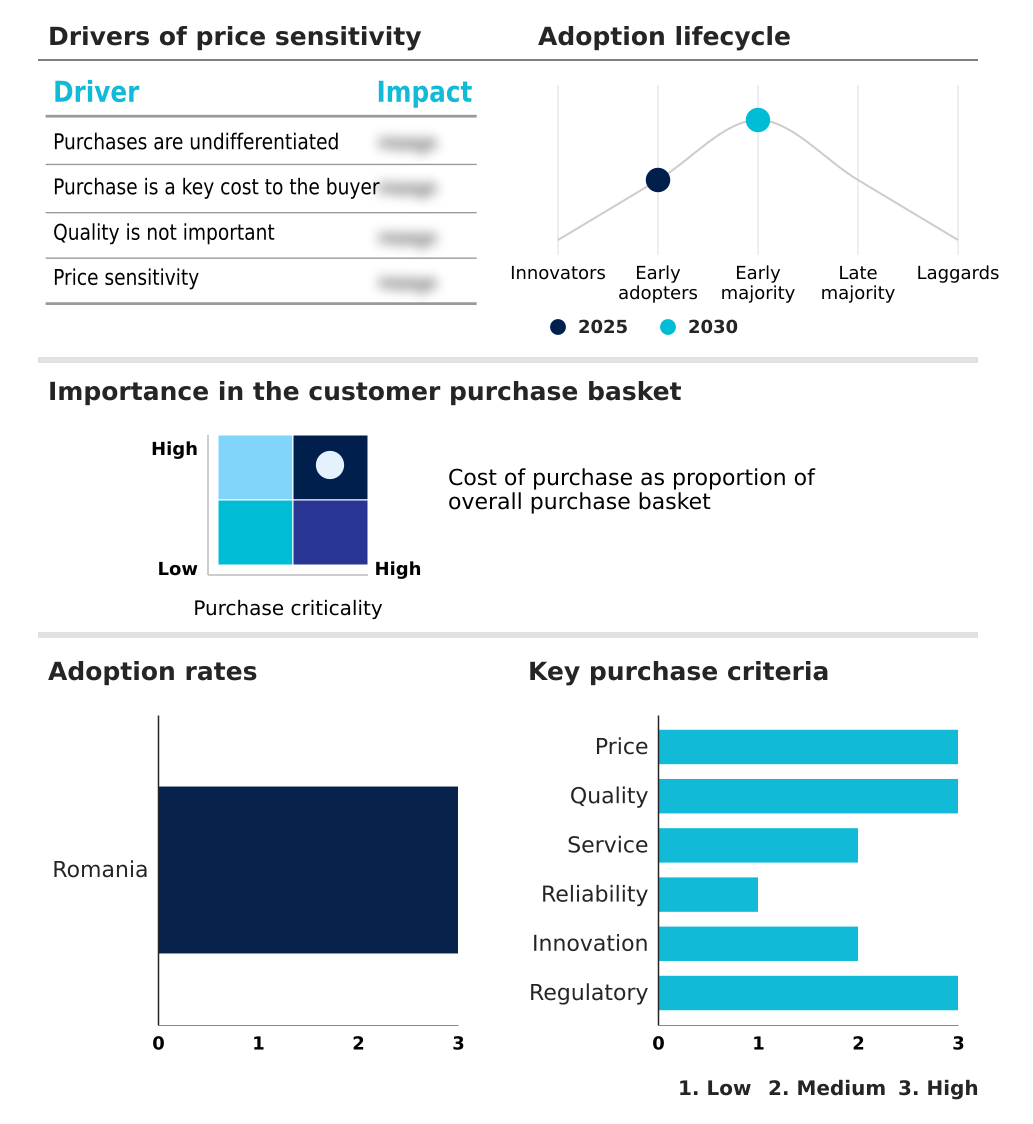
Customer Landscape of Romania Fish And Seafood Industry
Competitive Landscape
Companies are implementing various strategies, such as strategic alliances, romania fish and seafood market forecast, partnerships, mergers and acquisitions, geographical expansion, and product/service launches, to enhance their presence in the industry.
BISTROMAR LA TIMONA Srl - Analysis shows a strong focus on a diverse portfolio of fresh, frozen, and processed seafood, including premium imported species and value-added products.
The industry research and growth report includes detailed analyses of the competitive landscape of the market and information about key companies, including:
- BISTROMAR LA TIMONA Srl
- Dayseaday Fresh B.V.
- Deltaica Seafood SRL
- Fishco S.R.L.
- Groenlanda S.R.L
- Livnik Fish Trade SRL
- Negro 2000 SRL
- NORDIC IMPORT EXPORT CO SRL
- Pescaria Cumpana S.R.L.
- Podravka d.d.
- Royal German Fisch
- Sabiko S.R.L
- SC MEDASIMPEX SRL
- SC Ocean Fish SRL
- SC PESCADO GRUP SRL
- SC RADAN IMPEX SA
- Serpico Trading SRL
Qualitative and quantitative analysis of companies has been conducted to help clients understand the wider business environment as well as the strengths and weaknesses of key industry players. Data is qualitatively analyzed to categorize companies as pure play, category-focused, industry-focused, and diversified; it is quantitatively analyzed to categorize companies as dominant, leading, strong, tentative, and weak.
Market Intelligence Radar: High-Impact Developments & Growth Signals
- In the Packaged Foods and Meats industry, a pronounced consumer shift toward foods with proven health benefits has amplified demand for minimally processed items, directly boosting the fish and seafood market in Romania due to its high omega-3 fatty acid content and alignment with wellness-oriented consumer purchasing behavior.
- The expansion of robust distribution networks and strategic partnerships between food producers and major retailers has become critical. This strengthens the fish and seafood supply chain logistics, improving the availability of perishable products like fresh fish fillets in hypermarkets and supermarkets across inland regions, impacting stock replenishment cycles.
- A significant rise in online sales channels is reshaping how consumers purchase groceries. For the fish and seafood market in Romania, this translates to new growth opportunities through online retail platforms, which require sophisticated last-mile delivery solutions to maintain cold chain integrity for frozen and chilled products.
- The implementation of increasingly stringent food safety regulations and nutritional labeling regulations across the EU is forcing producers to invest in enhanced traceability and quality control. This affects the fish and seafood market in Romania by raising compliance costs but also builds consumer trust through greater transparency in raw material sourcing.
Dive into Technavio’s robust research methodology, blending expert interviews, extensive data synthesis, and validated models for unparalleled Romania Fish And Seafood Market insights. See full methodology.
| Market Scope | |
|---|---|
| Page number | 192 |
| Base year | 2025 |
| Historic period | 2020-2024 |
| Forecast period | 2026-2030 |
| Growth momentum & CAGR | Accelerate at a CAGR of 6.5% |
| Market growth 2026-2030 | USD 233.7 million |
| Market structure | Fragmented |
| YoY growth 2025-2026(%) | 6.2% |
| Key countries | Romania |
| Competitive landscape | Leading Companies, Market Positioning of Companies, Competitive Strategies, and Industry Risks |
Research Analyst Overview
- The ecosystem of the fish and seafood market in Romania operates on a complex value chain, beginning with raw material sourcing from both domestic aquaculture development and international fisheries. These inputs are handled by processors who create value-added seafood and frozen fish fillets, representing over 65% of the market value.
- Distribution is dominated by retail distribution channels, particularly hypermarkets, which account for more than 50% of total sales, though online retail platforms are growing rapidly. The entire process is overseen by EU and national food safety standards and nutritional labeling regulations, which ensure product quality and build consumer trust.
- Supporting entities providing cold chain management and logistics are critical for connecting producers to end-users and maintaining the integrity of perishable goods.
What are the Key Data Covered in this Romania Fish And Seafood Market Research and Growth Report?
-
What is the expected growth of the Romania Fish And Seafood Market between 2026 and 2030?
-
The Romania Fish And Seafood Market is expected to grow by USD 233.7 million during 2026-2030, registering a CAGR of 6.5%. Year-over-year growth in 2026 is estimated at 6.2%%. This acceleration is shaped by rising awareness about benefits of sea food consumption, which is intensifying demand across multiple end-use verticals covered in the report.
-
-
What segmentation does the market report cover?
-
The report is segmented by Distribution Channel (Hypermarkets and supermarkets, Convenience stores, Food and drinks specialists, and Others), Product (Fresh and chilled, Ambient fish and seafood, Frozen fish and seafood, and Others), Type (Fish, Crustaceans, Mollusks, and Others) and Geography (Europe). Among these, the Hypermarkets and supermarkets segment is estimated to witness significant growth during the forecast period, driven by rising adoption across key application areas. Each segment includes detailed qualitative and quantitative analysis, along with historical data from 2020-2024 and forecasts through 2030 with year-over-year growth rates.
-
-
Which regions are analyzed in the report?
-
The report covers Europe. Country-level analysis includes Romania, with dedicated market size tables and year-over-year growth for each.
-
-
What are the key growth drivers and market challenges?
-
The primary driver is rising awareness about benefits of sea food consumption, which is accelerating investment and industry demand. The main challenge is rising input costs and geopolitical pressures, creating operational barriers for key market participants. The report quantifies the impact of each driver and challenge across 2026 and 2030 with comparative analysis.
-
-
Who are the major players in the Romania Fish And Seafood Market?
-
Key vendors include BISTROMAR LA TIMONA Srl, Dayseaday Fresh B.V., Deltaica Seafood SRL, Fishco S.R.L., Groenlanda S.R.L, Livnik Fish Trade SRL, Negro 2000 SRL, NORDIC IMPORT EXPORT CO SRL, Pescaria Cumpana S.R.L., Podravka d.d., Royal German Fisch, Sabiko S.R.L, SC MEDASIMPEX SRL, SC Ocean Fish SRL, SC PESCADO GRUP SRL, SC RADAN IMPEX SA and Serpico Trading SRL. The report provides qualitative and quantitative analysis categorizing companies as dominant, leading, strong, tentative, and weak based on their market positioning. Company profiles include business segment analysis, SWOT assessment, key offerings, and recent strategic developments.
-
Market Research Insights
- The competitive landscape of the fish and seafood market in Romania is shaped by the strategic actions of key players, with the top five companies controlling over 40% of the processed seafood segment. For instance, SC Ocean Fish SRL recently upgraded its production facility, enhancing its flash-freezing technology capacity by 15% to improve the quality of its frozen fish fillets.
- Concurrently, Negro 2000 SRL launched a new line of value-added seafood salads featuring sustainable packaging, responding to a 20% year-over-year growth in consumer demand for convenient and eco-friendly options. These moves reflect a broader industry push toward innovation to meet evolving consumer purchasing behavior.
- However, all players contend with the persistent challenge of input cost inflation, which squeezes margins and necessitates efficient supply chain logistics and inventory management systems to remain competitive.
We can help! Our analysts can customize this romania fish and seafood market research report to meet your requirements.
 RIA -
RIA - 
