


Industrial I/O (Input/Output) Modules Market Size 2024-2028
The industrial i/o (input/output) modules market size is forecast to increase by USD 2.53 billion, at a CAGR of 5.95% between 2023 and 2028.
- The market is experiencing significant growth, driven by the increasing demand for automation and the trend towards Industry 4.0. This shift towards digitization and data exchange in various industries is leading to a surge in the adoption of Industrial I/O modules. However, the market faces challenges, including high installation costs and scalability issues associated with the use of these modules.
- Companies must navigate these obstacles to effectively capitalize on the market's potential and remain competitive. Strategic investments in research and development, cost optimization, and scalable solutions will be crucial for market success. The ability to provide reliable, cost-effective, and scalable Industrial I/O modules that support automation and data exchange will be key differentiators for market leaders.
What will be the Size of the Industrial I/O (Input/Output) Modules Market during the forecast period?
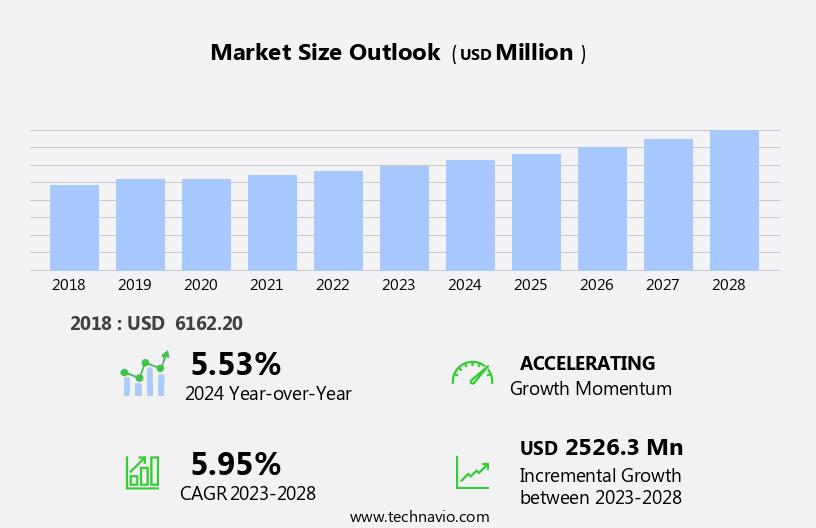
Explore in-depth regional segment analysis with market size data - historical 2018-2022 and forecasts 2024-2028 - in the full report.
Request Free Sample
The input/output (I/O) modules market continues to evolve, driven by the increasing demand for industrial automation and real-time data processing across various sectors. These modules play a crucial role in facilitating seamless communication between various machines and systems in manufacturing, process control, and other industrial applications. Real-time data acquisition is a key requirement in today's industrial landscape, and I/O modules support this need by providing reliable and accurate data from sensors such as proximity sensors, flow sensors, level sensors, pressure sensors, and temperature sensors. These sensors are essential in monitoring and optimizing processes in industries like manufacturing, oil and gas, and water and wastewater treatment.
Industrial standards, such as IEC 61131-3 and ISA-S75, ensure interoperability and compatibility among different I/O modules and systems. Moreover, industrial cybersecurity is becoming increasingly important, and I/O modules are being designed with features such as network security and EMC (electromagnetic compatibility) to protect against cyber threats and electromagnetic interference. IP rating is another critical factor in the I/O modules market, particularly in applications where the modules are exposed to harsh environments. Industrial automation software and simulation software enable the design, programming, and testing of control systems, while automation software facilitates the integration of various industrial communication protocols, including CAN bus and industrial communication.
Analog I/O modules support continuous process control applications, while motor drives and servo motors enable precise machine control. Remote monitoring and data logging capabilities enable real-time monitoring and analysis of industrial processes, leading to improved process optimization and efficiency. Edge computing and cloud integration are also gaining traction in the I/O modules market, enabling real-time data processing and analysis at the edge of the network, reducing latency and improving overall system performance. Overall, the I/O modules market is a dynamic and evolving landscape, with ongoing innovation and development in response to the changing needs of industrial applications.
How is this Industrial I/O (Input/Output) Modules Industry segmented?
The industrial i/o (input/output) modules industry research report provides comprehensive data (region-wise segment analysis), with forecasts and estimates in "USD million" for the period 2024-2028, as well as historical data from 2018-2022 for the following segments.
- End-user
- Process industries
- Discrete industries
- Product
- PLC IO
- DC IO
- Industrial PC IO
- Geography
- North America
- US
- Europe
- Germany
- UK
- APAC
- China
- Japan
- Rest of World (ROW)
- North America
By End-user Insights
The process industries segment is estimated to witness significant growth during the forecast period.
In the realm of industrial automation, the market for Input/Output (I/O) modules is experiencing significant growth, driven by various industry trends. Discrete I/O and digital I/O modules are in high demand for machine control applications, enabling efficient communication between various components in manufacturing processes. Configuration software and programming software play a crucial role in streamlining the setup and operation of these modules. Hazardous environments, such as those found in the oil and gas industry, necessitate the use of ruggedized I/O modules with certifications for industrial standards like IEC 61131-3. Industrial cybersecurity is another critical factor influencing the market, with the increasing importance of protecting industrial networks from cyber threats.
Real-time data acquisition and processing are essential in various industries, including manufacturing automation and process control. Sensors, such as level sensors, flow sensors, pressure sensors, temperature sensors, and proximity sensors, play a vital role in data acquisition. These sensors are used in various applications, from monitoring industrial processes to ensuring machine performance and safety. IP rating and environmental resistance are essential considerations for I/O modules used in harsh environments. Servo motors, stepper motors, and motor drives are common actuators used in automation applications, requiring precise control and monitoring. Remote monitoring and network security are also essential aspects of industrial automation, ensuring efficient operation and protecting against potential threats.
EMC (electromagnetic compatibility) is a critical factor in the design and implementation of industrial I/O modules, ensuring proper functionality and minimizing interference in industrial environments. Edge computing and cloud integration are emerging trends, enabling real-time data processing and analysis, as well as remote access and control. Industrial software, such as automation software and industrial communication protocols like CAN bus, play a crucial role in integrating and managing various components of industrial systems. Process optimization and data logging are essential applications for industrial I/O modules, ensuring efficient and effective industrial processes. Solenoid valves and other actuators are commonly used to control various industrial processes, further increasing the demand for I/O modules.
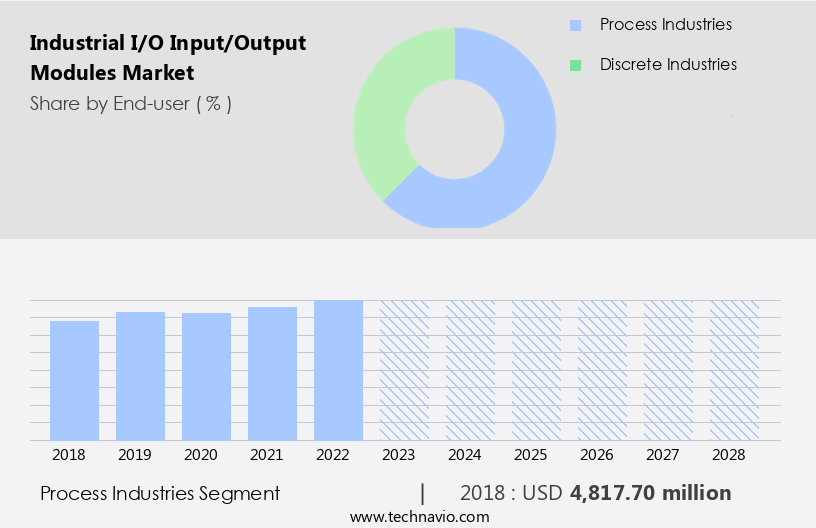
The Process industries segment was valued at USD 4.82 billion in 2018 and showed a gradual increase during the forecast period.
Regional Analysis
APAC is estimated to contribute 30% to the growth of the global market during the forecast period.Technavio’s analysts have elaborately explained the regional trends and drivers that shape the market during the forecast period.

The market in Europe is witnessing significant growth, driven by the power, automotive, and water and wastewater industries. The automotive sector holds a prominent position, with numerous players based in France, Germany, Spain, and the UK, among more than 20 countries in the region. European automobile brands' increasing global popularity is fueling demand for industrial I/O modules. These modules play a crucial role in machine control, process optimization, and real-time data acquisition in various applications. Hazardous environments and industrial standards, such as IEC 61131-3 and industrial cybersecurity, necessitate the use of robust and reliable input/output modules. Level sensors, proximity sensors, flow sensors, and pressure sensors are essential components in industrial automation, manufacturing, and process control systems.
Industrial communication protocols like CAN bus facilitate seamless data exchange between devices, while IP rating ensures environmental resistance. Servo motors, motor drives, and stepper motors require precise control and monitoring, which is achieved through programming software and remote monitoring. Industrial software solutions, including automation software, simulation software, data acquisition, and process control, are integral to the effective implementation of industrial I/O modules. Additionally, edge computing, EMC compliance, and network security are essential considerations for industrial applications. Temperature sensors, solenoid valves, and control systems are other components that benefit from the use of industrial I/O modules. In summary, the Industrial I/O Modules Market in Europe is experiencing growth due to the demands of various industries, including automotive, power, and water and wastewater.
Robust and reliable I/O modules are essential for machine control, process optimization, and real-time data acquisition in hazardous environments and industrial applications. Industrial communication, software, and various sensors are integral components of the industrial I/O modules market in Europe.
Market Dynamics
Our researchers analyzed the data with 2023 as the base year, along with the key drivers, trends, and challenges. A holistic analysis of drivers will help companies refine their marketing strategies to gain a competitive advantage.
What are the key market drivers leading to the rise in the adoption of Industrial I/O (Input/Output) Modules Industry?
- The increasing demand for automation and the implementation of Industry 4.0 technologies are the primary factors fueling market growth.
- The industrial Input/Output (I/O) modules market is experiencing significant growth due to the increasing demand for automation and Industry 4.0 technologies. Automation is increasingly being adopted across various sectors such as manufacturing, transportation, and power generation, as organizations aim to enhance productivity and cut costs. The integration of automation systems with the Internet of Things (IoT) and cloud-based technologies has fueled the demand for industrial I/O modules, enabling organizations to connect their equipment and control systems with other devices and systems. Additionally, the adoption of Industry 4.0, which emphasizes smart manufacturing and interconnected systems, is expected to further boost the market for industrial I/O modules.
- Discrete I/O and digital I/O modules are essential components of automation systems, allowing for the transfer of digital and analog signals between devices. Configuration software plays a crucial role in simplifying the setup and management of these modules. In hazardous environments, level sensors and other industrial I/O modules are employed to ensure safety and reliability. Industrial cybersecurity is another critical factor influencing the market for industrial I/O modules. With the increasing connectivity of industrial systems, there is a growing need to secure these systems against cyber threats. IEC 61131-3, an international standard for programmable automation systems, provides guidelines for implementing cybersecurity measures in industrial control systems.
- Machine control applications, such as servo motors, also rely on industrial I/O modules for precise and efficient operation. These modules enable real-time data exchange between control systems and actuators, ensuring optimal performance and reliability. In conclusion, the market for industrial I/O modules is poised for continued growth, driven by the increasing adoption of automation and Industry 4.0 technologies. Discrete I/O, digital I/O, configuration software, level sensors, industrial cybersecurity, and machine control applications are all key areas of focus in this market.
What are the market trends shaping the Industrial I/O (Input/Output) Modules Industry?
- The increasing prevalence of automation and data exchange is a significant market trend in industries. This development reflects the growing importance of technology in streamlining processes and enhancing productivity.
- The market is experiencing significant growth due to the increasing trend of automation and data interchange in various industries. These modules play a crucial role in facilitating CPU-to-network communication, data transmission, power load control, and machine operations. By linking various types of equipment, system integrators can gain greater control over industrial networks and improve system management and operational visibility. IO modules are increasingly being adopted to address communication challenges in outdated equipment or systems. Communication modules enable manufacturers to expand their network to include all production equipment, thereby enhancing system performance and data collection capabilities. These modules are particularly valuable in sectors where collecting peripheral data in large volumes, speeds, and formats is a common challenge.
- Industrial standards such as EtherNet/IP, PROFIBUS, and Modbus ensure interoperability and compatibility between different devices and systems. Programming software and simulation tools enable easy configuration and testing of IO modules, while IP rating ensures their resistance to harsh industrial environments. Analog I/O modules provide continuous measurement of process variables, while flow sensors and proximity sensors offer real-time data on fluid and solid flow rates and object presence, respectively. In conclusion, the Industrial I/O modules market is driven by the need for seamless data exchange and improved system management in industrial automation. These modules play a vital role in connecting various equipment, ensuring compatibility, and providing real-time data for better decision-making.
- Communication modules, in particular, are essential for expanding industrial networks and overcoming data collection challenges.
What challenges does the Industrial I/O (Input/Output) Modules Industry face during its growth?
- The integration of Industrial IO modules, which comes with significant installation costs and scalability challenges, poses a major hurdle to the industry's growth trajectory.
- Industrial IoT (Input/Output) modules play a crucial role in manufacturing automation, enabling seamless industrial communication between various systems and devices. These modules support several industrial communication protocols, including CAN bus. However, the high cost of installing IO modules and the limited scalability pose challenges to market growth. IO modules are pre-assembled components, which cannot be dismantled or modified, thereby restricting the number of product configurations available. This limitation makes it challenging for end-users to adapt to changing scalability requirements. Moreover, the number of optical configurations is typically restricted to 6-8. The cost consideration is a significant factor in industrial applications, making IO modules less suitable for ultra-high-volume operations.
- Environmental resistance, pressure sensors, stepper motors, motor drives, remote monitoring, network security, and EMC (electromagnetic compatibility) are essential features of industrial IO modules. Environmental resistance ensures the modules can function effectively in harsh industrial conditions. Pressure sensors measure the pressure in industrial processes, while stepper motors and motor drives control motion. Remote monitoring enables real-time monitoring of industrial processes, while network security safeguards against cyber threats. EMC compliance ensures that the modules can operate in electromagnetically noisy environments without interfering with other devices. In conclusion, while industrial IO modules offer numerous benefits, their high cost and limited scalability pose challenges to market growth.
- End-users require a more flexible and cost-effective solution to meet their evolving industrial automation needs. Nonetheless, the essential features of industrial IO modules, such as environmental resistance, pressure sensors, stepper motors, motor drives, remote monitoring, network security, and EMC compliance, continue to drive demand.
Exclusive Customer Landscape
The industrial i/o (input/output) modules market forecasting report includes the adoption lifecycle of the market, covering from the innovator’s stage to the laggard’s stage. It focuses on adoption rates in different regions based on penetration. Furthermore, the industrial i/o (input/output) modules market report also includes key purchase criteria and drivers of price sensitivity to help companies evaluate and develop their market growth analysis strategies.

Customer Landscape
Key Companies & Market Insights
Companies are implementing various strategies, such as strategic alliances, industrial i/o (input/output) modules market forecast, partnerships, mergers and acquisitions, geographical expansion, and product/service launches, to enhance their presence in the industry.
ABB Ltd. - The S900 remote I/O industrial module system is an advanced solution engineered for demanding applications in the chemical, pharmaceutical, and oil & gas sectors. This system's design ensures optimal performance and reliability, making it an ideal choice for industries requiring stringent process control and safety standards. The system's modular architecture allows for seamless integration with various automation systems, enabling users to streamline their operations and improve overall efficiency. With robust features and scalable capabilities, the S900 system is a game-changer for industries seeking to enhance their industrial automation infrastructure.
The industry research and growth report includes detailed analyses of the competitive landscape of the market and information about key companies, including:
- ABB Ltd.
- Advantech Co. Ltd.
- Analog Devices Inc.
- DAE Instrument
- Distec Ltd.
- Emerson Electric Co.
- General Electric Co.
- HYDAC International GmbH
- ifm electronic gmbh
- KEBA Group AG
- Mitsubishi Electric Corp.
- Moxa Inc.
- NOVUS Automation Inc.
- OMRON Corp.
- Pepperl and Fuchs SE
- Rockwell Automation Inc.
- Siemens AG
- TE Connectivity Ltd.
- TURCK India Automation Pvt. Ltd.
- WAGO GmbH and Co. KG
Qualitative and quantitative analysis of companies has been conducted to help clients understand the wider business environment as well as the strengths and weaknesses of key industry players. Data is qualitatively analyzed to categorize companies as pure play, category-focused, industry-focused, and diversified; it is quantitatively analyzed to categorize companies as dominant, leading, strong, tentative, and weak.
Recent Development and News in Industrial I/O (Input/Output) Modules Market
- In January 2024, Schneider Electric, a leading energy management and automation company, announced the launch of its new TeSys D30M series of Industrial I/O modules, featuring enhanced connectivity and advanced diagnostics capabilities (Schneider Electric Press Release, 2024).
- In March 2024, Siemens and Bosch Rexroth, two major industrial automation players, entered into a strategic partnership to develop and offer a joint portfolio of Industrial Internet of Things (IIoT) solutions, including advanced Industrial I/O modules (Siemens Press Release, 2024).
- In May 2024, Moxa, a leading provider of industrial networking and automation solutions, raised USD50 million in a Series C funding round led by CVC Capital Partners, to accelerate its growth in the Industrial I/O market and expand its product offerings (Moxa Press Release, 2024).
- In February 2025, the European Union approved the Industrial Internet Reference Architecture Model (IIRAM), which includes guidelines for standardizing Industrial I/O modules and interfaces, aiming to boost interoperability and ease the integration of industrial systems (European Commission Press Release, 2025).
Research Analyst Overview
- In the dynamic industrial I/O market, discrete manufacturing sectors continue to drive growth, integrating fieldbus couplers and industrial gateways for seamless process automation. Industrial energy efficiency is a significant trend, with continuous manufacturing processes adopting predictive analytics and data analytics for optimization. Industrial displays, operator panels, and data visualization tools facilitate real-time monitoring and control. Assembly lines and materials handling systems leverage machine learning algorithms for improved performance and lifecycle management. Process simulation and virtual commissioning enable efficient design and testing, while logistics automation and supply chain optimization utilize digital twins for enhanced visibility. Industrial ethernet switches and energy management systems support the integration of AI and batch processing, ensuring industrial IoT compatibility.
- Process automation in various industries, including packaging systems, benefits from advanced technologies like process simulation, signal conditioning, and factory automation. The market is further fueled by the adoption of industrial displays, operator panels, and data analytics for improved efficiency and productivity. Predictive maintenance and energy management are essential aspects of industrial I/O, with AI and machine learning playing a crucial role in optimizing industrial processes. Continuous manufacturing, logistics automation, and materials handling systems are increasingly adopting these technologies for enhanced performance and cost savings. The integration of data analytics, process simulation, and virtual commissioning in industrial I/O systems is transforming the manufacturing landscape.
- Industrial energy efficiency, lifecycle management, and supply chain optimization are key priorities, driving the market forward. Process automation and industrial IoT are shaping the future of manufacturing, with the adoption of industrial displays, operator panels, and data visualization tools enabling real-time monitoring and control. The integration of AI, machine learning, and predictive analytics is revolutionizing industrial processes, leading to increased efficiency and productivity. In the realm of industrial I/O, the integration of fieldbus couplers, industrial gateways, and process automation technologies is transforming manufacturing processes. Industrial displays, operator panels, and data analytics tools facilitate real-time monitoring and control, while predictive maintenance and energy management systems optimize industrial processes.
- The industrial I/O market is witnessing significant growth, with discrete manufacturing sectors leading the charge. Continuous manufacturing processes are adopting predictive analytics and data analytics for optimization, while industrial displays, operator panels, and data visualization tools facilitate real-time monitoring and control. Process automation and industrial IoT are transforming manufacturing processes, with the adoption of fieldbus couplers, industrial gateways, and process simulation tools driving efficiency and productivity. Industrial energy efficiency and lifecycle management are key priorities, with the integration of AI, machine learning, and predictive analytics enabling optimized industrial processes.
Dive into Technavio’s robust research methodology, blending expert interviews, extensive data synthesis, and validated models for unparalleled Industrial I/O (Input/Output) Modules Market insights. See full methodology.
|
Market Scope |
|
|
Report Coverage |
Details |
|
Page number |
180 |
|
Base year |
2023 |
|
Historic period |
2018-2022 |
|
Forecast period |
2024-2028 |
|
Growth momentum & CAGR |
Accelerate at a CAGR of 5.95% |
|
Market growth 2024-2028 |
USD 2526.3 million |
|
Market structure |
Fragmented |
|
YoY growth 2023-2024(%) |
5.53 |
|
Key countries |
US, China, Germany, Japan, and UK |
|
Competitive landscape |
Leading Companies, Market Positioning of Companies, Competitive Strategies, and Industry Risks |
What are the Key Data Covered in this Industrial I/O (Input/Output) Modules Market Research and Growth Report?
- CAGR of the Industrial I/O (Input/Output) Modules industry during the forecast period
- Detailed information on factors that will drive the growth and forecasting between 2024 and 2028
- Precise estimation of the size of the market and its contribution of the industry in focus to the parent market
- Accurate predictions about upcoming growth and trends and changes in consumer behaviour
- Growth of the market across Europe, APAC, North America, Middle East and Africa, and South America
- Thorough analysis of the market’s competitive landscape and detailed information about companies
- Comprehensive analysis of factors that will challenge the industrial i/o (input/output) modules market growth of industry companies
We can help! Our analysts can customize this industrial i/o (input/output) modules market research report to meet your requirements.
 RIA -
RIA - 
