


Nail Gun Market Size and Growth Forecast 2026-2030
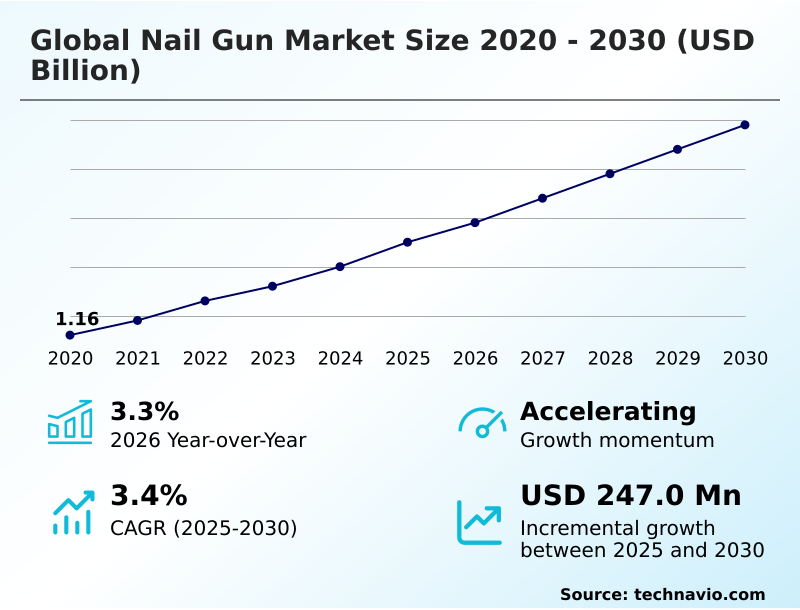
The Nail Gun Market size was valued at USD 1.35 billion in 2025 growing at a CAGR of 3.4% during the forecast period 2026-2030.
APAC accounts for 33.8% of incremental growth during the forecast period. The Cordless segment by Product was valued at USD 711.9 million in 2024, while the Framing nailers segment holds the largest revenue share by Type.
The market is projected to grow by USD 430.5 million from 2020 to 2030, with USD 247 million of the growth expected during the forecast period of 2025 to 2030.
Get Key Insights on Market Forecast (PDF) Request Free Sample
Nail Gun Market Overview
The nail gun market is undergoing a significant operational shift, driven by the wide-scale adoption of cordless fastening systems that enhance job site mobility solutions. The transition from traditional pneumatic nailer technology to tools powered by advanced lithium-ion battery platforms and high-performance brushless motor efficiency is a defining dynamic. This evolution is particularly visible in regions like APAC, which contributes significantly to market momentum. In practice, a large-scale residential construction firm deploying tools with smart tool connectivity can leverage digital asset management platforms to track usage, schedule maintenance, and reduce tool loss across multiple sites, improving overall project efficiency. The emphasis on ergonomics and safety, through features like anti-dry fire mechanisms and vibration reduction, is also influencing procurement decisions. These advancements, coupled with growth in both new construction and renovation, underscore the industry's focus on productivity, safety, and technological integration, with North America representing a substantial portion of market activity.
Drivers, Trends, and Challenges in the Nail Gun Market
End-user decision-making in the nail gun market is becoming increasingly nuanced, moving beyond basic specifications to detailed, application-specific evaluations. The debate over cordless vs pneumatic nail gun performance is a prime example; while pneumatic tools offer consistent power for industrial lines, cordless platforms provide unmatched mobility, a critical factor for contractors focused on reducing setup time.
For new construction, selecting the best nail gun for residential framing involves balancing power, weight, and battery ecosystem compatibility. A growing area is the use of heavy-duty nailers for mass timber, a segment driven by sustainable construction trends where fastener penetration and structural integrity are paramount.
For large construction firms, adopting a smart nail gun for tool fleet management allows for real-time asset tracking and predictive maintenance, significantly reducing downtime and loss. In contrast, an individual craftsman might prioritize an ergonomic nail gun for finish carpentry, focusing on balance, a non-marring tip, and minimal user fatigue to ensure high-quality work on delicate moldings.
These purchasing decisions are also influenced by regulations like the EU's Machinery Directive 2006/42/EC, which mandates stringent safety features. The productivity gains from using a power nailer over manual methods are significant, with studies showing task completion times can be reduced by more than 50%.
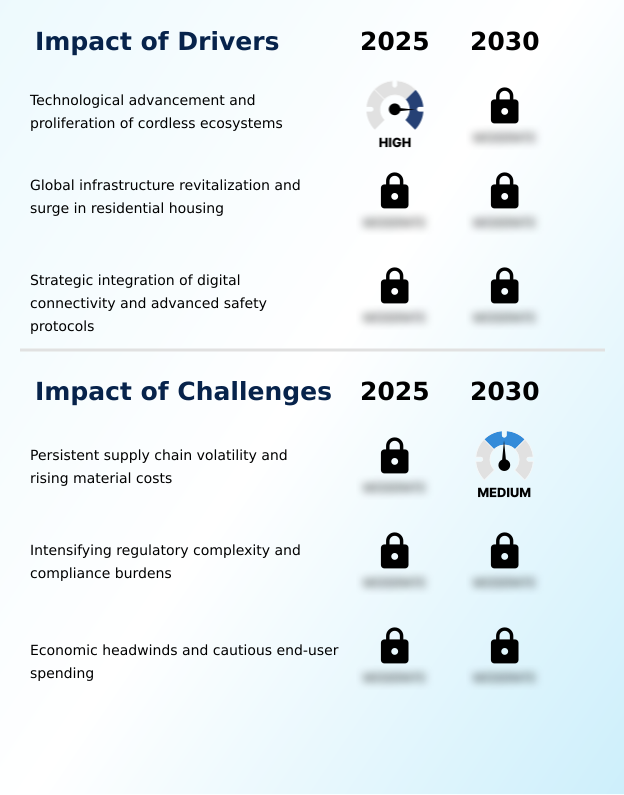
Primary Growth Driver: Technological advancements, particularly the proliferation of cordless ecosystems, are a key driver propelling market growth.
The primary market driver is the rapid advancement in cordless technology, powered by high-capacity lithium-ion battery systems and efficient brushless motors. This innovation is displacing traditional pneumatic tools by offering enhanced mobility and convenience.
The sustained expansion of the global construction sector, particularly in regions like APAC which is growing at a notable rate, provides a foundational demand for these tools.
Furthermore, the strategic integration of digital connectivity and advanced safety protocols is becoming a key purchasing criterion. Features such as anti-dry fire mechanisms and sophisticated sequential firing triggers are now standard, addressing the industry's increasing focus on job site safety.
This convergence of technological proliferation and robust construction activity propels market growth.
Emerging Market Trend: The market is seeing a significant trend toward human-centric design and advanced ergonomic engineering. This focus aims to enhance user comfort and reduce long-term health risks associated with tool operation.
The market is trending towards human-centric design and advanced ergonomic engineering, where user well-being directly influences product development. Manufacturers are utilizing lightweight magnesium alloys and vibration-dampening technologies to reduce operator fatigue. This focus is particularly evident in North America, which represents a substantial portion of the market.
Another major trend is the development of fastening solutions for sustainable and bio-based building materials, such as cross-laminated timber (CLT), meeting the demands of green construction initiatives. Concurrently, the integration of IoT-enabled smart tools is providing data-driven insights for fleet management.
The cordless product category continues to dominate, holding a larger share of the market than corded models, underscoring the industry-wide move towards greater mobility and convenience on the job site.
Key Industry Challenge: Persistent supply chain volatility and rising material costs present a key challenge affecting the industry's growth trajectory.
The market faces significant economic headwinds from persistent supply chain volatility and rising material costs for key inputs like steel and polymers, which directly impact manufacturing profitability. This is compounded by intensifying regulatory complexity and compliance burdens, particularly with the expansion of Extended Producer Responsibility (EPR) frameworks that mandate lifecycle management of tools and batteries.
These regulations, while promoting sustainability, add operational costs. Furthermore, cautious end-user spending among contractors and DIY consumers, driven by broader economic uncertainty and higher financing costs, is leading to deferred tool purchases and a greater focus on value-driven options, thereby challenging sales volumes for premium equipment and compelling manufacturers to adapt their pricing and product strategies.
Explore Full Market Dynamics Analysis Request Free Sample
Nail Gun Market Segmentation
The nail gun industry research report provides comprehensive data including region-wise segment analysis, with forecasts and analysis for the period 2026-2030, as well as historical data from 2020-2024 for the following segments.
Product Segment Analysis
The cordless segment is estimated to witness significant growth during the forecast period.
The cordless segment is fundamentally reshaping fastening tasks across the construction industry.
The widespread adoption of advanced lithium-ion battery platforms and high-efficiency brushless motor efficiency has enabled cordless fastening systems to achieve performance levels that now rival traditional pneumatic nailer technology.
This technological shift delivers significant improvements in job site mobility solutions and user fatigue reduction by eliminating cumbersome air hoses, a critical factor for enhancing on-site safety and productivity.
Professional contractors now benefit from unparalleled portability without sacrificing power, which is essential for both structural and finishing applications.
This segment, which accounts for a majority of the market, continues to expand as battery ecosystems become more standardized, improving the total cost of ownership and solidifying the move away from tethered power sources.
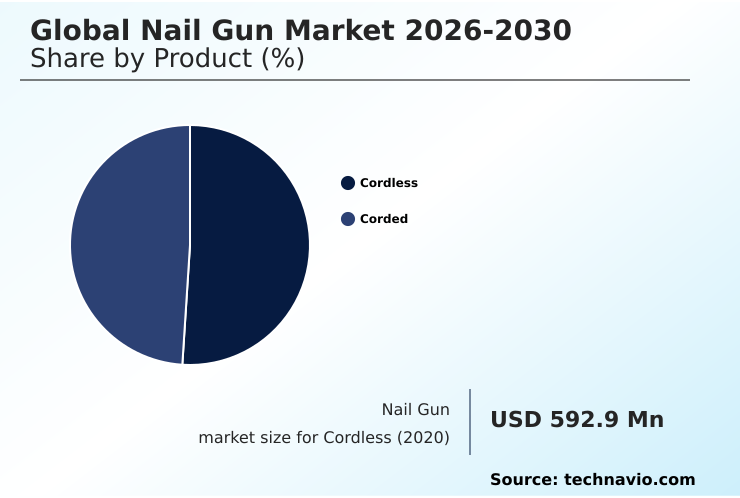
The Cordless segment was valued at USD 711.9 million in 2024 and showed a gradual increase during the forecast period.
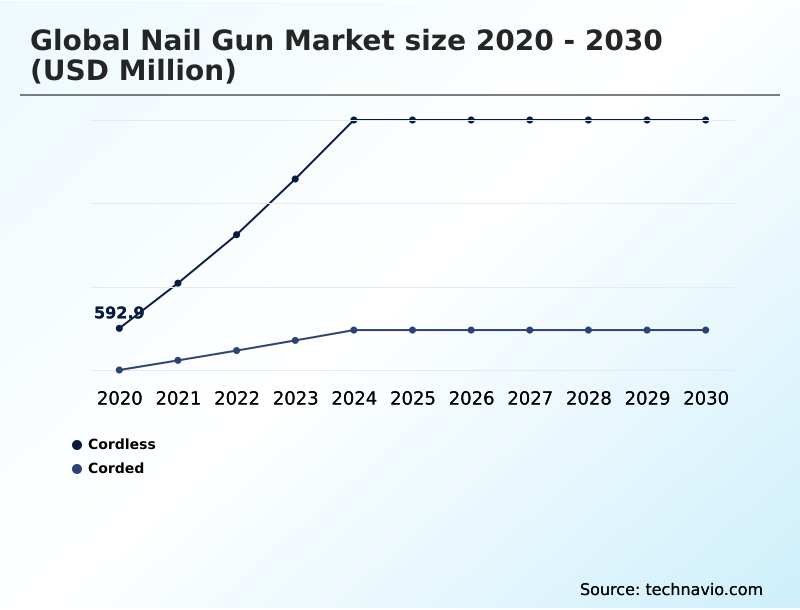
Nail Gun Market by Region: APAC Leads with 33.8% Growth Share
APAC is estimated to contribute 33.8% to the growth of the global market during the forecast period.
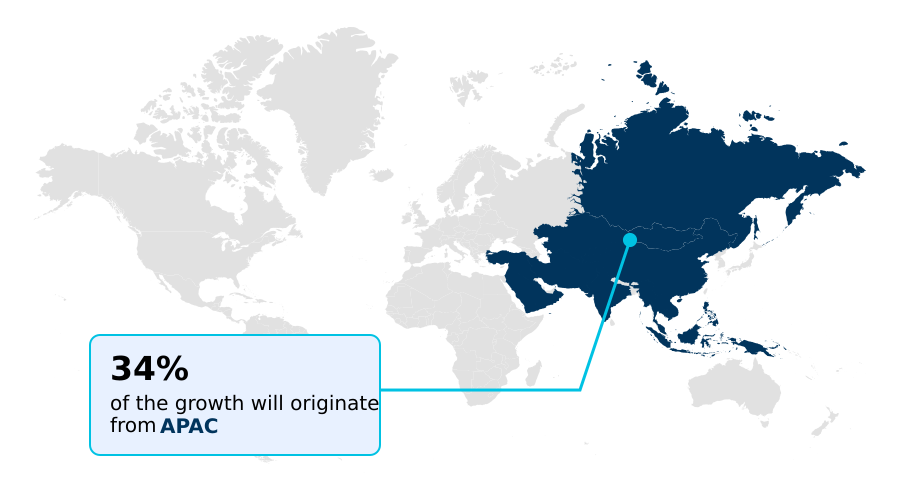
The geographic landscape is diverse, with distinct regional drivers. APAC is a major growth engine, accounting for nearly 34% of the market's incremental growth, fueled by urbanization and the use of prefabricated housing fasteners in large-scale residential projects.
In contrast, North America, holding a significant market share, is characterized by a mature construction sector where cordless tool adoption is high.
Europe shows strong demand for specialized tools like those for cross-laminated timber fastening and bio-based material nailers, driven by strict sustainable building codes.
Meanwhile, industrial segments in regions like South America and Mexico drive demand for industrial pallet nailers and concrete and steel nailers, reflecting their roles as manufacturing and logistics hubs.
This regional variation requires manufacturers to tailor their product development and distribution strategies to local construction practices and regulatory environments.
Customer Landscape Analysis for the Nail Gun Market
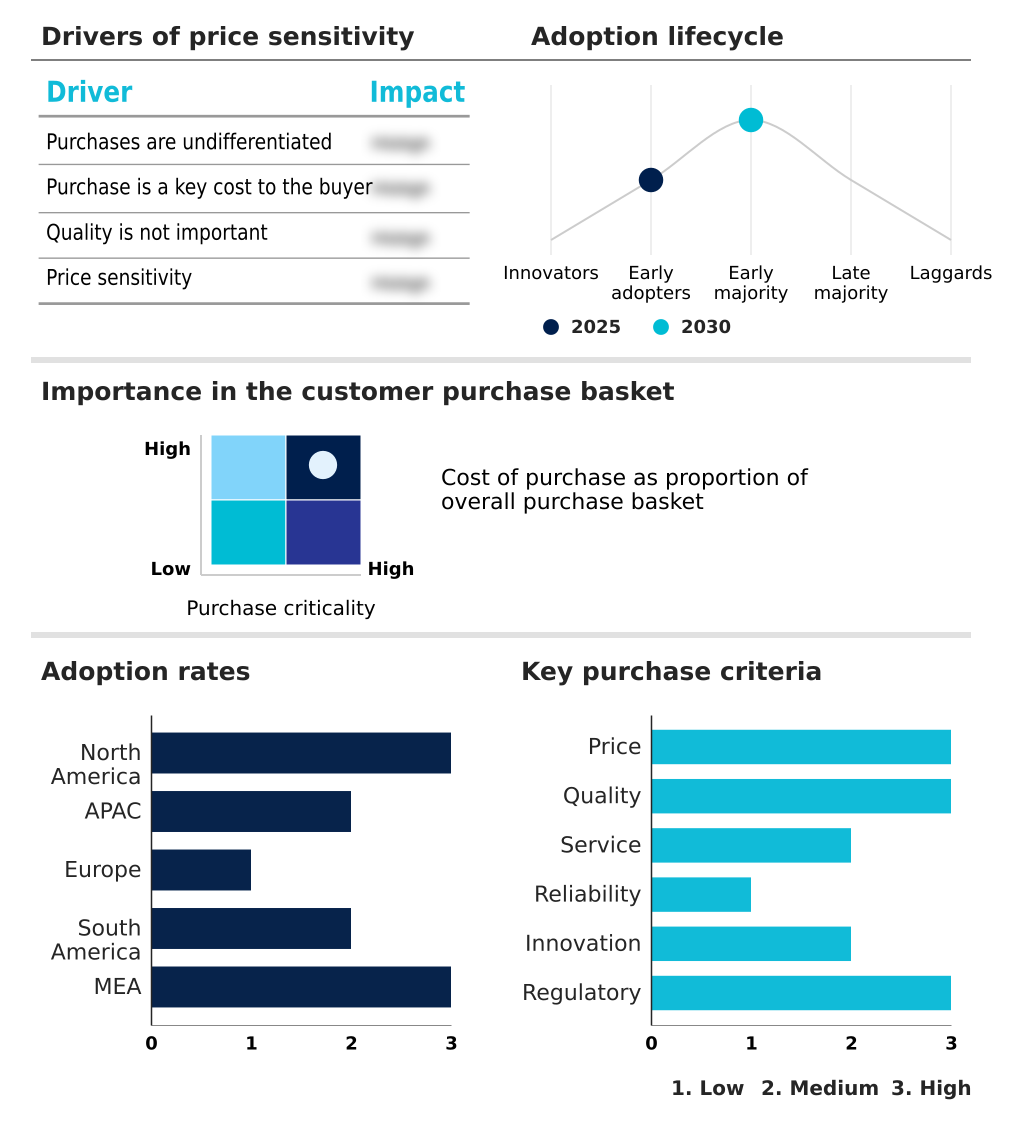
The nail gun market forecasting report includes the adoption lifecycle of the market, covering from the innovator’s stage to the laggard’s stage. It focuses on adoption rates in different regions based on penetration. Furthermore, the nail gun market report also includes key purchase criteria and drivers of price sensitivity to help companies evaluate and develop their market growth analysis strategies.
Competitive Landscape of the Nail Gun Market
Companies are implementing various strategies, such as strategic alliances, partnerships, mergers and acquisitions, geographical expansion, and product/service launches, to enhance their presence in the nail gun market industry.
Everwin Pneumatic Corp. - Provides a comprehensive range of professional-grade fastening solutions, including innovative cordless and pneumatic systems for construction and woodworking applications worldwide.
The industry research and growth report includes detailed analyses of the competitive landscape of the market and information about key companies, including:
- Everwin Pneumatic Corp.
- Festool GmbH
- Illinois Tool Works Inc.
- Joh. Friedrich Behrens AG
- Koki Holdings Co. Ltd.
- Kyocera Corp.
- Makita Corp.
- MAX Co. Ltd.
- Meite Mechanical Co. Ltd.
- Metabowerke GmbH
- Omer S.p.A.
- PREBENA Wilfried GmbH and Co.
- Raimund Beck KG
- Stanley Black and Decker Inc.
- Tacwise Group Plc
- Techtronic Industries Co. Ltd.
Qualitative and quantitative analysis of companies has been conducted to help clients understand the wider business environment as well as the strengths and weaknesses of key industry players. Data is qualitatively analyzed to categorize companies as pure play, category-focused, industry-focused, and diversified; it is quantitatively analyzed to categorize companies as dominant, leading, strong, tentative, and weak.
Recent Developments in the Nail Gun Market
- In October 2024, the United States Department of Transportation announced the allocation of significant federal funding for several major bridge and highway reconstruction projects, which is expected to stimulate demand for heavy-duty fastening equipment.
- In February 2025, Milwaukee Tool introduced a new iteration of its cordless framing nailer featuring a redesigned magnesium housing and an anti-vibration handle assembly aimed at reducing user fatigue during high-volume tasks.
- In February 2025, Stanley Black and Decker Inc. introduced a new line of brushless motor cordless nail guns, featuring a lightweight design and an advanced battery system to improve efficiency and user ergonomics.
- In April 2025, Hilti AG announced a strategic partnership with a sensor technology firm to develop a new generation of smart nail guns designed to incorporate advanced sensors that adjust nail driving force based on material detection.
Research Analyst Overview: Nail Gun Market
The market's evolution is defined by the strategic shift from tethered power to intelligent, mobile solutions. The cordless segment now represents a larger share of the market than its corded counterpart, driven by advancements that enable an 18-gauge brad nailer to offer precision without the constraint of a hose.
Boardroom-level decisions on capital expenditure are now heavily influenced by the total cost of ownership, where integrated technology plays a key role. For example, adopting tools with one-key tool tracking and integrated telematics sensors provides data for cloud-based tool diagnostics, directly impacting asset management and operational uptime.
This trend extends to materials, with the use of lightweight magnesium alloy housing to improve ergonomics and comply with occupational health standards like OSHA's guidelines on musculoskeletal disorders. Meanwhile, the industrial sector is advancing toward automated nailing systems for high-volume production of items requiring L-shaped cleat fasteners, pushing the boundaries of manufacturing efficiency and precision.
Dive into Technavio’s robust research methodology, blending expert interviews, extensive data synthesis, and validated models for unparalleled Nail Gun Market insights. See full methodology.
| Market Scope | |
|---|---|
| Page number | 296 |
| Base year | 2025 |
| Historic period | 2020-2024 |
| Forecast period | 2026-2030 |
| Growth momentum & CAGR | Accelerate at a CAGR of 3.4% |
| Market growth 2026-2030 | USD 247.0 million |
| Market structure | Fragmented |
| YoY growth 2025-2026(%) | 3.3% |
| Key countries | US, Canada, Mexico, China, Japan, India, South Korea, Australia, Indonesia, Germany, UK, France, Italy, Spain, The Netherlands, Brazil, Argentina, Chile, Saudi Arabia, UAE, South Africa, Turkey and Egypt |
| Competitive landscape | Leading Companies, Market Positioning of Companies, Competitive Strategies, and Industry Risks |
Nail Gun Market: Key Questions Answered in This Report
-
What is the expected growth of the Nail Gun Market between 2026 and 2030?
-
The Nail Gun Market is expected to grow by USD 247 million during 2026-2030, registering a CAGR of 3.4%. Year-over-year growth in 2026 is estimated at 3.3%%. This acceleration is shaped by technological advancement and proliferation of cordless ecosystems, which is intensifying demand across multiple end-use verticals covered in the report.
-
-
What segmentation does the market report cover?
-
The report is segmented by Product (Cordless, and Corded), Type (Framing nailers, Roofing nailers, Flooring nailers, and Others), Application (Residential, Commercial, and Industrial) and Geography (North America, APAC, Europe, South America, Middle East and Africa). Among these, the Cordless segment is estimated to witness significant growth during the forecast period, driven by rising adoption across key application areas. Each segment includes detailed qualitative and quantitative analysis, along with historical data from 2020-2024 and forecasts through 2030 with year-over-year growth rates.
-
-
Which regions are analyzed in the report?
-
The report covers North America, APAC, Europe, South America and Middle East and Africa. APAC is estimated to contribute 33.8% to market growth during the forecast period. Country-level analysis includes US, Canada, Mexico, China, Japan, India, South Korea, Australia, Indonesia, Germany, UK, France, Italy, Spain, The Netherlands, Brazil, Argentina, Chile, Saudi Arabia, UAE, South Africa, Turkey and Egypt, with dedicated market size tables and year-over-year growth for each.
-
-
What are the key growth drivers and market challenges?
-
The primary driver is technological advancement and proliferation of cordless ecosystems, which is accelerating investment and industry demand. The main challenge is persistent supply chain volatility and rising material costs, creating operational barriers for key market participants. The report quantifies the impact of each driver and challenge across 2026 and 2030 with comparative analysis.
-
-
Who are the major players in the Nail Gun Market?
-
Key vendors include Everwin Pneumatic Corp., Festool GmbH, Illinois Tool Works Inc., Joh. Friedrich Behrens AG, Koki Holdings Co. Ltd., Kyocera Corp., Makita Corp., MAX Co. Ltd., Meite Mechanical Co. Ltd., Metabowerke GmbH, Omer S.p.A., PREBENA Wilfried GmbH and Co., Raimund Beck KG, Stanley Black and Decker Inc., Tacwise Group Plc and Techtronic Industries Co. Ltd.. The report provides qualitative and quantitative analysis categorizing companies as dominant, leading, strong, tentative, and weak based on their market positioning. Company profiles include business segment analysis, SWOT assessment, key offerings, and recent strategic developments.
-
Nail Gun Market Research Insights
The market's momentum is influenced by a dual focus on high-performance tooling and regulatory compliance. Procurement decisions for a professional-grade framing nailer or a high-volume roofing nailer are increasingly shaped by features that promote user fatigue reduction, such as advanced vibration dampening technology. This is especially critical in jurisdictions with stringent occupational health and safety standards.
Simultaneously, the demand for fastening solutions compatible with sustainable building materials is growing, pushing innovation. The cordless segment now holds a larger share than the corded segment, reflecting the industry-wide preference for portability.
The use of a specialized flooring nailer for hardwood installation or precision trim carpentry tools for detailed work further highlights the market's segmentation based on specific, high-value applications.
We can help! Our analysts can customize this nail gun market research report to meet your requirements.
 RIA -
RIA - 
