
US Pickup Truck Market Analysis - Size and Forecast 2025-2029

US Pickup Truck Market Analysis - Size and Forecast 2025-2029

Published: Jan 2025 144 Pages SKU: IRTNTR45467

Market Overview at a Glance

$51.6 B
Market Opportunity
4.6%
CAGR
4.4
YoY growth 2024-2025(%)

US Pickup Truck Market Size 2025-2029 

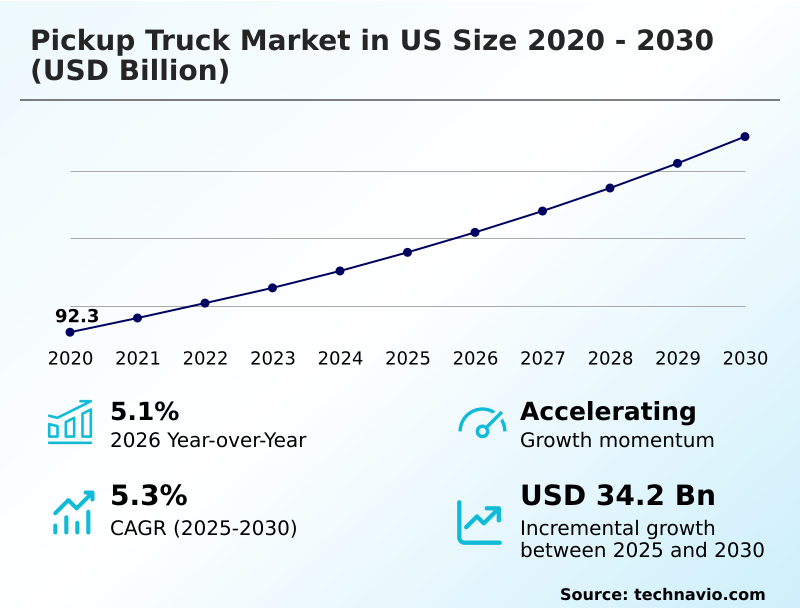
The US pickup truck market size is forecast to increase by USD 51.6 billion, at a CAGR of 4.6% between 2024 and 2029.

The market is experiencing significant growth, driven by the increased utility of pickup trucks for both personal and commercial use. Another key trend is the incorporation of lighter materials in pickup truck manufacturing, leading to improved fuel efficiency and reduced emissions. Additionally, the sales of used pickup trucks in the US continue to rise, offering an attractive option for budget-conscious consumers. These factors contribute to the market's steady expansion, making it an intriguing space for industry players to explore. However, the market has faced sluggish demand due to various factors, including supply chain disruptions caused by lockdowns and the shortage of auto parts, including semiconductor chips.

What will be the US Pickup Truck Market Size During the Forecast Period?

Pickup Truck Market in US Size

 Request Free Sample

  • The pickup truck market continues to be a significant player In the global automotive industry, driven by customers seeking vehicles with high torque, payload capacity, and towing ability. Fuel efficiency remains a key consideration for consumers, with a growing interest in alternative fuel types, including diesel and electric vehicles (EVs). The diesel segment, in particular, is expected to experience a rise in affordability, leading to increased growth in developing economies.
  • The recovery of the market is anticipated, with fuel type insights indicating a shift towards more fuel-efficient options. The cargo area and general utility of pickup trucks make them a versatile choice for consumers, with applications ranging from personal use to commercial purposes. Despite challenges, the pickup truck market is poised for continued growth, with production and sales expected to rebound In the coming years.

How is this market segmented and which is the largest segment?

The market research report provides comprehensive data (region-wise segment analysis), with forecasts and estimates in "USD billion" for the period 2025-2029, as well as historical data from 2019-2023 for the following segments.

  • Product
    • Full-size pickup truck
    • Small-size and mid-size pickup truck
  • Type
    • Extended cab and crew cab
    • Regular cab
  • Geography
    • US

By Product Insights

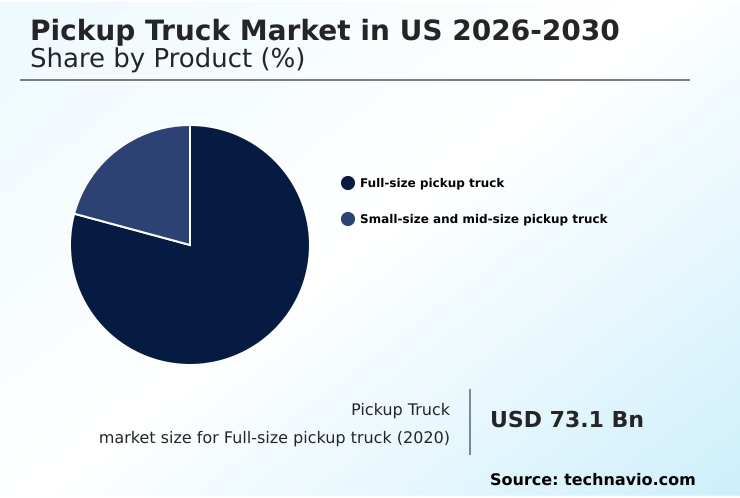
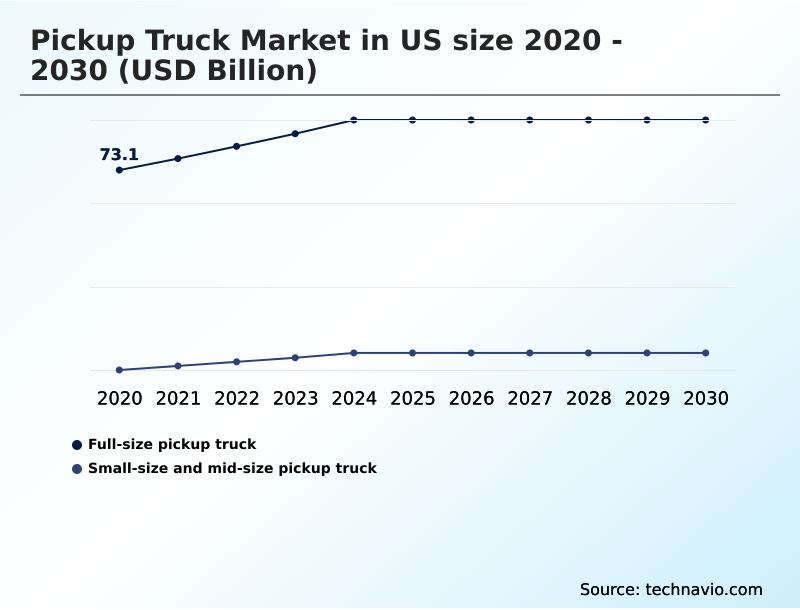
  • The full-size pickup truck segment is estimated to witness significant growth during the forecast period.

Full-size pickup trucks, defined as vehicles with a gross vehicle weight rating (GVWR) between 6,000 lbs. And 14,000 lbs., dominate the US pickup truck market. Manufacturers prioritize these models due to their higher profit margins compared to smaller counterparts. Enhanced engine capacity and increased ground clearance characterize full-size pickups. Some variants, labeled as heavy-duty (3500 and 2500 series), offer superior load-hauling and towing capabilities, enabling them to tow fifth-wheel trailers. Fuel efficiency, payload capacity, towing capacity, and customization are key factors influencing customer preferences. Diesel engines and gasoline are the primary fuel types, with diesel offering greater torque and payload capacity but higher CO2 emissions.

Developing economies and recovery from lockdowns are expected to fuel growth In the pickup truck market. The industry faces challenges such as supply chain disruptions, labor shortages, and semiconductor chip shortages. The market encompasses various players, including Stellantis Group, and the growth rate is anticipated to increase In the coming years. Electric vehicles (EVs) are emerging as a potential threat, with light-duty pickup trucks undergoing electrification.

Pickup Truck Market in US Share by Product

Get a glance at the market report of share of various segments Request Free Sample

Market Dynamics

Our US Pickup Truck Market researchers analyzed the data with 2024 as the base year, along with the key drivers, trends, and challenges. A holistic analysis of drivers will help companies refine their marketing strategies to gain a competitive advantage.

What are the key market drivers leading to the rise in the adoption of US Pickup Truck Market?

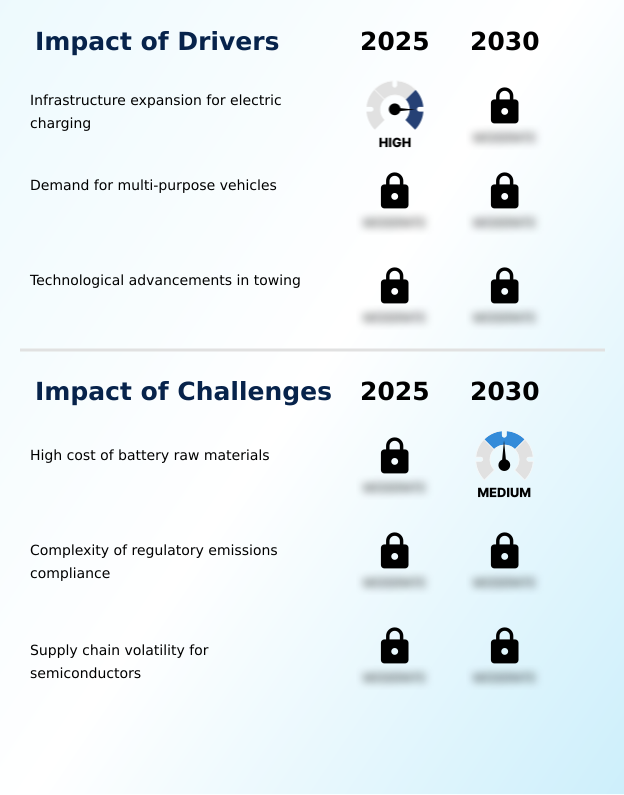
Increased utility of pickup trucks is the key driver of the market.

  • Pickup trucks have gained significant popularity In the US market due to their versatility and utility. These vehicles offer larger payload capacities and towing capabilities, making them ideal for both commercial and personal use. The increased cargo area allows for the transportation of larger loads, surpassing the capabilities of passenger cars, SUVs, crossovers, and hatchbacks. Pickup trucks come in various trims, such as extended cab models, which prioritize additional passenger seats without compromising cargo bed space. Torque, a critical factor in pickup trucks, is essential for hauling heavy loads and towing trailers. Fuel efficiency is another essential consideration for customers, with many opting for diesel fuel type due to its higher torque and payload capacity.
  • However, the shift towards electric vehicles (EVs) and the rising affordability of these vehicles may impact the fuel type insights In the future. The pickup truck market has experienced some sluggish demand due to various factors, including supply chain disruptions caused by lockdowns, labor shortages, and the lack of availability of auto parts, including semiconductor chips. Despite these challenges, the market is expected to recover, with growth rates projected to increase In the coming years. CO2 emissions and fuel type are crucial factors influencing the market in developing economies. As consumers become more environmentally conscious, there may be a shift towards light-duty pickup trucks with lower emissions and higher fuel efficiency.

What are the market trends shaping the US Pickup Truck Market?

Increasing incorporation of lighter materials in pickup truck manufacturing is the upcoming trend In the market.

  • In the market, there is a growing emphasis on enhancing fuel efficiency and reducing CO2 emissions, leading vehicle manufacturers to explore alternative materials for manufacturing these vehicles. The use of lighter materials, such as aluminum, in pickup trucks can result in significant fuel savings and increased towing capacity. For instance, Ford Motor's aluminum F-150 pickup truck weighs approximately 700 lbs. Less than its steel counterpart, allowing for improved mileage and superior towing capabilities with a V6 engine instead of a V8 engine. The shift towards lighter materials also enables more engine power to be allocated to pulling or towing, thereby increasing the overall utility of the pickup truck.
  • With the increasing focus on fuel efficiency and the rising affordability of these vehicles, the growth rate of the light-duty pickup truck market is expected to remain strong, despite the recent sluggish demand due to various factors such as lockdowns and supply chain disruptions. Furthermore, the transition towards electric vehicles (EVs) is also gaining momentum, with companies like Stellantis Group investing In the development of electric pickup trucks. Fuel type insights suggest that diesel pickup trucks still dominate the market, but the shift towards cleaner fuel alternatives is expected to continue. The production and sales of passenger cars and passenger vehicles, including pickup trucks, are anticipated to recover In the coming years, driven by consumer reach and the availability of auto parts, including semiconductor chips and labor.

What challenges does the US Pickup Truck Market face during the growth?

Increasing sales of used vehicles in the US is a key challenge affecting the market growth.

  • The market is influenced by several factors, including torque, payload capacity, fuel efficiency, and towing capacity. These vehicles are popular for their general utility and high cargo area, making them a preferred choice for both personal and commercial use. However, the demand for pickup trucks has been sluggish due to various reasons, such as increasing consumer reach for fuel-efficient passenger cars and the impact of lockdowns on the supply chain. Fuel type is another significant factor In the pickup truck market. Traditionally, diesel pickups have been popular due to their higher torque and towing capacity.
  • However, with increasing CO2 emissions concerns, there is a growing trend towards fuel-efficient pickups, especially those running on gasoline. The production and sales of light-duty pickup trucks are expected to grow at a moderate rate, driven by rising affordability and the increasing popularity of electric vehicles (EVs) in developing economies. The growth rate of the pickup truck market is also influenced by factors such as the availability of auto parts, semiconductor chips, labor, and the recovery of various industries. Fuel type insights suggest that the demand for diesel pickups may decline further as consumers shift towards more eco-friendly options.

Exclusive Customer Landscape

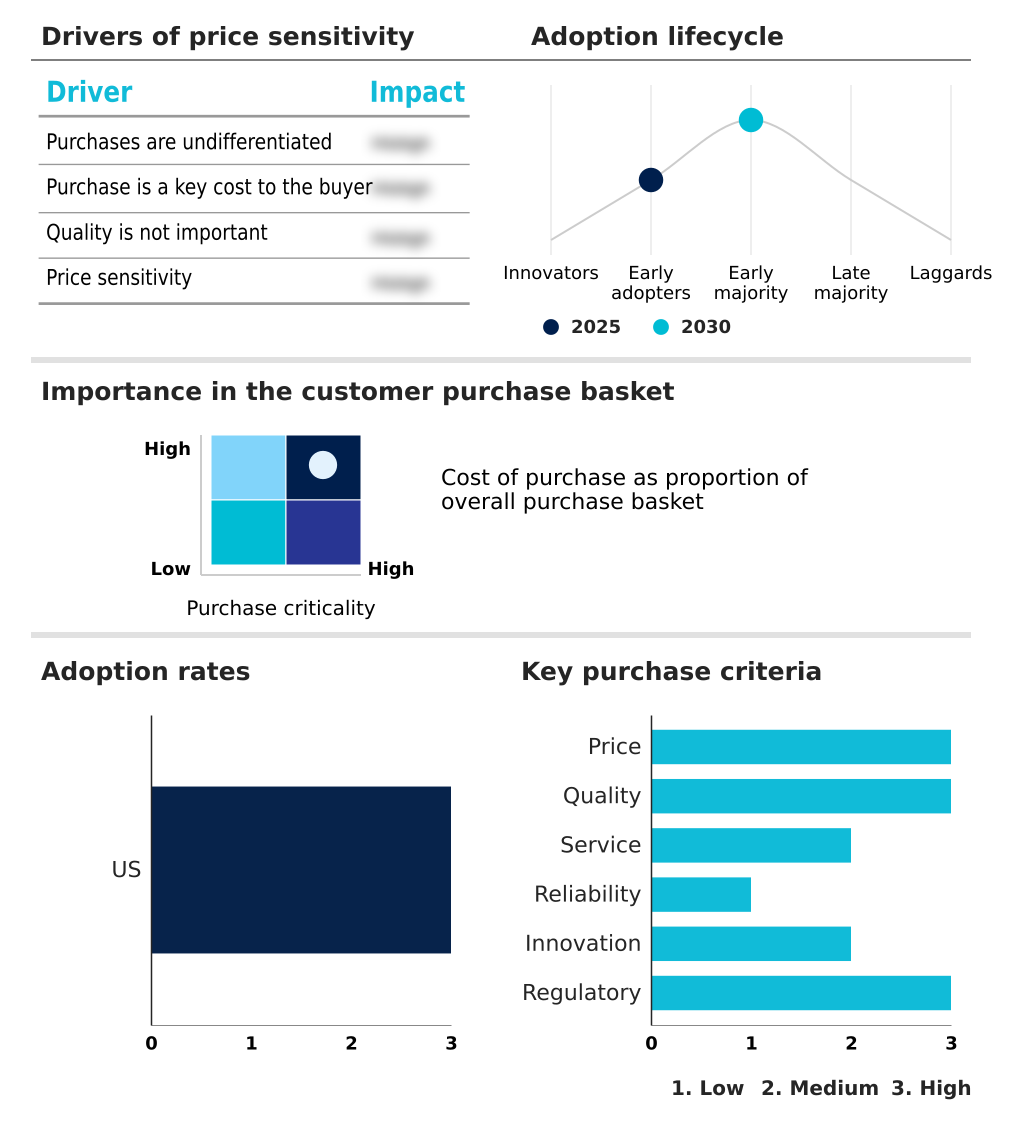
The market forecasting report includes the adoption lifecycle of the market, covering from the innovator's stage to the laggard's stage. It focuses on adoption rates in different regions based on penetration. Furthermore, the market report also includes key purchase criteria and drivers of price sensitivity to help companies evaluate and develop their market growth analysis strategies.
Pickup Truck Market in US Share by Geography

 Customer Landscape

Key Companies & Market Insights

Companies are implementing various strategies, such as strategic alliances, market forecast, partnerships, mergers and acquisitions, geographical expansion, and product/service launches, to enhance their presence In the market.

Chevrolet -  The company offers pickup truck such as Colorado, Silverado, and Silverado HD, known for their durability, towing capacity, and advanced features.

The market research and growth report includes detailed analyses of the competitive landscape of the market and information about key companies, including:

  • Ford Motor Co.
  • Honda Motor Co. Ltd.
  • Hyundai Motor Co.
  • Isuzu Motors Ltd.
  • Mitsubishi Motors Corp.
  • Nissan Motor Co. Ltd.
  • Rivian Automotive LLC
  • Stellantis NV
  • Tesla Inc.
  • Toyota Motor Corp.
  • Volkswagen AG

Qualitative and quantitative analysis of companies has been conducted to help clients understand the wider business environment as well as the strengths and weaknesses of key market players. Data is qualitatively analyzed to categorize companies as pure play, category-focused, industry-focused, and diversified; it is quantitatively analyzed to categorize companies as dominant, leading, strong, tentative, and weak.

Research Analyst Overview

The market continues to exhibit strong dynamics, driven by the demand for vehicles with high torque and payload capacity. These vehicles cater to a broad customer base, including businesses and individuals who require general utility and towing capabilities. Fuel efficiency remains a significant consideration for consumers, with both diesel and gasoline options available. Despite the sluggish demand in some sectors due to various external factors, the pickup truck market is poised for growth. Developing economies are increasingly becoming key consumer reaches for these vehicles, driven by rising affordability and the need for reliable transportation solutions. Fuel type insights reveal that the market is undergoing a shift towards more environmentally-friendly options. While diesel continues to dominate the market, the adoption of electric vehicles (EVs) is on the rise. Light-duty pickup trucks, in particular, are expected to witness significant growth in the EV segment.

Further, production and sales of pickup trucks have been impacted by various challenges, including supply chain disruptions, labor shortages, and the lack of availability of essential auto parts, such as semiconductor chips. These issues have led to production delays and increased prices, affecting the overall market recovery. The market for passenger cars and pickup trucks is interconnected, with the latter often serving as a key indicator of economic health. The impact of lockdowns and other restrictions on the automotive industry has led to a ripple effect, affecting both markets. As the market evolves, horsepower and towing capacity continue to be essential factors for customers. However, the focus on reducing CO2 emissions and improving fuel efficiency is becoming increasingly important.

Market Scope

Report Coverage

Details

Page number

144

Base year

2024

Historic period

2019-2023

Forecast period

2025-2029

Growth momentum & CAGR

Accelerate at a CAGR of 4.6%

Market growth 2025-2029

USD 51.6 billion

Market structure

Concentrated

YoY growth 2024-2025(%)

4.4

Competitive landscape

Leading Companies, Market Positioning of Companies, Competitive Strategies, and Industry Risks

Request Free Sample

What are the Key Data Covered in this Market Research and Growth Report?

  • CAGR of the market during the forecast period
  • Detailed information on factors that will drive the market growth and forecasting between 2025 and 2029
  • Precise estimation of the size of the market  and its contribution of the market in focus to the parent market
  • Accurate predictions about upcoming market growth and trends and changes in consumer behaviour
  • Growth of the market across US
  • Thorough analysis of the market's competitive landscape and detailed information about companies
  • Comprehensive analysis of factors that will challenge the growth of market companies

We can help! Our analysts can customize this market research report to meet your requirements. Get in touch

1 Executive Summary

  • 1.1 Market overview
    • Executive Summary - Chart on Market Overview
    • Executive Summary - Data Table on Market Overview
    • Executive Summary - Chart on Country Market Characteristics
    • Executive Summary - Chart on Market Segmentation by Product
    • Executive Summary - Chart on Market Segmentation by Type
    • Executive Summary - Chart on Company Market Positioning

2 Technavio Analysis

  • 2.1 Analysis of price sensitivity, lifecycle, customer purchase basket, adoption rates, and purchase criteria
    • Analysis of price sensitivity, lifecycle, customer purchase basket, adoption rates, and purchase criteria
  • 2.2 Criticality of inputs and Factors of differentiation
    • Overview on criticality of inputs and factors of differentiation
  • 2.3 Factors of disruption
    • Overview on factors of disruption
  • 2.4 Impact of drivers and challenges
    • Impact of drivers and challenges in 2024 and 2029

3 Market Landscape

  • 3.1 Market ecosystem
    • Parent Market
    • Data Table on - Parent Market
  • 3.2 Market characteristics
    • Market characteristics analysis
  • 3.3 Value chain analysis
    • Value chain analysis

4 Market Sizing

  • 4.1 Market definition
    • Offerings of companies included in the market definition
  • 4.2 Market segment analysis
    • Market segments
  • 4.3 Market size 2024
    • 4.4 Market outlook: Forecast for 2024-2029
      • Chart on US - Market size and forecast 2024-2029 ($ billion)
      • Data Table on US - Market size and forecast 2024-2029 ($ billion)
      • Chart on US: Year-over-year growth 2024-2029 (%)
      • Data Table on US: Year-over-year growth 2024-2029 (%)

    5 Historic Market Size

    • 5.1 Pickup Truck Market in US 2019 - 2023
      • Historic Market Size - Data Table on Pickup Truck Market in US 2019 - 2023 ($ billion)
    • 5.2 Product segment analysis 2019 - 2023
      • Historic Market Size - Product Segment 2019 - 2023 ($ billion)
    • 5.3 Type segment analysis 2019 - 2023
      • Historic Market Size - Type Segment 2019 - 2023 ($ billion)

    6 Qualitative Analysis

    • 6.1 The AI Impact on Pickup Truck Market in US

      7 Five Forces Analysis

      • 7.1 Five forces summary
        • Five forces analysis - Comparison between 2024 and 2029
      • 7.2 Bargaining power of buyers
        • Bargaining power of buyers - Impact of key factors 2024 and 2029
      • 7.3 Bargaining power of suppliers
        • Bargaining power of suppliers - Impact of key factors in 2024 and 2029
      • 7.4 Threat of new entrants
        • Threat of new entrants - Impact of key factors in 2024 and 2029
      • 7.5 Threat of substitutes
        • Threat of substitutes - Impact of key factors in 2024 and 2029
      • 7.6 Threat of rivalry
        • Threat of rivalry - Impact of key factors in 2024 and 2029
      • 7.7 Market condition
        • Chart on Market condition - Five forces 2024 and 2029

      8 Market Segmentation by Product

      • 8.1 Market segments
        • Chart on Product - Market share 2024-2029 (%)
        • Data Table on Product - Market share 2024-2029 (%)
      • 8.2 Comparison by Product
        • Chart on Comparison by Product
        • Data Table on Comparison by Product
      • 8.3 Full-size pickup truck - Market size and forecast 2024-2029
        • Chart on Full-size pickup truck - Market size and forecast 2024-2029 ($ billion)
        • Data Table on Full-size pickup truck - Market size and forecast 2024-2029 ($ billion)
        • Chart on Full-size pickup truck - Year-over-year growth 2024-2029 (%)
        • Data Table on Full-size pickup truck - Year-over-year growth 2024-2029 (%)
      • 8.4 Small-size and mid-size pickup truck - Market size and forecast 2024-2029
        • Chart on Small-size and mid-size pickup truck - Market size and forecast 2024-2029 ($ billion)
        • Data Table on Small-size and mid-size pickup truck - Market size and forecast 2024-2029 ($ billion)
        • Chart on Small-size and mid-size pickup truck - Year-over-year growth 2024-2029 (%)
        • Data Table on Small-size and mid-size pickup truck - Year-over-year growth 2024-2029 (%)
      • 8.5 Market opportunity by Product
        • Market opportunity by Product ($ billion)
        • Data Table on Market opportunity by Product ($ billion)

      9 Market Segmentation by Type

      • 9.1 Market segments
        • Chart on Type - Market share 2024-2029 (%)
        • Data Table on Type - Market share 2024-2029 (%)
      • 9.2 Comparison by Type
        • Chart on Comparison by Type
        • Data Table on Comparison by Type
      • 9.3 Extended cab and crew cab - Market size and forecast 2024-2029
        • Chart on Extended cab and crew cab - Market size and forecast 2024-2029 ($ billion)
        • Data Table on Extended cab and crew cab - Market size and forecast 2024-2029 ($ billion)
        • Chart on Extended cab and crew cab - Year-over-year growth 2024-2029 (%)
        • Data Table on Extended cab and crew cab - Year-over-year growth 2024-2029 (%)
      • 9.4 Regular cab - Market size and forecast 2024-2029
        • Chart on Regular cab - Market size and forecast 2024-2029 ($ billion)
        • Data Table on Regular cab - Market size and forecast 2024-2029 ($ billion)
        • Chart on Regular cab - Year-over-year growth 2024-2029 (%)
        • Data Table on Regular cab - Year-over-year growth 2024-2029 (%)
      • 9.5 Market opportunity by Type
        • Market opportunity by Type ($ billion)
        • Data Table on Market opportunity by Type ($ billion)

      10 Customer Landscape

      • 10.1 Customer landscape overview
        • Analysis of price sensitivity, lifecycle, customer purchase basket, adoption rates, and purchase criteria

      11 Drivers, Challenges, and Opportunity/Restraints

      • 11.1 Market drivers
        • 11.2 Market challenges
          • 11.3 Impact of drivers and challenges
            • Impact of drivers and challenges in 2024 and 2029
          • 11.4 Market opportunities/restraints

            12 Competitive Landscape

            • 12.1 Overview
              • 12.2 Competitive Landscape
                • Overview on criticality of inputs and factors of differentiation
              • 12.3 Landscape disruption
                • Overview on factors of disruption
              • 12.4 Industry risks
                • Impact of key risks on business

              13 Competitive Analysis

              • 13.1 Companies profiled
                • Companies covered
              • 13.2 Company ranking index
                • Company ranking index
              • 13.3 Market positioning of companies
                • Matrix on companies position and classification
              • 13.4 Chevrolet
                • Chevrolet - Overview
                • Chevrolet - Product / Service
                • Chevrolet - Key offerings
                • SWOT
              • 13.5 Ford Motor Co.
                • Ford Motor Co. - Overview
                • Ford Motor Co. - Business segments
                • Ford Motor Co. - Key offerings
                • Ford Motor Co. - Segment focus
                • SWOT
              • 13.6 Honda Motor Co. Ltd.
                • Honda Motor Co. Ltd. - Overview
                • Honda Motor Co. Ltd. - Business segments
                • Honda Motor Co. Ltd. - Key news
                • Honda Motor Co. Ltd. - Key offerings
                • Honda Motor Co. Ltd. - Segment focus
                • SWOT
              • 13.7 Hyundai Motor Co.
                • Hyundai Motor Co. - Overview
                • Hyundai Motor Co. - Business segments
                • Hyundai Motor Co. - Key news
                • Hyundai Motor Co. - Key offerings
                • Hyundai Motor Co. - Segment focus
                • SWOT
              • 13.8 Isuzu Motors Ltd.
                • Isuzu Motors Ltd. - Overview
                • Isuzu Motors Ltd. - Product / Service
                • Isuzu Motors Ltd. - Key news
                • Isuzu Motors Ltd. - Key offerings
                • SWOT
              • 13.9 Mitsubishi Motors Corp.
                • Mitsubishi Motors Corp. - Overview
                • Mitsubishi Motors Corp. - Business segments
                • Mitsubishi Motors Corp. - Key news
                • Mitsubishi Motors Corp. - Key offerings
                • Mitsubishi Motors Corp. - Segment focus
                • SWOT
              • 13.10 Nissan Motor Co. Ltd.
                • Nissan Motor Co. Ltd. - Overview
                • Nissan Motor Co. Ltd. - Business segments
                • Nissan Motor Co. Ltd. - Key news
                • Nissan Motor Co. Ltd. - Key offerings
                • Nissan Motor Co. Ltd. - Segment focus
                • SWOT
              • 13.11 Rivian Automotive LLC
                • Rivian Automotive LLC - Overview
                • Rivian Automotive LLC - Product / Service
                • Rivian Automotive LLC - Key news
                • Rivian Automotive LLC - Key offerings
                • SWOT
              • 13.12 Stellantis NV
                • Stellantis NV - Overview
                • Stellantis NV - Business segments
                • Stellantis NV - Key news
                • Stellantis NV - Key offerings
                • Stellantis NV - Segment focus
                • SWOT
              • 13.13 Tesla Inc.
                • Tesla Inc. - Overview
                • Tesla Inc. - Business segments
                • Tesla Inc. - Key news
                • Tesla Inc. - Key offerings
                • Tesla Inc. - Segment focus
                • SWOT
              • 13.14 Toyota Motor Corp.
                • Toyota Motor Corp. - Overview
                • Toyota Motor Corp. - Business segments
                • Toyota Motor Corp. - Key news
                • Toyota Motor Corp. - Key offerings
                • Toyota Motor Corp. - Segment focus
                • SWOT
              • 13.15 Volkswagen AG
                • Volkswagen AG - Overview
                • Volkswagen AG - Business segments
                • Volkswagen AG - Key news
                • Volkswagen AG - Key offerings
                • Volkswagen AG - Segment focus
                • SWOT

              14 Appendix

              • 14.1 Scope of the report
                • 14.2 Inclusions and exclusions checklist
                  • Inclusions checklist
                  • Exclusions checklist
                • 14.3 Currency conversion rates for US$
                  • Currency conversion rates for US$
                • 14.4 Research methodology
                  • Research methodology
                • 14.5 Data procurement
                  • Information sources
                • 14.6 Data validation
                  • Data validation
                • 14.7 Validation techniques employed for market sizing
                  • Validation techniques employed for market sizing
                • 14.8 Data synthesis
                  • Data synthesis
                • 14.9 360 degree market analysis
                  • 360 degree market analysis
                • 14.10 List of abbreviations
                  • List of abbreviations

                Research Methodology

                Technavio presents a detailed picture of the market by way of study, synthesis, and summation of data from multiple sources. The analysts have presented the various facets of the market with a particular focus on identifying the key industry influencers. The data thus presented is comprehensive, reliable, and the result of extensive research, both primary and secondary.

                INFORMATION SOURCES

                Primary sources

                • Manufacturers and suppliers
                • Channel partners
                • Industry experts
                • Strategic decision makers

                Secondary sources

                • Industry journals and periodicals
                • Government data
                • Financial reports of key industry players
                • Historical data
                • Press releases

                DATA ANALYSIS

                Data Synthesis

                • Collation of data
                • Estimation of key figures
                • Analysis of derived insights

                Data Validation

                • Triangulation with data models
                • Reference against proprietary databases
                • Corroboration with industry experts

                REPORT WRITING

                Qualitative

                • Market drivers
                • Market challenges
                • Market trends
                • Five forces analysis

                Quantitative

                • Market size and forecast
                • Market segmentation
                • Geographical insights
                • Competitive landscape

                Interested in this report?

                Get your sample now to see our research methodology and insights!

                Download Now

                Frequently Asked Questions

                Pickup Truck market growth will increase by $ 51.6 bn during 2025-2029 .

                The Pickup Truck market is expected to grow at a CAGR of 4.6% during 2025-2029 .

                Pickup Truck market is segmented by Product( Full-size pickup truck, Small-size and mid-size pickup truck, mid-size pickup truck) Type( Extended cab and crew cab, Regular cab, Regular cab)

                Chevrolet, Ford Motor Co., Honda Motor Co. Ltd., Hyundai Motor Co., Isuzu Motors Ltd., Mitsubishi Motors Corp., Nissan Motor Co. Ltd., Rivian Automotive LLC, Stellantis NV, Tesla Inc., Toyota Motor Corp., Volkswagen AG are a few of the key vendors in the Pickup Truck market.

                North America will register the highest growth rate of 100% among the other regions. Therefore, the Pickup Truck market in North America is expected to garner significant business opportunities for the vendors during the forecast period.

                US

                • Increased utility of pickup trucksPickup trucks are increasingly being preferred over sedans and hatchbacks is the driving factor this market.
                • as these offer a higher value proposition. Also is the driving factor this market.
                • the increased trunk capacity and towing capability of pickup trucks make them suitable for both commercial and non-commercial purposes. These vehicles can transport greater cargo loads is the driving factor this market.
                • as well as carry a 5-member family is the driving factor this market.
                • unlike an SUV is the driving factor this market.
                • a crossover is the driving factor this market.
                • a hatchback is the driving factor this market.
                • or a sedan. Pickup trucks in the US are offered with various trims for seating more passengers without reducing the cargo carrying capacity. For instance is the driving factor this market.
                • the extended cab trim offered by manufacturers for pickup trucks focuses on offering additional passenger seats without reducing cargo bed space.Vehicle makers are capitalizing on the increasing demand for pickup trucks in the US and implementing various refinements to increase their fuel efficiency. Vehicle makers are equipping pickup trucks with plush interiors to provide a premium feel to passengers. This is also one of the reasons for the growing preference for pickup trucks by families looking for a comfortable or daily commute family car in the US. For instance is the driving factor this market.
                • the Honda Ridgeline is the driving factor this market.
                • a highly popular compact pickup is the driving factor this market.
                • offers seven trim levels with distinct interiors lined with soft-touch materials in the US. This proposition has allowed the vehicle to be an ideal family car instead of a rugged-looking work vehicle is the driving factor this market.
                • which is the driving factor this market.
                • in turn is the driving factor this market.
                • will drive the growth of the market in focus during the forecast period. is the driving factor this market.

                The Pickup Truck market vendors should focus on grabbing business opportunities from the Full-size pickup truck segment as it accounted for the largest market share in the base year.