


Polymethyl Methacrylate (PMMA) Market Analysis APAC, Europe, North America, South America, Middle East and Africa - US, China, Japan, Germany, France - Size and Forecast 2024-2028

Polymethyl Methacrylate (PMMA) Market Analysis APAC, Europe, North America, South America, Middle East and Africa - US, China, Japan, Germany, France - Size and Forecast 2024-2028

Published: Nov 2023 179 Pages SKU: IRTNTR43433

Market Overview at a Glance

$1.79 B
Market Opportunity
5.54%
CAGR
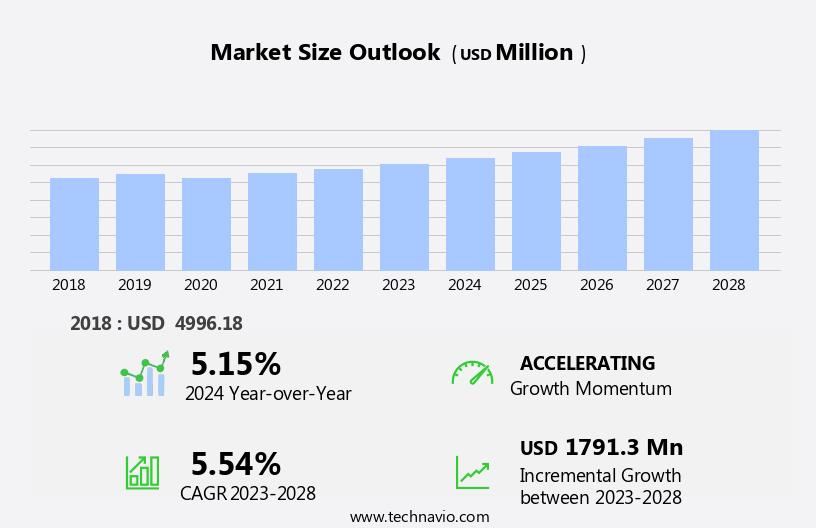
5.15
YoY growth 2023-2024(%)

Polymethyl Methacrylate (PMMA) Market Size 2024-2028 

The polymethyl methacrylate (pmma) market size is forecast to increase by USD 1.79 billion at a CAGR of 5.54% between 2023 and 2028.

  • The market is experiencing significant growth due to increasing demand from the construction industry in emerging economies. This trend is driven by the rising infrastructure development and urbanization in countries like China and India. Another key factor fueling market growth is the growing importance of bio-based PMMA, which is gaining popularity due to its eco-friendliness and sustainability. However, the market is also facing challenges from the volatility in raw material prices used in PMMA production. This price instability can impact the profitability of PMMA manufacturers and may lead to increased production costs. Despite these challenges, the future of the PMMA market looks promising, with continued growth expected due to its wide range of applications and benefits.
  • What will be the Size of the Polymethyl Methacrylate (PMMA) Market During the Forecast Period?
    Polymethyl Methacrylate (PMMA) Market Size

     Request Free Sample

  • The market encompasses the production and application of this thermoplastic polymer in various industries, including construction and electronics. PMMA, also known as acrylic, offers unique properties such as chemical resistance, durability, and optical clarity, making it a preferred choice for applications requiring high light transmission and UV stability. In the construction sector, PMMA is utilized in structured multiwall sheets for roofing and cladding, offering superior mechanical strength and weather resistance. In electronics, PMMA is used In the production of optical components, such as lenses and displays, due to its excellent UV stability and electrical insulation properties. Furthermore, PMMA finds applications in various industries, including healthcare, windows and skylights, signs, aircraft canopies, and bio-based PMMA, which contributes to the growth of the ecosystem.
  • PMMA is often compared to polycarbonates and PVC polymers, but its unique properties, such as light transmission and mechanical strength, distinguish it in various applications. PMMA is used as an alternative to glass in various applications, providing advantages in terms of weight, durability, and cost.
  • How is this Polymethyl Methacrylate (PMMA) Industry segmented and which is the largest segment?

    The polymethyl methacrylate (pmma) industry research report provides comprehensive data (region-wise segment analysis), with forecasts and estimates in "USD million" for the period 2024-2028, as well as historical data from 2018-2022 for the following segments.

    • Type
      • Extruded sheets
      • Pellets
      • Others
    • Application
      • Signs and display
      • Construction
      • Automotive
      • Electronics
      • Others
    • Geography
      • APAC
        • China
        • Japan
      • Europe
        • Germany
        • France
      • North America
        • US
      • South America
        • Middle East and Africa

        By Type Insights

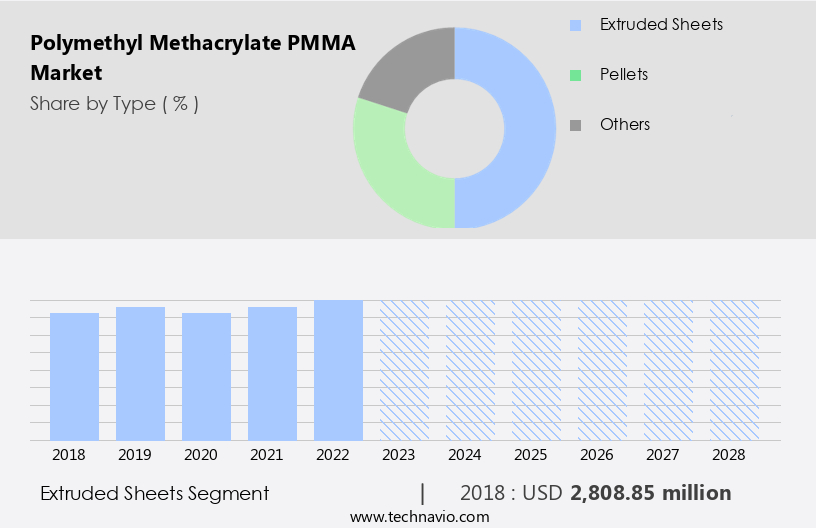
        • The extruded sheets segment is estimated to witness significant growth during the forecast period.

        The market for extruded sheets is projected to experience steady growth due to the increasing demand in various industries. Extruded PMMA sheets offer superior mechanical and optical properties, making them suitable for applications in construction, electronics, and automotive sectors. These sheets are utilized In the manufacturing of windows, skylights, signs, aircraft canopies, and healthcare equipment, among others. PMMA's advantages include excellent UV resistance, chemical resistance, durability, and light transmission. The growth of industries such as urbanization, digitalization, robotics, and aviation is expected to fuel the demand for PMMA extruded sheets. The material's versatility, combined with its weathering and aging resistance, further bolsters its appeal.

        The PMMA market is driven by factors such as increasing energy efficiency in buildings, the growing popularity of electric vehicles, and the need for lightweight materials in various industries.
        Polymethyl Methacrylate (PMMA) Market Size

        Get a glance at the  Polymethyl Methacrylate (PMMA) Industry report of share of various segments Request Free Sample

        The Extruded sheets segment was valued at USD 2.81 billion in 2018 and showed a gradual increase during the forecast period.

        Regional Analysis

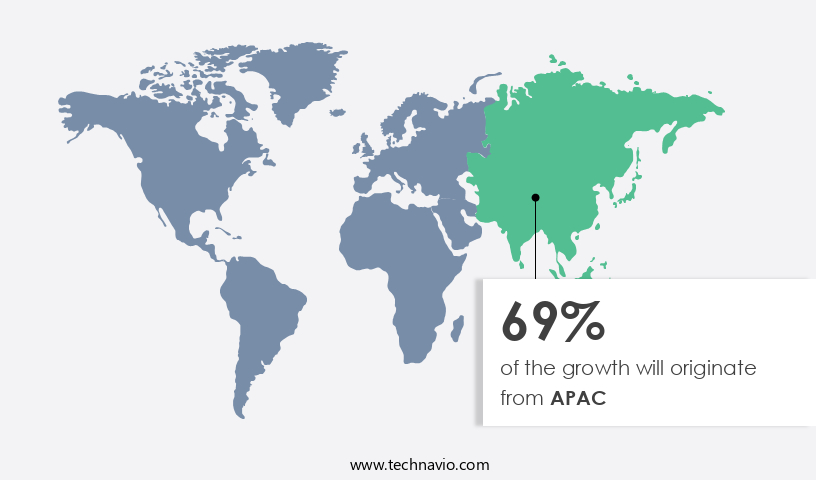
        • APAC is estimated to contribute 69% to the growth of the global market during the forecast period.

        Technavio’s analysts have elaborately explained the regional trends and drivers that shape the market during the forecast period.
        Polymethyl Methacrylate (PMMA) Market Share by Geography

        For more insights on the market share of various regions, Request Free Sample

        The Asia Pacific (APAC) region dominates The market due to the expansion of the construction and automotive sectors. In 2021, China, Japan, India, and South Korea were significant contributors to the automotive industry in APAC. The increasing production of motor vehicles In these countries will fuel PMMA demand, as it is extensively used in automotive applications. Additionally, urbanization in APAC is driving infrastructure development and non-residential construction activities, creating opportunities for PMMA In the region. For instance, India's urban population is projected to account for 40% of the country's total population and generate 75% of its GDP by 2030.

        PMMA's unique properties, such as chemical resistance, durability, light transmission, and mechanical strength, make it suitable for various applications in construction, electronics, and other industries. The PMMA market is expected to grow significantly due to the increasing demand from sectors like industrialization, digitalization, robotics, virtual reality, augmented reality, IoT, 5G connectivity, aviation industry, and flexible packaging.

        Market Dynamics

        Our  researchers analyzed the data with 2023 as the base year, along with the key drivers, trends, and challenges. A holistic analysis of drivers will help companies refine their marketing strategies to gain a competitive advantage.

        What are the key market drivers leading to the rise In the adoption of Polymethyl Methacrylate (PMMA) Industry?

        Increased demand from construction industry in emerging economies is the key driver of the market.

      • PMMA, also known as acrylic, is a thermoplastic polymer widely used across various industries due to its superior chemical resistance, durability, and optical clarity. In the construction sector, PMMA's high transparency, glossy finish, and resistance to UV light make it an ideal choice for applications such as windows, skylights, signs, aircraft canopies, and facades. The construction industry's growth, driven by infrastructure development in countries like China, has led to increased demand for PMMA. Despite the volatility In the real estate sector, the Chinese government's investment in rail and road infrastructure has propelled the country's construction industry forward. PMMA's use extends beyond construction to the electronics industry, where it is used In the production of electronic products, machinery manufacturing, and even in emerging technologies such as virtual reality, augmented reality, IoT, and 5G connectivity.
      • PMMA's versatility also makes it suitable for applications in solar devices, energy-efficient buildings, automotive parts, and flexible packaging. Its resistance to UV light, mechanical strength, and light transmission properties make it a preferred choice for various applications, including lamp covers, sound barriers, and greenhouses. PMMA's use In the aviation industry includes aircraft canopies and signage, while its pellets and beads are used in various industrial applications. The global PMMA market is expected to grow significantly due to the increasing industrialization, digitalization, and urbanization trends, as well as the rising demand for lightweight materials and energy-efficient solutions. However, factors such as crude oil prices and geopolitical factors may impact the market's growth.
      • What are the market trends shaping the Polymethyl Methacrylate (PMMA) Industry?

        Growing importance of bio-based PMMA is the upcoming market trend.

      • The market is witnessing significant growth due to the increasing demand for sustainable and eco-friendly polymers. Environmental regulations, such as REACH and EPA clearance, are driving market expansion, as industries seek to reduce their carbon footprint. The depletion of fossil fuel reserves and the volatile prices of crude oil are also contributing factors, leading to the development of bio-based PMMA. Bio-based PMMA is gaining popularity in various industries, particularly in healthcare, due to its superior bio-compatibility compared to polycarbonates (PC) and Polyvinyl chloride (PVC) polymers. In the healthcare sector, bio-based PMMA is being extensively used in manufacturing medical components, including medical implants and drug delivery systems, due to its biocompatibility.
      • Moreover, the demand for PMMA In the construction industry is increasing due to its excellent chemical resistance, durability, and light transmission properties. PMMA is commonly used in windows, skylights, signs, aircraft canopies, and other applications where optical clarity, UV stability, and mechanical strength are essential. The electronics industry is also a significant consumer of PMMA, particularly In the manufacturing of electrical and electronic components, machinery, and robotics. PMMA's excellent mechanical strength and lightweight properties make it an ideal material for use in virtual reality and augmented reality devices, IoT, and 5G connectivity applications. In conclusion, the PMMA market is experiencing growth due to the increasing demand for sustainable polymers, the development of bio-based PMMA, and its versatile applications in various industries, including electronics, construction, and healthcare.
      • The market is expected to continue expanding as industries seek to reduce their carbon footprint and adopt more sustainable materials.
      • What challenges does the Polymethyl Methacrylate (PMMA) Industry face during its growth?

        Volatility in raw material prices used in production on PMMA is a key challenge affecting the industry growth.

      • The market is significantly influenced by the price volatility of petrochemicals, which serve as the primary raw materials for PMMA production. The price instability of crude oil, a key component of petrochemicals, poses a significant challenge for PMMA manufacturers in maintaining profitability. This issue is further compounded by geopolitical factors, such as the ongoing instability in Iraq, the second-largest producer of crude oil In the Organization of the Petroleum Exporting Countries (OPEC). PMMA is extensively used in various industries, including Construction, Electronics, and Automotive, among others. In Construction, PMMA is utilized In the production of Structured multiwall sheets, Extruded sheets, and Pellets for applications such as Windows, Skylights, Signs, Aircraft canopies, and Facades.
      • In the Electronics industry, PMMA is employed In the manufacturing of Electrical and Electronics, Machinery, and Electronic products due to its chemical resistance, durability, light transmission, and UV stability. In the Automotive segment, PMMA is used In the production of Body parts, Lamp covers, Sound barriers, and Thermoplastic polymer for applications such as Body parts, Lamp covers, and Sound barriers. Despite these challenges, the PMMA market is expected to grow due to the increasing demand for lightweight materials, energy-efficient buildings, and the expansion of the Electrical and Electronics, Aviation, and Automotive industries. However, the market growth may be hindered by the volatility of crude oil prices and geopolitical factors.
      • Exclusive Customer Landscape

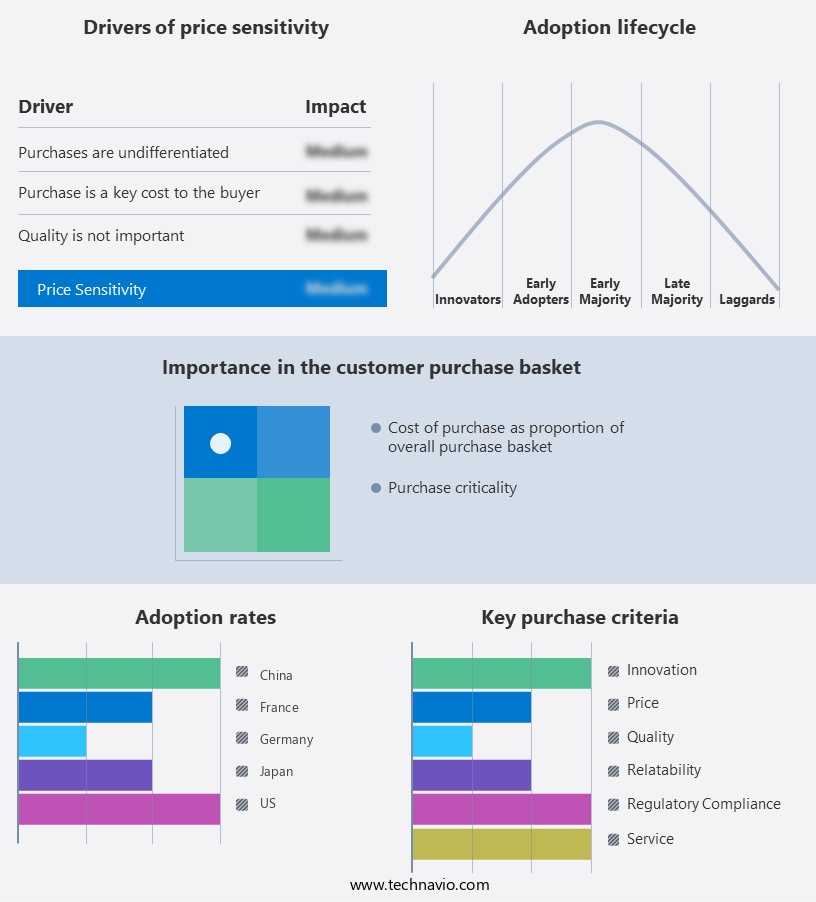
        The polymethyl methacrylate (pmma) market forecasting report includes the adoption lifecycle of the market, covering from the innovator’s stage to the laggard’s stage. It focuses on adoption rates in different regions based on penetration. Furthermore, the polymethyl methacrylate (pmma) market report also includes key purchase criteria and drivers of price sensitivity to help companies evaluate and develop their market growth analysis strategies.
        Polymethyl Methacrylate (PMMA) Market Share by Geography

         Customer Landscape

        Key Companies & Market Insights

        Companies are implementing various strategies, such as strategic alliances, polymethyl methacrylate (pmma) market forecast, partnerships, mergers and acquisitions, geographical expansion, and product/service launches, to enhance their presence In the industry.

        Asahi Kasei Corp. - Polymethyl methacrylate (PMMA) is a versatile acrylic resin widely used in various industries due to its superior properties. DELPET SRG097, a notable PMMA variant, showcases exceptional transparency, surface hardness, and chemical resistance. This acrylic resin is ideal for applications requiring high durability and clarity. PMMA's extensive usage can be attributed to its inherent advantages, including resistance to weathering, UV light, and impact. Industries such as automotive, construction, healthcare, and electronics leverage PMMA for its unparalleled performance and adaptability.

        The industry research and growth report includes detailed analyses of the competitive landscape of the market and information about key companies, including:

        • Asahi Kasei Corp.
        • Avient Corp.
        • Celanese Corp.
        • Chimei Corp.
        • Dow Chemical Co.
        • Gehr Kunstoffwerk GmbH and Co. KG
        • Go Yen Chemical Industrial Co. Ltd
        • KURARAY Co. Ltd.
        • LG Chem Ltd.
        • Lotte Chemical Corp.
        • Makevale Group
        • Mitsubishi Chemical Corp.
        • Nippon Shokubai Co. Ltd.
        • Plaskolite Inc.
        • Roehm GmbH
        • Samyang Corp.
        • Saudi Basic Industries Corp.
        • Schweiter Technologies AG
        • Trinseo PLC
        • Wanhua Chemical Group Co. Ltd.

        Qualitative and quantitative analysis of companies has been conducted to help clients understand the wider business environment as well as the strengths and weaknesses of key industry players. Data is qualitatively analyzed to categorize companies as pure play, category-focused, industry-focused, and diversified; it is quantitatively analyzed to categorize companies as dominant, leading, strong, tentative, and weak.

        Research Analyst Overview

        Polymethyl methacrylate (PMMA) is a versatile thermoplastic polymer that offers unique properties, making it an essential component in various industries. PMMA, also known as acrylic, is valued for its chemical resistance, durability, and optical clarity. These characteristics make it an ideal choice for applications where high transparency, rigidity, and resistance to environmental stressors are required. The PMMA market is driven by the growing demand for lightweight and durable materials in several sectors. In the construction industry, PMMA is used In the production of structured multiwall sheets for roofing and cladding applications due to its excellent light transmission and mechanical strength.

        In the electronics sector, PMMA is utilized In the manufacturing of electrical and electronic components due to its excellent insulating properties and resistance to UV light. The automotive industry is another significant end-user of PMMA. It is used In the production of body parts, lamp covers, and sound barriers due to its lightweight nature and excellent mechanical properties. PMMA is also used In the aviation industry for aircraft canopies and windows, providing excellent optical clarity and UV stability. The healthcare sector is another growing market for PMMA. It is used In the production of medical equipment and devices due to its biocompatibility and transparency.

        In the solar energy sector, PMMA is used In the production of solar devices due to its excellent optical properties and resistance to environmental stressors. The PMMA market is also driven by the increasing trend towards energy-efficient buildings. PMMA is used In the production of insulating windows and skylights, providing excellent thermal insulation and natural light transmission. In the transportation sector, PMMA is used In the production of electric vehicles due to its lightweight nature and excellent mechanical properties. The PMMA market is also influenced by the ongoing trend towards industrialization and digitalization. PMMA is used In the manufacturing of machinery and equipment due to its excellent mechanical properties and resistance to environmental stressors.

        It is also used In the production of robotics, virtual reality, and augmented reality devices due to its optical clarity and durability. The PMMA market is expected to grow significantly due to the increasing demand for lightweight and durable materials in various industries. Factors such as urbanization, the Internet of Things (IoT), and 5G connectivity are also expected to drive the growth of the PMMA market. Despite the positive outlook, the PMMA market is not without challenges. The market is influenced by several factors, including crude oil prices and geopolitical factors. These factors can impact the production and pricing of PMMA, potentially affecting the growth of the market.

        In conclusion, the PMMA market is driven by the growing demand for lightweight and durable materials in various industries. PMMA's unique properties, including its chemical resistance, durability, and optical clarity, make it an ideal choice for applications where high transparency, rigidity, and resistance to environmental stressors are required. The market is expected to grow significantly due to the increasing trend towards industrialization and digitalization, but it is not without challenges, including the impact of crude oil prices and geopolitical factors.

        Market Scope

        Report Coverage

        Details

        Page number

        179

        Base year

        2023

        Historic period

        2018-2022

        Forecast period

        2024-2028

        Growth momentum & CAGR

        Accelerate at a CAGR of 5.54%

        Market growth 2024-2028

        USD 1791.3 million

        Market structure

        Fragmented

        YoY growth 2023-2024(%)

        5.15

        Key countries

        US, China, Japan, Germany, and France

        Competitive landscape

        Leading Companies, Market Positioning of Companies, Competitive Strategies, and Industry Risks

        Request Free Sample

        What are the Key Data Covered in this Polymethyl Methacrylate (PMMA) Market Research and Growth Report?

        • CAGR of the Polymethyl Methacrylate (PMMA) industry during the forecast period
        • Detailed information on factors that will drive the growth and forecasting between 2024 and 2028
        • Precise estimation of the size of the market and its contribution of the industry in focus to the parent market
        • Accurate predictions about upcoming growth and trends and changes in consumer behaviour
        • Growth of the market across APAC, Europe, North America, South America, and Middle East and Africa
        • Thorough analysis of the market’s competitive landscape and detailed information about companies
        • Comprehensive analysis of factors that will challenge the polymethyl methacrylate (pmma) market growth of industry companies

        We can help! Our analysts can customize this polymethyl methacrylate (pmma) market research report to meet your requirements.

        Get in touch


        Table of Contents not available.

        Research Methodology

        Technavio presents a detailed picture of the market by way of study, synthesis, and summation of data from multiple sources. The analysts have presented the various facets of the market with a particular focus on identifying the key industry influencers. The data thus presented is comprehensive, reliable, and the result of extensive research, both primary and secondary.

        INFORMATION SOURCES

        Primary sources

        • Manufacturers and suppliers
        • Channel partners
        • Industry experts
        • Strategic decision makers

        Secondary sources

        • Industry journals and periodicals
        • Government data
        • Financial reports of key industry players
        • Historical data
        • Press releases

        DATA ANALYSIS

        Data Synthesis

        • Collation of data
        • Estimation of key figures
        • Analysis of derived insights

        Data Validation

        • Triangulation with data models
        • Reference against proprietary databases
        • Corroboration with industry experts

        REPORT WRITING

        Qualitative

        • Market drivers
        • Market challenges
        • Market trends
        • Five forces analysis

        Quantitative

        • Market size and forecast
        • Market segmentation
        • Geographical insights
        • Competitive landscape

        Interested in this report?

        Get your sample now to see our research methodology and insights!

        Download Now

        Frequently Asked Questions

        Polymethyl Methacrylate (PMMA) market growth will increase by 1791.3 million during 2024-2028.

        The Polymethyl Methacrylate (PMMA) market is expected to grow at a CAGR of 5.54% during 2024-2028.

        Polymethyl Methacrylate (PMMA) market is segmented by Type( Extruded sheets, Pellets, Others, Electronics, Others) Application( Signs and display, Construction, Automotive, Electronics, Others)

        Asahi Kasei Corp., Avient Corp., Celanese Corp., Chimei Corp., Dow Chemical Co., Gehr Kunstoffwerk GmbH and Co. KG, Go Yen Chemical Industrial Co. Ltd, KURARAY Co. Ltd., LG Chem Ltd., Lotte Chemical Corp., Makevale Group, Mitsubishi Chemical Corp., Nippon Shokubai Co. Ltd., Plaskolite Inc., Roehm GmbH, Samyang Corp., Saudi Basic Industries Corp., Schweiter Technologies AG, Trinseo PLC, Wanhua Chemical Group Co. Ltd. are a few of the key vendors in the Polymethyl Methacrylate (PMMA) market.

        APAC will register the highest growth rate of 68.8% among the other regions. Therefore, the Polymethyl Methacrylate (PMMA) market in APAC is expected to garner significant business opportunities for the vendors during the forecast period.

        US, China, Japan, Germany, France

        • Increased demand from construction industry in emerging economiesPMMA is used in the construction sector due to its high optical features is the driving factor this market.
        • glossy finish and high transparency is the driving factor this market.
        • better dimensional stability and rigidity is the driving factor this market.
        • resistance to UV rays is the driving factor this market.
        • high resistance to scratching is the driving factor this market.
        • and rigidity. Despite the volatile growth in the real estate sector in China is the driving factor this market.
        • the rapid development of rail and road infrastructure by the government to sustain the fast-growing industrial sector has resulted in significant growth of the construction industry in recent years. The construction industry in China is dominated by state-owned enterprises. The increased expenditure by the government on construction has propelled the country to the forefront of the global scenario. The volatile real estate sector had shown great promise over the second half of the previous decade and currently accounts for nearly one-third of the overall share in the global construction industry. The entry of major construction players from the EU into the lucrative Chinese polymethyl methacrylate (PMMA) market in recent years has further fueled the growth of this industry. The manufacturers in the market are sure to benefit from the growth in the construction industry during the forecast period. This is because the construction industry is among the major consumers of PMMA for paving and roofing applications. The implementation of advanced technologies is the driving factor this market.
        • such as in smart buildings and in construction projects is the driving factor this market.
        • encourages contractors to build new and advanced structures is the driving factor this market.
        • especially in countries such as South Africa and Egypt. The Middle East is hosting events such as the FIFA World Cup 2024 in Dubai and Dubai Expo 2024 in the UAE. Such events will increase the demand for hotels and transportation networks is the driving factor this market.
        • thereby fostering the demand for PMMA is the driving factor this market.
        • which is the driving factor this market.
        • in turn is the driving factor this market.
        • is anticipated to drive the growth of the market in focus during the forecast period. is the driving factor this market.

        The Polymethyl Methacrylate (PMMA) market vendors should focus on grabbing business opportunities from the Extruded sheets segment as it accounted for the largest market share in the base year.
