
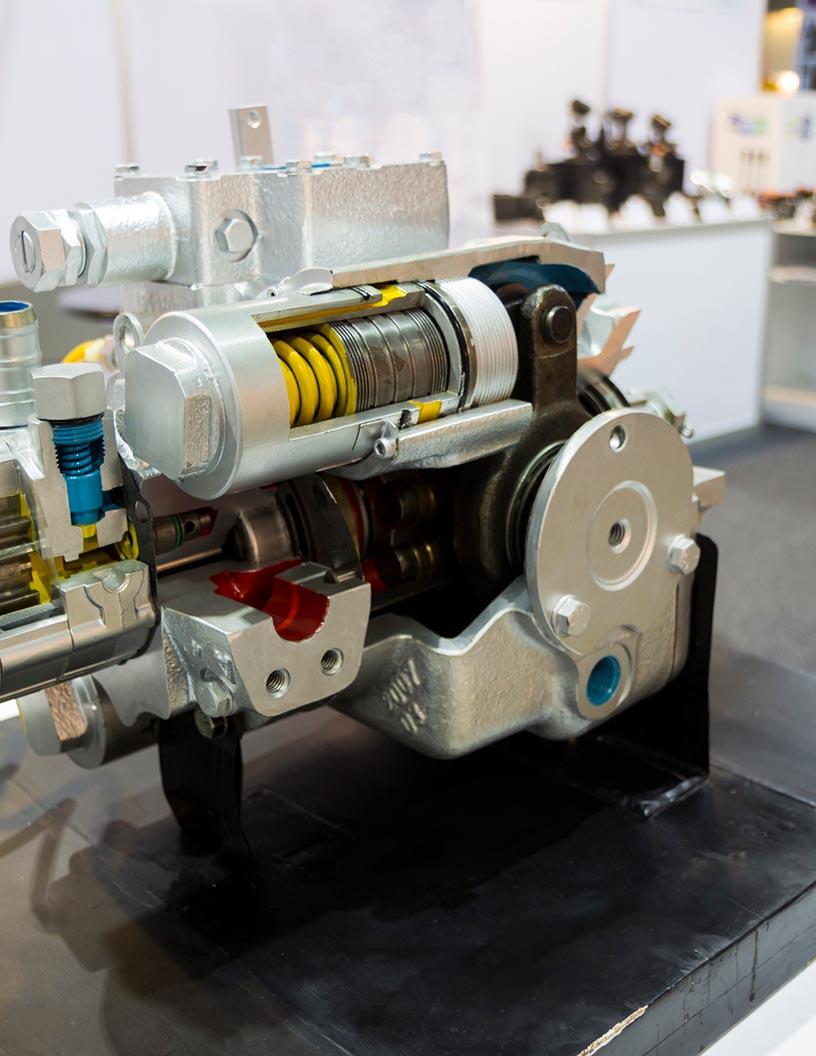

Positive Displacement Pumps Market Analysis APAC, Europe, North America, South America, Middle East and Africa - China, US, Germany, Japan, Russia - Size and Forecast 2024-2028

Positive Displacement Pumps Market Analysis APAC, Europe, North America, South America, Middle East and Africa - China, US, Germany, Japan, Russia - Size and Forecast 2024-2028

Published: Oct 2024 167 Pages SKU: IRTNTR45787

Market Overview at a Glance

$3.23 B
Market Opportunity
5.1%
CAGR
4.8
YoY growth 2023-2024(%)

Positive Displacement Pumps Market Size 2024-2028 

The positive displacement pumps market size is forecast to increase by USD 3.23 billion at a CAGR of 5.1% between 2023 and 2028.

  • The market is experiencing significant growth, driven by the chemical industry's increasing demand for high-pressure output and precise fluid handling. Smart pump technologies, which include advanced monitoring and diagnostics, are gaining popularity in high-viscosity fluid transfer applications. The oil reserves exploration and production sector also contribute to market growth due to the need for reliable and efficient pumping systems.
  • However, market trends are influenced by the volatility in raw material prices, which can impact the cost of manufacturing and ultimately, the price of pumps. The market analysis report highlights these factors and more, providing insights into the market's future growth prospects. Reciprocating pumps, which use pistons to displace fluid, are ideal for high-pressure applications.

What will be the Size of the Market During the Forecast Period?
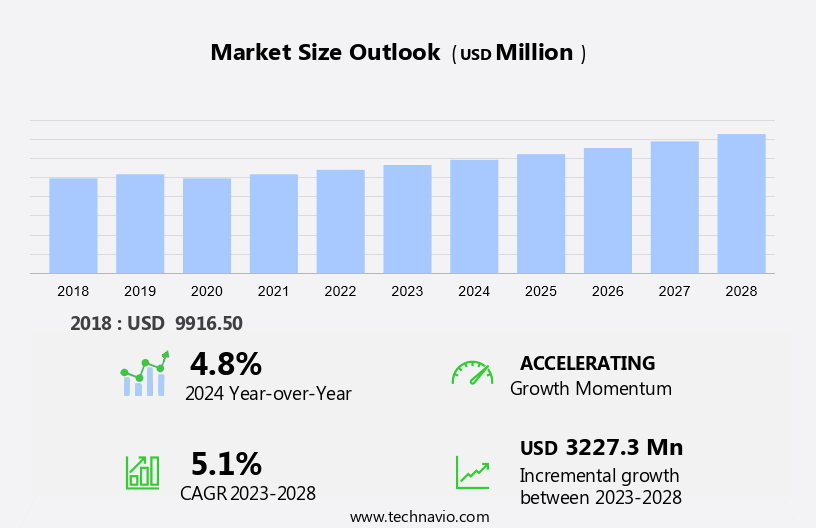
Positive Displacement Pumps Market Size

 Request Free Sample

  • Positive displacement pumps (PDPs) are essential components in various industrial processes, including chemical processing plants and wastewater treatment. These pumps operate by displacing a fixed volume of fluid with each pump cycle, making them ideal for handling high-viscosity fluids, hydraulic systems, and crude oil transfer. In the chemical processing sector, PDPs play a crucial role in chemical dosing, ensuring accurate and efficient delivery of chemicals. They are also widely used in the oil and gas industry for fluid transfer during the production and processing of hydrocarbon assets. In wastewater treatment, PDPs help maintain infrastructure development by effectively moving viscous fluids and ensuring energy efficiency.
  • Additionally, PDPs are indispensable in numerous industries, including chemical manufacturing, personal care, dairy processing, and mining activities. The market is experiencing significant growth due to the increasing demand for these pumps in various applications. Rotary pumps and reciprocating pumps are the two primary types of positive displacement pumps. Rotary pumps, which use rotating impellers to move fluid, are commonly used for handling corrosive and abrasive fluids. The demand for PDPs in industrial operations is driven by several factors. Firstly, the increasing focus on energy efficiency and reducing operational costs has led to the adoption of PDPs, which offer higher energy efficiency compared to centrifugal pumps.
  • Secondly, the need for handling high-viscosity fluids and ensuring precise fluid transfer has resulted in the widespread use of PDPs in various industries. PDPs are also essential in oil and gas applications, particularly in crude oil transfer. The growing oil reserves and the need for efficient and reliable fluid transfer solutions have fueled the demand for PDPs in this sector. Moreover, PDPs play a critical role in wastewater treatment by effectively handling contaminated fluids and ensuring the efficient operation of treatment plants. The increasing focus on environmental regulations and the need for effective wastewater management have further boosted the demand for PDPs in this sector.
  • In conclusion, the market is witnessing significant growth due to the increasing demand for these pumps in various industries, including chemical processing, oil and gas, and wastewater treatment. The ability of PDPs to handle high-viscosity fluids, ensure energy efficiency, and offer precise fluid transfer makes them an indispensable component in industrial operations.

How is this market segmented and which is the largest segment?

The market research report provides comprehensive data (region-wise segment analysis), with forecasts and estimates in "USD billion" for the period 2024-2028, as well as historical data from 2018-2022 for the following segments.

  • End-user
    • Oil and gas
    • Water and wastewater
    • Chemical and petrochemical
    • Others
  • Product
    • Rotary pumps
    • Reciprocating pumps
  • Geography
    • APAC
      • China
      • Japan
    • Europe
      • Germany
    • North America
      • US
    • South America
    • Middle East and Africa

By End-user Insights

  • The oil and gas segment is estimated to witness significant growth during the forecast period.

Positive displacement pumps play a significant role in various industries, including Chemical Manufacturing, Personal Care, Dairy Processing, and Hydrocarbon assets, among others. In the Chemical processing plants sector, these pumps are utilized for transferring fluids with accuracy and efficiency. Within the Personal Care industry, positive displacement pumps are employed for transferring viscous and non-viscous fluids in the production of cosmetics and other personal care products. In the Dairy Processing industry, positive displacement pumps are essential for handling milk and other dairy products due to their ability to maintain consistent flow rates and pressure.

Moreover, these pumps are crucial in Hydrocarbon assets for applications such as Wastewater treatment, where they ensure the efficient and effective removal of contaminants. Despite the recent challenges faced by the oil and gas industry due to fluctuating crude oil and natural gas prices, the sector's gradual recovery is leading to increased investments in new projects. Positive displacement pumps are indispensable in upstream oil and gas applications, such as drilling fluid circulation, hydraulic fracturing, deep-sea pumping, and cementing operations. Furthermore, they are also utilized in midstream transportation and downstream refineries. The Global PDP market is expected to grow steadily, driven by the increasing demand for these pumps in various industries. Companies in the sector are focusing on innovation and technology to improve the efficiency and performance of positive displacement pumps. Some of the key players in the market include Chemical processing plants, Wastewater treatment facilities, Dairy Processing companies, and Hydrocarbon asset owners.
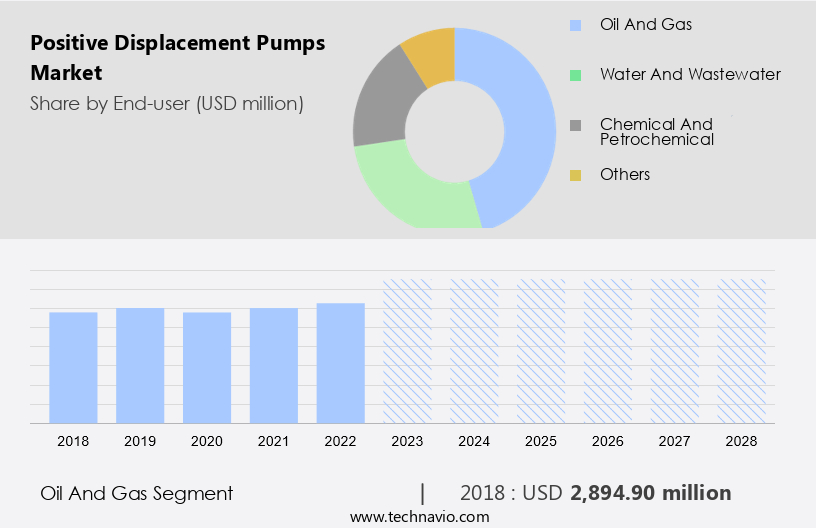
Positive Displacement Pumps Market Size

Get a glance at the market report of share of various segments Request Free Sample

The oil and gas segment was valued at USD 2.89 billion in 2018 and showed a gradual increase during the forecast period.

Regional Analysis

  • APAC is estimated to contribute 49% to the growth of the global market during the forecast period.

Technavio's analysts have elaborately explained the regional trends and drivers that shape the market during the forecast period.

Positive Displacement Pumps Market Share by Geography

For more insights on the market share of various regions Request Free Sample

In Asia Pacific (APAC), the significant presence of oil-consuming and industrial countries, as well as the world's largest automotive manufacturing hub, positions this region as a major contributor to The market. The region's diverse economy, consisting of both developed and developing countries, results in varying demand for these pumps across different nations. The oil and gas sector in APAC is witnessing expansion, leading to anticipated investments in the region during the forecast period. These investments are projected to generate demand for positive displacement pumps, particularly in the energy generation sector, including shale gas reserves and refinery capacities. Furthermore, the increasing adoption of Industrial Internet of Things (IIoT) technology in APAC's industrial sector is expected to further boost the demand for these pumps. Positive displacement pumps, such as peristaltic pumps, play a crucial role in moving fluids efficiently and reliably, making them indispensable in various industries, including oil and gas, chemical, and industrial manufacturing.

Market Dynamics

Our researchers analyzed the data with 2023 as the base year, along with the key drivers, trends, and challenges. A holistic analysis of drivers will help companies refine their marketing strategies to gain a competitive advantage.

What are the key market drivers leading to the rise in adoption of Positive Displacement Pumps Market?

Developments in the water and wastewater industry are the key drivers of the market.

  • The global need for clean water continues to escalate due to population growth and increasing demands for domestic, commercial, and industrial uses. This requirement is driving significant investments in the enhancement and establishment of water treatment facilities worldwide. These investments are anticipated to generate new prospects for the expansion of the market. The demand for clean water has been steadily increasing over the past few decades, particularly in developing countries, where urbanization and economic growth are leading to increased investments in new water treatment infrastructure. Positive Displacement Pumps are essential components in various industries, including Chemical Processing Plants, Wastewater Treatment, Oil and Gas, and Hydraulic Systems, due to their ability to handle high-viscosity fluids effectively.
  • As a result, the market is poised for substantial growth. Key industries such as Oil and Gas, Chemical Processing, and Wastewater Treatment are significant contributors to the market. These industries rely heavily on Positive Displacement Pumps for transferring crude oil, processing chemicals, and treating wastewater, respectively. As these industries continue to expand, the demand for Positive Displacement Pumps is expected to grow accordingly. In conclusion, the global demand for clean water is fueling investments in water treatment facilities, which in turn, are creating new opportunities for the market. The ability of Positive Displacement Pumps to handle high-viscosity fluids makes them indispensable in various industries, including Oil and Gas, Chemical Processing, and Wastewater Treatment.

What are the market trends shaping the Positive Displacement Pumps Market?

Rising demand for pump repair and remanufacturing from high-performance applications is the upcoming trend in the market.

  • In the realm of large-scale and critical applications, such as offshore oil and gas exploration, chemical processing, and petrochemicals, the cost of investing in pumping systems can be substantial. Given the high financial stakes, many end-users prefer to repair or remanufacture worn-out or degraded components instead of opting for costly replacements. In industries with corrosive and harsh environments, material deposition technologies, including plasma arc welding and laser cladding, are commonly used for the repair and renovation of mechanical components. These techniques, classified as material processing and coating methods, play a pivotal role in restoring the functionality and durability of pumps and pumping systems.
  • Additionally, high-pressure output pumps, a crucial component in various industries, are subjected to the rigors of handling high-viscosity fluids, making them prone to wear and tear. Smart pump technologies, such as precision fluid handling systems, are increasingly being adopted to mitigate the challenges posed by these applications. These advanced technologies offer enhanced efficiency, reliability, and reduced maintenance costs. The oil and gas sector, with its vast oil reserves, is a significant consumer of high-pressure pumps. The demand for these pumps is driven by the need to transport crude oil from remote locations to refineries and processing facilities. The use of smart pump technologies in this sector is expected to increase, given the benefits they offer in terms of improved efficiency, reduced downtime, and extended component life.
  • In summary, the use of advanced material deposition technologies and smart pump solutions is transforming the landscape of pumping systems in industries that require high-pressure output and handling of high-viscosity fluids. These innovations are enabling end-users to reduce costs, enhance efficiency, and ensure reliable operations.

What challenges does Positive Displacement Pumps Market face during the growth?

Volatility in raw material prices is a key challenge affecting the market growth.

  • Positive displacement pumps, including rotary and reciprocating types, play a crucial role in chemical dosing and handling viscous fluids in various industries. Infrastructure development and the pursuit of energy efficiency have driven the demand for these pumps.
  • However, the market faces challenges due to the price volatility of raw materials, such as cast iron, bronze, stainless steel, aluminum, and copper. This can hinder the adoption of positive displacement pumps in price-sensitive regions. The recent instability in raw material prices is due to increased taxes, duties, and tariffs, as well as production disruptions in metal ore-producing countries. These factors can disrupt the entire supply chain, increasing the cost of the final product. 

Exclusive Customer Landscape

The market forecasting report includes the adoption lifecycle of the market, covering from the innovator's stage to the laggard's stage. It focuses on adoption rates in different regions based on penetration. Furthermore, the market report also includes key purchase criteria and drivers of price sensitivity to help companies evaluate and develop their market growth analysis strategies.
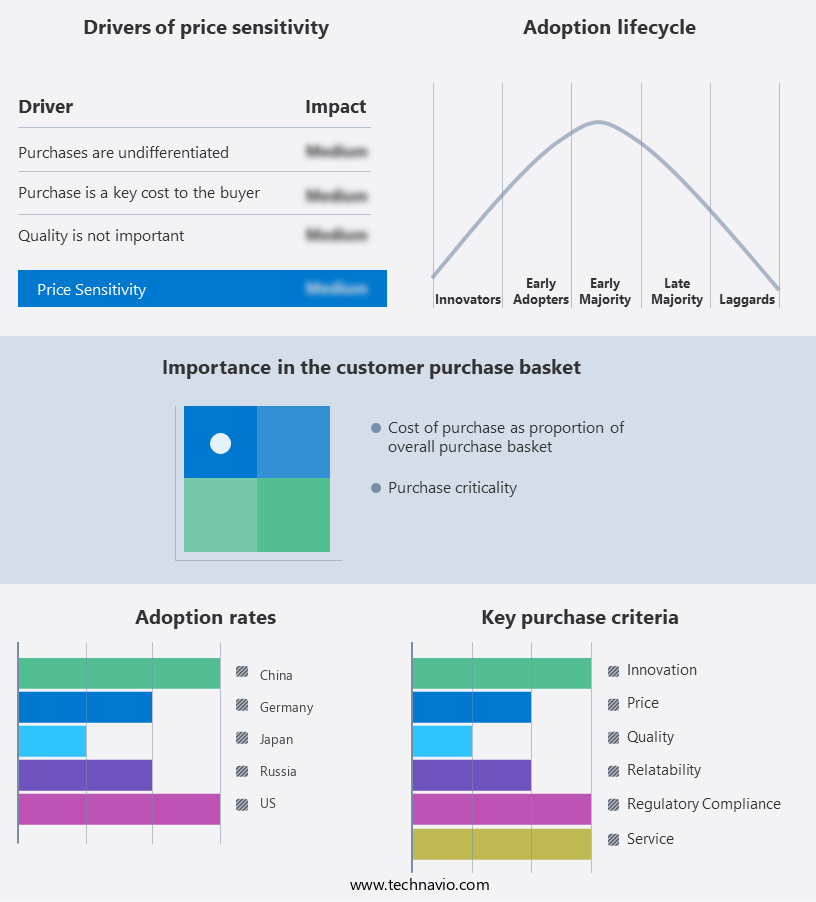
Positive Displacement Pumps Market Share by Geography

 Customer Landscape

Key Companies & Market Insights

Companies are implementing various strategies, such as strategic alliances, market forecast, partnerships, mergers and acquisitions, geographical expansion, and product/service launches, to enhance their presence in the market.

The market research and growth report includes detailed analyses of the competitive landscape of the market and information about key companies, including:

  • Alfa Laval AB
  • Ampco Pumps Co.
  • Bailey International LLC
  • Borger GmbH
  • Bosch Rexroth AG
  • Cat Pumps
  • CIRCOR International Inc.
  • Dover Corp.
  • Flowserve Corp.
  • Grundfos Holding AS
  • HYDAC International GmbH
  • IDEX Corp.
  • ITT Inc.
  • NOV Inc.
  • Parker Hannifin Corp.
  • Pentair Plc
  • SPX FLOW Inc.
  • Sulzer Ltd.
  • The Weir Group Plc
  • Xylem Inc.

Qualitative and quantitative analysis of companies has been conducted to help clients understand the wider business environment as well as the strengths and weaknesses of key market players. Data is qualitatively analyzed to categorize companies as pure play, category-focused, industry-focused, and diversified; it is quantitatively analyzed to categorize companies as dominant, leading, strong, tentative, and weak.

Research Analyst Overview

Positive displacement pumps (PDPs) play a vital role in various industries, including chemical processing plants and wastewater treatment, where handling high-viscosity fluids is a common requirement. PDPs, such as rotary pumps and reciprocating pumps, are widely used in hydraulic systems, oil and gas industries for crude oil transfer, chemical dosing, and fluid handling. Infrastructure development and energy efficiency are key drivers for the global PDP market. PDPs are essential for handling high-pressure output fluids in chemical manufacturing processes, particularly in industries like personal care, dairy processing, and food and beverage. The oil and gas sector relies heavily on PDPs for fluid transfer in hydrocarbon assets, power generation, and shale gas reserves.

In summary, smart pump technologies, including IoT-enabled pump monitoring systems, have gained significant traction in industrial operations to ensure energy efficiency and minimize waste. PDPs are also crucial in wastewater treatment to prevent contamination and maintain water quality. Mining activities and energy demand further expand the application scope of PDPs. PDPs are indispensable in handling high-viscosity fluids, making them an integral part of various industries, including oil and gas, power generation, and chemical processing. Precision fluid handling and pulsation dampeners are essential features that enhance the performance and reliability of PDPs. Peristaltic pumps are another type of PDPs gaining popularity due to their flexibility and ability to handle a wide range of fluids.

Market Scope

Report Coverage

Details

Page number

167

Base year

2023

Historic period

2018-2022

Forecast period

2024-2028

Growth momentum & CAGR

Accelerate at a CAGR of 5.1%

Market growth 2024-2028

USD 3.23 billion

Market structure

Fragmented

YoY growth 2023-2024(%)

4.8

Key countries

China, US, Germany, Japan, and Russia

Competitive landscape

Leading Companies, Market Positioning of Companies, Competitive Strategies, and Industry Risks

Request Free Sample

What are the Key Data Covered in this Market Research and Growth Report?

  • CAGR of the market during the forecast period
  • Detailed information on factors that will drive the market growth and forecasting between 2024 and 2028
  • Precise estimation of the size of the market  and its contribution of the market in focus to the parent market
  • Accurate predictions about upcoming market growth and trends and changes in consumer behaviour
  • Growth of the market across APAC, Europe, North America, South America, and Middle East and Africa
  • Thorough analysis of the market's competitive landscape and detailed information about companies
  • Comprehensive analysis of factors that will challenge the growth of market companies

We can help! Our analysts can customize this market research report to meet your requirements. Get in touch

1 Executive Summary

  • 1.1 Market overview
    • Executive Summary - Chart on Market Overview
    • Executive Summary - Data Table on Market Overview
    • Executive Summary - Chart on Global Market Characteristics
    • Executive Summary - Chart on Market by Geography
    • Executive Summary - Chart on Market Segmentation by End-user
    • Executive Summary - Chart on Market Segmentation by Product
    • Executive Summary - Chart on Incremental Growth
    • Executive Summary - Data Table on Incremental Growth
    • Executive Summary - Chart on Company Market Positioning

2 Market Landscape

  • 2.1 Market ecosystem
    • Parent Market
    • Data Table on - Parent Market
  • 2.2 Market characteristics
    • Market characteristics analysis
  • 2.3 Value chain analysis
    • Value Chain Analysis

3 Market Sizing

  • 3.1 Market definition
    • Offerings of companies included in the market definition
  • 3.2 Market segment analysis
    • Market segments
  • 3.3 Market size 2023
    • 3.4 Market outlook: Forecast for 2023-2028
      • Chart on Global - Market size and forecast 2023-2028 ($ million)
      • Data Table on Global - Market size and forecast 2023-2028 ($ million)
      • Chart on Global Market: Year-over-year growth 2023-2028 (%)
      • Data Table on Global Market: Year-over-year growth 2023-2028 (%)

    4 Historic Market Size

    • 4.1 Global Positive Displacement Pumps Market 2018 - 2022
      • Historic Market Size - Data Table on Global Positive Displacement Pumps Market 2018 - 2022 ($ million)
    • 4.2 End-user segment analysis 2018 - 2022
      • Historic Market Size - End-user Segment 2018 - 2022 ($ million)
    • 4.3 Product segment analysis 2018 - 2022
      • Historic Market Size - Product Segment 2018 - 2022 ($ million)
    • 4.4 Geography segment analysis 2018 - 2022
      • Historic Market Size - Geography Segment 2018 - 2022 ($ million)
    • 4.5 Country segment analysis 2018 - 2022
      • Historic Market Size - Country Segment 2018 - 2022 ($ million)

    5 Five Forces Analysis

    • 5.1 Five forces summary
      • Five forces analysis - Comparison between 2023 and 2028
    • 5.2 Bargaining power of buyers
      • Bargaining power of buyers - Impact of key factors 2023 and 2028
    • 5.3 Bargaining power of suppliers
      • Bargaining power of suppliers - Impact of key factors in 2023 and 2028
    • 5.4 Threat of new entrants
      • Threat of new entrants - Impact of key factors in 2023 and 2028
    • 5.5 Threat of substitutes
      • Threat of substitutes - Impact of key factors in 2023 and 2028
    • 5.6 Threat of rivalry
      • Threat of rivalry - Impact of key factors in 2023 and 2028
    • 5.7 Market condition
      • Chart on Market condition - Five forces 2023 and 2028

    6 Market Segmentation by End-user

    • 6.1 Market segments
      • Chart on End-user - Market share 2023-2028 (%)
      • Data Table on End-user - Market share 2023-2028 (%)
    • 6.2 Comparison by End-user
      • Chart on Comparison by End-user
      • Data Table on Comparison by End-user
    • 6.3 Oil and gas - Market size and forecast 2023-2028
      • Chart on Oil and gas - Market size and forecast 2023-2028 ($ million)
      • Data Table on Oil and gas - Market size and forecast 2023-2028 ($ million)
      • Chart on Oil and gas - Year-over-year growth 2023-2028 (%)
      • Data Table on Oil and gas - Year-over-year growth 2023-2028 (%)
    • 6.4 Water and wastewater - Market size and forecast 2023-2028
      • Chart on Water and wastewater - Market size and forecast 2023-2028 ($ million)
      • Data Table on Water and wastewater - Market size and forecast 2023-2028 ($ million)
      • Chart on Water and wastewater - Year-over-year growth 2023-2028 (%)
      • Data Table on Water and wastewater - Year-over-year growth 2023-2028 (%)
    • 6.5 Chemical and petrochemical - Market size and forecast 2023-2028
      • Chart on Chemical and petrochemical - Market size and forecast 2023-2028 ($ million)
      • Data Table on Chemical and petrochemical - Market size and forecast 2023-2028 ($ million)
      • Chart on Chemical and petrochemical - Year-over-year growth 2023-2028 (%)
      • Data Table on Chemical and petrochemical - Year-over-year growth 2023-2028 (%)
    • 6.6 Others - Market size and forecast 2023-2028
      • Chart on Others - Market size and forecast 2023-2028 ($ million)
      • Data Table on Others - Market size and forecast 2023-2028 ($ million)
      • Chart on Others - Year-over-year growth 2023-2028 (%)
      • Data Table on Others - Year-over-year growth 2023-2028 (%)
    • 6.7 Market opportunity by End-user
      • Market opportunity by End-user ($ million)
      • Data Table on Market opportunity by End-user ($ million)

    7 Market Segmentation by Product

    • 7.1 Market segments
      • Chart on Product - Market share 2023-2028 (%)
      • Data Table on Product - Market share 2023-2028 (%)
    • 7.2 Comparison by Product
      • Chart on Comparison by Product
      • Data Table on Comparison by Product
    • 7.3 Rotary pumps - Market size and forecast 2023-2028
      • Chart on Rotary pumps - Market size and forecast 2023-2028 ($ million)
      • Data Table on Rotary pumps - Market size and forecast 2023-2028 ($ million)
      • Chart on Rotary pumps - Year-over-year growth 2023-2028 (%)
      • Data Table on Rotary pumps - Year-over-year growth 2023-2028 (%)
    • 7.4 Reciprocating pumps - Market size and forecast 2023-2028
      • Chart on Reciprocating pumps - Market size and forecast 2023-2028 ($ million)
      • Data Table on Reciprocating pumps - Market size and forecast 2023-2028 ($ million)
      • Chart on Reciprocating pumps - Year-over-year growth 2023-2028 (%)
      • Data Table on Reciprocating pumps - Year-over-year growth 2023-2028 (%)
    • 7.5 Market opportunity by Product
      • Market opportunity by Product ($ million)
      • Data Table on Market opportunity by Product ($ million)

    8 Customer Landscape

    • 8.1 Customer landscape overview
      • Analysis of price sensitivity, lifecycle, customer purchase basket, adoption rates, and purchase criteria

    9 Geographic Landscape

    • 9.1 Geographic segmentation
      • Chart on Market share by geography 2023-2028 (%)
      • Data Table on Market share by geography 2023-2028 (%)
    • 9.2 Geographic comparison
      • Chart on Geographic comparison
      • Data Table on Geographic comparison
    • 9.3 APAC - Market size and forecast 2023-2028
      • Chart on APAC - Market size and forecast 2023-2028 ($ million)
      • Data Table on APAC - Market size and forecast 2023-2028 ($ million)
      • Chart on APAC - Year-over-year growth 2023-2028 (%)
      • Data Table on APAC - Year-over-year growth 2023-2028 (%)
    • 9.4 Europe - Market size and forecast 2023-2028
      • Chart on Europe - Market size and forecast 2023-2028 ($ million)
      • Data Table on Europe - Market size and forecast 2023-2028 ($ million)
      • Chart on Europe - Year-over-year growth 2023-2028 (%)
      • Data Table on Europe - Year-over-year growth 2023-2028 (%)
    • 9.5 North America - Market size and forecast 2023-2028
      • Chart on North America - Market size and forecast 2023-2028 ($ million)
      • Data Table on North America - Market size and forecast 2023-2028 ($ million)
      • Chart on North America - Year-over-year growth 2023-2028 (%)
      • Data Table on North America - Year-over-year growth 2023-2028 (%)
    • 9.6 South America - Market size and forecast 2023-2028
      • Chart on South America - Market size and forecast 2023-2028 ($ million)
      • Data Table on South America - Market size and forecast 2023-2028 ($ million)
      • Chart on South America - Year-over-year growth 2023-2028 (%)
      • Data Table on South America - Year-over-year growth 2023-2028 (%)
    • 9.7 Middle East and Africa - Market size and forecast 2023-2028
      • Chart on Middle East and Africa - Market size and forecast 2023-2028 ($ million)
      • Data Table on Middle East and Africa - Market size and forecast 2023-2028 ($ million)
      • Chart on Middle East and Africa - Year-over-year growth 2023-2028 (%)
      • Data Table on Middle East and Africa - Year-over-year growth 2023-2028 (%)
    • 9.8 China - Market size and forecast 2023-2028
      • Chart on China - Market size and forecast 2023-2028 ($ million)
      • Data Table on China - Market size and forecast 2023-2028 ($ million)
      • Chart on China - Year-over-year growth 2023-2028 (%)
      • Data Table on China - Year-over-year growth 2023-2028 (%)
    • 9.9 US - Market size and forecast 2023-2028
      • Chart on US - Market size and forecast 2023-2028 ($ million)
      • Data Table on US - Market size and forecast 2023-2028 ($ million)
      • Chart on US - Year-over-year growth 2023-2028 (%)
      • Data Table on US - Year-over-year growth 2023-2028 (%)
    • 9.10 Germany - Market size and forecast 2023-2028
      • Chart on Germany - Market size and forecast 2023-2028 ($ million)
      • Data Table on Germany - Market size and forecast 2023-2028 ($ million)
      • Chart on Germany - Year-over-year growth 2023-2028 (%)
      • Data Table on Germany - Year-over-year growth 2023-2028 (%)
    • 9.11 Japan - Market size and forecast 2023-2028
      • Chart on Japan - Market size and forecast 2023-2028 ($ million)
      • Data Table on Japan - Market size and forecast 2023-2028 ($ million)
      • Chart on Japan - Year-over-year growth 2023-2028 (%)
      • Data Table on Japan - Year-over-year growth 2023-2028 (%)
    • 9.12 Russia - Market size and forecast 2023-2028
      • Chart on Russia - Market size and forecast 2023-2028 ($ million)
      • Data Table on Russia - Market size and forecast 2023-2028 ($ million)
      • Chart on Russia - Year-over-year growth 2023-2028 (%)
      • Data Table on Russia - Year-over-year growth 2023-2028 (%)
    • 9.13 Market opportunity by geography
      • Market opportunity by geography ($ million)
      • Data Tables on Market opportunity by geography ($ million)

    10 Drivers, Challenges, and Opportunity/Restraints

    • 10.1 Market drivers
      • 10.2 Market challenges
        • 10.3 Impact of drivers and challenges
          • Impact of drivers and challenges in 2023 and 2028
        • 10.4 Market opportunities/restraints

          11 Competitive Landscape

          • 11.1 Overview
            • 11.2 Competitive Landscape
              • Overview on criticality of inputs and factors of differentiation
            • 11.3 Landscape disruption
              • Overview on factors of disruption
            • 11.4 Industry risks
              • Impact of key risks on business

            12 Competitive Analysis

            • 12.1 Companies profiled
              • Companies covered
            • 12.2 Market positioning of companies
              • Matrix on companies position and classification
            • 12.3 Alfa Laval AB
              • Alfa Laval AB - Overview
              • Alfa Laval AB - Business segments
              • Alfa Laval AB - Key news
              • Alfa Laval AB - Key offerings
              • Alfa Laval AB - Segment focus
            • 12.4 Bailey International LLC
              • Bailey International LLC - Overview
              • Bailey International LLC - Product / Service
              • Bailey International LLC - Key offerings
            • 12.5 Bosch Rexroth AG
              • Bosch Rexroth AG - Overview
              • Bosch Rexroth AG - Product / Service
              • Bosch Rexroth AG - Key offerings
            • 12.6 Flowserve Corp.
              • Flowserve Corp. - Overview
              • Flowserve Corp. - Business segments
              • Flowserve Corp. - Key offerings
              • Flowserve Corp. - Segment focus
            • 12.7 Grundfos Holding AS
              • Grundfos Holding AS - Overview
              • Grundfos Holding AS - Product / Service
              • Grundfos Holding AS - Key news
              • Grundfos Holding AS - Key offerings
            • 12.8 ITT Inc.
              • ITT Inc. - Overview
              • ITT Inc. - Business segments
              • ITT Inc. - Key offerings
              • ITT Inc. - Segment focus
            • 12.9 SPX FLOW Inc.
              • SPX FLOW Inc. - Overview
              • SPX FLOW Inc. - Product / Service
              • SPX FLOW Inc. - Key news
              • SPX FLOW Inc. - Key offerings
            • 12.10 Sulzer Ltd.
              • Sulzer Ltd. - Overview
              • Sulzer Ltd. - Business segments
              • Sulzer Ltd. - Key news
              • Sulzer Ltd. - Key offerings
              • Sulzer Ltd. - Segment focus
            • 12.11 The Weir Group Plc
              • The Weir Group Plc - Overview
              • The Weir Group Plc - Business segments
              • The Weir Group Plc - Key news
              • The Weir Group Plc - Key offerings
              • The Weir Group Plc - Segment focus
            • 12.12 Xylem Inc.
              • Xylem Inc. - Overview
              • Xylem Inc. - Business segments
              • Xylem Inc. - Key news
              • Xylem Inc. - Key offerings
              • Xylem Inc. - Segment focus

            13 Appendix

            • 13.1 Scope of the report
              • 13.2 Inclusions and exclusions checklist
                • Inclusions checklist
                • Exclusions checklist
              • 13.3 Currency conversion rates for US$
                • Currency conversion rates for US$
              • 13.4 Research methodology
                • Research methodology
              • 13.5 Data procurement
                • Information sources
              • 13.6 Data validation
                • Data validation
              • 13.7 Validation techniques employed for market sizing
                • Validation techniques employed for market sizing
              • 13.8 Data synthesis
                • Data synthesis
              • 13.9 360 degree market analysis
                • 360 degree market analysis
              • 13.10 List of abbreviations
                • List of abbreviations

              Research Methodology

              Technavio presents a detailed picture of the market by way of study, synthesis, and summation of data from multiple sources. The analysts have presented the various facets of the market with a particular focus on identifying the key industry influencers. The data thus presented is comprehensive, reliable, and the result of extensive research, both primary and secondary.

              INFORMATION SOURCES

              Primary sources

              • Manufacturers and suppliers
              • Channel partners
              • Industry experts
              • Strategic decision makers

              Secondary sources

              • Industry journals and periodicals
              • Government data
              • Financial reports of key industry players
              • Historical data
              • Press releases

              DATA ANALYSIS

              Data Synthesis

              • Collation of data
              • Estimation of key figures
              • Analysis of derived insights

              Data Validation

              • Triangulation with data models
              • Reference against proprietary databases
              • Corroboration with industry experts

              REPORT WRITING

              Qualitative

              • Market drivers
              • Market challenges
              • Market trends
              • Five forces analysis

              Quantitative

              • Market size and forecast
              • Market segmentation
              • Geographical insights
              • Competitive landscape

              Interested in this report?

              Get your sample now to see our research methodology and insights!

              Download Now

              Frequently Asked Questions

              Positive Displacement Pumps market growth will increase by $ 3227.3 mn during 2024-2028 .

              The Positive Displacement Pumps market is expected to grow at a CAGR of 5.1% during 2024-2028 .

              Positive Displacement Pumps market is segmented by End-user( Oil and gas, Water and wastewater, Chemical and petrochemical, Others) Product( Rotary pumps, Reciprocating pumps, Chemical and petrochemical, Others)

              Alfa Laval AB, Ampco Pumps Co., Bailey International LLC, Borger GmbH, Bosch Rexroth AG, Cat Pumps, CIRCOR International Inc., Dover Corp., Flowserve Corp., Grundfos Holding AS, HYDAC International GmbH, IDEX Corp., ITT Inc., NOV Inc., Parker Hannifin Corp., Pentair Plc, SPX FLOW Inc., Sulzer Ltd., The Weir Group Plc, Xylem Inc. are a few of the key vendors in the Positive Displacement Pumps market.

              APAC will register the highest growth rate of 49% among the other regions. Therefore, the Positive Displacement Pumps market in APAC is expected to garner significant business opportunities for the vendors during the forecast period.

              China, US, Germany, Japan, Russia

              • Developments in water and wastewater industryThe rapidly growing global population is augmenting the demand for clean water for drinking and other purposes. Clean water is required for domestic is the driving factor this market.
              • commercial is the driving factor this market.
              • and industrial uses and processes. The growing demand for clean water is driving investments in the upgrading and new installation of water treatment facilities worldwide is the driving factor this market.
              • which is the driving factor this market.
              • in turn is the driving factor this market.
              • are expected to create new opportunities for the growth of the global positive displacement pumps market. The demand for clean water has continued to rise rapidly over the past several decades is the driving factor this market.
              • especially in developing countries is the driving factor this market.
              • where the rapid pace of urbanization and economic growth is driving investments in new water treatment infrastructure. Emerging economies such as China is the driving factor this market.
              • India is the driving factor this market.
              • Indonesia is the driving factor this market.
              • Saudi Arabia is the driving factor this market.
              • and other Asian and Middle East countries are investing substantial sums in water treatment infrastructure to support the growth of the economy. The dwindling of freshwater resources due to land and water pollution is forcing most countries to adopt technologies for wastewater and effluent treatment. The importance of water and wastewater treatment in the mining is the driving factor this market.
              • oil and gas is the driving factor this market.
              • and other end-user industries has encouraged companies to follow sustainable water management practices such as capturing the drain water by using liners and pipes is the driving factor this market.
              • which could enter the groundwater and the reuse of treated water. Mining companies are also socially and legislatively responsible for ensuring that the mining activities do not affect the sites surrounding the area. This has compelled mining companies to install various rotary lobe pumps to remove highly viscous liquid in wastewater treatment.  The agriculture sector also uses positive displacement pumps in various applications. These pumps are used for high-pressure agricultural pumping purposes is the driving factor this market.
              • including chemical injections is the driving factor this market.
              • fluid transfer is the driving factor this market.
              • sprayers is the driving factor this market.
              • and chemical metering. In countries such as India is the driving factor this market.
              • where the agricultural sector is a major contributor to the overall GDP is the driving factor this market.
              • the highest demand for positive displacement pumps is from agricultural water-pumping purposes. The declining size of agricultural farms in the country is the driving factor this market.
              • coupled with the highly efficient design of positive displacement pumps is the driving factor this market.
              • makes them suitable for agricultural pumping applications. This factor is also driving the penetration of solar energy-based positive displacement pumps in remote farming and agricultural operations. Thus is the driving factor this market.
              • rising investments in new water and wastewater treatment is the driving factor this market.
              • water reuse is the driving factor this market.
              • and upgrading of existing water supply infrastructure across the world are expected to propel the market growth during the forecast period. is the driving factor this market.

              The Positive Displacement Pumps market vendors should focus on grabbing business opportunities from the Oil and gas segment as it accounted for the largest market share in the base year.
