



Print Management Market Size 2026-2030
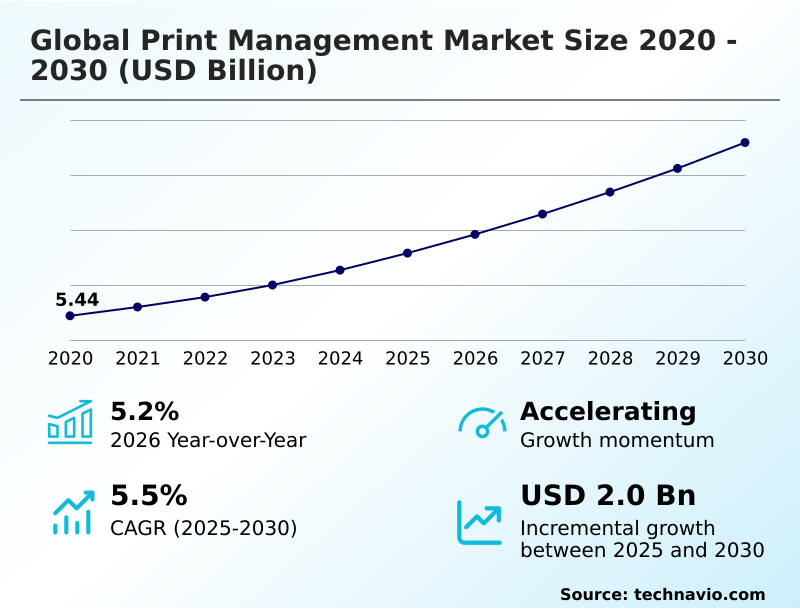
The print management market size is valued to increase by USD 2.00 billion, at a CAGR of 5.5% from 2025 to 2030. Escalating demand for cloud-based infrastructure across enterprises will drive the print management market.
Major Market Trends & Insights
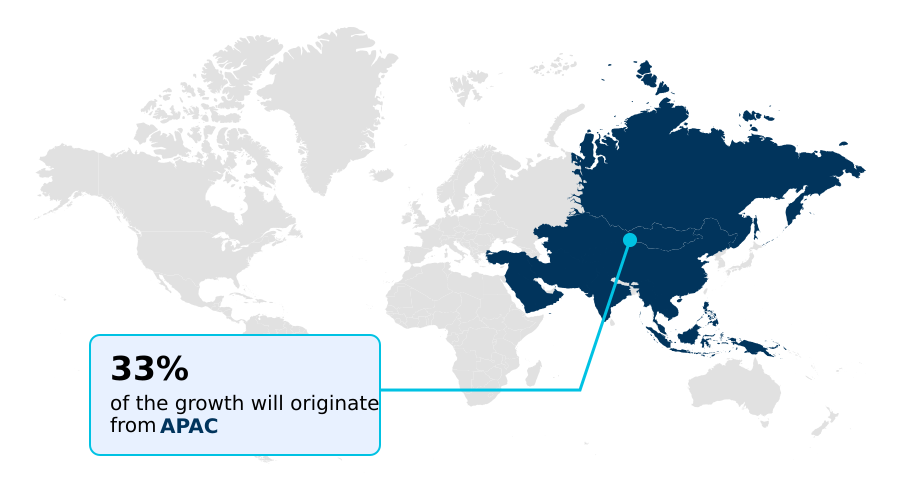
- APAC dominated the market and accounted for a 32.8% growth during the forecast period.
- By Component - Software segment was valued at USD 4.69 billion in 2024
- By Deployment - Cloud segment accounted for the largest market revenue share in 2024
Market Size & Forecast
- Market Opportunities: USD 3.15 billion
- Market Future Opportunities: USD 2.00 billion
- CAGR from 2025 to 2030 : 5.5%
Market Summary
- The print management market is undergoing robust evolution, driven by the persistent need for operational efficiency, document security, and sustainable business practices. As enterprises navigate the complexities of hybrid work models, the demand for centralized control over document output infrastructure has intensified. Organizations are moving from unmonitored printing environments toward highly structured, cloud-based print management solutions.
- This transition allows for hardware consolidation, reduction in paper consumption, and enforcement of strict access controls, thereby mitigating data breach risks. A major catalyst for growth is the integration of advanced analytics and artificial intelligence within the software.
- For instance, in a large healthcare network, predictive analytics can forecast maintenance for a fleet of multifunction devices, reducing downtime by over 30% and ensuring critical patient documents are always available. This shift from reactive to proactive management is vital. However, high implementation costs and resistance to change from personnel accustomed to legacy systems can impede adoption.
- As security threats become more sophisticated, the implementation of zero trust network architectures within print environments will remain a critical focus for stakeholders.
What will be the Size of the Print Management Market during the forecast period?
Get Key Insights on Market Forecast (PDF) Get Free Sample
How is the Print Management Market Segmented?
The print management industry research report provides comprehensive data (region-wise segment analysis), with forecasts and estimates in "USD million" for the period 2026-2030, as well as historical data from 2020-2024 for the following segments.
- Component
- Software
- Services
- Deployment
- Cloud
- On-premises
- End-user
- Large enterprises
- SMEs
- Geography
- North America
- US
- Canada
- Mexico
- Europe
- Germany
- UK
- France
- APAC
- China
- Japan
- India
- Middle East and Africa
- Saudi Arabia
- UAE
- South Africa
- South America
- Brazil
- Argentina
- Colombia
- Rest of World (ROW)
- North America
By Component Insights
The software segment is estimated to witness significant growth during the forecast period.
The software segment is the cornerstone of the print management market, enabling the digital transformation of document workflows. Modern platforms, often delivered via a software as a service model, provide centralized administration for complex technology infrastructure, significantly reducing administrative overhead.
Effective information handling is achieved through workflow automation and business process automation, which can improve operational efficiency by up to 35%. These solutions offer robust security features like end-to-end encryption, which are critical for organizations looking to secure their document lifecycles.
As businesses evolve, the software component remains pivotal, providing the intelligence and control necessary to optimize print environments and enforce security policies.
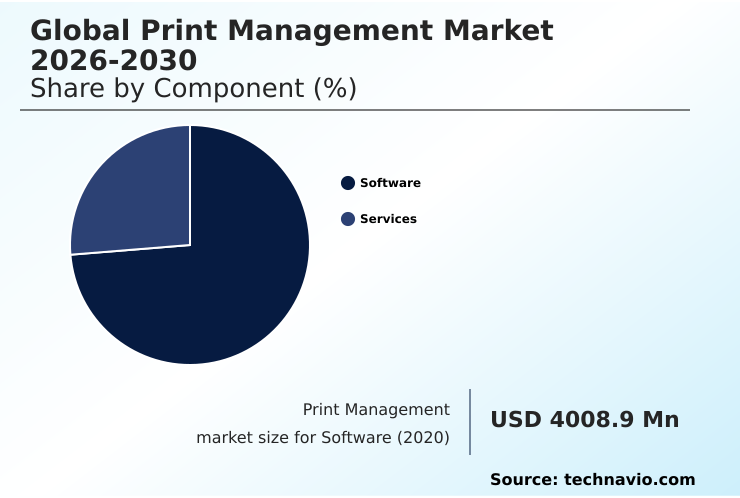
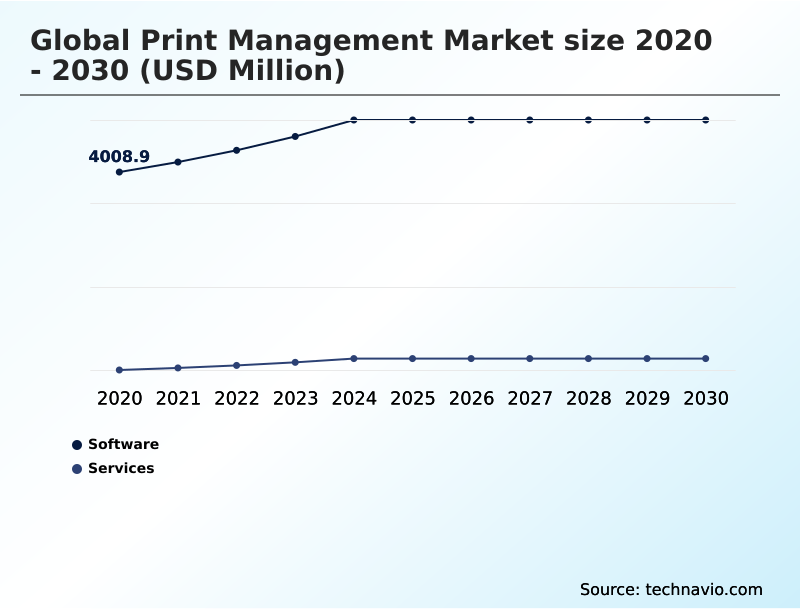
The Software segment was valued at USD 4.69 billion in 2024 and showed a gradual increase during the forecast period.
Regional Analysis
APAC is estimated to contribute 32.8% to the growth of the global market during the forecast period.Technavio’s analysts have elaborately explained the regional trends and drivers that shape the market during the forecast period.
See How Print Management Market Demand is Rising in APAC Get Free Sample
The market's geographic landscape is diverse, with North America leading in the adoption of mature technologies, contributing 24% of incremental growth.
In this region, there is a strong emphasis on zero trust network access and robust endpoint security for all connected devices. Europe focuses heavily on data privacy regulations, driving demand for secure release technology and biometric scanners to ensure compliance.
The APAC region, representing 33% of market growth, is rapidly adopting these solutions, especially in manufacturing and supply chain logistics, where electronic signatures and detailed audit trail generation are crucial.
Across all regions, better cost allocation and secure information handling remain universal goals for enterprises adopting modern print management solutions.
Market Dynamics
Our researchers analyzed the data with 2025 as the base year, along with the key drivers, trends, and challenges. A holistic analysis of drivers will help companies refine their marketing strategies to gain a competitive advantage.
- In the evolving corporate landscape, organizations are increasingly adopting solutions from the Global Print Management Market 2026-2030 for hybrid work to address the needs of a distributed workforce. The core objective is to achieve seamless, secure, and efficient document handling regardless of employee location.
- A key enabler is cloud print management for remote workforces, which eliminates the dependency on physical servers and provides a centralized platform for monitoring and control.
- This transition is often coupled with the deployment of a serverless print infrastructure for cost reduction, which offers a more agile and scalable alternative to traditional on-premises systems, reducing infrastructure-related operational expenses by more than 30% compared to legacy setups. For industries handling sensitive information, such as finance and healthcare, enterprise output management software for compliance is non-negotiable.
- These platforms provide detailed audit trails and enforce strict access controls. A critical feature within this framework is secure document release for data privacy, requiring user authentication at the device to prevent unauthorized access to confidential documents.
- Ultimately, the goal is to leverage an automated workflow for business process optimization, integrating print and digital processes to reduce manual intervention, minimize errors, and accelerate core business functions.
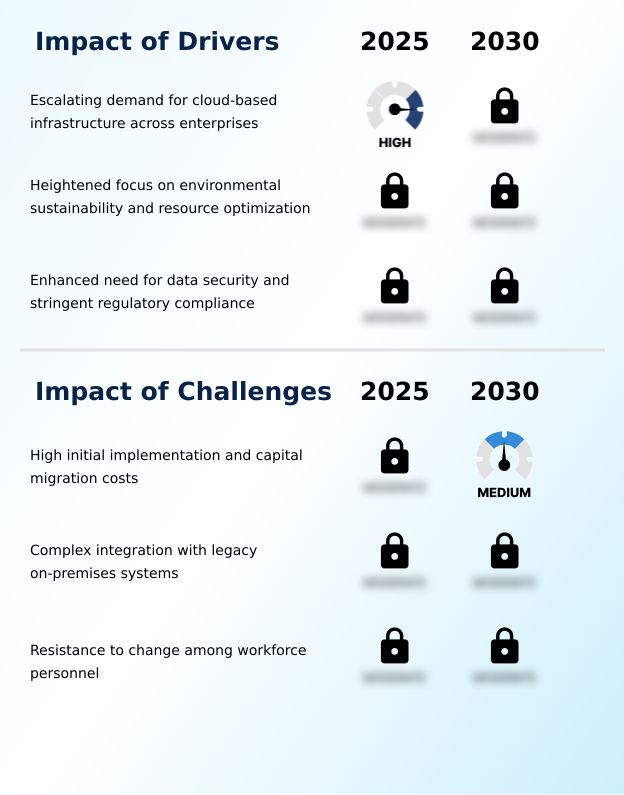
What are the key market drivers leading to the rise in the adoption of Print Management Industry?
- A primary market driver is the escalating demand for cloud-based infrastructure as enterprises seek to enhance operational efficiency and reduce capital expenditures.
- The escalating migration to cloud-based infrastructure is a primary driver, enabling significant capital expenditure reduction and enhancing operational agility. Simultaneously, a heightened focus on environmental sustainability and resource optimization compels organizations to adopt solutions offering granular tracking of materials.
- This aids in hardware consolidation, with some enterprises reducing their device fleet by 25%. The critical need for robust data security compliance and adherence to stringent regulatory compliance is propelling the adoption of advanced document security enforcement measures.
- Systems featuring a rigorous user authentication protocol are now standard, ensuring that sensitive information is protected throughout its lifecycle.
What are the market trends shaping the Print Management Industry?
- The integration of artificial intelligence and predictive analytics is emerging as a transformative trend, enabling proactive monitoring and optimization of print infrastructure.
- Key trends are reshaping the market, led by the integration of predictive analytics for proactive maintenance, which reduces device downtime by over 30%. The adoption of managed print services is accelerating to support hybrid work environments, offering remote accessibility and enhanced security. These services are crucial for improving user adoption metrics as they simplify complex processes.
- Advanced workflow automation, leveraging optical character recognition, is driving paperless initiatives by converting physical documents into searchable digital archiving formats. Furthermore, the demand for sophisticated mobile printing capabilities continues to grow, allowing employees to remain productive regardless of location, with organizations reporting a 15% increase in workforce agility.
What challenges does the Print Management Industry face during its growth?
- A key challenge restraining market growth is the high initial implementation cost and financial burden associated with migrating to modern print management systems.
- A significant challenge involves the complexity of legacy system integration, which can stall technology procurement and increase administrative overhead. Many organizations struggle to reconcile modern serverless peripheral administration with outdated infrastructure, where a lack of APIs can increase integration project timelines by over 50%. This complicates fleet management optimization and real-time device health monitoring.
- Furthermore, concerns regarding data sovereignty and the control of print job routing can create resistance, while poor change management protocols often lead to low user adoption. Aligning new systems with long-standing corporate sustainability pledges without disrupting established workflows remains a delicate balancing act.
Exclusive Technavio Analysis on Customer Landscape
The print management market forecasting report includes the adoption lifecycle of the market, covering from the innovator’s stage to the laggard’s stage. It focuses on adoption rates in different regions based on penetration. Furthermore, the print management market report also includes key purchase criteria and drivers of price sensitivity to help companies evaluate and develop their market growth analysis strategies.
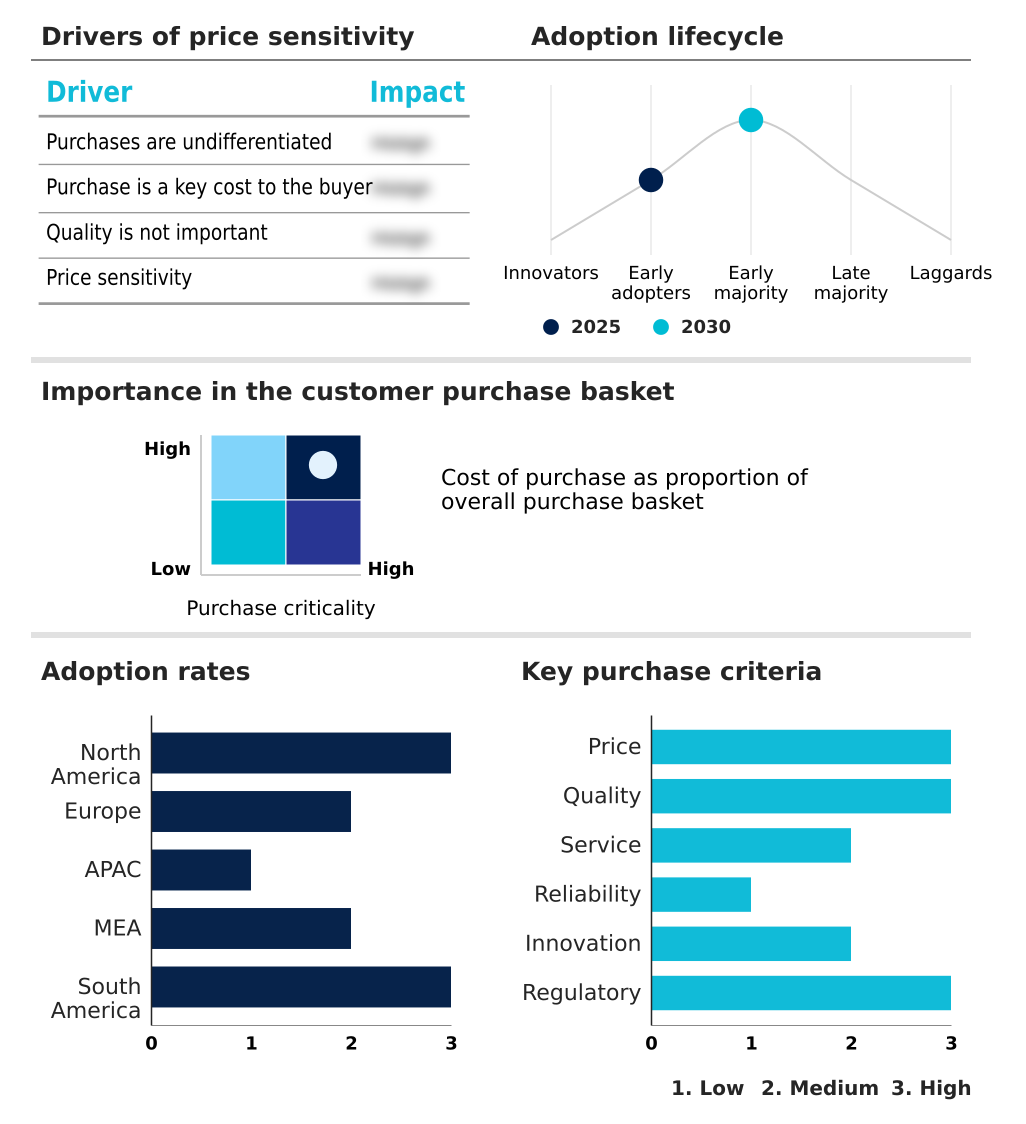
Customer Landscape of Print Management Industry
Competitive Landscape
Companies are implementing various strategies, such as strategic alliances, print management market forecast, partnerships, mergers and acquisitions, geographical expansion, and product/service launches, to enhance their presence in the industry.
Brother International Corp. - Provides secure, integrated print management solutions for enterprise fleet monitoring, user authentication, and automated document workflows.
The industry research and growth report includes detailed analyses of the competitive landscape of the market and information about key companies, including:
- Brother International Corp.
- Canon Inc.
- ECI Software Solutions Inc.
- HP Inc.
- Konica Minolta Inc.
- Kyocera Corp.
- Levi Ray and Shoup Inc
- Lexmark International Inc.
- MyQ
- NT-ware
- PaperCut Software Pty Ltd
- Pharos Systems International
- Ricoh Co. Ltd.
- Seiko Epson Corp.
- ThinPrint GmbH
- Toshiba Corp.
- Tungsten Automation Corp.
- Vasion
- Xerox Holdings Corp.
- Y Soft Corporation
Qualitative and quantitative analysis of companies has been conducted to help clients understand the wider business environment as well as the strengths and weaknesses of key industry players. Data is qualitatively analyzed to categorize companies as pure play, category-focused, industry-focused, and diversified; it is quantitatively analyzed to categorize companies as dominant, leading, strong, tentative, and weak.
Recent Development and News in Print management market
- In August 2025, Microsoft introduced Universal Print Anywhere, also referred to as pull printing, for Microsoft 365 customers worldwide. This new feature enables users to submit print jobs from any device and securely release them at any compatible printer, enhancing flexibility and strengthening document security.
- In July 2025, Kyocera Document Solutions announced an expansion of its partnership with Westcoast. The strengthened collaboration is aimed at enhancing the delivery of A4 print solutions through a more integrated distribution and service framework, enabling improved availability and end-to-end print management services.
- In May 2025, the release of uniFLOW Online 2025.2 marked a significant step forward in the modernization of print management systems, delivering a range of enhancements designed to better support both end users and IT administrators.
- In February 2025, Oracle Corporation introduced a comprehensive update to its enterprise resource planning architecture, prioritizing decentralized peripheral management across hybrid networks and validating the shift toward serverless peripheral administration.
Dive into Technavio’s robust research methodology, blending expert interviews, extensive data synthesis, and validated models for unparalleled Print Management Market insights. See full methodology.
| Market Scope | |
|---|---|
| Page number | 296 |
| Base year | 2025 |
| Historic period | 2020-2024 |
| Forecast period | 2026-2030 |
| Growth momentum & CAGR | Accelerate at a CAGR of 5.5% |
| Market growth 2026-2030 | USD 2004.1 million |
| Market structure | Fragmented |
| YoY growth 2025-2026(%) | 5.2% |
| Key countries | US, Canada, Mexico, Germany, UK, France, Italy, Spain, The Netherlands, China, Japan, India, South Korea, Australia, Indonesia, Saudi Arabia, UAE, South Africa, Turkey, Israel, Brazil, Argentina and Colombia |
| Competitive landscape | Leading Companies, Market Positioning of Companies, Competitive Strategies, and Industry Risks |
Research Analyst Overview
- From a research analyst's perspective, the market's trajectory is defined by a convergence of security and efficiency imperatives. The move toward cloud-based infrastructure is a fundamental redesign of enterprise document ecosystems, enabling serverless peripheral administration and advanced fleet management optimization. This digital transformation is underpinned by a focus on zero trust network access and rigorous endpoint security.
- Core technologies such as secure release technology with user authentication protocol, including biometric scanners and electronic signatures, are becoming standard for document security enforcement. We see end-to-end encryption as table stakes. The integration of predictive analytics for device health monitoring and automated supply replenishment is driving down operational costs, with some firms achieving a 40% reduction in service calls.
- For hybrid work environments, mobile printing capabilities are essential. The market is maturing from basic print job routing to intelligent workflow automation using optical character recognition, all managed through a centralized administration panel. However, issues of data sovereignty and hardware consolidation remain key boardroom topics.
What are the Key Data Covered in this Print Management Market Research and Growth Report?
-
What is the expected growth of the Print Management Market between 2026 and 2030?
-
USD 2.00 billion, at a CAGR of 5.5%
-
-
What segmentation does the market report cover?
-
The report is segmented by Component (Software, and Services), Deployment (Cloud, and On-premises), End-user (Large enterprises, and SMEs) and Geography (North America, Europe, APAC, Middle East and Africa, South America)
-
-
Which regions are analyzed in the report?
-
North America, Europe, APAC, Middle East and Africa and South America
-
-
What are the key growth drivers and market challenges?
-
Escalating demand for cloud-based infrastructure across enterprises, High initial implementation and capital migration costs
-
-
Who are the major players in the Print Management Market?
-
Brother International Corp., Canon Inc., ECI Software Solutions Inc., HP Inc., Konica Minolta Inc., Kyocera Corp., Levi Ray and Shoup Inc, Lexmark International Inc., MyQ, NT-ware, PaperCut Software Pty Ltd, Pharos Systems International, Ricoh Co. Ltd., Seiko Epson Corp., ThinPrint GmbH, Toshiba Corp., Tungsten Automation Corp., Vasion, Xerox Holdings Corp. and Y Soft Corporation
-
Market Research Insights
- Market dynamics are shaped by the pursuit of operational efficiency and stringent regulatory compliance. The shift from capital expenditure reduction strategies to software as a service models improves cost allocation by up to 20%. To meet data privacy regulations and corporate sustainability pledges, organizations leverage solutions for environmental sustainability and resource optimization.
- This supports better information handling and secure audit trail generation, vital for data security compliance. Technology procurement is now influenced by the ease of legacy system integration, as poor integration can increase administrative overhead. Proactive maintenance enhances supply chain logistics and reduces downtime.
- Successful deployments hinge on strong change management protocols to drive user adoption metrics, with well-managed transitions showing a 40% higher success rate. The push for remote accessibility continues to redefine technology infrastructure.
We can help! Our analysts can customize this print management market research report to meet your requirements.
 RIA -
RIA - 
