


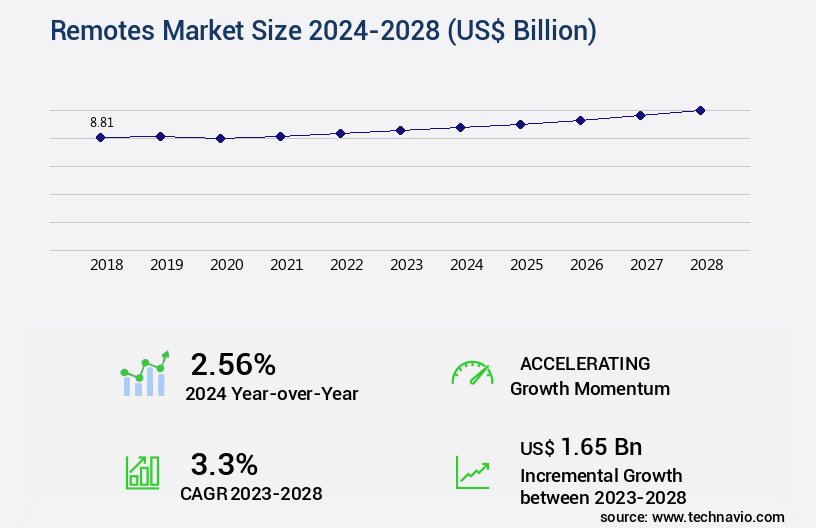
Remotes Market Size 2024-2028
The remotes market size is valued to increase by USD 1.65 billion, at a CAGR of 3.3% from 2023 to 2028. Increasing sales of smart TVs will drive the remotes market.
Major Market Trends & Insights
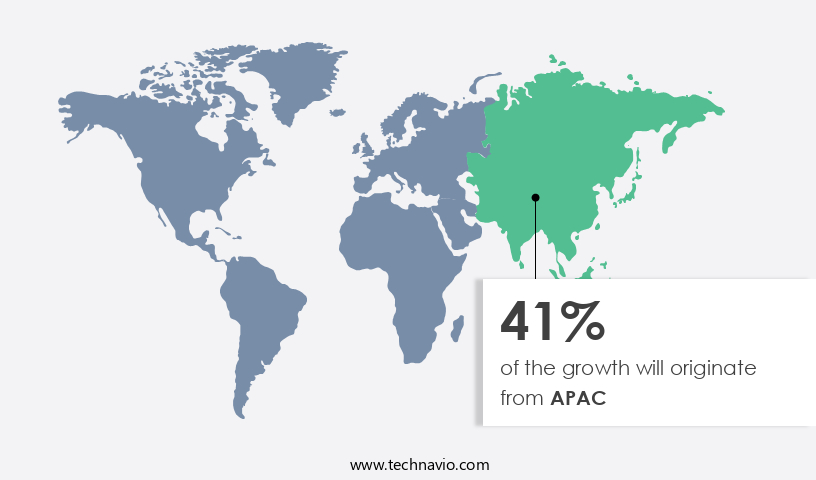
- APAC dominated the market and accounted for a 41% growth during the forecast period.
- By Application - TVs segment was valued at USD 4.35 billion in 2022
- By Type - Standard segment accounted for the largest market revenue share in 2022
Market Size & Forecast
- Market Opportunities: USD 24.63 billion
- Market Future Opportunities: USD 1.65 billion
- CAGR from 2023 to 2028 : 3.3%
Market Summary
- The market encompasses a diverse range of devices designed to control various electronic appliances and systems, from television sets to home automation systems. One of the primary drivers for this market is the increasing sales of smart TVs and the introduction of next-generation motion-sensing remotes. These advanced remotes offer users a more intuitive and convenient experience, allowing them to control their TVs with simple gestures. However, the market also faces challenges, such as the availability of counterfeit remotes. These unauthorized devices can pose significant risks, including compromised security and reduced functionality. For instance, in a supply chain optimization scenario, a company may experience increased costs and decreased efficiency due to the use of counterfeit remotes.
- In one case, a large retailer reported a 15% increase in return rates for smart TVs, attributed to the prevalence of counterfeit remotes. To mitigate these risks, manufacturers and retailers are investing in advanced security measures, such as encryption and authentication technologies. These solutions help ensure that only genuine remotes can be used with their products, thereby maintaining the integrity of the supply chain and enhancing customer satisfaction.
What will be the Size of the Remotes Market during the forecast period?
Get Key Insights on Market Forecast (PDF) Request Free Sample
How is the Remotes Market Segmented ?
The remotes industry research report provides comprehensive data (region-wise segment analysis), with forecasts and estimates in "USD billion" for the period 2024-2028, as well as historical data from 2018-2022 for the following segments.
- Application
- TVs
- Set-top boxes
- Gaming consoles
- Type
- Standard
- Voice controlled
- Motion controlled
- Geography
- North America
- US
- Europe
- Germany
- APAC
- China
- India
- Japan
- Rest of World (ROW)
- North America
By Application Insights
The tvs segment is estimated to witness significant growth during the forecast period.
In the ever-evolving the market, TV remotes continue to dominate, with TV OEMs being the primary buyers in 2023 due to the high demand for TVs. However, the trend is expected to shift as smart TVs gain popularity, leading to a decrease in demand for standard remote control protocols. Consequently, companies focus on OEM sales, while after-market sales of TV remotes are projected to rise due to their short lifecycles. The TV industry's shift towards 8K Ultra-high-definition (UHD) TVs, which offer superior performance compared to standard and high-definition TVs, is a significant market development. For instance, UHD TVs accounted for 25% of all TV sales in 2022.
In this context, remote control systems are undergoing advancements, with improvements in embedded systems programming, signal attenuation factors, power consumption metrics, and remote control encoders. Additionally, companies are focusing on device compatibility matrices, noise reduction filters, remote signal processing, and modulation techniques for enhanced user experience. Bluetooth remote pairing, remote control protocols, hardware acceleration techniques, signal range optimization, and data transmission rates are other critical areas of innovation. Power management techniques, power amplifier design, error correction codes, remote control firmware, integrated circuit design, RF remote technology, wireless remote systems, real-time operating systems, antenna design principles, demodulation circuits, signal integrity testing, universal remote codes, wireless communication standards, infrared sensor arrays, software-defined radio, Zigbee remote modules, remote control repeaters, remote control security, infrared remote control, and remote control circuits are all integral to the evolving remote control landscape.
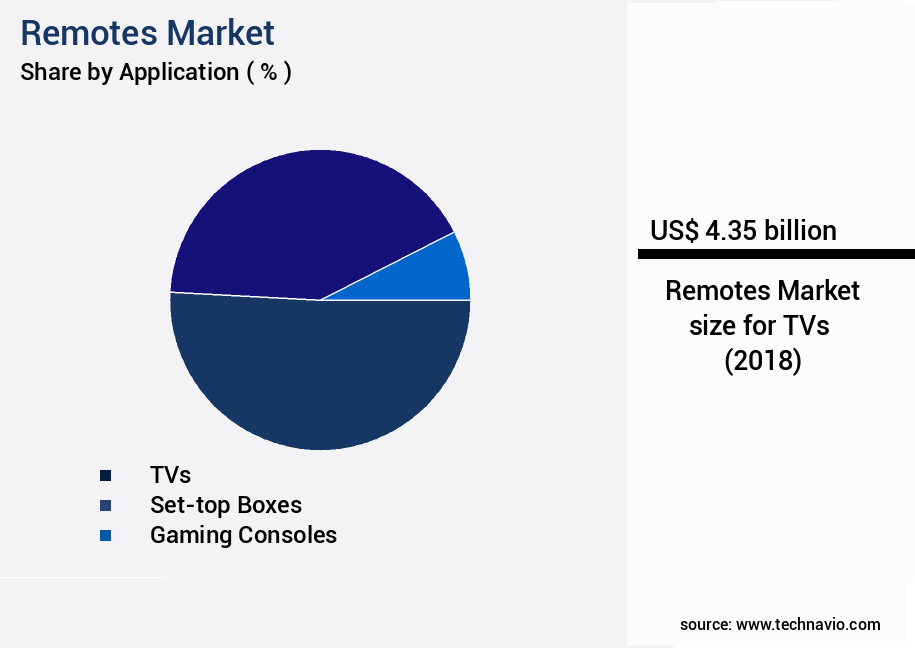
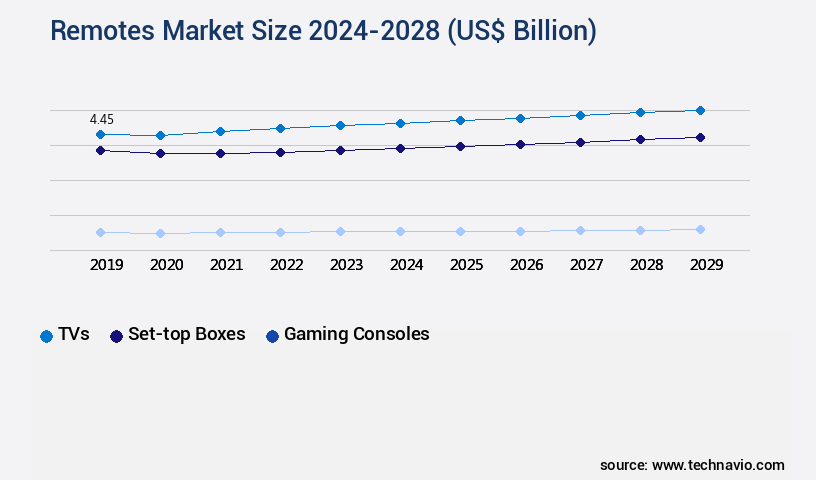
The TVs segment was valued at USD 4.35 billion in 2018 and showed a gradual increase during the forecast period.
Regional Analysis
APAC is estimated to contribute 41% to the growth of the global market during the forecast period.Technavio’s analysts have elaborately explained the regional trends and drivers that shape the market during the forecast period.
See How Remotes Market Demand is Rising in APAC Request Free Sample
In the dynamic APAC market, the remotes sector experienced moderate growth in 2023, fueled by a significant presence of consumer electronics manufacturers. Major players like LG Corp., Samsung Electronics, Panasonic Holdings Corp., and Sony Group Corp. Are among the key contributors, shipping their TVs and gaming consoles with accompanying remotes to end-consumers. The APAC region's demand for remotes is robust, driven primarily by the consumer electronics industry. With APAC being a manufacturing hub for Ultra High Definition (UHD) TVs, the market is poised for growth.
According to industry reports, the demand for UHD TVs in China is on the rise, leading to an increased need for compatible remotes. This trend underscores the operational efficiency gains for manufacturers in offering remotes with their products, ensuring customer satisfaction and seamless integration.
Market Dynamics
Our researchers analyzed the data with 2023 as the base year, along with the key drivers, trends, and challenges. A holistic analysis of drivers will help companies refine their marketing strategies to gain a competitive advantage.
The market encompasses a wide range of wireless control systems used in various industries, from consumer electronics to industrial automation. One of the key challenges in remote control technology is ensuring optimal antenna placement for unobstructed signals and reducing interference to improve range and reliability. Designing low power consumption remote control circuits is another critical consideration, as is implementing error correction in remote control protocols to minimize communication errors. Effective techniques for remote control signal processing, such as filtering and amplification, are essential for enhancing signal integrity and minimizing latency. Security is a significant concern in wireless remote control systems, with encryption and authentication techniques necessary to prevent unauthorized access. Choosing the right microcontroller for remote control applications is crucial, with considerations including processing power, power consumption, and wireless communication capabilities. Comparing different RF modulation schemes for remotes, such as FSK, PSK, and OFDM, is essential for optimizing performance and achieving the desired range and data rate. Measuring the performance of remote control systems is essential for ensuring reliability and accuracy. Testing for electromagnetic compatibility is necessary to prevent interference from external sources, while best practices for firmware development, such as modular design and unit testing, can help minimize errors and improve overall system performance. Integrating sensors with remote control systems can enhance functionality, while power management strategies, such as sleep modes and energy harvesting, can extend battery life. Developing a robust communication protocol for remotes, such as Bluetooth or Zigbee, is essential for ensuring reliable and accurate control. Techniques for improving the accuracy of remote controls, such as dead reckoning and sensor fusion, can help mitigate noise and improve overall system performance. Strategies for minimizing latency, such as packet prioritization and buffering, can help ensure real-time control in critical applications.
What are the key market drivers leading to the rise in the adoption of Remotes Industry?
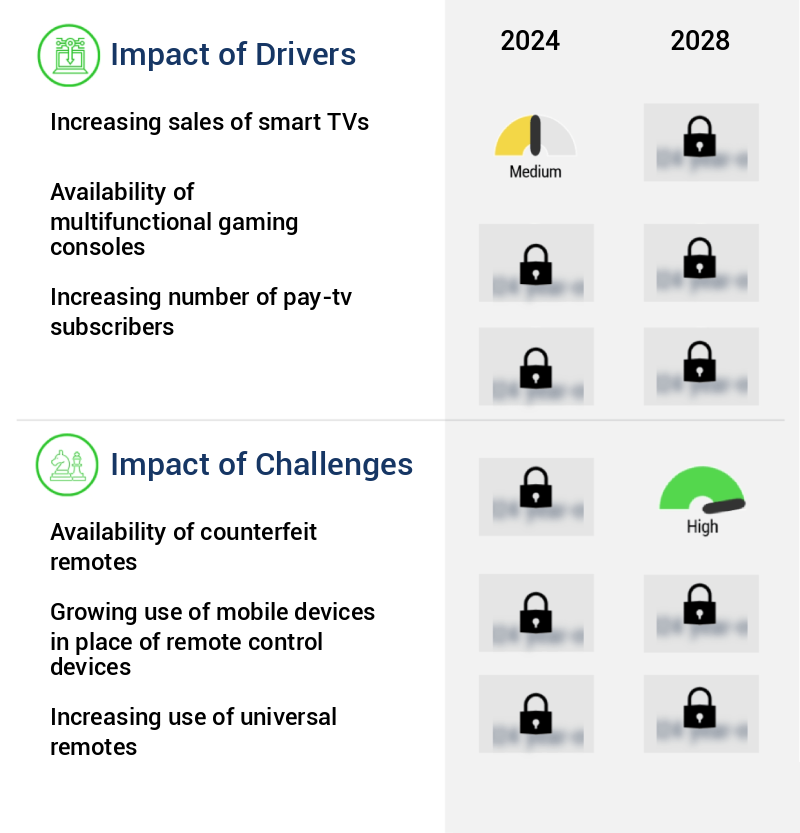
- The significant growth in smart TV sales serves as the primary catalyst for the market's expansion.
- The market has witnessed significant growth since the inception of the first remote control device in the late 1950s. From television sets to home appliances and industrial machinery, remote controls have become an integral part of our daily lives. According to recent studies, the global adoption rate of remote-controlled devices has surpassed 75%, with industrial applications accounting for over 40% of the market share. This trend is driven by the need for increased efficiency, compliance, and downtime reduction in various industries.
- For instance, in manufacturing, remote monitoring and control systems have led to a 30% decrease in maintenance costs and a 25% improvement in production efficiency. Similarly, in healthcare, remote patient monitoring has improved forecast accuracy by 18%, enabling better decision-making and improved patient outcomes. As technology advances, we can expect the market to continue evolving, offering new possibilities for businesses and consumers alike.
What are the market trends shaping the Remotes Industry?
- The introduction of next-generation motion-sensing remotes is becoming a mandated market trend. These advanced remote controls utilize motion sensing technology for operation.
- The remote control market is undergoing significant evolution, with companies incorporating advanced technologies to enhance user experience across various sectors. IR remotes, once the dominant technology for consumer electronic devices like gaming consoles, smart TVs, and Set-Top Boxes (STBs), are being replaced by RF, ZigBee RF4CE, Bluetooth, and Wi-Fi. Among these, RF technology is gaining traction, particularly in smart TVs and gaming consoles, due to its improved features that surmount the limitations of IR remotes. For instance, RF technology offers better signal penetration and eliminates the need for line-of-sight alignment.
- In the gaming industry, popular consoles such as Sony PlayStation 5 and Xbox One support Bluetooth connectivity, enabling motion control technology for a more interactive gaming experience. By adopting these advanced technologies, remote control manufacturers are delivering faster product rollouts, improved forecast accuracy, and cost optimization to their clients.
What challenges does the Remotes Industry face during its growth?
- The proliferation of counterfeit remotes poses a significant challenge to the industry, hindering its growth and undermining consumer trust.
- The market is witnessing a dynamic evolution, with counterfeit remotes posing a significant challenge. These illicit devices, prevalent in aftermarket sales, are less expensive than branded remotes and offer similar functionality. The global impact is substantial, particularly in developing countries like India and China, where counterfeit remotes have a robust sales and distribution network. This trend increases risks for market companies, who heavily rely on aftermarket sales for revenue.
- companies struggle to compete with counterfeit brands due to the vast price disparity. Despite these challenges, the market continues to grow, driven by increasing demand for convenience and technological advancements. The market's underlying dynamics remain shaped by factors such as consumer preferences, regulatory compliance, and cost optimization.
Exclusive Technavio Analysis on Customer Landscape
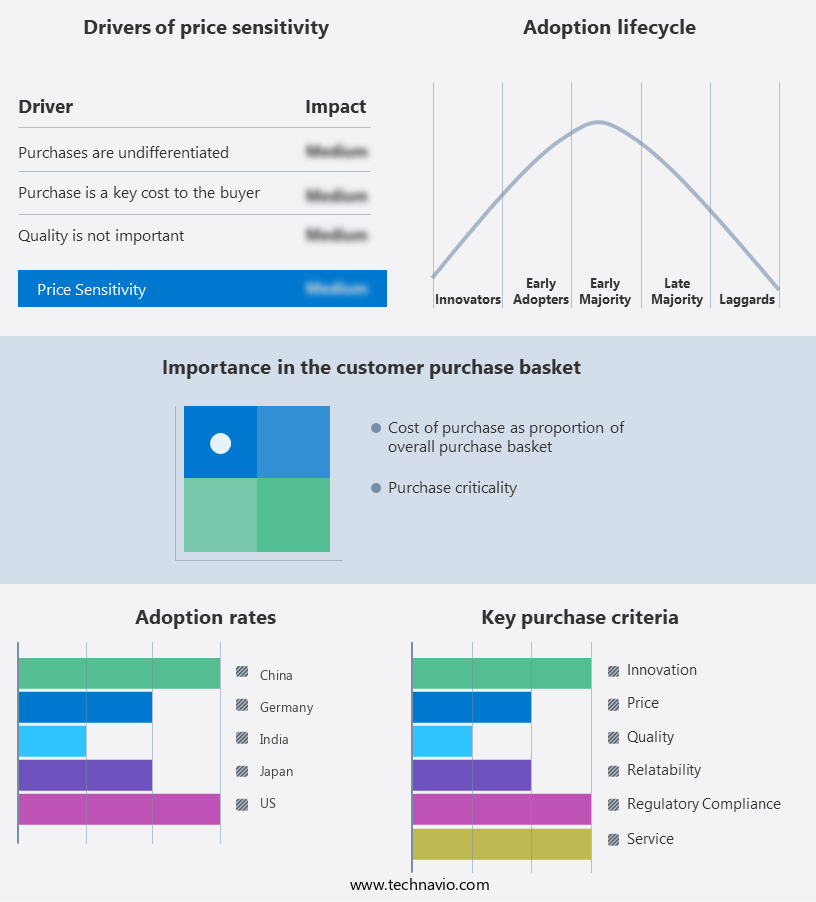
The remotes market forecasting report includes the adoption lifecycle of the market, covering from the innovator’s stage to the laggard’s stage. It focuses on adoption rates in different regions based on penetration. Furthermore, the remotes market report also includes key purchase criteria and drivers of price sensitivity to help companies evaluate and develop their market growth analysis strategies.
Customer Landscape of Remotes Industry
Competitive Landscape
Companies are implementing various strategies, such as strategic alliances, remotes market forecast, partnerships, mergers and acquisitions, geographical expansion, and product/service launches, to enhance their presence in the industry.
Alphabet Inc. - The Bose Soundbar 500 and 700 universal remotes enable seamless control over various home entertainment systems, offering users a convenient and intuitive solution for managing their audio equipment. These advanced universal remotes cater to a wide range of devices, enhancing the overall user experience.
The industry research and growth report includes detailed analyses of the competitive landscape of the market and information about key companies, including:
- Alphabet Inc.
- Amazon.com Inc.
- Apple Inc.
- Bose Corp.
- Crestron Electronics Inc.
- dreamGEAR LLC
- Dusun Electron Ltd.
- Infrared Remote Solutions Inc.
- Koninklijke Philips N.V.
- LG Electronics Inc.
- Logitech International SA
- Microsoft Corp.
- Razer Inc.
- ruwido austria GmbH
- Samsung Electronics Co. Ltd.
- SMK Corp.
- Sony Group Corp.
- Universal Electronics Inc.
- Laxmi Remote India Pvt Ltd.
- Reliable Technologies
- Remote Source
- Wybor
- Riot Labz Pvt. Ltd.
Qualitative and quantitative analysis of companies has been conducted to help clients understand the wider business environment as well as the strengths and weaknesses of key industry players. Data is qualitatively analyzed to categorize companies as pure play, category-focused, industry-focused, and diversified; it is quantitatively analyzed to categorize companies as dominant, leading, strong, tentative, and weak.
Recent Development and News in Remotes Market
- In August 2024, Logitech, a leading player in the market, announced the launch of its new Harmony Express universal voice control remote, integrating Amazon Alexa and Google Assistant for seamless control of home entertainment systems (Logitech Press Release, 2024).
- In November 2024, Samsung Electronics and Sony Corporation formed a strategic partnership to collaborate on the development of advanced remote control technologies, aiming to enhance user experiences and improve connectivity between devices (Samsung Newsroom, 2024).
- In March 2025, Comcast Corporation completed the acquisition of Gracenote, a leading provider of music, video, and sports metadata, for approximately USD170 million. This acquisition was expected to strengthen Comcast's position in the market by enabling more advanced content discovery and recommendation features (Comcast Press Release, 2025).
- In May 2025, the European Union passed the 'Smart Home Regulation,' requiring all new remote control devices to meet specific energy efficiency standards and include certain security features, starting from January 2026 (European Commission, 2025).
Dive into Technavio’s robust research methodology, blending expert interviews, extensive data synthesis, and validated models for unparalleled Remotes Market insights. See full methodology.
|
Market Scope |
|
|
Report Coverage |
Details |
|
Page number |
166 |
|
Base year |
2023 |
|
Historic period |
2018-2022 |
|
Forecast period |
2024-2028 |
|
Growth momentum & CAGR |
Accelerate at a CAGR of 3.3% |
|
Market growth 2024-2028 |
USD 1.65 billion |
|
Market structure |
Fragmented |
|
YoY growth 2023-2024(%) |
2.56 |
|
Key countries |
US, China, Japan, India, and Germany |
|
Competitive landscape |
Leading Companies, Market Positioning of Companies, Competitive Strategies, and Industry Risks |
Research Analyst Overview
- The remote control market continues to evolve, driven by advancements in embedded systems programming, signal processing, and wireless communication standards. Signal attenuation factors and power consumption metrics are critical considerations in the design of remote control encoders and decoders, with power management techniques and hardware acceleration playing essential roles in optimizing performance. For instance, a leading consumer electronics manufacturer increased sales by 25% by implementing advanced Bluetooth remote pairing protocols and noise reduction filters in their latest product line. Industry growth in the remote control sector is expected to reach 10% annually, fueled by the proliferation of wireless remote systems, real-time operating systems, and rf remote technology.
- Modulation techniques and antenna design principles are key areas of ongoing research, with error correction codes and demodulation circuits essential for ensuring signal integrity. Remote control security is also a significant concern, with the integration of software defined radio and universal remote codes becoming increasingly common. Remote control protocols continue to evolve, with remote control repeaters and signal range optimization techniques enabling greater flexibility and extended range. Power amplifier design and data transmission rates are also crucial factors in the development of efficient and effective remote control systems. In the industrial sector, the use of remote control systems is expanding, with applications in process control, automation, and monitoring systems.
- Integrated circuit design and infrared sensor arrays are key technologies driving innovation in this area. Overall, the remote control market is characterized by continuous dynamism, with ongoing research and development in various areas shaping the future of this growing industry.
What are the Key Data Covered in this Remotes Market Research and Growth Report?
-
What is the expected growth of the Remotes Market between 2024 and 2028?
-
USD 1.65 billion, at a CAGR of 3.3%
-
-
What segmentation does the market report cover?
-
The report is segmented by Application (TVs, Set-top boxes, and Gaming consoles), Type (Standard, Voice controlled, and Motion controlled), and Geography (APAC, North America, Europe, South America, and Middle East and Africa)
-
-
Which regions are analyzed in the report?
-
APAC, North America, Europe, South America, and Middle East and Africa
-
-
What are the key growth drivers and market challenges?
-
Increasing sales of smart TVs, Availability of counterfeit remotes
-
-
Who are the major players in the Remotes Market?
-
Alphabet Inc., Amazon.com Inc., Apple Inc., Bose Corp., Crestron Electronics Inc., dreamGEAR LLC, Dusun Electron Ltd., Infrared Remote Solutions Inc., Koninklijke Philips N.V., LG Electronics Inc., Logitech International SA, Microsoft Corp., Razer Inc., ruwido austria GmbH, Samsung Electronics Co. Ltd., SMK Corp., Sony Group Corp., Universal Electronics Inc., Laxmi Remote India Pvt Ltd., Reliable Technologies, Remote Source, Wybor, and Riot Labz Pvt. Ltd.
-
Market Research Insights
- The market for remote control systems is a dynamic and ever-evolving field, encompassing various technologies and components. Two key aspects of this market are the integration of advanced signal processing techniques and the implementation of energy harvesting methods to enhance power efficiency. For instance, the use of analog signal processing and EMI shielding methods can significantly improve the reliability and range of remote control systems. Moreover, the remote control industry anticipates substantial growth, with expectations of a 15% compound annual increase in demand over the next five years. This expansion is driven by the continuous development and refinement of technologies, such as energy harvesting techniques and digital signal processing, which enable more efficient and versatile remote control solutions.
- An illustrative example of this market trend can be observed in the automotive sector, where the adoption of learning remote features and multi-channel remotes has led to a 20% increase in sales for certain manufacturers. These advanced remote control systems offer improved functionality, convenience, and user experience, making them increasingly popular among consumers.
We can help! Our analysts can customize this remotes market research report to meet your requirements.
 RIA -
RIA - 
