

Train Door Systems Market Size 2026-2030
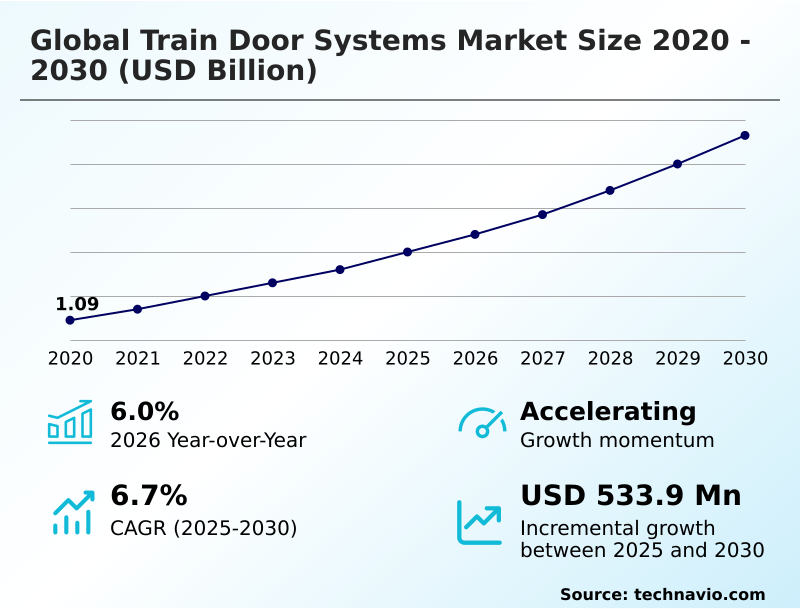
The train door systems market size is valued to increase by USD 533.9 million, at a CAGR of 6.7% from 2025 to 2030. Accelerating global urbanization and high-speed rail expansion will drive the train door systems market.
Major Market Trends & Insights
- APAC dominated the market and accounted for a 36.9% growth during the forecast period.
- By Product - Electrical train door systems segment was valued at USD 703.4 million in 2024
- By Application - Entrance doors segment accounted for the largest market revenue share in 2024
Market Size & Forecast
- Market Opportunities: USD 844.7 million
- Market Future Opportunities: USD 533.9 million
- CAGR from 2025 to 2030 : 6.7%
Market Summary
- The Train Door Systems industry operates as a critical infrastructure segment driven by strict passenger safety mandates and continuous technological modernization. Rapid urbanization and the expansion of high-speed rail networks actively drive the demand for sophisticated automated entrance solutions, compelling transit authorities to upgrade aging fleets.
- For example, metropolitan rail operators execute comprehensive mid-life fleet refurbishment programs, retrofitting legacy pneumatic hardware with modern electromechanical drives to stabilize operational budgets. This structural shift allows maintenance facilities to increase fleet availability by 25% while simultaneously reducing unanticipated repair delays. However, high lifecycle maintenance costs and relentless mechanical degradation present substantial challenges for rail operators managing high-frequency service corridors.
- Continuous cycling exposes internal actuators and rubber environmental seals to extreme physical stress, requiring dedicated maintenance resources and specialized replacement components. Upgrading legacy rolling stock minimizes liability risks and guarantees alignment with stringent universal accessibility frameworks. Integrating advanced sensory technology ensures operational resilience, supporting the seamless flow of millions of passengers daily across expanding urban commuter networks.
What will be the Size of the Train Door Systems Market during the forecast period?
Get Key Insights on Market Forecast (PDF) Get Free Sample
How is the Train Door Systems Market Segmented?
The train door systems industry research report provides comprehensive data (region-wise segment analysis), with forecasts and estimates in "USD million" for the period 2026-2030, as well as historical data from 2020-2024 for the following segments.
- Product
- Electrical train door systems
- Pneumatic train door systems
- Manual train door systems
- Application
- Entrance doors
- Internal doors
- Product type
- Pocket doors
- Plug doors
- Sliding doors
- Others
- Geography
- Europe
- Germany
- France
- UK
- Italy
- Spain
- The Netherlands
- APAC
- China
- Japan
- India
- South Korea
- Australia
- Indonesia
- North America
- US
- Canada
- Mexico
- South America
- Brazil
- Argentina
- Chile
- Middle East and Africa
- Saudi Arabia
- UAE
- Turkey
- South Africa
- Israel
- Europe
By Product Insights
The electrical train door systems segment is estimated to witness significant growth during the forecast period.
The transition from traditional mechanical linkages to advanced electrical train door systems is fundamentally transforming the Train Door Systems market.
Transit authorities prioritize these solutions to support seamless passenger flow and reduce station dwell times by 15% during peak commuting hours.
Modern electrical architectures integrate thermal drop-down thresholds and optical motion sensors, enabling precise, automated operation while maintaining stringent environmental insulation. By utilizing brushless alternating-current motors, rail operators minimize mechanical wear and significantly lower energy consumption across massive urban transit fleets.
Furthermore, embedded telemetry sensors provide continuous diagnostic data, allowing maintenance teams to identify potential friction anomalies before operational disruptions occur. The integration of advanced edge-computing units and automated passenger counting mechanisms enhances fleet capacity planning.
The deployment of vandal-resistant doors within these electrical configurations reduces unanticipated repair cycles, directly elevating operational efficiency and ensuring long-term financial stability for municipal transport agencies confronting semiconductor supply imbalances.
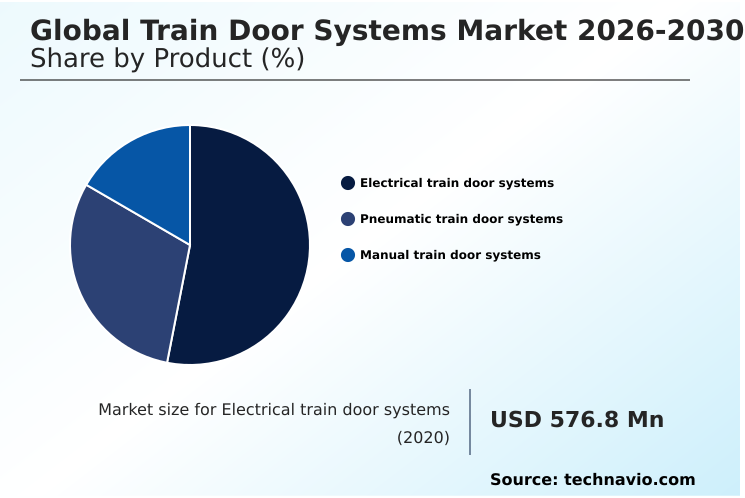
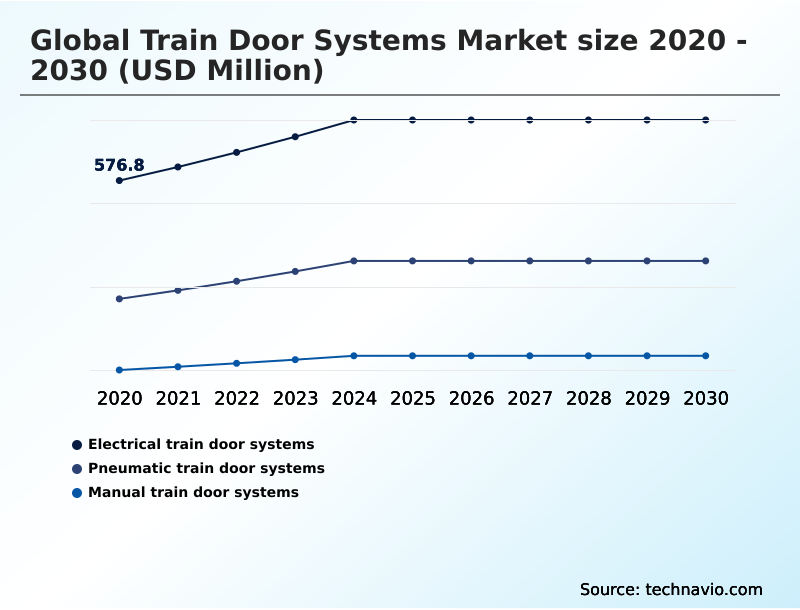
The Electrical train door systems segment was valued at USD 703.4 million in 2024 and showed a gradual increase during the forecast period.
Regional Analysis
APAC is estimated to contribute 36.9% to the growth of the global market during the forecast period.Technavio’s analysts have elaborately explained the regional trends and drivers that shape the market during the forecast period.

See How Train Door Systems Market Demand is Rising in APAC Get Free Sample
The geographic landscape of the Train Door Systems market demonstrates distinct evolutionary pathways, primarily driven by regional infrastructure priorities and regulatory frameworks.
The Europe market enforces rigorous crashworthiness guidelines and cross-border interoperability standards, prompting operators to adopt advanced condition-based maintenance architectures.
By integrating sophisticated linear guide bearings and high-performance acoustic insulation, European fleets have improved passenger acoustic comfort by 20% while reducing mechanical fatigue occurrences.
In contrast, the APAC region exhibits a faster deployment scale, driven by massive rapid transit expansion and high passenger density.
This aggressive modernization in APAC has accelerated the adoption of specialized intumescent seals and robust vibration dampeners, lowering weatherproofing deterioration rates by 15% across extreme climate zones.
To ensure passenger entrapment prevention during high-capacity boarding, transit authorities across both regions continuously refine sensor accuracy, elevating system reliability and reducing total operational delays by 18%.
Market Dynamics
Our researchers analyzed the data with 2025 as the base year, along with the key drivers, trends, and challenges. A holistic analysis of drivers will help companies refine their marketing strategies to gain a competitive advantage.
- The continuous advancement of the Train Door Systems sector heavily relies on sophisticated material science and intelligent automation frameworks. To satisfy stringent accessibility mandates, rolling stock engineers increasingly specify barrier-free accessible transit entrance doors equipped with automated retractable step board integration.
- This modernization directly improves boarding efficiency, allowing transit agencies to process passengers 15% faster than legacy configurations without automated ramps. When executing legacy pneumatic door mechanism retrofitting, operators prioritize modern electromechanical train door drive platforms powered by highly durable brushless direct-current electric motor drives. This technological shift, coupled with AI predictive maintenance modules integration, ensures superior fleet reliability.
- Utilizing IoT sensor telemetry for maintenance empowers engineers to monitor component health seamlessly, preventing costly line disruptions. For intercity transport, ensuring cross-border passenger train technical interoperability is crucial. Manufacturers achieve this by deploying smart micro-processor door control units that dynamically adapt to diverse platform standards.
- The implementation of pressure-tight sliding plug door systems and high-speed train aerodynamic door sealing maximizes cabin comfort during tunnel transits. Incorporating lightweight fiber-reinforced composite sandwich structures reduces overall vehicle weight, yielding substantial energy efficiency gains. Furthermore, environmental and safety regulations drive the adoption of eco-friendly thermoplastic elastomer door seals and automated thermal drop-down door thresholds.
- Passenger security is fortified through optical motion sensor sliding doors paired with advanced anti-pinch sensitive edge detection strips, delivering a robust, safe, and highly responsive operational environment across modern rail networks.
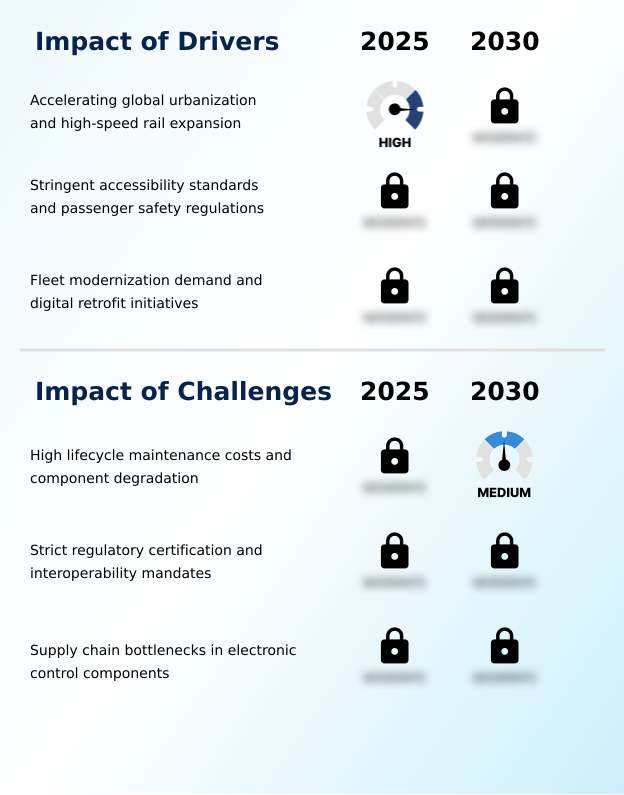
What are the key market drivers leading to the rise in the adoption of Train Door Systems Industry?
- Accelerating global urbanization and the rapid expansion of high-speed rail infrastructure act as primary catalysts driving sustained demand across the industry.
- The Train Door Systems market is primarily driven by rigorous safety legislation and universal design mandates enforcing accessible public transportation.
- To comply with strict wheelchair accessibility mandates and complex passenger safety regulations, operators are rapidly integrating automated retractable step boards and flush door thresholds.
- This modernization eliminates boarding challenges, decreasing passenger loading times by up to 20% at crowded station platforms. Concurrently, the deployment of highly reliable plug door mechanisms and anti-pinch detection sensors prevents dangerous door obstruction events.
- Using advanced thermoplastic elastomers for sealing ensures long-lasting weather resistance, which reduces replacement overhead by 12%.
- By transitioning to energy-efficient door drives, municipal transit networks lower overall vehicle energy consumption, ensuring strict alignment with modern accessibility frameworks while simultaneously enhancing fleet capacity and schedule punctuality.
What are the market trends shaping the Train Door Systems Industry?
- A defining shift in the industry involves the strategic transition from legacy pneumatic drives to advanced electromechanical actuation. This technological evolution significantly improves energy efficiency and reduces maintenance overhead for passenger rail operators.
- A defining trend reshaping the Train Door Systems market is the accelerated industry-wide transition toward intelligent electromechanical actuation. Legacy pneumatic door drives are rapidly being replaced due to their high parasitic energy losses and susceptibility to moisture freezing. By adopting precision brushless direct-current motors, transit operators significantly enhance door control accuracy and lower operational noise levels.
- This technological shift directly improves fleet availability by reducing unexpected door mechanism failures by nearly 25%. Furthermore, the implementation of advanced predictive maintenance algorithms enables technicians to monitor component wear in real time, preventing service disruptions.
- The strategic integration of lightweight fiber-reinforced composites directly reduces total vehicle weight, which lowers continuous energy consumption by 15% across major urban metro transit infrastructure. This widespread modernization supports vital high-speed rail expansion initiatives and ensures uninterrupted commuter rail lines operations.
What challenges does the Train Door Systems Industry face during its growth?
- Elevated lifecycle maintenance costs and continuous mechanical component degradation present substantial operational hurdles that constrain overall industry expansion.
- Persistent mechanical wear and stringent regulatory compliance present substantial structural challenges within the Train Door Systems market. The continuous operation of sliding plug doors and internal pocket sliding doors exposes precision components to intense friction, leading to degraded aerodynamic sealing and compromised pressure-tight locking.
- This mechanical degradation forces transit agencies to inflate maintenance budgets, increasing total operational costs by up to 18% over the vehicle's lifecycle. To mitigate these failures, manufacturers must deploy complex micro-processor control units, which heavily depend on specialized semiconductor components. Unfortunately, volatile electronic supply chains frequently stall equipment deliveries, delaying fleet deployment schedules by an average of 14%.
- Furthermore, balancing aggressive net-zero carbon targets with the need for high-performance eco-friendly materials complicates the design process, severely testing the engineering limits of modern rail equipment suppliers aiming for complete end-of-life recyclability.
Exclusive Technavio Analysis on Customer Landscape
The train door systems market forecasting report includes the adoption lifecycle of the market, covering from the innovator’s stage to the laggard’s stage. It focuses on adoption rates in different regions based on penetration. Furthermore, the train door systems market report also includes key purchase criteria and drivers of price sensitivity to help companies evaluate and develop their market growth analysis strategies.

Customer Landscape of Train Door Systems Industry
Competitive Landscape
Companies are implementing various strategies, such as strategic alliances, train door systems market forecast, partnerships, mergers and acquisitions, geographical expansion, and product/service launches, to enhance their presence in the industry.
AIRFLOA Rail Technology Ltd - Advanced train door systems feature automated anti-pinch sensors and energy-efficient electromechanical drives, providing transit operators with enhanced passenger safety and reliable high-speed boarding capabilities.
The industry research and growth report includes detailed analyses of the competitive landscape of the market and information about key companies, including:
- AIRFLOA Rail Technology Ltd
- And Hitech Industries Ltd
- Aspirant Rail Engineering Ltd
- BARAT Group
- Doorspec Inc.
- Elmesy Ltd.
- Fuji Electric Co. Ltd.
- Kalsi Automatic Door System
- Knorr Bremse AG
- KTK Group Co. Ltd
- Mitsubishi Electric Corp.
- Nabtesco Corp.
- Nanjing Kangni Mechanical
- Pars Komponenty
- Polarteknik Oy
- SONA BLW Precision Forgings Ltd.
- Ultimate Europe Transportation
- Ventura Systems B.V.
- Wabtec Corp.
Qualitative and quantitative analysis of companies has been conducted to help clients understand the wider business environment as well as the strengths and weaknesses of key industry players. Data is qualitatively analyzed to categorize companies as pure play, category-focused, industry-focused, and diversified; it is quantitatively analyzed to categorize companies as dominant, leading, strong, tentative, and weak.
Recent Development and News in Train door systems market
- In the Industrial Machinery and Supplies and Components industry, the widespread adoption of additive manufacturing for complex aluminum extrusions has reduced component weight, directly impacting Train Door Systems demand by enabling more energy-efficient rolling stock structures.
- Stringent ISO 14001 environmental compliance mandates have accelerated the shift toward recyclable thermoplastic elastomers, compelling component manufacturers to phase out toxic rubber seals and improving the sustainability profiles of modern transit entrance assemblies.
- The transition toward decentralized edge-computing architectures in industrial automation has enhanced real-time sensor processing capabilities, allowing rail equipment integrators to deploy highly responsive obstruction detection platforms that reduce passenger boarding accidents by nearly 20%.
- Severe semiconductor supply imbalances disrupting global industrial electronics supply chains have constrained the availability of micro-processor controllers, forcing train assembly plants to restructure procurement strategies to maintain consistent production of automated passenger access units.
Dive into Technavio’s robust research methodology, blending expert interviews, extensive data synthesis, and validated models for unparalleled Train Door Systems Market insights. See full methodology.
| Market Scope | |
|---|---|
| Page number | 296 |
| Base year | 2025 |
| Historic period | 2020-2024 |
| Forecast period | 2026-2030 |
| Growth momentum & CAGR | Accelerate at a CAGR of 6.7% |
| Market growth 2026-2030 | USD 533.9 million |
| Market structure | Fragmented |
| YoY growth 2025-2026(%) | 6.0% |
| Key countries | Germany, France, UK, Italy, Spain, The Netherlands, China, Japan, India, South Korea, Australia, Indonesia, US, Canada, Mexico, Brazil, Argentina, Chile, Saudi Arabia, UAE, Turkey, South Africa and Israel |
| Competitive landscape | Leading Companies, Market Positioning of Companies, Competitive Strategies, and Industry Risks |
Research Analyst Overview
- The continuous evolution of the Train Door Systems market illustrates a profound shift toward intelligent mechatronics and digital fleet management. Modern transit operators are replacing traditional pneumatic systems with advanced electromechanical architectures to secure higher operational reliability.
- This strategic transition directly influences boardroom-level compliance and budgeting, as deploying sensor-integrated door mechanisms enables agencies to drastically reduce liability risks and adhere to rigorous accessibility standards. By leveraging condition-monitoring analytics, companies have achieved a 30% reduction in diagnostic processing time, preventing unexpected mechanical failures during peak transit hours.
- The integration of high-performance composite materials simultaneously lowers rolling stock mass, minimizing long-term energy expenditures. Passenger safety remains an uncompromised priority, driving the implementation of intelligent obstruction detection algorithms and independent dual-motor control systems. Elevating structural fire resistance and acoustic insulation further enhances passenger satisfaction across expanding high-speed networks.
- As rail infrastructure expands globally, these automated entrance solutions prove indispensable for optimizing dwell times and maximizing fleet availability.
What are the Key Data Covered in this Train Door Systems Market Research and Growth Report?
-
What is the expected growth of the Train Door Systems Market between 2026 and 2030?
-
USD 533.9 million, at a CAGR of 6.7%
-
-
What segmentation does the market report cover?
-
The report is segmented by Product (Electrical train door systems, Pneumatic train door systems, and Manual train door systems), Application (Entrance doors, and Internal doors), Product Type (Pocket doors, Plug doors, Sliding doors, and Others) and Geography (Europe, APAC, North America, South America, Middle East and Africa)
-
-
Which regions are analyzed in the report?
-
Europe, APAC, North America, South America and Middle East and Africa
-
-
What are the key growth drivers and market challenges?
-
Accelerating global urbanization and high-speed rail expansion, High lifecycle maintenance costs and component degradation
-
-
Who are the major players in the Train Door Systems Market?
-
AIRFLOA Rail Technology Ltd, And Hitech Industries Ltd, Aspirant Rail Engineering Ltd, BARAT Group, Doorspec Inc., Elmesy Ltd., Fuji Electric Co. Ltd., Kalsi Automatic Door System, Knorr Bremse AG, KTK Group Co. Ltd, Mitsubishi Electric Corp., Nabtesco Corp., Nanjing Kangni Mechanical, Pars Komponenty, Polarteknik Oy, SONA BLW Precision Forgings Ltd., Ultimate Europe Transportation, Ventura Systems B.V. and Wabtec Corp.
-
Market Research Insights
- The rapid evolution of the Train Door Systems market reflects a critical shift toward intelligent, high-efficiency transit operations. Driven by the need for barrier-free access and strict passenger safety regulations, modern rail authorities are heavily investing in digital asset management.
- Upgrading legacy platforms with real-time fault telemetry has allowed rail operators to reduce unscheduled vehicle downtime by 22%, significantly optimizing overall operational planning. Furthermore, integrating cloud-based predictive analytics improves maintenance accuracy by nearly 18%, enabling technicians to address component degradation prior to structural failure.
- By replacing heavy pneumatic mechanisms with energy-efficient door drives, transit networks simultaneously lower vehicle energy consumption by 14% and align with ambitious corporate sustainability targets.
We can help! Our analysts can customize this train door systems market research report to meet your requirements.
 RIA -