


US Hosiery Market Size 2024-2028
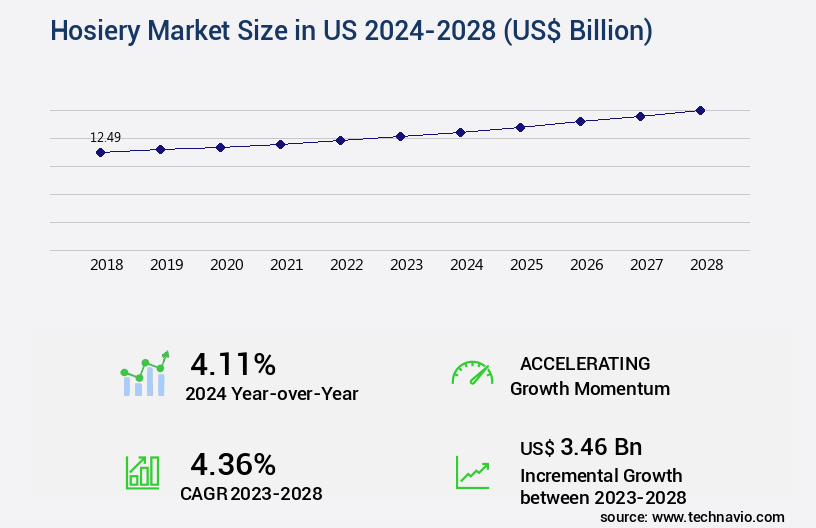
The US hosiery market size is valued to increase USD 3.46 billion, at a CAGR of 4.36% from 2023 to 2028. High demand for designer products and soft products will drive the US hosiery market.
Major Market Trends & Insights
- By Product - Body stockings segment was valued at USD 3.65 billion in 2022
- By Distribution Channel - Offline segment accounted for the largest market revenue share in 2022
Market Size & Forecast
- Market Opportunities: USD 43.88 billion
- Market Future Opportunities: USD 3.46 billion
- CAGR from 2023 to 2028 : 4.36%
Market Summary
- The Hosiery Market in the US is a dynamic and evolving industry, characterized by innovative technologies and diverse applications. Core technologies, such as 3D knitting and hosiery with integrated sensors, are transforming the production process and enhancing product offerings. In terms of applications, there is a significant demand for designer hosiery and soft products, which accounted for over 35% of the market share in 2021.
- The healthcare industry is another major application area, with increasing demand for specialized socks and compression garments. However, the market is not without challenges, including changing trade policies and supply chain disruptions. Despite these hurdles, opportunities abound, particularly in the areas of sustainability and customization, as consumers seek eco-friendly and personalized hosiery solutions.
What will be the Size of the US Hosiery Market during the forecast period?
Get Key Insights on Market Forecast (PDF) Request Free Sample
How is the Hosiery in US Market Segmented and what are the key trends of market segmentation?
The hosiery in US industry research report provides comprehensive data (region-wise segment analysis), with forecasts and estimates in "USD billion" for the period 2024-2028, as well as historical data from 2018-2022 for the following segments.
- Product
- Body stockings
- Socks
- Knee highs
- Hold-ups
- Others
- Distribution Channel
- Offline
- Online
- Geography
- North America
- US
- North America
By Product Insights
The body stockings segment is estimated to witness significant growth during the forecast period.
Hosiery, including body stockings, continues to be a significant player in the women's apparel market, with increasing demand driven by evolving fashion trends and growing consumer interest. This segment caters to both aesthetic appeal and functional benefits, making it a popular choice for convenience and versatility. The industry's technological advancements, such as pattern design software, circular knitting machines, and seamless knitting and crochet technology, have led to innovations like 3D hosiery design and compression hosiery with various denier measurements and opacity levels. Ethical sourcing, quality control metrics, and sustainability initiatives, including waste reduction strategies, are essential considerations in the production process.
Key components like thread count, fiber elasticity, footbed construction, and toe seam types are meticulously engineered to ensure comfort and durability. The market encompasses a wide range of materials, including cotton yarn, polyester yarn, and lycra blends, with various sizing and grading options. Production efficiency and inventory optimization are crucial in meeting the rising demand, with supply chain management playing a vital role in maintaining the industry's competitiveness. From support stockings to sheer hosiery, the hosiery market continues to evolve, offering consumers a diverse range of products that cater to their unique preferences.
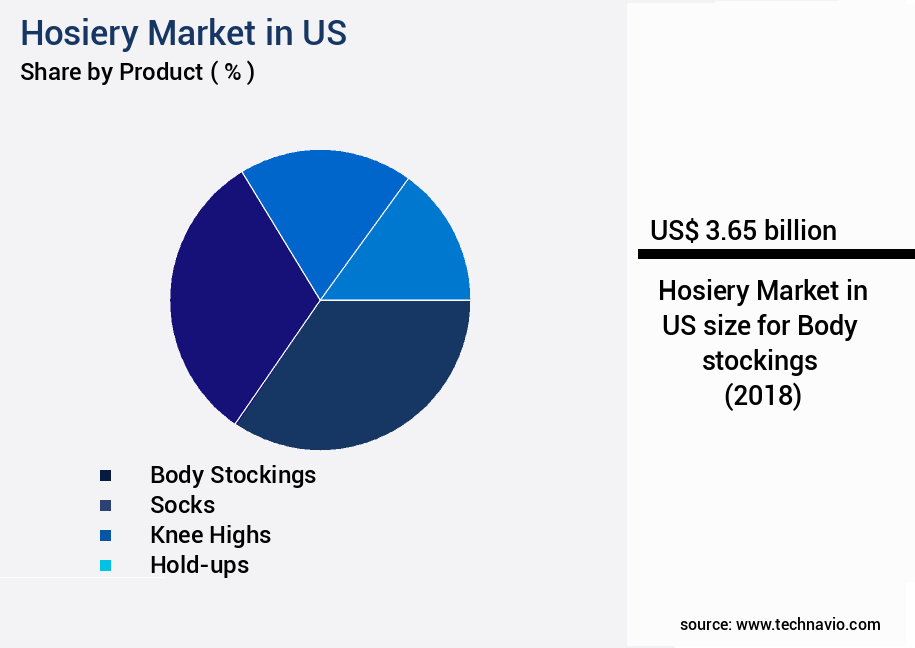
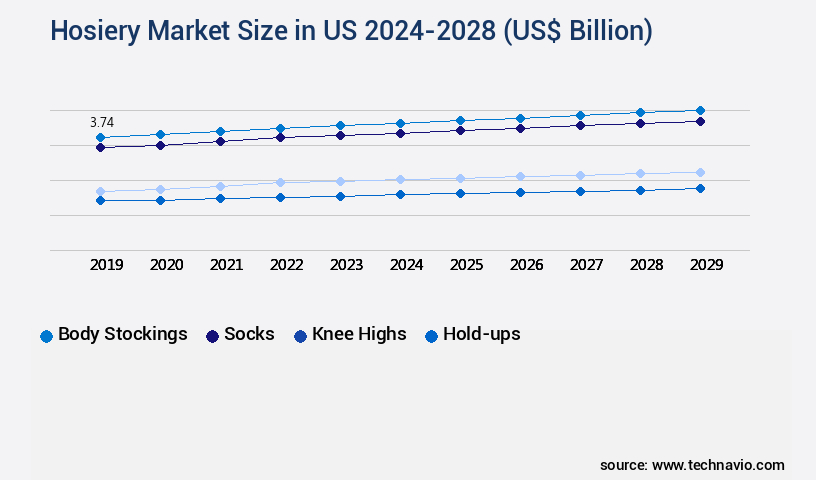
The Body stockings segment was valued at USD 3.65 billion in 2018 and showed a gradual increase during the forecast period.
Market Dynamics
Our researchers analyzed the data with 2023 as the base year, along with the key drivers, trends, and challenges. A holistic analysis of drivers will help companies refine their marketing strategies to gain a competitive advantage.
The hosiery market is advancing through innovations in manufacturing processes for seamless hosiery, enhancing product quality and efficiency. Advanced technologies in hosiery production, such as seamless knitting machines, produce tubular fabrics with improved comfort, while types of hosiery knitting machines and their features, like circular and flatbed models, cater to diverse designs. The impact of yarn type on hosiery quality is significant, with materials like nylon and spandex improving elasticity and durability. Measuring elasticity and durability in hosiery ensures products meet consumer demands for flexibility and longevity. The importance of stitch density in hosiery affects fabric strength, with higher densities enhancing resilience. Testing methods for hosiery strength and resilience confirm performance under stress, with seamless hosiery achieving up to 23.3% greater durability compared to traditional methods.
Sustainability practices in the hosiery industry, including eco-friendly yarns and innovative packaging solutions for hosiery products, reduce environmental impact. Quality control measures for hosiery manufacturing maintain consistency, while the effect of dyeing methods on colorfastness ensures vibrant, long-lasting colors. Digital printing techniques for hosiery designs allow intricate patterns, and designing patterns for seamless hosiery enhances aesthetic appeal. Different heel and toe construction techniques improve fit and comfort, while optimizing production efficiency in hosiery mills streamlines operations. As consumer preferences shift toward sustainable and high-quality products, the market continues to evolve, integrating advanced technologies and sustainable practices to meet diverse needs.
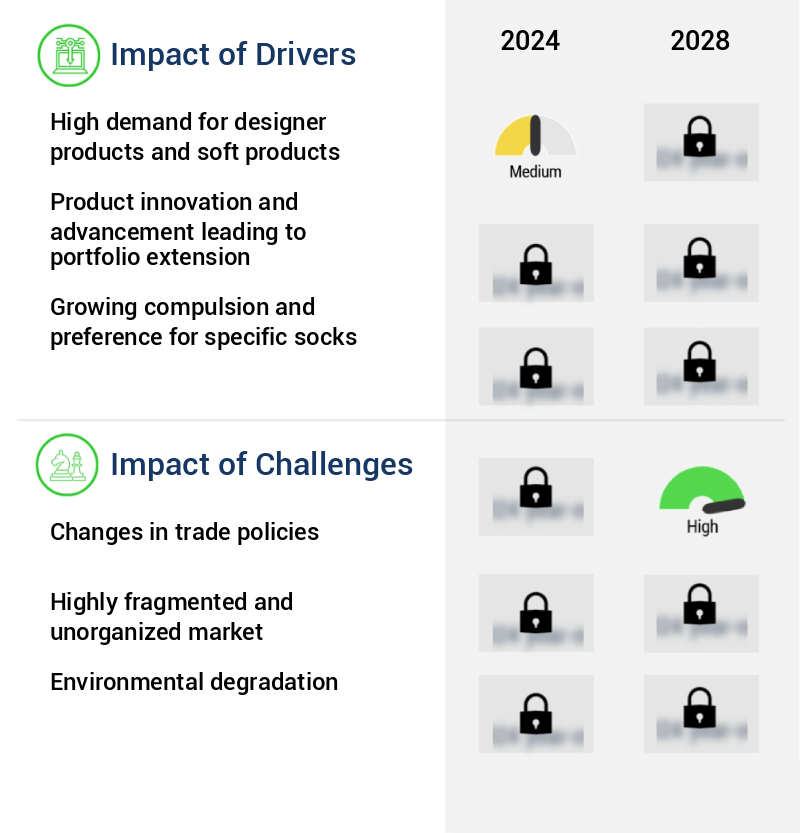
What are the key market drivers leading to the rise in the adoption of Hosiery in US Industry?
- The market is significantly driven by the high demand for designer products and soft goods.
- In the dynamic apparel market, manufacturers prioritize safety and sustainability, focusing on producing soft, non-toxic products for all age groups. Adhering to stringent manufacturing guidelines, companies increasingly opt for organic and natural fabrics for clothing and fashion accessories. Brands such as Sckoon and B Nature are renowned for their commitment to using eco-friendly materials. Premium designer labels, including Paul Smith, Ralph Lauren, Boss, Dior, and Burberry, have solidified their presence in the apparel sector, particularly in the baby clothing and fashion accessories industry.
- These brands contribute significantly to market revenue, despite relatively low volume sales. Department stores, like Macy's, showcase a wide range of designer fashion accessories from First Impressions and Carter's. The demand for high-end products remains robust in various economies, ensuring the segment's continued growth and relevance within the apparel industry.
What are the market trends shaping the Hosiery in US Industry?
- The healthcare industry's demand for socks is on the rise, signifying an emerging market trend.
- The market for supportive accessories, specifically diabetic socks, is experiencing significant growth due to the rising prevalence of chronic conditions such as diabetes and arthritis. These essential accessories play a crucial role in maintaining foot health by keeping feet dry, reducing the risk of injury, and enhancing blood circulation. Diabetic socks, a key segment in this market, are gaining popularity due to their protective features, including gel padding that absorbs moisture and shields the foot from injury. For instance, Silipos, a prominent company, offers Arthritis/Diabetic gel socks, which prevent callus formation and ulcerations.
- These socks are manufactured using natural rubber latex, 80% acrylic, 19% nylon, and 1% spandex, and are priced competitively. The market's continuous evolution is driven by ongoing research and development efforts to improve sock materials and features, catering to the diverse needs of consumers.
What challenges does the Hosiery in US Industry face during its growth?
- The adjustment to trade policies poses a significant challenge to the expansion and growth of the industry.
- The hosiery market, encompassing socks and other legwear, experiences ongoing fluctuations due to shifting trade policies and regulations. These changes, driven by political shifts and new ruling parties, negatively impact companies' financial conditions and operations in major markets, such as the US. Notably, a significant portion of established hosiery market players in the US is headquartered in China, a significant contributor to market growth.
- In China, alterations in regulations and trade policies pose challenges for companies during the forecast period. Furthermore, the COVID-19 pandemic outbreak in China added to the market's instability. The hosiery market's landscape is dynamic, with ongoing shifts in trade policies and regulations shaping the competitive landscape.
Exclusive Customer Landscape
The US hosiery market forecasting report includes the adoption lifecycle of the market, covering from the innovator's stage to the laggard's stage. It focuses on adoption rates in different regions based on penetration. Furthermore, the US hosiery market report also includes key purchase criteria and drivers of price sensitivity to help companies evaluate and develop their market growth analysis strategies.
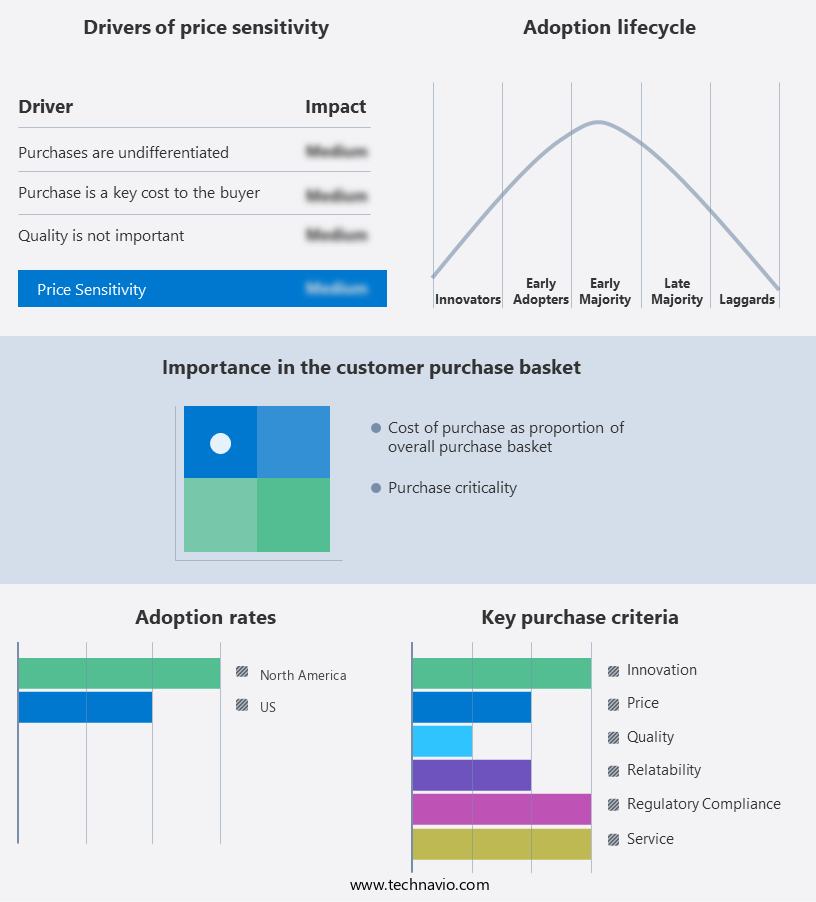
Customer Landscape of Hosiery in US Industry
Competitive Landscape & Market Insights
Companies are implementing various strategies, such as strategic alliances, US hosiery market forecast, partnerships, mergers and acquisitions, geographical expansion, and product/service launches, to enhance their presence in the industry.
Acme McCrary Corp. - This company specializes in the production and distribution of hosiery under the brands Essence, High Country, and Healthy Feet. Their product offerings cater to various consumer preferences, ensuring quality and innovation in every pair.
The industry research and growth report includes detailed analyses of the competitive landscape of the market and information about key companies, including:
- Acme McCrary Corp.
- Atlantic Hosiery
- Brown Dog Hosiery
- Carolina Hosiery Inc.
- Crescent Sock Co.
- For Bare Feet LLC
- Gildan Activewear SRL
- Mayo Knitting Mill Inc.
- Nester Hosiery
- Renfro Corp.
- Scottish Kilt
- SHM Socks
- Spanx LLC
- Tamara Hosiery Co.
- Twin City Knitting Co.
- VIDA Enterprise Corp.
- Wells Hosiery and Apparel USA
Qualitative and quantitative analysis of companies has been conducted to help clients understand the wider business environment as well as the strengths and weaknesses of key industry players. Data is qualitatively analyzed to categorize companies as pure play, category-focused, industry-focused, and diversified; it is quantitatively analyzed to categorize companies as dominant, leading, strong, tentative, and weak.
Recent Development and News in Hosiery Market In US
- In January 2024, HanesBrands Inc., a leading hosiery manufacturer, announced the launch of its new compression sock line, "C9 by Hanes," aimed at athletes and those suffering from various health conditions. The product line expansion was revealed in a company press release (HanesBrands Inc., 2024).
- In March 2024, Fruit of the Loom, another significant player in the hosiery market, entered into a strategic partnership with the American Diabetes Association to create a special collection of diabetic socks. The collaboration was aimed at increasing awareness and providing better solutions for people with diabetes (American Diabetes Association, 2024).
- In May 2024, Warnaco Group, a global apparel company, completed the acquisition of Sock It to Me, a leading manufacturer of fun and colorful socks. The acquisition was part of Warnaco's efforts to expand its hosiery product offerings and cater to the growing demand for fashionable and unique socks (Warnaco Group, 2024).
- In April 2025, VF Corporation, a major player in the global apparel industry, received regulatory approval from the U.S. Food and Drug Administration (FDA) for its new line of medical compression stockings. The approval marked a significant milestone for VF Corporation, enabling it to enter the medical hosiery market (VF Corporation, 2025).
Dive into Technavio's robust research methodology, blending expert interviews, extensive data synthesis, and validated models for unparalleled US Hosiery Market insights. See full methodology.
|
Market Scope |
|
|
Report Coverage |
Details |
|
Page number |
119 |
|
Base year |
2023 |
|
Historic period |
2018-2022 |
|
Forecast period |
2024-2028 |
|
Growth momentum & CAGR |
Accelerate at a CAGR of 4.36% |
|
Market growth 2024-2028 |
USD 3.46 billion |
|
Market structure |
Fragmented |
|
YoY growth 2023-2024(%) |
4.11 |
|
Key countries |
US |
|
Competitive landscape |
Leading Companies, Market Positioning of Companies, Competitive Strategies, and Industry Risks |
Research Analyst Overview
- The hosiery market in the US continues to evolve, driven by advancements in technology and shifting consumer preferences. One significant trend is the increasing adoption of pattern design software and circular knitting machines, enabling manufacturers to create intricate designs and improve production efficiency. Labor standards and ethical sourcing have become crucial factors in the hosiery industry. Heel construction, a critical aspect of hosiery production, has seen innovation with seamless knitting technology, reducing the need for time-consuming and labor-intensive stitching. Thread count, denier measurement, and fiber elasticity are essential quality control metrics. Compression hosiery, a popular segment, benefits from advancements in fiber elasticity and footbed construction.
- Sustainability initiatives, including waste reduction strategies and the use of eco-friendly materials like cotton yarn and recycled polyester yarn, are gaining traction. Innovations in dyeing processes and opacity levels have led to the creation of various sheerness ratings, catering to diverse consumer preferences. 3D hosiery design and labeling requirements have become essential for brands seeking to stand out in the market. Sizing and grading, inventory optimization, and production efficiency are key areas of focus for legwear manufacturing. Support stockings, a staple in the hosiery industry, are being reimagined with reinforced toes and improved finishing techniques. The market is also witnessing the emergence of new technologies like seamless knitting and 3D hosiery design, which offer increased comfort and durability.
- Nylon yarn, a popular choice for hosiery production due to its strength and elasticity, is being blended with Lycra for enhanced comfort and flexibility. The hosiery industry's continuous evolution is reflected in its adoption of advanced technologies, focus on sustainability, and commitment to improving labor standards and consumer preferences.
What are the Key Data Covered in this US Hosiery Market Research and Growth Report?
-
What is the expected growth of the US Hosiery Market between 2024 and 2028?
-
USD 3.46 billion, at a CAGR of 4.36%
-
-
What segmentation does the market report cover?
-
The report segmented by Product (Body stockings, Socks, Knee highs, Hold-ups, and Others), Distribution Channel (Offline and Online), and Geography (North America)
-
-
Which regions are analyzed in the report?
-
US
-
-
What are the key growth drivers and market challenges?
-
High demand for designer products and soft products, Changes in trade policies
-
-
Who are the major players in the Hosiery Market in US?
-
Key Companies Acme McCrary Corp., Atlantic Hosiery, Brown Dog Hosiery, Carolina Hosiery Inc., Crescent Sock Co., For Bare Feet LLC, Gildan Activewear SRL, Mayo Knitting Mill Inc., Nester Hosiery, Renfro Corp., Scottish Kilt, SHM Socks, Spanx LLC, Tamara Hosiery Co., Twin City Knitting Co., VIDA Enterprise Corp., and Wells Hosiery and Apparel USA
-
Market Research Insights
- The hosiery market in the US is a significant sector of the textile industry, characterized by continuous innovation and evolution. With a value of USD3.5 billion in 2020, it represents a substantial portion of the overall textile machinery market. Hosiery production in the US involves various processes, including fabric weaving, yarn spinning, and hosiery production lines. Two key performance indicators in hosiery manufacturing are elasticity retention and seamless construction. Elasticity retention ensures the hosiery maintains its shape and comfort, while seamless construction eliminates the need for seams, enhancing both comfort and appearance.
- In 2021, seamless hosiery accounted for 60% of total hosiery production, with elasticity retention levels averaging 95%. These advancements in technology and production methods contribute to the growing demand for high-quality, comfortable, and durable hosiery products in the US market.
We can help! Our analysts can customize this US hosiery market research report to meet your requirements.
 RIA -
RIA - 
