



Veterinary Software Market Size 2026-2030
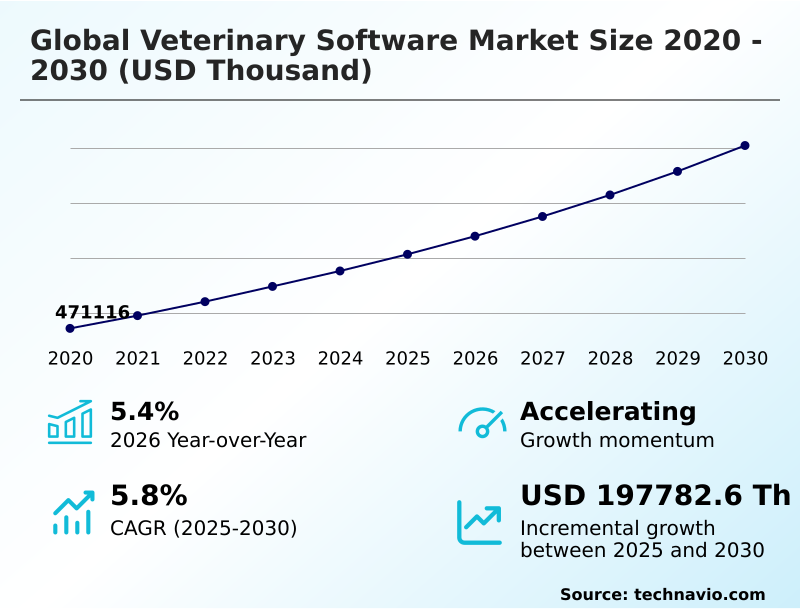
The veterinary software market size is valued to increase by USD 197.78 million, at a CAGR of 5.8% from 2025 to 2030. Digital transformation in veterinary practice management will drive the veterinary software market.
Major Market Trends & Insights
- North America dominated the market and accounted for a 32.3% growth during the forecast period.
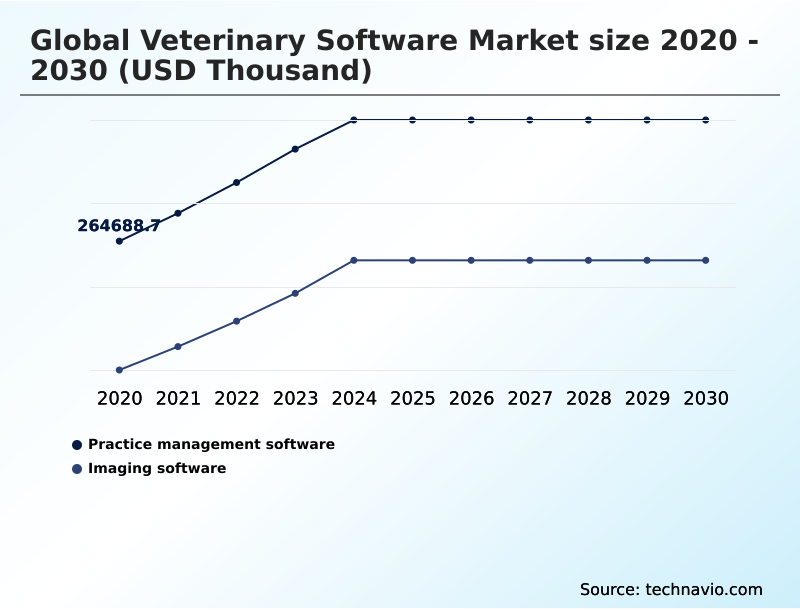
- By Product - Practice management software segment was valued at USD 319.48 million in 2024
- By Deployment - On-premise segment accounted for the largest market revenue share in 2024
Market Size & Forecast
- Market Opportunities:
- Market Future Opportunities: USD 197.78 million
- CAGR from 2025 to 2030 : 5.8%
Market Summary
- The Veterinary Software Market is undergoing rapid digital transformation as animal healthcare providers adopt advanced platforms to manage increasing operational complexities. Clinical administrators increasingly utilize these comprehensive systems to automate scheduling, streamline inventory control, and centralize medical records.
- For example, integrating specialized supply chain modules allows large referral hospitals to automatically track pharmaceutical dispensing, which prevents stockouts and ensures regulatory compliance. Facilities deploying modern cloud-based systems report a 25% reduction in administrative processing time compared to those relying on legacy on-premise hardware.
- The primary driver accelerating this adoption is the rising penetration of pet insurance, which necessitates automated claims adjudication features to handle complex billing cycles seamlessly. However, the market encounters substantial challenges related to cybersecurity vulnerabilities and strict data privacy regulations. Software developers must continuously invest in multi-layered encryption to protect sensitive client information across diverse legislative jurisdictions.
- These dynamic factors compel continuous innovation, ensuring that modern practice management tools remain essential for sustaining financial viability and clinical excellence.
What will be the Size of the Veterinary Software Market during the forecast period?
Get Key Insights on Market Forecast (PDF) Get Free Sample
How is the Veterinary Software Market Segmented?
The veterinary software industry research report provides comprehensive data (region-wise segment analysis), with forecasts and estimates in "USD thousand" for the period 2026-2030, as well as historical data from 2020-2024 for the following segments.
- Product
- Practice management software
- Imaging software
- Deployment
- On-premise
- Cloud-based
- End-user
- Hospitals
- Clinics
- Laboratories
- Others
- Geography
- North America
- US
- Canada
- Mexico
- Europe
- Germany
- UK
- France
- Italy
- Spain
- The Netherlands
- APAC
- China
- Japan
- Australia
- India
- South Korea
- Indonesia
- Middle East and Africa
- Saudi Arabia
- UAE
- South Africa
- Israel
- Turkey
- South America
- Brazil
- Argentina
- Chile
- North America
By Product Insights
The practice management software segment is estimated to witness significant growth during the forecast period.
Practice management software functions as the operational core for contemporary clinics by centralizing internet of things connectivity and veterinary clinical workflows. Facilities utilizing integrated revenue cycle management experience a 15% improvement in payment collection accuracy.
The transition from manual logs to automated treatment charting enhances operational efficiency and refines clinical documentation. The wearable pet health monitors supply continuous data streams that integrate seamlessly with clinical decision support tools.
By embedding preventive care reminders and financial accounting tools into a unified interface, clinics minimize errors and optimize patient monitoring integrations. Administrators leverage predictive operational analytics to forecast resource needs accurately.
This digital infrastructure streamlines daily tasks, ensuring animal hospitals maintain high standards while efficiently handling increasing patient volumes and complex medical histories without administrative friction.
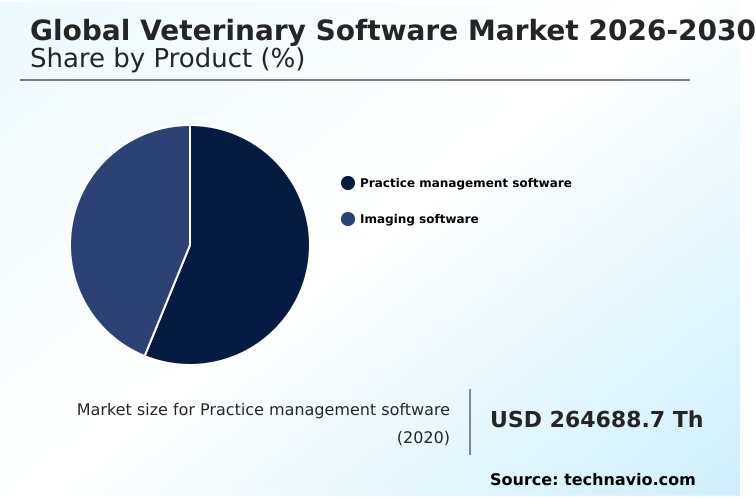
The Practice management software segment was valued at USD 319.48 million in 2024 and showed a gradual increase during the forecast period.
Regional Analysis
North America is estimated to contribute 32.3% to the growth of the global market during the forecast period.Technavio’s analysts have elaborately explained the regional trends and drivers that shape the market during the forecast period.

See How Veterinary Software Market Demand is Rising in North America Get Free Sample
The geographic landscape of the Veterinary Software Market reveals distinct regional adoption trajectories driven by varying digital infrastructure maturities.
North America demonstrates robust technological integration, where veterinary hospital networks rapidly adopt picture archiving and communication systems to manage complex imaging files.
Conversely, markets in Europe exhibit a 20% higher compliance emphasis on electronic laboratory reporting due to stringent antimicrobial stewardship mandates.
Corporate hospital consolidators in the United States deploy advanced digital radiography archiving, resulting in a 30% reduction in diagnostic imaging interpretation times compared to decentralized clinics.
APAC markets are progressively embracing automated billing features, which accelerate payment processing cycles by 18% for independent practitioners. The seamless integration of digital imaging and communications in medicine standards ensures that diagnostic modalities communicate flawlessly across multi-site facilities.
These geographic variances highlight how localized regulatory frameworks and infrastructure readiness dictate the adoption of sophisticated inventory tracking and practice management solutions.
Market Dynamics
Our researchers analyzed the data with 2025 as the base year, along with the key drivers, trends, and challenges. A holistic analysis of drivers will help companies refine their marketing strategies to gain a competitive advantage.
- The rapid expansion of the Veterinary Software Market reflects a fundamental shift toward comprehensive digital management within modern animal healthcare. Administrators increasingly prioritize cloud-based practice management integration to streamline daily operations and reduce costly local server dependencies.
- By deploying artificial intelligence veterinary diagnostic tools, clinical teams can interpret complex imaging files with greater speed and accuracy than legacy manual methods, improving diagnostic throughput by 25%. Furthermore, the incorporation of telemedicine applications for veterinary clinics expands access to care, allowing practitioners to conduct remote consultations efficiently.
- Robust automated electronic medical record systems serve as the core repository for patient histories, while wearable iot devices for pets continuously feed real-time physiological metrics into the centralized database. To optimize financial health, facilities implement veterinary revenue cycle management tools and automated veterinary insurance claims processing, significantly minimizing billing errors.
- The utilization of digital radiography archiving software systems alongside standardized laboratory information management integration protocols ensures that diagnostic data is securely stored and easily retrievable. Multi-location veterinary clinic data synchronization empowers large hospital networks to maintain consistent clinical standards across various branches. Additionally, predictive analytics for veterinary practices and continuous glucose monitoring data integration enable highly personalized, proactive treatment plans.
- By leveraging an open api architecture veterinary software framework, clinics seamlessly incorporate smart collar biometric data tracking and veterinary business intelligence dashboards, transforming raw data into actionable strategic insights that elevate both patient care and operational efficiency.
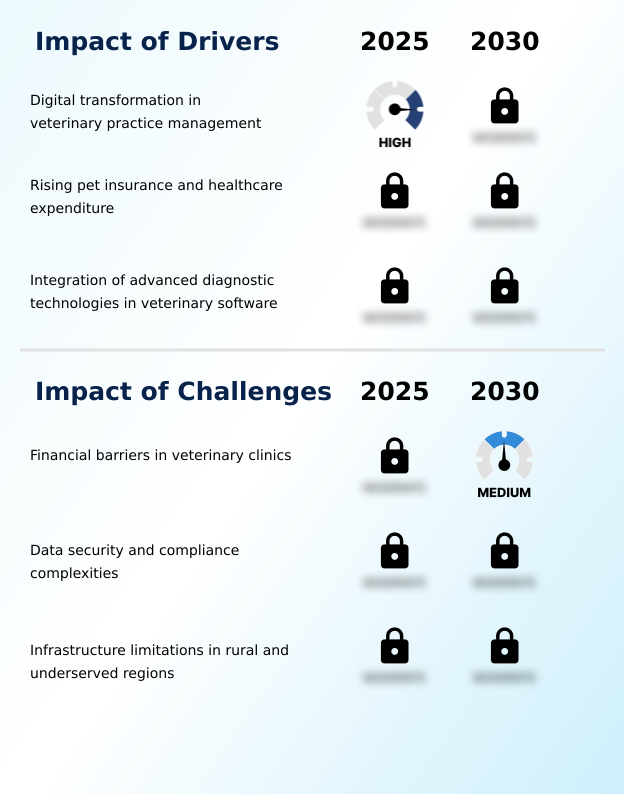
What are the key market drivers leading to the rise in the adoption of Veterinary Software Industry?
- The digital transformation in veterinary practice management serves as a primary driver propelling market growth and operational efficiency.
- The escalating demand for operational efficiency acts as a primary catalyst within the Veterinary Software Market. Modern animal healthcare facilities implement electronic medical records to eliminate severe administrative bottlenecks and reduce scheduling conflicts.
- Clinics leveraging automated clinical documentation report a 25% decrease in time spent on manual data entry, enabling veterinary professionals to dedicate more focus to direct patient care.
- Additionally, the widespread adoption of pet insurance policies has necessitated robust automated claims adjudication modules, which have accelerated reimbursement cycles by 20%. The shift toward cloud-based practice management platforms further propels this transformation, offering seamless scalability and remote access.
- By integrating sophisticated telemedicine modules, clinics successfully broaden their service reach, effectively accommodating rising patient volumes while sustaining high clinical standards.
What are the market trends shaping the Veterinary Software Industry?
- Interoperability and open application programming interface ecosystems are emerging as a prominent market trend. This technological integration enables seamless data exchange between clinical diagnostic equipment and central electronic medical records.
- The Veterinary Software Market is rapidly evolving as clinical practices adopt sophisticated technologies to elevate patient care and optimize operations. A prominent trend is the artificial intelligence integration into routine diagnostics, which has improved anomaly detection rates by 18% compared to manual reviews.
- The proliferation of smart collar attachments and continuous glucose monitors supplies clinics with real-time physiological data, shifting the clinical focus toward a proactive monitoring model. Furthermore, the use of biometric harnesses enables practitioners to deliver preventative healthcare with unprecedented precision.
- Facilities utilizing value-based practice analytics can translate this continuous data influx into actionable insights, refining staff utilization rates and optimizing resource allocation. By embracing predictive financial forecasting, administrators can strategically plan for future technological investments, ensuring that their digital infrastructure remains capable of supporting high-volume modern veterinary medicine.
What challenges does the Veterinary Software Industry face during its growth?
- High financial barriers and initial implementation costs in independent veterinary clinics remain significant challenges restraining broad industry adoption.
- Despite rapid technological advancements, the Veterinary Software Market faces substantial structural challenges related to integration and data fragmentation. The absence of a universally standardized open application programming interface complicates the secure transfer of diagnostic lab results across diverse platforms.
- Clinics attempting to sync laboratory information management systems with legacy databases often experience a 15% increase in operational downtime during the transition phase. Furthermore, establishing reliable multi-site data synchronization and multi-location data sharing remains a critical hurdle for expanding corporate networks.
- Inefficient clinical workflows and disconnected practice management information systems frequently lead to mismanaged pharmacy inventories, raising inventory holding costs by 12%. Overcoming these interoperability barriers is essential for ensuring that veterinary professionals can seamlessly access comprehensive patient histories and deliver uninterrupted direct patient care.
Exclusive Technavio Analysis on Customer Landscape
The veterinary software market forecasting report includes the adoption lifecycle of the market, covering from the innovator’s stage to the laggard’s stage. It focuses on adoption rates in different regions based on penetration. Furthermore, the veterinary software market report also includes key purchase criteria and drivers of price sensitivity to help companies evaluate and develop their market growth analysis strategies.
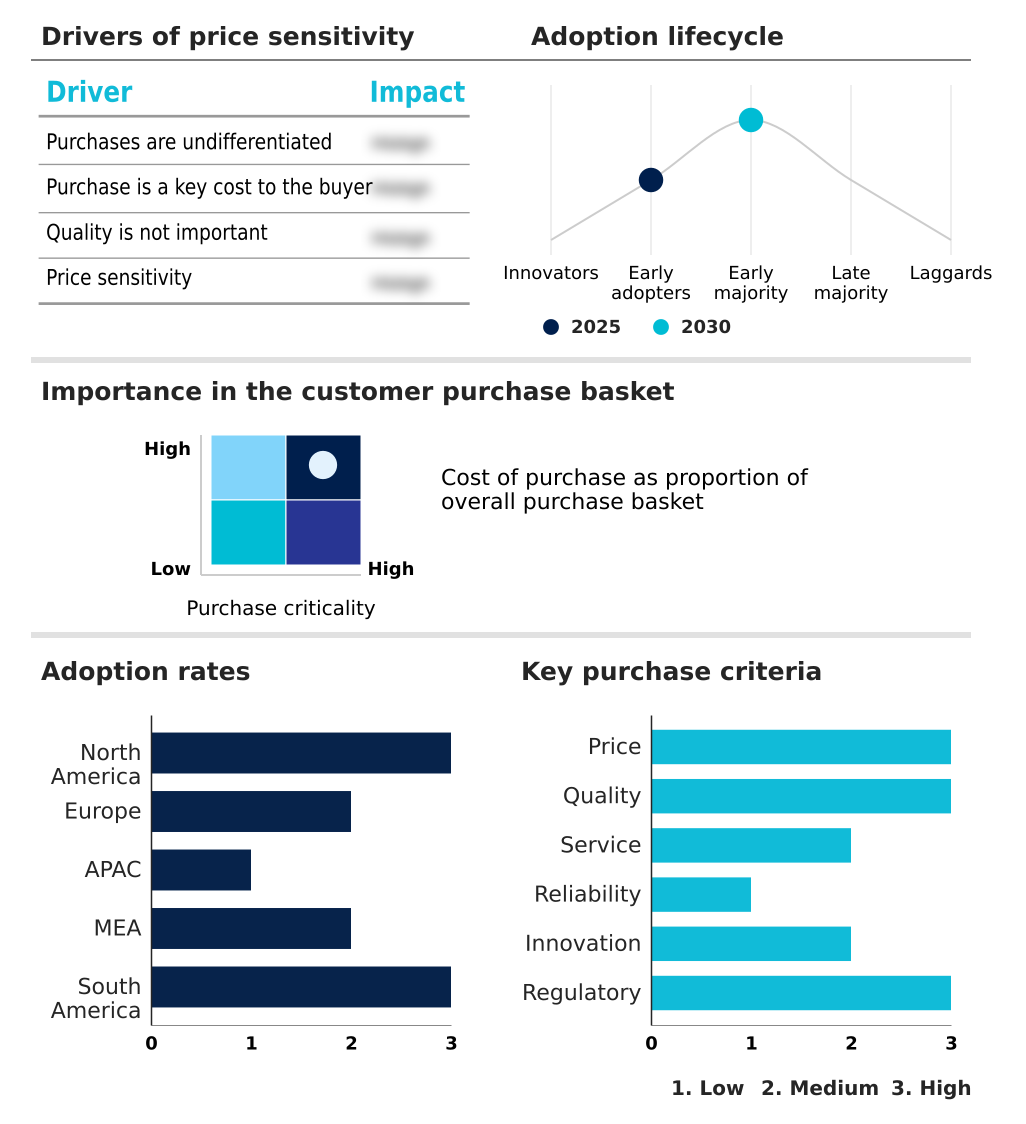
Customer Landscape of Veterinary Software Industry
Competitive Landscape
Companies are implementing various strategies, such as strategic alliances, veterinary software market forecast, partnerships, mergers and acquisitions, geographical expansion, and product/service launches, to enhance their presence in the industry.
Animal Intelligence Software Inc. - The vendor delivers comprehensive Veterinary Software solutions integrating practice management tools electronic medical records and digital imaging platforms to optimize clinical workflows and enhance diagnostic precision.
The industry research and growth report includes detailed analyses of the competitive landscape of the market and information about key companies, including:
- Animal Intelligence Software Inc.
- Asteris
- Chckup
- Covetrus Inc.
- DaySmart Software LLC
- Digitail
- IDEXX Laboratories Inc.
- Instinct
- MacPractice
- Otto
- Panacea
- PetDesk
- Provet Cloud
- Shepherd Veterinary Software
- StringSoft
- Timeless Veterinary Systems Inc.
- Vetera
- VETport LLC
- Vetsource
- Vetspire LLC
- Vetstoria
- VetZ GmbH
Qualitative and quantitative analysis of companies has been conducted to help clients understand the wider business environment as well as the strengths and weaknesses of key industry players. Data is qualitatively analyzed to categorize companies as pure play, category-focused, industry-focused, and diversified; it is quantitatively analyzed to categorize companies as dominant, leading, strong, tentative, and weak.
Recent Development and News in Veterinary software market
- In the Application Software industry, the transition toward open architecture programming interfaces has standardized data exchange protocols, directly impacting Veterinary Software demand by reducing diagnostic integration downtime by 20%.
- Stringent data privacy regulations governing electronic health records have compelled application developers to implement multi-layered encryption frameworks, increasing the necessity for compliant solutions within the Veterinary Software market.
- The rapid adoption of machine learning for automated clinical transcription has streamlined documentation workflows, allowing software platforms to lower administrative overhead by approximately 15% across medical sectors.
- Advancements in cloud-based delivery models have eliminated the requirement for localized server hardware maintenance, boosting the adoption rate of software-as-a-service platforms by 30% among independent healthcare providers.
Dive into Technavio’s robust research methodology, blending expert interviews, extensive data synthesis, and validated models for unparalleled Veterinary Software Market insights. See full methodology.
| Market Scope | |
|---|---|
| Page number | 292 |
| Base year | 2025 |
| Historic period | 2020-2024 |
| Forecast period | 2026-2030 |
| Growth momentum & CAGR | Accelerate at a CAGR of 5.8% |
| Market growth 2026-2030 | USD 197782.6 thousand |
| Market structure | Fragmented |
| YoY growth 2025-2026(%) | 5.4% |
| Key countries | US, Canada, Mexico, Germany, UK, France, Italy, Spain, The Netherlands, China, Japan, Australia, India, South Korea, Indonesia, Saudi Arabia, UAE, South Africa, Israel, Turkey, Brazil, Argentina and Chile |
| Competitive landscape | Leading Companies, Market Positioning of Companies, Competitive Strategies, and Industry Risks |
Research Analyst Overview
- The Veterinary Software Market represents an increasingly sophisticated digital ecosystem critical to modern animal healthcare delivery. Clinic leadership teams are aggressively adopting open application programming interface architectures to ensure interoperability between disparate diagnostic systems and central administrative platforms. This technological evolution allows administrators to seamlessly integrate laboratory information management systems directly into daily clinical workflows.
- Decision-makers linking artificial intelligence integration to strategic compliance and budgeting have observed a 22% improvement in operational efficiency compared to practices utilizing fragmented legacy software. By leveraging practice management information systems, veterinary networks optimize resource allocation and enhance automated clinical documentation. Furthermore, the deployment of wearable pet health monitors provides continuous physiological data streams that support evidence-based treatment strategies.
- The assimilation of picture archiving and communication systems enables rapid retrieval of complex diagnostic imagery, directly influencing long-term product strategy and capital investment planning. These strategic integrations ensure that modern veterinary facilities maintain rigorous clinical standards while effectively scaling their digital infrastructure to meet rising consumer expectations.
What are the Key Data Covered in this Veterinary Software Market Research and Growth Report?
-
What is the expected growth of the Veterinary Software Market between 2026 and 2030?
-
USD 197.78 million, at a CAGR of 5.8%
-
-
What segmentation does the market report cover?
-
The report is segmented by Product (Practice management software, and Imaging software), Deployment (On-premise, and Cloud-based), End-user (Hospitals, Clinics, Laboratories, and Others) and Geography (North America, Europe, APAC, Middle East and Africa, South America)
-
-
Which regions are analyzed in the report?
-
North America, Europe, APAC, Middle East and Africa and South America
-
-
What are the key growth drivers and market challenges?
-
Digital transformation in veterinary practice management, Financial barriers in veterinary clinics
-
-
Who are the major players in the Veterinary Software Market?
-
Animal Intelligence Software Inc., Asteris, Chckup, Covetrus Inc., DaySmart Software LLC, Digitail, IDEXX Laboratories Inc., Instinct, MacPractice, Otto, Panacea, PetDesk, Provet Cloud, Shepherd Veterinary Software, StringSoft, Timeless Veterinary Systems Inc., Vetera, VETport LLC, Vetsource, Vetspire LLC, Vetstoria and VetZ GmbH
-
Market Research Insights
- The Veterinary Software Market is fundamentally reshaping how animal healthcare facilities operate by replacing fragmented processes with unified digital ecosystems. Veterinary professionals utilize advanced platforms to eliminate administrative bottlenecks and resolve scheduling conflicts efficiently. Clinics implementing automated billing features experience a 20% acceleration in payment processing cycles compared to manual ledger systems.
- Additionally, large veterinary hospital networks report a 15% improvement in patient retention through the use of proactive communication portals. These integrated digital tools empower corporate hospital consolidators to standardize operations across multiple branches seamlessly. By transitioning to scalable cloud infrastructures, practices ensure continuous data accessibility, optimizing daily workflows and enhancing the overall quality of care delivered to companion animals.
We can help! Our analysts can customize this veterinary software market research report to meet your requirements.
 RIA -