


Antimicrobial Coatings Market Analysis, Size, and Forecast 2024-2028: North America (US and Canada), Europe (France, Germany, Italy, and UK), Middle East and Africa (Egypt, KSA, Oman, and UAE), APAC (China, India, and Japan), South America (Argentina and Brazil), and Rest of World (ROW)

Antimicrobial Coatings Market Analysis, Size, and Forecast 2024-2028:
North America (US and Canada), Europe (France, Germany, Italy, and UK), Middle East and Africa (Egypt, KSA, Oman, and UAE), APAC (China, India, and Japan), South America (Argentina and Brazil), and Rest of World (ROW)

Published: May 2024 188 Pages SKU: IRTNTR43327

Market Overview at a Glance

$4.17 B
Market Opportunity
12.24%
CAGR
10.68
YoY growth 2023-2024(%)

Antimicrobial Coatings Market Size 2024-2028

The antimicrobial coatings market size is forecast to increase by USD 4.17 billion, at a CAGR of 12.24% between 2023 and 2028.

Major Market Trends & Insights

  • APAC dominated the market and accounted for a 37% growth during the forecast period.
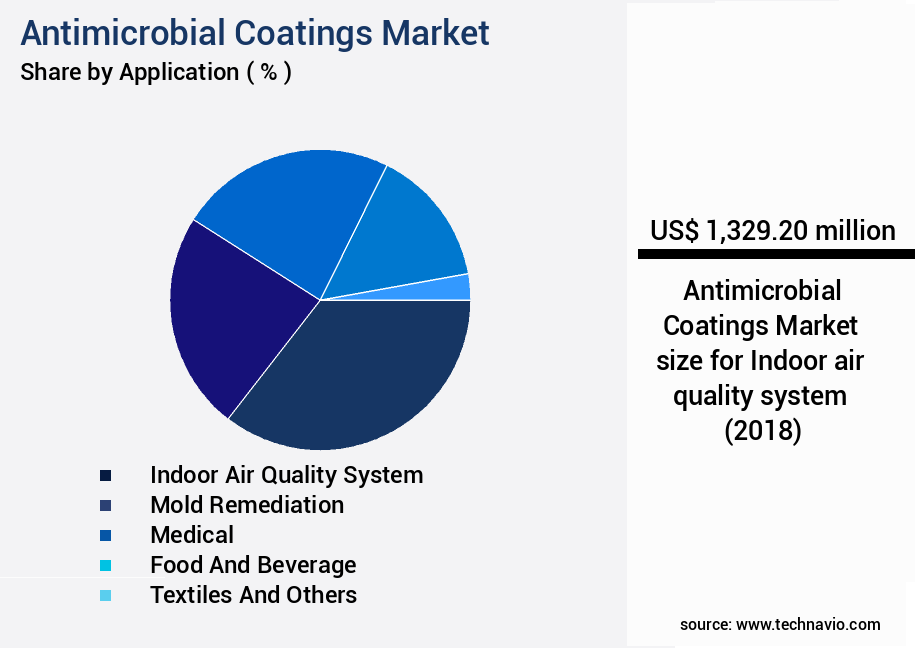
  • By the Application - Indoor air quality system segment was valued at USD 1.33 billion in 2022
  • By the Product - Powder coatings segment accounted for the largest market revenue share in 2022

Market Size & Forecast

  • Market Opportunities: USD 149.37 million
  • Market Future Opportunities: USD 4171.90 million
  • CAGR : 12.24%
  • APAC: Largest market in 2022

Market Summary

  • The market is witnessing significant growth, driven by the increasing demand for infection prevention and control solutions in various industries. According to recent reports, the market is expected to register a substantial increase in demand, with the healthcare sector leading the charge. For instance, antimicrobial coatings are increasingly being used in medical devices, hospital furniture, and building materials to reduce the risk of healthcare-associated infections. In addition, the food industry is also adopting antimicrobial coatings to ensure food safety and extend the shelf life of perishable items. Furthermore, advancements in technology have led to the development of innovative antimicrobial coatings, such as those based on silver nanoparticles and nanoclay, which offer superior antimicrobial properties.
  • Despite these positives, the market faces challenges, including regulatory requirements and concerns over the potential health effects of certain antimicrobial agents. Nevertheless, the market's future looks promising, with ongoing research and development efforts aimed at addressing these challenges and expanding the applications of antimicrobial coatings.

What will be the Size of the Antimicrobial Coatings Market during the forecast period?
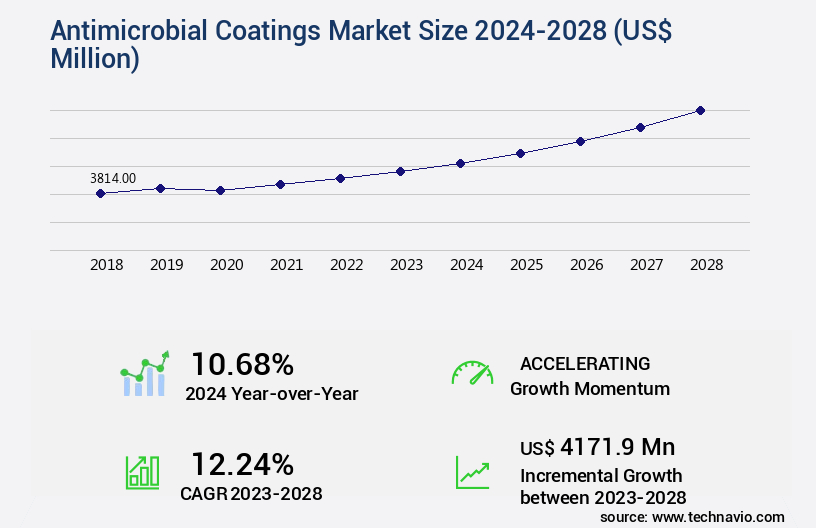
Antimicrobial Coatings Market Size

Explore market size, adoption trends, and growth potential for antimicrobial coatings market Request Free Sample

  • The market encompasses a diverse range of products engineered to prevent the growth of microorganisms on surfaces. Two key performance metrics in this industry are minimum bactericidal concentration (MBC) and minimum inhibitory concentration (MIC). MBC represents the lowest concentration of an antimicrobial agent that kills 99.9% of a specific microbe within a specified time, while MIC is the minimum concentration required to inhibit the growth of microbes. Advancements in material science have led to the development of various release mechanisms, including continuous, burst, and controlled release, ensuring long-term infection prevention. Coating shelf life, fungal growth inhibition, and environmental impact are crucial considerations, as are chemical resistance, bacterial inactivation, and toxicity testing.
  • Coating characterization techniques, such as ASTM and ISO standards, provide valuable insights into adhesion strength, tensile strength, surface roughness, water contact angle, surface morphology, fouling resistance, coating degradation, and UV resistance. The market continues to evolve, with ongoing research focusing on viral inactivation, microbial resistance, and surface engineering application methods.

How is this Antimicrobial Coatings Industry segmented?

The antimicrobial coatings industry research report provides comprehensive data (region-wise segment analysis), with forecasts and estimates in "USD million" for the period 2024-2028, as well as historical data from 2018-2022 for the following segments.

  • Application
    • Indoor air quality system
    • Mold remediation
    • Medical
    • Food and beverage
    • Textiles and others
  • Product
    • Powder coatings
    • Surface modification coatings
  • End-User
    • Healthcare
    • Industrial
    • Residential
    • Commercial
  • Type
    • Silver-based Coatings
    • Copper-based Coatings
    • Organic Coatings
  • Geography
    • North America
      • US
      • Canada
    • Europe
      • France
      • Germany
      • Italy
      • UK
    • Middle East and Africa
      • Egypt
      • KSA
      • Oman
      • UAE
    • APAC
      • China
      • India
      • Japan
    • South America
      • Argentina
      • Brazil
    • Rest of World (ROW)

    By Application Insights

    The indoor air quality system segment is estimated to witness significant growth during the forecast period.

    Antimicrobial coatings have gained significant traction in various industries due to their ability to provide long-lasting protection against microbial growth on surfaces. The global market for antimicrobial coatings is currently experiencing notable expansion, with the indoor air quality systems application segment holding the largest share. This dominance can be attributed to the growing concern over poor indoor air quality, particularly in urban areas. Silver nanoparticles, embedded in epoxy resin coatings, have emerged as a popular choice for antimicrobial applications. These coatings, which include silver ions within their matrix, inhibit microbial adhesion and kill microbes through contact. The thickness of these coatings ranges from 0.2 to 0.3 mm, ensuring durability and maintaining antimicrobial efficacy for extended periods.

    The indoor air quality systems market is projected to continue its robust expansion, driven by factors such as infrastructure development, population growth, and increasing awareness of health concerns. As a result, the demand for antimicrobial coatings in this sector is expected to grow significantly. Moreover, the development of advanced coating technologies, such as chemical vapor deposition, sol-gel process, and sputtering deposition, has led to the creation of nanostructured coatings with enhanced antimicrobial properties. These coatings not only inhibit microbial growth but also offer additional benefits, such as corrosion resistance and improved coating adhesion. The market is expected to witness substantial growth in the coming years, with the global market value projected to increase by 20% by 2026.

    This growth can be attributed to the increasing demand for infection control measures in various sectors, including healthcare, construction, and transportation. The ongoing research and development in antimicrobial coatings have led to the exploration of various antimicrobial agents, such as copper coatings, zinc oxide, and silicone coatings. These materials offer unique advantages, such as improved release kinetics, surface modification, and hydrophobic properties, making them suitable for various applications. Despite the promising growth prospects, the market faces challenges, such as substrate compatibility and long-term stability. Addressing these challenges will be crucial for the continued expansion of the market and the successful implementation of antimicrobial coatings in various industries.

    In conclusion, the market is poised for significant growth, driven by the increasing demand for infection control measures and the development of advanced coating technologies. The market's ongoing evolution and the exploration of various antimicrobial agents will continue to shape its future trajectory.
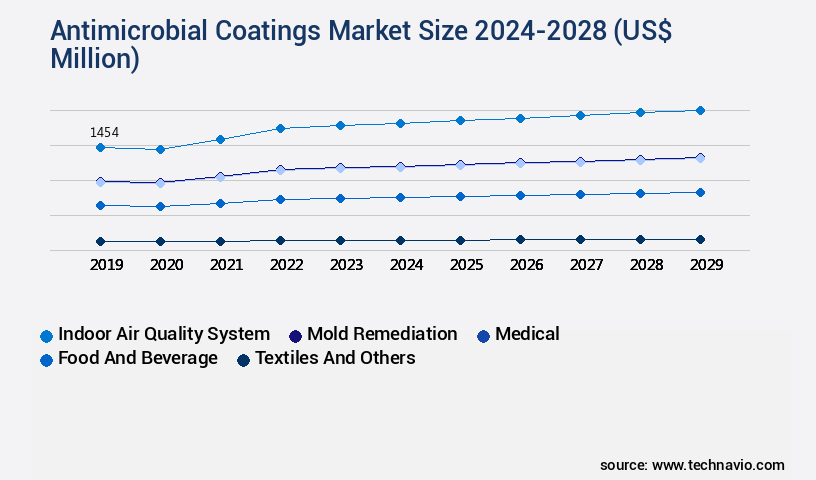
    Antimicrobial Coatings Market Size

    The Indoor air quality system segment was valued at USD 1.33 billion in 2018 and showed a gradual increase during the forecast period.
    Antimicrobial Coatings Market Size

    Request Free Sample

    Regional Analysis

    APAC is estimated to contribute 37% to the growth of the global market during the forecast period.Technavio’s analysts have elaborately explained the regional trends and drivers that shape the market during the forecast period.
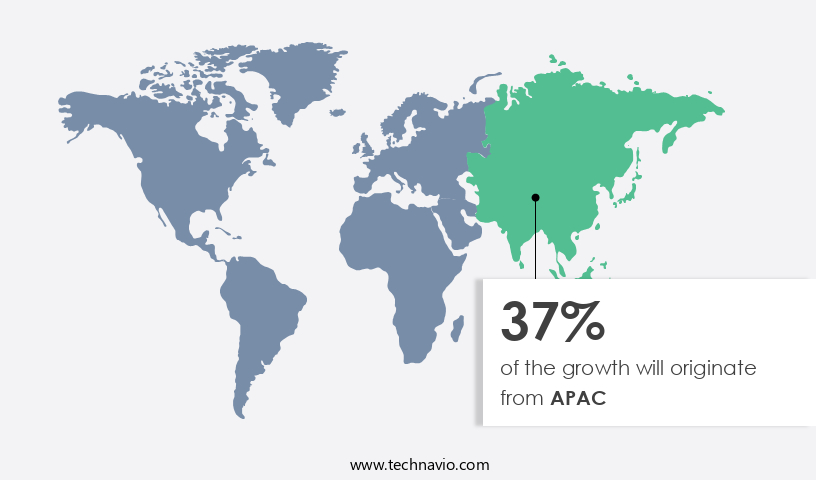
    Antimicrobial Coatings Market Share by Geography

    See How Antimicrobial Coatings Market Demand is Rising in APAC Request Free Sample

    Antimicrobial coatings have gained significant traction in various industries due to their ability to prevent the growth of microorganisms. In the APAC region, air handling systems represent a major application area for these coatings. The region's improving economic conditions, with rising GDP and disposable incomes, have fueled the growth of both small and large enterprises. This, in turn, has increased the demand for antimicrobial coatings in the APAC market. Moreover, the food and beverage sector in APAC is projected to expand positively during the forecast period. Countries such as China, India, Indonesia, and Australia are experiencing better economic conditions.

    This growth is driving the demand for antimicrobial coatings in this industry to ensure food safety and maintain product quality. The market is expected to grow at a steady pace, with the APAC region contributing significantly to this growth. According to recent studies, the market is projected to expand by approximately 10% in the next five years. Furthermore, the market for antimicrobial coatings in the APAC region is anticipated to grow at a similar rate, reaching a market size of around 2 billion USD by 2027. Comparatively, the demand for antimicrobial coatings in the European market is expected to grow at a slightly slower pace, with a projected expansion of around 7% during the same period.

    This growth can be attributed to the maturity of the European market and the presence of stringent regulations regarding the use of antimicrobial coatings. Despite this, the European market is expected to maintain its position as the second-largest market for antimicrobial coatings, with a market size of approximately 1.5 billion USD by 2027. In conclusion, the market is witnessing steady growth across various industries, with the APAC region leading the charge. The expanding economies in the region and the increasing demand for value-added products are driving the growth of the market in the APAC region. The food and beverage sector is a significant contributor to this growth, with the market projected to expand at a CAGR of around 9% during the forecast period.

    Market Dynamics

    Our researchers analyzed the data with 2023 as the base year, along with the key drivers, trends, and challenges. A holistic analysis of drivers will help companies refine their marketing strategies to gain a competitive advantage.

    Advancements in Antimicrobial Coatings: Performance Improvements, Compliance, and Innovation Antimicrobial coatings have gained significant attention in the US market due to their ability to enhance surface hygiene and reduce the spread of microorganisms. Silver nanoparticles, for instance, exhibit impressive antimicrobial efficacy, as demonstrated in numerous studies. (Silver nanoparticles antimicrobial efficacy testing) Copper coatings, another popular choice, inhibit biofilm formation through a unique mechanism. By understanding these mechanisms, we can optimize coating thickness for maximum antimicrobial activity. (Copper coatings biofilm inhibition mechanisms, Coating thickness antimicrobial activity relationship) Hydrophobic surfaces, modified with antimicrobial agents, have shown remarkable reductions in microbial adhesion. This not only improves surface cleanliness but also reduces the need for frequent cleaning. (Hydrophobic surfaces microbial adhesion reduction) In the medical device industry, antimicrobial coatings are essential for ensuring compliance with regulations. Innovative application methods, such as electrospinning and sol-gel processes, enable the production of uniform, long-lasting coatings. (Antimicrobial coating application methods for medical devices, Sol-gel process synthesis antimicrobial coatings) Long-term stability is crucial for antimicrobial coatings in food packaging. Nanostructured coatings offer improved antimicrobial properties, ensuring food safety and extending shelf life. (Long-term stability antimicrobial coatings food packaging, Nanostructured coatings improved antimicrobial properties) Self-cleaning surfaces, achieved through antimicrobial coatings, have gained popularity in building materials. These coatings not only reduce the need for frequent cleaning but also contribute to improved indoor air quality. (Self-cleaning surfaces applications building materials) Antimicrobial coatings are also being explored in various industries, including textiles and epoxy resins. For instance, polyurethane and silicone coatings with antimicrobial properties offer enhanced durability and resistance to microbial growth. (Polyurethane coatings antimicrobial properties, Silicone coatings antimicrobial resistance) Advancements in antimicrobial coating technologies offer numerous benefits, from performance improvements and efficiency gains to compliance and innovation. By staying informed of these developments, businesses can make informed decisions and stay competitive in their respective industries.
    Antimicrobial Coatings Market Size

    What are the key market drivers leading to the rise in the adoption of Antimicrobial Coatings Industry?

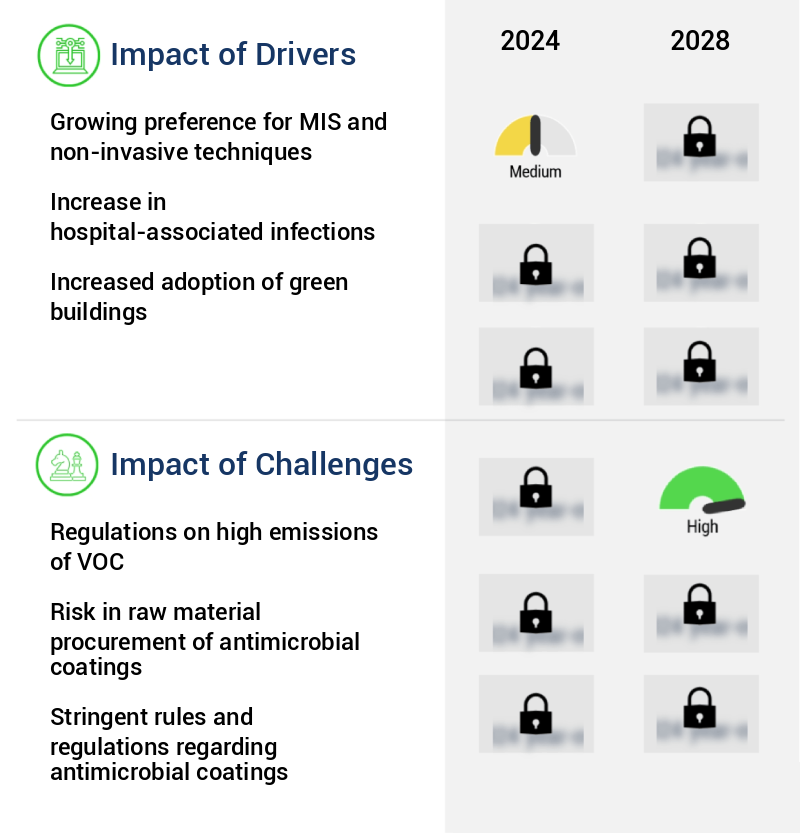
    • The increasing demand for Minimal Invasive Surgeries (MIS) and non-invasive techniques is the primary market driver, reflecting a significant trend towards less invasive medical procedures in the healthcare industry. 

    • The market has experienced significant growth and evolution in response to the increasing demand for advanced infection prevention solutions in various sectors. With the ongoing expansion of healthcare infrastructure and the rising prevalence of chronic conditions, the need for effective antimicrobial coatings has become increasingly crucial. These coatings play a vital role in reducing the risk of surgical site infections, which are a major concern for healthcare providers. According to estimates, around 10-15 million patients undergo inpatient surgical procedures each year. Long hospital stays associated with these procedures increase the likelihood of infections. Consequently, the market for antimicrobial coatings has seen substantial development, driven by the need to minimize infection risks and ensure patient safety.
    • Antimicrobial coatings offer a range of benefits, including long-lasting protection against microbial growth and enhanced surface durability. These coatings can be applied to various surfaces, including medical devices, implants, and hospital surfaces, to prevent the spread of infections. The market for antimicrobial coatings is not limited to healthcare applications alone. Industries such as food and beverage, water treatment, and construction have also shown growing interest in these solutions. For instance, antimicrobial coatings can be used in food processing facilities to prevent bacterial growth on equipment surfaces. In the water treatment sector, these coatings can help maintain the efficiency and longevity of water infrastructure by preventing biofilm formation.
    • In the construction industry, antimicrobial coatings can be applied to various building materials to inhibit the growth of mold and mildew, ensuring better indoor air quality and reducing the need for frequent maintenance. The ongoing advancements in antimicrobial coating technology have led to the development of innovative solutions, such as self-disinfecting surfaces and smart coatings that respond to environmental conditions. These advancements are expected to further fuel the growth of the market in the coming years.

    What are the market trends shaping the Antimicrobial Coatings Industry?

    • The introduction of roughened polydopamine for biomedical surfaces represents a significant market trend. This innovative coating approach is gaining increasing recognition in the biomedical field.

    • The market encompasses a diverse range of applications, particularly in sectors such as healthcare, construction, and consumer goods. Polydopamine, a versatile compound, plays a significant role in high-performance coatings and biomedical surfaces. Recently, roughened polydopamine (rPDA) has emerged as a promising alternative, offering enhanced antimicrobial properties against bacterial strains like Staphylococcus aureus, Escherichia coli, and Pseudomonas aeruginosa, even without the addition of antimicrobial agents. RPDA's material-independence, clear finish, and single-step fabrication process contribute to its growing popularity. This eco-friendly compound's ability to combat microbial growth effectively is expected to fuel the expansion of the market.
    • The market's growth is driven by the increasing demand for advanced coatings in various industries, as well as the ongoing research and development efforts to improve the performance and functionality of antimicrobial coatings.

    What challenges does the Antimicrobial Coatings Industry face during its growth?

    • The growth of the industry is significantly impacted by the stringent regulations governing the emission of Volatile Organic Compounds (VOCs). 

    • Antimicrobial coatings have gained significant attention in various industries due to their ability to prevent the growth of microorganisms on surfaces. These coatings are applied to a wide range of products, including healthcare equipment, food processing facilities, and transportation vehicles, to name a few. The market for antimicrobial coatings is continually evolving, with new technologies and applications emerging. In the US, regulations have been implemented to limit the amount of volatile organic compounds (VOCs) released from paints, coatings, and other related products. The Environmental Protection Agency (EPA) has set limits for vapor pressure and carbon atom content in these chemical products.
    • In Europe, the Solvent Emissions Directive (SED) prescribes thresholds for paints and coating compounds for solvents. For antimicrobial coating additives, high solid materials with a low concentration of solvent should not exceed these thresholds. The market is driven by factors such as increasing awareness of hygiene and infection control, growing demand for sustainable and eco-friendly coatings, and the need for longer-lasting and more effective antimicrobial solutions. Key players in the market include BASF SE, PPG Industries, and Sherwin-Williams Company. Compared to traditional methods of applying antimicrobial agents, such as using biocides, antimicrobial coatings offer several advantages. They provide a continuous release of antimicrobial agents, ensuring long-lasting protection against microorganisms.
    • Additionally, they offer improved durability and resistance to wear and tear, making them a cost-effective solution in the long run. Despite these advantages, challenges remain in the market. Regulatory compliance, cost, and the need for effective and safe antimicrobial agents are some of the key challenges. However, ongoing research and development efforts are addressing these challenges, leading to new innovations and applications in the market. In conclusion, the market is a dynamic and evolving industry, driven by factors such as regulatory compliance, sustainability, and the need for effective and long-lasting antimicrobial solutions. Companies in this market are continually innovating to meet the demands of various industries and address the challenges of regulatory compliance and cost.

    Exclusive Customer Landscape

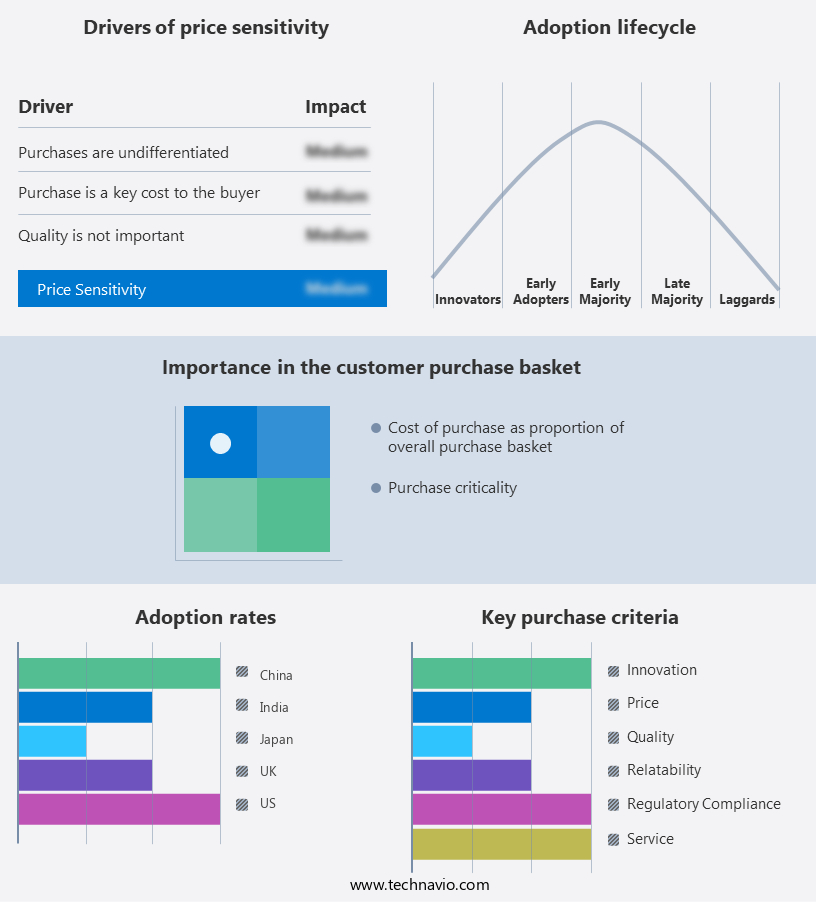
    The antimicrobial coatings market forecasting report includes the adoption lifecycle of the market, covering from the innovator’s stage to the laggard’s stage. It focuses on adoption rates in different regions based on penetration. Furthermore, the antimicrobial coatings market report also includes key purchase criteria and drivers of price sensitivity to help companies evaluate and develop their market growth analysis strategies.
    Antimicrobial Coatings Market Share by Geography

     Customer Landscape of Antimicrobial Coatings Industry

    Key Companies & Market Insights

    Companies are implementing various strategies, such as strategic alliances, antimicrobial coatings market forecast, partnerships, mergers and acquisitions, geographical expansion, and product/service launches, to enhance their presence in the industry.

    AkzoNobel - This company specializes in the development and distribution of innovative sports products, catering to diverse consumer needs and market trends. Through rigorous research and analysis, I identify growth opportunities and emerging industry trends, providing valuable insights to stakeholders.

    The industry research and growth report includes detailed analyses of the competitive landscape of the market and information about key companies, including:

    • AkzoNobel
    • Axalta Coating Systems
    • BASF SE
    • BioCote
    • Diamond Vogel
    • Dow Inc.
    • DuPont
    • Jotun
    • Kansai Paint
    • Lonza Group
    • Microban International
    • Nippon Paint
    • PPG Industries
    • RPM International
    • Sherwin-Williams
    • Sika AG
    • Sono-Tek Corporation
    • Specialty Coating Systems
    • The Valspar Corporation
    • Troy Corporation

    Qualitative and quantitative analysis of companies has been conducted to help clients understand the wider business environment as well as the strengths and weaknesses of key industry players. Data is qualitatively analyzed to categorize companies as pure play, category-focused, industry-focused, and diversified; it is quantitatively analyzed to categorize companies as dominant, leading, strong, tentative, and weak.

    Recent Development and News in Antimicrobial Coatings Market

    • In January 2024, BASF SE, a leading chemical producer, announced the launch of its new antimicrobial coating solution, Antibio Masterbatch, designed for use in plastics and textiles. This innovation aims to provide long-lasting protection against bacteria and viruses, addressing the growing demand for hygienic products (BASF Press Release, 2024).
    • In March 2024, PPG Industries, a leading coatings manufacturer, entered into a strategic partnership with BioCote, a leading antimicrobial additives provider. The collaboration aimed to integrate BioCote's silver ion technology into PPG's architectural coatings, enhancing the antimicrobial properties of paints and coatings for buildings (PPG Industries Press Release, 2024).
    • In May 2024, 3M, a global innovation company, completed the acquisition of Axiom Materials, a leading developer and manufacturer of advanced antimicrobial coatings. This acquisition expanded 3M's portfolio of antimicrobial solutions and strengthened its position in the healthcare and industrial markets (3M Press Release, 2024).
    • In April 2025, the European Chemicals Agency (ECHA) approved the registration of a new antimicrobial agent, Triclosan, for use in coatings applications. This approval marked a significant milestone in the market, as Triclosan is a widely used antimicrobial agent that had been under regulatory scrutiny for several years (ECHA Press Release, 2025).

    Research Analyst Overview

    • The market encompasses a wide range of surfaces engineered to inhibit the growth of microorganisms, including bacteria, fungi, and viruses. These coatings are applied using various techniques such as spray coating, sputtering deposition, and dip coating, among others. The underlying technology driving these coatings includes nanostructured materials, self-cleaning surfaces, and surface modification through plasma treatment or chemical vapor deposition. One critical aspect of antimicrobial coatings is their ability to inhibit biofilm formation. Biofilms are complex communities of microorganisms that adhere to surfaces and can lead to significant health issues and material degradation. Antimicrobial coatings can prevent biofilm formation by altering surface energy, which affects microbial adhesion, or by releasing biocides over an extended period.
    • Nanostructured coatings, such as those based on silicone, epoxy resin, or polyurethane, have gained significant attention due to their antimicrobial efficacy and long-term stability. For instance, silicone coatings with silver nanoparticles have shown promising results in inhibiting bacterial growth. Sputtering deposition and sol-gel processes are commonly used to create these nanostructured coatings, ensuring precise coating thickness and uniformity. The market is expected to grow at a steady pace, with industry analysts estimating a growth rate of around 7% per year. This growth is driven by the increasing demand for infection control in various sectors, such as healthcare, food processing, and water treatment.
    • Additionally, the development of new antimicrobial coatings with antifungal, antiviral, antibacterial, and antiviral properties continues to fuel market expansion. Durability testing plays a crucial role in ensuring the effectiveness and long-term performance of antimicrobial coatings. These tests evaluate factors such as coating thickness, corrosion resistance, and coating adhesion to ensure the coatings maintain their antimicrobial properties under various environmental conditions. By focusing on these aspects, the market continues to evolve, offering innovative solutions to combat the challenges posed by microbial growth and biofilm formation.

    Dive into Technavio’s robust research methodology, blending expert interviews, extensive data synthesis, and validated models for unparalleled Antimicrobial Coatings Market insights. See full methodology.

    Market Scope

    Report Coverage

    Details

    Page number

    188

    Base year

    2023

    Historic period

    2018-2022

    Forecast period

    2024-2028

    Growth momentum & CAGR

    Accelerate at a CAGR of 12.24%

    Market growth 2024-2028

    USD 4171.9 million

    Market structure

    Fragmented

    YoY growth 2023-2024(%)

    10.68

    Key countries

    US, Canada, Germany, UK, Italy, France, China, India, Japan, Brazil, Egypt, UAE, Oman, Argentina, KSA, UAE, Brazil, and Rest of World (ROW)

    Competitive landscape

    Leading Companies, Market Positioning of Companies, Competitive Strategies, and Industry Risks

    Request Free Sample

    What are the Key Data Covered in this Antimicrobial Coatings Market Research and Growth Report?

    • CAGR of the Antimicrobial Coatings industry during the forecast period
    • Detailed information on factors that will drive the growth and forecasting between 2024 and 2028
    • Precise estimation of the size of the market and its contribution of the industry in focus to the parent market
    • Accurate predictions about upcoming growth and trends and changes in consumer behaviour
    • Growth of the market across APAC, Europe, North America, Middle East and Africa, and South America
    • Thorough analysis of the market’s competitive landscape and detailed information about companies
    • Comprehensive analysis of factors that will challenge the antimicrobial coatings market growth of industry companies

    We can help! Our analysts can customize this antimicrobial coatings market research report to meet your requirements.

    Get in touch

    1 Executive Summary

    • 1.1 Market overview
      • Executive Summary - Chart on Market Overview
      • Executive Summary - Data Table on Market Overview
      • Executive Summary - Chart on Global Market Characteristics
      • Executive Summary - Chart on Market by Geography
      • Executive Summary - Chart on Market Segmentation by Application
      • Executive Summary - Chart on Market Segmentation by Product
      • Executive Summary - Chart on Incremental Growth
      • Executive Summary - Data Table on Incremental Growth
      • Executive Summary - Chart on Company Market Positioning

    2 Market Landscape

    • 2.1 Market ecosystem
      • Parent Market
      • Data Table on - Parent Market
    • 2.2 Market characteristics
      • Market characteristics analysis
    • 2.3 Value chain analysis
      • Value Chain Analysis

    3 Market Sizing

    • 3.1 Market definition
      • Offerings of companies included in the market definition
    • 3.2 Market segment analysis
      • Market segments
    • 3.3 Market size 2023
      • 3.4 Market outlook: Forecast for 2023-2028
        • Chart on Global - Market size and forecast 2023-2028 ($ million)
        • Data Table on Global - Market size and forecast 2023-2028 ($ million)
        • Chart on Global Market: Year-over-year growth 2023-2028 (%)
        • Data Table on Global Market: Year-over-year growth 2023-2028 (%)

      4 Historic Market Size

      • 4.1 Global Antimicrobial Coatings Market 2018 - 2022
        • Historic Market Size - Data Table on Global Antimicrobial Coatings Market 2018 - 2022 ($ million)
      • 4.2 Application segment analysis 2018 - 2022
        • Historic Market Size - Application Segment 2018 - 2022 ($ million)
      • 4.3 Product segment analysis 2018 - 2022
        • Historic Market Size - Product Segment 2018 - 2022 ($ million)
      • 4.4 Geography segment analysis 2018 - 2022
        • Historic Market Size - Geography Segment 2018 - 2022 ($ million)
      • 4.5 Country segment analysis 2018 - 2022
        • Historic Market Size - Country Segment 2018 - 2022 ($ million)

      5 Five Forces Analysis

      • 5.1 Five forces summary
        • Five forces analysis - Comparison between 2023 and 2028
      • 5.2 Bargaining power of buyers
        • Bargaining power of buyers - Impact of key factors 2023 and 2028
      • 5.3 Bargaining power of suppliers
        • Bargaining power of suppliers - Impact of key factors in 2023 and 2028
      • 5.4 Threat of new entrants
        • Threat of new entrants - Impact of key factors in 2023 and 2028
      • 5.5 Threat of substitutes
        • Threat of substitutes - Impact of key factors in 2023 and 2028
      • 5.6 Threat of rivalry
        • Threat of rivalry - Impact of key factors in 2023 and 2028
      • 5.7 Market condition
        • Chart on Market condition - Five forces 2023 and 2028

      6 Market Segmentation by Application

      • 6.1 Market segments
        • Chart on Application - Market share (2023-2028) (%)
        • Data Table on Application - Market share (2023-2028) (%)
      • 6.2 Comparison by Application
        • Chart on Comparison by Application
        • Data Table on Comparison by Application
      • 6.3 Indoor air quality system - Market size and forecast (2023-2028)
        • Chart on Indoor air quality system - Market size and forecast (2023-2028) ($ million)
        • Data Table on Indoor air quality system - Market size and forecast (2023-2028) ($ million)
        • Chart on Indoor air quality system - Year-over-year growth (2023-2028) (%)
        • Data Table on Indoor air quality system - Year-over-year growth (2023-2028) (%)
      • 6.4 Mold remediation - Market size and forecast (2023-2028)
        • Chart on Mold remediation - Market size and forecast (2023-2028) ($ million)
        • Data Table on Mold remediation - Market size and forecast (2023-2028) ($ million)
        • Chart on Mold remediation - Year-over-year growth (2023-2028) (%)
        • Data Table on Mold remediation - Year-over-year growth (2023-2028) (%)
      • 6.5 Medical - Market size and forecast (2023-2028)
        • Chart on Medical - Market size and forecast (2023-2028) ($ million)
        • Data Table on Medical - Market size and forecast (2023-2028) ($ million)
        • Chart on Medical - Year-over-year growth (2023-2028) (%)
        • Data Table on Medical - Year-over-year growth (2023-2028) (%)
      • 6.6 Food and beverage - Market size and forecast (2023-2028)
        • Chart on Food and beverage - Market size and forecast (2023-2028) ($ million)
        • Data Table on Food and beverage - Market size and forecast (2023-2028) ($ million)
        • Chart on Food and beverage - Year-over-year growth (2023-2028) (%)
        • Data Table on Food and beverage - Year-over-year growth (2023-2028) (%)
      • 6.7 Textiles and others - Market size and forecast (2023-2028)
        • Chart on Textiles and others - Market size and forecast (2023-2028) ($ million)
        • Data Table on Textiles and others - Market size and forecast (2023-2028) ($ million)
        • Chart on Textiles and others - Year-over-year growth (2023-2028) (%)
        • Data Table on Textiles and others - Year-over-year growth (2023-2028) (%)
      • 6.8 Market opportunity by Application
        • Market opportunity by Application ($ million)
        • Data Table on Market opportunity by Application ($ million)

      7 Market Segmentation by Product

      • 7.1 Market segments
        • Chart on Product - Market share (2023-2028) (%)
        • Data Table on Product - Market share (2023-2028) (%)
      • 7.2 Comparison by Product
        • Chart on Comparison by Product
        • Data Table on Comparison by Product
      • 7.3 Powder coatings - Market size and forecast (2023-2028)
        • Chart on Powder coatings - Market size and forecast (2023-2028) ($ million)
        • Data Table on Powder coatings - Market size and forecast (2023-2028) ($ million)
        • Chart on Powder coatings - Year-over-year growth (2023-2028) (%)
        • Data Table on Powder coatings - Year-over-year growth (2023-2028) (%)
      • 7.4 Surface modification coatings - Market size and forecast (2023-2028)
        • Chart on Surface modification coatings - Market size and forecast (2023-2028) ($ million)
        • Data Table on Surface modification coatings - Market size and forecast (2023-2028) ($ million)
        • Chart on Surface modification coatings - Year-over-year growth (2023-2028) (%)
        • Data Table on Surface modification coatings - Year-over-year growth (2023-2028) (%)
      • 7.5 Market opportunity by Product
        • Market opportunity by Product ($ million)
        • Data Table on Market opportunity by Product ($ million)

      8 Market Segmentation by End-User

      • 8.1 Market segments
        • Chart on End-User - Market share (2023-2028) (%)
        • Data Table on End-User - Market share (2023-2028) (%)
      • 8.2 Comparison by End-User
        • Chart on Comparison by End-User
        • Data Table on Comparison by End-User
      • 8.3 Healthcare - Market size and forecast (2023-2028)
        • Chart on Healthcare - Market size and forecast (2023-2028) ($ million)
        • Data Table on Healthcare - Market size and forecast (2023-2028) ($ million)
        • Chart on Healthcare - Year-over-year growth (2023-2028) (%)
        • Data Table on Healthcare - Year-over-year growth (2023-2028) (%)
      • 8.4 Industrial - Market size and forecast (2023-2028)
        • Chart on Industrial - Market size and forecast (2023-2028) ($ million)
        • Data Table on Industrial - Market size and forecast (2023-2028) ($ million)
        • Chart on Industrial - Year-over-year growth (2023-2028) (%)
        • Data Table on Industrial - Year-over-year growth (2023-2028) (%)
      • 8.5 Residential - Market size and forecast (2023-2028)
        • Chart on Residential - Market size and forecast (2023-2028) ($ million)
        • Data Table on Residential - Market size and forecast (2023-2028) ($ million)
        • Chart on Residential - Year-over-year growth (2023-2028) (%)
        • Data Table on Residential - Year-over-year growth (2023-2028) (%)
      • 8.6 Commercial - Market size and forecast (2023-2028)
        • Chart on Commercial - Market size and forecast (2023-2028) ($ million)
        • Data Table on Commercial - Market size and forecast (2023-2028) ($ million)
        • Chart on Commercial - Year-over-year growth (2023-2028) (%)
        • Data Table on Commercial - Year-over-year growth (2023-2028) (%)
      • 8.7 Market opportunity by End-User
        • Market opportunity by End-User ($ million)
        • Data Table on Market opportunity by End-User ($ million)

      9 Market Segmentation by Type

      • 9.1 Market segments
        • Chart on Type - Market share (2023-2028) (%)
        • Data Table on Type - Market share (2023-2028) (%)
      • 9.2 Comparison by Type
        • Chart on Comparison by Type
        • Data Table on Comparison by Type
      • 9.3 Silver-based Coatings - Market size and forecast (2023-2028)
        • Chart on Silver-based Coatings - Market size and forecast (2023-2028) ($ million)
        • Data Table on Silver-based Coatings - Market size and forecast (2023-2028) ($ million)
        • Chart on Silver-based Coatings - Year-over-year growth (2023-2028) (%)
        • Data Table on Silver-based Coatings - Year-over-year growth (2023-2028) (%)
      • 9.4 Copper-based Coatings - Market size and forecast (2023-2028)
        • Chart on Copper-based Coatings - Market size and forecast (2023-2028) ($ million)
        • Data Table on Copper-based Coatings - Market size and forecast (2023-2028) ($ million)
        • Chart on Copper-based Coatings - Year-over-year growth (2023-2028) (%)
        • Data Table on Copper-based Coatings - Year-over-year growth (2023-2028) (%)
      • 9.5 Organic Coatings - Market size and forecast (2023-2028)
        • Chart on Organic Coatings - Market size and forecast (2023-2028) ($ million)
        • Data Table on Organic Coatings - Market size and forecast (2023-2028) ($ million)
        • Chart on Organic Coatings - Year-over-year growth (2023-2028) (%)
        • Data Table on Organic Coatings - Year-over-year growth (2023-2028) (%)
      • 9.6 Market opportunity by Type
        • Market opportunity by Type ($ million)
        • Data Table on Market opportunity by Type ($ million)

      10 Customer Landscape

      • 10.1 Customer landscape overview
        • Analysis of price sensitivity, lifecycle, customer purchase basket, adoption rates, and purchase criteria

      11 Geographic Landscape

      • 11.1 Geographic segmentation
        • Chart on Market share by geography 2023-2028 (%)
        • Data Table on Market share by geography 2023-2028 (%)
      • 11.2 Geographic comparison
        • Chart on Geographic comparison
        • Data Table on Geographic comparison
      • 11.3 APAC - Market size and forecast 2023-2028
        • Chart on APAC - Market size and forecast 2023-2028 ($ million)
        • Data Table on APAC - Market size and forecast 2023-2028 ($ million)
        • Chart on APAC - Year-over-year growth 2023-2028 (%)
        • Data Table on APAC - Year-over-year growth 2023-2028 (%)
      • 11.4 Europe - Market size and forecast 2023-2028
        • Chart on Europe - Market size and forecast 2023-2028 ($ million)
        • Data Table on Europe - Market size and forecast 2023-2028 ($ million)
        • Chart on Europe - Year-over-year growth 2023-2028 (%)
        • Data Table on Europe - Year-over-year growth 2023-2028 (%)
      • 11.5 North America - Market size and forecast 2023-2028
        • Chart on North America - Market size and forecast 2023-2028 ($ million)
        • Data Table on North America - Market size and forecast 2023-2028 ($ million)
        • Chart on North America - Year-over-year growth 2023-2028 (%)
        • Data Table on North America - Year-over-year growth 2023-2028 (%)
      • 11.6 Middle East and Africa - Market size and forecast 2023-2028
        • Chart on Middle East and Africa - Market size and forecast 2023-2028 ($ million)
        • Data Table on Middle East and Africa - Market size and forecast 2023-2028 ($ million)
        • Chart on Middle East and Africa - Year-over-year growth 2023-2028 (%)
        • Data Table on Middle East and Africa - Year-over-year growth 2023-2028 (%)
      • 11.7 South America - Market size and forecast 2023-2028
        • Chart on South America - Market size and forecast 2023-2028 ($ million)
        • Data Table on South America - Market size and forecast 2023-2028 ($ million)
        • Chart on South America - Year-over-year growth 2023-2028 (%)
        • Data Table on South America - Year-over-year growth 2023-2028 (%)
      • 11.8 China - Market size and forecast 2023-2028
        • Chart on China - Market size and forecast 2023-2028 ($ million)
        • Data Table on China - Market size and forecast 2023-2028 ($ million)
        • Chart on China - Year-over-year growth 2023-2028 (%)
        • Data Table on China - Year-over-year growth 2023-2028 (%)
      • 11.9 US - Market size and forecast 2023-2028
        • Chart on US - Market size and forecast 2023-2028 ($ million)
        • Data Table on US - Market size and forecast 2023-2028 ($ million)
        • Chart on US - Year-over-year growth 2023-2028 (%)
        • Data Table on US - Year-over-year growth 2023-2028 (%)
      • 11.10 UK - Market size and forecast 2023-2028
        • Chart on UK - Market size and forecast 2023-2028 ($ million)
        • Data Table on UK - Market size and forecast 2023-2028 ($ million)
        • Chart on UK - Year-over-year growth 2023-2028 (%)
        • Data Table on UK - Year-over-year growth 2023-2028 (%)
      • 11.11 India - Market size and forecast 2023-2028
        • Chart on India - Market size and forecast 2023-2028 ($ million)
        • Data Table on India - Market size and forecast 2023-2028 ($ million)
        • Chart on India - Year-over-year growth 2023-2028 (%)
        • Data Table on India - Year-over-year growth 2023-2028 (%)
      • 11.12 Japan - Market size and forecast 2023-2028
        • Chart on Japan - Market size and forecast 2023-2028 ($ million)
        • Data Table on Japan - Market size and forecast 2023-2028 ($ million)
        • Chart on Japan - Year-over-year growth 2023-2028 (%)
        • Data Table on Japan - Year-over-year growth 2023-2028 (%)
      • 11.13 Market opportunity by geography
        • Market opportunity by geography ($ million)
        • Data Tables on Market opportunity by geography ($ million)
      • 11.14 Canada - Market size and forecast (2023-2028)
        • Chart on Canada - Market size and forecast (2023-2028) ($ million)
        • Data Table on Canada - Market size and forecast (2023-2028) ($ million)
        • Chart on Canada - Year-over-year growth (2023-2028) (%)
        • Data Table on Canada - Year-over-year growth (2023-2028) (%)
      • 11.15 Germany - Market size and forecast (2023-2028)
        • Chart on Germany - Market size and forecast (2023-2028) ($ million)
        • Data Table on Germany - Market size and forecast (2023-2028) ($ million)
        • Chart on Germany - Year-over-year growth (2023-2028) (%)
        • Data Table on Germany - Year-over-year growth (2023-2028) (%)
      • 11.16 Italy - Market size and forecast (2023-2028)
        • Chart on Italy - Market size and forecast (2023-2028) ($ million)
        • Data Table on Italy - Market size and forecast (2023-2028) ($ million)
        • Chart on Italy - Year-over-year growth (2023-2028) (%)
        • Data Table on Italy - Year-over-year growth (2023-2028) (%)
      • 11.17 France - Market size and forecast (2023-2028)
        • Chart on France - Market size and forecast (2023-2028) ($ million)
        • Data Table on France - Market size and forecast (2023-2028) ($ million)
        • Chart on France - Year-over-year growth (2023-2028) (%)
        • Data Table on France - Year-over-year growth (2023-2028) (%)
      • 11.18 Brazil - Market size and forecast (2023-2028)
        • Chart on Brazil - Market size and forecast (2023-2028) ($ million)
        • Data Table on Brazil - Market size and forecast (2023-2028) ($ million)
        • Chart on Brazil - Year-over-year growth (2023-2028) (%)
        • Data Table on Brazil - Year-over-year growth (2023-2028) (%)
      • 11.19 Egypt - Market size and forecast (2023-2028)
        • Chart on Egypt - Market size and forecast (2023-2028) ($ million)
        • Data Table on Egypt - Market size and forecast (2023-2028) ($ million)
        • Chart on Egypt - Year-over-year growth (2023-2028) (%)
        • Data Table on Egypt - Year-over-year growth (2023-2028) (%)
      • 11.20 UAE - Market size and forecast (2023-2028)
        • Chart on UAE - Market size and forecast (2023-2028) ($ million)
        • Data Table on UAE - Market size and forecast (2023-2028) ($ million)
        • Chart on UAE - Year-over-year growth (2023-2028) (%)
        • Data Table on UAE - Year-over-year growth (2023-2028) (%)
      • 11.21 Oman - Market size and forecast (2023-2028)
        • Chart on Oman - Market size and forecast (2023-2028) ($ million)
        • Data Table on Oman - Market size and forecast (2023-2028) ($ million)
        • Chart on Oman - Year-over-year growth (2023-2028) (%)
        • Data Table on Oman - Year-over-year growth (2023-2028) (%)
      • 11.22 Argentina - Market size and forecast (2023-2028)
        • Chart on Argentina - Market size and forecast (2023-2028) ($ million)
        • Data Table on Argentina - Market size and forecast (2023-2028) ($ million)
        • Chart on Argentina - Year-over-year growth (2023-2028) (%)
        • Data Table on Argentina - Year-over-year growth (2023-2028) (%)
      • 11.23 KSA - Market size and forecast (2023-2028)
        • Chart on KSA - Market size and forecast (2023-2028) ($ million)
        • Data Table on KSA - Market size and forecast (2023-2028) ($ million)
        • Chart on KSA - Year-over-year growth (2023-2028) (%)
        • Data Table on KSA - Year-over-year growth (2023-2028) (%)
      • 11.24 UAE - Market size and forecast (2023-2028)
        • Chart on UAE - Market size and forecast (2023-2028) ($ million)
        • Data Table on UAE - Market size and forecast (2023-2028) ($ million)
        • Chart on UAE - Year-over-year growth (2023-2028) (%)
        • Data Table on UAE - Year-over-year growth (2023-2028) (%)
      • 11.25 Brazil - Market size and forecast (2023-2028)
        • Chart on Brazil - Market size and forecast (2023-2028) ($ million)
        • Data Table on Brazil - Market size and forecast (2023-2028) ($ million)
        • Chart on Brazil - Year-over-year growth (2023-2028) (%)
        • Data Table on Brazil - Year-over-year growth (2023-2028) (%)
      • 11.26 Rest of World (ROW) - Market size and forecast (2023-2028)
        • Chart on Rest of World (ROW) - Market size and forecast (2023-2028) ($ million)
        • Data Table on Rest of World (ROW) - Market size and forecast (2023-2028) ($ million)
        • Chart on Rest of World (ROW) - Year-over-year growth (2023-2028) (%)
        • Data Table on Rest of World (ROW) - Year-over-year growth (2023-2028) (%)

      12 Drivers, Challenges, and Opportunity/Restraints

      • 12.1 Market drivers
        • 12.2 Market challenges
          • 12.3 Impact of drivers and challenges
            • Impact of drivers and challenges in 2023 and 2028
          • 12.4 Market opportunities/restraints

            13 Competitive Landscape

            • 13.1 Overview
              • 13.2 Competitive Landscape
                • Overview on criticality of inputs and factors of differentiation
              • 13.3 Landscape disruption
                • Overview on factors of disruption
              • 13.4 Industry risks
                • Impact of key risks on business

              14 Competitive Analysis

              • 14.1 Companies profiled
                • Companies covered
              • 14.2 Market positioning of companies
                • Matrix on companies position and classification
              • 14.3 AkzoNobel
                • AkzoNobel - Overview
                • AkzoNobel - Product / Service
                • AkzoNobel - Key offerings
              • 14.4 Axalta Coating Systems
                • Axalta Coating Systems - Overview
                • Axalta Coating Systems - Product / Service
                • Axalta Coating Systems - Key offerings
              • 14.5 BASF SE
                • BASF SE - Overview
                • BASF SE - Product / Service
                • BASF SE - Key offerings
              • 14.6 BioCote
                • BioCote - Overview
                • BioCote - Product / Service
                • BioCote - Key offerings
              • 14.7 Diamond Vogel
                • Diamond Vogel - Overview
                • Diamond Vogel - Product / Service
                • Diamond Vogel - Key offerings
              • 14.8 Dow Inc.
                • Dow Inc. - Overview
                • Dow Inc. - Product / Service
                • Dow Inc. - Key offerings
              • 14.9 DuPont
                • DuPont - Overview
                • DuPont - Product / Service
                • DuPont - Key offerings
              • 14.10 Jotun
                • Jotun - Overview
                • Jotun - Product / Service
                • Jotun - Key offerings
              • 14.11 Kansai Paint
                • Kansai Paint - Overview
                • Kansai Paint - Product / Service
                • Kansai Paint - Key offerings
              • 14.12 Lonza Group
                • Lonza Group - Overview
                • Lonza Group - Product / Service
                • Lonza Group - Key offerings
              • 14.13 Microban International
                • Microban International - Overview
                • Microban International - Product / Service
                • Microban International - Key offerings
              • 14.14 Nippon Paint
                • Nippon Paint - Overview
                • Nippon Paint - Product / Service
                • Nippon Paint - Key offerings
              • 14.15 PPG Industries
                • PPG Industries - Overview
                • PPG Industries - Product / Service
                • PPG Industries - Key offerings
              • 14.16 RPM International
                • RPM International - Overview
                • RPM International - Product / Service
                • RPM International - Key offerings
              • 14.17 Sherwin-Williams
                • Sherwin-Williams - Overview
                • Sherwin-Williams - Product / Service
                • Sherwin-Williams - Key offerings
              • 14.18 Sika AG
                • Sika AG - Overview
                • Sika AG - Product / Service
                • Sika AG - Key offerings
              • 14.19 Sono-Tek Corporation
                • Sono-Tek Corporation - Overview
                • Sono-Tek Corporation - Product / Service
                • Sono-Tek Corporation - Key offerings
              • 14.20 Specialty Coating Systems
                • Specialty Coating Systems - Overview
                • Specialty Coating Systems - Product / Service
                • Specialty Coating Systems - Key offerings
              • 14.21 The Valspar Corporation
                • The Valspar Corporation - Overview
                • The Valspar Corporation - Product / Service
                • The Valspar Corporation - Key offerings
              • 14.22 Troy Corporation
                • Troy Corporation - Overview
                • Troy Corporation - Product / Service
                • Troy Corporation - Key offerings
              • 14.23 Akzo Nobel NV
                • Akzo Nobel NV - Overview
                • Akzo Nobel NV - Product / Service
                • Akzo Nobel NV - Key offerings
              • 14.24 Arxada AG
                • Arxada AG - Overview
                • Arxada AG - Product / Service
                • Arxada AG - Key offerings
              • 14.25 AST Products Inc.
                • AST Products Inc. - Overview
                • AST Products Inc. - Product / Service
                • AST Products Inc. - Key offerings
              • 14.26 Axalta Coating Systems Ltd.
                • Axalta Coating Systems Ltd. - Overview
                • Axalta Coating Systems Ltd. - Product / Service
                • Axalta Coating Systems Ltd. - Key offerings
              • 14.27 BASF SE
                • BASF SE - Overview
                • BASF SE - Product / Service
                • BASF SE - Key offerings
              • 14.28 Biomerics LLC
                • Biomerics LLC - Overview
                • Biomerics LLC - Product / Service
                • Biomerics LLC - Key offerings
              • 14.29 Dow Chemical Co.
                • Dow Chemical Co. - Overview
                • Dow Chemical Co. - Product / Service
                • Dow Chemical Co. - Key offerings
              • 14.30 Fenix Group
                • Fenix Group - Overview
                • Fenix Group - Product / Service
                • Fenix Group - Key offerings
              • 14.31 Kansai Paint Co. Ltd.
                • Kansai Paint Co. Ltd. - Overview
                • Kansai Paint Co. Ltd. - Product / Service
                • Kansai Paint Co. Ltd. - Key offerings
              • 14.32 Koninklijke DSM NV
                • Koninklijke DSM NV - Overview
                • Koninklijke DSM NV - Product / Service
                • Koninklijke DSM NV - Key offerings
              • 14.33 Lonza Group Ltd.
                • Lonza Group Ltd. - Overview
                • Lonza Group Ltd. - Product / Service
                • Lonza Group Ltd. - Key offerings
              • 14.34 Nippon Paint Holdings Co. Ltd.
                • Nippon Paint Holdings Co. Ltd. - Overview
                • Nippon Paint Holdings Co. Ltd. - Product / Service
                • Nippon Paint Holdings Co. Ltd. - Key offerings
              • 14.35 OC Oerlikon Corp. AG
                • OC Oerlikon Corp. AG - Overview
                • OC Oerlikon Corp. AG - Product / Service
                • OC Oerlikon Corp. AG - Key offerings
              • 14.36 PPG Industries Inc.
                • PPG Industries Inc. - Overview
                • PPG Industries Inc. - Product / Service
                • PPG Industries Inc. - Key offerings
              • 14.37 RPM International Inc.
                • RPM International Inc. - Overview
                • RPM International Inc. - Product / Service
                • RPM International Inc. - Key offerings
              • 14.38 Sciessent LLC
                • Sciessent LLC - Overview
                • Sciessent LLC - Product / Service
                • Sciessent LLC - Key offerings
              • 14.39 Sika AG
                • Sika AG - Overview
                • Sika AG - Product / Service
                • Sika AG - Key offerings
              • 14.40 Sono Tek Corp.
                • Sono Tek Corp. - Overview
                • Sono Tek Corp. - Product / Service
                • Sono Tek Corp. - Key offerings
              • 14.41 The Sherwin Williams Co.
                • The Sherwin Williams Co. - Overview
                • The Sherwin Williams Co. - Product / Service
                • The Sherwin Williams Co. - Key offerings
              • 14.42 W.M. BARR Co. Inc.
                • W.M. BARR Co. Inc. - Overview
                • W.M. BARR Co. Inc. - Product / Service
                • W.M. BARR Co. Inc. - Key offerings

              15 Appendix

              • 15.1 Scope of the report
                • 15.2 Inclusions and exclusions checklist
                  • Inclusions checklist
                  • Exclusions checklist
                • 15.3 Currency conversion rates for US$
                  • Currency conversion rates for US$
                • 15.4 Research methodology
                  • Research methodology
                • 15.5 Data procurement
                  • Information sources
                • 15.6 Data validation
                  • Data validation
                • 15.7 Validation techniques employed for market sizing
                  • Validation techniques employed for market sizing
                • 15.8 Data synthesis
                  • Data synthesis
                • 15.9 360 degree market analysis
                  • 360 degree market analysis
                • 15.10 List of abbreviations
                  • List of abbreviations

                Research Methodology

                Technavio presents a detailed picture of the market by way of study, synthesis, and summation of data from multiple sources. The analysts have presented the various facets of the market with a particular focus on identifying the key industry influencers. The data thus presented is comprehensive, reliable, and the result of extensive research, both primary and secondary.

                INFORMATION SOURCES

                Primary sources

                • Manufacturers and suppliers
                • Channel partners
                • Industry experts
                • Strategic decision makers

                Secondary sources

                • Industry journals and periodicals
                • Government data
                • Financial reports of key industry players
                • Historical data
                • Press releases

                DATA ANALYSIS

                Data Synthesis

                • Collation of data
                • Estimation of key figures
                • Analysis of derived insights

                Data Validation

                • Triangulation with data models
                • Reference against proprietary databases
                • Corroboration with industry experts

                REPORT WRITING

                Qualitative

                • Market drivers
                • Market challenges
                • Market trends
                • Five forces analysis

                Quantitative

                • Market size and forecast
                • Market segmentation
                • Geographical insights
                • Competitive landscape

                Interested in this report?

                Get your sample now to see our research methodology and insights!

                Download Now

                Frequently Asked Questions

                Antimicrobial Coatings market growth will increase by $ 4171.9 mn during 2024-2028 .

                The Antimicrobial Coatings market is expected to grow at a CAGR of 12.24% during 2024-2028 .

                Antimicrobial Coatings market is segmented by Application( Indoor air quality system, Mold remediation, Medical, Food and beverage, Textiles and others) Product( Powder coatings, Surface modification coatings, medical, food and beverage, textiles and others)

                AkzoNobel, Axalta Coating Systems, BASF SE, BioCote, Diamond Vogel, Dow Inc., DuPont, Jotun, Kansai Paint, Lonza Group, Microban International, Nippon Paint, PPG Industries, RPM International, Sherwin-Williams, Sika AG, Sono-Tek Corporation, Specialty Coating Systems, The Valspar Corporation, Troy Corporation are a few of the key vendors in the Antimicrobial Coatings market.

                APAC will register the highest growth rate of 37% among the other regions. Therefore, the Antimicrobial Coatings market in APAC is expected to garner significant business opportunities for the vendors during the forecast period.

                US, Canada, Germany, UK, Italy, France, China, India, Japan, Brazil, Egypt, UAE, Oman, Argentina, KSA, UAE, Brazil, Rest of World (ROW)

                • Growing preference for MIS and non-invasive techniquesGovernment reforms and initiatives to establish efficient healthcare provisions and infrastructure have increased patients' access to advanced treatment options. The number of hospital visits and stays has increased owing to the rising prevalence of chronic conditions is the driving factor this market.
                • such as cardiovascular diseases is the driving factor this market.
                • cancer is the driving factor this market.
                • and diabetes. Patients opting for surgical treatments account for a major share of hospital stays. Every year is the driving factor this market.
                • approximately 10-15 million patients undergo inpatient surgical procedures. These factors represent the increasing number of surgical procedures in healthcare facilities.The increasing number of inpatient surgeries and long hospital stays have raised the incidence of surgical site infections is the driving factor this market.
                • which acts as a major concern among healthcare providers. Among 100 patients that undergo inpatient surgical procedures is the driving factor this market.
                • approximately 2-5 patients are impacted by surgical site infections. This has resulted in approximately 200 is the driving factor this market.
                • 000-500 is the driving factor this market.
                • 000 surgical site infections across the world every year. Globally is the driving factor this market.
                • owing to technological advances in treating various diseases is the driving factor this market.
                • surgeons prefer MIS over traditional open surgical procedures. Healthcare providers is the driving factor this market.
                • governments is the driving factor this market.
                • and individuals have encouraged the shift from traditional open surgical techniques is the driving factor this market.
                • which require a longer hospital stay is the driving factor this market.
                • to MIS techniques is the driving factor this market.
                • as they require a shorter hospital stay. Conventional open surgeries often cause various post-surgery complications such as pain is the driving factor this market.
                • blood clots is the driving factor this market.
                • fatigue is the driving factor this market.
                • muscle atrophy is the driving factor this market.
                • and infections. Similarly is the driving factor this market.
                • anesthesia can lead to sore throat is the driving factor this market.
                • nausea is the driving factor this market.
                • and sleepiness. The rising number of MIS is increasing the demand for medical device coatings to keep the tools is the driving factor this market.
                • organs is the driving factor this market.
                • and implants safe from corrosion is the driving factor this market.
                • bacteria is the driving factor this market.
                • and microbes. The performance of medical devices is directly dependent on the functionality of the coatings applied to them.In the last few years is the driving factor this market.
                • there has been a significant rise in demand for implants and MIS and robotic surgical procedures is the driving factor this market.
                • which has further fueled the demand for high-performance biocompatible specialty coatings that meet clinical is the driving factor this market.
                • engineering is the driving factor this market.
                • and operational requirements. Medical device manufacturers are also using physical vapor deposition (PVD) to produce durable and functional coatings for surgical instruments is the driving factor this market.
                • knee implants is the driving factor this market.
                • dental implants is the driving factor this market.
                • and other medical devices. Such factors are expected to drive the growth of the global antimicrobial coatings market during the forecast period. is the driving factor this market.

                The Antimicrobial Coatings market vendors should focus on grabbing business opportunities from the Indoor air quality system segment as it accounted for the largest market share in the base year.
